alan moore’s invisible girls and phantom ladies (1983)

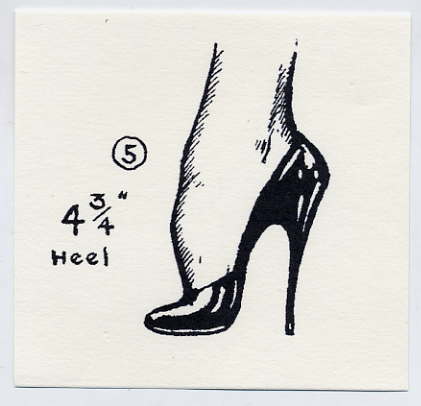
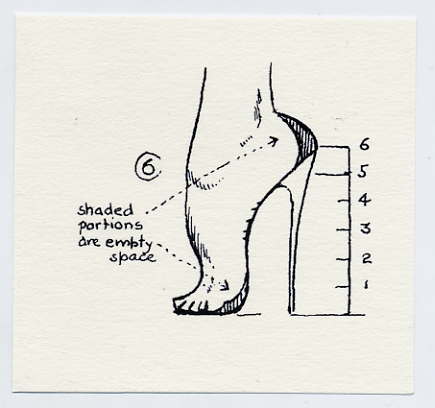
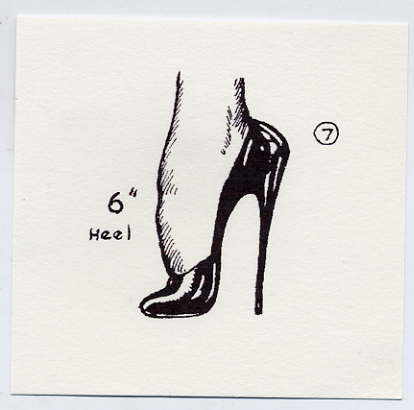
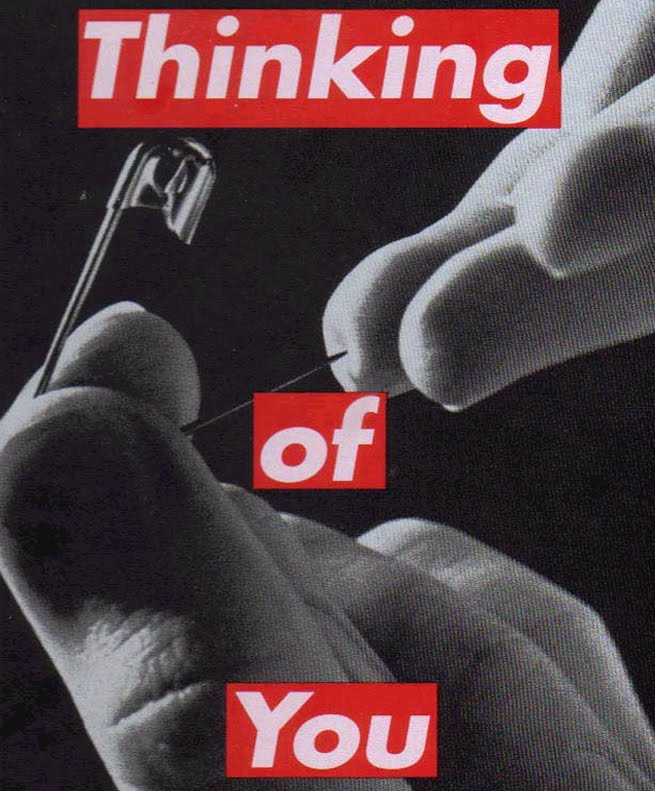
During the afternoons I teach a small group of highly susceptible kids. They are easily influenced because of their age, which is around 9-12 years. Besides Thursdays and Fridays I have a group of only boys. I have my hands full, but a lot about the male specie becomes clear to me as I watch these boys.  They are forever ranting about Comic Books. Of course I share this passion, so we often discuss certain comic book characters etc. I always tell the boys that violence is bad (I mean, when I give a piece of clay to a girl, she will start kneading it and start problem solving about how she would produce a beautiful item. When I give a ball of clay to a boy, chances are he would threaten to throw another boy with it,or, like one boy actually did, start throwing it to the floor as hard as he can to see if he can flatten it in that manner.) One boy said he is going to draw `Thor´ for me, so I asked if there are no female characters he can draw for me and he replied sure, he´ll draw ´Invisible woman`. I am trying to find ways to teach these boys to become real men. And I´m not so sure the comic books are helping. I really love the work of Alan Moore, and recently came across his Invisible Girls and Phantom Ladies.

In his essay ‘And all right, we need a woman’: victimized heroines and heroic victims in Alan Moore’s quasi-Victorian graphic novels`,  Maciej Sulmicki writes:

“Moore has long ago declared an interest in the image of women in comics books and recently confirmed that he has always felt ‘that [women’s problems] was an area that needed to be addressed’. 25 years ago, in a three-installment essay in The Daredevils he wrote of ‘Invisible Girls and Phantom Ladies’, i.e. sexism in comics. Although the text is written in a jocular tone, the main message is quite serious: that comics are rather fueling sexism and gender inequality than combating them. Women in mainstream comics are said to serve primarily as decoration, especially in visual terms, this being the case even when the female characters have something important to say. Such an approach to the visual presentation of females is a continuation of a long-standing tradition, visible as early as in comic strips from the first half of the twentieth century. Moore claims, however, that graphic depiction is not as important as the type of character as which the woman is presented. Both ‘helpless quivering victims’ and pale copies of female superheroes, as well as examples of rough ‘Marvel-style’ feminism serve to fuel stereotypes. In the case of the first two, scantily-clad and often captured and tied up heroines are accused of fueling ‘sordid adult fantasies’ and ideas such as women enjoying being raped. In the final installment of the essay Moore opines that the masculine world of comics is unlikely to significantly change its approach in favor of equal rights unless it is motivated from the outside – by the readers.”
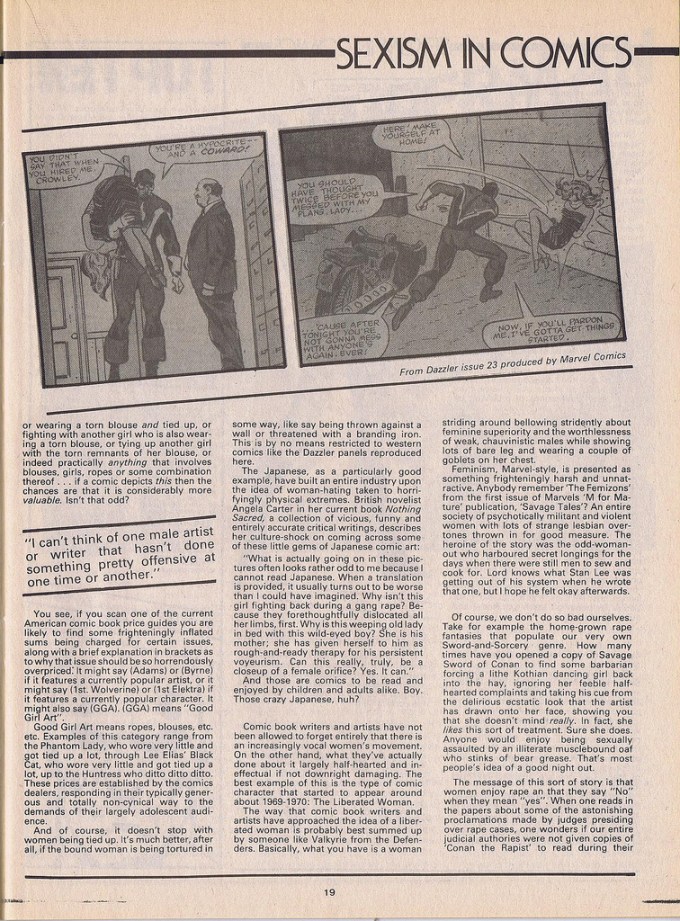
Moore´s Invisible Girls and Phantom Ladies: Originally published in The Daredevils #4 – #6 (Marvel UK, April – June 1983)

PART I

Okay. Seeing as this is such a sticky subject suppose I’d better lay my cards on the table straight away.

I’m a wimpy, indecisive, burned-out woolly-minded liberal old hippy who eats quiche, saves whales, is friendly to the Earth and subscribes to Spare Rib, The Black One-Parent Gay Catholic Gazette, and Animal Welfare Against Nuking the Nazis Quarterly and if anybody wants to make anything of it, then I’ll quite cheerfully butt them in the face until their nose is flat enough to rollerskate on.

The reason I’m prepared to make such a candid confession is because I’m pretty sure that after reading the article in hand most of you will be saying pretty much the same things about me anyway and I thought it’d look better if I got in first. And the reason I’m donning my Sou’Wester in preparation for a torrent of abuse is because this feature concerns women, and women don’t seem to be a very popular topic nowadays. There are a couple of possible reasons for this sad state of affairs.

The first is that a small but vocal percentage of feminists are quite obviously as mad as snakes and have hopelessly damaged personalities. They pounce with demented glee upon increasingly trivial and unimportant examples of ‘sexism’, they make outrageously twisted and generalised statements to the Press along the lines of “All men are rapists“, and in general make themselves very difficult to like.

The problem arises when these foaming maniacs are presented in the media as being a representative cross section of the women’s movement, thus reinforcing the image of feminism that most men are only too eager to accept as the truth: an army of crop-haired Amazon gargoyles who chainsmoke untipped Woodbines, shift cement blocks for a living and have a physique somewhere between that of Popeye and a Commer van.

The other reason is that men, over the last few thousand years, have come to enjoy the perks and privileges that are part and parcel of being born into the male gender and are very reluctant to give them up. Men in general are a pretty insecure bunch and when they start to feel threatened by something they tend to respond by hurling forth salvoes of scorn and contempt, or, failing that, they refuse to take the issue seriously at all.

Even generally broadminded people who believe that the abolition of slavery in America was by and large a good thing seem to get very defensive and hysterical when it’s their Sunday Lunch that’s being threatened by the Women’s Movement. My guess is that if these gentlemen had been Southern Plantation owners they’d have felt the same reluctance in forgoing the pleasures of their Negro house-boy bringing them a Mint Julep on the veranda.

All right. So that’s the basic situation, and it’s one that is obscured by a lot of bluster, silliness and ratbrainery on both sides. But once you’ve swept away all the damned lies and statistics, it becomes plain that there really is a serious problem under there somewhere. Women in general are not really getting a fair suck of the sauce-stick, and it’s not just in obvious areas like equal pay for equal work and who brings up baby.

These areas are obviously important, but they’re all symptoms that spring from a central illness, an illness that affects the way it which we see women and the way we treat them in our largely male-oriented society.
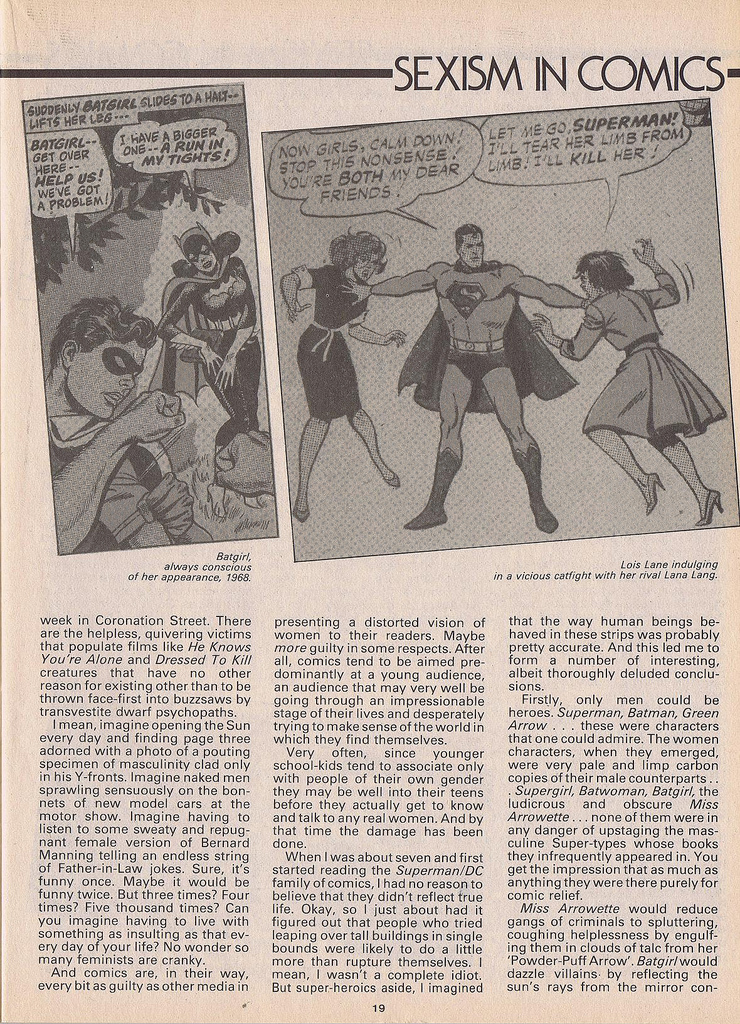
The media presents us with a number of different stereotypes to choose from when forming our ideas of womanhood. There’s a wide variety of different designs, and they’re all about as palatable as a lobster with skin cancer. Continue reading
two english poems by jorge luis borges

I

The useless dawn finds me in a deserted street-
corner; I have outlived the night.
Nights are proud waves; darkblue topheavy waves
laden with all the hues of deep spoil, laden with
things unlikely and desirable.
Nights have a habit of mysterious gifts and refusals,
of things half given away, half withheld,
of joys with a dark hemisphere. Nights act
that way, I tell you.
The surge, that night, left me the customary shreds
and odd ends: some hated friends to chat
with, music for dreams, and the smoking of
bitter ashes. The things my hungry heart
has no use for.
The big wave brought you.
Words, any words, your laughter; and you so lazily
and incessantly beautiful. We talked and you
have forgotten the words.
The shattering dawn finds me in a deserted street
of my city.
Your profile turned away, the sounds that go to
make your name, the lilt of your laughter:
these are the illustrious toys you have left me.
I turn them over in the dawn, I lose them, I find
them; I tell them to the few stray dogs and
to the few stray stars of the dawn.
Your dark rich life …
I must get at you, somehow; I put away those
illustrious toys you have left me, I want your
hidden look, your real smile — that lonely,
mocking smile your cool mirror knows.

II

What can I hold you with?
I offer you lean streets, desperate sunsets, the
moon of the jagged suburbs.
I offer you the bitterness of a man who has looked
long and long at the lonely moon.
I offer you my ancestors, my dead men, the ghosts
that living men have honoured in bronze:
my father’s father killed in the frontier of
Buenos Aires, two bullets through his lungs,
bearded and dead, wrapped by his soldiers in
the hide of a cow; my mother’s grandfather
–just twentyfour– heading a charge of
three hundred men in Peru, now ghosts on
vanished horses.
I offer you whatever insight my books may hold,
whatever manliness or humour my life.
I offer you the loyalty of a man who has never
been loyal.

epidermal macabre by theodore roethke

Image Andres Serrano

Indelicate is he who loathes
The aspect of his fleshy clothes, —
The flying fabric stitched on bone,
The vesture of the skeleton,
The garment neither fur nor hair,
The cloak of evil and despair,
The veil long violated by
Caresses of the hand and eye.
Yet such is my unseemliness:
I hate my epidermal dress,
The savage blood’s obscenity,
The rags of my anatomy,
And willingly would I dispense
With false accouterments of sense,
To sleep immodestly, a most
Incarnadine and carnal ghost.

impressed

“Thus the first capacity of human intellect is that the mind is fitted to receive the impressions made on it; either through the senses by outward objects, or by its own operations when it reflects on them. This is the first step a man makes towards the discovery of anything, and the groundwork whereon to build all those notions which ever he shall have naturally in this world. All those sublime thoughts which tower above the clouds, and reach as high as heaven itself, take their rise and footing here: in all that great extent wherein the mind wanders, in those remote speculations it may seem to be elevated with, it stirs not one jot beyond those ideas which sense or reflection have offered for its contemplation.”

John Locke. 1690. An Essay Concerning Human Understanding.

resolutions by franz kafka

To lift yourself out of a miserable mood, even if you have to do it by strength of will, should be easy. I force myself out of my chair, stride around the table, exercise my head and neck, make my eyes sparkle, tighten the muscles around them. Defy my own feelings, welcome A. enthusiastically supposing he comes to see me, amiably tolerate B. in my room, swallow all that is said at C.’s, whatever pain and trouble it may cost me, in long draughts.

Yet even if I manage that, one single slip, and a slip cannot be avoided, will stop the whole process, easy and painful alike, and I will have to shrink back into my own circle again.

So perhaps the best resource is to meet everything passively, to make yourself an inert mass, and, if you feel that you are being carried away, not to let yourself be lured into taking a single unnecessary step, to stare at others with the eyes of an animal, to feel no compunction, in short, with your own hand to throttle down whatever ghostly life remains in you, that is, to enlarge the final peace of the graveyard and let nothing survive save that.

A characteristic movement in such a condition is to run your little finger along your eyebrows.

Translated by Willa and Edwin Muir

pessoa: “because i’ve already seen cats staring at the moon”

Life would be unbearable if we made ourselves conscious of it. Happily we don’t do so. We live with the same unconsciousness as the animals, in the same futile and useless way, and if we anticipate death, which might be assumed, though one can’t be certain, we anticipate it by way of forgetting so much and with so many distractions and subterfuges that we can scarcely say we think about it at all.

So we live our lives, with little grounds for thinking we’re superior to animals. Our difference from them consists in the purely external detail that we speak and write, that we have the abstract intelligence for both distancing ourselves by employing it concretely and by imagining impossible things. All those qualities, therefore, are accidents of our basic organism. Speaking and writing do nothing new for our primordial instinct to live without knowing how. Our abstract intelligence is of no use except in concocting systems or notions about half-systems rather than permitting us to be animals out under the sun. Our imagination of the impossible is not exclusive to us, because I’ve already seen cats staring at the moon, and I don’t know whether they weren’t yearning for it.

– Fernando Pessoa, Always Astonished (San Francisco: City Lights Books, 1988), transl. Edwin Honig, pp 118-19.

melancholic creatures

“If melancholy emerges from the depths of the creaturely realm to which the speculative thought of the age felt bound by the bonds of the church itself, then this explained its omnipotence. In fact it is the most genuinely creaturely of the contemplative impulses, and it has always been noticed that its power need be no less in the gaze of a dog than in the attitude of a pensive genius. ‘Sir, sorrow was not ordained for beasts but men, yet if men do exceed in it they become beasts’, says Sancho Panza to Don Quixote.”

– Walter Benjamin, from The Origin of German Tragic Drama

she wolf

“If your heart is pounding, think upon a child’s most obscene moments.

With a child, different moments are separated–

ingenuousness
joyful games
dirtiness.

An adult links these moments together: in dirtiness he attains an ingenuous joy.

Dirtiness without a childish shame, games without a child’s joy, ingenuousness without the thoughtless reflex by which it is characterized in children–all of these are but comedies staged by adulthood’s reductive seriousness. Health, on the other hand, maintains childhood’s burning flame. The worst impotence coincides with the domination of seriousness.

Naked breasts and the obscenity of your sex have the power to bring about that which as a little girl, able to do nothing, you could only dream.

—III.—

Battered by frozen despair, by the majestic horrors of life! At exasperation’s end. Today I find myself at the edge of the abyss. At the limit of disaster and an intolerable happiness. At the very peak of a vertiginous height I sing a HALLELUIAH: the purest, most dolorous you could hear.

Calamity’s solitude is a halo, a veil of tears with which you will be able to cover your dog’s nakedness.

Listen to me. I speak softly in your ear. But don’t misunderstand my soft tone. Go out into the anguished night, naked, go to the place where the path turns.

Press your fingers into your moist folds. It will be sweet to smell upon you the viscous, bitter scent of pleasure: the damp, stale odor of flesh made happy. Voluptuousness contracts the lips burning to open out onto anguish. The wind upon the small of your back makes you feel more than naked as you quake and quiver with the cartilaginous snap of your spine–that snapping which makes the whites of your eyes roll up to fill the voids between your eyelids.

In a lonely forest far from your abandoned clothing will you hunch down carefully like a she-wolf.

Lightning with its fierce stench and pounding rain are the companions of anguish and obscenity.

Get up, and flee: childish, abandoned, howling in frightened laughter.”

-From Halleluiah! The Catechism of dianus by Georges Bataille

breathe sparingly

“Silently, Siddhartha exposed himself to burning rays of the sun directly
above, glowing with pain, glowing with thirst, and stood there, until he
neither felt any pain nor thirst any more.  Silently, he stood there in
the rainy season, from his hair the water was dripping over freezing
shoulders, over freezing hips and legs, and the penitent stood there,
until he could not feel the cold in his shoulders and legs any more,
until they were silent, until they were quiet.  Silently, he cowered in
the thorny bushes, blood dripped from the burning skin, from festering
wounds dripped pus, and Siddhartha stayed rigidly, stayed motionless,
until no blood flowed any more, until nothing stung any more, until
nothing burned any more.

Siddhartha sat upright and learned to breathe sparingly, learned to
get along with only few breaths, learned to stop breathing.  He
learned, beginning with the breath, to calm the beat of his heart,
leaned to reduce the beats of his heart, until they were only a few and
almost none.”

 – from Siddhartha by Hermann Hesse

michaël borremans: identity is a retrograde myth

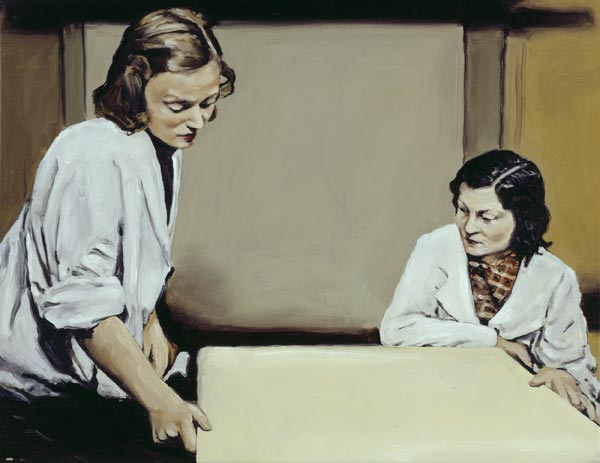
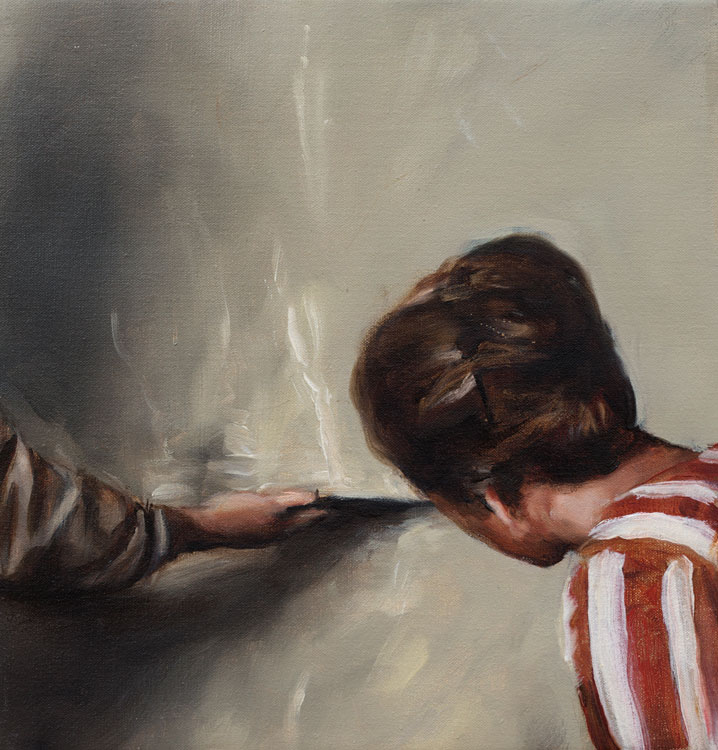
Belgian Artist Michaël Borremans insists that his figurative works and portraits do not depict individuals. He aspires to the archetypal, the generic and the anonymous. Identity is a retrograde myth, social function and structural determination are the defining human conditions. So it goes. But Borremans’ figures invite a kind of sympathetic response which undermines his arguments against the dignity of the individual.

David Coggins interviews Michael Borremans:David Coggins  Your new exhibition features a number of recent films. What can people who only know your paintings expect to see?
Michaël Borremans  I’m showing a couple of older films. Add and Remove [2002] is based on a painting from my first show at David’s gallery. What I try to do with films comes out of the paintings. While painting, I had the feeling that I needed a different element of light or movement. My interest in film has always been there since I was young, so I started experimenting. The Storm [2006] is a 35mm projection of a live image. But the work is still more painting than film—the medium is film, but the way I approach it is like painting. That’s why the films are so unusual. When people ask me if they can screen the films publicly, I can’t agree to it because they’re really not meant for that.
DC  Because the films are very slow.
Mb  Yes. The rhythm is very important—they have to be as slow as breathing. I’m experimenting in the way I show them—mostly on an LCD flat screen which is framed, and this frame is wooden, so the film is like a framed work.
DC  Your paintings have such a physical quality. Was it hard to give up that painterly surface?
MB  Not really. A filmed image has another quality—you use lenses, you use lights. I use actual film[not video], so the images are grainy. You can get some painterly qualities even though it’s another language; it has its own poetry. I’m interested in cinematic esthetics, like going in and out of focus.
DC  So you can manipulate the cinematic qualities the same way you can manipulate the surface of a canvas or of paper?
MB  Yes.
DC  In your paintings, you make references to the history of the medium—to Manet and Goya, for example. Do your films likewise refer to a cinematic history with its own traditions and allusions?
MB  I don’t refer to these things intentionally—the references are there in all my work. There are references to the history of art that are not specific. They appeal to your consciousness in a very open way. It’s something I think about. All the imagery of the 20th century and earlier is baggage we have to deal with. My work is an answer to that, a dialogue with that.
DC  With anyone in particular?
MB  Not really. But of course there are figures you pick out, like Manet, who you’re so conscious about. My last show at David Zwirner [“Horse Hunting,” 2006] was really an intentional dialogue with Manet paintings like The Dead Toreador and The Execution of Maximilian.
DC  And he appeals to you as the beginning of modernist painting?
MB  He’s an interesting figure because he’s seen that way. But at the same time he’s also the last classic painter, and that aspect is just as important.
DC  Can you discuss the difference between narrative in painting and in film? In film we generally expect something to happen, but you seem to resist that expectation.
MB  You can look at the films for two seconds or watch them straight through; they’re like a presence. With the paintings, at first you expect a narrative, because the figures are familiar. But then you see that some parts of the paintings don’t match, or don’t make sense. The works don’t come to a conclusion in the way we expect them to. The images are unfinished: they remain open. That makes them durable.
DC  There’s a mystery in your paintings that a viewer wants to solve, but it can’t be solved. You invite people in but make an image that’s ultimately unreadable. Is there a tension that you’re looking for?
MB  There’s a dichotomy—there are two poles and you’re in between them. There is a tension, but it’s not a game—it’s like research.

DC  Your drawings deal with figures that are extremely small, your paintings can be very large and your films are often projected life-size. Could you address scale, and shifts in scale, in your work?

MB  Scale is for reference, for recognition. By playing with that and making it unclear, you provoke a kind of anarchy in the image. In the drawings I use that a lot and make references to models. In our society we use models to try things, to test things; scientists use models. The model as a metaphor for our actions is very appealing to me. That’s why you have these tiny figures.
DC  Like an architectural model where a figure shows the scale?
MB  Yes, like in architecture, but also in warfare.


DC  You often portray people carrying out activities that are fruitless. People have compared your work to Beckett’s. Do you think that your work deals with the absurd so overtly?
MB  The actions are often senseless. But the work switches between an aspect of the absurd and a romantic connotation, like a vanitas. That the human being is a victim of his situation and is not free is a conviction of mine.
DC  There’s a feeling in your work of invisible power, of things the figures are waiting for and can’t see, or something that’s beyond their control. Continue reading

history by robert lowell

History has to live with what was here,
clutching and close to fumbling all we had–
it is so dull and gruesome how we die,
unlike writing, life never finishes.
Abel was finished; death is not remote,
a flash-in-the-pan electrifies the skeptic,
his cows crowding like skulls against high-voltage wire,
his baby crying all night like a new machine.
As in our Bibles, white-faced, predatory,
the beautiful, mist-drunken hunter’s moon ascends–
a child could give it a face: two holes, two holes,
my eyes, my mouth, between them a skull’s no-nose–
O there’s a terrifying innocence in my face
drenched with the silver salvage of the mornfrost.

lee miller

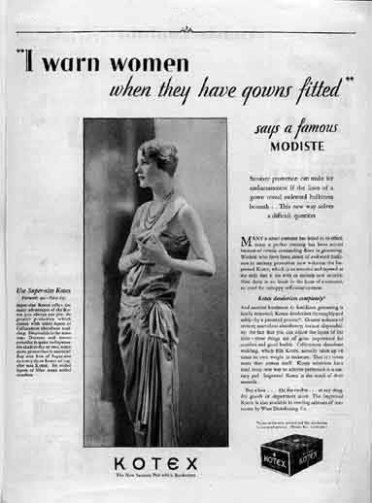
Even during the scandalous Roaring 20s, when women were bobbing their hair and baring their arms, products for “that time of the month” were advertised only very discreetly in women’s magazines. And until 1928, those ads featured line drawings or pastel paintings of females, never real women. But that taboo ended when photographer Edward Steichen sold a photo he’d shot of model and Voguecover girl Lee Miller to the Kotex Company. Miller’s modeling career in the U.S. was essentially kaput thanks to the scandalous placement of her photograph, and she fled to Paris where she studied photography and eventually became a renowned photographer in her own right.

In 1929, Lee traveled to Paris with the intention of apprenticing herself to the surrealist artist and photographer Man Ray. Although, at first, he insisted that he did not take students, Miller soon became his photographic assistant, as well as his lover and muse. While she was in Paris, she began her own photographic studio, often taking over Man Ray’s fashion assignments to enable him to concentrate on his painting. In fact, many of the photographs taken during this period and credited to Man Ray were actually taken by Lee.
At the outbreak of World War II, Miller was living in Hampstead, London with Roland Penrose when the bombing of the city began. Ignoring pleas from friends and family to return to the US, Miller embarked on a new career in photojournalism as the official war photographer for Vogue, documenting the Blitz. Lee was accredited into the U.S. Army as a war correspondent for Condé Nast Publications from December 1942.
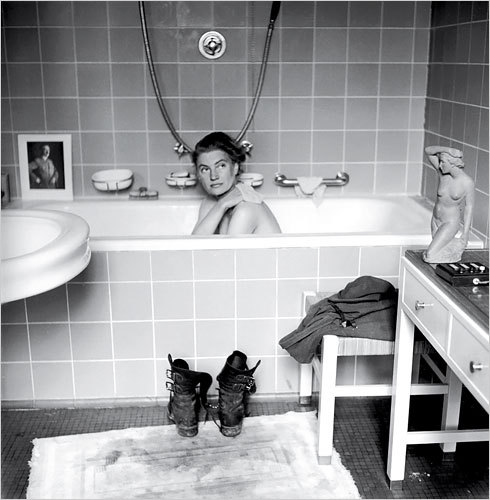
She teamed up with the American photographer David E. Scherman, a LIFE correspondent on many assignments. Miller traveled to France less than a month after D-Day and recorded the first use of napalm at the siege of St. Malo, the liberation of Paris, the battle for Alsace, and the horror of the Nazi concentration camps at Buchenwald and Dachau. One photograph by Scherman of Miller in the bathtub of Adolf Hitler’s apartment in Munich is one of the most iconic images from the Miller-Scherman partnership.
 Miller wrote to her Vogue editor Audrey Winters:

“I was living in Hitler’s private apartment when his death was announced, midnight of Mayday … Well, alright, he was dead. He’d never really been alive to me until today. He’d been an evil-machine-monster all these years, until I visited the places he made famous, talked to people who knew him, dug into backstairs gossip and ate and slept in his house. He became less fabulous and therefore more terrible, along with a little evidence of his having some almost human habits; like an ape who embarrasses and humbles you with his gestures, mirroring yourself in caricature. “There, but for the Grace of God, walks I.”

When the photo came out, it was considered an extremely poor judgement. For some, Miller posing nude in the tub of one of the most repulsive men in history was nothing more than a ill-timed reflection of the adage, “To the victor goes the spoils”. For others, it represents the power of life over death, “The living do what they can and the dead suffer what they must”. Lee Miller herself shied away from the controversies but reprouding the image very rarely and noted that she was merely trying to wash the odors of Dachau away.


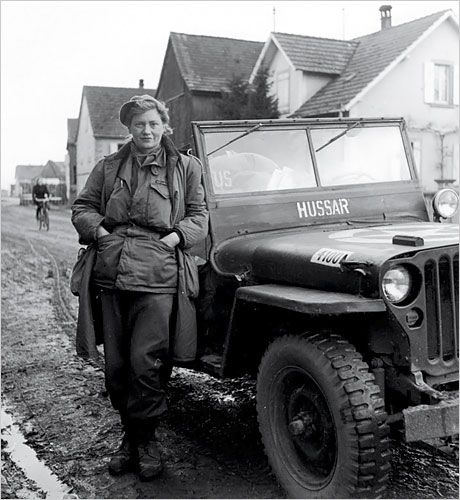
Lee Miller smiles in combat fatigues in Alsace 1944. It was said that no soldier could resist a photographer with a fashion model’s striking beauty. The photo was taken by her friend and colleague, Life magazine’s David E. Scherman.

adorno on beauty and the lie

Even the tree which blooms, lies, the moment that one perceives its bloom without the shadow of horror; even the innocent “How beautiful” becomes an excuse for the ignominy of existence, which is otherwise, and there is no longer any beauty or any consolation, except in the gaze which goes straight to the horror, withstands it, and in the undiminished consciousness of negativity, holds fast to the possibility of that which is better.