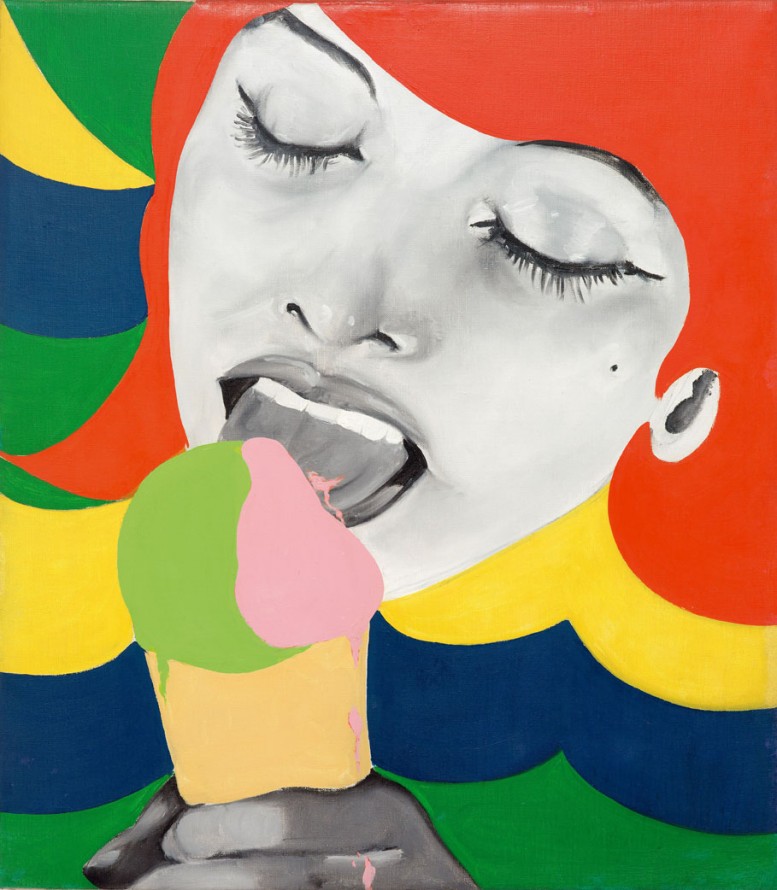
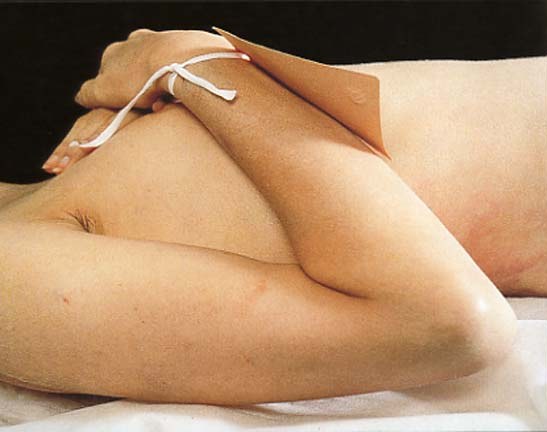
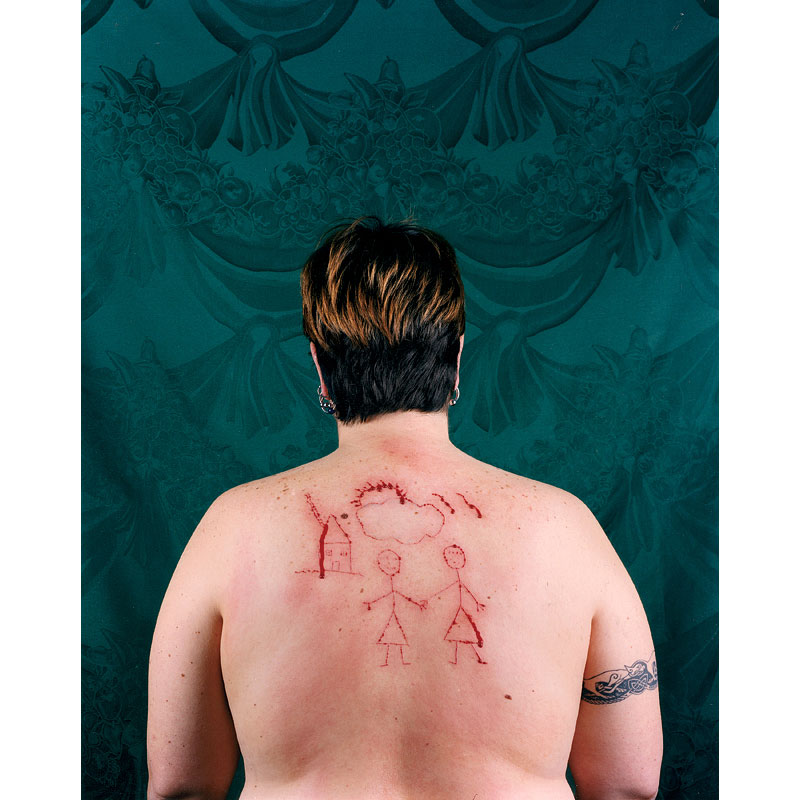
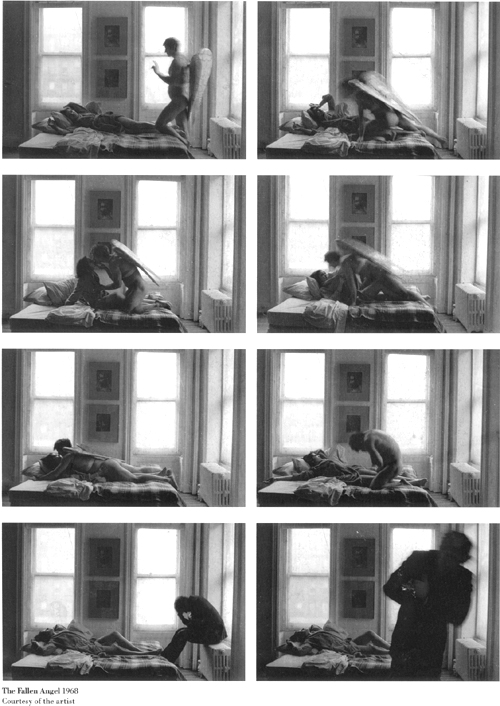
louise bourgeois & tracey emin: do not abandon me

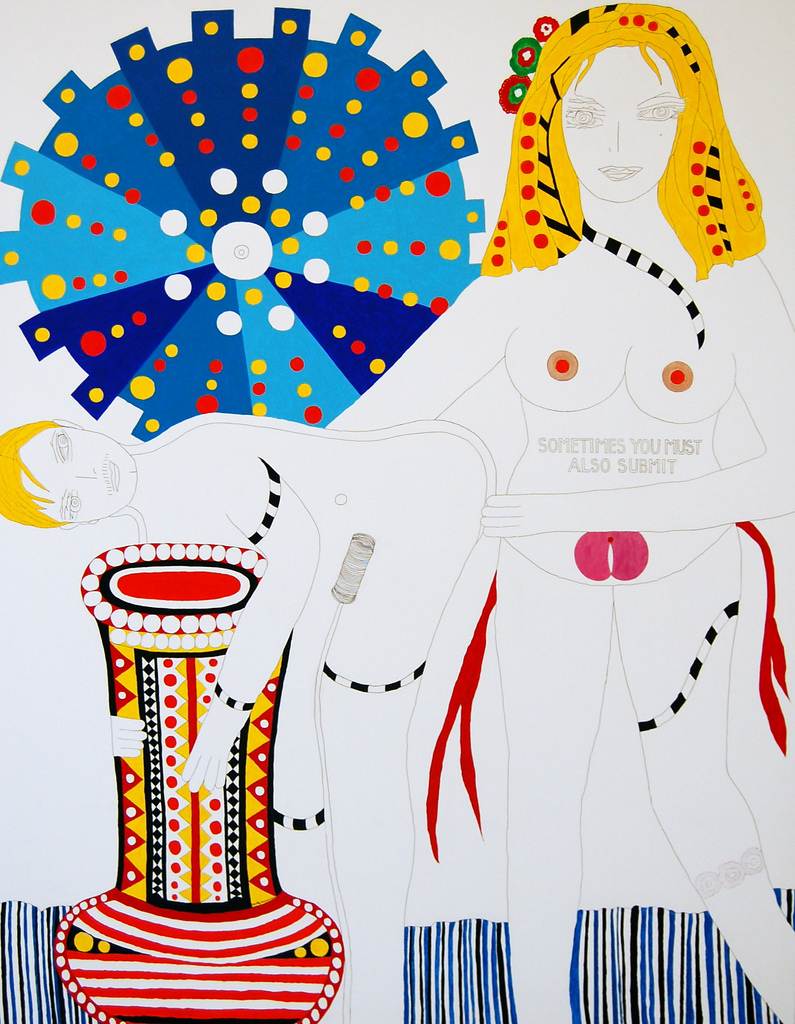
“Louise Bourgeois and Tracey Emin both blur the boundary between art and life is by pouring the turbulent history of an individual’s psyche into the work. The difference between them is that, for Bourgeois, life seeps into art, whereas for Emin, life collides with art. Do Not Abandon Me brings together these two approaches to also blur the boundary between two individuals’ life histories in a moving, sometimes upsetting and admirable collection of work.
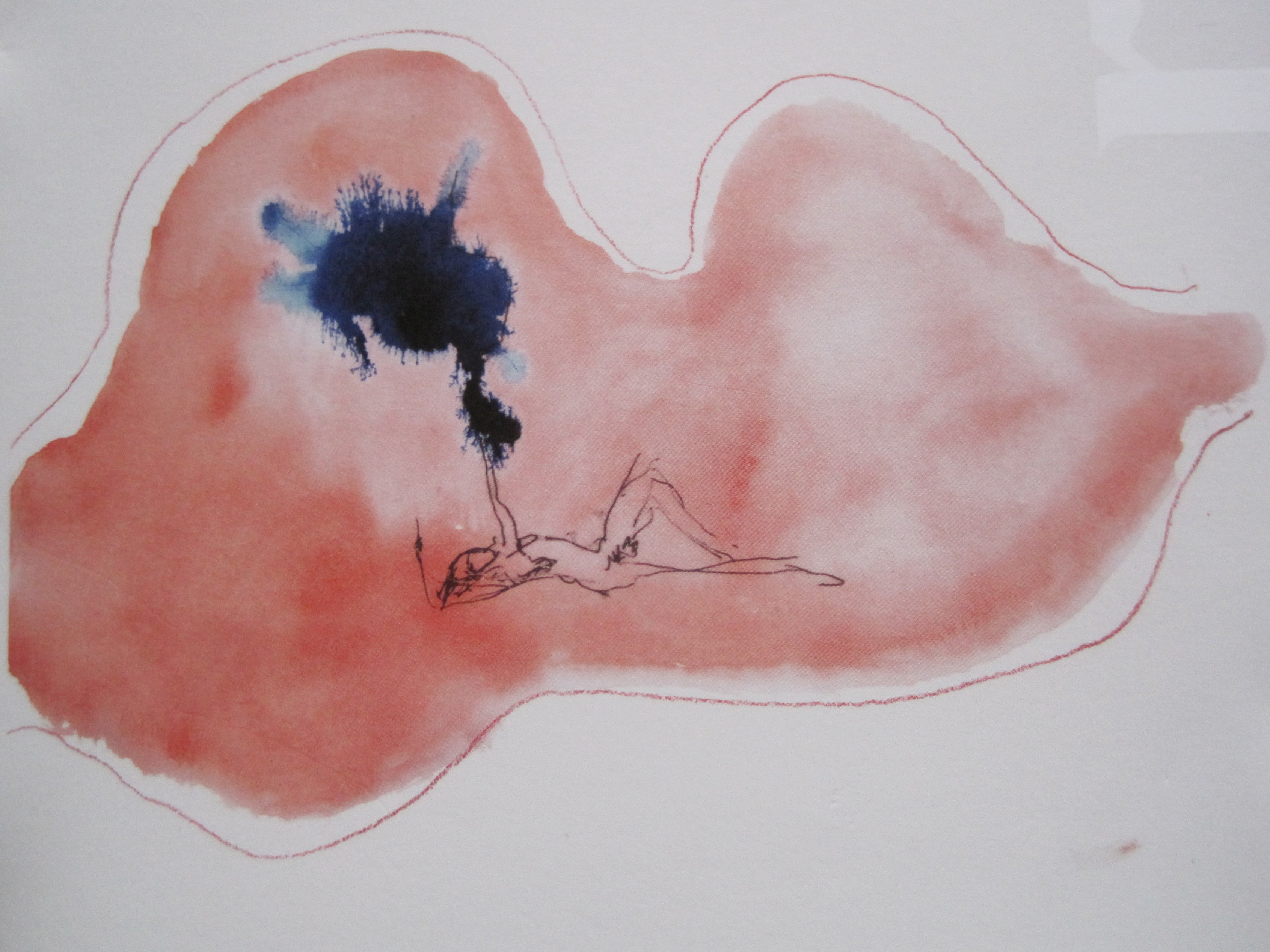
Bourgeois began the project by painting male and female torsos on paper; the gouache pigments are combined with water to give fluidity to the mixtures of red, blue and black. All the bodies are depicted in profile, in various positions, presenting delicate silhouettes that form the basis of the final works. These were then passed to Emin for embellishment, who reportedly cradled them like porcelain babies for months on end, until she finally saw beneath the surfaces of the mute bodies. Emin’s contribution consists of smaller figures drawn in pencil and the addition of occasionally coherent, hurriedly scratched out words. The idea is that Emin’s additions tease out the emotions, anxieties, ideas and histories that already lay dormant in Bourgeois’ paintings.

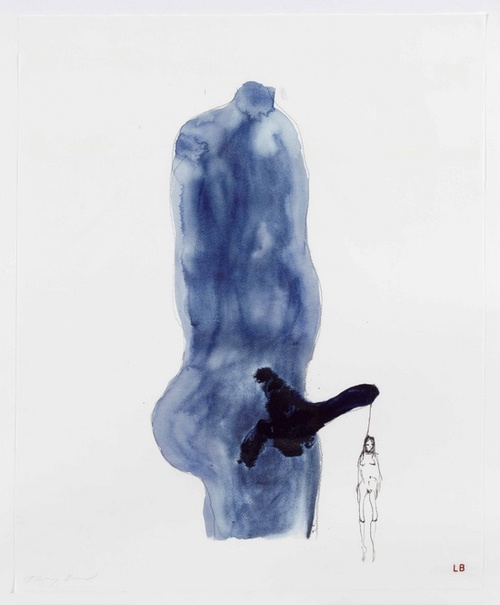
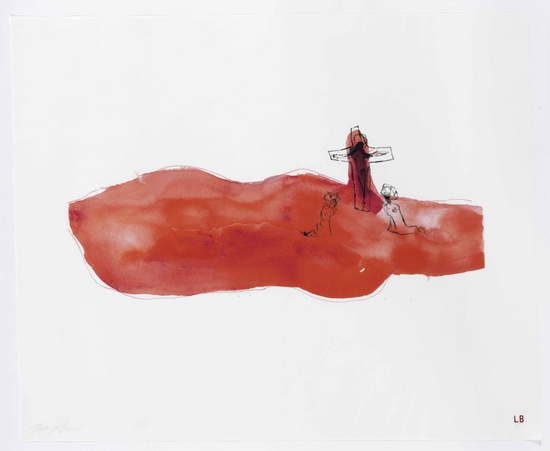
The works are elegant in form and colour; they are simple but playful, and tinged with a wry seriousness. The elegance derives from the delicate hues and the way they are loosely contained within soft lines, which accentuates the simplicity of bodies represented only in outline. The playfulness is in Emin’s characteristically childish scrawl, which sometimes seems unsure of how to respond to nudity so opts to make a joke of it. Come unto Me depicts a man lying on his back, with two miniature women kneeling at the base of his penis on which a third woman hangs on a cross. The serious message that women are subjugated to male sexuality is obscured by the humorous conception of the erect penis as a purely structural accessory to an ancient form of execution.
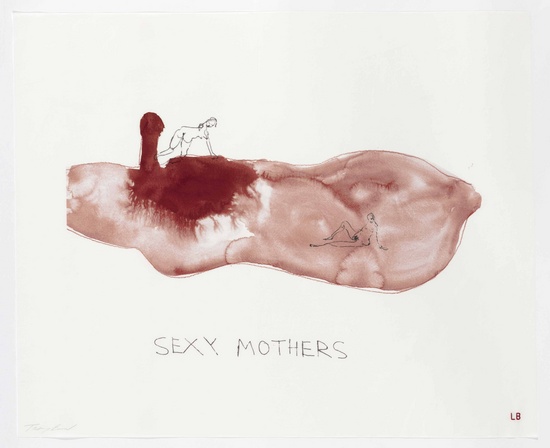
The forgoing theme is clearly a feminist agenda, and the result of both artists’ preoccupations. The relation between man and woman is characterised as one where the woman is locked in service to the man who rejects her pleas for love, thus having to accept the potency of his sexuality as a form of affection. And So I Kissed You offers a heartbreaking image of male sexual obsession while Just Hanging predicts emotional and physical death as a result of this servitude.
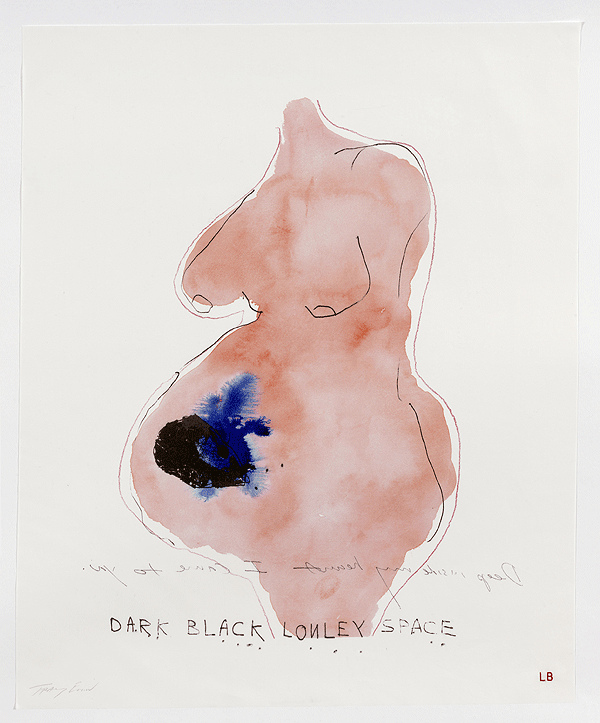
In other works, the female relation to child-bearing is explored as an experience of pain, personal loss and lingering failure. I Wanted to Love You More shows a female figure embedded within the pregnant bulge of a woman, expressing perhaps the desire of an embittered mother to get closer to her unwanted child. Reaching for You shows a woman who has burrowed into her own womb in order to retrieve a lost, perhaps aborted, child.
These are serious, and sometimes harrowing, themes. You get the feeling, however, that Bourgeois meant them to retain the autobiographical subtlety and integrity of artistic form that her meditations on her mother – the huge spider sculptures, titled Maman – possessed. As a child of surrealism, Bourgeois excelled in burying her neurosis under layers of symbolism and maintaining a visceral glee in the materiality of her art. But with Emin, there is no such thing: like in her neon pleas for love that shout desperation through the night sky or her bed that celebrates her frantic degeneracy, her contributions to these works drags the emotions to the surface and screams a blood-curdling cry. At this point of contrast between the two artists’ approaches, Emin begins to look tired, as if repeating her story in the same language of vulgarity is the only way she knows how, having never learned Bourgeois’ subtlety. It looks, then, as if Bourgeois’ invitation to collaboration is also an attempt at tutelage.

Nonetheless, the work derives its brilliance from the contrast between the collaborators, where Emin has mapped her own ideas on to Bourgeois’. If you couldn’t tell where Bourgeois ends and Emin begins, you would lose the sense that two individuals are trying to tell their own stories together precisely because their stories are so remarkably similar. In the end, Bourgeois is responsible for the aesthetic brilliance of these works, while Emin brings the emotions in. Combined, these two elements make a provocative show in which Bourgeois, at the end of her illustrious career, hands her mantel to Emin, securing both of their places in art history as experts in autobiographical art.”
Text By Daniel Barnes blogged from here
the romance of winds

There is a whirlwind in southern Morocco, the aajej, against which the fellahin defend themselves with knives. There is the africo, which has at times reached into the city of Rome. The alm, a fall wind out of Yugoslavia. The arifi, also christened aref or rifi, which scorches with numerous tongues. These are permanent winds that live in the present tense.
There are other, less constant winds that change direction, that can knock down horse and rider and realign themselves anticlockwise. The bist roz leaps into Afghanistan for 170 days, burying villages. There is the hot, dry ghibli from Tunis, which rolls and rolls and produces a nervous condition. The haboob — a Sudan dust storm that dresses in bright yellow walls a thousand metres high and is followed by rain. The harmattan, which blows and eventually drowns itself into the Atlantic. Imbat, a sea breeze in North Africa. Some winds that just sigh towards the sky. Night dust storms that come with the cold. The khamsin, a dust in Egypt from March to May, named after the Arabic word for ‘fifty,’ blooming for fifty days–the ninth plague of Egypt. The datoo out of Gibraltar, which carries fragrance.

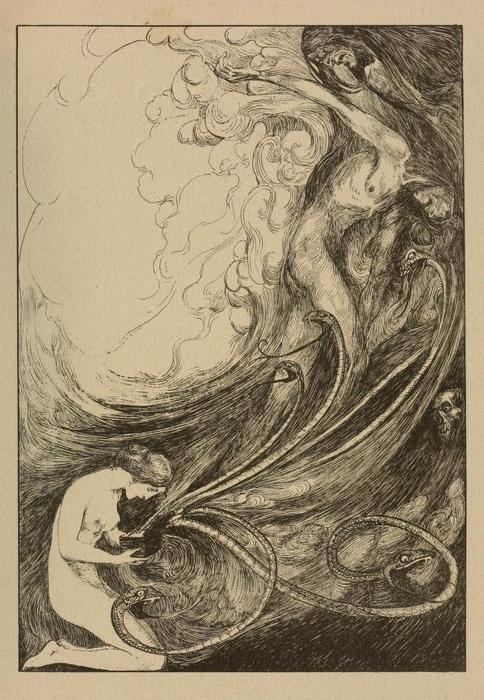
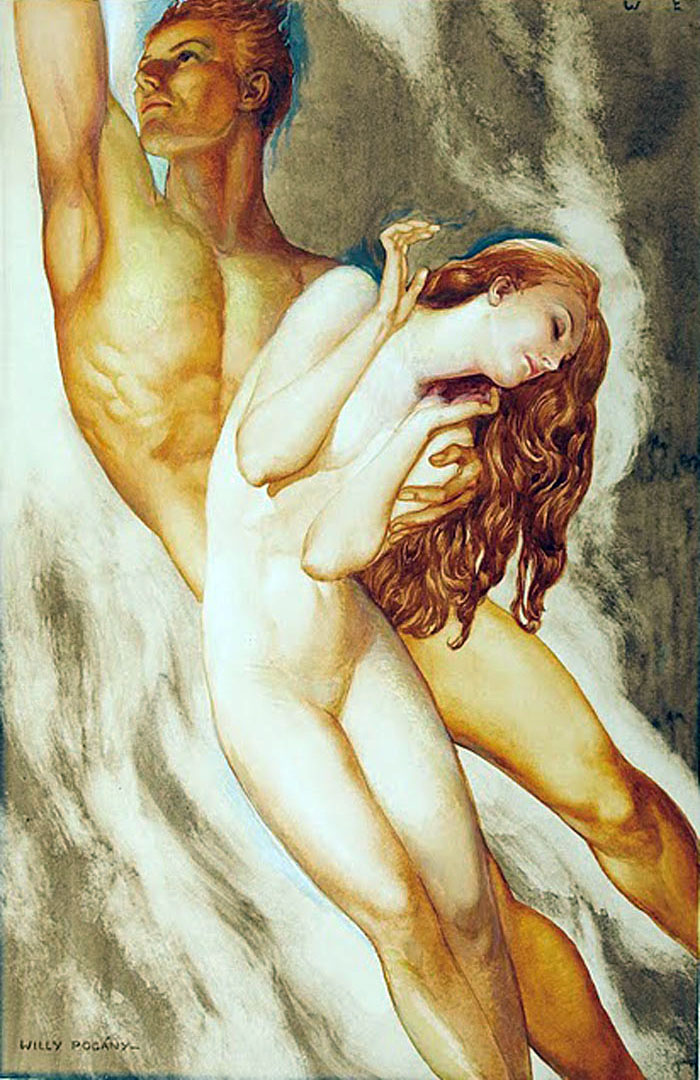
Illustration by Willy Pogany (Hungary, 1882-1955)

There is also the ——, the secret wind of the desert, whose name was erased by a king after his son died within it. And the nafhat — a blast out of Arabia. The mezzar-ifoullousen — a violent and cold southwesterly known to Berbers as ‘that which plucks the fowls.’ The beshabar, a black and dry northeasterly out of the Caucasus, ‘black wind.’ The samiel from Turkey, ‘poison and wind,’ used often in battle. As well as the other ‘poison winds,’ the simoom, of North Africa, and the solano, whose dust plucks off rare petals, causing giddiness.

Other, private winds.

Travelling along the ground like a flood. Blasting off paint, throwing down telephone poles, transporting stones and statue heads. The harmattan blows across the Sahara filled with red dust, dust as fire, as flour, entering and coagulating in the locks of rifles. Mariners called this red wind the ‘sea of darkness.’ Red sand fogs out of the Sahara were deposited as far north as Cornwall and Devon, producing showers of mud so great this was also mistaken for blood. ‘Blood rains were widely reported in Portugal and Spain in 1901.’

There are always millions of tons of dust in the air, just as there are millions of cubes of air in the earth and more living flesh in the soil (worms, beetles, underground creatures) than there is grazing and existing on it. Herodotus records the death of various armies engulfed in the simoom who were never seen again. One nation was ‘so enraged by this evil wind that they declared war on it and marched out in full battle array, only to be rapidly and completely interred.

— Michael Ondaatje, from The English Patient.

schtumm!

Illustration done by Willy Pogany in 1914 for T. W. Rolleston’s Tale of Lohengrin,1914. You can download the whole book from HERE.

Lohengrin is a character in German Arthurian literature. His story, which first appears in Wolfram von Eschenbach’s Parzival, is a version of the Knight of the Swan legend known from a variety of medieval sources.

The son of Parzival (Percival), Lohengrin is a knight of the Holy Grail sent in a boat pulled by swans to rescue a maiden, Elsa, who is the daughter of the Duke of Brabant, and who is forbidden to ask about his identity. At King Arthur’s command he is taken by a swan through the air to Mainz, where he fights for Elsa, overthrows her persecutor, and marries her. He then accompanies the emperor to fight against the Hungarians, and subsequently against the Saracens. On his return home to Cologne, Elsa, contrary to the prohibition, persists in asking him about his origin. After being asked a third time he tells her, but at that instant is carried away by the swan back to the Grail.

Wolfram’s story was expanded in two later romances. In 1848 Richard Wagner adapted the medieval tale into his popular opera Lohengrin, on which Rolleston based his book.

the woman in my life – playing with the concept of the feminine

Image

Rapunzel

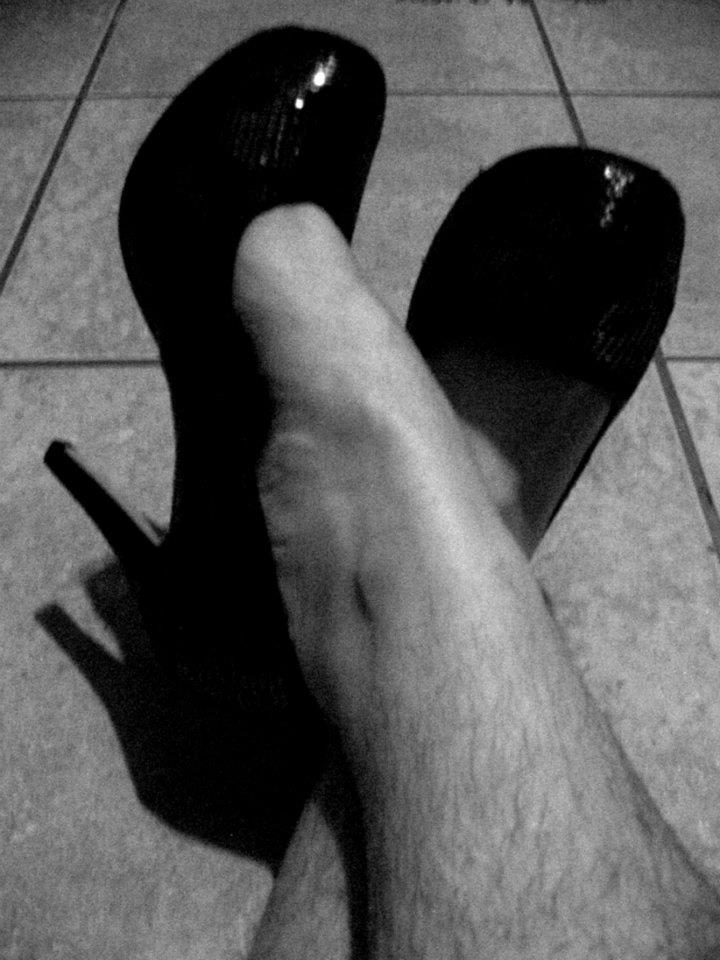
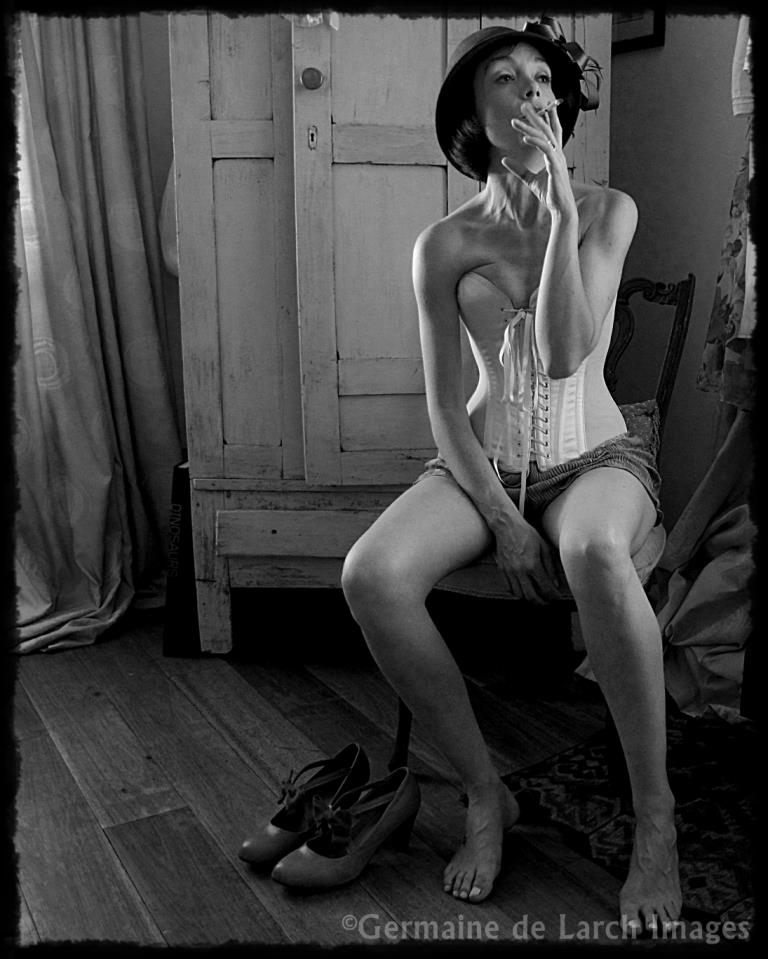
Grabbing my identity by the throat has allowed me to play with other identities in the space of play and performance. Being more secure in how I identify in terms of gender identity, gender expression and sexual orientation has allowed me the freedom to explore my boundaries: what I’m comfortable with and how far I can push myself.

Up until two years ago I found the feminine cloyingly repulsive and unnatural. My mother’s attempts to feminise me always left me feeling exceedingly uncomfortable, and I clearly remember the hideousness of my matric dance outfit and how I felt like a drag queen, and yet not, because it was an enforced drag, not the drag that stems from a place of play and a sense of security in one’s own gender.

Image

Playing the Femme Fatale, I

Since beginning the photographic project of documenting my play with gender, I have experienced conflicting emotions and reactions to placing myself within a feminine frame. Firstly, I found myself approaching the feminine from the space of play, experimentation and boundary testing. The idea of donning the feminine has been more exciting and less frightening, and I’ve truly had fun with and loved the experience of seeing the photographic results. The artistic process has thus been very revelatory and enjoyable.

Image

My Greta Garbo Moment

The physical experience, the experience of my self apart from the artistic process, has been difficult. I’ve been able to perform the feminine to the extent of playing with costume, props and make-up, but have been unable to perform feminine characteristics, behaviours, mannerisms and poses. Along with the wigs, dresses and shoes, I am still visited by those old feelings of intense discomfort, a sense of not being me, of having an otherness enforced on me. Even in the privacy of my own home with only me to witness my transformation, I am unable to express a femininity that stems from me rather than the costume. One interesting thing, though, is that when I’m playing the feminine and photographing myself, I’m able to smile (almost unable not to), while in my other self-portraits smiling feels unnatural and uncomfortable. In the blurb to this blog I say that, “I approach other spaces through fearlessly exploring inner space.” Sometimes the exploration is more brave than fearless. A lot of the time my performances touch a nerve, pointing to something I still need to investigate further, approaching it more carefully in my next encounter with it. Because sometimes when staring into the looking glass, it’s not only unexplored selves that stare back. Sometimes there are demons.

Image

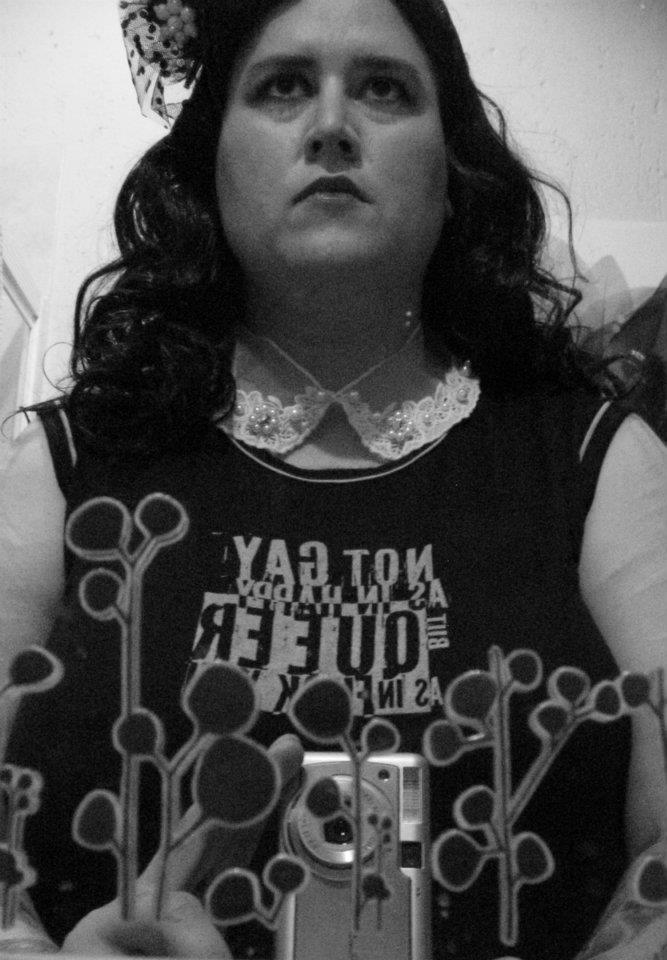
Not Gay as in Happy, Queer as in Fuck You

Looking back on these photos and experiments, I’m very happy with the results, because they denote a bravery that was previously unavailable to me; a sense of adventure I never had; and, a sense of playfulness I’m so grateful to have found.

Image

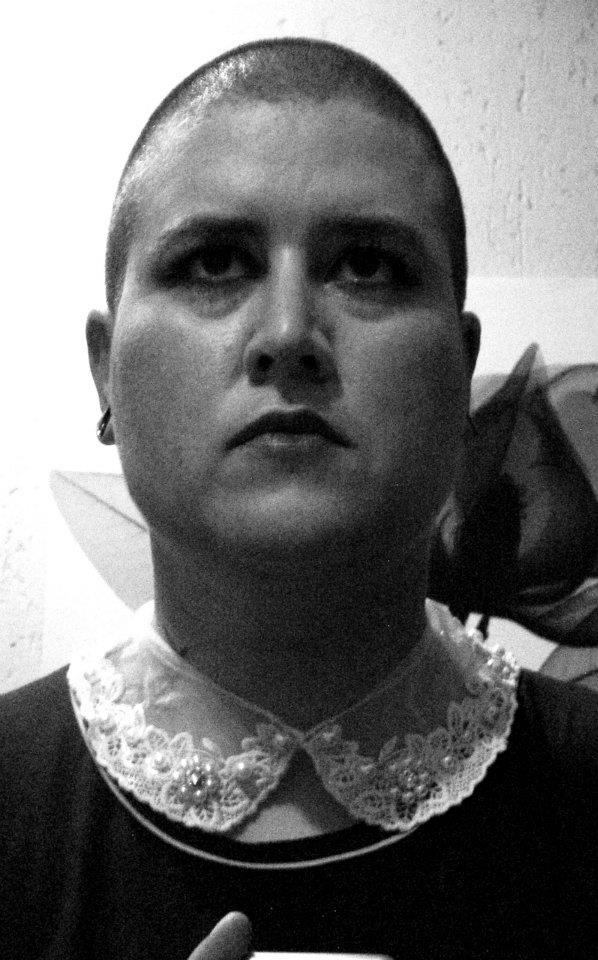
beatific

© Germaine de Larch Images. First published on www.life-writ-large.posterous.com

alan moore’s invisible girls and phantom ladies (1983)

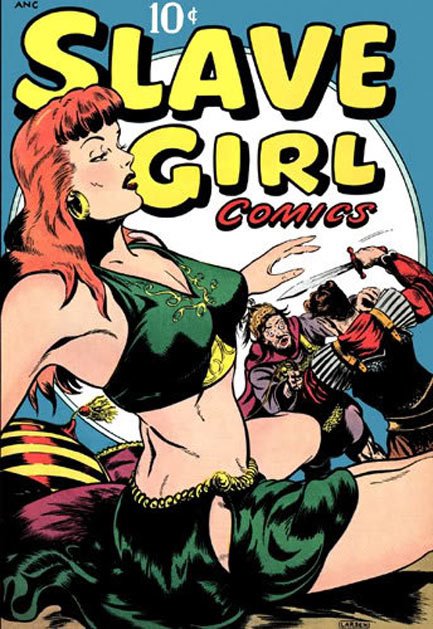
During the afternoons I teach a small group of highly susceptible kids. They are easily influenced because of their age, which is around 9-12 years. Besides Thursdays and Fridays I have a group of only boys. I have my hands full, but a lot about the male specie becomes clear to me as I watch these boys.  They are forever ranting about Comic Books. Of course I share this passion, so we often discuss certain comic book characters etc. I always tell the boys that violence is bad (I mean, when I give a piece of clay to a girl, she will start kneading it and start problem solving about how she would produce a beautiful item. When I give a ball of clay to a boy, chances are he would threaten to throw another boy with it,or, like one boy actually did, start throwing it to the floor as hard as he can to see if he can flatten it in that manner.) One boy said he is going to draw `Thor´ for me, so I asked if there are no female characters he can draw for me and he replied sure, he´ll draw ´Invisible woman`. I am trying to find ways to teach these boys to become real men. And I´m not so sure the comic books are helping. I really love the work of Alan Moore, and recently came across his Invisible Girls and Phantom Ladies.

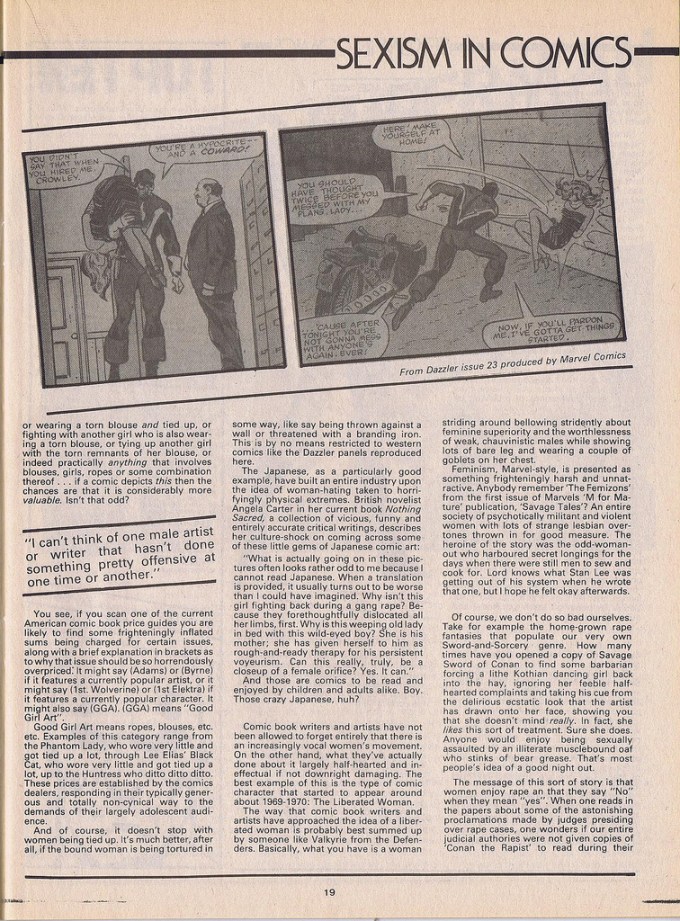
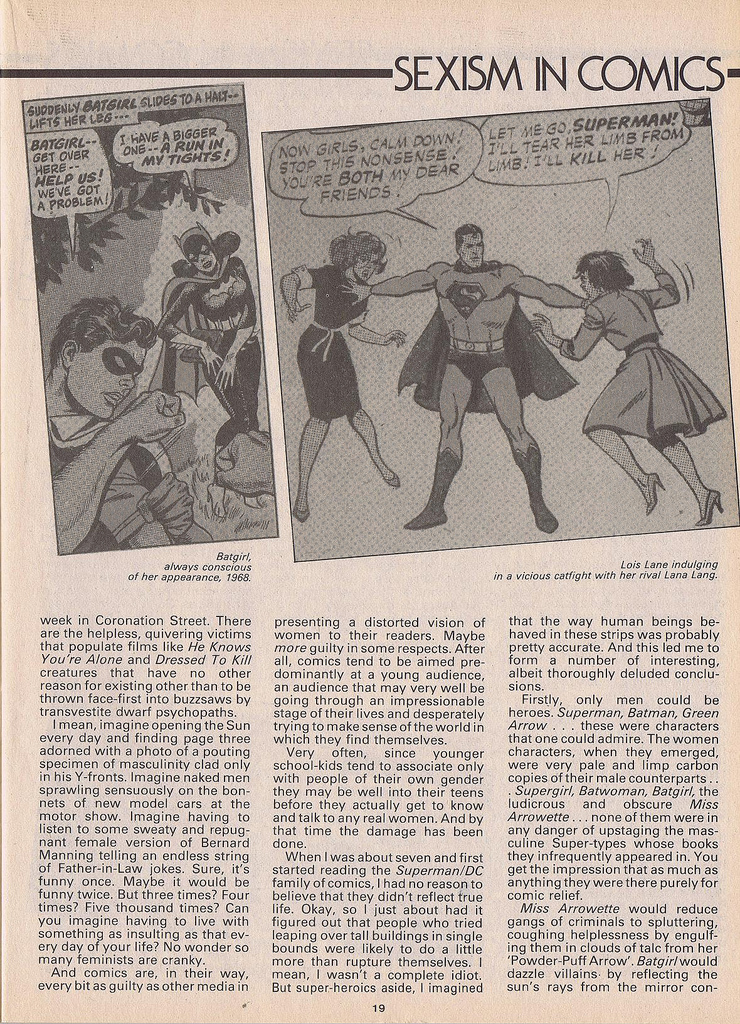
In his essay ‘And all right, we need a woman’: victimized heroines and heroic victims in Alan Moore’s quasi-Victorian graphic novels`,  Maciej Sulmicki writes:

“Moore has long ago declared an interest in the image of women in comics books and recently confirmed that he has always felt ‘that [women’s problems] was an area that needed to be addressed’. 25 years ago, in a three-installment essay in The Daredevils he wrote of ‘Invisible Girls and Phantom Ladies’, i.e. sexism in comics. Although the text is written in a jocular tone, the main message is quite serious: that comics are rather fueling sexism and gender inequality than combating them. Women in mainstream comics are said to serve primarily as decoration, especially in visual terms, this being the case even when the female characters have something important to say. Such an approach to the visual presentation of females is a continuation of a long-standing tradition, visible as early as in comic strips from the first half of the twentieth century. Moore claims, however, that graphic depiction is not as important as the type of character as which the woman is presented. Both ‘helpless quivering victims’ and pale copies of female superheroes, as well as examples of rough ‘Marvel-style’ feminism serve to fuel stereotypes. In the case of the first two, scantily-clad and often captured and tied up heroines are accused of fueling ‘sordid adult fantasies’ and ideas such as women enjoying being raped. In the final installment of the essay Moore opines that the masculine world of comics is unlikely to significantly change its approach in favor of equal rights unless it is motivated from the outside – by the readers.”

Moore´s Invisible Girls and Phantom Ladies: Originally published in The Daredevils #4 – #6 (Marvel UK, April – June 1983)

PART I

Okay. Seeing as this is such a sticky subject suppose I’d better lay my cards on the table straight away.

I’m a wimpy, indecisive, burned-out woolly-minded liberal old hippy who eats quiche, saves whales, is friendly to the Earth and subscribes to Spare Rib, The Black One-Parent Gay Catholic Gazette, and Animal Welfare Against Nuking the Nazis Quarterly and if anybody wants to make anything of it, then I’ll quite cheerfully butt them in the face until their nose is flat enough to rollerskate on.

The reason I’m prepared to make such a candid confession is because I’m pretty sure that after reading the article in hand most of you will be saying pretty much the same things about me anyway and I thought it’d look better if I got in first. And the reason I’m donning my Sou’Wester in preparation for a torrent of abuse is because this feature concerns women, and women don’t seem to be a very popular topic nowadays. There are a couple of possible reasons for this sad state of affairs.

The first is that a small but vocal percentage of feminists are quite obviously as mad as snakes and have hopelessly damaged personalities. They pounce with demented glee upon increasingly trivial and unimportant examples of ‘sexism’, they make outrageously twisted and generalised statements to the Press along the lines of “All men are rapists“, and in general make themselves very difficult to like.

The problem arises when these foaming maniacs are presented in the media as being a representative cross section of the women’s movement, thus reinforcing the image of feminism that most men are only too eager to accept as the truth: an army of crop-haired Amazon gargoyles who chainsmoke untipped Woodbines, shift cement blocks for a living and have a physique somewhere between that of Popeye and a Commer van.

The other reason is that men, over the last few thousand years, have come to enjoy the perks and privileges that are part and parcel of being born into the male gender and are very reluctant to give them up. Men in general are a pretty insecure bunch and when they start to feel threatened by something they tend to respond by hurling forth salvoes of scorn and contempt, or, failing that, they refuse to take the issue seriously at all.

Even generally broadminded people who believe that the abolition of slavery in America was by and large a good thing seem to get very defensive and hysterical when it’s their Sunday Lunch that’s being threatened by the Women’s Movement. My guess is that if these gentlemen had been Southern Plantation owners they’d have felt the same reluctance in forgoing the pleasures of their Negro house-boy bringing them a Mint Julep on the veranda.

All right. So that’s the basic situation, and it’s one that is obscured by a lot of bluster, silliness and ratbrainery on both sides. But once you’ve swept away all the damned lies and statistics, it becomes plain that there really is a serious problem under there somewhere. Women in general are not really getting a fair suck of the sauce-stick, and it’s not just in obvious areas like equal pay for equal work and who brings up baby.

These areas are obviously important, but they’re all symptoms that spring from a central illness, an illness that affects the way it which we see women and the way we treat them in our largely male-oriented society.

The media presents us with a number of different stereotypes to choose from when forming our ideas of womanhood. There’s a wide variety of different designs, and they’re all about as palatable as a lobster with skin cancer. Continue reading

rabindranath tagore in conversation with albert einstein

AUGUST 19, 1930

TAGORE: I was discussing with Dr. Mendel today the new mathematical discoveries which tell us that in the realm of infinitesimal atoms chance has its play; the drama of existence is not absolutely predestined in character.

EINSTEIN: The facts that make science tend toward this view do not say good-bye to causality.

TAGORE: Maybe not, yet it appears that the idea of causality is not in the elements, but that some other force builds up with them an organized universe.

EINSTEIN: One tries to understand in the higher plane how the order is. The order is there, where the big elements combine and guide existence, but in the minute elements this order is not perceptible.

TAGORE: Thus duality is in the depths of existence, the contradiction of free impulse and the directive will which works upon it and evolves an orderly scheme of things.

EINSTEIN: Modern physics would not say they are contradictory. Clouds look as one from a distance, but if you see them nearby, they show themselves as disorderly drops of water.

TAGORE: I find a parallel in human psychology. Our passions and desires are unruly, but our character subdues these elements into a harmonious whole. Does something similar to this happen in the physical world? Are the elements rebellious, dynamic with individual impulse? And is there a principle in the physical world which dominates them and puts them into an orderly organization?

EINSTEIN: Even the elements are not without statistical order; elements of radium will always maintain their specific order, now and ever onward, just as they have done all along. There is, then, a statistical order in the elements.

TAGORE: Otherwise, the drama of existence would be too desultory. It is the constant harmony of chance and determination which makes it eternally new and living.

EINSTEIN: I believe that whatever we do or live for has its causality; it is good, however, that we cannot see through to it.
Continue reading

epidermal macabre by theodore roethke

Image Andres Serrano

Indelicate is he who loathes
The aspect of his fleshy clothes, —
The flying fabric stitched on bone,
The vesture of the skeleton,
The garment neither fur nor hair,
The cloak of evil and despair,
The veil long violated by
Caresses of the hand and eye.
Yet such is my unseemliness:
I hate my epidermal dress,
The savage blood’s obscenity,
The rags of my anatomy,
And willingly would I dispense
With false accouterments of sense,
To sleep immodestly, a most
Incarnadine and carnal ghost.

tiga – shoes

Directed by Alex & Liane, the video for Tiga’s ‘Shoes’ “imagines a horrifying dystopia in which people other than myself are interviewed,” says the Man of Music Future, “I had to calm myself down by staring at my MySpace photos for a couple of hours.” (This was, after all, 2009 ;)

michaël borremans: identity is a retrograde myth

Belgian Artist Michaël Borremans insists that his figurative works and portraits do not depict individuals. He aspires to the archetypal, the generic and the anonymous. Identity is a retrograde myth, social function and structural determination are the defining human conditions. So it goes. But Borremans’ figures invite a kind of sympathetic response which undermines his arguments against the dignity of the individual.

David Coggins interviews Michael Borremans:David Coggins  Your new exhibition features a number of recent films. What can people who only know your paintings expect to see?
Michaël Borremans  I’m showing a couple of older films. Add and Remove [2002] is based on a painting from my first show at David’s gallery. What I try to do with films comes out of the paintings. While painting, I had the feeling that I needed a different element of light or movement. My interest in film has always been there since I was young, so I started experimenting. The Storm [2006] is a 35mm projection of a live image. But the work is still more painting than film—the medium is film, but the way I approach it is like painting. That’s why the films are so unusual. When people ask me if they can screen the films publicly, I can’t agree to it because they’re really not meant for that.
DC  Because the films are very slow.
Mb  Yes. The rhythm is very important—they have to be as slow as breathing. I’m experimenting in the way I show them—mostly on an LCD flat screen which is framed, and this frame is wooden, so the film is like a framed work.
DC  Your paintings have such a physical quality. Was it hard to give up that painterly surface?
MB  Not really. A filmed image has another quality—you use lenses, you use lights. I use actual film[not video], so the images are grainy. You can get some painterly qualities even though it’s another language; it has its own poetry. I’m interested in cinematic esthetics, like going in and out of focus.
DC  So you can manipulate the cinematic qualities the same way you can manipulate the surface of a canvas or of paper?
MB  Yes.
DC  In your paintings, you make references to the history of the medium—to Manet and Goya, for example. Do your films likewise refer to a cinematic history with its own traditions and allusions?
MB  I don’t refer to these things intentionally—the references are there in all my work. There are references to the history of art that are not specific. They appeal to your consciousness in a very open way. It’s something I think about. All the imagery of the 20th century and earlier is baggage we have to deal with. My work is an answer to that, a dialogue with that.
DC  With anyone in particular?
MB  Not really. But of course there are figures you pick out, like Manet, who you’re so conscious about. My last show at David Zwirner [“Horse Hunting,” 2006] was really an intentional dialogue with Manet paintings like The Dead Toreador and The Execution of Maximilian.
DC  And he appeals to you as the beginning of modernist painting?
MB  He’s an interesting figure because he’s seen that way. But at the same time he’s also the last classic painter, and that aspect is just as important.
DC  Can you discuss the difference between narrative in painting and in film? In film we generally expect something to happen, but you seem to resist that expectation.
MB  You can look at the films for two seconds or watch them straight through; they’re like a presence. With the paintings, at first you expect a narrative, because the figures are familiar. But then you see that some parts of the paintings don’t match, or don’t make sense. The works don’t come to a conclusion in the way we expect them to. The images are unfinished: they remain open. That makes them durable.
DC  There’s a mystery in your paintings that a viewer wants to solve, but it can’t be solved. You invite people in but make an image that’s ultimately unreadable. Is there a tension that you’re looking for?
MB  There’s a dichotomy—there are two poles and you’re in between them. There is a tension, but it’s not a game—it’s like research.

DC  Your drawings deal with figures that are extremely small, your paintings can be very large and your films are often projected life-size. Could you address scale, and shifts in scale, in your work?

MB  Scale is for reference, for recognition. By playing with that and making it unclear, you provoke a kind of anarchy in the image. In the drawings I use that a lot and make references to models. In our society we use models to try things, to test things; scientists use models. The model as a metaphor for our actions is very appealing to me. That’s why you have these tiny figures.
DC  Like an architectural model where a figure shows the scale?
MB  Yes, like in architecture, but also in warfare.


DC  You often portray people carrying out activities that are fruitless. People have compared your work to Beckett’s. Do you think that your work deals with the absurd so overtly?
MB  The actions are often senseless. But the work switches between an aspect of the absurd and a romantic connotation, like a vanitas. That the human being is a victim of his situation and is not free is a conviction of mine.
DC  There’s a feeling in your work of invisible power, of things the figures are waiting for and can’t see, or something that’s beyond their control. Continue reading