
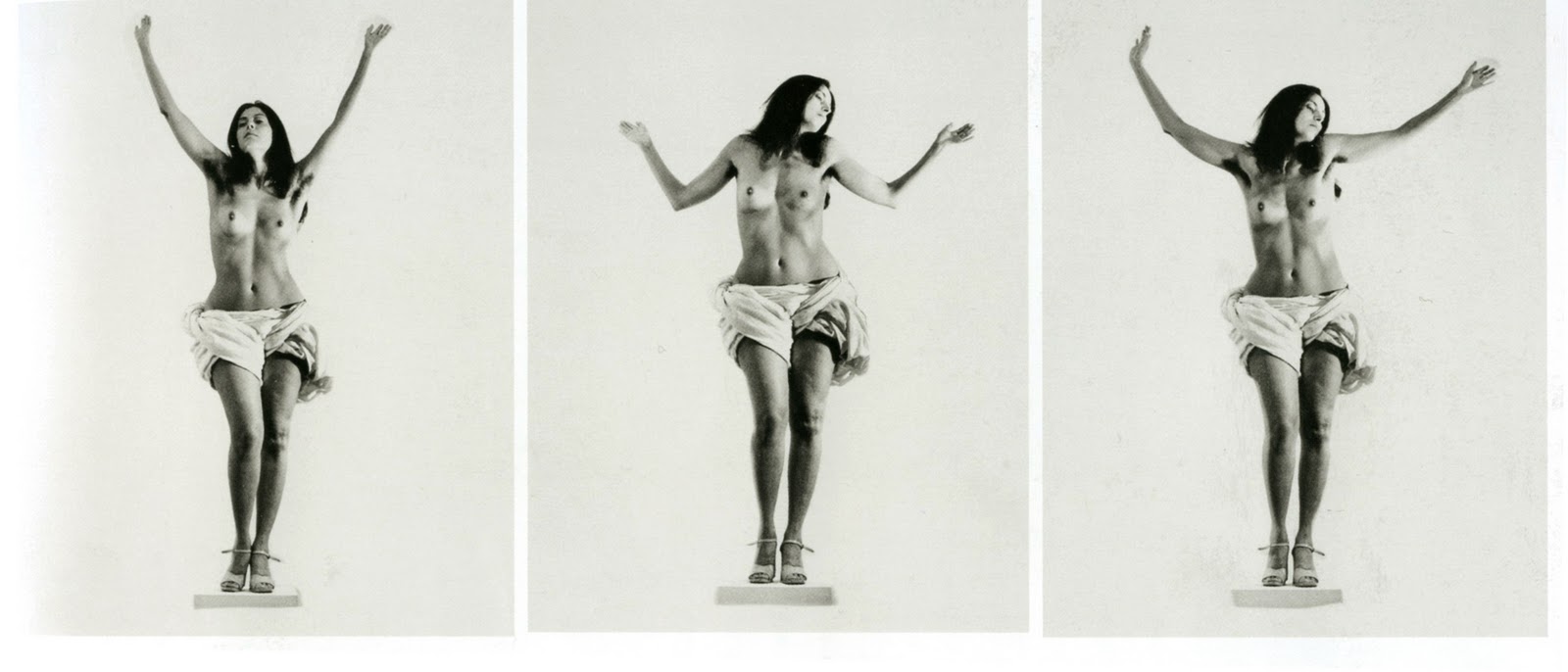
 The politics of inclusion that shaped feminist discourse in the 1960s and 1970s spawned a legacy of body-based performance art, much of which was associated with women artists who used their own face as a subject of continual exploration. The self- imaging of women artists such as the provocative American artist Hannah Wilke was frequently attacked and dismissed by art critics as being indulgent exercises in narcissism that only served to reinforce the objectification of the female body. The charge of narcissism leveled on Wilke and her work may have been warranted, however, this should not be considered as a pejorative. Rather, the narcissism of Wilke can be viewed as a shrewd feminist tactic of self-objectification aimed at reclaiming the eroticized female body from the exclusive domain of male sexual desire. The ‘self-love’ of narcissism is a necessary component to this reclaiming of the body and the assertion of a female erotic will as being distinct from that of the male artist. Wilke wielded her narcissistic self-love as a powerful tool of critique, defiantly placing her own image into the hallowed halls of the male-dominated art institution.


The term “narcissism” derives from the ancient Greek myth of Narcissus, a beautiful but arrogant youth who cruelly spurned the love of his admirers. For his cruelty, he was cursed by the goddess Nemesis and fell in love with his own reflection in a pool of water. The doomed Narcissus pined away for his unattainable lover – the image of his own self – and literally died as a result of his amorous longing.
Sigmund Freud bestowed the name of this mythic Greek youth upon his psychoanalytic theory of narcissism, a theory that describes normal personality development. According to Freud, the self-love of narcissism is a normal complement to the development of a healthy ego. Whereas a certain amount of narcissism is desirable, an excess of self-love is considered dysfunctional and indicative of pathology. This latter definition of narcissism, the one of pathological self-absorption, has cast our current understanding of narcissism in a negative light and reinforced the use of the term as a pejorative.
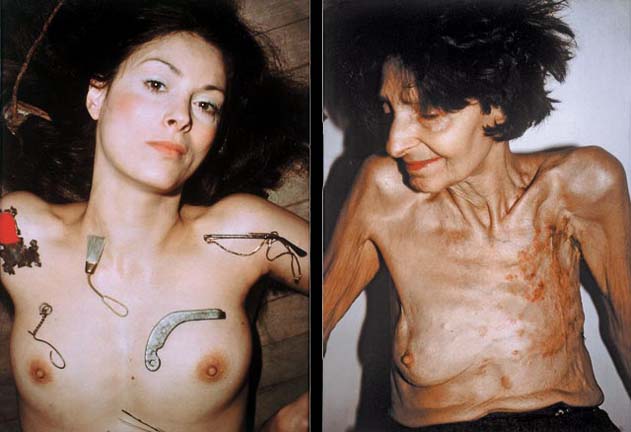
The psychoanalytic theories of Freud suggest that negative or pathological narcissism is a specifically female perversion. Art critic Amelia Jones writes that “[d]rawing loosely on Freud’s definitions – which connect narcissism to both a stage of development and to a form of homosexual neurosis – narcissism has come in everyday parlance to mean simply a kind of “self-love” epitomized through woman’s obsession with her own appearance.” Hence, the charges of narcissism leveled on Hannah Wilke were attempts by the critics to summarily dismiss her work as mere manifestations of a woman’s obsessive self-love and infer, according to Jones, that Wilke’s art was not “successfully feminist.”
Continue reading here

 fleurmach