Belgian Artist Michaël Borremans insists that his figurative works and portraits do not depict individuals. He aspires to the archetypal, the generic and the anonymous. Identity is a retrograde myth, social function and structural determination are the defining human conditions. So it goes. But Borremans’ figures invite a kind of sympathetic response which undermines his arguments against the dignity of the individual.
David Coggins interviews Michael Borremans: David Coggins Your new exhibition features a number of recent films. What can people who only know your paintings expect to see?
Michaël Borremans I’m showing a couple of older films. Add and Remove [2002] is based on a painting from my first show at David’s gallery. What I try to do with films comes out of the paintings. While painting, I had the feeling that I needed a different element of light or movement. My interest in film has always been there since I was young, so I started experimenting. The Storm [2006] is a 35mm projection of a live image. But the work is still more painting than film—the medium is film, but the way I approach it is like painting. That’s why the films are so unusual. When people ask me if they can screen the films publicly, I can’t agree to it because they’re really not meant for that.
DC Because the films are very slow.
Mb Yes. The rhythm is very important—they have to be as slow as breathing. I’m experimenting in the way I show them—mostly on an LCD flat screen which is framed, and this frame is wooden, so the film is like a framed work.
DC Your paintings have such a physical quality. Was it hard to give up that painterly surface?
MB Not really. A filmed image has another quality—you use lenses, you use lights. I use actual film[not video], so the images are grainy. You can get some painterly qualities even though it’s another language; it has its own poetry. I’m interested in cinematic esthetics, like going in and out of focus.
DC So you can manipulate the cinematic qualities the same way you can manipulate the surface of a canvas or of paper?
MB Yes.
DC In your paintings, you make references to the history of the medium—to Manet and Goya, for example. Do your films likewise refer to a cinematic history with its own traditions and allusions?
MB I don’t refer to these things intentionally—the references are there in all my work. There are references to the history of art that are not specific. They appeal to your consciousness in a very open way. It’s something I think about. All the imagery of the 20th century and earlier is baggage we have to deal with. My work is an answer to that, a dialogue with that.
DC With anyone in particular?
MB Not really. But of course there are figures you pick out, like Manet, who you’re so conscious about. My last show at David Zwirner [“Horse Hunting,” 2006] was really an intentional dialogue with Manet paintings like The Dead Toreador and The Execution of Maximilian.
DC And he appeals to you as the beginning of modernist painting?
MB He’s an interesting figure because he’s seen that way. But at the same time he’s also the last classic painter, and that aspect is just as important.
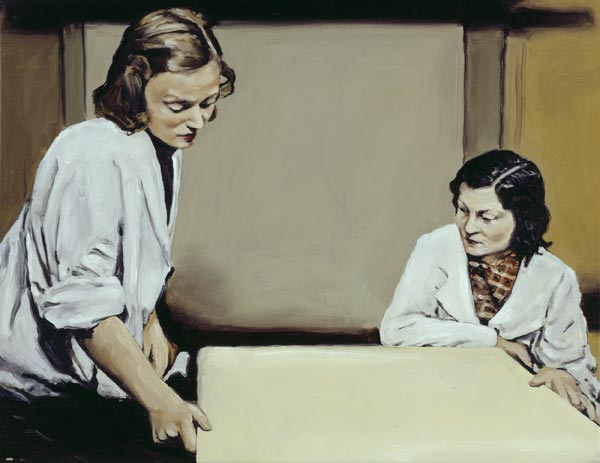 DC Can you discuss the difference between narrative in painting and in film? In film we generally expect something to happen, but you seem to resist that expectation.
MB You can look at the films for two seconds or watch them straight through; they’re like a presence. With the paintings, at first you expect a narrative, because the figures are familiar. But then you see that some parts of the paintings don’t match, or don’t make sense. The works don’t come to a conclusion in the way we expect them to. The images are unfinished: they remain open. That makes them durable.
DC There’s a mystery in your paintings that a viewer wants to solve, but it can’t be solved. You invite people in but make an image that’s ultimately unreadable. Is there a tension that you’re looking for?
MB There’s a dichotomy—there are two poles and you’re in between them. There is a tension, but it’s not a game—it’s like research.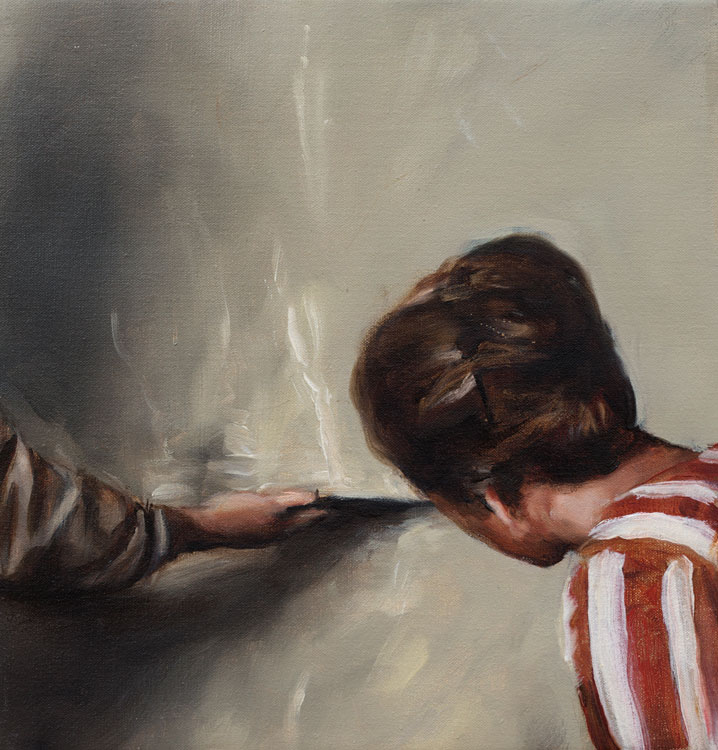
DC Your drawings deal with figures that are extremely small, your paintings can be very large and your films are often projected life-size. Could you address scale, and shifts in scale, in your work?
MB Scale is for reference, for recognition. By playing with that and making it unclear, you provoke a kind of anarchy in the image. In the drawings I use that a lot and make references to models. In our society we use models to try things, to test things; scientists use models. The model as a metaphor for our actions is very appealing to me. That’s why you have these tiny figures.
DC Like an architectural model where a figure shows the scale?
MB Yes, like in architecture, but also in warfare.

DC You often portray people carrying out activities that are fruitless. People have compared your work to Beckett’s. Do you think that your work deals with the absurd so overtly?
MB The actions are often senseless. But the work switches between an aspect of the absurd and a romantic connotation, like a vanitas. That the human being is a victim of his situation and is not free is a conviction of mine.
DC There’s a feeling in your work of invisible power, of things the figures are waiting for and can’t see, or something that’s beyond their control. Continue reading
 fleurmach