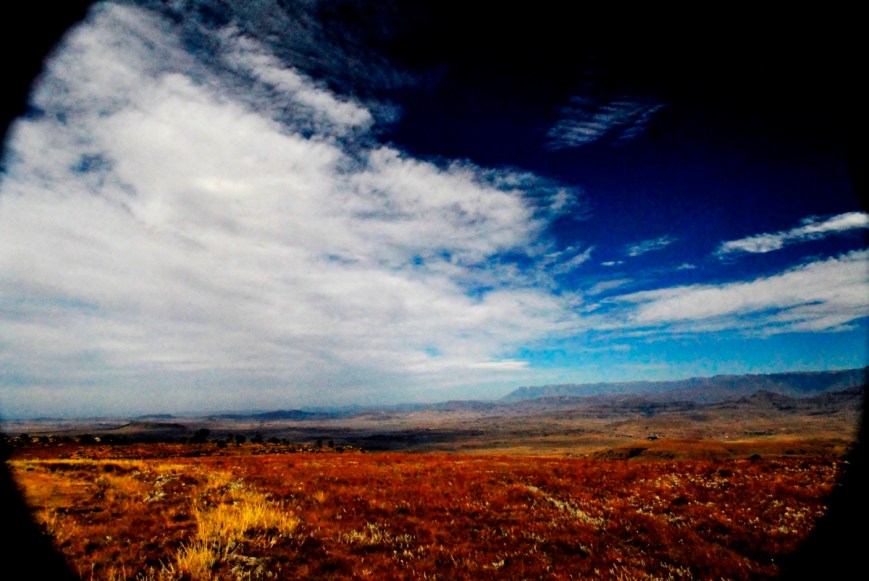
the star and the hammerkop …

“the star knows the time when our heart no longer breathes,
and then it shoots, it falls down as our heart falls down,
and the star’s noise, dying away, takes our heart away”

— ‘The Star and the Hammerkop are Those that Tell Us that One of our People Has Died’

(Bleed, Lloyd; reworked Alan James)
San/Bushman Tradition, ? – 1910

charles baudelaire – le crépuscule du soir (evening twilight)

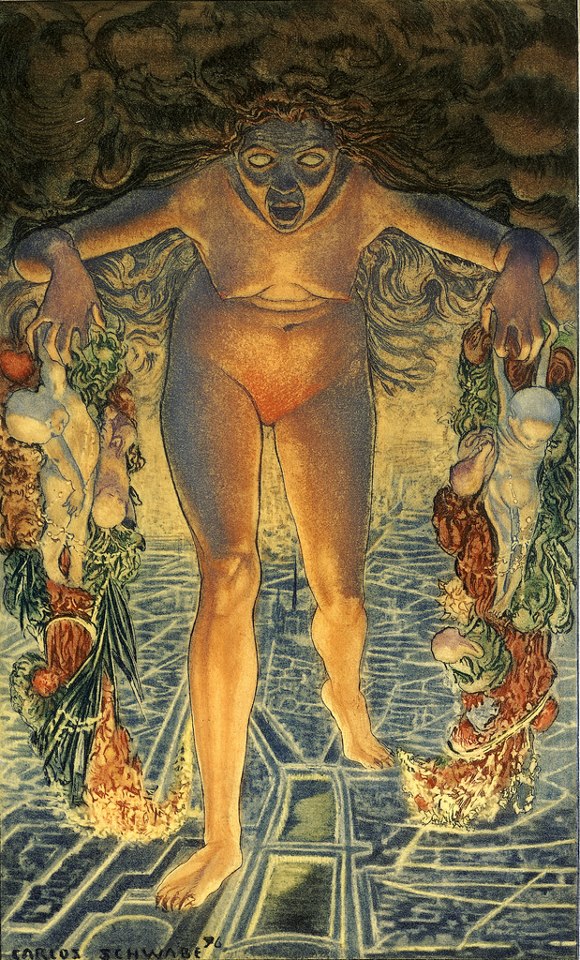
Carlos Schwabe
“Le crépuscule du soir”
from Fleurs du Mal (1900)


This poem is from Baudelaire’s 1861 masterpiece, Les Fleurs du Mal (read the original French, as well as two more, quite divergent, translations HERE):

Evening Twilight

Delightful evening, partner of the crook,
Steals in, wolf-padded, like a complice: look:
Heaven, like a garret, closes to the day,
And Man, impatient, turns a beast of prey.

Sweet evening, loved by those whose arms can tell,
Without a lie, “Today we’ve laboured well:”
Sweet evening, it is she who brings relief
To men with souls devoured by one fierce grief,
Obstinate thinkers drowsy in the head,
And toil-bent workmen groping to their bed.

But insalubrious demons of the airs,
Like business people, wake to their affairs
And, flying, knock, like bats, on walls and shutters.
Now Prostitution lights up in the gutters
Across the glimmering jets the wind torments.
Like a huge ant-hive it unseals its vents.
On every side it weaves its hidden tracks
Like enemies preparing night-attacks.
It squirms within the City’s breast of mire,
A worm that steals the food that men desire.

One hears the kitchens hissing here and there,
Operas squealing, orchestras ablare.
Cheap tables d’hôte, where gaming lights the eyes,
Fill up with whores, and sharpers, their allies:
And thieves, whose office knows no truce nor rest,
Will shortly now start working, too, with zest,
Gently unhinging doors and forcing tills,
To live some days and buy their sweethearts frills.

Collect yourself, my soul, in this grave hour
And shut your ears against the din and stour.
It is the hour when sick men’s pains increase.
Death grips them by the throat, and soon they cease
Their destined task, to find the common pit.
The ward is filled with sighings. Out of it
Not all return the scented soup to taste,
Warm at the hearthside, by some loved-one placed.

But then how few among them can recall
Joys of the hearth, or ever lived at all!

— translated by Roy Campbell, Poems of Baudelaire (New York: Pantheon Books, 1952)
sappho

Sappho – Charles-August Mengin
Oil on canvas, 1877

THE MUSES

Hither now, O Muses, leaving the golden
House of God unseen in the azure spaces,
Come and breathe on bosom and brow and kindle
Song like the sunglow;

Come and lift my shaken soul to the sacred
Shadow cast by Helicon’s rustling forests;
Sweep on wings of flame from the middle ether,
Seize and uplift me;

Thrill my heart that throbs with unwonted fervor,
Chasten mouth and throat with immortal kisses,
Till I yield on maddening heights the very
Breath of my body.

~ from The Poems of Sappho: An Interpretative Rendition into English, translated by John Myers O’Hara, 1870-1944.

More about her life and poetry : The Tenth Muse

friedrich hölderlin – out for a walk

The margins of the forest are beautiful,
as if painted onto the green slopes.
I walk around, and sweet peace
rewards me for the thorns
in my heart, when the mind has grown
dark, for right from the start
art and thinking have cost it pain.
There are lovely pictures in the valley,
for example the gardens and trees,
and the narrow footbridge, and the brook,
hardly visible. How beautifully
the landscape shines, cheerfully distant,
like a splendid picture, where I come
to visit when the weather is mild.
A kindly divinity leads us on at first
with blue, then prepares clouds,
shaped like gray domes, with
searing lightning and rolling thunder,
then comes the loveliness of the fields,
and beauty wells forth from
the source of the primal image.

on friedrich hölderlin’s “hyperion”

Hölderlin’s work, like Celan’s after him, is a practice of creating the universality of music out of the treacherous medium of words. The frisson of this practice is an impossible, and irresistible, place to live and die. Like Orpheus, Hyperion keeps looking back. And like Orpheus, Hölderlin the poet relives the moment of his lost love in a melodious, maddening loop.

~ Elizabeth Bachner, on Hyperion by Friedrich Hölderlin. Read her whole review HERE.

yes yes by charles bukowski

when God created love he didn’t help most
when God created dogs He didn’t help dogs
when God created plants that was average
when God created hate we had a standard utility
when God created me He created me
when God created the monkey He was asleep
when He created the giraffe He was drunk
when He created narcotics He was high
and when He created suicide He was low

when He created you lying in bed
He knew what He was doing
He was drunk and He was high
and He created the mountains and the sea and fire at the same time

He made some mistakes
but when He created you lying in bed
He came all over His Blessed Universe.


robert desnos – i have dreamed of you so much

I have dreamed of you so much that you are no longer real.
Is there still time for me to reach your breathing body, to kiss your mouth and make
your dear voice come alive again?

I have dreamed of you so much that my arms, grown used to being crossed on my
chest as I hugged your shadow, would perhaps not bend to the shape of your body.
For faced with the real form of what has haunted me and governed me for so many
days and years, I would surely become a shadow.

O scales of feeling.

I have dreamed of you so much that surely there is no more time for me to wake up.
I sleep on my feet prey to all the forms of life and love, and you, the only one who
counts for me today, I can no more touch your face and lips than touch the lips and
face of some passerby.

I have dreamed of you so much, have walked so much, talked so much, slept so much
with your phantom, that perhaps the only thing left for me is to become a phantom
among phantoms, a shadow a hundred times more shadow than the shadow the
moves and goes on moving, brightly, over the sundial of your life.

man ray – l’étoile de mer

Based on the poetry of Robert Desnos

Almost all of the scenes in this film are shot either off a mirror like the final shot, or through diffused and textured glass.

Les dents des femmes sont des objets si charmants… (Women’s teeth are such charming objects…)

… qu’ on ne devrait les voir qu’ en rêve ou à l’instant de l’amour. (… that one ought to see them only in a dream or in the instant of love.)

Si belle! Cybèle? (So beautiful! Cybèle?)

Nous sommes à jamais perdus dans le désert de l’éternèbre. (We are forever lost in the desert of eternal darkness.)

Qu’elle est belle (How beautiful she is)

“Après tout” (“After all”)

Si les fleurs étaient en verre (If the flowers were in glass)

Belle, belle comme une fleur de verre (Beautiful, beautiful like a flower of glass)
Belle comme une fleur de chair (Beautiful like a flower of flesh)
Il faut battre les morts quand ils sont froids. (One must beat the dead while they are cold.)

Les murs de la Santé (The walls of the Santé)
Et si tu trouves sur cette terre une femme à l’amour sincère… (And if you find on this earth a woman of sincere love…)
Belle comme une fleur de feu (Beautiful like a flower of fire)
Le soleil, un pied à l’étrier, niche un rossignol dans un voile de crêpe. (The sun, one foot in the stirrup, nestles a nightingale in a veil of crepe.)

Vous ne rêvez pas (You are not dreaming)

Qu’elle était belle (How beautiful she was)
Qu’elle est belle (How beautiful she is)

zbigniew herbert – the envoy of mr cogito

Go where those others went to the dark boundary
for the golden fleece of nothingness your last prize

go upright among those who are on their knees
among those with their backs turned and those toppled in the dust

you were saved not in order to live
you have little time you must give testimony

be courageous when the mind deceives you be courageous
in the final account only this is important

and let your helpless Anger be like the sea
whenever you hear the voice of the insulted and beaten

let your sister Scorn not leave you
for the informers executioners cowards—they will win
they will go to your funeral and with relief will throw a lump of earth
the woodborer will write your smoothed-over biography

and do not forgive truly it is not in your power
to forgive in the name of those betrayed at dawn

beware however of unnecessary pride
keep looking at your clown’s face in the mirror
repeat: I was called—weren’t there better ones than I

beware of dryness of heart love the morning spring
the bird with an unknown name the winter oak

light on a wall the splendour of the sky
they don’t need your warm breath
they are there to say: no one will console you

be vigilant—when the light on the mountains gives the sign—arise and go
as long as blood turns in the breast your dark star

repeat old incantations of humanity fables and legends
because this is how you will attain the good you will not attain
repeat great words repeat them stubbornly
like those crossing the desert who perished in the sand

and they will reward you with what they have at hand
with the whip of laughter with murder on a garbage heap

go because only in this way will you be admitted to the company of cold skulls
to the company of your ancestors: Gilgamesh Hector Roland
the defenders of the kingdom without limit and the city of ashes

Be faithful Go

~ Zbigniew Herbert, translated by Bogdana and John Carpenter, from Selected Poems of Zbigniew Herbert. Source: Mr Cogito (1993). Oxford University Press, Ltd.

Thanks to poet and journalist Fiona Zerbst for sharing this on her Facebook page today. You can check out Fiona’s blog HERE.

beached (2004)

no more chemicals…
ooh! a stick!
an essay in the sand!
and! and! and! and?

kelp lice hop among the dis i n te gr a t i ng l et t ers

the sea yawns loudly.
so did my friends.

they went home,
long ago,
with the tide.

they’re in bed.

i tried the same.

i’m tired.
but how
could
i
hope
to follow?
a hatful of hollow is quite a lot of nothing.

william butler yeats – a crazed girl

That crazed girl improvising her music.
Her poetry, dancing upon the shore,

Her soul in division from itself
Climbing, falling, she knew not where,
Hiding amid the cargo of a steamship,
Her knee-cap broken, that girl I declare
A beautiful lofty thing, or a thing
Heroically lost, heroically found.

No matter what disaster occurred
She stood in desperate music wound,
Wound, wound, and she made in her triumph
Where the bales and the baskets lay
No common intelligible sound
But sang, ‘O sea-starved, hungry sea.’

elizabeth barrett browning – a musical instrument

What was he doing, the great god Pan,
Down in the reeds by the river?
Spreading ruin and scattering ban,
Splashing and paddling with hoofs of a goat,
And breaking the golden lilies afloat
With the dragon-fly on the river.

He tore out a reed, the great god Pan,
From the deep cool bed of the river:
The limpid water turbidly ran,
And the broken lilies a-dying lay,
And the dragon-fly had fled away,
Ere he brought it out of the river.

High on the shore sat the great god Pan
While turbidly flowed the river;
And hacked and hewed as a great god can,
With his hard bleak steel at the patient reed,
Till there was not a sign of the leaf indeed
To prove it fresh from the river.

He cut it short, did the great god Pan,
(How tall it stood in the river!)
Then drew the pith, like the heart of a man,
Steadily from the outside ring,
And notched the poor dry empty thing
In holes, as he sat by the river.

‘This is the way,’ laughed the great god Pan
(Laughed while he sat by the river),
‘The only way, since gods began
To make sweet music, they could succeed.’
Then, dropping his mouth to a hole in the reed,
He blew in power by the river.

Sweet, sweet, sweet, O Pan!
Piercing sweet by the river!
Blinding sweet, O great god Pan!
The sun on the hill forgot to die,
And the lilies revived, and the dragon-fly
Came back to dream on the river.

Yet half a beast is the great god Pan,
To laugh as he sits by the river,
Making a poet out of a man:
The true gods sigh for the cost and pain, —
For the reed which grows nevermore again
As a reed with the reeds in the river.

a.a. milne – halfway down

Halfway down the stairs
is a stair
where i sit.
there isn’t any
other stair
quite like
it.
i’m not at the bottom,
i’m not at the top;
so this is the stair
where
I always
stop.

Halfway up the stairs
Isn’t up
And it isn’t down.
It isn’t in the nursery,
It isn’t in town.
And all sorts of funny thoughts
Run round my head.
It isn’t really
Anywhere!
It’s somewhere else
Instead!

michelle mcgrane – things that a bond girl should never leave home without

A double entendre,
a steady gun-arm, a failproof
recipe for Béarnaise sauce,
a kick-ass lipstick,
‘Five of a Kind’.

Contortionist training,
a reservation at Maxim’s,
a magnum of Taittinger Blanc
de Brut 1943 and twenty
Morland Specials.

A stolen copy
of Hogan’s Power Golf,
a smouldering silhouette,
a commando dagger,
a cyanide tablet.

Sagittarius rising,
a Côte d’Azur suntan,
opera glasses, life insurance,
fifty rounds of ammo,
a contact in Japan.

A bluff and a bikini,
a Triumph convertible,
a parachute, a silk peignoir,
a concealed blueprint,
an escape route.

Previously published in Magma 50.

arlyn culwick – on death

Image: Inflected Landscape by Arlyn Culwick

So, young Death, what could you be?
Even my father’s cancered body
brought me no sightless terror at eternity.
I suspect you have no sting.
Perhaps you, old splinter in the heart of love,
never were more than mirage,
though love would need you –
necessary certain death –
as a nail for a cross,
and cross and nail and Christ and
resurrection
are all love –
the ever-dying eternal life of all.

If so, where would you go,
you much-maligned seed of beginnings?
Youngest purveyor of life,
always exactly zero years old –
ever painted Grim Reaper,
thief of loved ones,
skeletal with age and demon-haunted.
You, unknowable ultimate horizon,
ear-whisperer of the infinite terror of endings,
do not impart any evil
except perhaps deluded dread.

You would go to a greater whole
of which you are inseparably part,
for shapes without space,
age without time,
or nails without crosses,
have no significance.
Thus you, youngest innocent death
are as much your own as the terror of
a darkened room:
mere mirage,
as seemingly all-powerful
as its infinite inscrutable blackness
and the child-fantasy it feeds.

You are love’s very vehicle.
Flesh for sacrifice, in dying,
is meaning-embodied matter –
is substance made significant –
surrendered, emptied, dissolute,
but never for itself, nor for nothing;
always for all,
for everything made sign;
spirit, soul, and soil pervaded
by kindest, complete kenosis,
all-originating, all-resurrecting.
Only silliest oldest humanity,
children trembling sightless in their beds,
give shadows a scythe and empty eye sockets
and forget the bedroom’s sturdy walls.

Check out Arlyn’s blog HERE.

federico garcia lorca – the passing stage of the siguiriya

Among black butterflies
goes a dark-haired girl
next to a white serpent
of mist.

Earth of light,
sky of earth.

She is chained to the tremor
of a never arriving rhythm;
she has a heart of silver
and a dagger in her right hand.

Where are you going, siguiriya,
with such a headless rhythm?
What moon’ll gather up your pain
of whitewash and oleander?

Earth of light,
sky of earth.

(translated by Ralph Angel)

La Seguiriya – A flamenco form with a mixed compás – combining 3/4 and 6/8 time (a feature that drives music experts to despair). The seguiriya takes its name from the Castilian ‘seguidilla’, a musical style to which it is related, literarily at least. It is considered the quintessential style of ‘cante jondo’, for its solemnity, the minimalism of the lyric, and the wailing ‘quejío’ associated with vocal performances.

“The Gypsy siguiriya had always evoked for me (an incurable lyricist) the endless road, one without crossroads, which ends at the pulsating fountain of the girl-child, poetry, the road where the first bird died and the first arrow rusted.

The Gypsy siguiriya begins with a dreadful cry, a cry that divides the landscape into two perfect hemispheres. It is the cry of dead generations, a poignant elegy for vanished centuries, the evocation of love filled with pathos beneath other winds and other moons.”

Read the text of a fascinating lecture by Lorca on the historical and artistic significance of Canto Jondo (“deep song”) HERE.