The elephant God Ganesh symbolises change. What I dig about Hinduism is that if you need to invoke something in your life at a certain time, for instance strength and courage, you can invoke the warrior god Shiva; if you feel you need protection, invoke Durga; if you need abundance, pray to Lakshmi, etc. Whether these deities exist external to you or whether you invoke your inner aspects which correspond to them is immaterial; they personify and give a face to what you need in your life at specific times, and there are invocations for each of them. Some are blessedly short: a prayer of protection can be said as you leave your home on a trip Om Doom Durgayei Namaha …
Category Archives: spirit
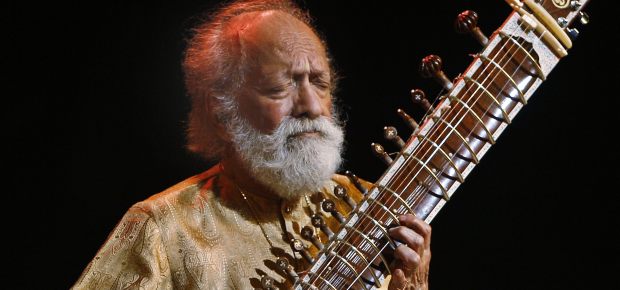
ravi shankar, go in peace and thank you for the sound
7 April 1920 – 11 December 2012
Pandit Ravi Shankar – Raga Asa Bhairav (আশা ভৈরব রাগ) from the album Maestro’s Choice. পণ্ডিত রবি শংকরের সেতারে আশা ভৈরব রাগ…
Listen to the entire Transmigration Macabre (1973) HERE. Transmigration Macabre was composed by Ravi Shankar for the British art film Viola, which tells of the growth and eventual victory of a possessed man’s belief that his dead wife has returned to life in the form of a cat that pursues him. The music traces his emotional turmoil as the man, dominated by his wife during her lifetime, struggles against her baneful influence after her death. ~ Richie Unterberger
bill hicks – revelations (1993)
Bill Hicks performing live at the Dominion Theatre in London. This is the entire show.
bob dylan – blind willie mctell
“Well, God is in His heaven
And we all want what’s His
But power and greed and corruptible seed
Seem to be all that there is
I’m gazing out the window
Of the St. James Hotel
And I know no one can sing the blues
Like Blind Willie McTell.”
Copyright © 1983 by Special Rider Music, from The Bootleg Series, Vol 1-3: Rare & Unreleased 1961-1991
jimi hendrix on the dick cavett show, july 1969
Interview
Performance
david whyte on faith and belief
and how we are all
preparing for that
abrupt waking,
and that calling,
and that moment
we have to say yes,
except it will
not come so grandly,
so Biblically,
but more subtly
and intimately in the face
of the one you know
you have to love
– David Whyte
john jacob niles – look down that lonesome road
he is on a journey, during the night…
‘He is on a journey, during the night, the end of which keeps receding. He has a sense of the danger, of the loss that the pseudo-object attracting him represents for him, but he cannot help taking the risk at the very moment he sets himself apart. And the more he strays, the more he is saved.’
– Julia Kristeva, 1982
cape town, 25 september 2012
björk in conversation with arvo pärt (1997)
“I like your music very, very much, because you give space to the listener. He can go inside and live there. But a lot of music from the last few centuries, you just have to sit, and listen.”
Björk interviews Arvo Pärt for the BBC program ‘Modern Minimalists’ (1997).
hafez on loneliness
Don’t surrender your loneliness so quickly.
Let it cut more deeply.
Let it ferment and season you
as few humans and even divine ingredients can.
Something missing in my heart tonight
has made my eyes so soft,
my voice so tender,
my need for God absolutely clear.
~ Hāfez
Biographical note:
Khwāja Šams ud-Dīn Muhammad Hāfez-e Šīrāzī, or simply Hāfez (Persian: خواجه شمسالدین محمد حافظ شیرازی), was a Persian mystic and poet. He was born sometime between the years 1310 and 1337. John Payne, who has translated the Diwan Hafez, regards Hafez as one of the three greatest poets of the world. His lyrical poems, known as ghazals, are noted for their beauty and bring to fruition the love, mysticism, and early Sufi themes that had long pervaded Persian poetry. Moreover, his poetry possesses elements of modern surrealism.
sezen aksu – hıdrellez (1997)
Turkish language version of the Roma song “Ederlezi”, made famous outside the Balkans via Goran Bregovic’s version in Emir Kusturica’s film, Time of the Gypsies.
The song got its name from Ederlezi (Turkish: Hıdırellez) which is a spring festival celebrated by Roma people in the Balkans, Turkey and elsewhere around the world.
From Wikipedia:
Hıdırellez or Hıdrellez (Turkish: Hıdrellez or Hıdırellez, Azerbaijani: Xıdır İlyas or Xıdır Nəbi, Crimean Tatar: Hıdırlez, Romani language: Ederlezi) is celebrated in Turkey and throughout the Turkic world as the day on which prophets Hızır (Al-Khidr) and Ilyas (Elijah) met on the earth. Hıdırellez starts on May 5 night and falls on May 6 in the Gregorian calendar and on April 23 in the Julian calendar. It celebrates the arrival of spring and is a religious holiday for the Alevi as well. Đurđevdan or the Feast of Saint George is the Christian variety of this spring festival celebrated throughout the Balkans, including Serbia and Bulgaria, notably in areas under the control of the Ottoman Empire by the end of the 16th century.
There are various theories about the origin of Hızır and Hıdırellez. Ceremonies and rituals were performed for various gods with the arrival of the spring or summer in Mesopotamia, Anatolia, Iran and other Mediterranean countries since ancient times. One widespread belief suggests that Hızır attained immortality by drinking the water of life. He often wanders the earth, especially in the spring, helping people in difficulty. People see him as a source of bounty and health, as the festival takes place in Spring, the time of new life.
English translation:
Spring has come,
I’ve tied a red pouch on a rose’s branch,
I’ve vowed a house with two rooms
In the name of a lover
The mountain is green, the branches are green
They’ve awakened for the bayram (festival day)
All hearts are happy
Only my fate is black
The scent of jonquils is everywhere,
It’s time.
This spring, I’m the only one
Whom the bayram has not affected
Don’t cry, Hıdrellez
Don’t cry for me
I’ve sowed pain, and instead of it,
Love will sprout, will sprout
In another spring.
He has neither a way (known) nor a trace
His face is not familiar
The long and short of it,
My wish from the God is love.
I don’t have anyone to love, I don’t have a partner
One more day has dawned.
O my star of luck,
Smile on me!
(Translation based on the one here; not sure how good it is!)
last night…
Last night I learned how to be a lover of God
To live in this world and call nothing my own.
~ Mevlana Rumi
nine inch nails – the way out is through
Unofficial video by Erik Innocent for the song “The Way Out Is Through” from the album The Fragile by Nine Inch Nails. This video won the Golden Peace Medallion at the 2007 Berkeley Video and Film Festival.
daydream more
the moon by jaime sabines
You can take the moon by the spoonful
or in capsules every two hours.
It’s useful as a hypnotic and sedative
and besides it relieves
those who have had too much philosophy.
A piece of moon in your purse
works better than a rabbit’s foot.
Helps you find a lover
or get rich without anyone knowing,
and it staves off doctors and clinics.
You can give it to children like candy
when they’ve not gone to sleep,
and a few drops of moon in the eyes of the old
helps them to die in peace.
Put a new leaf of moon
under your pillow
and you’ll see what you want to.
Always carry a little bottle of air of the moon
to keep you from drowning.
Give the key to the moon
to prisoners and the disappointed.
For those who are sentenced to death
and for those who are sentenced to life
there is no better tonic than the moon
in precise and regular doses.
Jaime Sabines
— Poemas sueltos, 1981
translated by W. S. Merwin
(thanks Cherry Bomb for putting this on FB a while ago.)
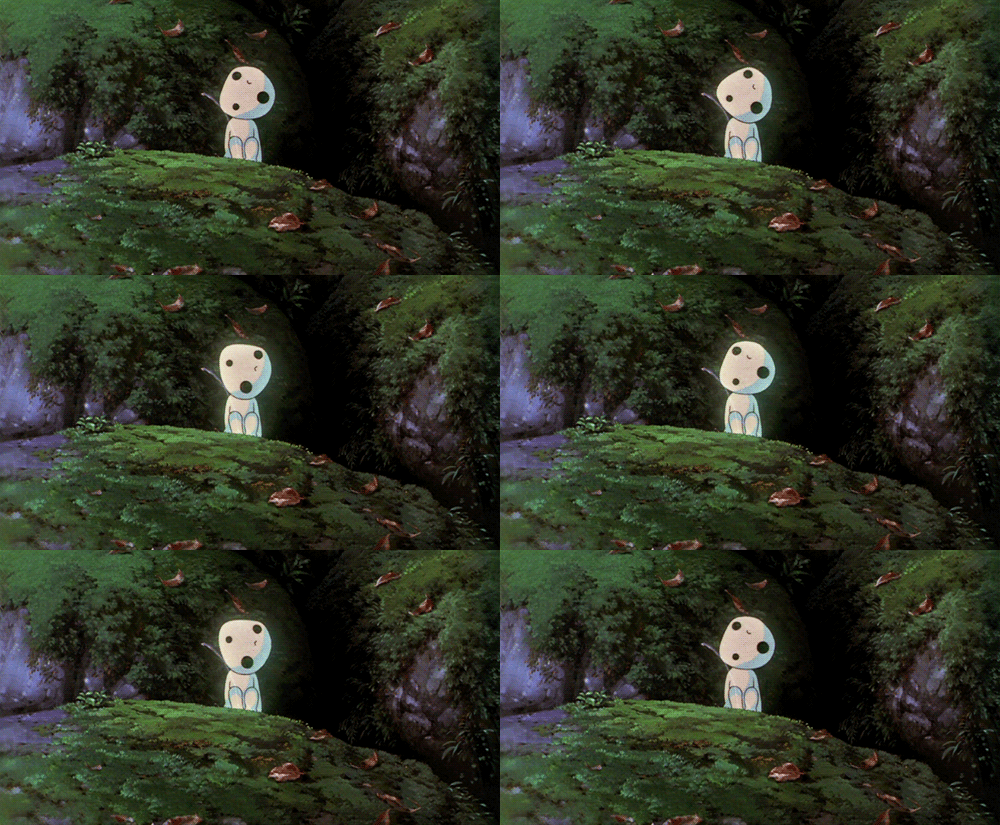
kodoma
Princess Mononoke is a period drama set in the late Muromachi period of Japan but with numerous fantastical elements. The story concentrates on involvement of the outsider Ashitaka in the struggle between the supernatural guardians of a forest and the humans of the Iron Town who consume its resources. There can be no clear victory, and the hope is that relationship between humans and nature can be cyclical.
“Mononoke” (物の怪) is not a name, but a general term in the Japanese language for a spirit or monster. The film was first released in Japan on July 12, 1997, and in the United States on October 29, 1999.
step back
the xx – angels
“Light reflects from your shadow;
It is more than I thought could exist.”
“Angels” is the first song The XX released off their September 2012 album, Coexist.
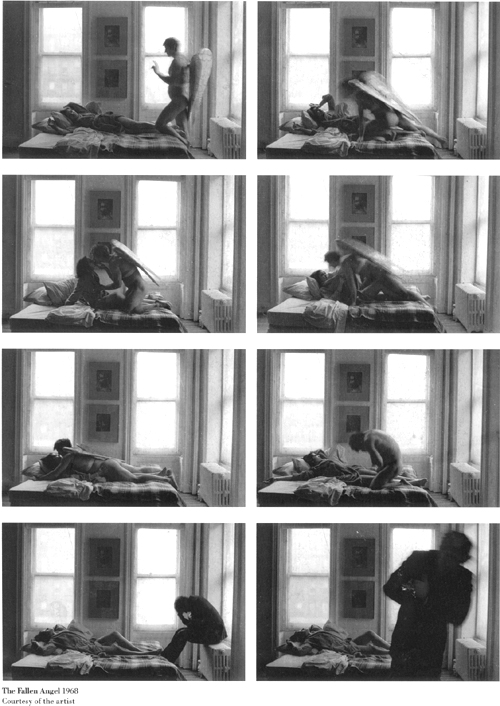
fallen angel
pessoa: “because i’ve already seen cats staring at the moon”
Life would be unbearable if we made ourselves conscious of it. Happily we don’t do so. We live with the same unconsciousness as the animals, in the same futile and useless way, and if we anticipate death, which might be assumed, though one can’t be certain, we anticipate it by way of forgetting so much and with so many distractions and subterfuges that we can scarcely say we think about it at all.
So we live our lives, with little grounds for thinking we’re superior to animals. Our difference from them consists in the purely external detail that we speak and write, that we have the abstract intelligence for both distancing ourselves by employing it concretely and by imagining impossible things. All those qualities, therefore, are accidents of our basic organism. Speaking and writing do nothing new for our primordial instinct to live without knowing how. Our abstract intelligence is of no use except in concocting systems or notions about half-systems rather than permitting us to be animals out under the sun. Our imagination of the impossible is not exclusive to us, because I’ve already seen cats staring at the moon, and I don’t know whether they weren’t yearning for it.
– Fernando Pessoa, Always Astonished (San Francisco: City Lights Books, 1988), transl. Edwin Honig, pp 118-19.
bodies
lamentation – martha graham
“As though you were stretching inside your own skin…”
Choreography: Martha Graham
Music by: Zoltan Kodaly
Danced by: Peggy Lyman
Created in 1930, filmed in 1976.
Martha Graham Dance Company
on making oneself visible in the world
There is a lovely root to the word humiliation – from the latin word humus, meaning soil or ground. When we are humiliated, we are in effect returning to the ground of our being.
Shedding the carapace we have been building so assiduously on the surface, we must by definition give up exactly what we thought was necessary to protect us from further harm. The outlaw is the radical, the one close to the roots of existence. The one who refuses to forget their humanity and, in remembering, helps everyone else remember too.
To die inside is to rob our outside life of any sense of arrival from that interior. Our work is to make ourselves visible in the world. This is the soul’s individual journey, and the soul would much rather fail at its own life than succeed at someone else’s.
– David Whyte, from Crossing the Unknown Sea
david whyte — the house of belonging
You must learn one thing. The world was made to be free in. Give up on all other worlds except the one to which you belong. Sometimes it takes darkness and the sweet confinement of your aloneness to learn anything or anyone that does not bring you alive is too small for you.
– David Whyte, from The House of Belonging.
jolie holland – alley flowers
From her debut album, Catalpa (2003). It’s my favourite album of hers, I think – gorgeously hypnotic, and impossible to place in space and time. It’s like she’s channelling the voice of a ghost out of early 20th century America’s Deep South… The words from her milk-white throat weave an occult journey, harking back even further – the lolloping, liquid rhythm of this song could be straight out of West Africa.
Quote from Amazon.com:
“If you didn’t know what it was, you’d swear it was recorded in the field 70 years ago. The outright primitive audio quality, acoustic instruments, the little mistakes and coughs left in… it’s a diamond in the rough, left uncut because there’s so much beauty in the imperfections.
“Then you notice the opening track’s [“Alley Flowers”] muffled frame-drum percussion is playing a “cabalistic” 12/8 against the guitar and vocal’s 4/4, the lyrical fantistical concreteness reminiscent of Syd Barrett or Hank Williams, the fluid soprano that sounds utterly self-taught, and you know it’s not an ordinary folk album at all.
“This is very, very different music from almost anything you’re likely to hear, especially in this day of cheap semi-pro equipment and easy software editing. But it’s truly miraculous.”
ram dass
“Across planes of consciousness, we have to live with the paradox that opposite things can be simultaneously true.”
– Ram Dass
gregory david roberts — shantaram
“It took me a long time and most of the world to learn what I know about love and fate and the choices we make, but the heart of it came to me in an instant, while I was chained to a wall and being tortured. I realised, somehow, through the screaming in my mind, that even in that shackled, bloody helplessness, I was still free: free to hate the men who were torturing me, or to forgive them. It doesn’t sound like much, I know. But in the flinch and bite of the chain, when it’s all you’ve got, that freedom is a universe of possibility. And the choice you make, between hating and forgiving, can become the story of your life.”
“The past reflects eternally between two mirrors—the bright mirror of words and deeds, and the dark one, full of things we didn’t do or say.”
“The ancient Sanskrit legends speak of a destined love, a karmic connection between souls that are fated to meet and collide and enrapture one another. The legends say that the loved one is instantly recognised because she’s loved in every gesture, every expression of thought, every movement, every sound, and every mood that prays in her eyes. The legends say that we know her by her wings—the wings that only we can see—and because wanting her kills every other desire of love.
The same legends also carry warnings that such fated love may, sometimes, be the possession and obsession of one, and only one, of the two souls twinned by destiny. But wisdom, in one sense, is the opposite of love. Love survives in us precisely because it isn’t wise.”
” … the soul has no culture. The soul has no nations. The soul has no colour or accent or way of life. The soul is forever. The soul is one. And when the heart has its moment of truth and sorrow, the soul can’t be stilled.”
“It’s forgiveness that makes us what we are. Without forgiveness, our species would’ve annihilated itself in endless retributions. Without forgiveness, there would be no history. Without that hope, there would be no art, for every work of art is in some way an act of forgiveness. Without that dream, there would be no love, for every act of love is in some way a promise to forgive. We live on because we can love, and we love because we can forgive.”
“They claim a hidden corner of our hearts, all those moments that stay with us unscreamed. That’s where loves, like elephants, drag themselves to die. It’s the place where pride allows itself to cry.”
“You can’t kill love. You can’t even kill it with hate. You can kill in-love, and loving, and even loveliness. You can kill them all, or numb them into dense, leaden regret, but you can’t kill love itself. Love is the passionate search for a truth other than your own; and once you feel it, honestly and completely, love is forever. Every act of love, every moment of the heart reaching out, is a part of the universal good: it’s a part of God, or what we call God, and it can never die.”
“The cloak of the past is cut from patches of feelings, and sewn with rebus threads. Most of the time, the best we can do is wrap it around ourselves for comfort or drag it behind us as we struggle to go on. But everything has its cause and its meaning. Every life, every love, every action and feeling and thought has its reason and significance: its beginning, and the part it plays in the end. Sometimes, we do see. Sometimes, we see the past so clearly, and read the legend of its parts with such acuity, that every stitch of time reveals its purpose, and a kind of message is enfolded in it. Nothing in any life, no matter how well or poorly lived, is wiser than failure or clearer than sorrow. And in the tiny, precious wisdom that they give to us, even those dread and hated enemies, suffering and failure, have their reason and their right to be.”
breathe sparingly
“Silently, Siddhartha exposed himself to burning rays of the sun directly
above, glowing with pain, glowing with thirst, and stood there, until he
neither felt any pain nor thirst any more. Silently, he stood there in
the rainy season, from his hair the water was dripping over freezing
shoulders, over freezing hips and legs, and the penitent stood there,
until he could not feel the cold in his shoulders and legs any more,
until they were silent, until they were quiet. Silently, he cowered in
the thorny bushes, blood dripped from the burning skin, from festering
wounds dripped pus, and Siddhartha stayed rigidly, stayed motionless,
until no blood flowed any more, until nothing stung any more, until
nothing burned any more.
Siddhartha sat upright and learned to breathe sparingly, learned to
get along with only few breaths, learned to stop breathing. He
learned, beginning with the breath, to calm the beat of his heart,
leaned to reduce the beats of his heart, until they were only a few and
almost none.”
– from Siddhartha by Hermann Hesse
emily brontë – wuthering heights
Heaven did not seem to be my home; and I broke my heart with weeping to come back to earth; and the angels were so angry that they flung me out into the middle of the heath on the top of Wuthering Heights; where I woke sobbing for joy. That will do to explain my secret, as well as the other. I’ve no more business to marry Edgar Linton than I have to be in heaven; and if the wicked man in there had not brought Heathcliff so low I shouldn’t have thought of it. It would degrade me to marry Heathcliff now; so he shall never know how I love him; and that not because he’s handsome, Nelly, but because he’s more myself than I am. Whatever our souls are made of, his and mine are the same, and Linton’s is as different as a moonbeam from lightning, or frost from fire…
… I cannot express it; but surely you and everybody have a notion that there is, or should be an existence of yours beyond you. What were the use of creation if I were entirely contained here? My great miseries in this world have been Heathcliff’s miseries, and I watched and felt each from the beginning; my great thought in living is himself. If all else perished, and he remained, I should still continue to be; and all else remained, and he were annihilated, the universe would turn to a mighty stranger; I should not seem a part of it. My love for Linton is like the foliage in the woods. Time will change it, I’m well aware, as winter changes the trees — my love for Heathcliff resembles the eternal rocks beneath — a source of little visible delight, but necessary. Nelly, I am Heathcliff — he’s always, always in my mind — not as a pleasure, any more than I am always a pleasure to myself — but as my own being — so, don’t talk of our separation again — it is impracticable.
~ Catherine Earnshaw (Ch. IX).
_____
Wuthering Heights is the only published novel by Emily Brontë, written between October 1845 and June 1846 and published in July of the following year. It was not printed until December 1847 under the pseudonym Ellis Bell, after the success of her sister Charlotte Brontë’s novel Jane Eyre. A posthumous second edition was edited by Charlotte in 1850.