
Author Archives: cherry bomb
the cherry faced lurchers – shot down (live, 1985)
simone weil – algebra
 Money, mechanization, algebra. The three monsters of contemporary civilization. Complete analogy.
Algebra and money are essentially levellers, the first intellectually, the second effectively.
About fifty years ago the life of the Provençal peasants ceased to be like that of the Greek peasants described by Hesiod. The destruction of science as conceived by the Greeks took place at about the same period. Money and algebra triumphed simultaneously.
The relation of the sign to the thing signified is being destroyed, the game of exchanges between signs is being multiplied of itself and for itself. And the increasing complication demands that there should be signs for signs… [Note that this comment comes decades before Baudrillard writes about simulacra in 1981.]
Among the characteristics of the modern world we must not forget the impossibility of thinking in concrete terms of the relationship between effort and the result of effort. There are too many intermediaries. As in the other cases, this relationship which does not lie in any thought, lies in a thing: money.
As collective thought cannot exist as thought, it passes into things (signs, machines…). Hence the paradox: it is the thing which thinks and the man who is reduced to the state of a thing.
There is no collective thought. On the other hand our science is collective like our technics. Specialization. We inherit not only results but methods which we do not understand. For the matter of that the two are inseparable, for the results of algebra provide methods for the other sciences.
To make an inventory or criticism of our civilization—what does that mean? To try to expose in precise terms the trap which has made man the slave of his own inventions. How has unconsciousness infiltrated itself into methodical thought and action?
To escape by a return to the primitive state is a lazy solution. We have to rediscover the original pact between the spirit and the world in this very civilization of which we form a part. But it is a task which is beyond our power on account of the shortness of life and the impossibility of collaboration and of succession. That is no reason for not undertaking it. The situation of all of us is comparable to that of Socrates when he was awaiting death in his prison and began to learn to play the lyre… At any rate we shall have lived…
The spirit, overcome by the weight of quantity, has no longer any other criterion than efficiency.
Modern life is given over to immoderation. Immoderation invades everything: actions and thought, public and private life.
The decadence of art is due to it. There is no more balance anywhere. The Catholic movement is to some extent in reaction against this; the Catholic ceremonies, at least, have remained intact. But then they are unrelated to the rest of existence.
Capitalism has brought about the emancipation of collective humanity with respect to nature. But this collective humanity has itself taken on with respect to the individual the oppressive function formerly exercised by nature.
This is true even with material things: fire, water etc. The community has taken possession of all these natural forces.
Question: can this emancipation, won by society, be transferred to the individual?
__
Excerpted from Simone Weil‘s Gravity and Grace. First French edition 1947. Translated by Emma Crawford. English language edition 1963. Routledge and Kegan Paul, London.
the the – slow emotion replay (1993)
Fine long-form video for this song, that I meant to post as part of my little early ’90s radio pop tape time capsule the other day. I love going to Youtube to look for a song I only ever knew as audio back in the day and discovering that it has a great music video that never made it to South African television.
john fahey – tulip (when you wore a tulip and i wore a big red rose)
From his 1964 album Vol.3: The Dance of Death and Other Plantation Favorites.
i’m glad i never (demo – 2015)
I recorded this 1971 Lee Hazlewood song last year in Copenhagen on New Year’s Eve with Jim Neversink. I love how a song’s original sense can be radically subverted when a person in a different subject position sings.
birthday tulips from debbie pryor (2016)
I watched them dying slowly at my desk, which I hardly left for the week after my birthday (dissertation drang). And what a magnificent way to go. They DID so much in those last days. Most flowers sit still and wilt gently. Not tulips! Tulips grow to double their height in the first two days in a vase. You can hear them moving at night when it’s quiet. The leaves squeak as they unfurl. They dance and overflow the vase, leaning over your work audaciously. Then the buds begin to open wider, wider still, the petals curling back gracefully, turning inside out to reveal ripe, full stamens, spilling a profusion of pollen, yellow stains all across your papers… exquisite, defiant contortion. What a wonderful birthday gift at 38 – the opportunity to meditate on living and aging with self-possession and purpose. Thank you Debs. x


simone weil – beauty
Beauty is the harmony of chance and the good.
Beauty is necessity which, while remaining in conformity with its own law and with that alone, is obedient to the good.
The subject of science is the beautiful (that is to say order, proportion, harmony) in so far as it is suprasensible and necessary.
The subject of art is sensible and contingent beauty discerned through the network of chance and evil.
The beautiful in nature is a union of the sensible impression and of the sense of necessity. Things must be like that (in the first place), and, precisely, they are like that.
Beauty captivates the flesh in order to obtain permission to pass right to the soul.
Among other unions of contraries found in beauty there is that of the instantaneous and the eternal.
The beautiful is that which we can contemplate. A statue, a picture which we can gaze at for hours.
The beautiful is something on which we can fix our attention. Gregorian music. When the same things are sung for hours each day and every day, whatever falls even slightly short of supreme excellence becomes unendurable and is eliminated.
The Greeks looked at their temples. We can endure the statues in the Luxembourg because we do not look at them. A picture such as one could place in the cell of a criminal sentenced to solitary confinement for life without it being an atrocity, on the contrary.
Only drama without movement is truly beautiful. Shakespeare’s tragedies are second-class with the exception of Lear. Those of Racine, third-class except for Phèdre. Those of Corneille of the nth class.
A work of art has an author and yet, when it is perfect, it has something which is essentially anonymous about it. It imitates the anonymity of divine art. In the same way the beauty of the world proves there to be a God who is personal and impersonal at the same time and is neither the one nor the other separately.
The beautiful is a carnal attraction which keeps us at a distance and implies a renunciation. This includes the renunciation of that which is most deep-seated, the imagination. We want to eat all the other objects of desire. The beautiful is that which we desire without wishing to eat it. We desire that it should be.
We have to remain quite still and unite ourselves with that which we desire yet do not approach. We unite ourselves to God in this way: we cannot approach him.
Distance is the soul of the beautiful.
The attitude of looking and waiting is the attitude which corresponds with the beautiful. As long as one can go on conceiving, wishing, longing, the beautiful does not appear. That is why in all beauty we find contradiction, bitterness and absence which are irreducible.
Poetry: impossible pain and joy. A poignant touch, nostalgia. Such is Provençal and English poetry. A joy which by reason of its unmixed purity hurts, a pain which by reason of its unmixed purity brings peace.
Beauty: a fruit which we look at without trying to seize it.
The same with an affliction which we contemplate without drawing back.
A double movement of descent: to do again, out of love, what gravity does. Is not the double movement of descent the key to all art?*
This movement of descent, the mirror of grace, is the essence of all music. All the rest only serves to enshrine it.
The rising of the notes is a purely sensorial rising. The descent is at the same time a sensorial descent and a spiritual rising. Here we have the paradise which every being longs for: where the slope of nature makes us rise towards the good.
In everything which gives us the pure authentic feeling of beauty there really is the presence of God. There is as it were an incarnation of God in the world and it is indicated by beauty.
The beautiful is the experimental proof that the incarnation is possible.
Hence all art of the highest order is religious in essence. (That is what people have forgotten today.) A Gregorian melody is as powerful a witness as the death of a martyr.
If the beautiful is the real presence of God in matter and if contact with the beautiful is a sacrament in the full sense of the word, how is it that there are so many perverted aesthetes? Nero. Is it like the hunger of those who frequent black masses for the consecrated hosts? Or is it, more probably, because these people do not devote themselves to what is genuinely beautiful, but to a bad imitation? For, just as there, is an art which is divine, so there is one which is demoniacal. It was no doubt the latter that Nero loved. A great deal of our art is of the devil.
A person who is passionately fond of music may quite well be a perverted person—but I should find it hard to believe this of any one who thirsted for Gregorian chanting. [hahaha!]
We must certainly have committed crimes which have made us accursed, since we have lost all the poetry of the universe.
Art has no immediate future because all art is collective and there is no more collective life (there are only dead collections of people), and also because of this breaking of the true pact between the body and the soul. Greek art coincided with the beginning of geometry and with athleticism, the art of the Middle Ages with the craftsmen’s guilds, the art of the Renaissance with the beginning of mechanics, etc. … Since 1914 there has been a complete cut. Even comedy is almost impossible. There is only room for satire (when was it easier to understand Juvenal?).
Art will never be reborn except from amidst a general anarchy— it will be epic no doubt, because affliction will have simplified a great many things… Is it therefore quite useless for you to envy Leonardo or Bach. Greatness in our times must take a different course. Moreover it can only be solitary, obscure and without an echo… (but without an echo, no art).
__
* Descendit ad inferos… So, in another order, great art redeems gravity by espousing it out of love. [Editor’s note.]
__
Excerpted from Simone Weil‘s Gravity and Grace. First French edition 1947. Translated by Emma Crawford. English language edition 1963. Routledge and Kegan Paul, London.
grimm versus gira (2008 – 2016)
I share this in solidarity with Larkin Grimm, and my niece Juliette, and every other woman who has been exploited or violated through unequal power relationships during artistic collaboration. Speak your truth. Don’t shut up. Make them squirm. Let them burn.
—
Yesterday, singer/songwriter Larkin Grimm claimed that Swans frontman Michael Gira raped her in spring 2008, when she was recording her album Parplar for Gira’s Young God label. In a Facebook post yesterday, she said she confronted Gira and he then dropped her from his label. Gira called Grimm’s accusations “a slanderous lie” on his personal Facebook page. In an official statement through his publicist, Gira has acknowledged the spring 2008 night in question, but calls the incident “an awkward mistake.” Read his full statement below. Update (2/27, 9:40 a.m.): Grimm sent us a statement in response to Gira’s comments, which she calls “an admission of guilt.” Read it below.
Michael Gira:
Eight years ago, while I was still married to my first wife, Larkin Grimm and I headed towards a consensual romantic moment that fortunately was not consummated. As she wrote in her recent social media postings about that night, I said to her, “this doesn’t feel right,” and abruptly but completely our only intimate encounter ended. It was an awkward mistake.
Larkin may regret, as I certainly do, that the ill-advised tryst went even that far, but now, as then, I hold her in high esteem for her music and her courage as an artist.
I long ago apologized to my wife and family and told them the truth about this incident. My hope is that Larkin finds peace with the demons that have been darkening her soul since long before she and I ever met.

Larkin Grimm:
This is a perfect example of why we need to have education about consent. In a gentlemanly move he admits the act happened but cannot conceive of himself as a rapist. Thank you Michael Gira for your honesty. This is your truth as you remember it. Unfortunately, this was still rape. I said no to you many times before that day, begged you not to interfere with me sexually, even made it a part of a verbal agreement we had when I signed a contract with you. I asked you to promise that you would never have sex with me. You assured me that I could trust you. That is about as clear a NO as I could ever cry. I asked for this because I had had other experiences in my music career and I KNEW.
That night I was far too intoxicated to give you consent for any sexual act. The psychological effects of this betrayal were devastating. Even worse, when I finally confronted you about what you had done, you terminated my relationship with Young God Records, damaging my career and leading people to believe there was something wrong with me or my music.
In the end, this is about business. Art is my career. I have worked long and hard for this career, making incredible sacrifices along the way to continue to make music. The fact that a man in power can throw a woman’s life and work away like they are garbage, simply because she won’t sleep with him, is an immoral injustice that happens to many, many women in music. I won’t stand for it and neither should you.
The “Demons darkening my soul” are the men like you who interfere with my ability to do my work as a musician. This is a job I am good at. All I want is to be left in peace while I am working.
From Pitchfork.
larkin grimm interview (2014)
larkin grimm – blonde and golden johns (live, 2009)
“Days go by like butterflies…”
“Blonde and Golden Johns” performed by Larkin Grimm at the Sidewalk Cafe in NYC.
alexis pauline gumbs – pulse (for the 50 and beyond)
A poem for those who died, shot in Pulse nightclub in Orlando this weekend past.

i was going to see you
i was going to dance
in the same place with you someday
i was going to pretend not to notice
how you and your friends smiled
when you saw me and my partner
trying to cumbia to bachata
but i was going to feel more free anyway
because you were smiling
and we were together
and you had your stomach out
and you felt beautiful in your sweat
i was going to smile when i walked by
i was going to hug you the first time
a friend of a friend introduced us
i was going to compliment your shoes
instead of writing you a love poem
i was going to smile every time i saw you
and struggle to remember your name
we were going to sing together
we were going to belt out Selena
i was going to mispronounce everything
except for amor
and ay ay ay
i was going to covet your confidence and your bracelet
i was going to be grateful for the sight of you
i was going scream YES!!! at nothing in particular
at everything especially
meaning you
meaning you beyond who i knew you to be
i was going to see you in hallways
and be too shy to say hello
you were going to come to the workshop
you were going to sign up for the workshop and not come
you were going to translate the webinar
even though my politics seemed out there
we were going to sign up for creating change the same day
and be reluctant about it for completely different reasons
we were going to watch the keynotes
and laugh at completely different times
i was going to hold your hand in a big activity
about the intimacy of strangers
about the strangeness of needing prayer
we were going to get the same automated voice message
when we complained that it was not what it should have been
we were going to be standing in the same line
for various overpriced drinks
during a shift change
i was going to breathe loudly so you would notice me
you were going to compliment my hair
it isn’t fair
because we were going to work
to beyonce and rihanna
and the rihanna’s and beyonce’s to come
and the beyonce’s and rihanna’s after that
we were going to not drink enough water
and stay out later than our immune systems could handle
we were going to sit in traffic in each others blindspots
listening to top 40 songs that trigger queer memories
just outside the scope of marketing predictions
we were going to get old and i was going to wonder
about the hint of a tattoo i could see under your sleeve
i was going to blink and just miss
the fought-for laughter lines around your liner-loved eyes
i was going to go out for my birthday
but i didn’t
and you did
we were going to be elders
just because we were still around
and i was going to listen to you on a panel
we didn’t feel qualified for
and hear you talk about your guilt
for still being alive
when so many of your friends were taken
by suicide
by AIDS
by racist police
and jealous ex-lovers
and poverty
and no access to healthcare
and how you had a stable job
you suffered at until the weekend
how you avoided the drama
and only went to the club at pride
and so here you were with no one to dance with anymore
i was going to see you and forget you
and only remember you in my hips
and how my smile came easier than clenching my teeth eventually
and how i finally learned whatever it is i still haven’t learned yet
i was going to hear you laugh and not know why
and not care
our ancestors fought for a future
and we were both going to be there
until we weren’t
and i don’t know if it would hurt more
to lose you later after knowing you
i don’t know if it would hurt more
to know you died on your own day
by your own hands
or any of the other systems
that stalk you and me and ours forever
i only know the pain that i am having
and that you are not here to share it
you are not here to bear it
you were going to pass me a candle at the next vigil
but now i am pulse
and now you
are flame.
robert greene – the 48 laws of power, or, how to be a consummately oppressive douchebag

Illustration by William Steig from Wilhelm Reich’s “Listen, Little Man” (1945)
LAW 1
NEVER OUTSHINE THE MASTER
Always make those above you feel comfortably superior. In your desire to please or impress them, do not go too far in displaying your talents or you might accomplish the opposite-inspire fear and insecurity. Make your masters appear more brilliant than they are and you will attain the heights of power.
LAW 2
NEVER PUT TOO MUCH TRUST IN FRIENDS, LEARN HOW TO USE ENEMIES
Be wary of friends-they will betray you more quickly, for they are easily aroused to envy. They also become spoiled and tyrannical. But hire a former enemy and he will be more loyal than a friend, because he has more to prove. In fact, you have more to fear from friends than from enemies. If you have no enemies, find a way to make them.
LAW 3
CONCEAL YOUR INTENTIONS
Keep people off-balance and in the dark, by never revealing the purpose behind your actions. If they have no clue what you are up to, they cannot prepare a defense. Guide them far enough down the wrong path, envelop them in enough smoke, and by the time they realize your intentions, it will be too late.
LAW 4
ALWAYS SAY LESS THAN NECESSARY
When you are trying to impress people with words, the more you say, the more common you appear, and the less in control. Even if you are saying something banal, it will seem original if you make it vague, open-ended, and sphinxlike. Powerful people impress and intimidate by saying less. The more you say, the more likely you are to say something foolish.
LAW 5
SO MUCH DEPENDS ON REPUTATION- GUARD IT WITH YOUR LIFE
Reputation is the cornerstone of power. Through reputation alone you can intimidate and win; once it slips, however, you are vulnerable, and will be attacked on all sides. Make your reputation unassailable. Always be alert to potential attacks and thwart them before they happen. Meanwhile, learn to destroy your enemies by opening holes in their own reputations. Then stand aside and let public opinion hang them.
LAW 6
COURT ATTENTION AT ALL COST
Everything is judged by its appearance; what is unseen counts for nothing. Never let yourself get lost in the crowd, then, or buried in oblivion. Stand out. Be conspicuous, at all cost. Make yourself a magnet of attention by appearing larger, more colorful, more mysterious than the bland and timid masses.
LAW 7
GET OTHERS TO DO THE WORK FOR YOU, BUT ALWAYS TAKE THE CREDIT
Use the wisdom, knowledge, and legwork of other people to further your own cause. Not only will such assistance save you valuable time and energy, it will give you a godlike aura of efficiency and speed. In the end your helpers will be forgotten and you will be remembered. Never do yourself what others can do for you.
LAW 8
MAKE OTHER PEOPLE COME TO YOU-USE BAIT IF NECESSARY
When you force the other person to act, you are the one in control. It is always better to make your opponent come to you, abandoning his own plans in the process. Lure him with fabulous gains-then attack. You hold the cards.
LAW 9
WIN THROUGH YOUR ACTIONS, NEVER THROUGH ARGUMENT
Any momentary triumph you think you have gained through argument is really a Pyrrhic victory: The resentment and ill will you stir up is stronger and lasts longer than any momentary change of opinion. It is much more powerful to get others to agree with you through your actions, without saying a word. Demonstrate, do not explicate.
LAW 10
INFECTION: AVOID THE UNHAPPY AND UNLUCKY
You can die from someone else’s misery-emotional states are as infectious as diseases. You may feel you are helping the drowning man but you are only precipitating your own disaster. The unfortunate sometimes draw misfortune on themselves; they will also draw it on you. Associate with the happy and fortunate instead.
LAW 11
LEARN TO KEEP PEOPLE DEPENDENT ON YOU
To maintain your independence you must always be needed and wanted. The more you are relied on, the more freedom you have. Make people depend on you for their happiness and prosperity and you have nothing to fear. Never teach them enough so that they can do without you.
LAW 12
USE SELECTIVE HONESTY AND GENEROSITY TO DISARM YOUR VICTIM
One sincere and honest move will cover over dozens of dishonest ones. Open-hearted gestures of honesty and generosity bring down the guard of even the most suspicious people. Once your selective honesty opens a hole in their armor, you can deceive and manipulate them at will. A timely gift-a Trojan horse-will serve the same purpose.
LAW 13
WHEN ASKING FOR HELP, APPEAL TO PEOPLE’S SELF-INTEREST, NEVER TO THEIR MERCY OR GRATITUDE
If you need to tum to an ally for help, do not bother to remind him of your past assistance and good deeds. He will find a way to ignore you. Instead, uncover something in your request, or in your alliance with him, that will benefit him, and emphasize it out of all proportion. He will respond enthusiastically when he sees some thing to be gained for himself.
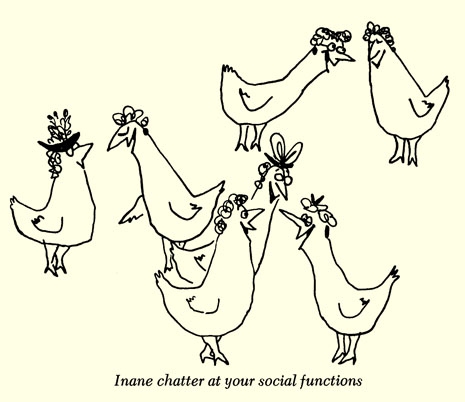
From Wilhelm Reich’s “Listen, Little Man” (1945)
LAW 14
POSE AS A FRIEND, WORK AS A SPY
Knowing about your rival is critical. Use spies to gather valuable information that will keep you a step ahead. Better still: Play the spy yourself. In polite social encounters, learn to probe. Ask indirect questions to get people to reveal their weaknesses and intentions. There is no occasion that is not an opportunity for artful spying.
LAW 15
CRUSH YOUR ENEMY TOTALLY
All great leaders since Moses have known that a feared enemy must be crushed completely. (Sometimes they have learned this the hard way.) If one ember is left alight, no matter how dimly it smolders, afire will eventually break out. More is lost through stopping halfway than through total annihilation: The enemy will recover, and will seek revenge. Crush him, not only in body but in spirit.
LAW 16
USE ABSENCE TO INCREASE RESPECT AND HONOR
Too much circulation makes the price go down: The more you are seen and heard from, the more common you appear. If you are already established in a group, temporary withdrawal from it will make you more talked about, even more admired. You must learn when to leave. Create value through scarcity.
LAW 17
KEEP OTHERS IN SUSPENDED TERROR: CULTIVATE AN AIR OF UNPREDICTABILITY
Humans are creatures of habit with an insatiable need to see familiarity in other people’s actions. Your predictability gives them a sense of control. Tum the tables: Be deliberately unpredictable. Behavior that seems to have no consistency or purpose will keep them off-balance, and they will wear themselves out trying to explain your moves. Taken to an extreme, this strategy can intimidate and terrorize.
LAW 18
DO NOT BUILD FORTRESSES TO PROTECT YOURSELF- ISOLATION IS DANGEROUS
The world is dangerous and enemies are everywhere-everyone has to protect themselves. A fortress seems the safest. But isolation exposes you to more dangers than it protects you from- it cuts you off from valuable information, it makes you conspicuous and an easy target. Better to circulate among people, find allies, mingle. You are shielded from your enemies by the crowd.
LAW 19
KNOW WHO YOU’RE DEALING WITH: DO NOT OFFEND THE WRONG PERSON
There are many different kinds of people in the world, and you can never assume that everyone will react to your strategies in the same way. Deceive or outmaneuver some people and they will spend the rest of their lives seeking revenge. They are wolves in lambs’ clothing. Choose your victims and opponents carefully, then never offend or deceive the wrong person.
LAW 20
DO NOT COMMIT TO ANYONE
It is the fool who always rushes to take sides. Do not commit to any side or cause but yourself. By maintaining your independence, you become the master of others-playing people against one another, making them pursue you.
LAW 21
PLAY A SUCKER TO CATCH A SUCKER: SEEM DUMBER THAN YOUR MARK
No one likes feeling stupider than the next person. The trick, then, is to make your victims feel smart-and not just smart, but smarter than you are. Once convinced of this, they will never suspect that you may have ulterior motives.
LAW 22
USE THE SURRENDER TACTIC: TRANSFORM WEAKNESS INTO POWER
When you are weaker, never fight for honor’s sake; choose surrender instead. Surrender gives you time to re cover, time to torment and irritate your conqueror, time to wait for his power to wane. Do not give him the satisfaction of fighting and defeating you- surrender first. By turning the other cheek you infuriate and unsettle him. Make surrender a tool of power.
LAW 23
CONCENTRATE YOUR FORCES
Conserve your forces and energies by keeping them concentrated at their strongest point. You gain more by finding a rich mine and mining it deeper, than by flitting from one shallow mine to another-intensity defeats extensity every time. When looking for sources of power to elevate you, find the one key patron, the fat cow who will give you milk for a long time to come.
LAW 24
PLAY THE PERFECT COURTIER
The perfect courtier thrives in a world where everything revolves around power and political dexterity. He has mastered the art of indirection; he flatters, yields to superiors, and asserts power over others in the most oblique and graceful manner. Learn and apply the laws of courtiership and there will be no limit to how far you can rise in the court.
LAW 25
RE-CREATE YOURSELF
Do not accept the rol.es that society foists on you. Re-create yourself by forging a new identity, one that commands attention and never bores the audience. Be the master of your own image rather than letting others define it for you. Incorporate dramatic devices into your public gestures and actions-your power will be enhanced and your character will seem larger than life.
LAW 26
KEEP YOUR HANDS CLEAN
You must seem a paragon of civility and efficiency: Your hands are never soiled by mistakes and nasty deeds. Maintain such a spotless appearance by using others as scapegoats and cat’s-paws to disguise your involvement.
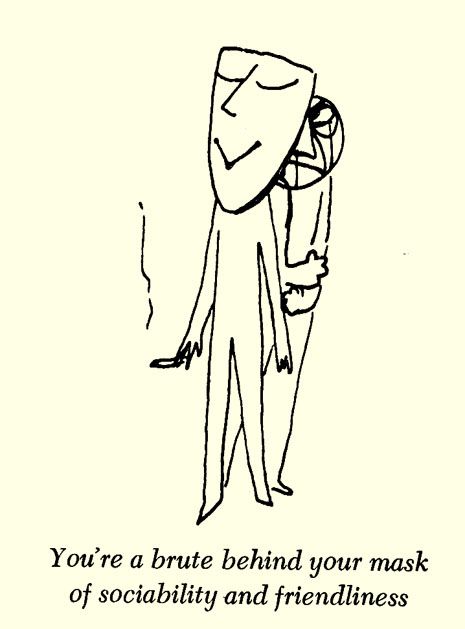
From Wilhelm Reich’s “Listen, Little Man” (1945)
LAW 27
PLAY ON PEOPLE’S NEED TO BELIEVE TO CREATE A CULTLIKE FOLLOWING
People have an overwhelming desire to believe in something. Become the focal point of such desire by offering them a cause, a new faith to follow. Keep your words vague but full of promise; emphasize enthusiasm over rationality and clear thinking. Give your new disciples rituals to perform, ask them to make sacrifices on your behalf. In the absence of organized religion and grand causes, your new belief system will bring you untold power.
LAW 28
ENTER ACTION WITH BOLDNESS
If you are unsure of a course of action, do not attempt it. Your doubts and hesitations will infect your execution. Timidity is dangerous: Better to enter with boldness. Any mistakes you commit through audacity are easily corrected with more audacity. Everyone admires the bold; no one honors the timid.
LAW 29
PLAN ALL THE WAY TO THE END
The ending is everything. Plan all the way to it, taking into account all the possible consequences, obstacles, and twists of fortune that might reverse your hard work and give the glory to others. By planning to the end you will not be overwhelmed by circumstances and you will know when to stop. Gently guide fortune and help determine the future by thinking far ahead.
LAW 30
MAKE YOUR ACCOMPLISHMENTS SEEM EFFORTLESS
Your actions must seem natural and executed with ease. All the toil and practice that go into them, and also all the clever tricks, must be concealed. When you act, act effortlessly, as if you could do much more. Avoid the temptation of revealing how hard you work-it only raises questions. Teach no one your tricks or they will be used against you.
LAW 31
CONTROL THE OPTIONS: GET OTHERS TO PLAY WITH THE CARDS YOU DEAL
The best deceptions are the ones that seem to give the other person a choice: Your victims feel they are in control, but are actually your puppets. Give people options that come out in your favor whichever one they choose. Force them to make choices between the lesser of two evils, both of which serve your purpose. Put them on the horns of a dilemma: They are gored wherever they turn.
LAW 32
PLAY TO PEOPLE’S FANTASIES
The truth is often avoided because it is ugly and unpleasant. Never appeal to truth and reality unless you are prepared for the anger that comes from disenchantment. Life is so harsh and distressing that people who can manufacture romance or conjure up fantasy are like oases in the desert: Everyone flocks to them. There is great power in tapping into the fantasies of the masses.
LAW 33
DISCOVER EACH MAN’S THUMBSCREW
Everyone has a weakness, a gap in the castle wall. That weakness is usually an insecurity, an uncontrollable emotion or need; it can also be a small secret pleasure. Either way, once found, it is a thumbscrew you can tum to your advantage.
LAW 34
BE ROYAL IN YOUR OWN FASHION: ACT LIKE A KING TO BE TREATED LIKE ONE
The way you carry yourself will often determine how you are treated: In the long run, appearing vulgar or common will make people disrespect you. For a king respects himself and inspires the same sentiment in others. By acting regally and confident of your powers, you make yourself seem destined to wear a crown.
LAW 35
MASTER THE ART OF TIMING
Never seem to be in a hurry-hurrying betrays a lack of control over yourself, and over time. Always seem patient, as if you know that everything will come to you eventually. Become a detective of the right moment; sniff out the spirit of the times, the trends that will carry you to power. Learn to stand back when the time is not yet ripe, and to strike fiercely when it has reached fruition.
LAW 36
DISDAIN THINGS YOU CANNOT HAVE: IGNORING THEM IS THE BEST REVENGE
By acknowledging a petty problem you give it existence and credibility. The more attention you pay an enemy, the stronger you make him; and a small mistake is often made worse and more visible when you try to fix it. It is sometimes best to leave things alone. If there is something you want but cannot have, show contempt for it. The less interest you reveal, the more superior you seem.
LAW 37
CREATE COMPELLING SPECTACLES
Striking imagery and grand symbolic gestures create the aura of power-everyone responds to them. Stage spectacles for those around you, then, full of arresting visuals and radiant symbols that heighten your presence. Dazzled by appearances, no one will notice what you are really doing.

From Wilhelm Reich’s “Listen, Little Man” (1945)
LAW 38
THINK AS YOU LIKE BUT BEHAVE LIKE OTHERS
If you make a show of going against the times, flaunting your unconventional ideas and unorthodox ways, people will think that you only want attention and that you look down upon them. They will find a way to punish you for making them feel inferior. It is far safer to blend in and nurture the common touch. Share your originality only with tolerant friends and those who are sure to appreciate your uniqueness.
LAW 39
STIR UP WATERS TO CATCH FISH
Anger and emotion are strategically counterproductive. You must always stay calm and objective. But if you can make your enemies angry while staying calm yourself, you gain a decided advantage. Put your enemies off-balance: Find the chink in their vanity through which you can rattle them and you hold the strings.
LAW 40
DESPISE THE FREE LUNCH
‘What is offered for free is dangerous-it usually involves either a trick or a hidden obligation. ‘What has worth is worth paying for. By paying your own way you stay clear of gratitude, guilt, and deceit. It is also often wise to pay the full price–there is no cutting corners with excellence. Be lavish with your money and keep it circulating, for generosity is a sign and a magnet for power.
LAW 41
AVOID STEPPING INTO A GREAT MAN’S SHOES
What happens first always appears better and more original than what comes after. If you succeed a great man or have a famous parent, you will have to accomplish double their achievements to outshine them. Do not get lost in their shadow, or stuck in a past not of your own making: Establish your own name and identity by changing course. Slay the overbearing father, disparage his legacy, and gain power by shining in your own way.
LAW 42
STRIKE THE SHEPHERD AND THE SHEEP WILL SCATTER
Trouble can often be traced to a single strong individual-the stirrer, the arrogant underling, the poisoner of goodwill. If you allow such people room to operate, others will succumb to their influence. Do not wait for the troubles they cause to multiply, do not try to negotiate with them-they are irredeemable. Neutralize their influence by isolating or banishing them. Strike at the source of the trouble and the sheep will scatter.
LAW 43
WORK ON THE HEARTS AND MINDS OF OTHERS
Coercion creates a reaction that will eventually work against you. You must seduce others into wanting to move in your direction. A person you have seduced becomes your loyal pawn. And the way to seduce others is to operate on their individual psychologies and weaknesses. Soften up the resistant by working on their emotions, playing on what they hold dear and what they fear. Ignore the hearts and minds of others and they will grow to hate you.
LAW 44
DISARM AND INFURIATE WITH THE MIRROR EFFECT
The mirror reflects reality, but it is also the perfect tool for deception: when you mirror your enemies, doing exactly as they do, they cannot figure out your strategy. The Mirror Effect mocks and humiliates them, making them overreact. By holding up a mirror to their psyches, you seduce them with the illusion that you share their values; by holding up a mirror to their actions, you teach them a lesson. Few can resist the power of the Mirror Effect.
LAW 45
PREACH THE NEED FOR CHANGE, BUT NEVER REFORM TOO MUCH AT ONCE
Everyone understands the need for change in the abstract, but on the day-to-day level people are creatures of habit. Too much innovation is traumatic, and will lead to revolt. If you are new to a position of power, or an outsider trying to build a power base, make a show of respecting the old way of doing things. If change is necessary, make it feel like a gentle improvement on the past.

From Wilhelm Reich’s “Listen, Little Man” (1945)
LAW 46
NEVER APPEAR TOO PERFECT
Appearing better than others is always dangerous, but most dangerous of all is to appear to have no faults or weaknesses. Envy creates silent enemies. It is smart to occasionally display defects, and admit to harmless vices, in order to deflect envy and appear more human and approachable. Only gods and the dead can seem perfect with impunity.
LAW 47
DO NOT GO PAST THE MARK YOU AIMED FOR: IN VICTORY, LEARN WHEN TO STOP
The moment of victory is often the moment of greatest peril. In the heat of victory, arrogance and overconfidence can push you past the goal you had aimed for, and by going too far, you make more enemies than you defeat. Do not allow success to go to your head. There is no substitute for strategy and careful planning. Set a goal, and when you reach it, stop.
LAW 48
ASSUME FORMLESSNESS
By taking a shape, by having a visible plan, you open yourself to attack. Instead of taking a form for your enemy to grasp, keep yourself adaptable and on the move. Accept the fact that nothing is certain and no law is fixed. The best way to protect yourself is to be as fluid and formless as water; never bet on stability or lasting order. Everything changes.
wilhelm reich on the plague-ridden vs. the living (1945)
Society moulds human character and in turn human character reproduces social ideology en masse. Thus, in reproducing the negation of life inherent in social ideology, people reproduce their own suppression.
Those who are truly alive are kindly and unsuspecting in their human relationships and consequently endangered under present conditions. They assume that others think and act generously, kindly, and helpfully, in accordance with the laws of life. This natural attitude, fundamental to healthy children as well as to primitive man, inevitably represents a great danger in the struggle for a rational way of life as long as the emotional plague subsists, because the plague-ridden impute their own manner of thinking and acting to their fellow men.
A kindly man believes that all men are kindly, while one infected with the plague believes that all men lie and cheat and are hungry for power. In such a situation the living are at an obvious disadvantage. When they give to the plague-ridden, they are sucked dry, then ridiculed or betrayed.
Read the whole of Reich’s essay, “The Emotional Plague” HERE, and an “orgonomic” analysis of mass murders and their relationship to repression HERE (an interesting take in the light of the Orlando nightclub shooting this past weekend, although I completely disagree with the conclusions drawn by the author about what the USA should do about it! I think, frankly, that the USA has an enormous log in its own eye where repression is concerned.)

Diagram by Wilhelm Reich depicting his theory of the antithetical functional unity between instinct and defense, and illustrating specific impulses.
[EDIT, 14 June 2016]: From Facebook this morning:

new order – power, corruption and lies (1983)
Peter Saville on his album cover artwork:
“The title seemed Machiavellian. So I went to the National Gallery looking for a Renaissance portrait of a dark prince. In the end, it was too obvious and I gave up for the day and bought some postcards from the shop. I was with my girlfriend at the time, who saw me holding a postcard of the Fantin-Latour painting of flowers and said, ‘You are not thinking of that for the cover?’ It was a wonderful idea. Flowers suggested the means by which power, corruption and lies infiltrate our lives. They’re seductive. Tony Wilson had to phone the gallery director for permission to use the image. In the course of the conversation, he said, ‘Sir, whose painting is it?’ To which the answer was, ‘It belongs to the people of Britain.’ Tony’s response was, ‘I believe the people want it.’ And the director said, ‘If you put it like that, Mr Wilson, I’m sure we can make an exception in this case.’”
(From HERE.)
helen mirren in age of consent (1969)
a lacanian interpretation of sartre’s ‘erostratus’ (1939)
Read Jean Paul Sartre’s short story Erostratus, written the year after his famous Nausea, HERE.

Salvador Dali – “Temple of Diana at Ephesus” (1942).
Jordan Alexander Hill on the story from a psychoanalytical perspective:
Jean-Paul Sartre’s “Erostratus” may be the shortest story in The Wall, yet it serves as a fitting psychoanalytic case-study. “Erostratus” tells the story of Paul Hilbert, a lonely man plagued by insecurity and sexual impotency, who attempts and ultimately fails to commit a heinous crime. Shortly into the story, it becomes clear that the crime is mostly an attempt to escape his mediocrity through an act of powerful self-assertion. We will look at this story not only through a traditional psychoanalytic lens, but also by applying important Lacanian principles. Sartre, who developed his own “existential” brand of psychoanalysis, surely wrote “Erostratus” to support certain phenomenological and ethical themes from Being and Nothingness—we’ll look at some of these perspectives. However, in many ways, we arrive at the deepest understanding of Hilbert and his motivations by bringing Lacanian theories into the discussion. In this paper, we first locate the basic existential and psychoanalytic themes that underpin “Erostratus”, in addition to looking at Lacan’s “mirror phase” and how this relates to Hilbert’s social development. “Erostratus” is essentially a story about narcissism, alienation, otherness, and desire. Lacan’s psychic structures—particularly the imaginary and symbolic orders—will give us a sense of where these emotions come from, how they affect our protagonist, and how they function in the larger narrative.
Like in many “existential” works, our protagonist is a bland working class guy with a routine existence and a mundane job. He has no friends to speak of and is a self-professed “anti-humanist”. As Hilbert’s impatience with his situation grows, he decides he must make a statement that will prove his anti-humanism and secure his name in the history books—he will murder six random people on a busy street in Paris. Hilbert is deeply moved by the ancient Greek story of “Erostratus,” which tells of a man who burned down the temple of Artemis at Ephesus to immortalize himself. What strikes him is that while nobody knows the name of the man who built the temple of Artemis, everyone remembers Erostratus, the man who destroyed it. The rest of the story follows Hilbert’s metamorphosis, as the day of his crime draws nearer. In what follows, Hilbert buys a gun and carries it around in public, becoming sexually aroused by the possibilities, and the power he now possesses. He becomes more and more obsessed with this power and even visits a prostitute, commanding her to walk around naked at gunpoint (he does this several times, each time ejaculating in his pants). As the day of his crime draws nearer, Hilbert spends his life savings on expensive meals and prostitutes, and even mails letters of his murderous intent to 102 famous French writers. Yet, in the end, Hilbert is incapable of following through. He winds up shooting only one man, a “big man”, and has a frantic meltdown in the street afterward. The story ends in a café lavatory, as Hilbert gives himself up to the police.
Let us first take a look at some of the elements that make up the “existential” composure of the story. Hilbert’s act of mailing letters to famous writers before committing his crime shows a deep insecurity over the potential legacy he wishes to leave. Hilbert must have others verify and be witness to his crime for the weight of his actions to seem real to him. In existential thought, this is an offense known as “being-for-others” (we’ll return to this later when we discuss Lacan). Hilbert no longer lives in a world where his actions and choices hold any real weight or significance. This lack of self-determination plunges Hilbert into a kind of moral nihilism, which only exacerbates his problems. Another significant element to note is the rise in power Hilbert feels as he buys a gun and brings it around with him wherever he goes. The angst or dread that follows—often described in existential circles as being a kind of “excitement or fear over the possibility of one’s own freedom”—is an important aspect of Hilbert’s condition. Furthermore, one would not have to use queer theory, nor is it beyond any stretch of the imagination, to assert that Sartre uses the gun here as a phallic symbol. For Hilbert, happiness truly is a warm gun, as the gun symbolizes the power he has always lacked socially and sexually. The fact that Hilbert makes prostitutes walk around naked at gun point, without letting them touch or look at him, is another teller. This voyeuristic behavior, according to Sartre, is a mechanism by which the individual avoids his or her own subjectivity—shirking responsibility—in order to live through the imagined subjectivity of another (Sartre, 1953, 244). Hilbert, it turns out, suffers in large part from a staggering lack of being (this “lack of being” doesn’t stem from any shortage of self-consciousness, but rather from a case of what I’ll call “mistaken identity,” in a Lacanian sense).
Hilbert’s crime, we come to find out, is not motivated by material gain or political ideology. What, then, is it motivated by? To start, let’s look at our protagonist’s own self-identification: Hilbert believes his crime is motivated by his “anti-humanism”. In the letter, he congratulates the famous authors for being humanists, for loving men. “You have humanism in your blood…” Hilbert writes, “You are delighted when your neighbor takes a cup from the table because there is a way of taking it which is strictly human… less supple, less rapid than that of a monkey”. He goes on to sarcastically praise the authors for relieving and consoling the masses. “People throw themselves greedily at your books… they think of a great love, which you bring them and that makes up for many things, for being ugly, for being cowardly, for being cuckolded, for not getting a raise on the first of January”. These sound like Hilbert’s own problems.
Later in the letter, Hilbert explains his own hatred of humanity. “I cannot love them… what attracts you to them disgusts me… men chewing slowly, all the while keeping an eye on everything, the left hand leafing through an economic review. Is it my fault I prefer to watch the sea-lions feeding?”. Given this, it would be a mistake to equate Hilbert’s anti-humanism to misanthropy. The word “misanthrope” is normally an intellectual self-label, which is defined by a general disgust with the thoughtlessness or lack of social awareness perceived in others. As Moliere notes in his Les Misanthrope: “I detest all men; Some because they are wicked and do evil, Others because they tolerate the wicked” (Moliere, I.i.). Hilbert, on the other hand, is not a misanthrope; he is a self-reflective watcher, a voyeur. And his anti-humanism—his “all-too-humanness” as he puts it it—seems to involve the hatred of those physical and emotional qualities which he observes in others, and which he himself cannot experience. Hilbert’s condition is strikingly similar to Sartre’s analysis of the poet Baudelaire. “For most of us,” Sartre contends, “it is enough to see the tree or house; we forget ourselves” (Sartre, 1950, 22). Baudelaire, however, “was the man who never forgot himself” (Sartre, 1950, 22). Hilbert, likewise, is too self-conscious to experience normal human emotions. He does not simply see things; but sees himself seeing things. As such, he has lost the unselfconscious grace and naturalness he so despises in others.
This deep self-consciousness, this narcissism, is something that alienates Hilbert, and makes normal communication with others almost impossible. If we asked Lacan, he would probably point us to the mirror phase and the imaginary order, which are both significant in Hilbert’s case. The mirror phase refers to a period in psychosexual development, when “the child for the first time becomes aware, through seeing its image in the mirror” (Homer 24). For Lacan, this marks the emergence of the ego, as the child realizes it can control the movements of this new image. This should not be confused with the advent of “selfhood,” but rather it is a moment of profound alienation, where we actually mistake this new mirror-image for our “self” (Homer 25).
Read more of this article HERE (and read the actual story HERE).
damn, girl

helen mirren in herostratus (1967)
A scene from the movie Herostratus (1967), directed by experimental filmmaker Don Levy.
The plot of Herostratus is deceptively simple: A young poet, Max (Michael Gothard), is sick of being poor, unemployed and feeling inadequate and unnoticed and trapped by society. After a few setbacks early in the film, particularly when it comes to paying the rent to a landlady he can no longer avoid, Max decides to commit suicide by jumping off a tall building. But Max decides to make a point of his death instead, and enlists the help of Farson (Peter Stephens), a successful public relations ad man, who helps him turn his suicide, conceived as a sacrificial act of protest against modern society, into a media circus.
Farson does not actually believe Max will go through with the suicide, and decides to let Max spend time at his studio, and its there that Max falls in love with Farson’s assistant Clio (Gabriella Licudi), with whom he shares his first sexual experience. Farson encourages their coupling, believing it’ll end in tears and the young man’s mental torment will be something he can further exploit, but then everyone finds out just how bad of a poet Max really is, and they encourage him to kill himself, for real, and Max realizes that his reactionary gesture is being seen by everyone as simply a cry for attention.
Depressed by this last futile attempt to make himself understood, Max goes up to to the roof but his suicidal jump is stopped by a man who happens to be working on the roof that day — but during their struggle, the worker falls to his death, and Max escapes into the woods.
Herostratus, it should be noted, is titled for the Greek poet who sought to immortalize his own name by setting fire to the Temple of Artemis in Ephesus, in the fourth century B.C. His name was later stricken from all records until it was discovered that Alexander the Great was born the night Herostratus committed his fatal act.
This was Don Levy’s first feature film after having attending on a scholarship at Cambridge University, where he began a PhD study in Theoretical Chemical Physics. At some point Levy withdrew from his science courses and began focusing on creative endeavors, including painting and playing jazz and filmmaking. He moved over to the London-based Slade School of Fine Art, where he made a series of short science documentaries, including his most successful film, 1962’s Time Is, which explored the theories and conception of time.
James Quinn, then director of the British Film Institute, had worked with Levy onTime Is, helping him secure a grant to finish the film. He then helped the director obtain the funds — from the BFI Experimental Film Fund — to make another short film, but Levy soon found his ambitions were exceeding the budget as it expanded into a feature-length production, with additional funding coming from the BBC. That film was Herostratus, and it took five years to complete, but it was largely met with indifference, and was not the spectacular success that Levy (and Quinn) had hoped for. After a handful of initial screenings, including its premiere at London’s Institute of Contemporary Artst, in April 1968, Herostratus was shelved and virtually forgotten.
Levy’s artistic filmmaking style — juxtaposing images of postwar urban decay and burlesque stripteases with carcasses hanging in an abattoir — met largely with indifference from the public and from most film critics, even though later critics have pointed out that he did have some influence on his contemporaries, including Richard Lester and Stanley Kubrick, especially on the latter’s 1971 film Clockwork Orange.
The few surviving prints of Herostratus show it to be a flawed yet highly perceptive dissection of 1960s idealism, seduced by the Mephistophelian deception of market forces and the empty promise of mass media celebrity.
Helen Mirren’s singular contribution (about 54 minutes into the film) as “Advert Woman” provides one of the few dark moments of humor in an otherwise very dark film. In the scene, she is wearing rubber gloves for the filming of a commercial which is supposed to be a statement about consumerism, but we know what the real product is: the camera lingers lasciviously (as it will so often in her later career) over her cleavage. Once she’s delivered her lines, Gothard scoops her up and carries her off set. The scene is barely more than three minutes long.
helen mirren dealing with a totally sexist interviewer (1975)
He is vile. She handles him with brilliant wit and poise.
r.e.m. – losing my religion (1991)
Here endeth tonight’s time capsule.
duran duran – come undone/ordinary world (1993)
james – born of frustration (1992)
1992 was also the year I got glandular fever (Epstein-Barr virus), which was to lead to three years spent mostly in bed, ill with chronic fatigue syndrome/M.E., physically broken and depressed as fuck, while everyone else my age got on with having teenage fun. The radio literally saved my life.
new order – regret
I finally got a boombox that I could tape stuff off the radio with in 1992. These songs I’m posting tonight from that time occupy an indelible place in me for that reason… and they all happen to be songs about melancholy and memory, strangely, too.
thomas dolby – close but no cigar (1992)
shakespears sister – hello (1992)
suzanne vega – liverpool (1992)
This song, tonight, though.
lombards at home

Thanks Lizza for reminding me of the iconoclasm in my blood. ;)
the damned – new rose (1976)
Psych music for driving to work on a Sunday. 🌹
john lydon interview (c 1978)
 fleurmach