“Our first film. This Way Up had money to make a video, we wanted to make something more like a film. We were told about Jarvis and Steve from Pulp, who were making films with Martin Wallace. We made it during the summer of ’93. Dickon’s not in it because he was in Mexico as part of his studies. It was good fun and hard work, driving around in our Ford Cortina, Jarvis squashed on the passenger seat floor. Sidonie, Stuart’s daughter, is the baby. It was the start of a long and joyful relationship with Martin Wallace, who’s become a wonderful friend.”
Author Archives: cherry bomb
anne michaels – phantom limbs (excerpt)
So much of the city
is our bodies. Places in us
old light still slants through to.
Places that no longer exist but are full of feeling,
like phantom limbs.
Even the city carries ruins in its heart.
Longs to be touched in places
only it remembers…
(from The Weight of Oranges / Miner’s Pond. McClelland & Stewart, 1997. p.86)
the gulabi gang

The Gulabi Gang (from Hindi “gulabi” = “pink” – “pink gang”) is a group of women vigilantes and activists originally from Banda in Bundelkhand district, Uttar Pradesh, India, but reported to be active across North India as of 2010. It is named after the pink saris worn by its members.
The gang was founded in 2006 by Sampat Pal Devi, a mother of five and former government health worker (also a former child bride), as a response to widespread domestic abuse and other violence against women. Gulabis visit abusive husbands and beat them up with laathis (bamboo sticks) unless they stop abusing their wives. In 2008, they stormed an electricity office in Banda district and forced officials to turn back the power they had cut in order to extract bribes. They have also stopped child marriages and protested dowry and female illiteracy.

 More information HERE and HERE, and more pictures by Arindam Mukherjee HERE.
jayne cortez – there it is
And if we don’t fight
if we don’t resist
if we don’t organise and unify and
get the power to control our own lives
then we will wear
the exaggerated look of captivity
the stylised look of submission
the bizarre look of suicide
the dehumanised look of fear
and the decomposed look of repression
forever and ever and ever
And there it is
not a tree

for the birds
i really don’t get it,
never have.
hard rock/metal in general, i mean.
too much sweaty hair thrashing around,
too many notes overcrowding each bar,
too many gratuitous tempo changes,
the voice (always male) too yowly or growly,
the lyrics, ridiculous.
i can dig the more spacey prog stuff from the ’70s, king crimson for example, or the o.t.t. weirdness of frank zappa, but the testosserterrain of deep purple/motorhead/budgie etc etc… i just don’t get it.
it reminds me of all the wankers i tried to sing or play guitar with at school.
i could never find anyone who wanted to do anything interesting.
all they did was spank away over and over for hours and hours at the same led zeppelin or sabbath or metallica riffs,
show off their paradiddle-diddle-diddle drumming,
their kakky renditions of les claypool slap bass,
drink black label quarts, smoke dagga, crow about forcing themselves on girls.

here’s a memory from when i was about 15 or 16… i’m at a house party in kloof, drunk and very bored, after one such disappointing “jam”. the drummer, julian (still remember his stinking name), with long fluffy hair and a straggly beard and juicy zits who’s maybe a bit older than the rest of us, starts kissing me and i’m kinda flattered but not feeling anything at all. so i crawl off a bit later when he’s getting another beer to go sleep in someone’s bedroom plastered with creepy iron maiden posters.
he comes to find me and i wake to his entire weight bearing down on me, smothered in salty, smoky hair and he’s forcing his hands into my panties and shoving his filthy callused stompie fingers in my virginity and his penis is grinding into my thigh and i can’t move or breathe. i’m choking. i bite at his furry beer tongue and he swears at me and slaps me, calls me a cocktease, and then he’s gone. mercifully. i need to vomit and wash myself but i daren’t go to the bathroom. i’m scared that he’ll come back. i’m lying there groggy and rigid with the reek of him on me, his plaque in my mouth, with that eddie creature leering down at me from the moonlit posters, with the drone of mosquitoes and the signature riffs of the morning birds over and over for hours and hours – bulbul, white-eye, hadeda, bulbul, white-eye, hadeda, bulbul, hadeda… somewhere a cock is crowing and finally i can get out of there.
coda: my younger sister got seduced by the whole scene and ended up pregnant at 16 by one of these fret-tapping frauds that she’d called her boyfriend for about 2 years. a few months after the baby came, he slunk off with the chick he’d been cheating on her with.
so yeah. i don’t enjoy hard rock/metal’s machismo-drenched doodling.
i find it the aural equivalent of being fucked badly.
there’s not a smidgen of feminine awareness in its puffed-up rooster strut.
september 15, 2008
against rape culture

Protesters in India
untitled, 2008

Photo: Rosemary Lombard, 2008 (single exposure with 2 megapixel Minolta camera)
stub me out
a cigarette burn
in your third i
soap&skin – thanatos
Song from Soap&Skin‘s debut album, Lovetune for Vacuum (2009, Play It Again Sam Records).
Video produced and directed by Benjamin and Stefan Ramirez Pérez.
Photography by Anja Plaschg, Benjamin Ramírez Pérez and Stefan Ramírez Pérez.
jessica tremp – over unto silence

Jessica Tremp – Over Unto Silence
william butler yeats – a coat
I made my song a coat
Covered with embroideries
Out of old mythologies
From heel to throat;
But the fools caught it,
Wore it in the world’s eyes
As though they’d wrought it.
Song, let them take it,
For there’s more enterprise
In walking naked.
clara rockmore – pastorale (anis fuleihan)
From Clara Rockmore’s Lost Theremin Album (1975)
Anis Fuleihan (April 2, 1900 – October 11, 1970) was a Cypriot-born American composer, conductor and pianist. Fuleihan’s music generally avoided serial structures, and was heavily influenced by Middle Eastern folk music. One of his works is a concerto for theremin, premiered by the New York Philharmonic under Leopold Stokowski in 1945; the soloist was Clara Rockmore.
Images: Alphonse Mucha
no compromise, no order
“What he would say, he cannot say to this woman whose openness is like a wound, whose youth is not mortal yet. He cannot alter what he loves most in her, her lack of compromise, where the romance of the poems she loves still sits with ease in the real world. Outside these qualities he knows there is no order in the world.”
― Michael Ondaatje, The English Patient
rosemary for remembrance

Jaroslava Schallerová in a still from “Valerie a Týden Divu” (Valerie & Her Week of Wonders). Director: Jaromil Jires, 1970
WATCH IT. It’s utterly beautiful.
dark – round the edges – 1972 (full album)
If this album had no vocals, it would be an almost perfect psychedelic rock trip. I enjoy it most when I manage to ignore the uninspired blandness of the singer (he only opens his mouth here and there to spout triteness, luckily). The best way I have found to do this is put it on loud and leave the room (so the vocals become less distinct), let it fill the house, and get on with the cleaning, which is what I’m doing now…
another fleurmach marching tune for 2013!
Recorded in 1965 by Peggy Lee, I love this version of “Pass Me By”, a Cy Coleman song originally from the 1964 film, Father Goose.
I got me ten fine toes to wiggle in the sand,
Lots of idle fingers snap to my command,
A lovely pair of heels that kick to beat the band,
Contemplating nature can be fascinating,
Add to these a nose that I can thumb,
And a mouth by gum have I,
To tell the whole darn world,
“If you don’t happen to like it, deal me out,
Thank you kindly, pass me by.”
lucille ball and paula stewart – hey, look me over
Marching orders from Fleurmach! Here’s to 2013 kicking 2012’s sorry ass!
Lucille Ball and Paula Stewart as Wildy and Janey Jackson, live on the Ed Sullivan Show (1961), performing “Hey, Look Me Over” from the Broadway musical, Wildcat. These feisty dames are Thelma and Louise’s crazy aunts.
Hey look me over, lend me an ear,
Fresh out of clover, morgaged up to here,
Don’t pass the plate folks,
Don’t pass the cup,
I figure whenever you’re down and out,
The only way is up…
And I’ll be up like a rose bud,
High on the vine,
Don’t thumb your nose folks,
Take a tip from mine,
I’m a little bit short of elbow room,
But let me get me some,
And look out world, here I come!
“one ventures from home on the thread of a tune”
A child in the dark, gripped with fear, comforts himself by singing under his breath. He walks and halts to his song. Lost, he takes shelter, or orients himself with his little song as best he can. The song is like a rough sketch of a calming and stabilizing, calm and stable, center in the heart of chaos. Perhaps the child skips as he sings, hastens or slows his pace. But the song itself is already a skip: it jumps from chaos to the beginnings of order in chaos and is in danger of breaking apart at any moment. There is always sonority in Ariadne’s thread. Or the song of Orpheus. … One launches forth, hazards an improvisation. But to improvise is to join with the World, or meld with it. One ventures from home on the thread of a tune.
~ Deleuze & Guattari, in “1837: Of the Refrain”, from A Thousand Plateaus. Capitalism and Schizophrenia. London: Continuum, 1987. pp. 343-4
the raincoats – adventures close to home (1979)
Passion that shouts
Red with anger
I lost myself
Through alleys of mysteries
I went up and down
like a demented train
Don’t take it personal
I choose my own fate
I follow love
I follow hate
Searching for something
that makes hearts move
I found myself
But my best possession
walked into the shade
and threatened to drift away
Don’t take it personal
I choose my own fate
I follow love
I follow hate
For all of myself
I left you behind as if I could
possessed by Quixote’s dream
Went to fight dragons in the land of concrete
Don’t take it personal
I choose my own fate
I follow love
I follow hate
Rolling in pain
discovered what hurts
and tasted hell
infatuated by madness
I danced in flames
and drank in the depth of love
in the death car (we’re alive)
Song by Iggy Pop and Goran Bregovic, from the wonderful soundtrack to Emir Kusturica’s tragicomic, surreal film, Arizona Dream (1993).
in the cathedral
Kip (Naveen Andrews) and Hana (Juliette Binoche) in The English Patient (1996), directed by Anthony Minghella, based on the book by Michael Ondaatje.
born free, and everywhere in chains (1762)
“L’homme est né libre, et partout il est dans les fers.”
~ Jean-Jacques Rousseau (1712-1778), from Du contrat social, Préambule (1762).

Louise Brooks (photographer and date unknown)
“the ghost of electricity howls in the bones of her face…”
Stripped-down, live cover by the (brilliant) Robyn Hitchcock of the (incredible) Bob Dylan song, “Visions of Johanna”, originally from Blonde on Blonde (1966).
the moscow coup attempt – sprout and the bean
Cover of Joanna Newsom’s song “Sprout and the Bean”, with vocals by Vera Ostrova — sans the shrillness of the original and with a beautiful video — off a 2010 compilation album called Versions of Joanna.
“And as I said, I slept as though dead, dreaming seamless dreams of lead.
When you go away, I am big-boned and fey in the dust of the day, in the dirt of the day.”
mia farrow, vogue 1966
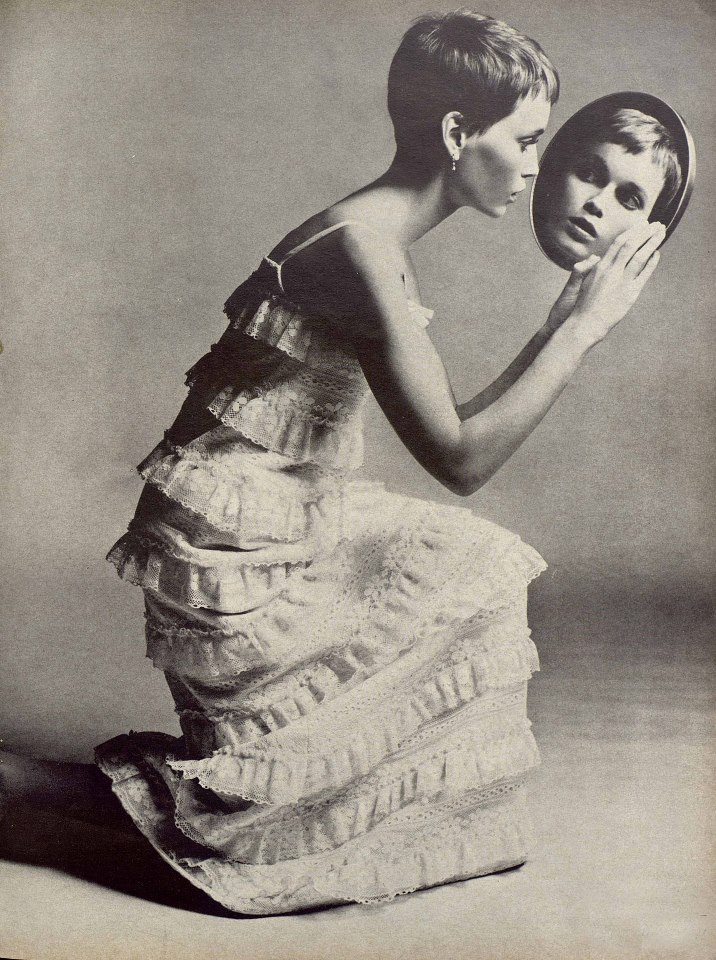
Mia Farrow – Vogue 1966. Photo by Richard Avedon (1923-2004)
garfunkel and oates – 29/31 (2012)
Garfunkel and Oates are an American comedy/musical duo from Los Angeles, California, consisting of actress-songwriters Kate Micucci and Riki Lindhome. The band name is derived from “two famous rock-and-roll second bananas”, Art Garfunkel and John Oates. In this song, Kate and Riki play the same woman, two years apart, at 29 and 31 respectively.
ruth etting – i’m nobody’s baby (1927)
Rising to fame in the twenties and early thirties, Ruth Etting was renowned for her great beauty, her gorgeous voice and her tragic life. She starred on Broadway, made movies in Hollywood, married a mobster, had numerous hit-records, and was known as America’s Sweetheart of Song.
Born in David City, Nebraska on November 23, 1897, Ruth left home at seventeen for Chicago and art school. She got a job designing costumes at a night club called the Marigold Gardens and when the tenor got sick, she was pulled into the show since she was the only one who could sing low enough. That led to dancing in the chorus line and eventually featured solos.
By 1918 she was the featured vocalist at the club and the Gimp entered her life. A Chicago gangster, Moe Snyder married Ruth in 1922 and managed her career for the next two decades. Her numerous radio appearances during these years led to her becoming known as Chicago’s Sweetheart.
In 1926 she was discovered by a record company executive and immediately signed to an exclusive recording deal with Columbia Records, which led to nationwide exposure. Her early recordings were very straightforward in delivery. She later commented that “I sounded like a little girl on those records!” and insisted that her voice was actually much deeper than these recordings would lead one to believe.
In 1927 Ruth hit New York and she was an instant success. Irving Berlin suggested her for the Ziegfeld Follies and she was hired after Ziegfeld checked her ankles, not her voice. She appeared in the Follies of 1927. In 1929 she starred with Eddie Cantor in Whoopee! and in 1930 she made 135 appearances in Simple Simon with Ed Wynn. In 1931 she appeared in the very last Follies, shortly before Ziegfeld’s death.
Her blond hair and blue eyes and stunning voice all led to her being dubbed the Sweetheart of Columbia Records, America’s Radio Sweetheart, and finally America’s Sweetheart of Song. She began to experiment with tempo and phrasing during this period in her career. Her trademark was to change the tempo – alternating between normal tempo, half-time and double-time to create and maintain interest.
Ruth had over sixty hit recordings. Among her best in the Jazz Age are “Button Up Your Overcoat” and “Mean to Me” and, in the depression, “Ten Cents A Dance”. Her versions of “Shine on Harvest Moon”, “Let Me Call You Sweetheart”, “You Made Me Love You” and “Love Me or Leave Me” became her signature songs.
Next she headed to Hollywood and made a string of movie shorts and three full-length features. Her big break came in Roman Scandals with Eddie Cantor and Lucille Ball in a bit part. Then came Gift of Gab and Hips Hips Hooray.
It was in Hollywood that her loveless marriage finally fell apart. In 1937 Ruth fell for her accompanist and, in a rage, the Gimp shot him. The musician survived, Snyder went to jail and Ruth ended up divorcing him and marrying her true love, Meryl Alderman. But the scandal was too much for her career to survive. She made a few attempts at a comeback, but her days as America’s Sweetheart were over.
(Information from ruthetting.com, a site maintained by the granddaughter of one of Ruth Etting’s cousins.)
voluntary slavery

what i rail against, impotently, and wish i could embrace
The following excerpt from John Berger’s Booker Prize-winning 1972 novel, G, contains devastating insight into the social/cultural meaning of being a woman in the world, and how utterly inescapable and deeply formative it is of one’s sense of self. Reading this made me nod and shake my head so hard I felt like I had whiplash afterwards.
Although this passage ostensibly deals with late nineteenth-century constructions of love and gendered identity, such tropes persist as fundamental to our conceptions now, albeit less formally and thus less obviously. So much of the pain and loneliness in my life has stemmed from an unconscious/inarticulate sense of exactly what Berger describes here and my horror and refusal of it all, played out in the choices I have made since childhood.
* * * * *
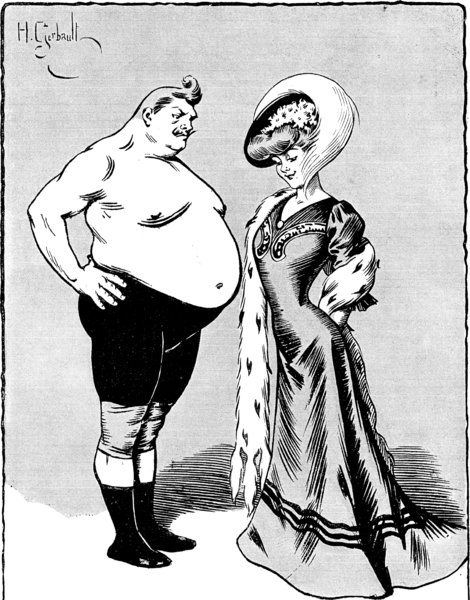
“Une Idée” – Henri Gerbault, 1907
The Situation of Women
… [T]he social presence of a woman was different in kind to that of a man. A man’s presence was dependent upon the promise of power which he embodied. If the promise was large and credible, his presence was striking. if it was small or incredible, he was found to have little presence. there were men, even many men, who were devoid of presence altogether. The promised power may have been moral, physical, temperamental, economic, social, sexual – but its object was always exterior to the man. A man’s presence suggested what he was capable of doing to you or for you.
By contrast, a woman’s presence expressed her own attitude to herself, and defined what could and could not be done to her. No woman lacked presence altogether. Her presence was manifest in her gestures, voice, opinions, expressions, clothes, chosen surroundings, taste – indeed there was nothing she could do which did not contribute to her presence.
To be born woman was to be born within an allotted and confined space, into the keeping of man. A woman’s presence developed as the precipitate of her ingenuity in living under such tutelage within such a limited cell. She furnished her cell, as it were, with her presence; not primarily in order to make it more agreeable to herself, but in the hope of persuading others to enter it.
A woman’s presence was the result of herself being split in two, and of her energy being inturned. A woman was always accompanied – except when quite alone – by her own image of herself. Whilst she was walking across a room or whilst she was weeping at the death of her father, she could not avoid envisaging herself walking or weeping. From earliest childhood she had been taught and persuaded to survey herself continually. And so she came to consider the surveyor and surveyed within her as two constituent yet always distinct elements of her identity as a woman.
A woman had to survey everything she was and everything she did because how she appeared to others, and ultimately how she appeared to men, was of crucial importance for her self-realisation. Her own sense of being in herself was supplanted by a sense of being appreciated as herself by another. Only when she was the content of another’s experience did her own life and experience seem meaningful to her. In order to live she had to install herself in another’s life.

Drawing by Henri Gerbault (1863 – 1930)
Men surveyed women before treating them. Consequently how a woman appeared to a man might determine how she would be treated. To acquire some control over this process, women had to contain it, and so they interiorised it. That part of a woman’s self which was the surveyor treated the part which was the surveyed, so as to demonstrate to others how her whole self should be treated. And this exemplary treatment of herself by herself constituted her presence. Every one of her actions, whatever its direct purpose, was also simultaneously an indication of how she should be treated.
If a woman threw a glass on the floor, this was an example of how she treated her own emotion of anger and so of how she would wish it to be treated by others. If a man had done the same, his action would only have been an expression of his anger. If a woman made good bread, this was an example of how she treated the cook in herself and accordingly of how she as a cook-woman should be treated by others. Only a man could make good bread for its own sake.
This subjunctive world of the woman, this realm of her presence, guaranteed that no action undertaken in it could ever possess full integrity; in each action there was an ambiguity which corresponded to an ambiguity in the self, divided between surveyor and surveyed. The so-called duplicity of woman was the result of the monolithic dominance of man.
A woman’s presence offered an example to others of how she would like to be treated – of how she would wish others to follow her in the way, or along the way, she treated herself. She could never cease offering this example, for it was the function of her presence. When, however, social convention or the logic of events demanded that she behave in a manner which contradicted the example she wished to give, she was said to be coquettish. Social convention insists that she should appear to reject something just said to her by a man. She turns away in apparent anger, but at the same time fingers her necklace and repeatedly lets it drop as tenderly as her own glance upon her breast.
When she is alone in her room and sure of being alone, a woman may look at herself in a mirror and put out her tongue. This makes her laugh and, on other occasions, cry.
It was with a woman’s presence that men fell in love. That part of a man which was submissive was mesmerised by the attention which she bestowed upon herself, and he dreamt of her bestowing the same attention upon himself. He imagined his own body, within her realm, being substituted for hers. This was a theme which occurred constantly in romantic poems about unrequited love. That part of a man which was masterful dreamt of possessing, not her body — this he called lust — but the variable mystery of her presence.
The presence of a woman in love could be very eloquent. the way she glanced or ran or spoke or turned to greet her lover might contain the quintessential quality of poetry. this would be obvious not only to the man she loved, but to any disinterested spectator. Why? Because the surveyor and the surveyed within herself were momentarily unified, and this unusual unity produced in her an absolute single-mindedness. The surveyor no longer surveyed. Her attitude to herself became as abandoned as she hoped her lover’s attitude to her would be. Her example was at last one of abandoning example. Only at such moments might a woman feel whole.
The state of being in love was usually short-lived — except in unhappy cases of unrequited love. Far shorter lived than the nineteenth-century romantic emphasis on the condition would lead us to believe. Sexual passion may have varied little throughout recorded history. But the account one renders to oneself about being in love is always informed and modified by the specific culture and social relations of the time.

„Würden Sie mir böse sein, wenn ich einen Kuss auf diese schöne Schulter drückte?“ „Das werden Sie ja nachher schon sehen“ (Henri Gerbault, 1901)
For the nineteenth-century European middle classes the state of being in love was characterised by a sense of excessive uncertainty in an otherwise certain world. It was a state exempt from the promise of Progress. Its characteristic uncertainty was the result of considering the beloved as though he or she were free. Nothing that was an expression of the beloved’s wishes could be taken for granted. No single decision of the beloved could guarantee the next. Each gesture had to be read for its fresh meaning. Every arrangement became questionable until it had taken place. Doubt produced its own form of erotic stimulation: the lover became the object of the beloved’s choice of full liberty. Or so it seemed to the couple in love. In reality, the bestowing of such liberty upon the other, the assumption that the other was so free, was part of the general process of idealising and making the beloved seem unique.
Each lover believed that he or she was the willing object of the other’s unlimited freedom and, simultaneously, that his or her own freedom, so circumscribed until now, was at last and finally assured within the terms of the other’s adoration. Thus each became convinced that to marry was to free oneself. Yet as soon as a woman became convinced of this (which might be long before her formal engagement) she was no longer single-minded, no longer whole. She had to survey herself now as the future betrothed, the future wife, the future mother of X’s children.
For a woman the state of being in love was a hallucinatory interregnum between two owners, her bridegroom taking the place of her father or later, perhaps, a lover taking the place of her husband.
The surveyor-in-herself quickly became identified with the new owner. She would begin to watch herself as if she were him. What would Maurice say, she would ask, if his wife (that is me) did this? Look at me, she would address the mirror, see what Maurice’s wife is like. The surveyor-in-herself became the new owner’s agent. (A relationship which might well include as much deceit or chicanery as can be found between any proprietor and agent.)
The surveyed-within-herself became the creature of proprietor and agent, of whom both must be proud, She, the surveyed, became their social puppet and their sexual object. The surveyor made the puppet talk at dinner like a good wife. And when it seemsed to her fit, she layed the surveyed down on a bed for her proprietor to enjoy. One might suppose that when a woman conceived and gave birth, surveyor and surveyed were temporarily reunited. Perhaps sometimes this happened. But childbirth was so surrounded with superstition and horror that most women submitted to it, screaming, confused, or unconscious, as to a punishment for their intrinsic duplicity. When they emerged from their ordeal and held the child in their arms they found they were the agents of the loving mother of their husband’s child.
“it’s alive!”
Mia Farrow and John Cassavetes in an excerpt from Rosemary’s Baby (Roman Polanski, 1968). A woman possessed… by her husband, first and foremost.
 fleurmach