annie ross – twisted (1959)

In 1952, Ross met Prestige Records owner Bob Weinstock, who asked her to write lyrics to a jazz solo, in a similar way to King Pleasure, a practice which would later be known as vocalese. The next day, she presented him with “Twisted”, a treatment of saxophonist Wardell Gray‘s 1949 composition of the same name, a classic example of the genre. She later said of the inspiration for the song:

“The title was infinite possibilities. You could marry anything to it and it was the name signified, “Twisted.” And it just occurred to me that it would be good as a kind of song about an analyst.”

“The melancholy river bears us on. When the moon comes through the trailing willow boughs, I see your face, I hear your voice. What are you whispering? Sorrow, sorrow. Joy, joy. Woven together in the moonlight.”

~ Virginia Woolf

motel7 – “daydreamers”


Solo Exhibition at 34FineArt, Cape Town

16 October 2012 – 10 November 2012

After her initial solo exhibition,Tears and Castles, at 34 Long Fine Art in 2009, Motel7 left South Africa to work in Europe and America. Having returned to South Africa she has reclaimed her position on the streets and in the Gallery environment.

Having worked in traditional mediums from an early age, Motel7 moved through the ranks of graffiti to street art and like many international artists, such as Banksy, Mr. Brainwash, Miss Van, Blek le Rat, D*Face and Nick Walker, she has secured her position as an acclaimed urban contemporary artist. Since then her work has been featured in numerous international exhibitions, including the Basel Art Fairs, as well as galleries in Amsterdam and Los Angeles. Motel7 continues to hone her skills in urban spaces whenever and wherever the opportunity presents itself.

Increasingly street artists occupy both urban and fine art environments. In cities like Cape Town, where street art is still illegal, artworks seldom remain on the walls for long enough to be fully appreciated before being cleaned off or defaced. Ironically, while the value of works in urban spaces is often overlooked, within the gallery environment these same works are approached with a more appreciative eye.

Daydreamers, Motel7’s second solo show, affirms the ease with which she straddles the divide between urban and gallery spaces – where the traditional process of work progressing from gallery environment to museum or public commission, is reversed. The exhibition is presented in her unique visual idiom, built-up over years of working in a challenging environment. The seemingly juxtaposed images of sculls, toys, fruit and sweets are complimented by the vintage quality of the paintings… it’s all about symbolizing daydreaming and nostalgia and the past.

Street art and graffiti are closely associated, but are often regarded as vandalism – evidence of urban decay – in stark contrast to gallery art, which is seen as the epitome of artistic achievement. Daydreamers demonstrates that it is not these works themselves which are different, but rather the contexts within which they are viewed.

Don’t miss the opening reception on 16 October. Find out more HERE.

helgé janssen – what stands between this and that? (2010)

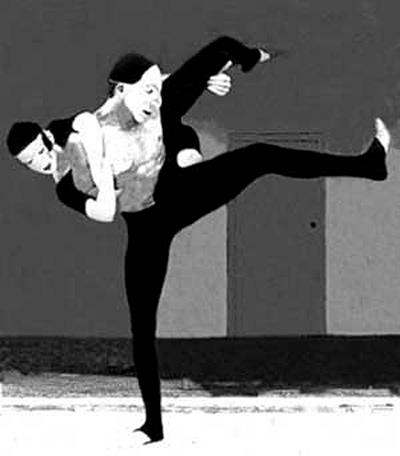
“CATALYST” – masked dance movement piece
Helgé Janssen/Gisele Stafford, Durban beachfront, 1984
Photograph: Peter Hart-Davies

what stands between this and that?

a look?
a glance?
a second fact?
a psychology?
an ideology?
a whim?
a schism?
a hollow dream?
a friend who intervenes?
a plissé
that would rather be
ironed out flat?

what stands between this and that?

a denial?
a pyre?
a burning sphere?
a time?
a place?
a thwarted mess?
a second guess?
a stall for time
that saves you grace?
a space between
a furtive glimpse?
a risk not worth taking?

what stands between this and that?

life as a rehearsal?
a chance to forget?
another escape?
the art of make-up?
a drowning of sorrows?
an always tomorrow?
a never yesterday?
somebody’s off day?
the centre lost?
the plot in recess?
just another day
without redress?

is this a life or just a mistake?

Thanks to Helgé for sharing this poem. Keep abreast of what this multi-talented and influential Durban artist has up his next immaculately designed sleeve HERE.

cherry bomb – gouttes mécaniques (mechanical teardrops) – 2008

“We’re all Frankie…”

A détournement: Fernand Léger – ‘Ballet Mécanique‘ (1924) versus Ordo Ecclesiae Mortis – ‘Frankie Teardrop‘ (cover of original by Martin Rev & Alan Vega’s Suicide in 1977).

Read more about détournement HERE. Watch the original  Ballet Mécanique HERE.

martha graham on artists (in a letter to agnes de mille)

“there is a vitality, a life force, a quickening that is translated through you into action, and because there is only one of you in all time, this expression is unique. and if you block it, it will never exist through any other medium, and will be lost. the world will not have it. it is not your business to determine how good it is, nor how valuable it is, nor how it compares with other expressions. it’s your business to keep it yours clearly and directly, to keep the channel open.

you do not even have to believe in yourself or your work. you have to keep open and aware directly to the urges that motivate you. keep the channel open. no artist is pleased. there is no satisfaction whatever at any time. there is only a queer, divine dissatisfaction, a blessed unrest that keeps us marching and makes us more alive than the others.”

from http://kagablog.com/

ari sitas – marikana*

The digital images fold as the TV screen tires
The cops, rifles in cabinet, past their third beer are edging towards bed
The night is quiet as the smelter has been closed,
the only music is of the wind on razor wire
the ears are too shut to hear the ancestral thuds on goatskin
humanity has somehow died in Marikana
who said what to whom remains a detailed trifle
the fury of the day has to congeal, the blood has to congeal
I reverse the footage bringing the miners back to life
in vain, the footage surges back and the first bullet
reappears and the next and the next and the next
and I reverse the footage in vain, again and again in vain
The image of the man in the green shroud endures
Who wove the blanket and what was his name?
There are no subtitles under the clump of bodies, no names
stapled on their unformed skull
A mist of ignorance also endures, a winter fog
woven into the fabric of the kill
The loom endures too, the weaver is asleep
The land of the high winds will receive the man naked
The earth will eat the stitch back to a thread
What will remain is the image and I in vain
Reversing him back to life to lead the hill to song
In vain, the footage surges back
another Mpondo, another Nquza Hill, another Wonder Hill
the shooting quietens: another anthill
My love, did I not gift you a necklace with a wondrous bird
pure royal platinum to mark our bond?- was it not the work of the
most reckless angel of craft and ingenuity? Was it not pretty?
Didn’t the bird have an enticing beak of orange with green tint?
Throw it away quickly, tonight it will turn nasty and gouge
a shaft into your slender neck
And it will hurt because our metals are the hardest- gold, pig iron, manganese
yes, platinum
Humanity has somehow died in Marikana
What is that uMzimu staring back at us tonight?
Darken the mirrors
Switch off the moon
Asphalt the lakes

At dawn, the driveway to the Master’s mansion
Is aflame with flower, so radiant from the superphosphates
of bone
of surplus oxygen and cash,
such flames, such a raw sun
such mourning by the shacks that squat in sulphur’s bracken
and I wait for the storm, the torrent, the lava of restitution
the avenger spirits that blunt the helicopter blades in vain
these also endure: the game and trout fishing of their elective chores
the auctions of diamond, art and share
the prized stallions of their dreams
their supple fingers fingering oriental skins and their silver crystals
counting the scalps of politicians in their vault
The meerkat paces through the scent of blood
I want it to pace through the scent of blood,
she is the mascot, the living totem
of the mine’s deep rock,
the one who guards the clans from the night’s devil
she is there as the restless ghosts of ancestors
by the rock-face
feeding her sinew and pap
goading her on:
the women who have loved the dead alive
the homesteads that have earned their sweat and glands
impassive nature that has heard their songs
the miners of our daily wealth that still defy
the harsh landscape of new furies
the meerkat endures-
torn certainties of class endure
the weaver also endures: there-
green blankets of our shrouded dreams
humanity has died in Marikana
The strike is over
The dead must return
to work

*(after a tough two weeks and seeing Pitika’s miner sculpture with the
green corrugated iron blanket)

Thanks to Ari for sharing this poem.

le journal de personne – je sans frontières

Machine translation with a bit of editing (my French is not great and will never do poetry justice – help and corrections most welcome!):

The world is a village… What a shame! A universe reduced to a bunch of earthworms, wandering without crossing borders … we are all orphans of the light …   it’s dead … it died giving us that day …. in 1789.

We are not brothers and sisters, but solitary tapeworms with more discomfort and just one eye … yes … yes … we are homogenous, even our genes!

We import love, we export hate…
The world is visible … there is no invisible world … yes … yes …
Predictable … we are all predictable … every man for himself … and we’re all for something.
Whether we like it or not.

Me, I do not go out.
I vibrate … but I’m not free …
In a world where we speak of free movement of capital, goods, services and people …
You put it politely when you say nomadism is back in fashion … “neocapitalism” is the code name of that planetary lie … where money acts as identity… I’m dollar, you’re yen, he’s euro … it’s all close to zero!
Temporary identity … illusory … ridiculous … it’s sick …
No identity madness please; everything is all and for all those who want access to it WITHOUT BORDERS on the basis of a universal constitution … the rights of every man and dog.
Why the dog?
Because it is necessary that someone speaks. No, I’m not talking about my dog … he is dead and buried … but of myself … I’ve replaced him in barking … barking … always knowing that I do not impede the caravan from passing.

Read it the original French.

tiqqun – notes on the local (2001)

Everything which today constitutes an acceptable landscape for us is the result of bloody violences and conflicts of rare brutality.
One can thus summarize that the demokratic government wants to make us forget. Forget that the suburbs have devoured the countryside, that the factory has devoured the suburbs, that the metropolis—tentacled, deafening and without repose—has devoured everything.
This observation doesn’t imply regret, this observation implies: seize everything. In the past, in the present.
The controlled territory where our life passes, between the supermarket and the digital lock on the lobby door, between the traffic signals and the pedestrian pathways, forms us. We are moreover inhabited by the space in which we live. Especially when everything, or nearly everything, from now on, functions there like a subliminal message. We don’t do certain things at certain places because we do not do those things.
Street furniture for example has almost no utility—how often, to our surprise, do we wonder who exactly could fill the benches of a neo-square without succumbing to more violent despair?—it has precisely one meaning and one function, and these are dissuasive. Their mission/charter “You are only home when at home, or where you pay, or where you are monitored.”

The world is becoming global, but it is shrinking.
The physical landscape we traverse each day with great speed (by car, using public transportation, on foot, in a rush) has effectively an unreal character because while there, no one lives as anything at all, nor could anyone possibly live as anything there. It’s a type of micro-desert where one is like an exile, between one private property and another, between one obligation and another.
The virtual landscape seems much more welcoming to us. The liquid crstal screen of the computer, internet navigation, the tele-visual or the play-station universes—these are infinitely more familiar to us than the streets of our neighborhood, populated at night by the moonlight of the streetlamps and the metal gates of closed stores.
It is not the global which opposes the local, it is the virtual.

The global is so little opposed to the local that actually the global creates it. The global only designates a certain distribution of differences from an homogenizing norm. Folklore is the product of cosmopolitanism. If we didn’t know that the local was local, it would be for us a little globality. The local is revealed as the global makes itself possible, and necessary. Go to work, do your shopping, travel far from home: this is what constitutes the local, which otherwise would more modestly be the place where we live.

All the same, we live strictly speaking nowhere. Our existence is simply divided into layers of schedules and topologies, in slices of tailored life.

But this isn’t all. They presently would like to make us live in the virtual, definitively deported. There, the life they wish for us would recompose into a curious unity of non-time and non-place. The virtual, says one Internet publicity, is ” the place where you do all that you cannot do in reality.” But when “everything is permitted,” it is the mechanism of the transfer from the power to act which is under surveillance. In other words” the virtual is the place where possibilities never become real, but remain indefinitely in the virtual state. Here, prevention has won over intervention: if everything is possible in the virtual it’s because the mechanism ensures that everything remains unchanged in our real life

Already, we tele-work and tele-consume. In tele-life, we will no longer be afflicted by the feelings of suffering from avoiding the possibilities which still dwell in public spaces, at each glance crossed and so soon abandoned. The unease, the embarrassing immersion among our contemporaries, for the better part unknown, in the streets or elsewhere, will be abolished. The local, expelled from the global, will itself be projected into the virtual in order to make us believe definitively that only the global exists. Draping this uniformity of multi-ethnicity and multi-culturalism will be necessary, to ensure the pill is swallowed.

As we wait for the tele-life, we post the hypothesis that our bodies in space have a political meaning and that the dominant ones maneuver permanently to hide this fact.
Shouting a slogan at home is not the same as shouting it in the stairwell or in the street. Doing it alone is not the same as doing it wit many others, and so on.

Space is political and space is alive, because space is populated, populated with our bodies which transform it by the simple fact that it contains them. And this is why it is monitored, and this is why it is closed.
Whoever imagines it as a void soon to fill up with objects, bodies, and things has a false idea of space. On the contrary, this idea of space is obtained by mentally removing from a tangible space of all the objects, of all the bodies, of all the things which dwell in it. The powers that be have now materialized this idea in their plazas, their highways, their architecture. But its threatened without pause by its birth defect. Should something take place inside the space it controls, should—thanks to some event—one end of the this space become a place, making an unexpected crease, this is what the Global Order wants to prevent. And against this, it has invented “the local,” in the sense of continuous adjustment of all input, capture, and management devices.

That is why I say that the local is political; because it is the place of present confrontation.

From Tiqqun 2.

charles baudelaire – le crépuscule du soir (evening twilight)

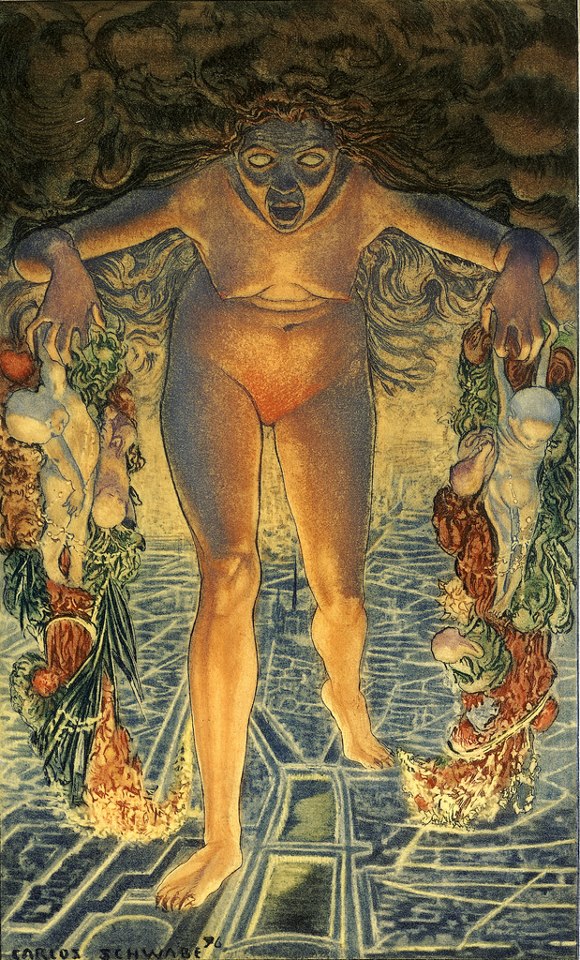
Carlos Schwabe
“Le crépuscule du soir”
from Fleurs du Mal (1900)


This poem is from Baudelaire’s 1861 masterpiece, Les Fleurs du Mal (read the original French, as well as two more, quite divergent, translations HERE):

Evening Twilight

Delightful evening, partner of the crook,
Steals in, wolf-padded, like a complice: look:
Heaven, like a garret, closes to the day,
And Man, impatient, turns a beast of prey.

Sweet evening, loved by those whose arms can tell,
Without a lie, “Today we’ve laboured well:”
Sweet evening, it is she who brings relief
To men with souls devoured by one fierce grief,
Obstinate thinkers drowsy in the head,
And toil-bent workmen groping to their bed.

But insalubrious demons of the airs,
Like business people, wake to their affairs
And, flying, knock, like bats, on walls and shutters.
Now Prostitution lights up in the gutters
Across the glimmering jets the wind torments.
Like a huge ant-hive it unseals its vents.
On every side it weaves its hidden tracks
Like enemies preparing night-attacks.
It squirms within the City’s breast of mire,
A worm that steals the food that men desire.

One hears the kitchens hissing here and there,
Operas squealing, orchestras ablare.
Cheap tables d’hôte, where gaming lights the eyes,
Fill up with whores, and sharpers, their allies:
And thieves, whose office knows no truce nor rest,
Will shortly now start working, too, with zest,
Gently unhinging doors and forcing tills,
To live some days and buy their sweethearts frills.

Collect yourself, my soul, in this grave hour
And shut your ears against the din and stour.
It is the hour when sick men’s pains increase.
Death grips them by the throat, and soon they cease
Their destined task, to find the common pit.
The ward is filled with sighings. Out of it
Not all return the scented soup to taste,
Warm at the hearthside, by some loved-one placed.

But then how few among them can recall
Joys of the hearth, or ever lived at all!

— translated by Roy Campbell, Poems of Baudelaire (New York: Pantheon Books, 1952)

egghead (2004)

I sleep with one eye open, so I can see them coming.
I can’t get away, but at least I can see them coming and steel myself.
Ideas like bunnies fuck me in my bed.

Sometimes they bounce in uninvited, coquettish, and it’s almost fun. They keep me up till morning. I writhe, giggle hysterically, chase them pillow to post. Fluff tickles, a humid sneeze, and I’m knocked up, swelling anaphylactically. On colder nights I’m gang-raped, tied down and stabbed, bloating with high-pressure jets of rabid spores.

However it happens, the thoughts germinate in swarms, another and another and another sprouting.

I’m weepy again. Exhausted.
I don’t want the mutants that grow from these unions. I wish there was a contraceptive. A chastity belt. Anything to stop this brood, to render my imagination infertile. The pills are useless.

I can feel my chemistry changing inexorably as the cells divide. Thalidomide embryos kick with vestigial limbs, opposable pink stubs. Leprous digits dropping off and repropagating like mitotic cacti. Opaque eyes, squamous ear buds, mouths filmed over with milky membrane. Foreheads bulging with gestating thoughts trapped in undifferentiated tissue, crying out restlessly in underwater bubbles before they can even breathe. They’re so ugly!
Fruitless and multiplying.
I have to abort them all.
Distended oxygen thieves.
They mustn’t breathe.
They mustn’t breed.
Halt the assembly line!

I wish I could give these little niggling creations a chance, the benefit of my doubt. Wish I were able to carry them to term, to quietly, patiently allow them to ripen inside me till they could live by themselves. If only human nature could be allowed to take its organicky course… I cry for their inchoateness as I spew them out. It seems such a pity that I’m allergic to them.
Yes, they’re poisoning me.
Yes, I make myself sick.
Yellow serum oozes the truth of what I’m doing. I’m bleeding inside, putrescing slowly.

Maybe I’ve succeeded this time in gouging free? I wonder every time if what I’ve done will make me barren.
But no, the root won’t be cauterised. I still malfunction just fine afterwards. Each time I pick at the raw scab over the umbilical entrance, each time I lance the pus, another swelling surfaces elsewhere, ballooning mercilessly with the filth that I’m never able to excise completely, swimming with stillborn nonsense.

I’m leaking rotten discharge out of every opening. I don’t even try to hide the bulimic blurts any more. Everyone knows. I can’t stay home ALL the time. I’ve become inured to their “Shut up!” “Shut up!”… I like to believe they’d be more sympathetic if only they understood the advanced state of septicaemia I’m living with. Then again, no one likes someone else’s bloody vomit on their shoes I s’pose… They recoil, grimaces masked with grins.

I smile beatifically.

Plop!

Another black clot of afterthought.

Malformed.
Malignant.
It smells disgusting.
And oh, the cramp!

The nausea rises, throbbing.

Heave. Swallow. Metallic post-nasal drip.

Rises again…
I can’t down another millilitre of this bloody mucus, eat one more word.

BLAAAAAAAAAAAAAAAAAHAHAHAHA

Sorry.
I’ll go home now.

Lock the door.

Lie down. Palms up.

Oh it’s quiet.

Teeth chattering.
SHUT UP!

Baby talk.
Stupidness.

Stupor.

Smooth and cool… So serene. So sterile for a few moments.
But the sweet stench is creeping back. I turn on my side, hug my legs up to my chest. And my cheek is wet with the dark patch spreading on my sheets. Squirming with infection, with congealing dread. I scrub and scrub, but the stain is under my nails.
So? I’ll paint them vamp red then.

I click on the hundred-watt bulb, swinging futile against the darkness, awaiting the cuddly incubi’s return. I can hear them breathing behind the curtains.

First published at http://www.africans.co.za, april 22, 2004

kahlil gibran to mary haskell (1908)

October 2, 1908
14 Avenue du Maine
Paris

My dear Mary – I had a long rest in the country with Syrian friends, a rich man with a great heart and a woman with both a beautiful soul and face. They both love poetry and poets. The town in which they live is like a large garden divided into little gardens by narrow paths. From a distance the houses with red roofs look like a handful of corals scattered on a piece of green velvet.

I am painting, or I am learning how to paint. It will take me a long time to paint as I want to, but it is beautiful to feel the growth of one’s own vision of things. There are times when I leave work with the feelings of a child who is put to bed early. Do you not remember, dear Mary, my telling you that I understand people and things through my sense of hearing, and that *sound* comes first to my soul? Now, dear Mary, I am beginning to understand things and people through my eyes. My memory seems to keep the shapes and colours of personalities and objects…

… It is almost midnight. The woman with the sweet voice, in the opposite studio, is no longer singing her sad Russian songs. The silence is profound. Good night, dear Mary. A thousand good nights from
Kahlil

November 8, 1908
Paris

When I am unhappy, dear Mary, I read your letters. When the mist overwhelms the “I” in me, I take two or three letters out of the little box and reread them. They remind me of my true self. They make me overlook all that is not high and beautiful in life. Each and every one of us must have a resting place somewhere. The resting place of my soul is a beautiful grove where my knowledge of you lives.

And now, I am wrestling with colour: The strife is terrible, one of us must triumph! I can almost hear you saying, “And what about drawing, Kahlil?” and Kahlil, with a thirst in his voice says, “Let me, O let me bathe my soul in colours; let me swallow the sunset and drink the rainbow.”

The professors in the academy say, “Do not make the model more beautiful than she is,” and my soul whispers, “O if you could only paint the model as beautiful as she really is.” Now what shall I do, dear Mary? Shall I please the professors or my soul? The dear old men know a great deal, but the soul is much nearer.

It is rather late, and I shall go to bed now, with many thoughts in my heart. Good night, dear Mary. God bless you always.
Kahlil

From Beloved Prophet – the love letters of Kahlil Gibran & Mary Haskell (1972)

on diotima

An excerpt from Joshua Billings’ paper entitled Hyperion’s symposium: an erotics of reception.
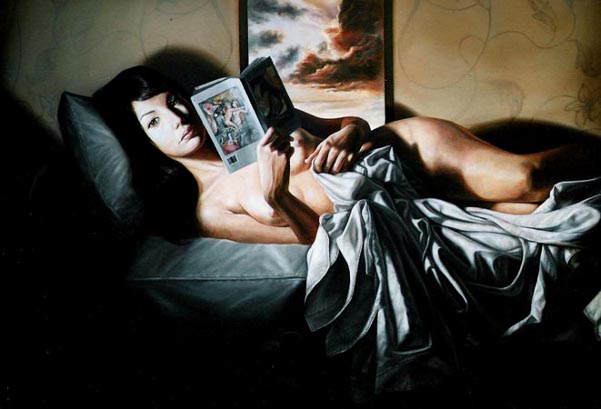
El Crepúsculo de Diotima
Ricardo Celma (1975, Argentina)

Diotima of Mantinea is a present absence in Plato’s Symposium. Her words form the most important of the symposium’s encomia to Eros, but she does not speak them herself. Socrates, her former pupil, relates her lesson in erotics to the assembly. She remains a mysterious figure: her name — ‘honoured by god’ — and her city, cognate with mantis, place her somewhere between human and divinity. Though the main narrative of the Symposium is doubly framed — it records the words of Apollodorus who recounts what he heard from Aristodemus — Diotima is still further removed from the literary present. She exists (if she exists at all) as a liminal, ambiguous being. But this is appropriate to her subject: Eros, a god characterized by perpetual incompleteness.

The Diotima of Friedrich Hölderlin’s Hyperion or the Hermit in Greece (Hyperion oder der Eremit in Griechenland), too, seems poised between being and non-being. As the title character’s beloved, her existence forms the hinge of the entire narrative, yet the pages in which she appears are relatively few and in them, she is most often passive and silent. Most formative for Hyperion, indeed, is her seemingly unmotivated death, reported at second-hand. The form of the novel, a series of retrospective letters from Hyperion, serves to heighten her absence just as the Symposium’s framing places its narrative in a doubly-remembered past. Hölderlin’s Diotima, like Plato’s, exists in eternal mediation, suggesting that Hyperion’s desire cannot be fulfilled, his ideal never realized.

This is the lesson of Diotima in the Symposium. In contrast to the previous speakers, Socrates emphasizes not the positive qualities of Eros, but the poverty that drives the god to seek beauties he does not possess. Socrates reports the speech of Diotima, who disabused him of the notion advocated by his friends. The Eros described by Diotima is liminal, neither beautiful nor ugly, and neither man nor god. He is a daimôn, whose existence is defined by his place between opposing realms. His power is

… interpreting and carrying to gods things from humans, and to humans things from gods: from humans, the entreaties and sacrifices; from gods, orders and exchanges for sacrifices. He is in the middle of both and fills the space between, so that all is bound by him. 

Eros is always relational, a mediation between two elements. This is a consequence of his birth, as the child of Penia and Poros, need and resource. Like his mother, he is unattractive and perpetually impoverished, yet he has the skills of his father that allow him occasionally to attain his desire. This makes him a paradox, poor but able to become rich, immortal but able to die: ‘sometimes he flourishes for a day and lives, whenever he has resources, and sometimes he dies, but is brought back to life again through the nature of his father.’ Eros is not a happy medium of his two parents, but an unstable oscillation between states of euporia and aporia.

Eros’ dialectical nature makes him philosophical, and distinguishes him from his parents. Those who are wise (like Poros) feel no need to philosophize, while those who are ignorant (like Penia) cannot comprehend their need. Eros’s philosophical nature is based on reflection; it results from the recognition of his own ignorance. Philosophy is a state of intellectual poverty that uses resource to gain insight:

Being a philosopher he is between a wise man and an ignorant. The cause of this is his birth: for he is from a wise and resourceful [euporos] father, and an unwise and unresourceful [aporos] mother. 

Socratic philosophy and erotic desire are parallel; both begin in a state of reflective aporia and strive towards euporia. Socrates’s self-conscious ignorance makes him the exemplary erotic seeker. In this respect, it is particularly important that the figure of Diotima is absent in the dialogue: erotic and philosophical fulfilments are deferred, set off in a mysterious past. Furthermore, Socrates (like the speakers who frame the story) is simply repeating an earlier conversation rather than engaging in his usual dialectics. What remains for the symposiasts as for the reader of the Symposium is a mediated presence that relates knowledge without being able to answer for it.

El Crepúsculo de Diotima
Ricardo Celma (1975, Argentina)

The connection of philosophy and desire suggests a productive nature of Eros, a way it escapes the constant oscillation between want and fleeting fulfilment. As we have already learned, Eros is unable to possess what it desires permanently. Instead of possession of the beautiful, Eros seeks to reproduce with the beautiful:

– Eros, Socrates, she said, is not of the beautiful, as you think.

– But what then?

– Of begetting and bringing forth on the beautiful.

– Let it be so, I said.

– It is so absolutely, she said. And why is it of begetting? Because begetting is eternal and undying as far as it is possible for a mortal. From what we have agreed, it is necessary that with good one desire immortality, if indeed eros is of the good being one’s own always. It is necessary from this very account that eros be also of immortality.

The account of Eros’ activity here changes abruptly: Eros finds a way out of lack, to a creative activity. This also necessitates a redefinition of Eros as desire, not for the beautiful or the good, but for an eternal existence. In place of possession, Eros turns to production. This is the crux on which Hölderlin’s reading of the Symposium will focus, as nostalgia for a lost ideal is transformed into the realization of future possibility. This dynamic constitutes what might be termed an ‘erotics of reception’.

Desire, according to Socrates, necessarily turns from the transient present towards an infinite future. In reporting Diotima’s words, Socrates enacts this temporal reorientation, making her absence the basis for philosophical production. He leads his companions, as erotic desire leads the philosopher, on the ascent to higher forms of beauty, and ultimately, to the idea. This is an increasingly contemplative act, in which desire for a beautiful body yields to desire for a beautiful soul, and ultimately, to knowledge of the essence of beauty:

Beginning from these very beauties, for the sake of that highest beauty he ascends eternally, just as if employing the rungs of a ladder, from one to two, and from two to all beautiful bodies; from beautiful bodies he proceeds to beautiful pursuits, from pursuits to beautiful sciences, and from these sciences arrives at that science which is concerned with the beautiful itself and nothing else, so that finally he comes to know what the beautiful is. 

The end of Eros is philosophical fulfilment, conceived as a reflection on immortal beauty. The ascent to the eternal form is parallel to the immortality of giving birth: both begin with a pregnancy of the soul that seeks a beautiful object. From the aporia of mortal bodies, philosophy fashions the euporia of wisdom. The figure of Diotima, an absence that produces knowledge, represents this progress to fulfilment through loss. In the Symposium, as in Hyperion, Diotima’s very pastness makes her the object of an erotic dialectic.
Read Joshua Billings’ whole paper, entitled  Hyperion’s symposium: an erotics of receptionOxford Classical Receptions Journal (2010) 2 (1): 4-24.

friedrich hölderlin – out for a walk

The margins of the forest are beautiful,
as if painted onto the green slopes.
I walk around, and sweet peace
rewards me for the thorns
in my heart, when the mind has grown
dark, for right from the start
art and thinking have cost it pain.
There are lovely pictures in the valley,
for example the gardens and trees,
and the narrow footbridge, and the brook,
hardly visible. How beautifully
the landscape shines, cheerfully distant,
like a splendid picture, where I come
to visit when the weather is mild.
A kindly divinity leads us on at first
with blue, then prepares clouds,
shaped like gray domes, with
searing lightning and rolling thunder,
then comes the loveliness of the fields,
and beauty wells forth from
the source of the primal image.

on friedrich hölderlin’s “hyperion”

Hölderlin’s work, like Celan’s after him, is a practice of creating the universality of music out of the treacherous medium of words. The frisson of this practice is an impossible, and irresistible, place to live and die. Like Orpheus, Hyperion keeps looking back. And like Orpheus, Hölderlin the poet relives the moment of his lost love in a melodious, maddening loop.

~ Elizabeth Bachner, on Hyperion by Friedrich Hölderlin. Read her whole review HERE.