The Detroit garage band the Pleasure Seekers originally comprised sisters Suzi, Patti, and Arlene Quatro, the daughters of jazz musician Art Quatro. The group started while the siblings were all still in their teens. They quickly transcended novelty status by writing their own material and playing their own instruments, and made their debut in 1966 with the local hit “Never Thought You’d Leave Me,” released on the Hideout label (the recording arm of the local teen club where Suzi reportedly worked as a counter clerk). A year later they jumped to Mercury for “Light of Love.” Eldest sister Arlene soon exited the Pleasure Seekers to begin a family — among her children was actress Sherilyn Fenn, best known for her work in the TV cult series Twin Peaks — and was replaced by another Quatro sister, Nancy. Throughout the remainder of the decade the band toured relentlessly, even appearing at a USO showcase at the peak of the Vietnam War, but mainstream success continued to elude them. Around 1969, the Pleasure Seekers rechristened themselves Cradle, a move which also heralded a harder-edged sound. By the early ’70s, however, the trio disbanded, with Suzi going on to fame as a solo performer while Patti joined the California band Fanny (info from allmusic.com).
Category Archives: dance
nobunny – blow dumb
I like it,that its a;velvet underground ripoff,but its not annoying..i love this song
shocking! the real purpose of your life!
And you thought you knew! Produced by Trey Parker and Matt Stone.
music for its own sake
“Life is like music for its own sake. We are living in an eternal now, and when we listen to music, we are not listening to the past, we are not listening to the future, we are listening to an expanded present.”
“The only way to make sense out of change is to plunge into it, move with it, and join the dance.”
~ Alan Watts
“unbound” tonight at greatmore studios’ 2012 showcase
Fleurmach highly recommends that you check out Greatmore Studios‘ Showcase 2012, particularly tonight’s live improvisational performance, entitled ‘Unbound’. Don’t miss this once-off collaboration, involving sound by musicians Alex Bozas, Garth Erasmus and Niklas Zimmer, dance by Jacki Job and photography of the performance projected live by Noncedo Gxekwa.
When? Wednesday 28 November (TONIGHT!). Doors open 18h00. Live performance commences 18h30.
Where? 47-49 Greatmore St, Woodstock, Cape Town. Map HERE.
The live performance will accompany an extensive exhibition by resident artists, visiting artists and guests, which promises to be really worthwhile. More info HERE.

Greatmore Studios is an artist-run initiative based in Cape Town. It revolves around a pool of permanent artists, an international visiting-artists-in-residency programme and a range of workshops and other activities. This initiative forms part of the Triangle Arts Trust, a United Kingdom-based organisation that facilitates an international network of artist-led workshops and residencies. This association affords artists access to information and opportunities to exchange ideas and skills with other artists around the world.
tiqqun – la congiura sacra – san francisco bay blues
Tiqqun – La Congiura Sacra – Operation Acephale 2 – San Francisco Bay Blues
midnight
dance!
bodies
lamentation – martha graham
“As though you were stretching inside your own skin…”
Choreography: Martha Graham
Music by: Zoltan Kodaly
Danced by: Peggy Lyman
Created in 1930, filmed in 1976.
Martha Graham Dance Company
kate bush – wuthering heights
Official music video (version 1) for the single “Wuthering Heights” – Kate’s debut single. Released in January 1978, it became a No.1 hit in the UK singles chart and remains Kate’s biggest-selling single. The song appears on Kate’s 1978 debut album, The Kick Inside, and was also re-recorded in 1986 for the greatest-hits album The Whole Story.
infinite body collapse
Screening of new video delay works by Alex Carpenter with dancer Alexis Maxwell
Perhaps ghosts don’t exist “between” normal points of focus, but reside at the core of these points. The essence of things lies within the things, not somewhere else. We don’t need to make the things softer and more delicate, just because we imagine an essence that is itself soft and delicate. If anything, we need to make the things LOUDER, MORE forceful, MORE singular. Maybe then, once our perception tires of the surface layers, becomes exhausted, we will at last see the fragile core that has always eluded us.
“Infinite Body Collapse” is a collection of new works by Alex Carpenter, drawn from recent video delay sessions with dancer Alexis Maxwell, as well as audio delay recordings made this summer in an allegedly haunted house in Alexandria, Virginia.
Through Alex’s video delay system, performed actions (danced, drawn, light-operated) are captured and layered continuously upon playback with previous cyclical generations, providing material for the performer to build on in a largely “unthinking” way. The system engages the performer in a focused, ecstatic process of observing and responding, as normal points of focus are saturated, obliterated, and a space is cleared for the unfolding of activity on a different scale.
This excerpt demonstrates perfectly how the best video delay material is built – with an emphasis on potential within the material, rather than a creator’s plan realized “through” material. This is not “composition”, it is excavation – a digging through to something normally invisible…
Microscope Gallery
4 Charles Place, Brooklyn
Saturday October 6th, 7pm ($6)
marie chouinard compagnie – bODY_rEMIX/gOLDBERG_vARIATIONS
An astonishing piece, created for the Venice Biennale’s International Festival of Contemporary Dance, Italy, 2005 by Canadian dancer, choreographer and dance company director Marie Chouinard, OC (born 14 May 1955). Some excerpts from the performance at Place des Arts, Montreal, 2007:
In this work by Marie Chouinard, the company’s ten dancers execute variations on the exercise of freedom. Often, the dancers appear on points: on one, two, and even four at a time. In a spectroscopy of the gesture, we also see them using different devices – crutches, rope, prostheses, horizontal bars, and harnesses – which at times liberate their movements, at others fetter it, and at still others create it.
This use of accessories gives rise to unusual bodily shapes and gestural dynamics and opens onto a universe of meticulous and playful explorations in which solos, duos, trios and group work, in their labour, pleasure and invention, echo the human condition.
An aesthete beyond norms, Marie Chouinard presents her ideas on the way the indefinableness of the Other and the flagrancy of Beauty brush up against one another through an interpretation of Johann Sebastian Bach’s Goldberg Variations. Subtle and extravagant, sumptuous and wild, the work’s movements plumb the insoluble mystery of the body, of the living being.
bruce lee on expression
On fighting, on self-knowledge, on honest expression, on balance… such an articulate man. “Be water, my friend.”
martha graham – frontier
”I took the puppet, which was myself, and I flung it against the sky. Because light is such a magical, magical thing. See, a bird never flies into the dark, who is built for the light.”
From the Nonesuch Dance Collection.
1976 recording
Introduction by Martha Graham.
Choreography by Martha Graham.
Performed by The Martha Graham Dance Company.
helgé janssen – what stands between this and that? (2010)
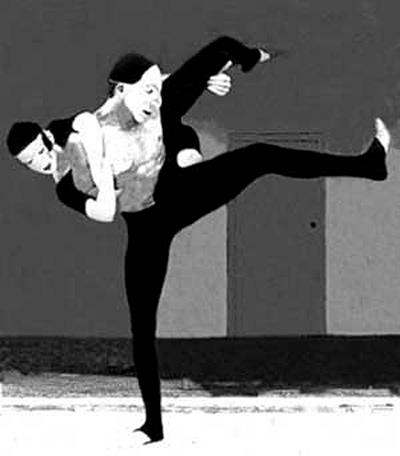
“CATALYST” – masked dance movement piece
Helgé Janssen/Gisele Stafford, Durban beachfront, 1984
Photograph: Peter Hart-Davies
what stands between this and that?
what stands between this and that?
what stands between this and that?
a look?
a glance?
a second fact?
a psychology?
an ideology?
a whim?
a schism?
a hollow dream?
a friend who intervenes?
a plissé
that would rather be
ironed out flat?
what stands between this and that?
what stands between this and that?
what stands between this and that?
a denial?
a pyre?
a burning sphere?
a time?
a place?
a thwarted mess?
a second guess?
a stall for time
that saves you grace?
a space between
a furtive glimpse?
a risk not worth taking?
what stands between this and that?
what stands between this and that?
what stands between this and that?
life as a rehearsal?
a chance to forget?
another escape?
the art of make-up?
a drowning of sorrows?
an always tomorrow?
a never yesterday?
somebody’s off day?
the centre lost?
the plot in recess?
just another day
without redress?
is this a life or just a mistake?
is this a life or just a mistake?
is this a life or just a mistake?
Thanks to Helgé for sharing this poem. Keep abreast of what this multi-talented and influential Durban artist has up his next immaculately designed sleeve HERE.
martha graham on artists (in a letter to agnes de mille)
“there is a vitality, a life force, a quickening that is translated through you into action, and because there is only one of you in all time, this expression is unique. and if you block it, it will never exist through any other medium, and will be lost. the world will not have it. it is not your business to determine how good it is, nor how valuable it is, nor how it compares with other expressions. it’s your business to keep it yours clearly and directly, to keep the channel open.
you do not even have to believe in yourself or your work. you have to keep open and aware directly to the urges that motivate you. keep the channel open. no artist is pleased. there is no satisfaction whatever at any time. there is only a queer, divine dissatisfaction, a blessed unrest that keeps us marching and makes us more alive than the others.”
from http://kagablog.com/
moon and flying snow
Beautiful fight scene between Moon (Zhang Ziyi) and Flying Snow (Maggie Cheung) in the yellow forest from the extended version of the movie “Hero”
Hero was first released in China on October 24, 2002. At that time, it was the most expensive project and the highest-grossing motion picture in Chinese film history.
sonics – the witch (1964)
federico garcia lorca – the passing stage of the siguiriya
Among black butterflies
goes a dark-haired girl
next to a white serpent
of mist.
Earth of light,
sky of earth.
She is chained to the tremor
of a never arriving rhythm;
she has a heart of silver
and a dagger in her right hand.
Where are you going, siguiriya,
with such a headless rhythm?
What moon’ll gather up your pain
of whitewash and oleander?
Earth of light,
sky of earth.
(translated by Ralph Angel)
La Seguiriya – A flamenco form with a mixed compás – combining 3/4 and 6/8 time (a feature that drives music experts to despair). The seguiriya takes its name from the Castilian ‘seguidilla’, a musical style to which it is related, literarily at least. It is considered the quintessential style of ‘cante jondo’, for its solemnity, the minimalism of the lyric, and the wailing ‘quejío’ associated with vocal performances.
“The Gypsy siguiriya had always evoked for me (an incurable lyricist) the endless road, one without crossroads, which ends at the pulsating fountain of the girl-child, poetry, the road where the first bird died and the first arrow rusted.
The Gypsy siguiriya begins with a dreadful cry, a cry that divides the landscape into two perfect hemispheres. It is the cry of dead generations, a poignant elegy for vanished centuries, the evocation of love filled with pathos beneath other winds and other moons.”
Read the text of a fascinating lecture by Lorca on the historical and artistic significance of Canto Jondo (“deep song”) HERE.
 fleurmach