” you are a night bird, moving after dark from bar to bar.”
” you are a night bird, moving after dark from bar to bar.”
“Well, I could liken you to a werewolf, the way you left me for dead, but I admit that I provided a full moon.
And I could liken you to a shark, the way you bit off my head, but then again I was waving around a bleeding, open wound.”
From The Idler Wheel Is Wiser Than The Driver of The Screw, And Whipping Cords Will Serve You More Than Ropes Will Ever Do (2012) – Fiona Apple/Epic Records.
Sinead O’Connor’s Nirvana cover on Dutch TV, 15 October 1995.
I left a trail of myself every place that I have been through,
And going bald is the most manly thing that I’m ever gonna do.
I tell the earth, “thanks for the hair, thanks for the skin, thanks for the bone”,
Though I now slowly give it back I still appreciate the loan.
Just tell me that you like me in the same sentence as a mountain side.
‘Cause it would be such a relief to be objectified.
‘Cause who says it’s so important to sort through these thoughts of ours.
Maybe that’s why we love to try to see ourselves from the outside
In photographs and videos and diaries and mirrors.
‘Cause it would be such a relief to be objectified.
And the closest that I ever got still seems to leave a lot to go,
But the horizon seems to be a place that nobody can know.
Looking forth and looking back, our vision can’t extend beyond the quaint vanishing points our bodies recommend,
And I’ll help you move some furniture somewhere it’s never been before, but the room’s so small the dresser drawer won’t let us get back out the door.
Just tell me that you like me in the same sentence as the building.
It would be such a relief to see…
I’m just a natural thing.
We’re only boats,
And the boats are only empty
And you can’t blame an empty boat that’s on a river to the sea.
You can’t blame a billion boats without a sail, without a sailor.
And that’s how we look in photographs, and diaries, and mirrors.
And the plants turn into ants, and the ants turn into plants,
And children are clumsy people, and old people are rotting children.
And I still don’t have a cell phone, but this sea shell gets reception,
And the ocean won’t stop calling, and I want a restraining order.
Just tell me that you like me in the same sentence as a building.
It would be such a relief to see I’m just a natural thing.
We’re just a natural thing.
Just like anything.
Everything posted today has been HEAVY, so I thought I’d offer a bit of light relief: Derrick Harriott… light as a cheese puff! ;)
An astonishing piece, created for the Venice Biennale’s International Festival of Contemporary Dance, Italy, 2005 by Canadian dancer, choreographer and dance company director Marie Chouinard, OC (born 14 May 1955). Some excerpts from the performance at Place des Arts, Montreal, 2007:
In this work by Marie Chouinard, the company’s ten dancers execute variations on the exercise of freedom. Often, the dancers appear on points: on one, two, and even four at a time. In a spectroscopy of the gesture, we also see them using different devices – crutches, rope, prostheses, horizontal bars, and harnesses – which at times liberate their movements, at others fetter it, and at still others create it.
This use of accessories gives rise to unusual bodily shapes and gestural dynamics and opens onto a universe of meticulous and playful explorations in which solos, duos, trios and group work, in their labour, pleasure and invention, echo the human condition.
An aesthete beyond norms, Marie Chouinard presents her ideas on the way the indefinableness of the Other and the flagrancy of Beauty brush up against one another through an interpretation of Johann Sebastian Bach’s Goldberg Variations. Subtle and extravagant, sumptuous and wild, the work’s movements plumb the insoluble mystery of the body, of the living being.
“Can’t seem to stop the bleeding; my skin is too thin…”
 From time to time a local artist sans record label will come in with a self-released album that blows us away. This is one of those times! Ella Joyce Buckley is a native of South Africa now based in Brooklyn, and the music on her lovely hand-made CD, Blood Finds No Sea, is an enthralling example of how much more a songwriter can be than just a person with songs and an instrument. Existing equally in the acoustic (as in, played instruments — a range of them) and electronic, Blood Finds No Sea is dramatic, intense and, in the most luminous way, Goth as hell. You can imagine her right at home on 4AD in the mid-’80s, when Cocteau Twins and Dead Can Dance were mixing shimmeringly bright colors into darkness (and elsewhere, Danielle Dax was at her best). With vast creativity, Buckley manipulates her gorgeous vocals into choirs, housefuls of spirits even, while strings both plucked and bowed ebb and swell, and keys poke holes in the darkness. The title track spires upward, like Tolkien’s elvish national anthem (oh, just indulge me), with Buckley’s double-tracked vox fixed in place while the music ascends around her. “Sister” features Buckley’s most extravagant vocal, with a plucked violin (I think?) leading into a howling mix of percussion and electronics. Buckley’s arranging skills are advanced — you could easily picture her scoring theater works (besides films), and perhaps she already does. For now, there is this CD, and it comes highly recommended.
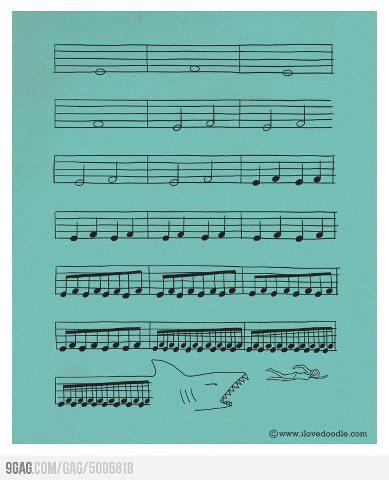 One of 9GAG’s funnier moments.
For Liepollo… Hamba kahle, sana. xx
“The main theme [of what we do] is expanding musical structures to a point where you can’t tell the difference anymore between music and not-music, or expanded to a point where it doesn’t make any difference anymore to you if it is music or not… It’s not going to be simplified into something like simple “destruction”. We don’t want anyone to come to the concerts just to see us destroying something. If we feel an attitude like that coming up we just get in a bad mood!”
Ah, Blixa, you lovely creature!
I
Just as my fingers on these keys
Make music, so the self-same sounds
On my spirit make a music, too.
Music is feeling, then, not sound;
And thus it is that what I feel,
Here in this room, desiring you,
Thinking of your blue-shadowed silk,
Is music. It is like the strain
Waked in the elders by Susanna;
Of a green evening, clear and warm,
She bathed in her still garden, while
The red-eyed elders, watching, felt
The basses of their beings throb
In witching chords, and their thin blood
Pulse pizzicati of Hosanna.
II
In the green water, clear and warm,
Susanna lay.
She searched
The touch of springs,
And found
Concealed imaginings.
She sighed,
For so much melody.
Upon the bank, she stood
In the cool
Of spent emotions.
She felt, among the leaves,
The dew
Of old devotions.
She walked upon the grass,
Still quavering.
The winds were like her maids,
On timid feet,
Fetching her woven scarves,
Yet wavering.
A breath upon her hand
Muted the night.
She turned —
A cymbal crashed,
Amid roaring horns.
III
Soon, with a noise like tambourines,
Came her attendant Byzantines.
They wondered why Susanna cried
Against the elders by her side;
And as they whispered, the refrain
Was like a willow swept by rain.
Anon, their lamps’ uplifted flame
Revealed Susanna and her shame.
And then, the simpering Byzantines
Fled, with a noise like tambourines.
IV
Beauty is momentary in the mind —
The fitful tracing of a portal;
But in the flesh it is immortal.
The body dies; the body’s beauty lives.
So evenings die, in their green going,
A wave, interminably flowing.
So gardens die, their meek breath scenting
The cowl of winter, done repenting.
So maidens die, to the auroral
Celebration of a maiden’s choral.
Susanna’s music touched the bawdy strings
Of those white elders; but, escaping,
Left only Death’s ironic scraping.
Now, in its immortality, it plays
On the clear viol of her memory,
And makes a constant sacrament of praise.
Some insightful stuff written about this poem is to be found HERE.
From his first album, Five Leaves Left, 1969.
Off their EP End of Daze – more HERE.
Buy it HERE.
The difference between Cohen and Dylan: whereas Dylan’s act is somewhat fabricated, a persona, there is no pretension in Cohen. He is himself, beautifully. Modest and plain.
Oh, please don’t give me that!
Yes, I’m a witch,
I’m a bitch
I don’t care what you say,
My voice is real.
My voice speaks truth,
I don’t fit in your ways.
I’m not gonna die for you,
You might as well face the truth,
I’m gonna stick around for quite awhile.
We’re gonna say,
We’re gonna try,
We’re gonna try it our way.
We’ve been repressed,
We’ve been depressed,
Suppression all the way.
We’re not gonna die for you,
We’re not seeking vengeance,
But we’re not gonna kill ourselves for your convenience.
Each time we don’t say what we wanna say, we’re dying.
Each time we close our minds to how we feel, we’re dying.
Each time we gotta do what we wanna do, we’re living.
Each time were open to what we see and hear, we’re living.
We’ll free you from the ghettos of your minds,
We’ll free you from your fears and binds,
We know you want things to stay as it is,
It’s gonna change, baby.
It’s gonna change, baby doll,
It’s gonna change, honey ball,
It’s gonna change, sugar cane,
It’s gonna change, sweetie legs.
So don’t try to make cock-pecked people out of us.
More HERE.

Janis Joplin live in Stockholm, Sweden, 1969.
A haunting 1959 field recording by folklorist Dr. Harry Oster of a prison worksong from Angola State Penitentiary in Lousiana: inmate Odea Mathews, accompanied only by the whirr of her sewing machine. You can find more information and purchase this recording HERE.
Along with Niklas, I attended a fascinating workshop at UCT last month – these are his reflections:
From August 22 to 24 this year, the Archive and Public Culture research initiative hosted a workshop, led by research fellow Dr Anette Hoffmann, under the title ‘sound/archive/voice/object.’ True to the trans-disciplinary spirit of APC, the range of academic positions present was heterogeneous, but beyond that, this workshop attracted a significant set of participants from beyond the institution: over three days in the much-loved Jon Berndt thought space, the voices of radio activism, sound art, turntablism and composition for film and theatre cross-faded with those of ethnomusicology, social anthropology, fine art and historical studies.
Dr Hoffmann’s carefully staged set of daily readings, gentle chairing and inspiring listening experiences of samples of ethnographic phonograph-recordings from Berlin’s Lautarchiv enabled us to begin thinking through the subject of sound in all its complexity. While ‘visual culture’ with its associated tropes has become commonplace, the same cannot be said for ‘sonic’ or ‘aural culture’ – the need for understanding sound (historically, psychologically, physiologically, etc.) is immanent, particularly when dealing with records of human subject research in the archive.
‘… sound is a product of the human senses and not a thing in the world apart from humans. Sound is a little piece of the vibrating world.’ (Jonathan Sterne)
As with other investigations into reproduction technologies developed in the 19th century (such as photography), a detailed understanding of the political, scientific and cultural drives that gave birth to them in the first place is key to surfacing relevant, contemporary perspectives on the audio archive. Studies into sound – and in particular the ethnographic voice recording – have so far remained in relative specialist isolation. In contrast to this, studies of visuality – and in particular ethnographic photographic portraiture – have been gaining interdisciplinary popularity. Beyond the misalignments of comparison between the two, and despite the multitude of overlaps between the orders of the eye and the ear, it becomes clear that the realms of the aural (or sonic) and the visual do require different sets of analytical tools.
‘The vocabulary may well distinguish nuances of meaning, but words fail us when we are faced with the intimate shades of the voice, which infinitely exceed meaning. (…) faced with the voice, words structurally fail.’ (Mladen Dolar)
Passive hearing and active listening involve a complex range of affective and cognitive processes which are incomparable to those associated with any other sense (other than perhaps touch) – any discussion of differences in technology for the capture and representation of aural as opposed to visual phenomena can only be secondary to this. In the shared process of active listening at the beginning of each workshop morning, the group sensed its way into some of the qualities of sound, particularly those of the speaking voice. We discovered that we are able to hear much more than we tend to trust ourselves to. The ethnographic and linguistic phonographic recordings of prisoners of war in WWI Germany from the Humboldt University’s Lautarchiv in Berlin revealed to us as listeners a small, but powerful glimpse into the potential of a different way of working with archival material. Because the transcripts and translations of the recordings were withheld until after the first listening-through, we relied on our own emotional and intellectual inferences in order to engage the questions that these ‘sound objects’ from the past carried into our present space. Listening engages us in a different way of knowing, as Dr Hoffmann pointed out, and ‘if the process of enunciation points at the locus of subjectivity in language, then voice also sustains an intimate link with the very notion of the subject.’ (Mladen Dolar)
Generally, the bigger paradigm of any research interest will at first tend towards sacrificing the individual voice to generalisation and dissection rather than a ‘regime of care’ as Prof Hamilton would remind us: sounds, in particular human voices on record are always re-presented in a web of power-relations, some of which are near-impossible to address, let alone shift. This becomes most paradoxical in thinking though the subaltern speaking position in the archive, where not only the act of recording has been an act of violence, but where the act of listening itself can be an act of othering and continued silencing. In view of this (in sound of this?), the best possible approach to reaching the necessary ‘audio condition’ from which to push at the limits of subaltern positionalities in the archive seems to be continuum of analysis, a reverence paid to the minutiae of humanity in the material. This was a recurring moment, a leitmotiv in our three days of sound studies: only a wide range of disciplines working together can actually achieve the description of the necessary aspects (aesthetic, ethical, cultural, historical, political, psychological) from which to consider a relevant engagement with the archive that sounds.
 fleurmach