From two interviews — Oct. 1983 and Nov. 1985. I find what she had to say particularly resonates with me from 1:47 in.
For more of this kind of stuff, check out Videowave on Facebook – an archive of music and art ignored by mainstream media.
From two interviews — Oct. 1983 and Nov. 1985. I find what she had to say particularly resonates with me from 1:47 in.
For more of this kind of stuff, check out Videowave on Facebook – an archive of music and art ignored by mainstream media.
An excerpt from Joshua Billings’ paper entitled Hyperion’s symposium: an erotics of reception.
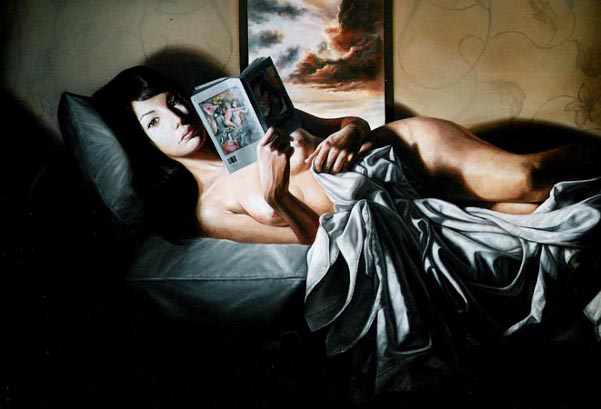
El Crepúsculo de Diotima
Ricardo Celma (1975, Argentina)
Diotima of Mantinea is a present absence in Plato’s Symposium. Her words form the most important of the symposium’s encomia to Eros, but she does not speak them herself. Socrates, her former pupil, relates her lesson in erotics to the assembly. She remains a mysterious figure: her name — ‘honoured by god’ — and her city, cognate with mantis, place her somewhere between human and divinity. Though the main narrative of the Symposium is doubly framed — it records the words of Apollodorus who recounts what he heard from Aristodemus — Diotima is still further removed from the literary present. She exists (if she exists at all) as a liminal, ambiguous being. But this is appropriate to her subject: Eros, a god characterized by perpetual incompleteness.
The Diotima of Friedrich Hölderlin’s Hyperion or the Hermit in Greece (Hyperion oder der Eremit in Griechenland), too, seems poised between being and non-being. As the title character’s beloved, her existence forms the hinge of the entire narrative, yet the pages in which she appears are relatively few and in them, she is most often passive and silent. Most formative for Hyperion, indeed, is her seemingly unmotivated death, reported at second-hand. The form of the novel, a series of retrospective letters from Hyperion, serves to heighten her absence just as the Symposium’s framing places its narrative in a doubly-remembered past. Hölderlin’s Diotima, like Plato’s, exists in eternal mediation, suggesting that Hyperion’s desire cannot be fulfilled, his ideal never realized.
This is the lesson of Diotima in the Symposium. In contrast to the previous speakers, Socrates emphasizes not the positive qualities of Eros, but the poverty that drives the god to seek beauties he does not possess. Socrates reports the speech of Diotima, who disabused him of the notion advocated by his friends. The Eros described by Diotima is liminal, neither beautiful nor ugly, and neither man nor god. He is a daimôn, whose existence is defined by his place between opposing realms. His power is
… interpreting and carrying to gods things from humans, and to humans things from gods: from humans, the entreaties and sacrifices; from gods, orders and exchanges for sacrifices. He is in the middle of both and fills the space between, so that all is bound by him.
Eros is always relational, a mediation between two elements. This is a consequence of his birth, as the child of Penia and Poros, need and resource. Like his mother, he is unattractive and perpetually impoverished, yet he has the skills of his father that allow him occasionally to attain his desire. This makes him a paradox, poor but able to become rich, immortal but able to die: ‘sometimes he flourishes for a day and lives, whenever he has resources, and sometimes he dies, but is brought back to life again through the nature of his father.’ Eros is not a happy medium of his two parents, but an unstable oscillation between states of euporia and aporia.
Eros’ dialectical nature makes him philosophical, and distinguishes him from his parents. Those who are wise (like Poros) feel no need to philosophize, while those who are ignorant (like Penia) cannot comprehend their need. Eros’s philosophical nature is based on reflection; it results from the recognition of his own ignorance. Philosophy is a state of intellectual poverty that uses resource to gain insight:
Being a philosopher he is between a wise man and an ignorant. The cause of this is his birth: for he is from a wise and resourceful [euporos] father, and an unwise and unresourceful [aporos] mother.
Socratic philosophy and erotic desire are parallel; both begin in a state of reflective aporia and strive towards euporia. Socrates’s self-conscious ignorance makes him the exemplary erotic seeker. In this respect, it is particularly important that the figure of Diotima is absent in the dialogue: erotic and philosophical fulfilments are deferred, set off in a mysterious past. Furthermore, Socrates (like the speakers who frame the story) is simply repeating an earlier conversation rather than engaging in his usual dialectics. What remains for the symposiasts as for the reader of the Symposium is a mediated presence that relates knowledge without being able to answer for it.
El Crepúsculo de Diotima
Ricardo Celma (1975, Argentina)
The connection of philosophy and desire suggests a productive nature of Eros, a way it escapes the constant oscillation between want and fleeting fulfilment. As we have already learned, Eros is unable to possess what it desires permanently. Instead of possession of the beautiful, Eros seeks to reproduce with the beautiful:
– Eros, Socrates, she said, is not of the beautiful, as you think.
– But what then?
– Of begetting and bringing forth on the beautiful.– Let it be so, I said.
– It is so absolutely, she said. And why is it of begetting? Because begetting is eternal and undying as far as it is possible for a mortal. From what we have agreed, it is necessary that with good one desire immortality, if indeed eros is of the good being one’s own always. It is necessary from this very account that eros be also of immortality.
The account of Eros’ activity here changes abruptly: Eros finds a way out of lack, to a creative activity. This also necessitates a redefinition of Eros as desire, not for the beautiful or the good, but for an eternal existence. In place of possession, Eros turns to production. This is the crux on which Hölderlin’s reading of the Symposium will focus, as nostalgia for a lost ideal is transformed into the realization of future possibility. This dynamic constitutes what might be termed an ‘erotics of reception’.
Desire, according to Socrates, necessarily turns from the transient present towards an infinite future. In reporting Diotima’s words, Socrates enacts this temporal reorientation, making her absence the basis for philosophical production. He leads his companions, as erotic desire leads the philosopher, on the ascent to higher forms of beauty, and ultimately, to the idea. This is an increasingly contemplative act, in which desire for a beautiful body yields to desire for a beautiful soul, and ultimately, to knowledge of the essence of beauty:
Beginning from these very beauties, for the sake of that highest beauty he ascends eternally, just as if employing the rungs of a ladder, from one to two, and from two to all beautiful bodies; from beautiful bodies he proceeds to beautiful pursuits, from pursuits to beautiful sciences, and from these sciences arrives at that science which is concerned with the beautiful itself and nothing else, so that finally he comes to know what the beautiful is.
The end of Eros is philosophical fulfilment, conceived as a reflection on immortal beauty. The ascent to the eternal form is parallel to the immortality of giving birth: both begin with a pregnancy of the soul that seeks a beautiful object. From the aporia of mortal bodies, philosophy fashions the euporia of wisdom. The figure of Diotima, an absence that produces knowledge, represents this progress to fulfilment through loss. In the Symposium, as in Hyperion, Diotima’s very pastness makes her the object of an erotic dialectic.
Read Joshua Billings’ whole paper, entitled Hyperion’s symposium: an erotics of reception. Oxford Classical Receptions Journal (2010) 2 (1): 4-24.
Hölderlin’s work, like Celan’s after him, is a practice of creating the universality of music out of the treacherous medium of words. The frisson of this practice is an impossible, and irresistible, place to live and die. Like Orpheus, Hyperion keeps looking back. And like Orpheus, Hölderlin the poet relives the moment of his lost love in a melodious, maddening loop.
~ Elizabeth Bachner, on Hyperion by Friedrich Hölderlin. Read her whole review HERE.
I am a woman – quite real – to myself
and all that is most virtual to others
accessible to myself
inaccessible to all the others
what is it that separates me from the others?
the veil of Maya, say some
the unbearable lightness of being, say others
illusions and allusions
there you have it, what protects us, the one and the others
what separates us, the ones from the others
to a friend who insisted on seeing me, I said, “not even in your dreams”
she took it badly and eclipsed herself from my mind
i was mistaken, badly mistaken, I should have told her
in dreams, why not, but not in real life
some hidden meaning… some secret meaning… some sacred meaning…
there you have it, what comprises Mystery
my life and I, we will always be out of reach
intimate intimity
Chimène* or Chimera
since ancient times the emphasis was always on the duplicity of all living things
am I a person or a personality?
real or virtual?
existence or excellence?
that I am Nobody makes my character more enigmatic but at the same time more consistent
it is paradoxical, but all who are tempted by infinity will know what I am saying
will push themselves to question Orpheus anew. He descended into hell to save Eurydice. Imagine the pain he put himself through. No, you can’t imagine, because it is unimaginable. And at the moment of returning to the surface, when he was in front and she behind him, the gods forbade him to turn around until they were both together at the other side of the barrier, on the human side, but Orpheus couldn’t restrain himself; he turned around, and lost Eurydice forever
* literary character signifying obsessive passion
(Thanks to Martin Jacklin for help with this translation. Original text HERE.)
on why we often desire what makes us miserable (to where we often come to regret the good old days of arranged marriages) and on why women don’t say what they think.
13. Within the terrible community, emotional education is based on systematic humiliation, and the pulverization of its members’ self-esteem. No one must be able to believe themselves to be a carrier of that kind of affectivity which would have the right to a place inside the community.The hegemonic type of affectivity inside the terrible community corresponds, paradoxically, to what is seen outside of it as the most backwards form. The tribe, the village, the clan, the gang, the army, the family; these are the human formations universally acknowledged as being the most cruel and the least gratifying, and yet in spite of all they persist within the terrible communities. And in them, women must take on a kind of virility that even males disclaim now in biopolitical democracies, all the while seeing themselves as women whose femininity has lost out to the masculine fantasy dominant at the very heart of the terrible community: the fantasy of plastic “sexy” woman (in the image of the Young-Girl, that carnal envelope) ready for use and consumption by genital sexuality.
14. In the terrible communities, women, because they cannot actually become men, must become like men, while remaining furiously heterosexual and prisoners of the most worn-out stereotypes. If nobody has the right, in the terrible community, to say the truth about human relations, that’s doubly true for women: any woman that undertakes parrhesia within the terrible community will be immediately classed as just some hysteric.
from Tiqqun 2: Theses on the terrible community.
(POST SCRIPTUM)
Everyone knows the terrible communities, whether because they’ve spent some time in them or because they’re still there. Or simply because they’re still stronger than the others, and so some of us have still partly remained in them – while at the same time being outside of them. The family, the school, work, prison – these are the classical faces of this contemporary form of hell, but they are the least interesting because they belong to a bygone depiction of commodity evolution, and are at present merely surviving on. There are some terrible communities, however, that fight against the existing state of things, and that are simultaneously quite attractive and much better than “this world.” And at the same time their way of approximating truth – and thus joy – distances them more than anything else from freedom.
The question that arises for us, in a final manner, is more of an ethical than a political nature, because the classical forms of politics are at the low water-mark, and their categories are leaving us, like the habits of childhood. The question is whether we prefer the possibility of unknown dangers to the certainty of the present misery. That is, whether we want to go on living and talking in accord (in a dissident manner, of course, but always in accord) with what has been done up to now – and thus with the terrible communities – or whether we want to really put to the test that little part of our desires that culture has still not managed to infest with its cumbersome quagmire and try to start out on a different path – in the name of a totally new kind of happiness.
This text was born as a contribution to that new journey.
Read the whole of this publication, translated from the original French, HERE.
“Yes, but what is man, what are men, what are they? I do not say that they haven’t kind hearts, if I fall down in a faint, they will rush to pick me up, if my house is on fire, they will rush in to put the fire out and help me, yes they have kind hearts but they are afraid, afraid, they are afraid, they are afraid. They fear women, they fear each other, they fear their neighbor, they fear other countries and then they hearten themselves in their fear by crowding together and following each other, and when they crowd together and follow each other they are brutes, like animals who stampede, and so they have written in the name male into the United States constitution, because they are afraid of black men because they are afraid of women, because they are afraid afraid. Men are afraid.”
“And women.”
“Ah women often have not any sense of danger, after all a hen screams pitifully when she sees an eagle but she is only afraid for her children, men are afraid for themselves, that is the real difference between men and women.”
“But Susan B, why do you not say these things out loud?”
“I say they are afraid, but if I were to tell them so their kindness would turn to hate. Yes the Quakers are right, they are not afraid because they do not fight, they do not fight.”
“But Susan B. you fight and you are not afraid.”
“I fight and I am not afraid, I fight but I am not afraid.”
“And you will win.”
“Win what, win what?”
I want to learn more and more to see as beautiful what is necessary in things; then I shall be one of those who make things beautiful. Amor fati: let that be my love henceforth! I do not want to wage war against what is ugly. I do not want to accuse; I do not even want to accuse those who accuse. Looking away shall be my only negation. And all in all and on the whole: some day I wish to be only a Yes-sayer.
~ from Die fröhliche Wissenschaft (The Joyful Science)
My formula for greatness in a human being is amor fati: that one wants nothing to be different, not forward, not backward, not in all eternity. Not merely bear what is necessary, still less conceal it—all idealism is mendaciousness in the face of what is necessary—but love it.
~ from Ecce Homo
(translations by Walter Kaufmann)
“Pear Drops were exciting because they had a dangerous taste. All of us were warned against eating them, and the result was that we ate them more than ever.”
~ Roald Dahl
We have left the land and have embarked. We have burned our bridges behind us—indeed, we have gone farther and destroyed the land behind us. Now, little ship, look out! Beside you is the ocean: to be sure, it does not always roar, and at times it lies spread out like silk and gold and reveries of graciousness. But hours will come when you will realize that it is infinite and that there is nothing more awesome than infinity. Oh, the poor bird that felt free and now strikes the walls of this cage! Woe, when you feel homesick for the land as if it had offered more freedom—and there is no longer any “land”.
~ From Friedrich Nietzsche’s Die fröhliche Wissenschaft (The Joyful Science) (1882/1887); translation by Walter Kaufmann.
“All of us exist in a swarming, pulsating world, driven mostly by an unconscious that we ignore and misunderstand. Within the framework of “civilisation” we remain as savage as possible. Against the dense traffic of modern life, we fortify our animal selves with video violence, imaginary sex, and music… but our inflamed and disoriented psyches smoulder on beneath the wet leaves of habit.”
~ from the sleeve notes of Robyn Hitchcock & the Egyptians’ 1988 album, Globe of Frogs.
“The fear of the secret decay of relationships is almost always caused by those involved allegedly or really finding things ‘too hard’. They are too weak in the face of reality, overtaxed by it on all sides, to muster the loving determination to maintain the relationship purely for its own sake. In the realm of utility, every relationship worthy of human beings takes on an aspect of luxury. No one can really afford it, and resentment at this breaks through in critical situations…
“…If the subject is deeply involved while the relationship’s outward aspect prevents him, with good reason, from indulging his impulse, the relation is turned to permanent suffering and thus endangered. The absurd significance of trivia like a missed phone call, a stinted handshake, a hackneyed turn of phrase, springs from their manifesting an inner dynamic otherwise held in check, and threatening the relationship’s objective concreteness. Psychologists may well condemn the fear and shock of such moments as neurotic, pointing out their disproportion to the relationship’s objective weight. Anyone who takes fright so easily is indeed ‘unrealistic’, and in his dependence on the reflexes of his own subjectivity betrays a faulty adjustment.
“Only when one responds to the inflection of another’s voice with despair is the relation as spontaneous as it should be between free people, while yet for that very reason becoming a torment which, moreover, takes on an air of narcissism in its fidelity to the idea of immediacy, its impotent protest against coldheartedness. The neurotic reaction is that which hits on the true state of affairs, while the one adjusted to reality already discounts the relationship as dead. The cleansing of human beings of the murk and impotence of affects is in direct proportion to the advance of dehumanization.”
~ Theodor W. Adorno, Messages in a Bottle

Image: Inflected Landscape by Arlyn Culwick
So, young Death, what could you be?
Even my father’s cancered body
brought me no sightless terror at eternity.
I suspect you have no sting.
Perhaps you, old splinter in the heart of love,
never were more than mirage,
though love would need you –
necessary certain death –
as a nail for a cross,
and cross and nail and Christ and
resurrection
are all love –
the ever-dying eternal life of all.
If so, where would you go,
you much-maligned seed of beginnings?
Youngest purveyor of life,
always exactly zero years old –
ever painted Grim Reaper,
thief of loved ones,
skeletal with age and demon-haunted.
You, unknowable ultimate horizon,
ear-whisperer of the infinite terror of endings,
do not impart any evil
except perhaps deluded dread.
You would go to a greater whole
of which you are inseparably part,
for shapes without space,
age without time,
or nails without crosses,
have no significance.
Thus you, youngest innocent death
are as much your own as the terror of
a darkened room:
mere mirage,
as seemingly all-powerful
as its infinite inscrutable blackness
and the child-fantasy it feeds.
You are love’s very vehicle.
Flesh for sacrifice, in dying,
is meaning-embodied matter –
is substance made significant –
surrendered, emptied, dissolute,
but never for itself, nor for nothing;
always for all,
for everything made sign;
spirit, soul, and soil pervaded
by kindest, complete kenosis,
all-originating, all-resurrecting.
Only silliest oldest humanity,
children trembling sightless in their beds,
give shadows a scythe and empty eye sockets
and forget the bedroom’s sturdy walls.
Check out Arlyn’s blog HERE.
“Avoid contact with all people in whom there is no possible resonance with what touches you most deeply and toward whom you have obligations of “kindness,” of “politeness.”- Laure, Collected writings

Although she wrote little and published almost nothing, Colette Peignot, a.k.a. Laure, is one of the more fascinating and intense women writers of the past century. Georges Bataille and Michel Leiris described her as “one of the most vehement existences [that] ever lived, one of the most conflicted.” They summarized her volatile personality as “[e]ager for affection and for disaster, oscillating between extreme audacity and the most dreadful anguish, as inconceivable on a scale of real beings as a mythical being, she tore herself on the thorns with which she surrounded herself until becoming nothing but a wound, never allowing herself to be confined by anything or anyone.” In other words, Laure was the epitome of what Bataille would dub the “sovereign” individual.
Read more HERE.
From Principia Discordia:
CONVENTIONAL CHAOS – GREYFACE
In the year 1166 B.C., a malcontented hunchbrain by the name of Greyface got it into his head that the universe was as humorless as he, and he began to teach that play was sinful because it contradicted the ways of Serious Order. “Look at all the order around you,” he said. And from that, he deluded honest men to believe that reality was a straightjacket affair and not the happy romance as men had known it.
It is not presently understood why men were so gullible at that particular time, for absolutely no one thought to observe all the disorder around them and conclude just the opposite. But anyway, Greyface and his followers took the game of playing at life more seriously than they took life itself and were known even to destroy other living beings whose ways of life differed from their own.
The unfortunate result of this is that mankind has since been suffering from a psychological and spiritual imbalance. Imbalance causes frustration, and frustration causes fear. And fear makes for a bad trip. Man has been on a bad trip for a long time now.
It is called THE CURSE OF GREYFACE.
Bullshit makes
the flowers grow
& that’s beautiful.

Photo: Motlatsi Khosi
THE CURSE OF GREYFACE AND THE INTRODUCTION OF NEGATIVISM
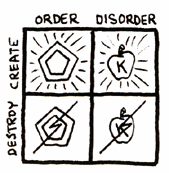
To choose order over disorder, or disorder over order, is to accept a trip composed of both the creative and the destructive. But to choose the creative over the destructive is an all-creative trip composed of both order and disorder. To accomplish this, one need only accept creative disorder along with, and equal to, creative order, and also be willing to reject destructive order as an undesirable equal to destructive disorder.
The Curse of Greyface included the division of life into order/disorder as the essential positive/negative polarity, instead of building a game foundation with creative/destructive as the essential positive/negative. He has thereby caused man to endure the destructive aspects of order and has prevented man from effectively participating in the creative uses of disorder. Civilization reflects this unfortunate division.
POEE proclaims that the other division is preferable, and we work toward the proposition that creative disorder, like creative order, is possible and desirable; and that destructive order, like destructive disorder, is unnecessary and undesirable.
Seek the Sacred Chao – therein you will find the foolishness of all ORDER/DISORDER. They are the same!
Read the whole text of POEE’s “Principia Discordia” here.