Official music video (version 1) for the single “Wuthering Heights” – Kate’s debut single. Released in January 1978, it became a No.1 hit in the UK singles chart and remains Kate’s biggest-selling single. The song appears on Kate’s 1978 debut album, The Kick Inside, and was also re-recorded in 1986 for the greatest-hits album The Whole Story.
Category Archives: spirit
infinite body collapse
Screening of new video delay works by Alex Carpenter with dancer Alexis Maxwell
Perhaps ghosts don’t exist “between” normal points of focus, but reside at the core of these points. The essence of things lies within the things, not somewhere else. We don’t need to make the things softer and more delicate, just because we imagine an essence that is itself soft and delicate. If anything, we need to make the things LOUDER, MORE forceful, MORE singular. Maybe then, once our perception tires of the surface layers, becomes exhausted, we will at last see the fragile core that has always eluded us.
“Infinite Body Collapse” is a collection of new works by Alex Carpenter, drawn from recent video delay sessions with dancer Alexis Maxwell, as well as audio delay recordings made this summer in an allegedly haunted house in Alexandria, Virginia.
Through Alex’s video delay system, performed actions (danced, drawn, light-operated) are captured and layered continuously upon playback with previous cyclical generations, providing material for the performer to build on in a largely “unthinking” way. The system engages the performer in a focused, ecstatic process of observing and responding, as normal points of focus are saturated, obliterated, and a space is cleared for the unfolding of activity on a different scale.
This excerpt demonstrates perfectly how the best video delay material is built – with an emphasis on potential within the material, rather than a creator’s plan realized “through” material. This is not “composition”, it is excavation – a digging through to something normally invisible…
Microscope Gallery
4 Charles Place, Brooklyn
Saturday October 6th, 7pm ($6)
kurt vonnegut on practising art

Reblogged from afropolitanexplosiv.
8|
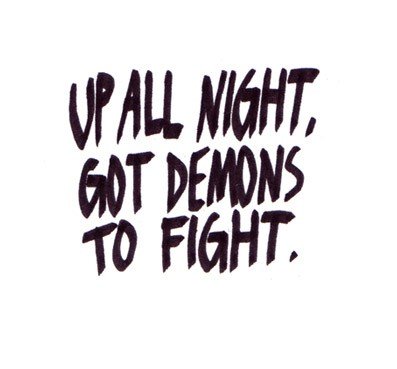
wish you were here by catherine anyango
(for scott of the antarctic)
kierkegaard on transcending despair
The despairing man who is unconscious of being in despair is, in comparison with him who is conscious of it, merely a negative step further from the truth and from salvation. Despair itself is a negativity, unconsciousness of it is a new negativity. But to reach truth one must pierce through every negativity. For here applies what the fairy tale recounts about a certain enchantment: the piece of music must be played through backward; otherwise the enchantment is not broken.
~ Søren Kierkegaard (under the pseudonym Anti-Climacus) – from The Sickness Unto Death (1849)
kuroneko (1968) showing tonight in cape town
Showing tonight at 20h15 at Labia on Orange, in association with the Good Film Society.
In this poetic and atmospheric horror fable, set in a village in war-torn medieval Japan, a malevolent spirit has been ripping out the throats of itinerant samurai. When a military hero is sent to dispatch the unseen force, he finds that he must struggle with his own personal demons as well. From Kaneto Shindo, director of the terror classic Onibaba, Kuroneko (Black Cat) is a spectacularly eerie twilight tale with a shocking feminist angle, evoked through ghostly special effects and mindblowingly awesome visuals.
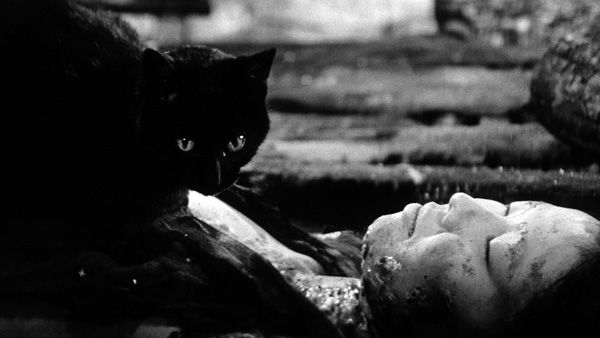
Maitland McDonagh on Kuroneko: The Mark of the Cat
Scratch the surface of a contemporary J-horror classic like Ringu (1998) or any of the Ju-on films (2000–03) and you’ll glimpse Yabu no naka no kuroneko (Black Cat from the Grove), released in the U.S. as simply Kuroneko (1968). Shot in shimmering, widescreen black and white and suffused with an unsettling eroticism, Kaneto Shindo’s elegant nightmare of earthbound violence and otherworldly revenge wasn’t the first film to be rooted in Japanese folk stories about onryo, the vengeful spirits of those who were abused in life, usually women, whose rage is so great it can’t be contained.
The Ghost of Yotsuya (Nobuo Nakagawa, 1959) and Kwaidan (Masaki Kobayashi, 1965) both preceded it, and other classics of Japan’s golden age of filmmaking—notably Kenji Mizoguchi’s Ugetsu (1953)—featured female spirits. And supernatural cats had appeared in Black Cat Mansion (Nakagawa, 1958) and The Ghost Cat of Otama Pond (Yoshihiro Ishikawa, 1960). But Shindo drew those threads together and wove them into Kuroneko’s unprecedentedly unnerving women, whose descendents are now many, and into a terrifically spooky story whose resonance extends beyond the satisfying chill of an exotic campfire tale and whose wrenching psychological anguish transcends specific cultural traditions…
… Western folklore regularly puts cats in general, and black cats in particular, in league with witches and other dark forces, but Japanese folktales are more ambiguous, starting with the fact that, while all felines are suspected of being more than handy mousers and cute house pets, they allow for two kinds of supernatural cats, the manekineko and the bakeneko. Anyone who has eaten in a Japanese restaurant knows what a manekineko looks like: perched somewhere near the cash register, it sits with one paw raised in greeting and the other resting on a coin, benevolently beckoning good fortune to come on in and stay awhile—Hello, Hello Kitty! Thebakeneko, by contrast, is kissing cousin to the shape-shifting fox (kitsune) and the sly, mischievous tanuki (a small, scruffily kawaii canid native to East Asia): none are inherently evil, but all are capable of using their supernatural knack for mimicking other creatures—including human beings—to stir up trouble. That said, the fact that bakeneko often eat the person whose form they’ve taken suggests they’re less amusing and more alarming than their fellow shapeshifters, and the shadow of feline malevolence lurks in Kuroneko’s fog-swirled gloom.
Read more of Maitland McDonagh’s article, which discusses the historical context of this horror masterpiece, HERE.
by margaret bertulli
I bleed
I bleed and I wonder
“Will this be the last time?”
I bleed, therefore I am
“What will it be like?
This cessation of menses?”
The unequivocal end of child-bearing.
And my womb, though childless,
Will it feel the end of possibility?
Perhaps.
And then the unforeseen strength,
Promised by gender and age, will come.
The sureness, the wisdom,
The spirit to sing my songs.
I know this as all women before me have known.
We know this as we smile at the moon
life on loan
“All life is loaned to us by God, whose crooked reflections we are. Love alone makes that reflection straight. Love alone gives us back ourselves.”
~ Erica Jong, from Shylock’s Daughter: A Novel of Love in Venice (W. W. Norton & Company, 2003.)
martha graham – frontier
”I took the puppet, which was myself, and I flung it against the sky. Because light is such a magical, magical thing. See, a bird never flies into the dark, who is built for the light.”
From the Nonesuch Dance Collection.
1976 recording
Introduction by Martha Graham.
Choreography by Martha Graham.
Performed by The Martha Graham Dance Company.
wallace stevens – peter quince at the clavier
I
Just as my fingers on these keys
Make music, so the self-same sounds
On my spirit make a music, too.
Music is feeling, then, not sound;
And thus it is that what I feel,
Here in this room, desiring you,
Thinking of your blue-shadowed silk,
Is music. It is like the strain
Waked in the elders by Susanna;
Of a green evening, clear and warm,
She bathed in her still garden, while
The red-eyed elders, watching, felt
The basses of their beings throb
In witching chords, and their thin blood
Pulse pizzicati of Hosanna.
II
In the green water, clear and warm,
Susanna lay.
She searched
The touch of springs,
And found
Concealed imaginings.
She sighed,
For so much melody.
Upon the bank, she stood
In the cool
Of spent emotions.
She felt, among the leaves,
The dew
Of old devotions.
She walked upon the grass,
Still quavering.
The winds were like her maids,
On timid feet,
Fetching her woven scarves,
Yet wavering.
A breath upon her hand
Muted the night.
She turned —
A cymbal crashed,
Amid roaring horns.
III
Soon, with a noise like tambourines,
Came her attendant Byzantines.
They wondered why Susanna cried
Against the elders by her side;
And as they whispered, the refrain
Was like a willow swept by rain.
Anon, their lamps’ uplifted flame
Revealed Susanna and her shame.
And then, the simpering Byzantines
Fled, with a noise like tambourines.
IV
Beauty is momentary in the mind —
The fitful tracing of a portal;
But in the flesh it is immortal.
The body dies; the body’s beauty lives.
So evenings die, in their green going,
A wave, interminably flowing.
So gardens die, their meek breath scenting
The cowl of winter, done repenting.
So maidens die, to the auroral
Celebration of a maiden’s choral.
Susanna’s music touched the bawdy strings
Of those white elders; but, escaping,
Left only Death’s ironic scraping.
Now, in its immortality, it plays
On the clear viol of her memory,
And makes a constant sacrament of praise.
Some insightful stuff written about this poem is to be found HERE.
søren kierkegaard on anxiety
In a logical system, it is convenient to say that possibility passes over into actuality. However, in actuality it is not so convenient, and an intermediate term is required. The intermediate term is anxiety… Anxiety is neither a category of necessity nor a category of freedom; it is entangled freedom, where freedom is not free in itself but entangled, not by necessity, but in itself…
… Anxiety may be compared with dizziness. He whose eye happens to look down into the yawning abyss becomes dizzy. But what is the reason for this? It is just as much in his own eye as in the abyss, for suppose he had not looked down. Hence anxiety is the dizziness of freedom, which emerges when the spirit wants to posit the synthesis and freedom looks down into its own possiblity, laying hold of finiteness to support itself. Freedom succumbs in this dizziness. Further than this, psychology cannot and will not go. In that very moment everything is changed, and freedom, when it again rises, sees that it is guilty. Between these two moments lies the leap, which no science has explained and which no science can explain.
~ Søren Kierkegaard (under the pseudonym Vigilius Haufniensis) – from The Concept of Anxiety (1844)
albert einstein on interdependence

odea mathews – something within me
A haunting 1959 field recording by folklorist Dr. Harry Oster of a prison worksong from Angola State Penitentiary in Lousiana: inmate Odea Mathews, accompanied only by the whirr of her sewing machine. You can find more information and purchase this recording HERE.
moon and flying snow
Beautiful fight scene between Moon (Zhang Ziyi) and Flying Snow (Maggie Cheung) in the yellow forest from the extended version of the movie “Hero”
Hero was first released in China on October 24, 2002. At that time, it was the most expensive project and the highest-grossing motion picture in Chinese film history.
nina hagen on god, death, rebirth and freedom (1984)
For more of this kind of stuff, check out Videowave on Facebook – an archive of music and art ignored by mainstream media.
The opening track from Nunsexmonkrock (1981)
kahlil gibran to mary haskell (1908)
October 2, 1908
14 Avenue du Maine
Paris
My dear Mary – I had a long rest in the country with Syrian friends, a rich man with a great heart and a woman with both a beautiful soul and face. They both love poetry and poets. The town in which they live is like a large garden divided into little gardens by narrow paths. From a distance the houses with red roofs look like a handful of corals scattered on a piece of green velvet.
I am painting, or I am learning how to paint. It will take me a long time to paint as I want to, but it is beautiful to feel the growth of one’s own vision of things. There are times when I leave work with the feelings of a child who is put to bed early. Do you not remember, dear Mary, my telling you that I understand people and things through my sense of hearing, and that *sound* comes first to my soul? Now, dear Mary, I am beginning to understand things and people through my eyes. My memory seems to keep the shapes and colours of personalities and objects…
… It is almost midnight. The woman with the sweet voice, in the opposite studio, is no longer singing her sad Russian songs. The silence is profound. Good night, dear Mary. A thousand good nights from
Kahlil
November 8, 1908
Paris
When I am unhappy, dear Mary, I read your letters. When the mist overwhelms the “I” in me, I take two or three letters out of the little box and reread them. They remind me of my true self. They make me overlook all that is not high and beautiful in life. Each and every one of us must have a resting place somewhere. The resting place of my soul is a beautiful grove where my knowledge of you lives.
And now, I am wrestling with colour: The strife is terrible, one of us must triumph! I can almost hear you saying, “And what about drawing, Kahlil?” and Kahlil, with a thirst in his voice says, “Let me, O let me bathe my soul in colours; let me swallow the sunset and drink the rainbow.”
The professors in the academy say, “Do not make the model more beautiful than she is,” and my soul whispers, “O if you could only paint the model as beautiful as she really is.” Now what shall I do, dear Mary? Shall I please the professors or my soul? The dear old men know a great deal, but the soul is much nearer.
It is rather late, and I shall go to bed now, with many thoughts in my heart. Good night, dear Mary. God bless you always.
Kahlil
From Beloved Prophet – the love letters of Kahlil Gibran & Mary Haskell (1972)
the caretaker – we cannot escape the past
Imagery from Carl Theodor Dreyer’s The Passion of Joan of Arc (1928)
hildegard von bingen – o euchari (1161)
Eucharius!
you walked blithely when you stayed
with the Son of God,
touching him, watching
his miracle-working.
You loved him with a perfect love
when terror fell on your friends —
who being human had no
strength to bear the brightness
of the good.
But you — in the blaze of utmost love —
drew him to your heart
when you gathered the sheaves
of his precepts.
Eucharius!
when the Word of God possessed you
in the blaze of the dove,
when the sun rose in your spirit,
you founded a church in your bliss.
Daylight shimmers in your heart
where three tabernacles stand
on a marble pillar
in the city of God.
In your preaching Ecclesia
savors old wine with new —
a chalice twice hallowed.
And in your teaching Ecclesia
argued with such force
that her shout rang over the mountains,
that the hills and the woods might bow
to suck her breasts.
Pray for this company now,
pray with resounding voice
that we forsake not Christ
in his sacred rites,
but become before his altar
a living sacrifice.
Translated by Barbara Newman
Comment from the maker of the video: “This piece was influenced by cubist works of circus and theatrical subjects in the Thyssen-Bornemisza Museum of Art in Madrid. It is also influenced by stained glass work I saw at the Theatre of Glass in Bath. The original piece is much more beautiful because of the larger file size.
The kinetic version of this piece is set against Hildegard von Bingens O Euchari (1161) sung by Emma Kirkby and Gothic Voices.”
~ D Lewis Baker
rickie lee jones – ghostyhead
amália rodrigues – barco negro
Amália Rodrigues sings the fado “Barco Negro” in a scene from Henri Verneuil’s 1955 film LES AMANTS DU TAGE.
Translation of the French conversation in the scene (which paraphrases the Portuguese lyrics of the song being performed by Amália behind it):
Child — Do you like it?
Woman — Very much. I’m sorry I don’t understand Portuguese. It must be beautiful.
Child — It’s the wife of a fisherman who died at sea. She goes down to the beach every night and talks to him as if he were alive. She tells him… She tells him… love things.
Man — [paraphrasing the singer] “I woke up this morning trembling next to you, afraid that I was less beautiful than yesterday. But your eyes told me, ‘No.’
“When you opened the door, the sun was gliding along the sea and your black boat was dancing in the light. Standing on the rocks, I saw you hoist sail and turn towards the open sea, while waving happily.
“The women praying at night along the shore say that you never returned. Madwomen, my love, madwomen! You never left. You’re everywhere around me, as always… In the wind, throwing sand against the windowpanes; in the water, singing on the fire; in the empty chair, staring at me; in the dark of the hearth; in the warmth of the bed; in the crook of my shoulder… You are there always. Always there. Always.”
 fleurmach