if anything could ever feel this real forever…

And I wonder
when I sing along with you
If everything could ever feel this real forever
If anything could ever be this good again
The only thing I’ll ever ask of you
You’ve got to promise not to stop when I say when
She sang

Dylan and Lauren (or Sandalwood, as they are calling themselves) perform their favourite track “Everlong”(originally by Foo Fighters) in the OxJam tent at Electric Picnic festival, Ireland, 2010.

Lauren (11) spotted the “Open Mic” sign outside the OxJam tent, grabbed her brother and barrelled over …within barely a minute I heard them announce “next up a brother and sister combo…” and I barely had time to get in with the camera, thankfully it took Dylan a minute to retune the borrowed guitar to drop-D.

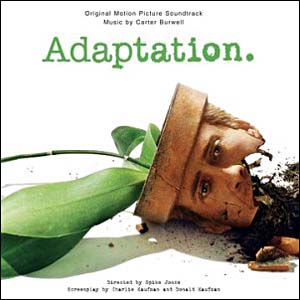
remixed from “adaptation” (2002)

JOHN LAROCHE:
You know why I like plants?

SUSAN ORLEAN:
Nuh uh.

JOHN LAROCHE:
Because they’re so mutable. Adaptation is a profound process. Means you figure out how to thrive in the world.

SUSAN ORLEAN:
[pause] Yeah but it’s easier for plants. I mean they have no memory. They just move on to whatever’s next. With a person though, adapting’s almost shameful. It’s like running away.
___

CHARLIE KAUFMAN: [voice-over]
I am pathetic, I am a loser…

ROBERT MCKEE:
So what is the substance of writing?

CHARLIE KAUFMAN: [voice-over]
I have failed, I am panicked. I’ve sold out, I am worthless, I… What the fuck am I doing here? What the fuck am I doing here? Fuck. It is my weakness, my ultimate lack of conviction that brings me here… And here I am because my jump into the abysmal well – isn’t that just a risk one takes when attempting something new? I should leave here right now. I’ll start over. I need to face this project head on and…

ROBERT MCKEE:
…and God help you if you use voice-over in your work, my friends. God help you. That’s flaccid, sloppy writing. Any idiot can write a voice-over narration to explain the thoughts of a character.
___

SUSAN ORLEAN:
There are too many ideas and things and people. Too many directions to go. I was starting to believe the reason it matters to care passionately about something, is that it whittles the world down to a more manageable size.
___

SUSAN ORLEAN:
Do you ever get lonely sometimes, Johnny?

JOHN LAROCHE:
Well, I was a weird kid. Nobody liked me. But I had this idea. If I waited long enough, someone would come around and just, you know… understand me. Like my mom, except someone else. She’d look at me and quietly say: “Yes.” Just like that. And I wouldn’t be alone anymore.
___

CHARLIE KAUFMAN:
There are no rules, Donald. And anyone who says there are is just, you know…

DONALD KAUFMAN:
Not rules, principles. McKee writes that a rule says you *must* do it this way. A principle says, this *works* and has through all remembered time.
___

JOHN LAROCHE:
Point is, what’s so wonderful is that every one of these flowers has a specific relationship with the insect that pollinates it. There’s a certain orchid looks exactly like a certain insect so the insect is drawn to this flower, its double, its soul mate, and wants nothing more than to make love to it. And after the insect flies off, spots another soul-mate flower and makes love to it, thus pollinating it. And neither the flower nor the insect will ever understand the significance of their lovemaking. I mean, how could they know that because of their little dance the world lives? But it does. By simply doing what they’re designed to do, something large and magnificent happens. In this sense they show us how to live – how the only barometer you have is your heart. How, when you spot your flower, you can’t let anything get in your way.
___

SUSAN ORLEAN:
What I came to understand is that change is not a choice. Not for a species of plant, and not for me.
___

CHARLIE KAUFMAN:
I have to go right home. I know how to finish the script now. It ends with Kaufman driving home after his lunch with Amelia, thinking he knows how to finish the script. Shit, that’s voice-over. McKee would not approve. How else can I show his thoughts? I don’t know. Oh, who cares what McKee says? It feels right. Conclusive. I wonder who’s gonna play me. Someone not too fat. I liked that Gerard Depardieu, but can he not do the accent? Anyway, it’s done. And that’s something. So: “Kaufman drives off from his encounter with Amelia, filled for the first time with hope.” I like this. This is good.

Read more about the background to the screenplay
this is my body, deal with it.

WARNING: The following picture might be considered obscene because subject is not thin. And we all know that only skinny people can show their stomachs and celebrate themselves. Well I’m not going to stand for that. This is my body. Not yours. MINE. Meaning the choices I make about it are none of your fucking business. Meaning my size IS NONE OF YOUR FUCKING BUSINESS.

If my big belly and fat arms and stretch marks and thick thighs offend you, then that’s okay. I’m not going to hide my body and my being to benefit your delicate sensitivities.

This picture is for the strange man at my nanny’s church who told me my belly was too big when I was five.
This picture is for my horseback riding trainer telling me I was too fat when I was nine.
This picture is for the girl from summer camp who told me I’d be really pretty if I just lost a few pounds
This picture is for all the fucking stupid advertising agents who are selling us cream to get rid of our stretch marks, a perfectly normal thing most people have (I got mine during puberty)
This picture is for the boy at the party who told me I looked like a beached whale.
This picture is for Emily from middle school, who bullied me incessantly, made mocking videos about me, sent me nasty emails, and called me “lard”. She made me feel like I didn’t deserve to exist. Just because I happened to be bigger than her. I was 12. And she continued to bully me via social media into high school.

MOST OF ALL, this picture is for me. For the girl who hated her body so much she took extreme measures to try to change it. Who cried for hours over the fact she would never be thin. Who was teased and tormented and hurt just for being who she was.

I’m so over that.

THIS IS MY BODY, DEAL WITH IT.”

Self-portrait by Stella

reblogged from thebodyloveblog.tumblr.com.

About Stella

david whyte – the house of belonging

I awoke
this morning
in the gold light
turning this way
and that

thinking for
a moment
it was one
day
like any other.

But
the veil had gone
from my
darkened heart
and
I thought

it must have been the quiet
candlelight
that filled my room,

it must have been
the first
easy rhythm
with which I breathed
myself to sleep,

it must have been
the prayer I said
speaking to the otherness
of the night.

And
I thought
this is the good day
you could
meet your love,

this is the black day
someone close
to you could die.

This is the day
you realize
how easily the thread
is broken
between this world
and the next

and I found myself
sitting up
in the quiet pathway
of light,

the tawny
close grained cedar
burning round
me like fire
and all the angels of this housely
heaven ascending
through the first
roof of light
the sun has made.

This is the bright home
in which I live,
this is where
I ask
my friends
to come,
this is where I want
to love all the things
it has taken me so long
to learn to love.

This is the temple
of my adult aloneness
and I belong
to that aloneness
as I belong to my life.

There is no house
like the house of belonging.

creative minds “mimic schizophrenia”

By Michelle Roberts – Health reporter, BBC News

Creativity is akin to insanity, say scientists who have been studying how the mind works. Brain scans reveal striking similarities in the thought pathways of highly creative people and those with schizophrenia.

Both groups lack important receptors used to filter and direct thought. It could be this uninhibited processing that allows creative people to “think outside the box”, say experts from Sweden’s Karolinska Institute. In some people, it leads to mental illness. But rather than a clear division, experts suspect a continuum, with some people having psychotic traits but few negative symptoms.

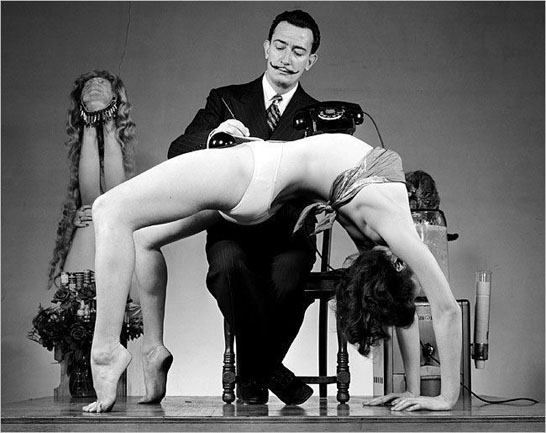
Salvador Dali – “Desk”

Art and suffering
Some of the world’s leading artists, writers and theorists have also had mental illnesses – the Dutch painter Vincent van Gogh and American mathematician John Nash (portrayed by Russell Crowe in the film A Beautiful Mind) to name just two.

Creativity is known to be associated with an increased risk of depression, schizophrenia and bipolar disorder. Similarly, people who have mental illness in their family have a higher chance of being creative.

The thalamus channels thoughts
Associate Professor Fredrik Ullen believes his findings could help explain why. He looked at the brain’s dopamine (D2) receptor genes which experts believe govern divergent thought. He found highly creative people who did well on tests of divergent thought had a lower than expected density of D2 receptors in the thalamus – as do people with schizophrenia. The thalamus serves as a relay centre, filtering information before it reaches areas of the cortex, which is responsible, amongst other things, for cognition and reasoning.

Continue reading

cherry bomb on the wrong rock show

Episode 128 of The Wrong Rock Show, originally broadcast on 15 October 2012 on Bush Radio 89.5FM, Cape Town, South Africa. Listen HERE.

The Wrong Rock Show is “a musical journey beyond the limitations of the mainstream to a place where vintage rock ‘n’ roll can rub shoulders with anarchic post-rock”. Created in April 2010, it broadcasts Monday evenings 10PM – 00AM (GMT+02) on Cape Town’s Bush Radio 89.5FM. It is streamed live at www.bushradio.co.za and shows are uploaded as cloudcasts at Mixcloud. The show is hosted by Greg ‘the Hammer’ Donnelly, Botha Kruger, Danie Marais, Henrik Gustafsson and alternating co-hosts, all of whom bring to the show their unique tastes and personal takes on what makes good, wrong rock music. I co-hosted with Botha Kruger this past Monday evening.

TRACK LIST – 15 October 2012

  1. Beat Girl – John Barry
  2. Manically Panicky – The Great Apes
  3. Turnstile Blues – Autolux
  4. The Only – Lykke Li
  5. The Night – Morphine
  6. Johnny – Paul Hawkins & The Awkward Silences
  7. (Ghost) Riders In The Sky – Starlite Wranglers
  8. City Of Refuge – The Black League
  9. Bending Albert’s Law – Karin Park
  10. In The Same Room – Julia Holter
  11. Show Me The Face – Chinawoman
  12. Heart Full Of Soul – The Yardbirds
  13. A Little Lost – Nat Baldwin
  14. Dancing In The Dark – Tegan And Sara
  15. Praise Be Man – Russian Circles
  16. May The Bridges You Burn Light The Way – Strage
  17. Speed – Moon Duo
  18. Jump Sturdy – Dr John
  19. Grinnin’ In Your Face – The Vespers
  20. 3, 6, 9 – Cat Power
  21. Wetboy Elegy – The Akabane Vulgars On Strong Bypass
  22. Ahab –  Skabengas
  23. Ramblin’ – Murder By Death
  24. Weightless Again – Cerys Matthews
  25. This Is How We Walk On The Moon – Arthur Russell
  26. Ill Fated Lovers Go Time Tripping – Bongwater
  27. She’s In Parties – Bauhaus
  28. Avatar – Swans

Listen HERE.
Duration: 2 hours
Hosts: Botha Kruger and Cherry Bomb
Follow The Wrong Rock Show on Facebook or Twitter.

the flower of seven colours

Cvetik Semicvetik (Flower of Seven Colours) is a beautiful Soviet children’s animation from 1948, based on a beloved folk tale about a little girl who receives a magic flower with seven free wishes from an old crone. None of her wishes leads to happiness, until the last wish, which she doesn’t use for herself, but for someone else. By making someone else happy, she is made happy too.

There are many different illustrated versions out there, but perhaps the most trippy one comes from the mind of Russian artist Benjamin Losin. Losin apparently illustrated two different versions of this book.

but a fleeting touch

But a Fleeting Touch
Jessica Tremp

Melbourne photographer Jessica Tremp captures life in a haunted woodland.

“When I was little I used to dream about being a dancer or that I could fly,” Tremp explains. “And that I would learn to speak the language of the animals in the forest or that of the most dramatic actor. With the click of a finger I’ve found a way to make these things come true.”

north korean children play stupendously creepy music

I found this North Korean children’s ensemble performance disturbing yet also fascinating… Maybe it’s due to my Western bias towards self-determination, but the regimented – no, automated – nature of this; the youngness of the children; their forced smiles, really upset me to watch. Everything is rote, down to the last tilt of the head. It also makes me wonder how much “childhood” they have – how heavy this weighs on their tiny shoulders… Or do they even feel it as oppressive at all? Maybe if you grow up where play (of the spontaneous sort) is not on the cultural menu, you never yearn for it, never feel alienation or exploitation?

Thanks Justin Allart for passing this on.

hoagy carmichael – stardust (original vocal version)

On October 31, 1927, Hoagy Carmichael and His Pals recorded Carmichael’s composition “Stardust” at the Gennett Records studio in Richmond, Indiana. Hoagy’s “pals,” Emil Seidel and His Orchestra, agreed to record the medium-tempo instrumental in between their Sunday evening and Monday matinee performances in Indianapolis, seventy miles away.

In 1928 Carmichael again recorded “Stardust,” this time with lyrics he had written, but Gennett rejected it because the instrumental had sold so poorly. The following year, at Mills Music, Mitchell Parish was asked to set lyrics to coworker Carmichael’s song. The result was the 1929 publication date of “Star Dust” with the music and lyrics we know today. The Mills publication changed the title slightly to “Star Dust” from “Stardust” as it was originally spelled.

This information taken from JazzStandards.com.

django reinhardt – stardust (1935)

Django Reinhardt recorded “Stardust” in 1935.

Stardust, 2/3/35, OLA 349-1 ,”Fremeaux FA 302, JSP 344, Conifer CDHD 230, EMI Jazz Time 790560-2″,” – Paris – Coleman Hawkins (ts), Stephane Grappelly (p), Django Reinhardt (g), Eugene d’Hellemmes (b), Maurice Chaillou (d).”

Chord chart:

| F69/// | F69/// | Fm7/// | Bb7/// | C6/// | A7/// | Dm/ A7/ | Dm/// |
| G7/ F#7/ | G7/// | C6/// | C6/// | D7/// | D7/// | G7/ F#7/ | G7/ G7+/ |
| F69/// | F69/// | Fm7/// | Bb7/// | C6/// | A7/// | Dm/ A7/ | Dm/// |
| Fm7/// | Bb7/// | C6/// | A7/// | Dm7/// | G7b9/// | C69/ Fm7/ | C69/// :||

the romance of winds

There is a whirlwind in southern Morocco, the aajej, against which the fellahin defend themselves with knives. There is the africo, which has at times reached into the city of Rome. The alm, a fall wind out of Yugoslavia. The arifi, also christened aref or rifi, which scorches with numerous tongues. These are permanent winds that live in the present tense.

There are other, less constant winds that change direction, that can knock down horse and rider and realign themselves anticlockwise. The bist roz leaps into Afghanistan for 170 days, burying villages. There is the hot, dry ghibli from Tunis, which rolls and rolls and produces a nervous condition. The haboob — a Sudan dust storm that dresses in bright yellow walls a thousand metres high and is followed by rain. The harmattan, which blows and eventually drowns itself into the Atlantic. Imbat, a sea breeze in North Africa. Some winds that just sigh towards the sky. Night dust storms that come with the cold. The khamsin, a dust in Egypt from March to May, named after the Arabic word for ‘fifty,’ blooming for fifty days–the ninth plague of Egypt. The datoo out of Gibraltar, which carries fragrance.

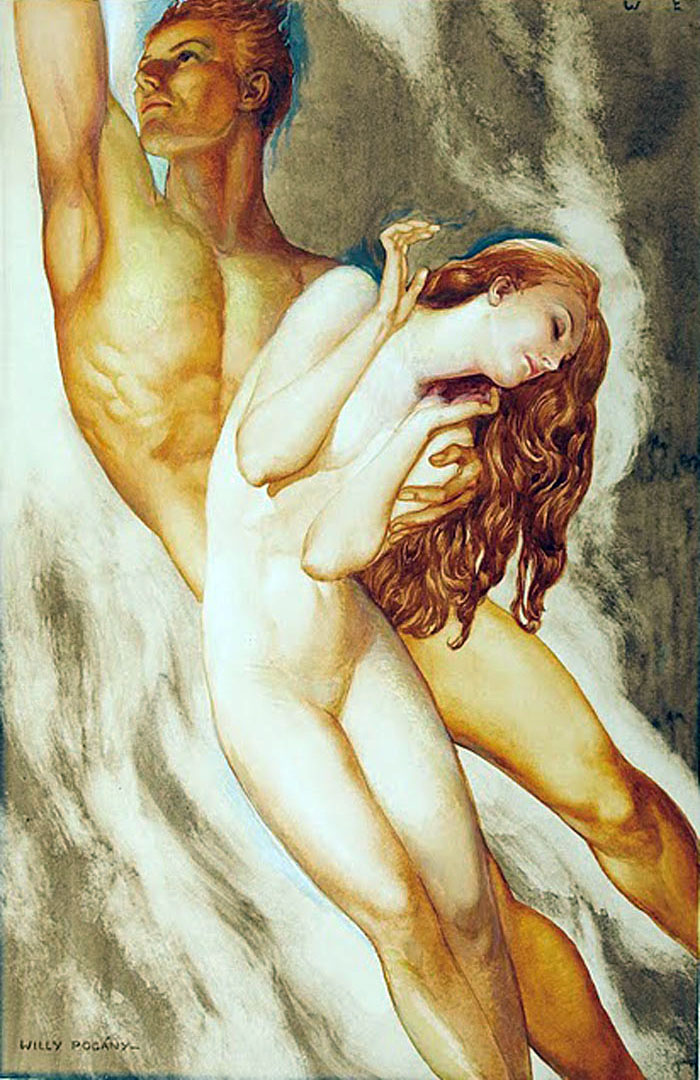
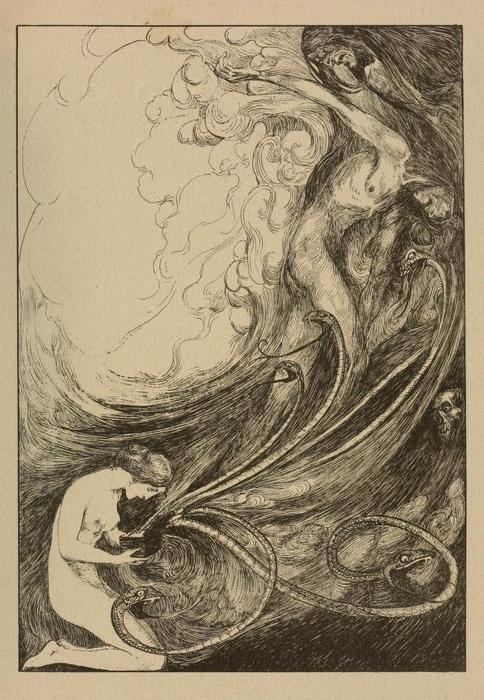
Illustration by Willy Pogany (Hungary, 1882-1955)

There is also the ——, the secret wind of the desert, whose name was erased by a king after his son died within it. And the nafhat — a blast out of Arabia. The mezzar-ifoullousen — a violent and cold southwesterly known to Berbers as ‘that which plucks the fowls.’ The beshabar, a black and dry northeasterly out of the Caucasus, ‘black wind.’ The samiel from Turkey, ‘poison and wind,’ used often in battle. As well as the other ‘poison winds,’ the simoom, of North Africa, and the solano, whose dust plucks off rare petals, causing giddiness.

Other, private winds.

Travelling along the ground like a flood. Blasting off paint, throwing down telephone poles, transporting stones and statue heads. The harmattan blows across the Sahara filled with red dust, dust as fire, as flour, entering and coagulating in the locks of rifles. Mariners called this red wind the ‘sea of darkness.’ Red sand fogs out of the Sahara were deposited as far north as Cornwall and Devon, producing showers of mud so great this was also mistaken for blood. ‘Blood rains were widely reported in Portugal and Spain in 1901.’

There are always millions of tons of dust in the air, just as there are millions of cubes of air in the earth and more living flesh in the soil (worms, beetles, underground creatures) than there is grazing and existing on it. Herodotus records the death of various armies engulfed in the simoom who were never seen again. One nation was ‘so enraged by this evil wind that they declared war on it and marched out in full battle array, only to be rapidly and completely interred.

— Michael Ondaatje, from The English Patient.

schtumm!

Illustration done by Willy Pogany in 1914 for T. W. Rolleston’s Tale of Lohengrin,1914. You can download the whole book from HERE.

Lohengrin is a character in German Arthurian literature. His story, which first appears in Wolfram von Eschenbach’s Parzival, is a version of the Knight of the Swan legend known from a variety of medieval sources.

The son of Parzival (Percival), Lohengrin is a knight of the Holy Grail sent in a boat pulled by swans to rescue a maiden, Elsa, who is the daughter of the Duke of Brabant, and who is forbidden to ask about his identity. At King Arthur’s command he is taken by a swan through the air to Mainz, where he fights for Elsa, overthrows her persecutor, and marries her. He then accompanies the emperor to fight against the Hungarians, and subsequently against the Saracens. On his return home to Cologne, Elsa, contrary to the prohibition, persists in asking him about his origin. After being asked a third time he tells her, but at that instant is carried away by the swan back to the Grail.

Wolfram’s story was expanded in two later romances. In 1848 Richard Wagner adapted the medieval tale into his popular opera Lohengrin, on which Rolleston based his book.