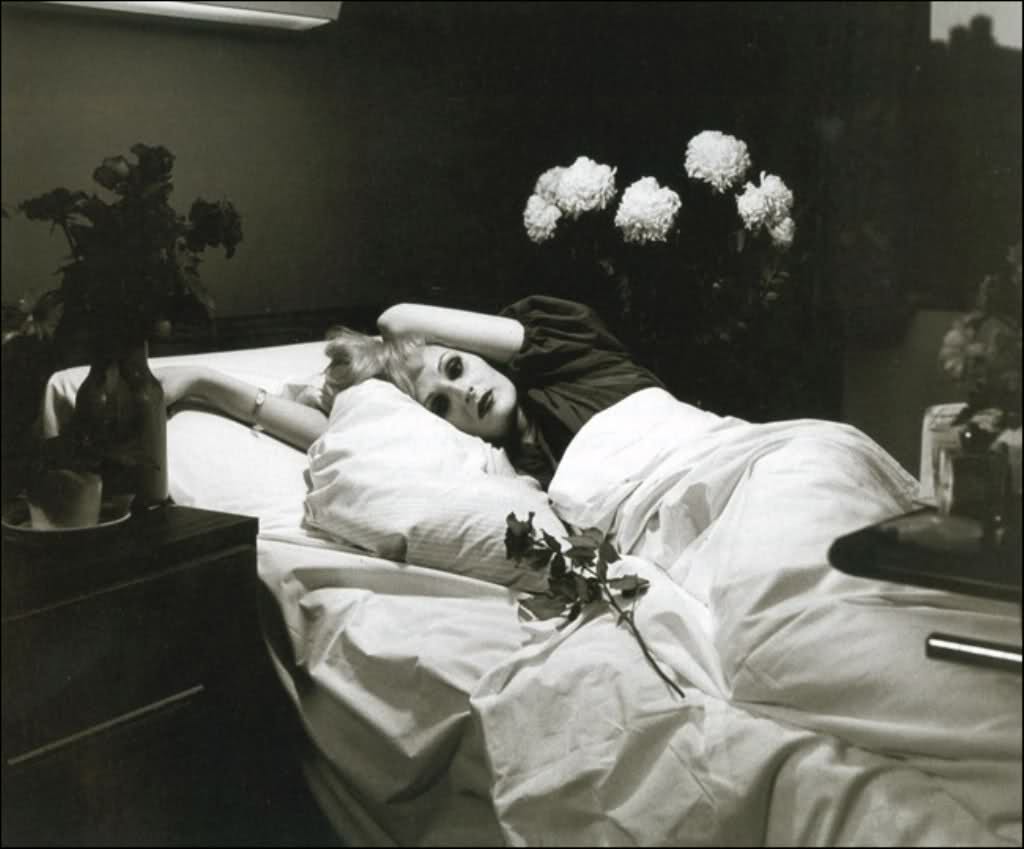
candy darling on her deathbed

Peter Hujar – “Candy Darling on Her Deathbed”
1974, gelatin-silver print

Candy Darling (November 24, 1944 – March 21, 1974), born James Lawrence Slattery, was an American actress, best known as a Warhol Superstar. A male-to-female transsexual, she starred in Andy Warhol’s films Flesh (1968) and Women in Revolt (1971), and was a muse of the band The Velvet Underground.

on making oneself visible in the world

There is a lovely root to the word humiliation – from the latin word humus, meaning soil or ground. When we are humiliated, we are in effect returning to the ground of our being.

Shedding the carapace we have been building so assiduously on the surface, we must by definition give up exactly what we thought was necessary to protect us from further harm. The outlaw is the radical, the one close to the roots of existence. The one who refuses to forget their humanity and, in remembering, helps everyone else remember too.

To die inside is to rob our outside life of any sense of arrival from that interior. Our work is to make ourselves visible in the world. This is the soul’s individual journey, and the soul would much rather fail at its own life than succeed at someone else’s.

David Whyte, from Crossing the Unknown Sea

john berger on being born a woman

To be born a woman is to be born, within an allotted and confined space, into the keeping of men. The social presence of women is developed as a result of their ingenuity in living under such tutelage within such a limited space. But this has been at the cost of a woman’s self being split into two.

A woman must continually watch herself. She is almost continually accompanied by her own image of herself. Whilst she is walking across a room or whilst she is weeping at the death of her father, she can scarcely avoid envisaging herself walking or weeping. From earliest childhood she has been taught and persuaded to survey herself continually. And so she comes to consider the surveyor and the surveyed within her as the two constituent yet always distinct elements of her identity as a woman. She has to survey everything she is and everything she does, because how she appears to men is of crucial importance for what is normally thought of as the success of her life. Her own sense of being in herself is supplanted by a sense of being appreciated as herself by another…

One might simplify this by saying: men act and women appear. Men look at women. Women watch themselves being looked at. This determines not only most relations between men and women but also the relation of women to themselves. The surveyor of woman in herself is male: the surveyed female. Thus she turns herself into an object — and most particularly an object of vision: a sight.

― John Berger, from Ways of Seeing.

jolie holland – alley flowers

From her debut album, Catalpa (2003). It’s my favourite album of hers, I think – gorgeously hypnotic, and impossible to place in space and time. It’s like she’s channelling the voice of a ghost out of early 20th century America’s Deep South… The words from her milk-white throat weave an occult journey, harking back even further – the lolloping, liquid rhythm of this song could be straight out of West Africa.

Quote from Amazon.com:
“If you didn’t know what it was, you’d swear it was recorded in the field 70 years ago. The outright primitive audio quality, acoustic instruments, the little mistakes and coughs left in… it’s a diamond in the rough, left uncut because there’s so much beauty in the imperfections.

“Then you notice the opening track’s [“Alley Flowers”] muffled frame-drum percussion is playing a “cabalistic” 12/8 against the guitar and vocal’s 4/4, the lyrical fantistical concreteness reminiscent of Syd Barrett or Hank Williams, the fluid soprano that sounds utterly self-taught, and you know it’s not an ordinary folk album at all.

“This is very, very different music from almost anything you’re likely to hear, especially in this day of cheap semi-pro equipment and easy software editing. But it’s truly miraculous.”

madrugada

What makes you sing so sweetly in the dark, White-eyes, hours before dawn? I want to know. Is it your sureness of the imminent arrival of the light? Or is it to wake the sun, in case it’s forgotten its appointment with the day? I want to know, because right now things are cold and dark here, and your song is puncturing the silence with a conviction I do not share.

emily brontë – wuthering heights

Heaven did not seem to be my home; and I broke my heart with weeping to come back to earth; and the angels were so angry that they flung me out into the middle of the heath on the top of Wuthering Heights; where I woke sobbing for joy. That will do to explain my secret, as well as the other. I’ve no more business to marry Edgar Linton than I have to be in heaven; and if the wicked man in there had not brought Heathcliff so low I shouldn’t have thought of it. It would degrade me to marry Heathcliff now; so he shall never know how I love him; and that not because he’s handsome, Nelly, but because he’s more myself than I am. Whatever our souls are made of, his and mine are the same, and Linton’s is as different as a moonbeam from lightning, or frost from fire…

… I cannot express it; but surely you and everybody have a notion that there is, or should be an existence of yours beyond you. What were the use of creation if I were entirely contained here? My great miseries in this world have been Heathcliff’s miseries, and I watched and felt each from the beginning; my great thought in living is himself. If all else perished, and he remained, I should still continue to be; and all else remained, and he were annihilated, the universe would turn to a mighty stranger; I should not seem a part of it. My love for Linton is like the foliage in the woods. Time will change it, I’m well aware, as winter changes the trees — my love for Heathcliff resembles the eternal rocks beneath — a source of little visible delight, but necessary. Nelly, I am Heathcliff — he’s always, always in my mind — not as a pleasure, any more than I am always a pleasure to myself — but as my own being — so, don’t talk of our separation again — it is impracticable.
~ Catherine Earnshaw (Ch. IX).

_____
Wuthering Heights is the only published novel by Emily Brontë, written between October 1845 and June 1846 and published in July of the following year. It was not printed until December 1847 under the pseudonym Ellis Bell, after the success of her sister Charlotte Brontë’s novel Jane Eyre. A posthumous second edition was edited by Charlotte in 1850.

kate bush – wuthering heights

Official music video (version 1) for the single “Wuthering Heights” – Kate’s debut single. Released in January 1978, it became a No.1 hit in the UK singles chart and remains Kate’s biggest-selling single. The song appears on Kate’s 1978 debut album, The Kick Inside, and was also re-recorded in 1986 for the greatest-hits album The Whole Story.

broken harbors

Stars of the Lid – “Broken Harbors” (Parts 1, 2 & 3) from The Tired Sounds Of Stars Of The Lid (Kranky, 2001)

Tom Jurek, writing for AllMusic, said of this recording:

Having always made records that exist at the margins of descriptive language, this project by Austin, Texas’ most spaced-out duo, Stars of the Lid, is their most ambitious to date, featuring 11 tracks parcelled over two CDs (or three LPs), four of which are multi-part suites. Taking a step further down the road they embarked upon with Avec Laudanum, the duo have expanded the pure space and black hole vistas they offered on Music for Nitrous Oxide and The Ballasted Orchestra to embrace small melodic fragments that seemingly endlessly repeat through minimally varying textures. The effect can either be soothing (“Requiem for Dying Mothers”), hypnotic (“Broken Harbors”), or unsettling (“Austin Texas Mental Hospital”). The trademark analogue guitar/tape cut ups are ever present; what would normally be considered the sound of a guitar is nowhere in aural earshot…

…There is a progression in all the music here, but it is so subtle, so quiet and unintrusive, the listener would have to pay very careful attention to everything that is happening. More realistic, however, is for those who take pleasure in SOTL’s music and inner space explorations — for this truly is a music of the inner terrain — to offer themselves little distraction other than a comfortable chair or resting place in order to let this music enter at will, naturally and expand until it takes you over the edge into something resembling sleep, but far more delicious. Despite its more song-like structures, More Tired Songs is actually for those who are tired of songs, period, and are looking for something less, something unspeakably beautiful and determinedly unmentionable in its vast and luxuriant erasure from any musical category.

anima rising

Joni Mitchell – “Don’t Interrupt the Sorrow”, from The Hissing of Summer Lawns (1975)


“It takes a heart like Mary’s these days when your man gets weak.”

Acoustic guitars – Joni Mitchell
Electric guitars – Larry Carlton
Dobro – Robben Ford
Bass – Wilton Felder
Drums – John Guerin
Congas – Victor Feldman

kierkegaard on transcending despair

The despairing man who is unconscious of being in despair is, in comparison with him who is conscious of it, merely a negative step further from the truth and from salvation. Despair itself is a negativity, unconsciousness of it is a new negativity. But to reach truth one must pierce through every negativity. For here applies what the fairy tale recounts about a certain enchantment: the piece of music must be played through backward; otherwise the enchantment is not broken.

~ Søren Kierkegaard (under the pseudonym Anti-Climacus) – from The Sickness Unto Death (1849)

pablo neruda – ode and burgeonings (1952)

I

The taste of your mouth and the color of your skin,
skin, mouth, fruit of these swift days,
tell me, were they always beside you
through years and journeys and moons and suns
and earth and weeping and rain and joy
or is it only now that
they come from your roots,
only as water brings to the dry earth
burgeonings that it did not know,
or as to the lips of the forgotten jug
the taste of the earth rises in the water?

I don’t know, don’t tell me, you don’t know.
Nobody knows these things.
But bringing all my senses close
to the light of your skin, you disappear,
you melt like the acid
aroma of a fruit
and the heat of a road,
and the smell of corn being stripped,
the honeysuckle of the pure afternoon,
the names of the dusty earth,
the infinite perfume of our country:
magnolia and thicket, blood and flour,
the gallop of horses,
the village’s dusty moon,
newborn bread:
ah from your skin everything comes back to my mouth,
comes back to my heart, comes back to my body,
and with you I become again
the earth that you are:
you are deep spring in me:
in you I know again how I am born.

2

Years of yours that I should have felt
growing near me like clusters
until you had seen how the sun and the earth
had destined you for my hands of stone,
until grape by grape you had made
the wine sing in my veins.
The wind or the horse
swerving were able
to make me pass through your childhood,
you have seen the same sky each day,
the same dark winter mud,
the endless branching of the plum trees
and their dark-purple sweetness.
Only a few miles of night,
the drenched distances
of the country dawn,
a handful of earth separated us, the transparent
walls
that we did not cross, so that life,
afterward, could put all
the seas and the earth
between us, and we could come together
in spite of space,
step by step seeking each other,
from one ocean to another,
until I saw that the sky was aflame
and your hair was flying in the light
and you came to my kisses with the fire
of an unchained meteor
and as you melted in my blood, the sweetness
of the wild plum
of our childhood I received in my mouth,
and I clutched you to my breast as
if I were regaining earth and life.

3

My wild girl, we have had
to regain time
and march backward, in the distance
of our lives, kiss after kiss,
gathering from one place what we gave
without joy, discovering in another
the secret road
that gradually brought your feet close to mine,
and so beneath my mouth
you see again the unfulfilled plant
of your life putting out its roots
toward my heart that was waiting for you.
And one by one the nights
between our separated cities
are joined to the night that unites us.
The light of each day,
its flame or its repose,
they deliver to us, taking them from time,
and so our treasure
is disinterred in shadow or light,
and so our kisses kiss life:
all love is enclosed in our love:
all thirst ends in our embrace.
Here we are at last face to face,
we have met,
we have lost nothing.
We have felt each other lip to lip,
we have changed a thousand times
between us death and life,
all that we were bringing
like dead medals
we threw to the bottom of the sea,
all that we learned
was of no use to us:
we begin again,
we end again
death and life.
And here we survive,
pure, with the purity that we created,
broader than the earth that could not lead us astray,
eternal as the fire that will burn
as long as life endures.

Continue reading