mount eerie – i hold nothing

Your love
swells and pounds me

I know nothing (now that I know you)
My face goes blank
My eyes go open gates
and the world can go (in them)
it can make us wealthy
and take away
so
I hold nothing (now that I hold you)

There’s no place to use our money where we live
The generous world suggests we live generously
so we lay
under low wide branches
of the oldest tree on the dune
or in the hay
where we will stay for so long without moving
that the careful birds finally relax
and make black nests in your black hair
and find ants walking around my unmoving feet
and we will only notice this play of the world
(that long moss is growing on us)
(that that wind has rewritten us)
(the give and take not stopping ever)
for only a moment
and then, having briefly noticed,
let the world roll on
through open gates

In a generous way
I give long walks to the dogs
I put commas and periods in song
I give closed eye to the day
I give peace to the long decay
(we do not need to fear dying)

— Written by Phil Elvrum, from the 2005 Mount Eerie album, “No Flashlight”: Songs of the Fulfilled Night

orphan drift this thursday at bolo’bolo

What do you get if you mix equal parts cutting edge continental philosophy, voodoo, psychedelics, underground dance music, cybernetics and multimedia experimentation? The notorious Orphan Drift!

Happening this Thursday, 25 July, from 20h00, Bolo’bolo Anarchist Info Shop and Vegan Cafe are delighted to announce an evening of Orphan Drift, featuring several short films from founding member Mer Roberts as well as a talk by UWC cyberculture theorist Delphi Carstens, followed by an almost certainly lively open discussion.

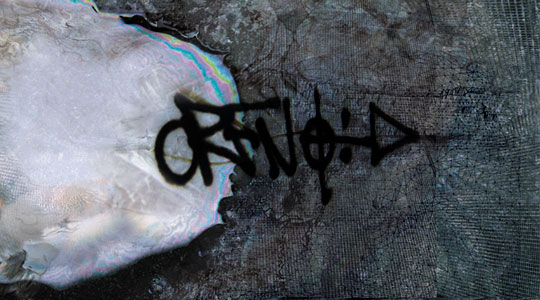
Orphan_Drift_540x300Here’s a taste of what you can expect on Thursday evening:

BACKGROUND
In the mid-90s, the legendary Cyber Culture Research Unit at the prestigious Warwick University was formed: their university-funded activities included producing collaged texts of Deleuze and Guattari, William Burroughs and binary code, theorising the occult underpinnings of markets, composing abrasive electronic music and, ostensibly, consuming inhuman doses of psychedelics as often as possible, much of this via the ORPHAN DRIFT collaborative artist project. A few years later, the CCRU was no more; founding member Nick Land – a genius philosopher and agent provocateur – had achieved full meltdown / deterritorialization and Sadie Plant, author of the well-known Writing On Drugs, had disappeared from sight.

The legacy of the CCRU is very much alive today though, a subterranean influence for the very latest movements in philosophy.

ABOUT ORPHAN DRIFT
Mer co-created the collaborative artist and hive mind 0rphan Drift in London in 1994. Although it was predominantly made up of visual artists, it also involved sound designers, concept engineers and media activists.

As an artistic entity, 0rphan Drift is known for immersive and visually complex works which use the sample and the remix extensively, treating information as matter and the image as a unit of contagion. The art produced is science fictional and immersive. It complicates the distinctions between material and immaterial phenomena and dimensions, both in content and media. Much of its work explored mimetic patterns of desire, production and consumption- particularly in relation to the rapid technological changes happening at the time- drawing heavily on cyberpunk fiction, polyrhythmic electronica and the underpinnings of African religious systems. This was the social context in which its shifting layers of frightening, disturbing, abject, schizophrenic, beautiful, deconstructive, poetic and fragmented frequencies were able to take affect.

0rphan Drift is cross-contextual and made extensive contributions from 1994 – 2004 in the social arenas around contemporary art, underground music and cyber-feminism/post-structural philosophy. 0D has participated internationally in over a decade of exhibitions, screenings and performance, exhibiting extensively in the UK, Europe, Canada and the States, including at the Cabinet Gallery and Tate Modern in London; writing the Scifi-theory text ‘Cyberpositive’, and featuring in DJ Spooky’s ‘Sound Unbound’ in the ‘Renegade Academics’ chapter. It contributed cybervisuals to the set of Stephen Speilberg’s ‘AI’ and ‘Minority Report’ features and Leftfield and NIN world tours, worked frequently with Kode 9 and participated in 10 years of international Video art and AV Electronica art events in Norway, Germany, Canada, UK, South Africa and USA.

We now collaborate between Cape Town and San Francisco and continue to make science fictional work which is guided by a neo-futurist sensibility and clearly a progression from our earlier work. Our new video work ‘Wilderness of Elsewheres, Colony 1’, which maps contemporary global concerns with survival, insecurity and the unknown, has been shown in Santiago and San Francisco and we subsequently produced a series of Post Apocalyptic postcards for Shadowshop; Stephanie Syjuco’s parasitic shop at SFMOMA. Recently we made video for Delphi Carsten’s Capetown Tedx Talk, ‘Hyperstition’, and were commissioned make ‘You Its Eyes 94-13’ for screening at CTM13, Berlin.

WHAT WE’LL BE SCREENING / HOSTING THIS THURSDAY EVENING

1: You Its Eyes. 1994-2013, 30 minute video remixing 0D’s earlier work
0D employs different frequencies and overlapping rhythmic patterns to activate submerged regions of the brain and create intimacy and proximity through video-sonic signal. The goal of 0D, writes Simon Reynolds (1996), is “the liberation of texture from its environment, of energy-flux from contoured form with the goal to recreate the intensity of being lost”. 0D describes the individual ‘self’ haunted by a sensory cross-talk of signals from realms beyond the physical. Voices from imagined futures haunt the contemporary technological landscape. Feedback from the machines evolves into an unfamiliarity of speed and complexity, coding the textual body and imagination as tools for change. The invisible, fantastical, and anarchic called upon here are what Deleuze and Guattari define as the essence of virtuality. These intensities carry the sorcerous forces that technology and science unleash as they delve further into the quantum, the chaotic and the abstract.

“Surrounding the human self and its island of experience lies a raging sea of intensities” (D&G). All journeys into this space involve a succession of becomings autistic, mimetic, contagious and machinic.

2: Hyperstition – A talk by Delphi Carstens
Delphi is a lecturer at UWC, as well as half of the duo which makes up Groovy Troopers Productions – creators of temporary autonomous zones in the form of art & trance festivals. Delphi is currently completing a doctorate thesis, and will present on: “hyperstition” — a neologism coined by Nick Land that combines the words ‘superstition’ and ‘hype’ to describe how fictions become fact and how our narratives (stories) shape our world. It also describes, particularly, the narrative of capitalism, which is driven by hype and speculation and, which more importantly, turns fictions into facts. One very important fiction that Delphi will be discussing is the fiction of the apocalypse. Focusing on the current secular meaning of apocalypse as well as how popular culture views our current global crisis and the importance of imagining ourselves differently. Hyperstition also describes the nexus where myth or magic and science meet. Delphi explores the world of hyperstition to describe the manner by which hype and speculation become facts in contemporary society. The future is looking uncertain and how we imagine this future may be more important than we realise. This talk will be both an intellectual and a felt experience.

3: A Wilderness Of Elsewheres. 2009, 10 minutes
A two-screen installation in which dark abstract video spaces flow into bright photographic landscapes (the raw desolate tundras of southern Africa), populated and de-populated by animated collages of architecture and fashion, cut and scanned from contemporary print publications. A deliberate rhythmic awkwardness creates an alien time frame. The screens share a soundscape, made from a wide variety of samples including glaciers melting and rocket launches, composed into a sonic ‘event’. The work is imbued with post-apocalyptic sensibility, urges to the neo-romantic and the science fictional blending of first and third world materiality. At once immersive and deconstructive, the work is collision, co-habitation, evolutionary fever-dream.

Join us in mapping the outer edges — and do come earlyish if you want to sit down while doing so ;) !

expose yourself to reality exposed

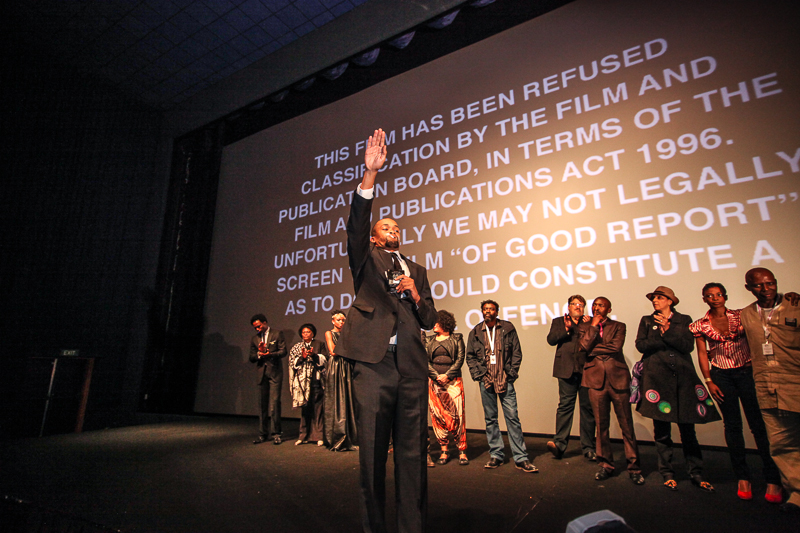
Diff-Opening-2Written by Sarah Dawson

On July 18, the Film and Publication Board’s refusal to classify the would-be opening film of the Durban International Film Festival, Jahmil XT Qubeka’s Of Good Report, became the flint that sparked the latest South African aesthetic controversy.

Unclassified films are illegal to screen, which means that this is a functional ban on the production. The ruling was imposed on the basis of having interpreted the representation of a sexual encounter of a Grade 9 pupil, Nolitha, (played by the 23-year old actress Petronella Tshuma) as being child pornography.

Tongues have been wagging in creative circles and the media, and given that the film is divorced from any overt perspective on political matters (as in the case ofThe Spear), it is clear that this matter relates to some quite primal conflict over the interpretation of a particular image.

In this case, the battle over meaning is taking place in the awkward, sexually liminal space of the moment of the young female character’s transition from archetypal “virgin” to archetypal “whore”, and what she, the figure of the girl, means.

It probably wouldn’t be completely unfair to assume that the film is objectionable to the classification board because of this very liminality, and the way in which the morality embedded in the process clearly regards anything that isn’t exclusively either “virgin” or “whore” as a kind of abomination.

This act of censorship is fundamentally based on a conflict of representation – meaning it’s as much an aesthetic one as it is an ideological one. This means that we need to be asking not the obvious and common question of whether we should or shouldn’t be allowed to depict female children in an erotic light, but rather what actually is a female child, and what is an erotic light?

South African film and South African audiences remain equally conservative. The idea that representations of people, places, things and events can have a lot of different meanings and aren’t consistently, singularly defined is, surprisingly, not taken for granted by the typical South African viewer, practitioner or institution of film.

We aren’t yet comfortable with the multifarious nature of representation, and expend a lot of hot air trying to settle on the one, all-encompassing, so-called “South African voice”, which it turns out, we’re really struggling to locate.

It’s a self-evidently flawed project, because its ridiculous to think that such a thing could ever actually exist in a finite sense.

Read the rest of this article HERE.

busker by-law? there is no busker by-law

For anyone who’s been following what’s been happening since blind busker Lunga Nono was publicly assaulted and arrested by Cape Town police recently… Also watch Nono’s own account of events HERE.

T.O. Molefe's avatarThe Modular Man

Image

This started out as an admonishment of Cape Town residents for our tardy outrage and showboat sense of civic responsibility. We turned up in huge numbers, I was going to say, when city law-enforcement officers publicly assaulted and arrested Lunga Gooodman Nono, but where were we when the laws and regulations he supposedly fell foul of were made? Public participation in law-making, after all, forms one of the key pillars of our constitutional democracy. It’s on us if unjust laws make it into the statute books.

View original post 893 more words

dear daily mail – sincerely, amanda palmer

When the UK’s Daily Mail tabloid paper covered Amanda Palmer’s recent performance at Glastonbury, they didn’t mention anything about the music that she played, choosing to focus only on a brief moment where her breast “escaped her bra”.

Palmer wasn’t thrilled about the lack of coverage her performance received and the extent of attention that was paid to her so-called wardrobe malfunction, and she decided to respond to the paper live on stage. About halfway through her hilarious and cutting song, she strips almost entirely naked. Astute:

bifo berardi on how to act now

I must act “as if”. As if the forces of labour and knowledge may overcome the forces of greed and of proprietary obsession. As if the cognitive workers may overcome the fractalisation of their life and intelligence, and give birth to a process of the self-organisation of collective knowledge. I must resist simply because I cannot know what will happen after the future, and I must preserve the consciousness and sensibility of social solidarity, of human empathy, of gratuitous activity, of freedom, equality and fraternity. Just in case, right? Just because we don’t know what is going to be happening next, in the empty space that comes after the future of modernity. I must resist because this is the only way to be in peace with my self.

— Franco “Bifo” Berardi, from After the Future

bataille on the insubordination of material facts

Human life, distinct from juridical existence, existing as it does on a globe isolated in celestial space, from night to day and from one country to another—human life cannot in any way be limited to the closed systems assigned to it by reasonable conceptions. The immense travail of recklessness, discharge, and upheaval that constitutes life could be expressed by stating that life starts with the deficit of these systems; at least what it allows in the way of order and reserve has meaning only from the moment when the ordered and reserved forces liberate and lose themselves for ends that cannot be subordinated to any thing one can account for. It is only by such insubordination—even if it is impoverished—that the human race ceases to be isolated in the unconditional splendour of material things.

― Georges Bataille, from The Notion of Expenditure

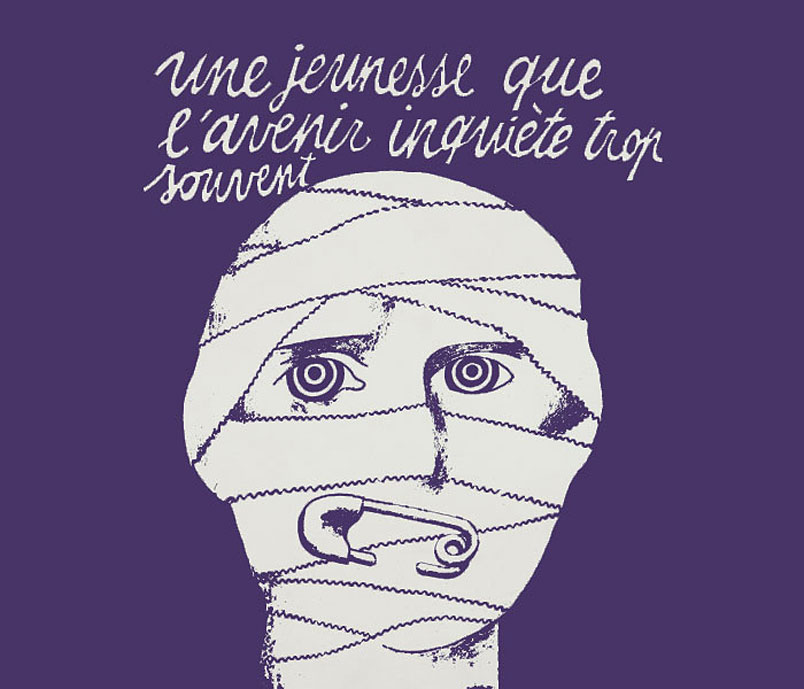
a young woman too often worried about the future

Anonymous Situationist Poster from 1968 Student Strike in Paris

Anonymous Atelier Populaire Poster from May 1968 Student Strike in Paris

1968 was the year when political struggle for freedom culminated in global protests that shaped the future of youth culture. Paris in May 1968, under the conservative constraints of De Gaulle and amid an atmosphere of poverty and unemployment, played host to some of the most widespread and fervent revolts the city had witnessed. Clashes between citizens and state brought Paris to a halt and left its leader clinging on for his dear political life.

After a week of particularly violent clashes, militant posters with strong colours and bold graphic messages started appearing in the streets — plastered on walls, pasted onto barricades, and carried as placards in demonstrations. Produced as “weapons in the service of the struggle” by the Atelier Populaire, the outfit newly set up by students and teachers at the École des Beaux Arts, these anonymous prints combine powerful imagery with impassioned slogans on mistrust of the media, hatred of the reigning political party and solidarity with the workers to provocative effect.

More posters and info HERE.


poesboekies

This celebration of 80s South African pulp photo comic culture was made by Lloyd Ross and Robbie Thorpe in the late 1990s.

And here’s a piece on the subject written by DR Walker:

In 1980, like so many other white males, I was dragged kicking and screaming into that institution we would come to know as the SADF. The culture shock was enormous, legions of brown clad eenvormigge troepies all marching to the tune of the National party. After almost a year of rondfok and “training” I eventually ended up in the “Operational Area” or “The Border” as it was so commonly known.

Diversions were few and far between; drinking, talking kak, getting messed around, an occasional incursion by Swapo, and reading whatever came to hand. Newspapers were great but they reminded us of home too much so we avoided them. Paperbacks we never saw or they were invariably bad cowboy novels. Our all time favourite though were those beloved and much maligned “Photo Picture Libraries” or, as we so fondly knew them: “P*** Boekies”. These trashy produced pieces of literature fascinated us because you did not need an imagination, and if you did not understand the text you could always look at the pictures. They were better than a comic and were made in South Africa too.

Of course we all had our favourites, there was “Tessa”, a platinum blonde who strutted around in a bikini all day, running through the jungles of urban South Africa while clad in her cossie and high heels. Clashing with sinister suit and shade wearing individuals who were clearly “the bad guys” Naturally she always came out on top, the hair on that blonde head not even disturbed. As far as we were concerned she was akin to a Goddess and she would have been mobbed had she ever come to the border. With hindsight, those same bad guys looked very much like the guys who appeared before the Truth Commission and spilt so much dirty laundry. Maybe Tessa knew something we did not?

Remember “Swart Luiperd, Wit Tier, Kaptein Duiwel, Grensvegter” and all that ilk? They were out in the bushes clutching their wooden machine guns, (this is a rifle, this is a gun, this is for shooting, this is for fun), killing off naughty cigar smoking Cuban clones who held the proverbial dishevelled damsel in distress captive after her convoy/aircraft/helicopter/hospital was invaded/crashed/broke down (delete whichever is not applicable). By our reckoning we were not needed on the border, those three guys would solve all the problems and we could go home to start our long delayed civvy existence. Now that I think of it, just maybe they were really out there doing dirty deeds while we were being fed propaganda about how good the SADF and SAP were. Go on reading HERE.

For a critical history of South African pulp comics, read Sean O’Toole’s 2012 Mail & Guardian piece.

jane elliot’s brown eyes/blue eyes racism experiment

It all seemed like a game at first… Watch this brilliant teacher recreate segregation in her 3rd grade classroom at the end of the 1960s, to demonstrate the arbitrary violence and effects of discrimination. A profound object lesson, and one the world still hasn’t been able to grasp; this is essential viewing. More about Jane Elliot’s work can be found HERE.

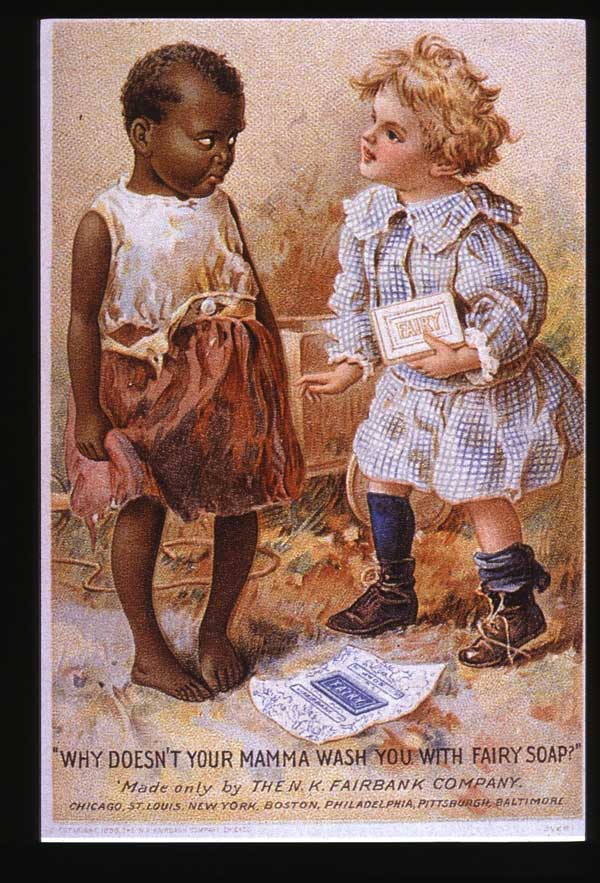
fairbanks-fairy-soap

essentially

hate and love

If only a change of heart could magically repair the concrete effects of centuries of evil and dispossession overnight… It can’t, but thank you, Nelson Rolihlahla Mandela, for holding on to hope; for leading by example. If we all started living from an unselfish basis of love and respect, things WOULD shift.

luce irigaray – women on the market

Chapter Eight from This Sex Which Is Not One, 1985. This text was originally published as “Le marche des femmes,” in Sessualita e politica, (Milan: Feltrinelli, 1978).

hands on experience

The society we know, our own culture, is based upon the exchange of women. Without the exchange of women, we are told, we would fall back into the anarchy (?) of the natural world, the randomness (?) of the animal kingdom. The passage into the social order, into the symbolic order, into order as such, is assured by the fact that men, or groups of men, circulate women among themselves, according to a rule known as the incest taboo.

Whatever familial form this prohibition may take in a given state of society, its signification has a much broader impact. It assures the foundation of the economic, social, and cultural order that has been ours for centuries.

Why exchange women? Because they are “scarce [commodities] . . . essential to the life of the group,” the anthropologist tells us.1 Why this characteristic of scarcity, given the biological equilibrium between male and female births? Because the “deep polygamous tendency, which exists among all men, always makes the number of available women seem insufficient. Let us add that even if there were as many women as men, these women would not be equally desirable … and that, by definition. . ., the most desirable women must form a minority. “2

Are men all equally desirable? Do women have no tendency toward polygamy? The good anthropologist does not raise such questions. A fortiori: why are men not objects of exchange among women? It is because women’s bodies – through their use, consumption, and circulation – provide for the condition making social life and culture possible, although they remain an unknown “infrastructure” of the elaboration of that social life and culture. The exploitation of the matter that has been sexualized female is so integral a part of our sociocultural horizon that there is no way to interpret it except within this horizon.

In still other words: all the systems of exchange that organize patriarchal societies and all the modalities of productive work that are recognized, valued, and rewarded in these societies are men’s business. The production of women, signs, and commodities is always referred back to men (when a man buys a girl, he “pays” the father or the brother, not the mother … ), and they always pass from one man to another, from one group of men to another. The work force is thus always assumed to be masculine, and “products” are objects to be used, objects of transaction among men alone.

Which means that the possibility of our social life, of our culture, depends upon a ho(m)mo-sexual monopoly? The law that orders our society is the exclusive valorization of men’s needs/desires, of exchanges among men. What the anthropologist calls the passage from nature to culture thus amounts to the institution of the reign of hom(m)o-sexuality. Not in an “immediate” practice, but in its “social” mediation. From this point on, patriarchal societies might be interpreted as societies functioning in the mode of “semblance.” The value of symbolic and imaginary productions is superimposed upon, and even substituted for, the value of relations of material, natural, and corporal (re)production.

sensualist gif

From “The Sensualist”, Kōshoku Ichidai Otoko’s animated interpretation of the 17th century novel by Ihara Seikaku

In this new matrix of History, in which man begets man as his own likeness, wives, daughters, and sisters have value only in that they serve as the possibility of, and potential benefit in, relations among men. The use of and traffic in women subtend and uphold the reign of masculine hom(m)o-sexuality, even while they maintain that hom(m)o-sexuality in speculations, mirror games, identifications, and more or less rivalrous appropriations, which defer its real practice. Reigning everywhere, although prohibited in practice, hom(m)o-sexuality is played out through the bodies of women, matter, or sign, and heterosexuality has been up to now just an alibi for the smooth workings of man’s relations with himself, of relations among men.

Whose “sociocultural endogamy” excludes the participation of that other, so foreign to the social order: woman. Exogamy doubtless requires that one leave one’s family, tribe, or clan, in order to make alliances. All the same, it does not tolerate marriage with populations that are too far away, too far removed from the prevailing cultural rules. A sociocultural endogamy would thus forbid commerce with women. Men make commerce of them, but they do not enter into any exchanges with them. Is this perhaps all the more true because exogamy is an economic issue, perhaps even subtends economy as such? The exchange of women as goods accompanies and stimulates exchanges of other “wealth” among groups of men. The economy in both the narrow and the broad sense-that is in place in our societies thus requires that women lend themselves to alienation in consumption, and to exchanges in which they do not participate, and that men be exempt from being used and circulated like commodities.

*

Marx’s analysis of commodities as the elementary form of capitalist wealth can thus be understood as an interpretation of the status of woman in so-called partriarchal societies. The organization of such societies, and the operation of the symbolic system on which this organization is based-a symbolic system whose instrument and representative is the proper name: the name of the father, the name of God-contain in a nuclear form the developments that Marx defines as characteristic of a capitalist regime: the submission of “nature” to a “labor” on the part of men who thus constitute “nature” as use value and exchange value; the division of labor among private producer-owners who exchange their women-commodities among themselves, but also among producers and exploiters or exploitees of the social order; the standardization of women according to proper names that determine their equivalences; a tendency to accumulate wealth, that is, a tendency for the representatives of the most “proper” names-the leaders-to capitalize more women than the others; a progression of the social work of the symbolic toward greater and greater abstraction; and so forth.

To be sure, the means of production have evolved, new techniques have been developed, but it does seem that as soon as the father-man was assured of his reproductive power and had marked his products with his name, that is, from the very origin of private property and the patriarchal family, social exploitation occurred. In other words, all the social regimes of “History” are based upon the exploitation of one “class” of producers, namely, women. Whose reproductive use value (reproductive of children and of the labor force) and whose constitution as exchange value underwrite the symbolic order as such, without any compensation in kind going to them for that “work.” For such compensation would imply a double system of exchange, that is, a shattering of the monopolization of the proper name (and of what it signifies as appropriative power) by father-men.

Thus the social body would be redistributed into producer-subjects no longer functioning as commodities because they provided the standard of value for commodities, and into commodity objects that ensured the circulation of exchange without participating in it as subjects.

*

Let us now reconsider a few points (3) in Marx’s analysis of value that seem to describe the social status of women.

Wealth amounts to a subordination of the use of things to their accumulation. Then would the way women are used matter less than their number? The possession of a woman is certainly indispensable to man for the reproductive use value that she represents; but what he desires is to have them all. To “accumulate” them, to be able to count off his conquests, seductions, possessions, both sequentially and cumulatively, as measure or standard(s).

All but one? For if the series could be closed, value might well lie, as Marx says, in the relation among them rather than in the relation to a standard that remains external to them – whether gold or phallus.

The use made of women is thus of less value than their appropriation one by one. And their “usefulness” is not what counts the most. Woman’s price is not determined by the “properties” of her body-although her body constitutes the material support of that price.

But when women are exchanged, woman’s body must be treated as an abstraction. The exchange operation cannot take place in terms of some intrinsic, immanent value of the commodity.

It can only come about when two objects-two women are in a relation of equality with a third term that is neither the one nor the other. It is thus not as “women” that they are exchanged, but as women reduced to some common feature-their current price in gold, or phalluses-and of which they would represent a plus or minus quantity. Not a plus or a minus of feminine qualities, obviously. Since these qualities are abandoned in the long run to the needs of the consumer, woman has value on the market by virtue of one single quality: that of being a product of man’s “labor.”

On this basis, each one looks exactly like every other. They all have the same phantom-like reality. Metamorphosed in identical sublimations, samples of the same indistinguishable work, all these objects now manifest just one thing, namely, that in their production a force of human labor has been expended, that labor has accumulated in them. In their role as crystals of that common social substance, they are deemed to have value.

Liu Jianhua - ceramic

Liu Jianhua – ceramic

As commodities, women are thus two things at once: utilitarian objects and bearers of value. “They manifest themselves therefore as commodities, or have the form of commodities, only in so far as they have two forms, a physical or natural form, and a value form” (p. 55).

But “the reality of the value of commodities differs in respect from Dame Quickly, that we don’t know ‘where to have it”’ (ibid.). Woman, object of exchange, differs from woman, use value, in that one doesn’t know how to take (hold of) her, for since “the value of commodities is the very opposite of the coarse materiality of their substance, not an atom of matter enters into its composition. Turn and examine a single commodity, by itself, as we will. Yet in so far as it remains an object of value, it seems impossible to grasp it” (ibid.). The value of a woman always escapes: black continent, hole in the symbolic, breach in discourse . . . It is only in the operation of exchange among women that something of this-something enigmatic, to be sure-can be felt. Woman thus has value only in that she can be exchanged. In the passage from one to the other, something else finally exists beside the possible utility of the “coarseness” of her body. But this value is not found, is not recaptured, in her. It is only her measurement against a third term that remains external to her, and that makes it possible to compare her with another woman, that permits her to have a relation to another commodity in terms of an equivalence that remains foreign to both.

Women-as-commodities are thus subject to a schism that divides them into the categories of usefulness and exchange value; into matter-body and an envelope that is precious but impenetrable, ungraspable, and not susceptible to appropriation by women themselves; into private use and social use.

In order to have a relative value, a commodity has to be confronted with another commodity that serves as its equivalent.

Its value is never found to lie within itself And the fact that it is worth more or less is not its own doing but comes from that to which it may be equivalent. Its value is transcendent to itself, super-natural, ek-static.

In other words, for the commodity, there is no mirror that copies it so that it may be at once itself and its “own” reflection. One commodity cannot be mirrored in another, as man is mirrored in his fellow man. For when we are dealing with commodities the self-same, mirrored, is not “its” own likeness, contains nothing of its properties, its qualities, its “skin and hair.” The likeness here is only a measure expressing the fabricated character of the commodity, its trans-formation by man’s (social, symbolic) “labor.” The mirror that envelops and paralyzes the commodity specularizes, speculates (on) man’s “labor.” Commodities, women, are a mirror of value of and for man. In order to serve as such, they give up their bodies to men as the supporting material of specularization, of speculation. They yield to him their natural and social value as a locus of imprints, marks, and mirage of his activity.

Commodities among themselves are thus not equal, nor alike, nor different. They only become so when they are compared by and for man. And the prosopopoeia of the relation of commodities among themselves is a projection through which producers exchangers make them reenact before their eyes their operations of specula(riza)tion. Forgetting that in order to reflect (oneself), to speculate (oneself), it is necessary to be a “subject,” and that matter can serve as a support for speculation but cannot itself speculate in any way.

Thus, starting with the simplest relation of equivalence between commodities, starting with the possible exchange of women, the entire enigma of the money form-of the phallic function-is implied. That is, the appropriation-disappropriation by man, for man, of nature and its productive forces, insofar as a certain mirror now divides and travesties both nature and labor. Man endows the commodities he produces with a narcissism that blurs the seriousness of utility, of use.

Desire, as soon as there is exchange, “perverts” need. But that perversion will be attributed to commodities and to their alleged relations. Whereas they can have no relationships except from the perspective of speculating third parties.

The economy of exchange-of desire-is man’s business. For two reasons: the exchange takes place between masculine subjects, and it requires a plus-value added to the body of the commodity, a supplement which gives it a valuable form. That supplement will be found, Marx writes, in another commodity, whose use value becomes, from that point on, a standard of value.

But that surplus-value enjoyed by one of the commodities might vary: ‘Just as many a man strutting about in a gorgeous uniform counts for more than when in mufti” (p. 60). Or just as “A, for instance, cannot be ‘your majesty’ to B, unless at the same time majesty in B’s eyes assume the bodily form of A, and, what is more, with every new father of the people, changes its features, hair, and many other things besides” (ibid.).

Commodities – “things” produced – would thus have the respect due the uniform, majesty, paternal authority. And even God. “The fact that it is value, is made manifest by its equality with the coat, just as the sheep’s nature of a Christian is shown in his resemblance to the Lamb of God” (ibid.).

Commodities thus share in the cult of the father, and never stop striving to resemble, to copy, the one who is his representative. It is from that resemblance, from that imitation of what represents paternal authority, that commodities draw their value – for men. But it is upon commodities that the producers-exchangers bring to bear this power play. “We see, then, all that our analysis of the value of commodities has already told us, is told us by the linen itself, so soon as it comes into communication with another commodity, the coat. Only it betrays its thoughts in that language with which alone it is familiar, the language of commodities. In order to tell us that its own value is created by labour in its abstract character of human labour, it says that the coat, in so far as it is worth as much as the linen, and therefore is value, consists of the same labour as the linen. In order to inform us that its sublime reality as value is not the same as its buckram body, it says that value has the appearance of a coat, and consequently that so far as the linen is value, it and the coat are as like as two peas. We may here remark, that the language of commodities has, besides Hebrew, many other more or less correct dialects. The German ‘werthsein,’ to be worth, for instance, expresses in a less striking manner than the Romance verbs ‘valere,’ ‘valer,’ ‘valoir,’ that the equating of commodity B to commodity A, is commodity A’s own mode of expressing its value. Paris vaut bien une messe” (pp. 60-61).

So commodities speak. To be sure, mostly dialects and patois, languages hard for “subjects” to understand. The important thing is that they be preoccupied with their respective values, that their remarks confirm the exchangers’ plans for them. Continue reading

oh sister where art thou? – la vie en rose

From The Lost Phone Recordings. This was recorded on a Nokia 95 phone by my sister Erica and me, playing around in my lounge a couple of years ago, inspired by a music box I picked up in Montmartre in 2007…  Our little music project, Oh Sister Where Art Thou?, was about trying to position ourselves playfully in relation to the performance of nostalgic pop classics. While the music may sound simple and cutesy, it was pretty complicated to negotiate. Issues of identity, history, place, privilege, voice, language, racial politics, respect, pastiche, authenticity, memory, erasure, iteration all intertwined… More to be written about this another day when I have time!

marimba memories

achiclose

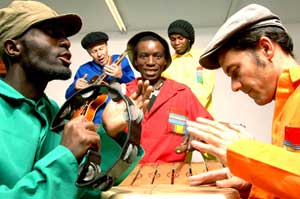
In the year 2000 I stopped my beat-up old car to help two guys who were carrying marimbas and gave them a lift up to Melville. On the way we got to chatting, discovered we were all musos, and I decided to come and jam with them while they busked, which I did, a few nights later.

This pair used to come all the way in from Orange Farm township in the Vaal, almost 40km out of Joburg, to busk until midnight outside Melville’s clubs and restaurants, then take a taxi or train home again. So whatever they earned, which was often a pittance, had to cover considerable transport costs – one of apartheid’s architectural legacies, which will take generations to change.

I kept playing with these two guys on the streets, for a couple of years, through winter and summer, on my djembe, cos it was quite something to experience. We were all from Zim, so we had something in common. It wasn’t the first time I had played with so-called black musicians, having played djembe with a maskande outfit called Abafana Bakwa Zulu a couple of years previous to this, but busking was new to me.

Busking is quite a cool way to get really fit on your instrument, and tight as a band. It’s kind of halfway between practicing and performing … sometimes you have an audience, and you have to step it up, and sometimes you don’t, and you can experiment with new songs and licks. If a crowd gathers you can hit on a song for like, 10 or 15 minutes, as long as they are getting into it, which can create some pretty deep calluses if you happen to be a drummer.

In winter, it got so cold that I used to play with a T-shirt, long-sleeve shirt, jersey and leather biker jacket on, plus a hat, even though I was drumming full-tilt. The crap thing about playing a djembe drum outside in the cold is that your hands are moving, creating wind, so even though they are hitting the goatskin hard, on the way up and down they are cooling off, and never really warm up.

Time passed and our little group, which we called Chapungu – meaning ‘whirlwind’ in Shona – apparently it has other, mystical connotations – became fairly good. The dudes found a place to store their instruments, or they would store them at my place, making getting to and from our favourite busking place on the corner of 7th and 4th in Melville much easier. We started getting better tips – we even got a R200 note from a tourist once – and we made a free one-day recording dubbed Sons of the Sun with a guy called Adrian Ziller, bless his heart. My friends helped to design the album cover and print it.

I started visiting the dudes in Orange Farm, which was a full-on jol. Many so-called whites think townships are miserable places, full of suffering and hardship. I’m sure they can be, especially at night in winter, or when the wind howls through Orange Farm, whipping up the dust.

But on my visits, I found a tangible sense of community; neighbours would wander in while we played and get into the vibe. Gangs of kids and dogs would pass by; fences were few and far between. I was uplifted by the music, which was, I guess, our common language, and started playing at events with the dudes, at schools, cultural gatherings, sports meetings, weddings.

There were quite a few kids who used to come and play with the adults; generally the girls would dance and the boys would drum or play on the marimbas, which were all handmade. We started making uniforms for them, with cloth supplied by my friends, or gathered from here and there in the township. The singer’s partner was carving out dance routines for the girls. Things were gathering momentum.

There was a couple in Joburg who were also keen to help our band; they had access to a trust fund, and donated some money which was used to buy tools, which were to be used for making marimbas. We also tried making drums, but it’s not an easy thing to make a good drum.

This couple took us on a trip to visit the Khomani San, who had been granted land by the SA government – but not the means to make a living from it. This couple, they were trying to set things up for some of the Bushmen, a camp which tourists could sleep at, a place to grow indigenous plants, that kind of thing. We met Dawid Kruiper, who was quite famous for his role in getting the land, and a couple of San sangomas. We slept in the camp, which was full of large, black scorpions, and read Tarot cards on the roof of the Landrover, while high on Sceletium, which gives you loads of energy, a natural speed. We dropped our pants and gave brown-eye to the bottle store. It was quite a trip.

Then the couple organised a group of musicians and performers to go on a country-wide tour to advertise a new MTN product. It was called the Multi-Talented Nomad tour, but I didn’t go on it, cos I was working full-time and couldn’t get two weeks’ leave. The guys went on the tour, made a couple of thousand bucks, and decided to go and visit the same Bushmen again, but this return trip didn’t go too well. They apparently shagged some of the Bushmen prostitutes and at least one of them caught AIDS. The singer, a short, fiery character with only one eye – died a few years later. He didn’t make it to the era of ARVs, when having AIDS is no longer a death sentence.

Things had started falling apart even before he died. As soon as we got funding, he and the bassist started arguing about who owned what, and the tools bought with the funding were kept at the singer’s place, and the whole positive vibe started crumbling.

Sometimes they would bitch at me about each other and I just hated being the middle. Fuck that. I really didn’t want to take sides. I was trying to help, not because I thought I should, but because I had just ended up getting involved in the music with these guys and I often had the means to help – the access to transport, to money, to the media. It was unavoidable, but sometimes it had unforeseen consequences.

Eventually, Chapungu broke up, and shortly afterward I was invited to take part in a musical play at the Aardklop festival in Potchefstroom, with the bassist and a group of performers from Orange Farm. We had a teacher who had toured Germany and he knocked our performance into shape, around the idea of a Magic Marimba Tree, from which music came, and provided nourishment to a parched land. I was the white priest, and wore a dog-collar for the role.

When we drove down to Potch I was the only so-called white in the cast of about 14 people. We played on the fringe of the festival and did workshops in the townships. I ate and slept in a room full of blacks, who seldom spoke English … my fault for not knowing Zulu, I guess. The best part was between gigs, as we jammed all day at the backpackers we were staying in, often with outsiders from the festival, who heard us and joined in.

Our mentor came to watch our final performance, hated it, and crapped all over us. We were totally dispirited. Then he wanted to ride back to Joburg in my car, not the overloaded minibus the rest of the crew were to travel in. I split before he could get in, pissed off with his attitude. We had tried our hardest to do a good show. Then we couldn’t get our money out of him. We only got paid after I threatened to put a debt collector on his ass.

The most vivid memory from the whole show, which went on for about a week, was when a beautiful young woman in the cast, who I had been eyeing from the start, stood behind me on the stage and softly put her hands on my shoulders, during the encore. Nothing more happened, but it was an intimate acknowledgment. I see you.

After Aardklop, some of the performers started congregating round the bassist’s place, practicing on the marimbas, and continuing with coaching kids, who would come in after school to play. They were also playing at a nearby school, the kids were winning prizes for their performances, it was all very organic and grassroots. I set up a website for the group. We started playing gigs at cultural events like the Green Africa Party, and then got onto the books of booking agencies, and began playing at corporate events like year-end parties. We made business cards, bought bright uniforms, and started playing quite regularly. This was before the recession, which killed the golden goose of regular corporate gigs, for us and loads of other musicians, including my drum teacher.

I was still doing a day-job, and was asked to write a piece on jazz experimental maestro Zim Ngqawana by the Daily Sun. I met his agent at the Zimology Institute, which he had set up for his jazz students, ironically right next to Orange Farm township. I got to know his agent better, and she helped us to set up an NGO for the musical training of the township kids. After some applications – again, with the help of a friend – we obtained funding, enough to provide the adults with salaries for a couple of years, and to buy some better musical instruments.

This era was our peak. Both the kids and the adults were getting lots of gigs. The kids took part in the FNB Dance Festival a couple of times and won prizes at the National Marimba Competition. They appeared on TV shows and in newspapers; soon we had an entire album of photos and clippings.

The adult group was traveling all over Gauteng and beyond, playing at weddings and parties and openings. A really good (so-called white) guitarist joined the crew, adding an extra car and skilled licks. I evolved a new style of playing the drums, with the djembe where the snare usually stands, and the snare off to the left. I could switch fast between snare and djembe, and play hi-hat and bass foot with both.

We had a huge repertoire of songs, way over 50 songs; some were covers, but many were originals, which had evolved over years of playing. We were playing gospel songs, African jazz, traditional African songs, including some Chimurenga stuff (Zim protest music) and some more bluesy and reggae stuff.

We got a trailer to put the marimbas in; slept over in posh places and demanded, and got, proper meals and treatment from clients, via the contracts with our agencies. Achimota also brought out a CD, recorded free of charge by Brendan Jury, called Ukuxolelana (Forgiveness).

But, after a time, cracks began to show. A key member of the group left to pursue his own musical career. His replacement had less energy and the group, already low on vibrancy, started losing impetus. The recession provided less jobs … the funding for the NGO dried up. The problem of getting to practices, when the guys were 40km out of town, was a thorn in our flesh from the start, but it didn’t matter when we were all into the whole thing – we basically practiced when we played at gigs. Now it was just this massive divide. We weren’t learning new songs, and things were getting stale.

I started standing back, trying to get the other members of the band involved in setting up gigs, obtaining funding, running things themselves. But no-one seemed willing, or able, to keep the ball rolling. I became tired of putting in time and effort, to make things happen: organising gigs, drawing money, sorting paperwork, dealing with clients, auditors and agents.

There were two final straws which made me pull out after twelve years of playing with my marimba mates. On both occasions, we were booked to play for corporate clients, and the guys didn’t pitch on time. I was left carrying the can, got crapped out by the agent and client both times, and, on the last gig, we lost our one remaining agent in the process. That was it.

I had so many experiences with these guys. We travelled thousands of kilometres together, listening to reggae and world music, dreaming of the day when Mugabe would finally die and we could visit Zim to dance on his grave. We often slept in the same room en route to gigs, and I even shared the same bed with them a couple of times.

We played to ecstatic, wildly dancing audiences, and totally bored executives, who would have likely preferred wallflowers to our presence… the catering staff at events was usually our best audience! We fixed broken trailers, cars, instruments, egos and homes together. We busked in Newtown for the whole of the Fifa World Cup. I even did sweat lodges and took psychedelics with some of the dudes.

But there was always that line, that divide, between black and white, between middle-class and poor, between living in town and living in township. It was crossed at times, but it always returned. I count myself lucky that I caught a glimpse of a totally different type of lifestyle and culture to that of white urban Johannesburg.

The door to Orange Farm is still slightly open. I still see the bassist now and then; he is teaching marimbas at a school in Joburg, and is now playing with his uncle, from Zim, who taught him how to play. That sounds innarestin. Me and the guitarist are going to go check it out one of these days. Because there is something utterly organic and magical about playing marimba music. No getting round that.

There were times when I grew frustrated, because things didn’t pan out the way I hoped they would, but overall I don’t regret the experience. Things are born and then they die. I read, in an article on South African NGOs, that you never know what effect you are going to have when you set up structures in poor communities. You have an idea of things going one way; they end up going in another. There might be one or two kids who become brilliant performers after having played with Achimota or Chapungu, or perhaps it changed their lives in some other way, a way which I couldn’t possibly have predicted. That would be enough. For me,  my life and music were sure as hell enriched.

Having reread what I just wrote, I realise how much my friends and partners helped me, every step along the way with this crazy adventure, and if they ever read this, thanks a ton guys. We couldn’t have done it without you. At base, at heart, people want to help each other; often, they just don’t know how, but there channels, if you look, or if they find you. This whole dog-eat-dog system that’s been forced down our throats, it’s a load of balls. A lot of us are learning to see past that now. I hope it keeps spreading.

howard zinn: “you can’t be neutral on a moving train”

“Civil disobedience is not our problem. Our problem is civil obedience. Our problem is that people all over the world have obeyed the dictates of leaders…and millions have been killed because of this obedience… Our problem is that people are obedient all over the world in the face of poverty and starvation and stupidity, and war, and cruelty. Our problem is that people are obedient while the jails are full of petty thieves, and all the while the grand thieves are running the country. That’s our problem.”

Watch this documentary: