niklas zimmer – thinking aloud through the archives that sound

Along with Niklas, I attended a fascinating workshop at UCT last month – these are his reflections:

From August 22 to 24 this year, the Archive and Public Culture research initiative hosted a workshop, led by research fellow Dr Anette Hoffmann, under the title ‘sound/archive/voice/object.’ True to the trans-disciplinary spirit of APC, the range of academic positions present was heterogeneous, but beyond that, this workshop attracted a significant set of participants from beyond the institution: over three days in the much-loved Jon Berndt thought space, the voices of radio activism, sound art, turntablism and composition for film and theatre cross-faded with those of ethnomusicology, social anthropology, fine art and historical studies.

Dr Hoffmann’s carefully staged set of daily readings, gentle chairing and inspiring listening experiences of samples of ethnographic phonograph-recordings from Berlin’s Lautarchiv enabled us to begin thinking through the subject of sound in all its complexity. While ‘visual culture’ with its associated tropes has become commonplace, the same cannot be said for ‘sonic’ or ‘aural culture’ – the need for understanding sound (historically, psychologically, physiologically, etc.) is immanent, particularly when dealing with records of human subject research in the archive.

‘… sound is a product of the human senses and not a thing in the world apart from humans. Sound is a little piece of the vibrating world.’ (Jonathan Sterne)

As with other investigations into reproduction technologies developed in the 19th century (such as photography), a detailed understanding of the political, scientific and cultural drives that gave birth to them in the first place is key to surfacing relevant, contemporary perspectives on the audio archive. Studies into sound – and in particular the ethnographic voice recording – have so far remained in relative specialist isolation. In contrast to this, studies of visuality – and in particular ethnographic photographic portraiture – have been gaining interdisciplinary popularity. Beyond the misalignments of comparison between the two, and despite the multitude of overlaps between the orders of the eye and the ear, it becomes clear that the realms of the aural (or sonic) and the visual do require different sets of analytical tools.

‘The vocabulary may well distinguish nuances of meaning, but words fail us when we are faced with the intimate shades of the voice, which infinitely exceed meaning. (…) faced with the voice, words structurally fail.’ (Mladen Dolar)

Passive hearing and active listening involve a complex range of affective and cognitive processes which are incomparable to those associated with any other sense (other than perhaps touch) – any discussion of differences in technology for the capture and representation of aural as opposed to visual phenomena can only be secondary to this. In the shared process of active listening at the beginning of each workshop morning, the group sensed its way into some of the qualities of sound, particularly those of the speaking voice. We discovered that we are able to hear much more than we tend to trust ourselves to. The ethnographic and linguistic phonographic recordings of prisoners of war in WWI Germany from the Humboldt University’s Lautarchiv in Berlin revealed to us as listeners a small, but powerful glimpse into the potential of a different way of working with archival material. Because the transcripts and translations of the recordings were withheld until after the first listening-through, we relied on our own emotional and intellectual inferences in order to engage the questions that these ‘sound objects’ from the past carried into our present space. Listening engages us in a different way of knowing, as Dr Hoffmann pointed out, and ‘if the process of enunciation points at the locus of subjectivity in language, then voice also sustains an intimate link with the very notion of the subject.’ (Mladen Dolar)

Generally, the bigger paradigm of any research interest will at first tend towards sacrificing the individual voice to generalisation and dissection rather than a ‘regime of care’ as Prof Hamilton would remind us: sounds, in particular human voices on record are always re-presented in a web of power-relations, some of which are near-impossible to address, let alone shift. This becomes most paradoxical in thinking though the subaltern speaking position in the archive, where not only the act of recording has been an act of violence, but where the act of listening itself can be an act of othering and continued silencing. In view of this (in sound of this?), the best possible approach to reaching the necessary ‘audio condition’ from which to push at the limits of subaltern positionalities in the archive seems to be continuum of analysis, a reverence paid to the minutiae of humanity in the material. This was a recurring moment, a leitmotiv in our three days of sound studies: only a wide range of disciplines working together can actually achieve the description of the necessary aspects (aesthetic, ethical, cultural, historical, political, psychological) from which to consider a relevant engagement with the archive that sounds.

the beautiful music all around us: field recordings and the american experience, by stephen wade

The Beautiful Music All Around Us presents the extraordinarily rich backstories of thirteen performances captured on Library of Congress field recordings between 1934 and 1942 in locations reaching from Southern Appalachia to the Mississippi Delta and the Great Plains. Including the children’s play song “Shortenin’ Bread,” the fiddle tune “Bonaparte’s Retreat,” the blues “Another Man Done Gone,” and the spiritual “Ain’t No Grave Can Hold My Body Down,” these performances were recorded in kitchens and churches, on porches and in prisons, in hotel rooms and school auditoriums. Documented during the golden age of the Library of Congress recordings, they capture not only the words and tunes of traditional songs but also the sounds of life in which the performances were embedded: children laugh, neighbors comment, trucks pass by.

Musician and researcher Stephen Wade sought out the performers on these recordings, their families, fellow musicians, and others who remembered them. He reconstructs the sights and sounds of the recording sessions themselves and how the music worked in all their lives. Some of these performers developed musical reputations beyond these field recordings, but for many, these tracks represent their only appearances on record: prisoners at the Arkansas State Penitentiary jumping on “the Library’s recording machine” in a rendering of “Rock Island Line”; Ora Dell Graham being called away from the schoolyard to sing the jump-rope rhyme “Pullin’ the Skiff”; Luther Strong shaking off a hungover night in jail and borrowing a fiddle to rip into “Glory in the Meetinghouse.”

Reflecting decades of research and detective work, the profiles and abundant photos in The Beautiful Music All Around Us bring to life largely unheralded individuals–domestics, farm laborers, state prisoners, schoolchildren, cowboys, housewives and mothers, loggers and miners–whose music has become part of the wider American musical soundscape. The book also includes an accompanying CD that presents these thirteen performances, songs and sounds of America in the 1930s and ’40s. By exploring how these singers and instrumentalists exerted their own creativity on inherited forms, “amplifying tradition’s gifts,” Wade shows how a single artist can make a difference within a democracy.

Musician, recording artist, and writer Stephen Wade is best known for his long-running stage performances of Banjo Dancing and On the Way Home. He also produced and annotated the Rounder CD collection that gave rise to this book, A Treasury of Library of Congress Field Recordings. Since 1996 his occasional commentaries on folksongs and traditional tunes have appeared on National Public Radio’s All Things Considered.

For more information, go to http://www.go.illinois.edu/StephenWade

*****
Video Produced by The Prairie Production Group
509 S. Country Fair Drive
Champaign, IL 61820
http://www.prairie-production.com

Videography and Editing by Sam Ambler

*****

motel7 – “daydreamers”


Solo Exhibition at 34FineArt, Cape Town

16 October 2012 – 10 November 2012

After her initial solo exhibition,Tears and Castles, at 34 Long Fine Art in 2009, Motel7 left South Africa to work in Europe and America. Having returned to South Africa she has reclaimed her position on the streets and in the Gallery environment.

Having worked in traditional mediums from an early age, Motel7 moved through the ranks of graffiti to street art and like many international artists, such as Banksy, Mr. Brainwash, Miss Van, Blek le Rat, D*Face and Nick Walker, she has secured her position as an acclaimed urban contemporary artist. Since then her work has been featured in numerous international exhibitions, including the Basel Art Fairs, as well as galleries in Amsterdam and Los Angeles. Motel7 continues to hone her skills in urban spaces whenever and wherever the opportunity presents itself.

Increasingly street artists occupy both urban and fine art environments. In cities like Cape Town, where street art is still illegal, artworks seldom remain on the walls for long enough to be fully appreciated before being cleaned off or defaced. Ironically, while the value of works in urban spaces is often overlooked, within the gallery environment these same works are approached with a more appreciative eye.

Daydreamers, Motel7’s second solo show, affirms the ease with which she straddles the divide between urban and gallery spaces – where the traditional process of work progressing from gallery environment to museum or public commission, is reversed. The exhibition is presented in her unique visual idiom, built-up over years of working in a challenging environment. The seemingly juxtaposed images of sculls, toys, fruit and sweets are complimented by the vintage quality of the paintings… it’s all about symbolizing daydreaming and nostalgia and the past.

Street art and graffiti are closely associated, but are often regarded as vandalism – evidence of urban decay – in stark contrast to gallery art, which is seen as the epitome of artistic achievement. Daydreamers demonstrates that it is not these works themselves which are different, but rather the contexts within which they are viewed.

Don’t miss the opening reception on 16 October. Find out more HERE.

shabbir banoobhai on steve biko, julius malema and corruption

“I knew Steve Biko,” I say again, thinking no one has heard me.

“We heard you the first time,” you reply. “So you knew Steve Biko – who is dead. We are looking for someone who knows Julius Malema – who is alive. The dead are of no use to budding entrepreneurs – except if you are inheriting from them.”

“Malema thinks only of himself,” I say. “Steve Biko thought of everyone except himself.”

“That’s why he is dead – and you are poor,” you reply. “The good disciple mirrors the master. So before you become a disciple, choose the right master.”

“What about the master?” I ask. “Can the master be good, if his disciples are poor?”

“Ah!” you say. “That’s a trick-question. If you give me some silver coins I might answer that.”

“Where will a poor man find silver coins to pay to learn whether his master is poor if he is poor?” I ask.

“Why does a poor man ask such a question when he cannot afford to know the answer?” you say.

“On reflection, I may be able to help you,” I say. “I may already be Malema’s disciple. The Imam at my mosque says we are all corrupt if we do not fight corruption.”

“I don’t have time to help you resolve your confusion,” you say.

“I prefer to confuse my enemies; not my friends.”

~ Shabbir Banoobhai
(thanks to Mphutlane wa Bofelo for sharing this on Facebook)

federico garcia lorca – the passing stage of the siguiriya

Among black butterflies
goes a dark-haired girl
next to a white serpent
of mist.

Earth of light,
sky of earth.

She is chained to the tremor
of a never arriving rhythm;
she has a heart of silver
and a dagger in her right hand.

Where are you going, siguiriya,
with such a headless rhythm?
What moon’ll gather up your pain
of whitewash and oleander?

Earth of light,
sky of earth.

(translated by Ralph Angel)

La Seguiriya – A flamenco form with a mixed compás – combining 3/4 and 6/8 time (a feature that drives music experts to despair). The seguiriya takes its name from the Castilian ‘seguidilla’, a musical style to which it is related, literarily at least. It is considered the quintessential style of ‘cante jondo’, for its solemnity, the minimalism of the lyric, and the wailing ‘quejío’ associated with vocal performances.

“The Gypsy siguiriya had always evoked for me (an incurable lyricist) the endless road, one without crossroads, which ends at the pulsating fountain of the girl-child, poetry, the road where the first bird died and the first arrow rusted.

The Gypsy siguiriya begins with a dreadful cry, a cry that divides the landscape into two perfect hemispheres. It is the cry of dead generations, a poignant elegy for vanished centuries, the evocation of love filled with pathos beneath other winds and other moons.”

Read the text of a fascinating lecture by Lorca on the historical and artistic significance of Canto Jondo (“deep song”) HERE.

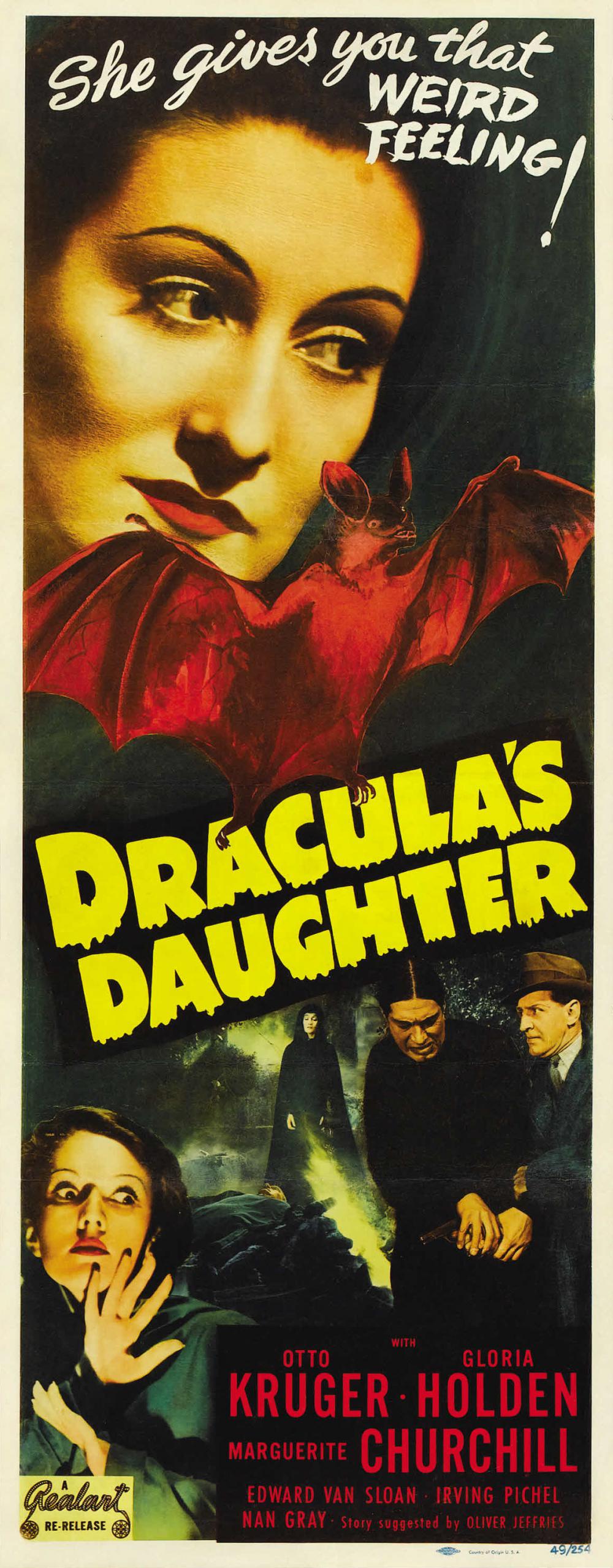
dracula’s daughter (1936)

“Why should Cecil B. DeMille have a monopoly on the great box office values of torture and cruelty?” asked John Balderton, the writer of a first draft of this long-delayed sequel to Dracula, the iconic, if somewhat tepid, 1931 version of Bram Stoker’s famous novel. Balderton envisioned a grisly horror film, full of the shrieks and cries of the damned, but his version didn’t make the cut. Instead, this version, based on one of Stoker’s stories, finally hit the screens in 1936, heavy on atmosphere and shocking (for its time) sexuality. Although it is a marked improvement on the original film, it’s still a bit of a snooze, relying too much on forced comedy and not enough on suspense or fright.

The film picks up exactly where the first film left off. Von Helsing (Edward Van Sloan), who was Van Helsing in the first film, has just offed Dracula, and Whitby constables stumble on the scene and arrest him as a murderer. The constable in charge is faced with quite a decision: try Von Helsing for murder and likely hang him, put him in the looney bin because of all his talk about vampires, or believe him. Von Helsing implores him to call on one of his former students, the renowned psychologist Dr. Garth (Otto Kruger), to help clear him.

Meanwhile, before things can get underway, a mysterious woman steals Dracula’s body and destroys it. Gloria Holden is Countess Zaleska, the titular daughter. She thinks that destroying her father’s corpse will free her from her vampiric curse, but it doesn’t work, as is obvious as soon as she returns to London and starts ogling the necks of dapper young men. It doesn’t help that her helper Sandor (Irving Pichel, who co-directed the great action film The Most Dangerous Game) keeps taunting her about how much she needs blood. The film treats vampirism as more of an addiction than an evil curse, and it’s fitting that she keeps an enabler around to sabotage her efforts to get clean.

After meeting Dr. Garth at a party, she decides that his experiments in hypnosis will help her. She attempts to seduce him, but he’s wary, especially as the body count in London starts to rise, as victims with strange puncture wounds on their necks start turning up. In the centerpiece of the film, as Zaleska attempts to do some painting to distract her from her need for blood, she enlists Sandor to bring her a model, Lili (Nan Grey).

Read more here

on chaos, creation and destruction

From Principia Discordia:

CONVENTIONAL CHAOS – GREYFACE

In the year 1166 B.C., a malcontented hunchbrain by the name of Greyface got it into his head that the universe was as humorless as he, and he began to teach that play was sinful because it contradicted the ways of Serious Order. “Look at all the order around you,” he said. And from that, he deluded honest men to believe that reality was a straightjacket affair and not the happy romance as men had known it.

It is not presently understood why men were so gullible at that particular time, for absolutely no one thought to observe all the disorder around them and conclude just the opposite. But anyway, Greyface and his followers took the game of playing at life more seriously than they took life itself and were known even to destroy other living beings whose ways of life differed from their own.

The unfortunate result of this is that mankind has since been suffering from a psychological and spiritual imbalance. Imbalance causes frustration, and frustration causes fear. And fear makes for a bad trip. Man has been on a bad trip for a long time now.

It is called THE CURSE OF GREYFACE.

Bullshit makes
the flowers grow
& that’s beautiful.

Photo: Motlatsi Khosi

THE CURSE OF GREYFACE AND THE INTRODUCTION OF NEGATIVISM

To choose order over disorder, or disorder over order, is to accept a trip composed of both the creative and the destructive. But to choose the creative over the destructive is an all-creative trip composed of both order and disorder. To accomplish this, one need only accept creative disorder along with, and equal to, creative order, and also be willing to reject destructive order as an undesirable equal to destructive disorder.

The Curse of Greyface included the division of life into order/disorder as the essential positive/negative polarity, instead of building a game foundation with creative/destructive as the essential positive/negative. He has thereby caused man to endure the destructive aspects of order and has prevented man from effectively participating in the creative uses of disorder. Civilization reflects this unfortunate division.

POEE proclaims that the other division is preferable, and we work toward the proposition that creative disorder, like creative order, is possible and desirable; and that destructive order, like destructive disorder, is unnecessary and undesirable.

Seek the Sacred Chao – therein you will find the foolishness of all ORDER/DISORDER. They are the same!

Read the whole text of POEE’s “Principia Discordia” here.