on the proliferation of magical stories


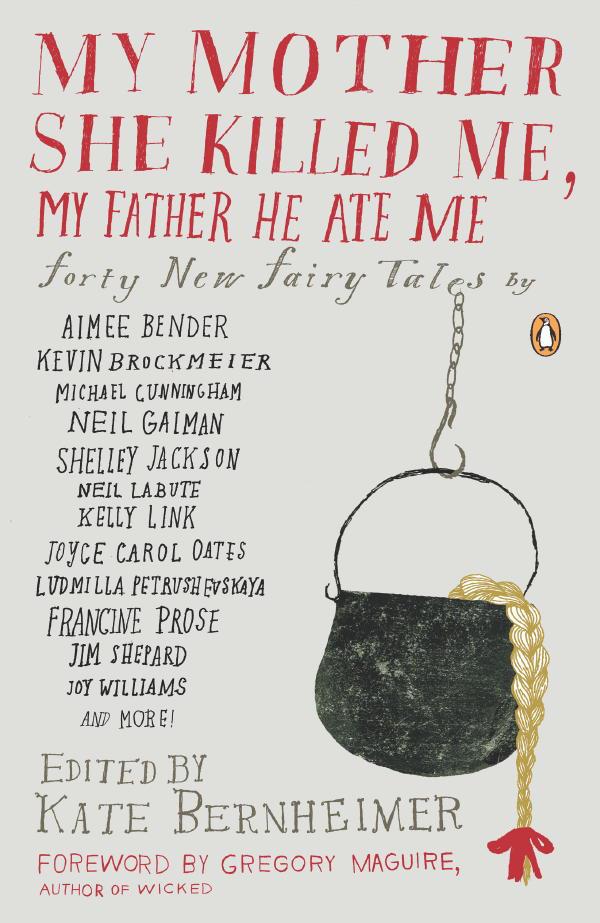
“I have a sense that a proliferation of magical stories, especially fairy tales, is correlated to a growing awareness of human separation from the wild and natural world. In fairy tales, the human and animal worlds are equal and mutually dependent. The violence, suffering and beauty are shared. Those drawn to fairy tales, perhaps, wish for a world that might live “forever after”. My work as a preservationist of fairy tales is entwined with all kinds of extinction.”

– Kate Bernheimer in the Introduction to My Mother She Killed Me, My Father He Ate Me: Forty New Fairy Tales (Penguin, 2010)

david whyte – the house of belonging

I awoke
this morning
in the gold light
turning this way
and that

thinking for
a moment
it was one
day
like any other.

But
the veil had gone
from my
darkened heart
and
I thought

it must have been the quiet
candlelight
that filled my room,

it must have been
the first
easy rhythm
with which I breathed
myself to sleep,

it must have been
the prayer I said
speaking to the otherness
of the night.

And
I thought
this is the good day
you could
meet your love,

this is the black day
someone close
to you could die.

This is the day
you realize
how easily the thread
is broken
between this world
and the next

and I found myself
sitting up
in the quiet pathway
of light,

the tawny
close grained cedar
burning round
me like fire
and all the angels of this housely
heaven ascending
through the first
roof of light
the sun has made.

This is the bright home
in which I live,
this is where
I ask
my friends
to come,
this is where I want
to love all the things
it has taken me so long
to learn to love.

This is the temple
of my adult aloneness
and I belong
to that aloneness
as I belong to my life.

There is no house
like the house of belonging.

i love therefore i exist

REFLECTION: LOVE BETWEEN BODIES

They are two people by mistake. The night corrects that.-Eduardo Galeano

The purpose of the reflection that follows is simple. Starting with what has been considered, it is a matter of noting the unsettled relationship with one’s own body and with other bodies (particularly with those that are objects of desire) imposed by the passing of time, a perspective that for reasons indicated in the chapter, our protagonists didn’t even have the possibility of considering.

In an initial very general overview of the subject, one thing that would immediately be noticed by someone who was questioning the place and the importance of the body in our lives is the fact that over the years the body loses its role of opportunity for pleasure, an attribute that it possesses almost spontaneously during one’s youth, and, in its place, it increasingly and unstoppably acquires the role of obstacle to the peaceable development of one’s very existence. With the passing of time, the body in effect turns precisely into that which resists us, which agitates us and reminds us of its existence through symptoms such as pain, discomfort or, of course, illness. In his book The Arc of Words, Andrés Trapiello has expressed this thought with a brilliant aphorism: “The body is like style: the less noticed it is, the healthier it is”.

In other terms, if we agree to call age that specific time that speaks through the body, one could affirm that the greatest characteristic of youth with regards to the relationship that it maintains with corporal physicality is precisely its fluidity, its immediacy, its transience. In this sense, a young person is someone who can call on his or her body with the knowledge that the body will rapidly return the call. On the other hand in a mature age everything is slow as Coetzee has pointed out, sometimes even extremely slow. So much so that even words end up acquiring this calm and slow rhythm and they take time to reach our lips. As I understand it, it was what an old friend of his commented to the great Fernando Fernán-Gómez, remembering the old times nostalgically: “Do you remember when we spoke rapidly?”.

Nevertheless, if it were only that, one could reassuringly maintain that in the last resort living is finding an accommodation —even if paradoxically it is an uncomfortable accommodation— in one’s own body. The problem, at least with respect to one of the subjects that our society thinks about with greatest difficulty (in this regard I could give as an example any of the novels of Michel Houellebecq), lies in the fact that in addition to that intra-subjective dimension to which I have just referred and which each one of us has to take on, there also exists a specific and particular material inter-subjectivity one of whose most prominent expressions is shown through desire.

I note that the most forceful commentaries these days tend to judge with an attitude that to my taste is frankly hypocritical —somewhere between indifference and paternalism— specifically the older the bodies involved are. It looks as if the maximum threshold which those of us who have definitely left behind the condition of glorious bodies find correct to accept, is that of tenderness barely covered by a gentle pastel color of residual passion. But maybe the body responds to a logic that is totally missed by those commentaries. Maybe just like the word remembers the soul, desire preserves the memory of the body.

Or maybe it is that the body has its own memory and is capable of seeing in the body that lies next to it what it was, even though now it may no longer be; it rescues from obscurity the shine of the past and it brings it with loving delicacy to the present, redeeming it from the ravages of time, the unmerciful punishment of evolution. Those who believe that bodies accept, are resigned, agree with what is handed to them are wrong. No. The body remembers the fulfillment that the other, with whom it is now melding with, had. The body preserves the memory —its own memory— of what it knew, of what once was its own. I am not referring to a dreamlike state or a fantasy. All those who do not know this experience: the feel of the violent stab of lust on recognizing in this body that has changed so radically, that almost in no way resembles that of the past, its contours lost, the fresh scent that identified it gone, the now faded smoothness of the skin, all of them should avoid smiling disdainfully, plentiful in their ignorance. Only from that memory of body which I have been referring to can such a revealing experience be understood. Those who do know it will not only know with perfect exactitude —with total precision— what I have been talking about. They will also enjoy an additional privilege: they will understand the deep significance of what is happening to them and, to a similar extent, maybe they will be able to reconcile with it, discarding in one fell swoop the sense of shame and blame that this society insists on placing on their consciences for committing the crime of desiring freely.

To summarize, I have never been able to understand why people limit themselves to swear eternal love to each other (though they do so less and less; that I do know). They ought to have the courage in certain circumstances to swear eternal desire. With luck and sensibility they might even be able to keep their promise. Certainly the mystics believed that. And, much closer to us, André Gorz expressed it at the beginning of a long letter that he wrote to his wife soon after finding out that she was ill, with some moving words embedded with sensitivity and tenderness:

You have just had your 82nd birthday. You have shrunk 6 cm, you don’t weigh more than 45 kg and you continue to be beautiful, elegant and desirable. We have lived together for 58 years and I love you more than ever. Once again I feel in my breast a consuming emptiness that is only eased by the warmth of your body next to mine.”

From I love, therefore I exist.
Love and the philosophers.

by Manuel Cruz
Translated by Gabriel Baum

daughter – youth

Thank you to Stella Star for sending me this.

Shadows settle on the place that you left
Our minds are troubled by the emptiness
Destroy the middle, it’s a waste of time
From the perfect start to the finish line

And if you’re still breathing, you’re the lucky ones
‘Cause most of us are heaving through corrupted lungs
Setting fire to our insides for fun
Collecting names of the lovers that went wrong
The lovers that went wrong

We are the reckless
We are the wild youth
Chasing visions of our futures
One day we’ll reveal the truth
That one will die before he gets there
And if you’re still bleeding, you’re the lucky ones
‘Cause most of our feelings, they are dead and they are gone
We’re setting fire to our insides for fun
Collecting pictures from the flood that wrecked our home
It was a flood that wrecked this

And you caused it

Well I’ve lost it all, I’m just a silhouette
A lifeless face that you’ll soon forget
My eyes are damp from the words you left
Ringing in my head, when you broke my chest

And if you’re in love, then you are the lucky one
‘Cause most of us are bitter over someone
Setting fire to our insides for fun
To distract our hearts from ever missing them
But I’m forever missing him

And you caused it

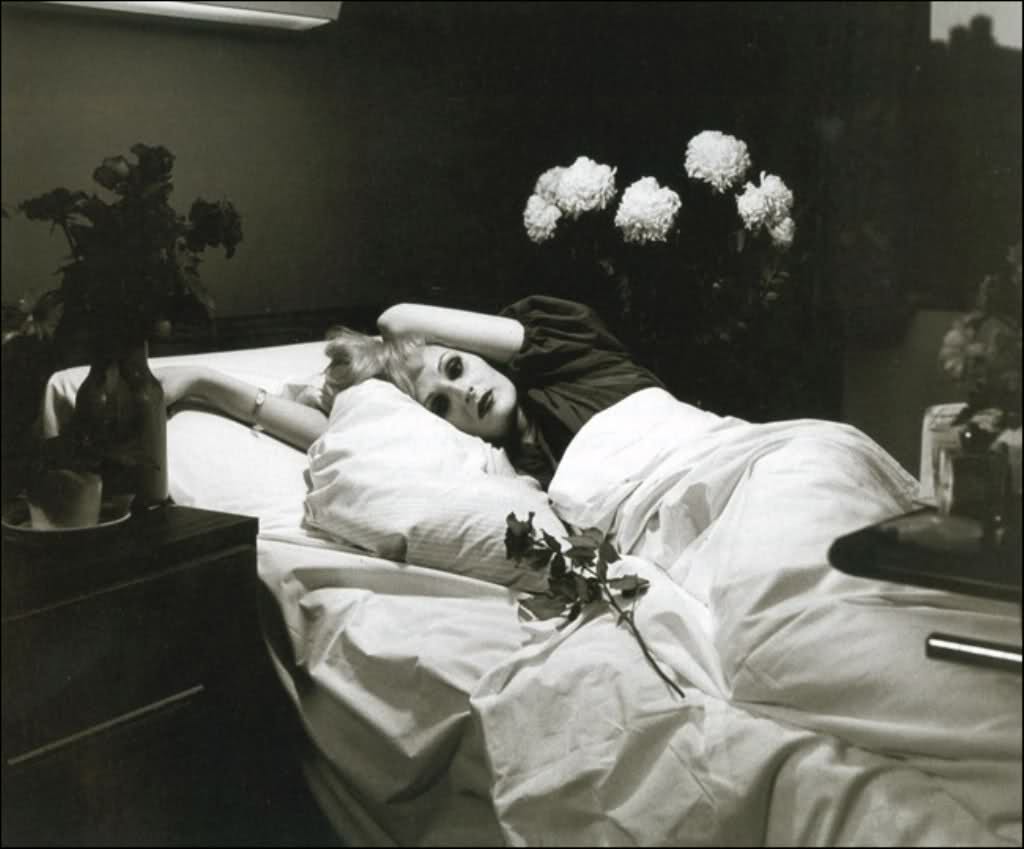
candy darling on her deathbed

Peter Hujar – “Candy Darling on Her Deathbed”
1974, gelatin-silver print

Candy Darling (November 24, 1944 – March 21, 1974), born James Lawrence Slattery, was an American actress, best known as a Warhol Superstar. A male-to-female transsexual, she starred in Andy Warhol’s films Flesh (1968) and Women in Revolt (1971), and was a muse of the band The Velvet Underground.

history by robert lowell

History has to live with what was here,
clutching and close to fumbling all we had–
it is so dull and gruesome how we die,
unlike writing, life never finishes.
Abel was finished; death is not remote,
a flash-in-the-pan electrifies the skeptic,
his cows crowding like skulls against high-voltage wire,
his baby crying all night like a new machine.
As in our Bibles, white-faced, predatory,
the beautiful, mist-drunken hunter’s moon ascends–
a child could give it a face: two holes, two holes,
my eyes, my mouth, between them a skull’s no-nose–
O there’s a terrifying innocence in my face
drenched with the silver salvage of the mornfrost.

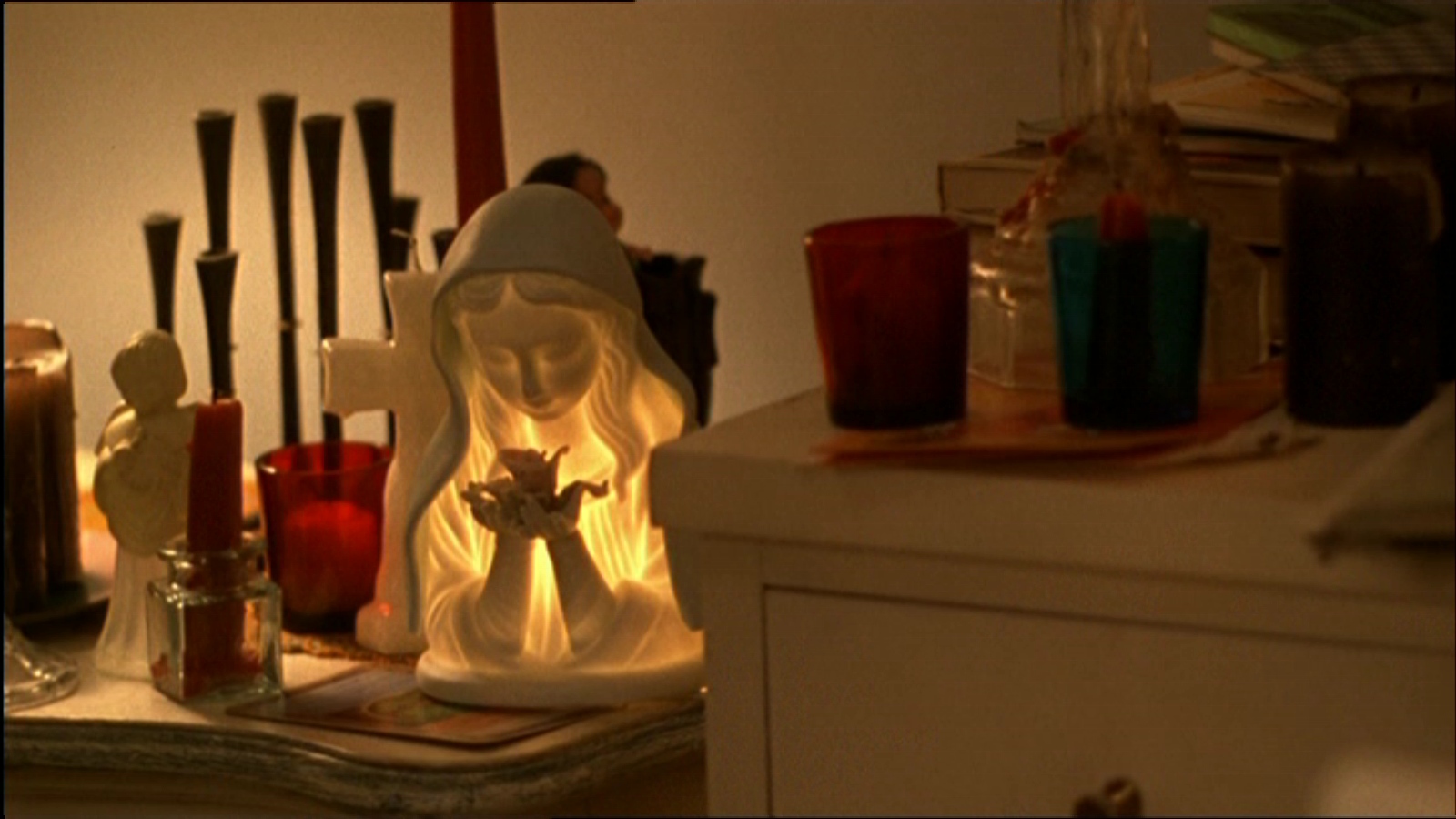
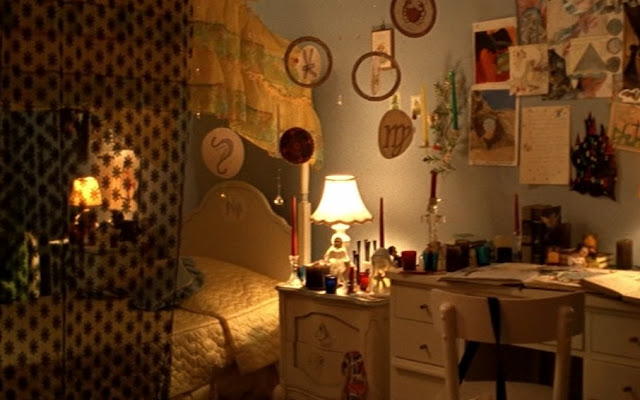
sofia coppola – from “the virgin suicides” (1999)

Narrator:

So much has been said about the girls over the years. But we have never found an answer. It didn’t matter in the end how old they had been, or that they were girls… but only that we had loved them, and that they hadn’t heard us calling… still do not hear us, up here in the tree house with our thinning hair and soft bellies, calling them from out of those rooms where they went to be alone for all time… and where we will never find the pieces to put them back together…

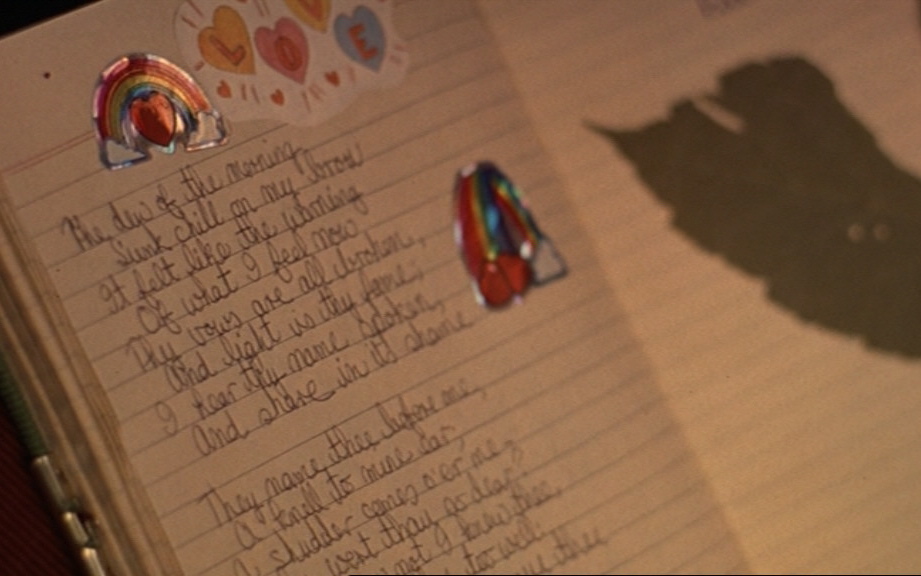
From Cecilia Lisbon’s diary:

Lux lost it over Kevin Haines, the garbage man. She’d wake up at five in the morning
and hang out on the front steps – like it wasn’t completely obvious.

She wrote his name in marker on all her underwear. Mom found them and bleached out the Kevins.
Lux was crying on her bed all day.

The trees like lungs filling with air.
My sister, the mean one, pulling my hair.

Narrator:

And so we started to learn about their lives, coming to hold collective memories of times we hadn’t experienced.

We felt the imprisonment of being a girl, the way it made your mind dreamy… so you ended up knowing
what colours went together.

We knew the girls were really women in disguise… that they understood love and even death… and that our job was merely to create the noise that seemed to fascinate them.

We knew that they knew everything about us. And that we couldn’t fathom them at all.

Screenplay based on the novel by Jeffrey Eugenides.

camus on desire

What distinguishes consciousness of self from the world of nature is not the simple act of contemplation by which it identifies itself with the exterior world and finds oblivion, but the desire it can feel with regard to the world. This desire re-establishes its identity when it demonstrates that the exterior world is something apart. In its desire, the exterior world consists of what it does not possess, but which nevertheless exists, and of what it would like to exist but which no longer does. Consciousness of self is therefore, of necessity, desire. But in order to exist it must be satisfied, and it can only be satisfied by the gratification of its desire. It therefore acts in order to gratify itself and, in so doing, it denies and suppresses its means of gratification. It is the epitome of negation.

from The Rebel

wallace stevens – peter quince at the clavier

I

Just as my fingers on these keys
Make music, so the self-same sounds
On my spirit make a music, too.
Music is feeling, then, not sound;
And thus it is that what I feel,
Here in this room, desiring you,

Thinking of your blue-shadowed silk,
Is music. It is like the strain
Waked in the elders by Susanna;

Of a green evening, clear and warm,
She bathed in her still garden, while
The red-eyed elders, watching, felt

The basses of their beings throb
In witching chords, and their thin blood
Pulse pizzicati of Hosanna.

II

In the green water, clear and warm,
Susanna lay.
She searched
The touch of springs,
And found
Concealed imaginings.
She sighed,
For so much melody.

Upon the bank, she stood
In the cool
Of spent emotions.
She felt, among the leaves,
The dew
Of old devotions.

She walked upon the grass,
Still quavering.
The winds were like her maids,
On timid feet,
Fetching her woven scarves,
Yet wavering.

A breath upon her hand
Muted the night.
She turned —
A cymbal crashed,
Amid roaring horns.

III

Soon, with a noise like tambourines,
Came her attendant Byzantines.

They wondered why Susanna cried
Against the elders by her side;

And as they whispered, the refrain
Was like a willow swept by rain.

Anon, their lamps’ uplifted flame
Revealed Susanna and her shame.

And then, the simpering Byzantines
Fled, with a noise like tambourines.

IV

Beauty is momentary in the mind —
The fitful tracing of a portal;
But in the flesh it is immortal.

The body dies; the body’s beauty lives.
So evenings die, in their green going,
A wave, interminably flowing.
So gardens die, their meek breath scenting
The cowl of winter, done repenting.
So maidens die, to the auroral
Celebration of a maiden’s choral.

Susanna’s music touched the bawdy strings
Of those white elders; but, escaping,
Left only Death’s ironic scraping.
Now, in its immortality, it plays
On the clear viol of her memory,
And makes a constant sacrament of praise.

Some insightful stuff written about this poem is to be found HERE.

cherry bomb – gouttes mécaniques (mechanical teardrops) – 2008

“We’re all Frankie…”

A détournement: Fernand Léger – ‘Ballet Mécanique‘ (1924) versus Ordo Ecclesiae Mortis – ‘Frankie Teardrop‘ (cover of original by Martin Rev & Alan Vega’s Suicide in 1977).

Read more about détournement HERE. Watch the original  Ballet Mécanique HERE.

martha graham on artists (in a letter to agnes de mille)

“there is a vitality, a life force, a quickening that is translated through you into action, and because there is only one of you in all time, this expression is unique. and if you block it, it will never exist through any other medium, and will be lost. the world will not have it. it is not your business to determine how good it is, nor how valuable it is, nor how it compares with other expressions. it’s your business to keep it yours clearly and directly, to keep the channel open.

you do not even have to believe in yourself or your work. you have to keep open and aware directly to the urges that motivate you. keep the channel open. no artist is pleased. there is no satisfaction whatever at any time. there is only a queer, divine dissatisfaction, a blessed unrest that keeps us marching and makes us more alive than the others.”

from http://kagablog.com/

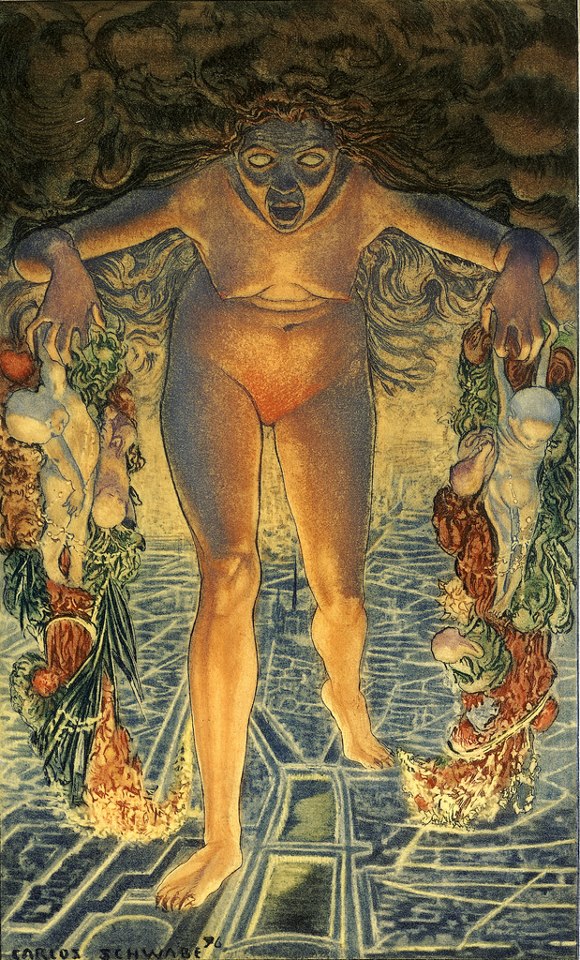
charles baudelaire – le crépuscule du soir (evening twilight)

Carlos Schwabe
“Le crépuscule du soir”
from Fleurs du Mal (1900)


This poem is from Baudelaire’s 1861 masterpiece, Les Fleurs du Mal (read the original French, as well as two more, quite divergent, translations HERE):

Evening Twilight

Delightful evening, partner of the crook,
Steals in, wolf-padded, like a complice: look:
Heaven, like a garret, closes to the day,
And Man, impatient, turns a beast of prey.

Sweet evening, loved by those whose arms can tell,
Without a lie, “Today we’ve laboured well:”
Sweet evening, it is she who brings relief
To men with souls devoured by one fierce grief,
Obstinate thinkers drowsy in the head,
And toil-bent workmen groping to their bed.

But insalubrious demons of the airs,
Like business people, wake to their affairs
And, flying, knock, like bats, on walls and shutters.
Now Prostitution lights up in the gutters
Across the glimmering jets the wind torments.
Like a huge ant-hive it unseals its vents.
On every side it weaves its hidden tracks
Like enemies preparing night-attacks.
It squirms within the City’s breast of mire,
A worm that steals the food that men desire.

One hears the kitchens hissing here and there,
Operas squealing, orchestras ablare.
Cheap tables d’hôte, where gaming lights the eyes,
Fill up with whores, and sharpers, their allies:
And thieves, whose office knows no truce nor rest,
Will shortly now start working, too, with zest,
Gently unhinging doors and forcing tills,
To live some days and buy their sweethearts frills.

Collect yourself, my soul, in this grave hour
And shut your ears against the din and stour.
It is the hour when sick men’s pains increase.
Death grips them by the throat, and soon they cease
Their destined task, to find the common pit.
The ward is filled with sighings. Out of it
Not all return the scented soup to taste,
Warm at the hearthside, by some loved-one placed.

But then how few among them can recall
Joys of the hearth, or ever lived at all!

— translated by Roy Campbell, Poems of Baudelaire (New York: Pantheon Books, 1952)

on diotima

An excerpt from Joshua Billings’ paper entitled Hyperion’s symposium: an erotics of reception.
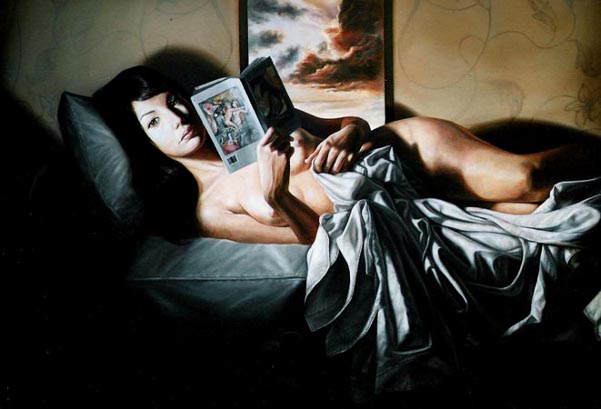
El Crepúsculo de Diotima
Ricardo Celma (1975, Argentina)

Diotima of Mantinea is a present absence in Plato’s Symposium. Her words form the most important of the symposium’s encomia to Eros, but she does not speak them herself. Socrates, her former pupil, relates her lesson in erotics to the assembly. She remains a mysterious figure: her name — ‘honoured by god’ — and her city, cognate with mantis, place her somewhere between human and divinity. Though the main narrative of the Symposium is doubly framed — it records the words of Apollodorus who recounts what he heard from Aristodemus — Diotima is still further removed from the literary present. She exists (if she exists at all) as a liminal, ambiguous being. But this is appropriate to her subject: Eros, a god characterized by perpetual incompleteness.

The Diotima of Friedrich Hölderlin’s Hyperion or the Hermit in Greece (Hyperion oder der Eremit in Griechenland), too, seems poised between being and non-being. As the title character’s beloved, her existence forms the hinge of the entire narrative, yet the pages in which she appears are relatively few and in them, she is most often passive and silent. Most formative for Hyperion, indeed, is her seemingly unmotivated death, reported at second-hand. The form of the novel, a series of retrospective letters from Hyperion, serves to heighten her absence just as the Symposium’s framing places its narrative in a doubly-remembered past. Hölderlin’s Diotima, like Plato’s, exists in eternal mediation, suggesting that Hyperion’s desire cannot be fulfilled, his ideal never realized.

This is the lesson of Diotima in the Symposium. In contrast to the previous speakers, Socrates emphasizes not the positive qualities of Eros, but the poverty that drives the god to seek beauties he does not possess. Socrates reports the speech of Diotima, who disabused him of the notion advocated by his friends. The Eros described by Diotima is liminal, neither beautiful nor ugly, and neither man nor god. He is a daimôn, whose existence is defined by his place between opposing realms. His power is

… interpreting and carrying to gods things from humans, and to humans things from gods: from humans, the entreaties and sacrifices; from gods, orders and exchanges for sacrifices. He is in the middle of both and fills the space between, so that all is bound by him. 

Eros is always relational, a mediation between two elements. This is a consequence of his birth, as the child of Penia and Poros, need and resource. Like his mother, he is unattractive and perpetually impoverished, yet he has the skills of his father that allow him occasionally to attain his desire. This makes him a paradox, poor but able to become rich, immortal but able to die: ‘sometimes he flourishes for a day and lives, whenever he has resources, and sometimes he dies, but is brought back to life again through the nature of his father.’ Eros is not a happy medium of his two parents, but an unstable oscillation between states of euporia and aporia.

Eros’ dialectical nature makes him philosophical, and distinguishes him from his parents. Those who are wise (like Poros) feel no need to philosophize, while those who are ignorant (like Penia) cannot comprehend their need. Eros’s philosophical nature is based on reflection; it results from the recognition of his own ignorance. Philosophy is a state of intellectual poverty that uses resource to gain insight:

Being a philosopher he is between a wise man and an ignorant. The cause of this is his birth: for he is from a wise and resourceful [euporos] father, and an unwise and unresourceful [aporos] mother. 

Socratic philosophy and erotic desire are parallel; both begin in a state of reflective aporia and strive towards euporia. Socrates’s self-conscious ignorance makes him the exemplary erotic seeker. In this respect, it is particularly important that the figure of Diotima is absent in the dialogue: erotic and philosophical fulfilments are deferred, set off in a mysterious past. Furthermore, Socrates (like the speakers who frame the story) is simply repeating an earlier conversation rather than engaging in his usual dialectics. What remains for the symposiasts as for the reader of the Symposium is a mediated presence that relates knowledge without being able to answer for it.

El Crepúsculo de Diotima
Ricardo Celma (1975, Argentina)

The connection of philosophy and desire suggests a productive nature of Eros, a way it escapes the constant oscillation between want and fleeting fulfilment. As we have already learned, Eros is unable to possess what it desires permanently. Instead of possession of the beautiful, Eros seeks to reproduce with the beautiful:

– Eros, Socrates, she said, is not of the beautiful, as you think.

– But what then?

– Of begetting and bringing forth on the beautiful.

– Let it be so, I said.

– It is so absolutely, she said. And why is it of begetting? Because begetting is eternal and undying as far as it is possible for a mortal. From what we have agreed, it is necessary that with good one desire immortality, if indeed eros is of the good being one’s own always. It is necessary from this very account that eros be also of immortality.

The account of Eros’ activity here changes abruptly: Eros finds a way out of lack, to a creative activity. This also necessitates a redefinition of Eros as desire, not for the beautiful or the good, but for an eternal existence. In place of possession, Eros turns to production. This is the crux on which Hölderlin’s reading of the Symposium will focus, as nostalgia for a lost ideal is transformed into the realization of future possibility. This dynamic constitutes what might be termed an ‘erotics of reception’.

Desire, according to Socrates, necessarily turns from the transient present towards an infinite future. In reporting Diotima’s words, Socrates enacts this temporal reorientation, making her absence the basis for philosophical production. He leads his companions, as erotic desire leads the philosopher, on the ascent to higher forms of beauty, and ultimately, to the idea. This is an increasingly contemplative act, in which desire for a beautiful body yields to desire for a beautiful soul, and ultimately, to knowledge of the essence of beauty:

Beginning from these very beauties, for the sake of that highest beauty he ascends eternally, just as if employing the rungs of a ladder, from one to two, and from two to all beautiful bodies; from beautiful bodies he proceeds to beautiful pursuits, from pursuits to beautiful sciences, and from these sciences arrives at that science which is concerned with the beautiful itself and nothing else, so that finally he comes to know what the beautiful is. 

The end of Eros is philosophical fulfilment, conceived as a reflection on immortal beauty. The ascent to the eternal form is parallel to the immortality of giving birth: both begin with a pregnancy of the soul that seeks a beautiful object. From the aporia of mortal bodies, philosophy fashions the euporia of wisdom. The figure of Diotima, an absence that produces knowledge, represents this progress to fulfilment through loss. In the Symposium, as in Hyperion, Diotima’s very pastness makes her the object of an erotic dialectic.
Read Joshua Billings’ whole paper, entitled  Hyperion’s symposium: an erotics of receptionOxford Classical Receptions Journal (2010) 2 (1): 4-24.

on friedrich hölderlin’s “hyperion”

Hölderlin’s work, like Celan’s after him, is a practice of creating the universality of music out of the treacherous medium of words. The frisson of this practice is an impossible, and irresistible, place to live and die. Like Orpheus, Hyperion keeps looking back. And like Orpheus, Hölderlin the poet relives the moment of his lost love in a melodious, maddening loop.

~ Elizabeth Bachner, on Hyperion by Friedrich Hölderlin. Read her whole review HERE.

noir désir with manu chao – le vent nous portera (2001)

I’m not scared of the road
We’ll have to see, have to taste
The weakness in our loins
And everything will be ok
The wind will carry us

Your message to Ursa Major
And the trajectory of your course
An instant of valour
Even if it’s for nothing
The wind will take it away
Everything will disappear but
The wind will carry us

The caress and the gunshot
That wound that tears us apart
The palace of the everyday
From yesterday and tomorrow
The wind will carry them

Genetics carried on the back
Chromosomes in the atmosphere
Taxis for the galaxies
And my flying carpet says
The wind will carry it off
Everything will disappear but
The wind will carry us

This perfume of our dead years
That can knock at your door
Infinity of destinies
We put some down but what do we retain?
The wind will take it away

While the tide comes in
And everyone is doing their accounts
I bring to the hollow of my shadow
A few bits of your dust
The wind will carry them
Everything will disappear but
The wind will carry us