waiting to exhale

lsd

*.* Love’s Secret Domain, 2004. Self-portrait manipulated with MS Photo Editor.

“I think,” Tehanu said in her soft, strange voice, “that when I die, I can breathe back the breath that made me live. I can give back to the world all that I didn’t do. All that I might have been and couldn’t be. All the choices I didn’t make. All the things I lost and spent and wasted. I can give them back to the world. To the lives that haven’t been lived yet. That will be my gift back to the world that gave me the life I did live, the love I loved, the breath I breathed.”

~ Ursula K. Le Guin – from The Dispossessed

apples

snow white poison appleLife will break you. Nobody can protect you from that, and living alone won’t either, for solitude will also break you with its yearning. You have to love. You have to feel. It is the reason you are here on earth. You are here to risk your heart. You are here to be swallowed up. And when it happens that you are broken, or betrayed, or left, or hurt, or death brushes near, let yourself sit by an apple tree and listen to the apples falling all around you in heaps, wasting their sweetness. Tell yourself you tasted as many as you could.

 Louise Erdrich (The Painted Drum)

tindersticks – city sickness (1993)

“Our first film. This Way Up had money to make a video, we wanted to make something more like a film. We were told about Jarvis and Steve from Pulp, who were making films with Martin Wallace. We made it during the summer of ’93. Dickon’s not in it because he was in Mexico as part of his studies. It was good fun and hard work, driving around in our Ford Cortina, Jarvis squashed on the passenger seat floor. Sidonie, Stuart’s daughter, is the baby. It was the start of a long and joyful relationship with Martin Wallace, who’s become a wonderful friend.”

the raincoats – adventures close to home (1979)

Passion that shouts
Red with anger
I lost myself
Through alleys of mysteries
I went up and down
like a demented train

Don’t take it personal
I choose my own fate
I follow love
I follow hate

Searching for something
that makes hearts move
I found myself
But my best possession
walked into the shade
and threatened to drift away

Don’t take it personal
I choose my own fate
I follow love
I follow hate

For all of myself
I left you behind as if I could
possessed by Quixote’s dream
Went to fight dragons in the land of concrete

Don’t take it personal
I choose my own fate
I follow love
I follow hate

Rolling in pain
discovered what hurts
and tasted hell
infatuated by madness
I danced in flames
and drank in the depth of love

love – long distance

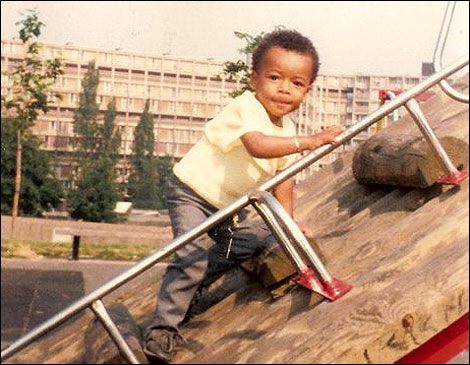
pam's brotherMy brother started running in my mother’s womb. This is the first lie. There will be more as the story progresses, I will only own up to this one. My brother never stopped running, he was born too early, a month, a week and 3 days before the doctor’s original prophesied dates – he came tumbling out and disturbed my grandfathers’ prayer.

This would be my brother, the rest of his life. He started crawling at nine and a half months and by 13 months was being chased down the street. My parents had to hire young nannies – the one who had nursed and cared for my two sisters and I, was old and suffered from arthritis – she could never catch up with him. My brother climbed, he curled his feet on curtains and grabbed and groped his way to the top of the rail, then slinked back down again, belly first, taunting gravity. My mother screamed and cried a lot between ages 9 months and 12 – she wore a crazed nervous expression and drank sugared water every other hour.

At age two, my brother packed a plastic bag – a white one with a red ‘OK’ on it and bid us farewell. We’d just sat down for dinner, he would have closed the door behind him and maybe even pulled open the gate but he was too short to reach either handle. I watched him climb up concrete wall, scratch his knee and elbow as he fought his way up. My mother screamed at him from inside the house, my father poured himself a stiff one – my sisters and i laughed ourselves hoarse. We loved our brother, his little antics brought us much mirth.

At age 12 after many attempts to ‘run away from home’ my brother woke up screaming from a nightmare and asked ‘If I went to Lesotho, would that be such a bad thing?’

We’d never seen Lesotho, we started crying that we’d miss him – our father called a friend and my mother checked the calendar. The following year, my brother left the family for good – he moved to a place we’d only ever seen in dramas – my father was relieved, my mother made new friends and every holiday my brother had some other family to visit for the two weeks or the month.

I think he’s in Havana now, met a girl when he was in Martinique, fell in love and followed her there. He claims he makes a living climbing things – I don’t know what to believe – I’ve only ever known my brother’s back and the bottom of his foot – I’ve never met the man he is.

garfunkel and oates – 29/31 (2012)

Garfunkel and Oates are an American comedy/musical duo from Los Angeles, California, consisting of actress-songwriters Kate Micucci and Riki Lindhome. The band name is derived from “two famous rock-and-roll second bananas”, Art Garfunkel and John Oates. In this song, Kate and Riki play the same woman, two years apart, at 29 and 31 respectively.

ruth etting – i’m nobody’s baby (1927)

Rising to fame in the twenties and early thirties, Ruth Etting was renowned for her great beauty, her gorgeous voice and her tragic life. She starred on Broadway, made movies in Hollywood, married a mobster, had numerous hit-records, and was known as America’s Sweetheart of Song.

Born in David City, Nebraska on November 23, 1897, Ruth left home at seventeen for Chicago and art school. She got a job designing costumes at a night club called the Marigold Gardens and when the tenor got sick, she was pulled into the show since she was the only one who could sing low enough. That led to dancing in the chorus line and eventually featured solos.

By 1918 she was the featured vocalist at the club and the Gimp entered her life. A Chicago gangster, Moe Snyder married Ruth in 1922 and managed her career for the next two decades. Her numerous radio appearances during these years led to her becoming known as Chicago’s Sweetheart.

In 1926 she was discovered by a record company executive and immediately signed to an exclusive recording deal with Columbia Records, which led to nationwide exposure. Her early recordings were very straightforward in delivery. She later commented that “I sounded like a little girl on those records!” and insisted that her voice was actually much deeper than these recordings would lead one to believe.

In 1927 Ruth hit New York and she was an instant success. Irving Berlin suggested her for the Ziegfeld Follies and she was hired after Ziegfeld checked her ankles, not her voice. She appeared in the Follies of 1927. In 1929 she starred with Eddie Cantor in Whoopee! and in 1930 she made 135 appearances in Simple Simon with Ed Wynn. In 1931 she appeared in the very last Follies, shortly before Ziegfeld’s death.

Her blond hair and blue eyes and stunning voice all led to her being dubbed the Sweetheart of Columbia Records, America’s Radio Sweetheart, and finally America’s Sweetheart of Song. She began to experiment with tempo and phrasing during this period in her career. Her trademark was to change the tempo – alternating between normal tempo, half-time and double-time to create and maintain interest.

Ruth had over sixty hit recordings. Among her best in the Jazz Age are “Button Up Your Overcoat” and “Mean to Me” and, in the depression, “Ten Cents A Dance”. Her versions of “Shine on Harvest Moon”, “Let Me Call You Sweetheart”, “You Made Me Love You” and “Love Me or Leave Me” became her signature songs.

Next she headed to Hollywood and made a string of movie shorts and three full-length features. Her big break came in Roman Scandals with Eddie Cantor and Lucille Ball in a bit part. Then came Gift of Gab and Hips Hips Hooray.

It was in Hollywood that her loveless marriage finally fell apart. In 1937 Ruth fell for her accompanist and, in a rage, the Gimp shot him. The musician survived, Snyder went to jail and Ruth ended up divorcing him and marrying her true love, Meryl Alderman. But the scandal was too much for her career to survive. She made a few attempts at a comeback, but her days as America’s Sweetheart were over.

(Information from ruthetting.com, a site maintained by the granddaughter of one of Ruth Etting’s cousins.)

re: god and human freedom

a conversation between cherry bomb and aryan kaganof


On Nov 20, 2007 10:14 PM, Rosemary Lombard wrote:

http://www.religion-online.org/showchapter.asp?title=2285&C=2159

came across this while reading around transcendence/immanence
a fascinating philosophical article
on god and human freedom
comes at christian scripture, existentialism, marxism
from an ENTIRELY different angle to the traditional church
very unorthodox
yet still from a christ-focused perspective
thought you’d also find it interesting
esp how it might relate to your youniverse

“ama et fac quod vis”
(love, and do what you will)
– st augustine

[although the he-personification of god
and use of ‘man’ to mean generic ‘human’ irks me a bit,
i see the publication’s date was 1970, so it’s alright ;]

Nov 21, 2007
poem for rose, paradoxically
Filed under: kagapoems, poetry, paradoxism — ABRAXAS @ 10:24 am

i stumbled upon
myself stumbling upon
the difference between transcendence and immanence

my stumbling was the means by which i knew
there was an i to stumble
upon that which was there to be stumbled upon

immanence implied that i was everything that i stumbled upon
and everything i stumbled upon was me
transcendence granted me existence outside of what i stumbled upon
and that my being might exist outside of knowing

what was unknowable was how to unstumble
and thus in my unstumbling upon
myself unstumbling
i became unme

now immanence implied that everything unme
could be unstumbled upon and that everything that could be unstumbled upon is in unme
whereas transcendence seemed to be saying that unme is also outside of unstumbling
and therefore could not be unstumbled upon

here i found a contradiction
because if it is only possible to stumble upon something outside of me
then surely it is impossible to unstumble upon something inside of unme
unless of course my stumbling upon
myself stumbling upon
was in fact inside of me

meaning that there is no difference between transcendence and immanence
hence god’s indifference
to the problem

On Nov 21, 2007 11:59 PM, Rosemary Lombard wrote:

yes
this is our business

does the ground worry
if a seed is growing or withering away?
or how often a wayfarer stumbles?

the substrate whereby
we are
is god
within with without
us

our embrace of existence lies in union
love is the yes to life
love is the blossom of anti-entropy

carly's loving hands

Carly’s loving hands (2008). Photo by Rosemary Lombard

on incarnation and sacrifice

christ

But supposing God became a man – suppose our human nature which can suffer and die was amalgamated with God’s nature in one person – then that person could help us. He could surrender His will, and suffer and die, because He was man; and He could do it perfectly because He was God. You and I can go through this process only if God does it in us; but God can only do it if He becomes man. Our attempts at this dying will succeed only if we men share in God’s dying, just as our thinking can succeed only because it is a drop out of the ocean of God’s intelligence: but we cannot share God’s dying unless God dies; and God cannot die except by being a man. That is the sense in which He pays our debt, and suffers for us what He Himself need not suffer at all.

~ C.S. Lewis, Mere Christianity

the pleasure seekers – what a way to die (1965)

The Detroit garage band the Pleasure Seekers originally comprised sisters Suzi, Patti, and Arlene Quatro, the daughters of jazz musician Art Quatro. The group started while the siblings were all still in their teens. They quickly transcended novelty status by writing their own material and playing their own instruments, and made their debut in 1966 with the local hit “Never Thought You’d Leave Me,” released on the Hideout label (the recording arm of the local teen club where Suzi reportedly worked as a counter clerk). A year later they jumped to Mercury for “Light of Love.” Eldest sister Arlene soon exited the Pleasure Seekers to begin a family — among her children was actress Sherilyn Fenn, best known for her work in the TV cult series Twin Peaks — and was replaced by another Quatro sister, Nancy. Throughout the remainder of the decade the band toured relentlessly, even appearing at a USO showcase at the peak of the Vietnam War, but mainstream success continued to elude them. Around 1969, the Pleasure Seekers rechristened themselves Cradle, a move which also heralded a harder-edged sound. By the early ’70s, however, the trio disbanded, with Suzi going on to fame as a solo performer while Patti joined the California band Fanny (info from allmusic.com).

tame impala – feels like we only go backwards

An anthem to atavism, with a great video directed by Joe Pelling and Becky Sloan, made entirely from plasticine collage. Off the album Lonerism, which came out on Modular in November 2012.

It feels like I only go backwards, baby
Every part of me says go ahead
I got my hopes up again, oh no, not again
Feels like we only go backwards, darling.

I know that you think you sound silly when you call my name
But I hear it inside my head all day
When I realize I’m just holding on to the hope that maybe your feelings don’t show

It feels like I only go backwards, baby
Every part of me says go ahead
Then I got my hopes up again, oh no, not again
Feels like we only go backwards darling.

The seed of all this indecision isn’t me, oh no
‘Cause I decided long ago
But that’s the way it seems to go
I’ve tried so hard to get to something real, it feels…
It feels like I only go backwards, darling…

e. e. cummings – somewhere i have never travelled,gladly beyond

somewhere i have never travelled,gladly beyond
any experience,your eyes have their silence:
in your most frail gesture are things which enclose me,
or which i cannot touch because they are too near

your slightest look easily will unclose me
though i have closed myself as fingers,
you open always petal by petal myself as Spring opens
(touching skilfully,mysteriously)her first rose

or if your wish be to close me, i and
my life will shut very beautifully ,suddenly,
as when the heart of this flower imagines
the snow carefully everywhere descending;

nothing which we are to perceive in this world equals
the power of your intense fragility:whose texture
compels me with the color of its countries,
rendering death and forever with each breathing

(i do not know what it is about you that closes
and opens;only something in me understands
the voice of your eyes is deeper than all roses)
nobody,not even the rain,has such small hands

__
From Complete Poems: 1904-1962 by E. E. Cummings, edited by George J. Firmage. Copyright © 1923, 1931, 1935, 1940, 1951, 1959, 1963, 1968, 1991 by the Trustees for the E. E. Cummings Trust. Copyright © 1976, 1978, 1979 by George James Firmage.

rilke – the dragon princess

Still from Kwaidan (Kobayashi, 1964)

Still from Kwaidan (Kobayashi, 1964)

To speak of solitude again, it becomes always clearer that this is at bottom not something that one can take or leave. We are solitary. We may delude ourselves and act as though this were not so. That is all. But how much better it is to realize that we are so, yes, even to begin by assuming it. We shall indeed turn dizzy then; for all points upon which our eye has been accustomed to rest are taken from us, there is nothing near any more and everything far is infinitely far. A person removed from his own room, almost without preparation and transition, and set upon the height of a great mountain range, would feel something of the sort; an unparalleled insecurity, an abandonment to something inexpressible would almost annihilate him. He would think himself falling or hurled into space, or exploded into a thousand pieces: what a monstrous lie his brain would have to invent to catch up with and explain the state of his senses!

So for him who becomes solitary all distances, all measures change; of these changes many take place suddenly, and then, as with the man on the mountaintop, extraordinary imaginings and singular sensations arise that seem to grow out beyond all bearing. But it is necessary for us to experience that too. We must assume our existence as broadly as we in any way can; everything, even the unheard-of, must be possible in it. That is at bottom the only courage that is demanded of us: to have the courage for the most strange, the most singular, and the most inexplicable that we may encounter. That mankind has in this sense been cowardly has done life endless harm; the experiences that are called “visions,” the whole so-called “spirit-world,” death, all those things that are so closely akin to us, have by daily parrying been so crowded out of life that the senses with which we could have grasped them are atrophied. To say nothing of God.

But fear of the inexplicable has not alone impoverished the existence of the individual; the relationship between one human being and another has also been cramped by it, as though it had been lifted out of the riverbed of endless possibilities and set down in a fallow spot on the bank, to which nothing happens. For it is not inertia alone that is responsible for human relationships repeating themselves from case to case, indescribably monotonous and unrenewed; it is shyness before any sort of new, unforeseeable experience with which one does not think oneself able to cope. But only someone who is ready for everything, who excludes nothing, not even the most enigmatical, will live the relation to another as something alive and will himself draw exhaustively from his own existence. For if we think of this existence of the individual as a larger or smaller room, it appears evident that most people learn to know only a corner of their room, a place by the window, a strip of floor on which they walk up and down. Thus they have a certain security. And yet that dangerous insecurity is so much more human which drives the prisoners in Poe’s stories to feel out the shapes of their horrible dungeons and not be strangers to the unspeakable terror of their abode.

We, however, are not prisoners. No traps or snares are set about us, and there is nothing which should intimidate or worry us. We are set down in life as in the element to which we best correspond, and over and above this we have through thousands of years of accommodation become so like this life, that when we hold still we are, through a happy mimicry, scarcely to be distinguished from all that surrounds us. We have no reason to mistrust our world, for it is not against us. Has it terrors, they are our terrors; has it abysses, those abysses belong to us; are dangers at hand, we must try to love them.

And if only we arrange our life according to that principle which counsels us that we must always hold to the difficult, then that which now still seems to us the most alien will become what we most trust and find most faithful. How should we be able to forget those ancient myths that are at the beginning of all peoples, the myths about dragons that at the last moment turn into princesses. Perhaps all the dragons in our lives are princesses who are only waiting to see us act, just once, with beauty and courage. Perhaps everything that frightens us is, in its deepest essence, something helpless that wants our love.

From Rilke on Love and Other Difficulties: Translations and Considerations of Rainer Maria Rilke by John J L Mood. Norton, 1993.