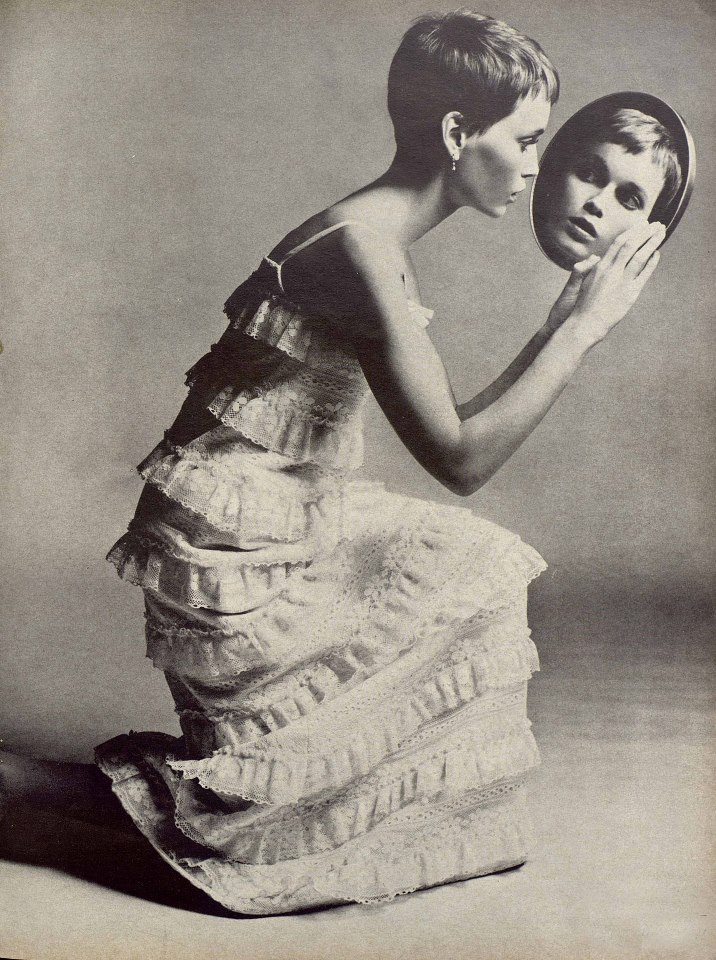
Mia Farrow – Vogue 1966. Photo by Richard Avedon (1923-2004)
Mia Farrow – Vogue 1966. Photo by Richard Avedon (1923-2004)
Garfunkel and Oates are an American comedy/musical duo from Los Angeles, California, consisting of actress-songwriters Kate Micucci and Riki Lindhome. The band name is derived from “two famous rock-and-roll second bananas”, Art Garfunkel and John Oates. In this song, Kate and Riki play the same woman, two years apart, at 29 and 31 respectively.
Rising to fame in the twenties and early thirties, Ruth Etting was renowned for her great beauty, her gorgeous voice and her tragic life. She starred on Broadway, made movies in Hollywood, married a mobster, had numerous hit-records, and was known as America’s Sweetheart of Song.
Born in David City, Nebraska on November 23, 1897, Ruth left home at seventeen for Chicago and art school. She got a job designing costumes at a night club called the Marigold Gardens and when the tenor got sick, she was pulled into the show since she was the only one who could sing low enough. That led to dancing in the chorus line and eventually featured solos.
By 1918 she was the featured vocalist at the club and the Gimp entered her life. A Chicago gangster, Moe Snyder married Ruth in 1922 and managed her career for the next two decades. Her numerous radio appearances during these years led to her becoming known as Chicago’s Sweetheart.
In 1926 she was discovered by a record company executive and immediately signed to an exclusive recording deal with Columbia Records, which led to nationwide exposure. Her early recordings were very straightforward in delivery. She later commented that “I sounded like a little girl on those records!” and insisted that her voice was actually much deeper than these recordings would lead one to believe.
In 1927 Ruth hit New York and she was an instant success. Irving Berlin suggested her for the Ziegfeld Follies and she was hired after Ziegfeld checked her ankles, not her voice. She appeared in the Follies of 1927. In 1929 she starred with Eddie Cantor in Whoopee! and in 1930 she made 135 appearances in Simple Simon with Ed Wynn. In 1931 she appeared in the very last Follies, shortly before Ziegfeld’s death.
Her blond hair and blue eyes and stunning voice all led to her being dubbed the Sweetheart of Columbia Records, America’s Radio Sweetheart, and finally America’s Sweetheart of Song. She began to experiment with tempo and phrasing during this period in her career. Her trademark was to change the tempo – alternating between normal tempo, half-time and double-time to create and maintain interest.
Ruth had over sixty hit recordings. Among her best in the Jazz Age are “Button Up Your Overcoat” and “Mean to Me” and, in the depression, “Ten Cents A Dance”. Her versions of “Shine on Harvest Moon”, “Let Me Call You Sweetheart”, “You Made Me Love You” and “Love Me or Leave Me” became her signature songs.
Next she headed to Hollywood and made a string of movie shorts and three full-length features. Her big break came in Roman Scandals with Eddie Cantor and Lucille Ball in a bit part. Then came Gift of Gab and Hips Hips Hooray.
It was in Hollywood that her loveless marriage finally fell apart. In 1937 Ruth fell for her accompanist and, in a rage, the Gimp shot him. The musician survived, Snyder went to jail and Ruth ended up divorcing him and marrying her true love, Meryl Alderman. But the scandal was too much for her career to survive. She made a few attempts at a comeback, but her days as America’s Sweetheart were over.
(Information from ruthetting.com, a site maintained by the granddaughter of one of Ruth Etting’s cousins.)

The following excerpt from John Berger’s Booker Prize-winning 1972 novel, G, contains devastating insight into the social/cultural meaning of being a woman in the world, and how utterly inescapable and deeply formative it is of one’s sense of self. Reading this made me nod and shake my head so hard I felt like I had whiplash afterwards.
Although this passage ostensibly deals with late nineteenth-century constructions of love and gendered identity, such tropes persist as fundamental to our conceptions now, albeit less formally and thus less obviously. So much of the pain and loneliness in my life has stemmed from an unconscious/inarticulate sense of exactly what Berger describes here and my horror and refusal of it all, played out in the choices I have made since childhood.
* * * * *
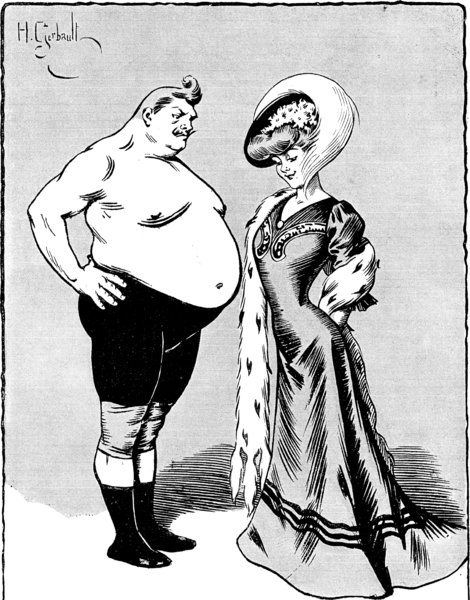
“Une Idée” – Henri Gerbault, 1907
The Situation of Women
… [T]he social presence of a woman was different in kind to that of a man. A man’s presence was dependent upon the promise of power which he embodied. If the promise was large and credible, his presence was striking. if it was small or incredible, he was found to have little presence. there were men, even many men, who were devoid of presence altogether. The promised power may have been moral, physical, temperamental, economic, social, sexual – but its object was always exterior to the man. A man’s presence suggested what he was capable of doing to you or for you.
By contrast, a woman’s presence expressed her own attitude to herself, and defined what could and could not be done to her. No woman lacked presence altogether. Her presence was manifest in her gestures, voice, opinions, expressions, clothes, chosen surroundings, taste – indeed there was nothing she could do which did not contribute to her presence.
To be born woman was to be born within an allotted and confined space, into the keeping of man. A woman’s presence developed as the precipitate of her ingenuity in living under such tutelage within such a limited cell. She furnished her cell, as it were, with her presence; not primarily in order to make it more agreeable to herself, but in the hope of persuading others to enter it.
A woman’s presence was the result of herself being split in two, and of her energy being inturned. A woman was always accompanied – except when quite alone – by her own image of herself. Whilst she was walking across a room or whilst she was weeping at the death of her father, she could not avoid envisaging herself walking or weeping. From earliest childhood she had been taught and persuaded to survey herself continually. And so she came to consider the surveyor and surveyed within her as two constituent yet always distinct elements of her identity as a woman.
A woman had to survey everything she was and everything she did because how she appeared to others, and ultimately how she appeared to men, was of crucial importance for her self-realisation. Her own sense of being in herself was supplanted by a sense of being appreciated as herself by another. Only when she was the content of another’s experience did her own life and experience seem meaningful to her. In order to live she had to install herself in another’s life.

Drawing by Henri Gerbault (1863 – 1930)
Men surveyed women before treating them. Consequently how a woman appeared to a man might determine how she would be treated. To acquire some control over this process, women had to contain it, and so they interiorised it. That part of a woman’s self which was the surveyor treated the part which was the surveyed, so as to demonstrate to others how her whole self should be treated. And this exemplary treatment of herself by herself constituted her presence. Every one of her actions, whatever its direct purpose, was also simultaneously an indication of how she should be treated.
If a woman threw a glass on the floor, this was an example of how she treated her own emotion of anger and so of how she would wish it to be treated by others. If a man had done the same, his action would only have been an expression of his anger. If a woman made good bread, this was an example of how she treated the cook in herself and accordingly of how she as a cook-woman should be treated by others. Only a man could make good bread for its own sake.
This subjunctive world of the woman, this realm of her presence, guaranteed that no action undertaken in it could ever possess full integrity; in each action there was an ambiguity which corresponded to an ambiguity in the self, divided between surveyor and surveyed. The so-called duplicity of woman was the result of the monolithic dominance of man.
A woman’s presence offered an example to others of how she would like to be treated – of how she would wish others to follow her in the way, or along the way, she treated herself. She could never cease offering this example, for it was the function of her presence. When, however, social convention or the logic of events demanded that she behave in a manner which contradicted the example she wished to give, she was said to be coquettish. Social convention insists that she should appear to reject something just said to her by a man. She turns away in apparent anger, but at the same time fingers her necklace and repeatedly lets it drop as tenderly as her own glance upon her breast.
When she is alone in her room and sure of being alone, a woman may look at herself in a mirror and put out her tongue. This makes her laugh and, on other occasions, cry.
It was with a woman’s presence that men fell in love. That part of a man which was submissive was mesmerised by the attention which she bestowed upon herself, and he dreamt of her bestowing the same attention upon himself. He imagined his own body, within her realm, being substituted for hers. This was a theme which occurred constantly in romantic poems about unrequited love. That part of a man which was masterful dreamt of possessing, not her body — this he called lust — but the variable mystery of her presence.
The presence of a woman in love could be very eloquent. the way she glanced or ran or spoke or turned to greet her lover might contain the quintessential quality of poetry. this would be obvious not only to the man she loved, but to any disinterested spectator. Why? Because the surveyor and the surveyed within herself were momentarily unified, and this unusual unity produced in her an absolute single-mindedness. The surveyor no longer surveyed. Her attitude to herself became as abandoned as she hoped her lover’s attitude to her would be. Her example was at last one of abandoning example. Only at such moments might a woman feel whole.
The state of being in love was usually short-lived — except in unhappy cases of unrequited love. Far shorter lived than the nineteenth-century romantic emphasis on the condition would lead us to believe. Sexual passion may have varied little throughout recorded history. But the account one renders to oneself about being in love is always informed and modified by the specific culture and social relations of the time.

„Würden Sie mir böse sein, wenn ich einen Kuss auf diese schöne Schulter drückte?“ „Das werden Sie ja nachher schon sehen“ (Henri Gerbault, 1901)
For the nineteenth-century European middle classes the state of being in love was characterised by a sense of excessive uncertainty in an otherwise certain world. It was a state exempt from the promise of Progress. Its characteristic uncertainty was the result of considering the beloved as though he or she were free. Nothing that was an expression of the beloved’s wishes could be taken for granted. No single decision of the beloved could guarantee the next. Each gesture had to be read for its fresh meaning. Every arrangement became questionable until it had taken place. Doubt produced its own form of erotic stimulation: the lover became the object of the beloved’s choice of full liberty. Or so it seemed to the couple in love. In reality, the bestowing of such liberty upon the other, the assumption that the other was so free, was part of the general process of idealising and making the beloved seem unique.
Each lover believed that he or she was the willing object of the other’s unlimited freedom and, simultaneously, that his or her own freedom, so circumscribed until now, was at last and finally assured within the terms of the other’s adoration. Thus each became convinced that to marry was to free oneself. Yet as soon as a woman became convinced of this (which might be long before her formal engagement) she was no longer single-minded, no longer whole. She had to survey herself now as the future betrothed, the future wife, the future mother of X’s children.
For a woman the state of being in love was a hallucinatory interregnum between two owners, her bridegroom taking the place of her father or later, perhaps, a lover taking the place of her husband.
The surveyor-in-herself quickly became identified with the new owner. She would begin to watch herself as if she were him. What would Maurice say, she would ask, if his wife (that is me) did this? Look at me, she would address the mirror, see what Maurice’s wife is like. The surveyor-in-herself became the new owner’s agent. (A relationship which might well include as much deceit or chicanery as can be found between any proprietor and agent.)
The surveyed-within-herself became the creature of proprietor and agent, of whom both must be proud, She, the surveyed, became their social puppet and their sexual object. The surveyor made the puppet talk at dinner like a good wife. And when it seemsed to her fit, she layed the surveyed down on a bed for her proprietor to enjoy. One might suppose that when a woman conceived and gave birth, surveyor and surveyed were temporarily reunited. Perhaps sometimes this happened. But childbirth was so surrounded with superstition and horror that most women submitted to it, screaming, confused, or unconscious, as to a punishment for their intrinsic duplicity. When they emerged from their ordeal and held the child in their arms they found they were the agents of the loving mother of their husband’s child.
Mia Farrow and John Cassavetes in an excerpt from Rosemary’s Baby (Roman Polanski, 1968). A woman possessed… by her husband, first and foremost.

The following videos are posted by very young teenage girls looking for validation from strangers online in the face of negative comments about their appearance… There are MANY, MANY videos like this on Youtube – it’s become a strange sort of meme.
The exact motives for making these movies are mixed, but if you read the comments under the videos, you’ll see how mean people can be under the cloak of anonymity – meaner, probably, than the unkindness at school that the girls are hoping to drown out with the “objective” opinions of strangers online, for this is what all the videos have in common.
I don’t think I will ever understand how hurting someone else, even if it is because you yourself are hurting, could help you feel better at all… which I guess is what always made me an easy target for bullies myself. I don’t retaliate because it doesn’t make sense to me to do so. That’s lethal bully-bait when coupled with the conviction to stand up for oneself, to speak back. I hit people teasing me a few times when I was a kid, mainly to get them out of my face. It made me feel sick to do that, and it didn’t help. Mostly I would just try to shout them down.
My mom’s mantra, “Sticks and stones may break my bones, but words will never harm me,” roared uselessly.
It took me years and years to figure out how futile and dangerous it is to try to shout, to speak, to whisper back, to appeal to sense and truth, to reason with cruelty. It doesn’t work, because cruelty isn’t rational. It is senseless. Cruelty is fed by any and every reaction. These girls won’t realise until the damage is already done and they have lost their voices completely. It hurts to watch them exposing themselves to so much pain.
“I feel like I could just go away and never come back. I feel like I’ve been standing all these years and keep getting torn down… Deep down inside, all girls know that other people’s opinions don’t matter, but we still go to other people for help because we don’t believe what people say.”
~ Faye (13). More on her story HERE.
“Bullying represents a negative form of seeking attention. The bully is an excessively damaged person asking for help in a devastating way. While compassion is a fantastic quality, our society does not have the tools to deal effectively with this scourge. As a victim of bullying throughout my educational career (including, though less frequent, at college) I had absolutely no support from anybody. People thought bullying was ‘funny’. The bully has no control of his bullying and is not going to stop because he is shown ‘compassion’.
“The bully seeks power from the very person most likely to let him have it! It is a very weird psychology. However society does not have any mechanism (certainly not in schools, although there are pockets of greater awareness) to check this hurtful and harmful behaviour because the bully will find a way outside of school environment.
“Usually, the only thing the bully will listen to is if he is challenged directly. Sadly this challenge may come at a time when the VICTIM has lost rationale and has become desperate. Domestic violence is another form of bullying. Once a victim is forced into silent suffering the results become tragic.
“Being bullied taught me how to become INVISIBLE and it took about 10 years of my life AS AN ADULT to work my way out of this ‘death’. This was my only defence. In hind sight this has given me an invaluable tool: I am now an eternal REBEL.”
~ Helge Janssen
Written in response to THIS OPINION PIECE on bullying, published today on the Daily Maverick website.
“Bullying is about rejection and belonging. It stems from the need for a place in the world and the feeling that one has been denied that need. When young people feel properly welcomed in the world, when they feel their gifts being led out, they do not feel the need to claim their place through violence or meanness. When a person bullies, or shoots his bully, it shows us that we did not provide that young person the opportunity to grow his or her gifts.
“Instead of recognising this, our emotional reaction is often to try to reclaim control, to clamp down. It is a reaction that feeds and deepens the roots of alienation in young people – roots that grab in the belly and grow through the heart until they bloom red in schools. In the United States, where I am from, we have experienced school violence at heretofore unknown levels. We have often responded in all the wrong ways and have managed to turn many of our schools into places that more closely resemble prisons than places in which the inherent gifts of each individual person are ushered into the world.”
Read the rest of this opinion piece HERE.
From the album Kinshasa Succursale (Crammed Discs, 2011)
Video shot in the streets of Kinshasa.
Electric thumb piano (likembé) played by Konono N°1, the legendary Congolese band whose junkyard sonics and trademark “Congotronics” sound has had a major influence on the electronic and indie rock scenes.
Directors: Spike and Jones
DOP: Nicolas Karakatsanis
Producer: Annemie Decorte (Dr. Film)
Styling: Ann Lauwerys
Mask: Katrien Matthys
More info:
http://www.baloji.com
http://www.crammed.be
‘Young gentros in Urban Outfitters “Navajo” tees saying “F**k the system” and “I don’t see color”: You are the problem.’
Two slam poets with Brave New Voices deliver this indictment of hipster cultural appropriation and its collateral damage. Read more HERE.


Churchill with “Marmelade”


The Ad-dressing of Cats
by T.S. Eliot

You've read of several kinds of Cat,
And my opinion now is that
You should need no interpreter
To understand their character.
You now have learned enough to see
That Cats are much like you and me
And other people whom we find
Possessed of various types of mind.
For some are same and some are mad
And some are good and some are bad
And some are better, some are worse--
But all may be described in verse.
You've seen them both at work and games,
And learnt about their proper names,
Their habits and their habitat:
But how would you ad-dress a Cat?

So first, your memory I'll jog,
And say:  A CAT IS NOT A DOG.

And you might now and then supply
Some caviare, or Strassburg Pie,
Some potted grouse, or salmon paste--
He's sure to have his personal taste.
(I know a Cat, who makes a habit
Of eating nothing else but rabbit,
And when he's finished, licks his paws
So's not to waste the onion sauce.)
A Cat's entitled to expect
These evidences of respect.
And so in time you reach your aim,
And finally call him by his NAME.

So this is this, and that is that:
And there's how you AD-DRESS A CAT.

Jean Gaumy
I feel terribly ashamed. I should rename my poor cat, who was ruined to a life of cuteness with a name like Tempura! I should rename her, or add a sassy surname, like Tempura Trenchett, to regain her literary dignity.
How will she feel if she ever had to come across Jean Paul Sartre’s ghost of a cat, “Nothing”!
I only wish I thought of the idea first.
reblogged from pennysparkle
“32 Flavors”, off Not a Pretty Girl (1995).
I have just been unreliably and earnestly informed that Lady Gaga’s fragrance, Fame, will impregnate the wearer with demons.
Song: Roy Orbison – Candy Colored Clown
 JOHN LAROCHE:
You know why I like plants?
SUSAN ORLEAN:
Nuh uh.
JOHN LAROCHE:
Because they’re so mutable. Adaptation is a profound process. Means you figure out how to thrive in the world.
SUSAN ORLEAN:
[pause] Yeah but it’s easier for plants. I mean they have no memory. They just move on to whatever’s next. With a person though, adapting’s almost shameful. It’s like running away.
___
CHARLIE KAUFMAN: [voice-over]
I am pathetic, I am a loser…
ROBERT MCKEE:
So what is the substance of writing?
CHARLIE KAUFMAN: [voice-over]
I have failed, I am panicked. I’ve sold out, I am worthless, I… What the fuck am I doing here? What the fuck am I doing here? Fuck. It is my weakness, my ultimate lack of conviction that brings me here… And here I am because my jump into the abysmal well – isn’t that just a risk one takes when attempting something new? I should leave here right now. I’ll start over. I need to face this project head on and…
ROBERT MCKEE:
…and God help you if you use voice-over in your work, my friends. God help you. That’s flaccid, sloppy writing. Any idiot can write a voice-over narration to explain the thoughts of a character.
___
SUSAN ORLEAN:
There are too many ideas and things and people. Too many directions to go. I was starting to believe the reason it matters to care passionately about something, is that it whittles the world down to a more manageable size.
___
SUSAN ORLEAN:
Do you ever get lonely sometimes, Johnny?
JOHN LAROCHE:
Well, I was a weird kid. Nobody liked me. But I had this idea. If I waited long enough, someone would come around and just, you know… understand me. Like my mom, except someone else. She’d look at me and quietly say: “Yes.” Just like that. And I wouldn’t be alone anymore.
___
CHARLIE KAUFMAN:
There are no rules, Donald. And anyone who says there are is just, you know…
DONALD KAUFMAN:
Not rules, principles. McKee writes that a rule says you *must* do it this way. A principle says, this *works* and has through all remembered time.
___
JOHN LAROCHE:
Point is, what’s so wonderful is that every one of these flowers has a specific relationship with the insect that pollinates it. There’s a certain orchid looks exactly like a certain insect so the insect is drawn to this flower, its double, its soul mate, and wants nothing more than to make love to it. And after the insect flies off, spots another soul-mate flower and makes love to it, thus pollinating it. And neither the flower nor the insect will ever understand the significance of their lovemaking. I mean, how could they know that because of their little dance the world lives? But it does. By simply doing what they’re designed to do, something large and magnificent happens. In this sense they show us how to live – how the only barometer you have is your heart. How, when you spot your flower, you can’t let anything get in your way.
___
SUSAN ORLEAN:
What I came to understand is that change is not a choice. Not for a species of plant, and not for me.
___
CHARLIE KAUFMAN:
I have to go right home. I know how to finish the script now. It ends with Kaufman driving home after his lunch with Amelia, thinking he knows how to finish the script. Shit, that’s voice-over. McKee would not approve. How else can I show his thoughts? I don’t know. Oh, who cares what McKee says? It feels right. Conclusive. I wonder who’s gonna play me. Someone not too fat. I liked that Gerard Depardieu, but can he not do the accent? Anyway, it’s done. And that’s something. So: “Kaufman drives off from his encounter with Amelia, filled for the first time with hope.” I like this. This is good.
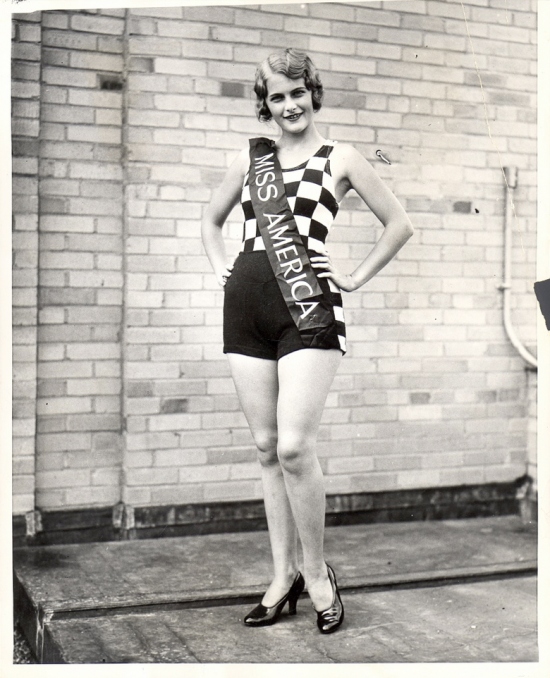 Miss America 1930, Margaret Ekdahl
 Marilyn Monroe
 Betty Page
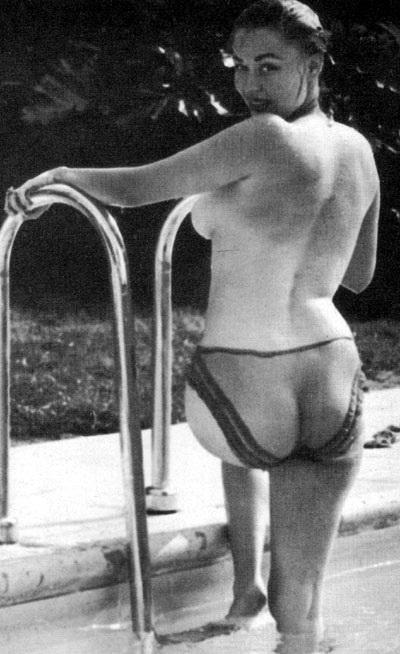 Donalda Jordan
 Candice Huffine 2010

Marquita Pring
 Fluvia Lacerda

But a Fleeting Touch
Jessica Tremp
Melbourne photographer Jessica Tremp captures life in a haunted woodland.
“When I was little I used to dream about being a dancer or that I could fly,” Tremp explains. “And that I would learn to speak the language of the animals in the forest or that of the most dramatic actor. With the click of a finger I’ve found a way to make these things come true.”

Slave Girl Comics
Avon Publications, February 1949
Download it free from the Digital Comics Museum.
Download this track HERE.
From the Self Non Self EP, 1989.
To be born a woman is to be born, within an allotted and confined space, into the keeping of men. The social presence of women is developed as a result of their ingenuity in living under such tutelage within such a limited space. But this has been at the cost of a woman’s self being split into two.
A woman must continually watch herself. She is almost continually accompanied by her own image of herself. Whilst she is walking across a room or whilst she is weeping at the death of her father, she can scarcely avoid envisaging herself walking or weeping. From earliest childhood she has been taught and persuaded to survey herself continually. And so she comes to consider the surveyor and the surveyed within her as the two constituent yet always distinct elements of her identity as a woman. She has to survey everything she is and everything she does, because how she appears to men is of crucial importance for what is normally thought of as the success of her life. Her own sense of being in herself is supplanted by a sense of being appreciated as herself by another…
One might simplify this by saying: men act and women appear. Men look at women. Women watch themselves being looked at. This determines not only most relations between men and women but also the relation of women to themselves. The surveyor of woman in herself is male: the surveyed female. Thus she turns herself into an object — and most particularly an object of vision: a sight.
― John Berger, from Ways of Seeing.
Oh, please don’t give me that!
Yes, I’m a witch,
I’m a bitch
I don’t care what you say,
My voice is real.
My voice speaks truth,
I don’t fit in your ways.
I’m not gonna die for you,
You might as well face the truth,
I’m gonna stick around for quite awhile.
We’re gonna say,
We’re gonna try,
We’re gonna try it our way.
We’ve been repressed,
We’ve been depressed,
Suppression all the way.
We’re not gonna die for you,
We’re not seeking vengeance,
But we’re not gonna kill ourselves for your convenience.
Each time we don’t say what we wanna say, we’re dying.
Each time we close our minds to how we feel, we’re dying.
Each time we gotta do what we wanna do, we’re living.
Each time were open to what we see and hear, we’re living.
We’ll free you from the ghettos of your minds,
We’ll free you from your fears and binds,
We know you want things to stay as it is,
It’s gonna change, baby.
It’s gonna change, baby doll,
It’s gonna change, honey ball,
It’s gonna change, sugar cane,
It’s gonna change, sweetie legs.
So don’t try to make cock-pecked people out of us.
 Published by Dirk Vermin and Fetish Press in 1994 ,in Las Vegas. A fantasy starring Betty with various big-name punkers with great illustrations.
Download it here


Chameleon girl,
you switch,
with each serial
killer moment,
A freckle-face, brown eyes soft
with endless promise,
Heels and stockings
in the glare of
the brake lights,
A sexy sneer on a culpable homicide,
Swallow my car-crash
under a blue cross,
soft skin plays over mine
in the morning.
Smells like the garden
of earthly delights,
a chorus of angels;
and demon-spurred riots.
I want to hold you in my arms,
but all it seems I can do is
write you songs.
I will collaborate on the mysteries,
with you take part in their downfall,
With you I am afraid
anything is possible.
I am a dangerous man,
I vanish like mist
in the face of
commitment.
But long after good and evil
and far beyond death do us part,
You’ll look around
and find that I’m still around
Track 3 from the album Severance by VBI. Music by Graeme Feltham. Words and Vocals by Martin Jacklin. More HERE.
 fleurmach