In this fascinating interview for Spinner, PJ Harvey describes the intensive process of anchoring down the words and forms of the songs in advance of recording her album, Let England Shake.
In this fascinating interview for Spinner, PJ Harvey describes the intensive process of anchoring down the words and forms of the songs in advance of recording her album, Let England Shake.
I have been working for the last while as researcher and production manager on a weekly SABC-commissioned TV documentary series, I Am Woman – Leap of Faith. Here’s one of the episodes, directed by Jane Kennedy:
In January 1996 Shelley Barry was 23 and on her way to a job interview in Cape Town when she was caught in the crossfire of taxi violence caused by rival taxi groups battling for ownership of the same routes.
She was sitting next to the taxi driver in the front of his minibus when an assassin pulled up alongside the moving vehicle and opened fire. The driver was shot seven times and was killed instantly. The taxi crashed, injuring many of its passengers.
Shelley was hit by one of the assassin’s bullets and was instantly paralysed. Her life hung in the balance and it was assumed she would not survive. The friend she was travelling with was seriously injured but has recovered, despite the bullet still lodged in her chest. Shelley has been in a wheelchair ever since. Today she is 42.
How does one create a life for oneself after something like this? How does one find work and meaning once again? Importantly, what happened to Shelley Barry’s dream, held close since childhood, of becoming a filmmaker?
Join this remarkable woman, teacher, activist and filmmaker as she describes her life before and after the shooting: The life of a young girl who told her childhood friends that one day her films would be on the big screen and has achieved that, despite a bullet getting in her way and forcing her into a wheelchair for over twenty years… The life of an activist who worked in the Presidency and has made a significant difference to the lives of the disabled in South Africa… The deeply spiritual journey of a sensitive, funny and bolshy woman who, despite her circumstances, is determined to continue making her mark on the world.
Shelley Barry graciously lets us into her world, describing the many Leaps of Faith she has taken so far and continues to take each and every day.
Catch the broadcast of this programme on SABC 3, Sundays at 09h30, or watch archived episodes on the I AM WOMAN – LEAP OF FAITH WEBSITE.

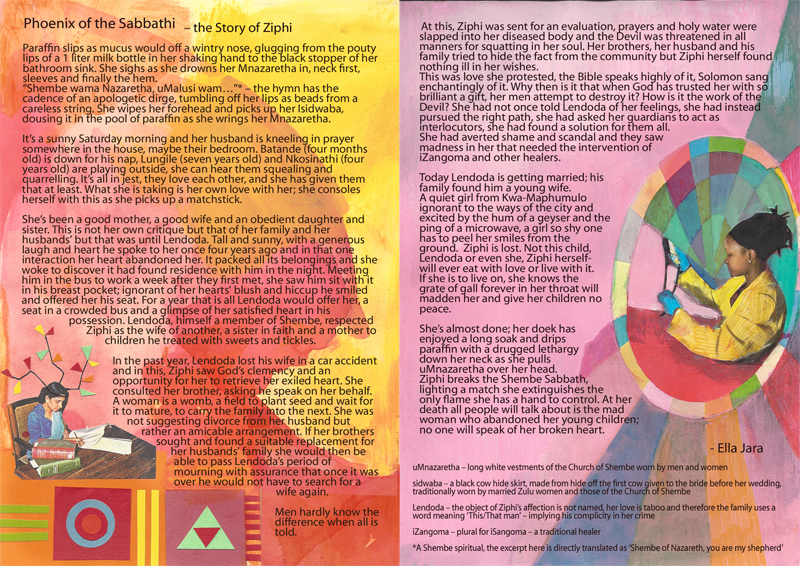
This is a page taken from FLEURZINE, a zine curated and illustrated by Julia Mary Grey. You can go and download this beautiful work of art for free on her site, HERE.
The name was inspired by Fleurmach, and six pieces of writing from this blog appear in the publication. This piece is by Fleurmach contributor NoHolyCows.
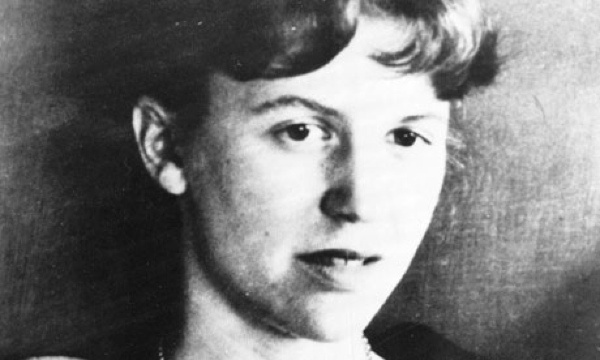 “Being born a woman is an awful tragedy… Yes, my consuming desire to mingle with road crews, sailors and soldiers, bar room regulars – to be a part of a scene, anonymous, listening, recording – all is spoiled by the fact that I am a girl, a female always in danger of assault and battery. My consuming interest in men and their lives is often misconstrued as a desire to seduce them, or as an invitation to intimacy. Yet, God, I want to talk to everybody I can as deeply as I can. I want to be able to sleep in an open field, to travel west, to walk freely at night…”
— Sylvia Plath
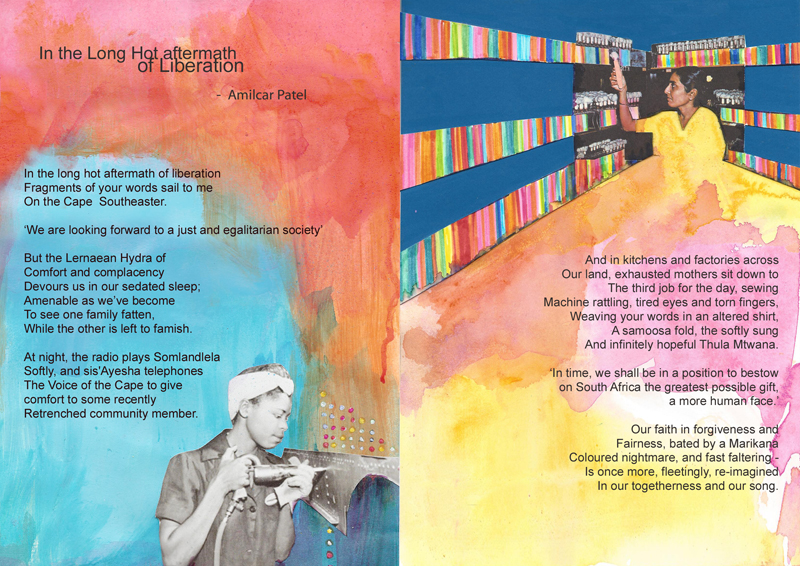 This is a page taken from FLEURZINE, a zine curated and illustrated by Julia Mary Grey. You can go and download this beautiful work of art for free on her site, HERE.
The name was inspired by Fleurmach, and six pieces of writing from this blog appear in the publication!
Directors: Djuna Wahlrab and Matthew Houck
Producers: Casey McGrath and Joshua Levine
Production Company: Phear Creative
“See, honey, I am not some broken thing
I do not lay here in the dark waiting for thee.
My heart is wild, and my bones are steel
and I could kill you with my bare hands if I was free.”
TRIGGER WARNINGS: rape; lethal violence; murder.
I have just dreamed again of being Anene Booysen at the moment of her rape and immediately after it, my pooled blood congealing as my insides lie unseamed in the dust outside me, hacked apart from me, the jagged outside slammed inside me, in my last flickers of awareness the spasms of their hate ripping through me, thudding waves of blows, my head a heavy, dull explosion… the swirling, pulsing aftershocks of pain… going cold, knowing I can never be back together again, that I am smeared asunder into the ground like a fly or a cockroach or an ant, irreversibly crushed. It’s that final. I am no longer me, just a slowly drying patch of gore, beyond being gathered up and revived, soothed, cradled, stitched, kissed better, healed. No one can fix this, not my ma, not the hospital, not God. There is no “if” or “but”. I am aware that this is how I have ended.
I have no words strong enough to express the horror of this experience every time it happens to me, this dream. Yet I need to try to write it out of me in the hope that I never dream it again. Shhh, I tell myself, shivering uncontrollably, curled rigid and foetal, it was only a dream.
But it isn’t. This really happened. Really happens. Continues to happen. And that is what is most horrifying of all.

“FUCK WOMEN’S DAY. FUCK IT.
Don’t ask me to celebrate Women’s Day. Don’t offer me ten percent off beauty products or a free glass of cheap bubbly. Don’t even ask me to commemorate the historic women’s march on the Union buildings – a milestone event whose noble essence has been sold down the river by leaders who are eager to claim some sort of retrospective credit for it, but don’t even pretend to honour its values.
Last year, I was in an epic rage. This year, I’m in despair.”
Read why Helen Moffett is so upset about this travesty of a public holiday HERE.
After “Pan’s Labyrinth”, 2009
Tonight at 20h00, Bolo’bolo in Observatory presents a free screening of a documentary about the life and ideas of Emma Goldman: anarchist, feminist and lifelong rabble rouser.
 For nearly half a century, Russian emigrant Emma Goldman was the most controversial woman in America, taunting the mainstream with her fervent attacks on government, big business, and war. To the tabloids, she was “Red Emma, queen of the anarchists,” but many admired Goldman for her defense of labour rights, women’s emancipation, birth control, and free speech.
Goldman’s life was indelibly marked by two violent acts: the attempted assassination of anti-union industrialist Henry Clay Frick by her comrade and lover Alexander Berkman (he spent 14 years in prison for the crime) and the 1901 slaying of President William McKinley by Leon Czolgosz, a young anarchist who claimed he had been “set on fire” by Goldman’s exhortations to political assassination and martyrdom. McKinley’s assassination led to widespread condemnation of Goldman and other anarchists. Fearing for her life, Goldman went underground.
In 1906, she reemerged as founder and editor of Mother Earth, an anarchist magazine devoted to politics and literature. Once again a public figure, she returned to the lecture circuit. Her talks on the struggling revolution in Russia, on the rights of workers, on civil liberties — even on anarchism — drew large, sympathetic crowds. For almost a decade, Goldman maintained a grueling schedule, spending nearly half of every year on the road. In one six-month period, she delivered 120 lectures in 37 cities.
An outspoken opponent of America’s entry into World War I, she was arrested and imprisoned for demonstrating against the draft. In 1919 she, Berkman, and 247 others were deported to Russia, just two years after the October revolution replaced the Czarist regime with Bolshevik tyranny. After two dispiriting years, Goldman and Berkman left the Soviet Union and dedicated themselves to revealing the truth about a revolution gone wrong.
“The State is the altar of political freedom and, like the religious altar, it is maintained for the purpose of human sacrifice.” – Emma Goldman
PS: Non-alcoholic drinks and vegan snacks will be on sale. You may bring your own beer or wine if you’d like. The screenings are free, but donations are welcome.
From The Black Book Of Capitalism (2008)
(which samples THIS)
Let us not think that because we are less brutal, less violent, less inhuman than our opponents we will carry the day. Brutality, violence, and inhumanity have an immense prestige that schoolbooks hide from children, that grown men do not admit, but that everyone bows before. For the opposite virtues to have as much prestige, they must be actively and constantly put into practice. Anyone who is merely incapable of being as brutal, as violent, and as inhuman as someone else, but who does not practice the opposite virtues, is inferior to that person in both inner strength and prestige, and he will not hold out in a confrontation.
“There is no man so good, who, were he to submit all his thoughts and actions to the laws, would not deserve hanging ten times in his life.”
— Michel de Montaigne, essayist (1533-1592)
For anyone who’s been following what’s been happening since blind busker Lunga Nono was publicly assaulted and arrested by Cape Town police recently… Also watch Nono’s own account of events HERE.

This started out as an admonishment of Cape Town residents for our tardy outrage and showboat sense of civic responsibility. We turned up in huge numbers, I was going to say, when city law-enforcement officers publicly assaulted and arrested Lunga Gooodman Nono, but where were we when the laws and regulations he supposedly fell foul of were made? Public participation in law-making, after all, forms one of the key pillars of our constitutional democracy. It’s on us if unjust laws make it into the statute books.
View original post 893 more words
Plus ça change, plus c’est la même chose…
From Forces of Victory, 1979.
Plus ça change, plus c’est la même chose…
“Murder is murder / Why’re they confused? / Another man dead / I read it in the news / Who gave them the fucking right / To run around like they own the night?”
In some cases, anonymity itself, which was supposed to express solidarity, abets sexism. Take Tiqqun. Founded in the late 1990s and dissolved after the 9/11 attacks, the French journal of radical philosophy attracted media attention when one of its founders, Julien Coupat, was arrested in November 2008 in connection with plans to sabotage the TGV train lines.
Semiotext(e) published translations of Tiqqun’s Introduction to Civil War and This is Not a Program between 2009 and 2011, and the anarchist press Little Black Cart books distributed Tiqqun 1 and Theory of Bloom in 2011 and 2012. Though their cops-and-robbers bombast sometimes raised our eyebrows, we read these with interest. Then, late last year, Semiotext(e) put out its next Tiqqun installment. Enclosed in a bright pink cover, and bookended with what looked like low-grade xerox collages of glossy magazine ads and soft porn, Preliminary Materials for a Theory of the Young-Girl confirmed all that we had begun to suspect.
Theory of the Young-Girl opens with a 10-page excursus sketching the “total war” that contemporary capitalism wages against anyone who dares oppose it. Echoing the work of Michel Foucault and Gilles Deleuze, Tiqqun argues that capitalism compels individuals to internalize its imperatives to live (and thus consume) in certain ways. Because the entire conflict is invisible, Tiqqun professes that “rethinking the offensive for our side is a matter of making the battlefield manifest,” revealing the processes by which contemporary society compels us to commodify even our intimate lives. Where can they best expose the front lines where capitalism is waging its invisible war? The “Young-Girl,” a figure Tiqqun invents to play both the exemplary subject of and the agent reproducing this system.
Tiqqun claims it has lady members and seems eager to reassure us that it does not hate us. “Listen,” Tiqqun writes. “The Young-Girl is obviously not a gendered concept … The Young-Girl is simply the model citizen as redefined by consumer society.” When early 20th century capitalism realized that, to reproduce itself, it would have to colonize social life, it particularly targeted the spheres of “youth” and “femininity”: the young, because they needed and wanted things, and did not yet work; women, because they governed social reproduction, i.e., had and raised kids.
The majority of what follows consists of a Situationist-ish collage that, in a series of vacillating typefaces and font sizes, presents the Young-Girl as a scapegoat as much as a victim.

Image by Shintaro Kago
Deep down inside, the Young-Girl has the personality of a tampon: she exemplifies all of the appropriate indifference, all of the necessary coldness demanded by the conditions of metropolitan life.
In love more than anywhere else, the Young-Girl behaves like an accountant.
There isn’t room for two in the body of a Young-Girl.
It appears that all the concreteness of the world has taken refuge in the ass of the Young-Girl.
There are beings that give you the desire to die slowly before their eyes, but the Young-Girl only excites the desire to vanquish her, to take advantage of her.
Like the nice guy from your grad-school program who tries to cover up his hurt feelings by concocting a general theory that explains why he never got a text after his one-night stand, the book portrays the Young-Girl as vain, frivolous, and acquisitive. She serves the traditional female role of reproducing the population and social order, but here, the social order is corrupt. Therefore, Tiqqun suggests, their intervention requires an ironic performance of misogyny. The question remains: Why is misogyny their only option? And why are so many thoughtful people ready to accept that a layer of irony suffices to turns hateful language into the basis of a sound critique?
We believe that Tiqqun has mistaken its object. The real enigma of our age is not the Young-Girl, who, we submit, has been punished enough already for how commodity culture exploits her. It is, rather, her boyish critic. Forms of crypto- and not-so-crypto misogyny have proved startlingly persistent not just within the radical left but also in the bourgeois-left spheres of cultural production: the publishing world, the museum, and the humanities departments of liberal-arts universities. We propose that a particular type is responsible for perpetuating such bad behavior. Call him the Man-Child.
***
It is not that we cannot talk Tiqqun talk. Look:
The Man-Child has two moods: indecision, and entitlement to this indecisiveness.
The Man-Child tells a racist joke. It is not funny. It is the fact that the Man-Child said something racist that is.
The Man-Child wants you to know that you should not take him too seriously, except when you should. At any given moment, he wants to you to take him only as seriously as he wants to be taken. When he offends you, he was kidding. When he means it, he means it. What he says goes.
The Man-Child thinks the meaning of his statement inheres in his intentions, not in the effects of his language. He knows that speech-act theory is passé.
The Man-Child’s irony may be a part of a generational aversion to political risk: he would not call out a sexist or racist joke, for fear of sounding too earnest. Ironically, the Man-Child lives up to a stereotype about the men from the rom-coms he holds in contempt: he has a fear of commitment.
The Man-Child won’t break up with you, but will simply stop calling. He doesn’t want to seem like an asshole.
He tells you he would break up with his girlfriend, but they share a lease.
The Man-Child breaks up with you even though the two of you are not in a relationship. He cites his fear of settling down. You don’t want marriage, at least not with him, but he never thought to ask you.
The Man-Child can’t even commit to saying no.
Why are you crying? The Man-Child is just trying to be reasonable. This is his calm voice.
The Man-Child isn’t a player. Many a Man-Child lacks throw-down. He puts on a movie and never makes a move.
Is Hamlet the original Man-Child? No: the Romantics made him one.
Just as not all men are Man-Children, neither are all Man-Children men.
Lena Dunham may be living proof that the Man-Child is now equal opportunity. That is, the character she plays on Girls is. A real man-child would never get it together to get an HBO show. As we watch Hannah Horvath pull a splinter out of her ass, we wonder: Is this second-wave feminism? Or fourth? It is no accident that Judd Apatow wrote the scene. The mesh tank Dunham wears over bare tits is isomorphic with the dick joke.
The hipster and the douchebag may be subspecies of the genus Man-Child.
If the Man-Child could use his ironic sexism to build a new world, would you want to live in it? Would anyone?
***
We could go on like this. Others have. Since Theory of the Young-Girl appeared in France in the late 1990s, the Man-Child has wandered far afield from the barricades, turning up more and more often in the mainstream liberal press. When Hanna Rosin published her widely discussed Atlantic essay and subsequent book, The End of Men, proposing that “modern, postindustrial society is just better suited to women,” she inaugurated a genre. A spate of articles lamented how the “mancession” was discouraging even nice boys from fulfilling the roles traditionally expected of them—holding a job, taking girls on dinner dates, eventually choosing one to marry, outearn, beget kids with, etc.
“The End of Courtship,” which the New York Times ran in January, is exemplary. “It is not uncommon to walk into the hottest new West Village bistro on a Saturday night and find five smartly dressed young women dining together—the nearest man the waiter,” its author concludes. “Income equality, or superiority, for women muddles the old, male-dominated dating structure.” Meanwhile, an online panic-mongering industry thrives by offering more or less reactionary advice to female page-viewers about how to turn whatever romantic temp work comes their way into a long-term contract.
Mancession Lit portrays the Man-Child as pitiful, contrasting him with women who are well-adjusted and adult. But it rarely acknowledges the real question that this odd couple raises. Namely, are women better suited to the new economy because they are easier to exploit?
In the mid-1970s, Italian Marxist feminists attempted to integrate an account of “immaterial labor” into their critique of capitalist society. They argued that when a shop attendant smiles for a customer, or a teacher worries too much about her students, or a parent does housework, they perform real labor. No accident that their examples came from spheres traditionally occupied by women. Antonio Negri and Michael Hardt later used the phrase “affective labor” to describe the emotional exertion that white-collar jobs increasingly require. Employers in economically dominant countries now primarily demand “education, attitude, character, and ‘prosocial’ behavior.” When job listings ask for “a worker with a good attitude,” what they want, say Hardt and Negri, is a smile.
In the culture sector, economic precarity constantly reminds employees of their expendability and, therefore, the importance of their investing affect in their workplace. To gain even an unpaid internship or a barely paid entry-level position in journalism, publishing, museums, or higher education, dedication is a must. Many jobs that used to be meal tickets for starving artists are now considered covetable and require “love.” A college freshman recently told us: “I have a passion for marketing.” A journalist friend recounts how, when she was still in college, a magazine editor approached her at a party with the line: “Yo, you should be my intern.” We imagine her smiling, as if to flatter his delusion that there were any print-media jobs still worth sleeping your way into; in any case, she did get a gig there.
Women’s long history of performing work without its even being acknowledged as work, much less compensated fairly, may account for their relative success in today’s white-collar economy. This is, at least, the story of the heroine that the new Mancession Lit has created. Call her the Grown Woman. A perpetual-motion machine of uncomplaining labor, shuttling between her job and household tasks, the Grown Woman could not be more different from either fat-year brats like Carrie Bradshaw, or Judd Apatow’s lady Man-Children. The Grown Woman holds down her job and pays for her own dinner. The Grown Woman feels like a bad mom when she sees the crafts and organic snacks that other moms are posting on Pinterest. She wonders whether feminism lied to her, but knows she will inherit the earth. Could this be because she is better than the Man-Child at performing what current economic conditions demand? She is certainly more practiced. Who among us hasn’t faked it, if only to make him stop asking?
***
Tiqqun knows and says what the Lifestyle section does or cannot: Today the economy is feminizing everyone. That is, it puts more and more people of both genders in the traditionally female position of undertaking work that traditionally patriarchal institutions have pretended is a kind of personal service outside capital so that they do not have to pay for it. When affective relationships become part of work, we overinvest our economic life with erotic value. Hence, “passion for marketing.” Hence, “Like” after “Like” button letting you volunteer your time to help Facebook sell your information to advertisers with ever greater precision.
In the postindustrial era, work and leisure grow increasingly indistinguishable: We are all shop girls now. From this “feminization of the world,” Tiqqun writes, “one can only expect the cunning promotion of all manner of servitudes.” At times, Tiqqun speaks of this exploitation sympathetically. More often, however, they blame the Young-Girl for opening the floodgates by complying with her own exploitation, thus making it easier for control capitalism to make her attitude compulsory for everyone.
Though its anxieties are of the moment, Tiqqun lifts its language from a long intellectual tradition that uses “woman” as shorthand. You can trace this line to Goethe’s Faust and the “eternal feminine” or Friedrich Schiller’s “Veiled Statue at Sais,” where “a youth, impelled by a burning thirst for knowledge,” pokes around Egypt looking for a busty sculpture of Isis that he calls “Truth.” Nietzsche continues using “woman” as a metaphor for the metaphysical essence that philosophers looked for beneath the surface of mere existence. But he borrows the language of his predecessors only to show how their quest failed—proposing, for instance, in Human, All Too Human that “women, however you may search them, prove to have no content but are purely masks.” Nietzsche’s point is that the woman called Truth was always already a cocktease: Nothing except existence exists.
Tiqqun offers an edgy update to such misogynist metaphors deployed for the purposes of demystification. At times, it speaks longingly of women who have not been utterly corrupted by capitalism. But when it learns what it knew all along—there is no outside; all human relationships have become reified—its disappointment at finding no one authentic to grow old with intensifies its vitriol. “It wasn’t until the Young-Girl appeared that one could concretely experience what it means to ‘fuck,’ that is, to fuck someone without fucking anyone in particular. Because to fuck a being that is really so abstract, so utterly interchangeable, is to fuck in the absolute.” Tiqqun’s language may be obscene, but its point is nothing new. The failure to see women as “anyone in particular,” or as subjects endowed with their own ends, has allowed men to fuck women over for centuries.
Read the rest of this incisive article HERE.
before my lack of words
am I under your spelling
unformed
your words
write me out
uniformed
regimented
rote
do you read me
de-scribed
written off
declaimed
b e y o n d y o u r p r o n o u n c e m e n t s
i remain
uninformed
unsigned
do you read me
Rough demo – Words & Music by Jim Neversink, 2013
“I think we ought to read only the kind of books that wound and stab us. If the book we are reading doesn’t wake us up with a blow on the head, what are we reading it for? …We need the books that affect us like a disaster, that grieve us deeply, like the death of someone we loved more than ourselves, like being banished into forests far from everyone, like a suicide. A book must be the axe for the frozen sea inside us.”
— Franz Kafka

… On the occasion of his 2013 visit to South Africa
From Andile Lungisa, president of the Panafrican Youth Union
Dear Mr Obama,
Your election as the first President of the United States of America of African ancestry aroused immeasurable passions among the great multitude in our continent and around the world. The forlorn hope was premised on the retrospectively foolish idea that because your forebears were of those who had been dehumanized, hunted, captured, brutalized and ‘civilized’ throughout history, your leadership of the sole hyper-power on the planet would usher a period of decency, respect of human life, justice and peace.
Listening to your ‘Hopey’ enunciations, our people believed that the God of the dispossessed, tyrannized and abandoned had at last heard their raw and enduring prayers and had raised a son of their seed to redeem their humanity and medicate their future. On the 27th of November 2008, the day of your election, we cried and danced in the slums of Nairobi, the barrios of Caracas, ghettos of Detroit, gutters of Khayelitsha, hell zones of Cite Soleil, the brutally occupied territories of Palestine, in Manshiet Nasser of Cairo, in the shanty towns of Mumbai, the Al Qaryahs of Bayda, and in the many wastelands around the globe. Your election, which was energized by the young people of the United States, we were convinced, was a repudiation of the callousness, force, contempt and criminality with which the powerful from the industrialized West treated the majority of men. More importantly we hoped your victory signalled the beginning of the end of the 500 year war that the West has waged against the rest of humankind.
The oratory subterfuge notwithstanding, your presidency, Mr Obama, has been a geyser of gunk, incessant deceit and vacuity. Not only have you inherited the boorish and fantastical logic of imperial grandiosity, but you have embellished it to frightening heights. In an attempt to arrest the terminal historic decline of the US’ global hegemony and retain its position as the gendarme of capital accumulation, you have cultivated and harnessed an infrastructure of control, domination, death and destruction and thus ensuring a brutal future for the majority of humanity. In a delicious irony, tragic-comic in proportion, Lady History has elected you Mr Obama, a lawman by trade of African descent, to preside over the systematic defiling of the rule of law, and in turn magnify the death of a democratic consciousness and ascendance of thuggery among the ruling elites in the West.
Your administration has overseen a historic transfer of wealth from the public to the rapacious banksters to whom you are beholden. You have exhibited cold indifference, save for the empty rhetorical platitudes, to the most serious job crisis since the Great Depression, which has devastated especially African American communities, and left millions in destitution. You have intensified the hunting of the Black liberation revolutionary, Assata Shakur, who sought refuge in Cuba in 1979, escaping from the racist American industrial gulag that disproportionately incarcerates Black and Hispanic youths.
In your sanctimonious lecturing, please tell the young people at the University of Johannesburg why you ordered the murder of the 16 year old, Abdulrahman al Alawaki. Better yet, advise them on the rationale for a former teacher of law to grant himself the right to secretly kill his own citizens and anyone else the corporate-industrial police state deems a ‘terrorist’. Mr Obama, exhibit some moral probity, not your strong suit I know, in front of the young, impressionable minds you will be addressing and express some remorse for the thousands of women and children that you have killed and injured in your ‘signature’ drone strikes.
Tell the young people why Bradley Manning, a real American hero, who exposed the true and ugly face of American militarism and criminality, has been arrested and treated in a ‘cruel and inhumane’ manner according to the United Nations, whilst those whom he exposed continue to live in impunity. The ‘humanitarian’ industrial violence you discharged on the then sovereign state of Libya, which you don’t consider to have been a war, because no American soldier died, has unleashed a racist pogrom against Black Africans by your ‘freedom fighters’. Any word for the victims of your liberators, Mr Obama?
Under your presidency, and largely because of the unforgivable stupidity of African leadership in this generation, the American empire is building the infrastructure for AFRICOM military command – a feat that your buffoonish predecessor could not achieve. You’ve continued aiding and abetting the Zionist criminal enterprise against the Palestinians. The apartheid state of Israel, which Archbishop Tutu deemed more egregious than apartheid South Africa, kills Palestinian children with weapons supplied by your administration.
You, Mr Obama, son of a Kenyan father, are no different from the Bantustan leaders that we had in this country, and no amount of lyrical gymnastics will change the facts of your presidency.
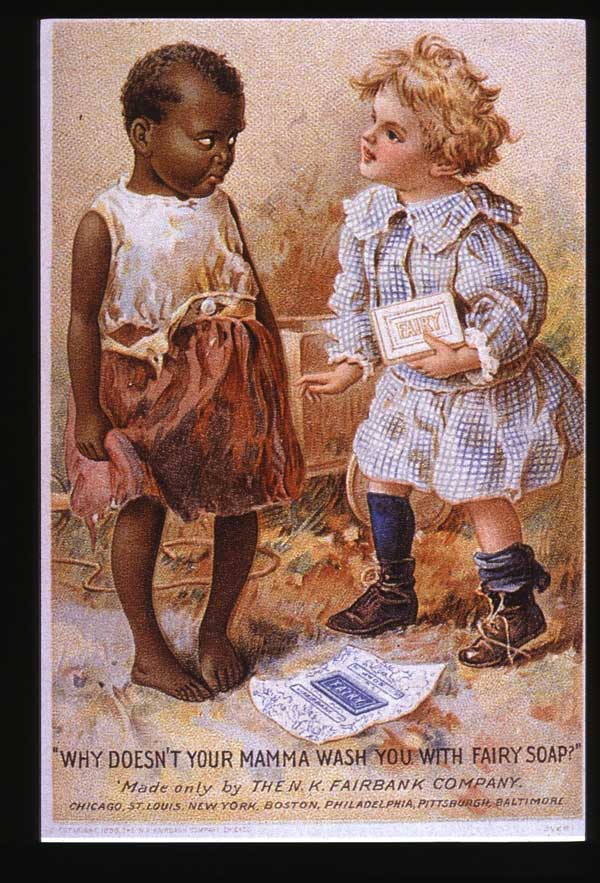
It all seemed like a game at first… Watch this brilliant teacher recreate segregation in her 3rd grade classroom at the end of the 1960s, to demonstrate the arbitrary violence and effects of discrimination. A profound object lesson, and one the world still hasn’t been able to grasp; this is essential viewing. More about Jane Elliot’s work can be found HERE.


 fleurmach