“Perhaps to a degree hardly achieved in the rest of the Continent, the human has consistently taken on the form of waste within the peculiar trajectory race and capitalism espoused in South Africa. Traditionally, we speak of “waste” as something produced bodily or socially by humans. In this sense, “waste” is that which is other than the human. Traditionally too, we speak of the intrinsic capacity of capitalism to waste human lives. We speak of how workers are wasted under capitalism in comparable fashion to natural resources. Marx in particular characterizes capitalist production as thoroughly wasteful with what he calls “human material” just as it is with “material resources”. It squanders “human beings, living labour”, “squandering not only flesh and blood, but nerves and brain, life and health as well”, he writes. In order to grasp the particular drama of the human in the history of South Africa, we should broaden this traditional definition of “waste” and consider the human itself as a waste product at the interface of race and capitalism. Squandering and wasting black lives has been an intrinsic part of the logic of capitalism, especially in those contexts in which race is central to the simultaneous production of wealth and of superfluous people…
… One of the most brutal effects of neo-liberalism in South Africa has been the generalization and radicalization of a condition of temporariness for the poor. For many people, the struggle to be alive has taken the form of a struggle against the constant corrosion of the present, both by change and by uncertainty.
In order to reanimate the idea of “the human” in contemporary South African politics and culture, there is therefore no escape from the need to reflect on the thoroughly political and historical character of wealth and property and the extent to which wealth and property have come to be linked with bodily life.”
And HERE is another discussion, by Richard Pithouse, which further sets out the colonial history of the discourse around people in a state of exception (in the context of shack dwellers).
Melati Suryodarmo (b. in 1969 in Surakarta, Indonesia, lives and works in Braunschweig, Germany) performs EXERGIE – Butter dance, an older piece but shown for the first time at Lilith.
20 blocks of butter in a square on the black dance carpet. Suryodarmo enters the space, dressed in a black tight dress and red high heels. She steps on the pieces of butter. She starts to dance to the sound of Indonesian shamanistic drums. She dances and falls, hitting the floor hard, rising, and continuously being on the verge of standing, slipping and falling in the butter. After twenty minutes Suryodarmo rises one last time, covered in butter, and leaves the space. http://www.melatisuryodarmo.com/
Copyright of the performance: Melati Suryodarmo
Documentation done by Lilith Performance Studio.
Copyright of the documentation belongs to Melati Suryodarmo and Lilith Performance Studio, Malmo, Sweden.
Performances took place 24 – 30 April 2015, presented by Autograph ABP at Rivington Place, London. Presented in two parts, seven evening performances in the gallery followed by a seven-week exhibition, ‘Whip it Good’ retraces the footsteps of colonialism and maps the contemporary reverberations of the triangular slave trade via a series of performances that will result in a body of new ‘action’ paintings.
During each performance, the artist radically transforms the whip – a potent sign and signifier of violence against the enslaved body – into a contemporary painting tool, evoking within both the spectators and the participants the physical and visceral brutality of the transatlantic slave trade. Deep black charcoal is rubbed into the whip, directed at a large-scale white canvas, and – following the artist’s initial ritual – offered to members of the audience to complete the painting.
However, the themes that emerge from Whip It Good trace beyond those of slavery: Ehlers’ actions powerfully disrupt historical relationships between agency and control in the contemporary. The ensuing ‘whipped’ canvases become transformative bearers of the historical legacy of imperial violence, and through a controversial artistic act re-awaken critical debates surrounding gender, race and power within artistic production. What the process generates for the artist, is an intensely focused space in which to make new work as part of a cathartic collaborative process.
Read Chandra Frank’s review of the performance, which also took place in Gallery Momo in South Africa, HERE.
The problem is that white people see racism as conscious hate, when racism is bigger than that. Racism is a complex system of social and political levers and pulleys set up generations ago to continue working on the behalf of whites at other people’s expense, whether whites know/like it or not. Racism is an insidious cultural disease. It is so insidious that it doesn’t care if you are a white person who likes Black people; it’s still going to find a way to infect how you deal with people who don’t look like you.
Yes, racism looks like hate, but hate is just one manifestation. Privilege is another. Access is another. Ignorance is another. Apathy is another, and so on. So while I agree with people who say no one is born racist, it remains a powerful system that we’re immediately born into. It’s like being born into air: you take it in as soon as you breathe.
It’s not a cold that you can get over. There is no anti-racist certification class. It’s a set of socioeconomic traps and cultural values that are fired up every time we interact with the world. It is a thing you have to keep scooping out of the boat of your life to keep from drowning in it. I know it’s hard work, but it’s the price you pay for owning everything.
“Protection [of women] is the rock that all men push. We call it our burden, but it’s really our privilege.” — Lou Solverson
Oom Piet * is sitting one night on his farm stoep by a fire. He is alone except for his dog Butch, which lifts its head slowly as a strange figure steps silently into the firelight. Deep in his cups, Piet realises he might be seeing an alien, but it could just be a figment of his inebriation. When his dog wags its tail and goes to greet the tall grey figure, he decides to trust its intuition and, with a slightly trembling hand, offers the large-eyed, curiously sexless creature his glass of brandy.
Turns out, after a couple of dops, that the alien has been studying mankind since it arrived through the medium of Google, so it’s English is pretty much immaculate, though its Afrikaans is at best, patchy. Piet’s English is passable, but he prefers the Taal. The alien’s name is unpronounceable, and from where it hails (though Piet forgets that name too) they have no sexes, replicating from offshoots of their body which are then spliced onto … Anyway, it’s understandably curious about the whole issue of gender, and surmising correctly that Piet knows almost nothing of the experience of being a woman, it asks the oom for some firsthand information about what it means to be a man.
“Well, men are supposed to be stronger than women,” is Piet’s first reaction, to which the alien whips out an iPad and starts checking if this is indeed true. “Well, yes, men are stronger physically,” (1) confirms the alien, enquiring how this factor affects interactions with women.
“Well, we can use our strength to protect our women,” says Piet gallantly.
From what, or whom, the alien wants to know?
Oom Piet thinks a bit. “In the old days, it was against wild animals and other tribes and things, but deesdae, I guess it’s mostly from other men.”
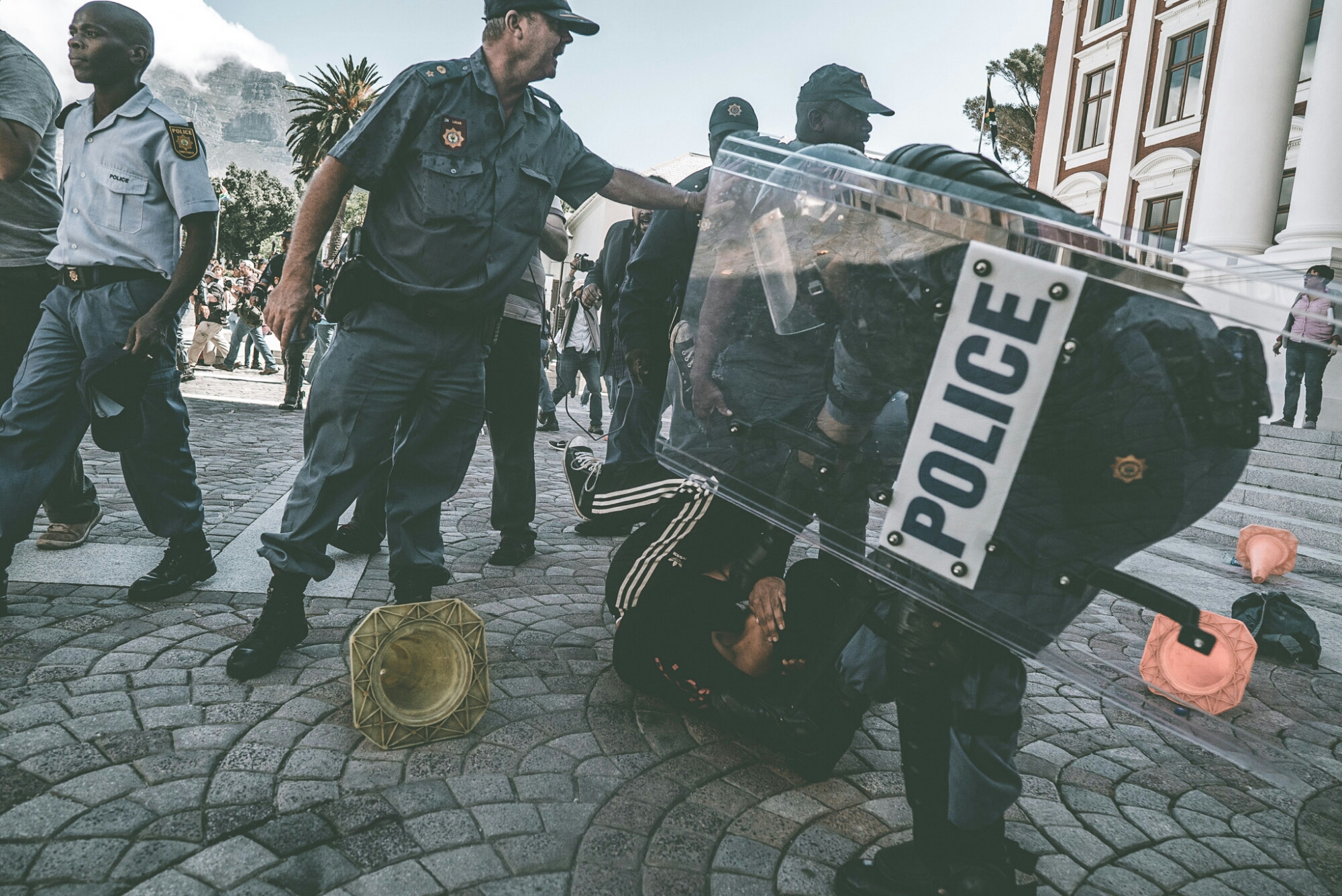
Outside Parliament, 21 October, 2015. Photo: Imraan Christian
He stood in front of us
held his palms up
be calm comrades
sit down comrades
do not do anything to antagonise them
Comrades.
They knew his face, though we could not see him between the arms of a chokehold.
He sat on the floor among us
legs crossed under him
Senzeni na?
Senzeni na?
They stunned us, clicked tazers.
White-police-coward-not-man
pulled him out and away.
Another chokehold.
He fell to the floor
when the first grenade cracked
through the crowd.
Pulled up and bashed against shields
holding his burned face
dragged across the gravel.
Senzeni na?
He sat on the steps
quietly
consoling comrades
away from the crowd
They ripped him to his feet
he showed his empty palms
into the back of a van.
No fists.
Empty palms.
He held his hands over his head.
He held his empty hands over his head.
He held his open palms over his head.
He held his head.
Hélène Cixous’ essay “Castration or Decapitation?” discusses the binary construction of sexuality and society, and how the feminine is defined by the negative: a woman is not a man because she lacks a penis. This “lack” keeps the female subject to definition by the male, as it is seen that because she is the “negative” pole to the man’s “positive”, the woman is concomitantly un-informed, and that therefore it is the position of the man to inform the woman. This imposed silence is what decapitates the feminine metaphorically, precluding her from speaking anything of meaning.
The following is an excerpt from this brilliant essay, translated by Annette Kuhn and published in Signs, Vol. 7, No. 1 (Autumn, 1981), pp. 41-55 (University of Chicago Press) – read the full essay HERE.
* * * * *
… It’s hard to imagine a more perfect example of a particular relationship between two economies: a masculine economy and a feminine economy, in which the masculine is governed by a rule that keeps time with two beats, three beats, four beats, with pipe and drum, exactly as it should be. An order that works by inculcation, by education. It’s always a question of education: an education that consists of trying to make a soldier of the feminine by force, the force history keeps reserved for woman, the “capital” force that is effectively decapitation. Women have no choice other than to be decapitated. The moral is that if they don’t actually lose their heads by the sword, they only keep them on condition that they lose them – lose them, that is, to complete silence, turned into automatons.
It’s a question of submitting feminine disorder, its laughter, its inability to take the drumbeats seriously, to the threat of decapitation. If man operates under the threat of castration, if masculinity is culturally ordered by the castration complex, it might be said that the backlash, the return, on women of this castration anxiety is its displacement as decapitation, execution, of woman, as loss of her head.
We are led to pose the woman question to history in quite elementary forms like, “Where is she? Is there any such thing as woman?” At worst, many women wonder whether they even exist. They feel they don’t exist and wonder if there has ever been a place for them. I am speaking of woman’s place,from woman’s place, if she takes (a) place.
In La Jeune Née I made use of a story that seemed to me particularly expressive of woman’s place: the story of Sleeping Beauty. Woman, if you look for her, has a strong chance of always being found in one position: in bed. In bed and asleep-“laid (out).” She is always to be found on or in a bed: Sleeping Beauty is lifted from her bed by a man because, as we all know, women don’t wake up by themselves: man has to intervene, you understand. She is lifted up by the man who will lay her in her next bed so that she may be confined to bed ever after, just as the fairy tales say.
From Disney’s “Sleeping Beauty”
And so her trajectory is from bed to bed: one bed to another, where she can dream all the more. There are some extraordinary analyses by Kierkegaard on women’s “existence”- or that part of it set aside for her by culture-in which he says he sees her as sleeper. She sleeps, he says, and first love dreams her and then she dreams of love. From dream to dream, and always in second position. In some stories, though, she can be found standing up, but not for long.
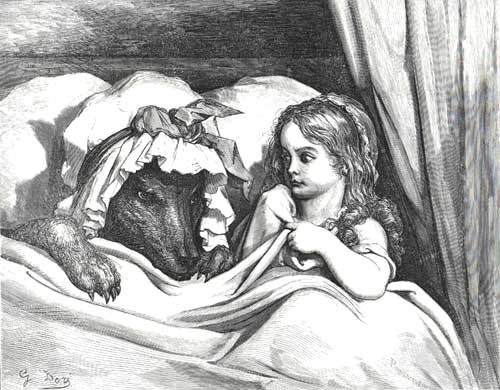
Take Little Red Riding Hood as an example: it will not, I imagine, be lost on you that the “red riding hood” in question is a little clitoris. Little Red Riding Hood basically gets up to some mischief: she’s the little female sex that tries to play a bit and sets out with her little pot of butter and her little jar of honey. What is interesting is that it’s her mother who gives them to her and sends her on an excursion that’s tempting precisely because it’s forbidden: Little Red Riding Hood leaves one house, mommy’s house, not to go out into the big wide world but to go from one house to another by the shortest route possible: to make haste, in other words, from the mother to the other.
The other in this case is grandmother, whom we might imagine as taking the place of the “Great Mother,” because there are great men but no great women: there are Grand-Mothers instead. And grandmothers are always wicked: she is the bad mother who always shuts the daughter in whenever the daughter might by chance want to live or take pleasure. So she’ll always be carrying her little pot of butter and her little jar of honey to grandmother, who is there as jealousy … the jealousy of the woman who can’t let her daughter go.
But in spite of all this Little Red Riding Hood makes her little detour, does what women should never do, travels through her own forest. She allows herself the forbidden … and pays dearly for it: she goes back to bed, in grandmother’s stomach. The Wolf is grandmother, and all women recognize the Big Bad Wolf! We know that always lying in wait for us somewhere in some big bed is a Big Bad Wolf.
Gustave Dore – The Disguised Wolf in Bed
The Big Bad Wolf represents, with his big teeth, his big eyes, and his grandmother’s looks, that great Superego that threatens all the little female red riding hoods who try to go out and explore their forest without the psychoanalyst’s permission. So, between two houses, between two beds, she is laid, ever caught in her chain of metaphors, metaphors that organize culture . . . ever her moon to the masculine sun, nature to culture, concavity to masculine convexity, matter to form, immobility/inertia to the march of progress, terrain trod by the masculine footstep, vessel… While man is obviously the active, the upright, the productive… and besides, that’s how it happens in History.
This opposition to woman cuts endlessly across all the oppositions that order culture. It’s the classic opposition, dualist and hierarchical. Man/Woman automatically means great/small, superior/inferior… means high or low, means Nature/History, means transformation/inertia. In fact, every theory of culture, every theory of society, the whole conglomeration of symbolic systems-everything, that is, that’s spoken, everything that’s organized as discourse, art, religion, the family, language, everything that seizes us, everything that acts on us – it is all ordered around hierarchical oppositions that come back to the man/ woman opposition, an opposition that can only be sustained by means of a difference posed by cultural discourse as “natural,” the difference between activity and passivity. It always works this way, and the opposition is founded in the couple [binary]. A couple posed in opposition, in tension, in conflict… a couple engaged in a kind of war in which death is always at work – and I keep emphasizing the importance of the opposition as couple, because all this isn’t just about one word; rather everything turns on the Word: everything is the Word and only the Word. To be aware of the couple, that it’s the couple that makes it all work, is also to point to the fact that it’s on the couple that we have to work if we are to deconstruct and transform culture. The couple as terrain, as space of cultural struggle, but also as terrain, as space demanding, insisting on, a complete transformation in the relation of one to the other. And so work still has to be done on the couple … on the question, for example, of what a completely different couple relationship would be like, what a love that was more than merely a cover for, a veil of, war would be like.
I said it turns on the Word: we must take culture at its word, as it takes us into its Word, into its tongue. You’ll understand why I think that no political reflection can dispense with reflection on language, with work on language. For as soon as we exist, we are born into language and language speaks (to) us, dictates its law, a law of death: it lays down its familial model, lays down its conjugal model, and even at the moment of uttering a sentence, admitting a notion of “being,” a question of being, an ontology, we are already seized by a certain kind of masculine desire, the desire that mobilizes philosophical discourse. As soon as the question “What is it?” is posed, from the moment a question is put, as soon as a reply is sought, we are already caught up in masculine interrogation. I say “masculine interrogation”: as we say so-and-so was interrogated by the police. And this interrogation precisely involves the work of signification: “What is it? Where is it?” A work of meaning, “This means that,” the predicative distribution that always at the same time orders the constitution of meaning. And while meaning is being constituted, it only gets constituted in a movement in which one of the terms of the couple is destroyed in favor of the other.
“Look for the lady,” as they say in the stories… “Cherchez la femme”– we always know that means: you’ll find her in bed. Another question that’s posed in History, rather a strange question, a typical male question, is: “What do women want?” The Freudian question, of course. In his work on desire, Freud asks somewhere, or rather doesn’t ask, leaves hanging in the air, the question “What do women want?” Let’s talk a bit about this desire and about why/how the question “What do women want?” gets put, how it’s both posed and left hanging in the air by philosophical discourse, by analytic discourse (analytic discourse being only one province of philosophical discourse), and how it is posed, let us say, by the Big Bad Wolf and the Grand-Mother.
“What does she want?” Little Red Riding Hood knew quite well what she wanted, but Freud’s question is not what it seems: it’s a rhetorical question. To pose the question “What do women want?” is to pose it already as answer, as from a man who isn’t expecting any answer, because the answer is “She wants nothing.” … “What does she want? … Nothing!” Nothing because she is passive. The only thing man can do is offer the question “What could she want, she who wants nothing?” Or in other words: “Without me, what could she want?”
Old Lacan takes up the slogan “What does she want?” when he says, “A woman cannot speak of her pleasure.” Most interesting! It’s all there, a woman cannot, is unable, hasn’t the power. Not to mention “speaking”: it’s exactly this that she’s forever deprived of. Unable to speak of pleasure = no pleasure, no desire: power, desire, speaking, pleasure, none of these is for woman. And as a quick reminder of how this works in theoretical discourse, one question: you are aware, of course, that for Freud/Lacan, woman is said to be “outside the Symbolic”: outside the Symbolic, that is outside language, the place of the Law, excluded from any possible relationship with culture and the cultural order. And she is outside the Symbolic because she lacks any relation to the phallus, because she does not enjoy what orders masculinity – the castration complex.
Woman does not have the advantage of the castration complex – it’s reserved solely for the little boy. The phallus, in Lacanian parlance also called the “transcendental signifier,” transcendental precisely as primary organizer of the structure of subjectivity, is what, for psychoanalysis, inscribes its effects, its effects of castration and resistance to castration and hence the very organization of language, as unconscious relations, and so it is the phallus that is said to constitute the a priori condition of all symbolic functioning. This has important implications as far as the body is concerned: the body is not sexed, does not recognize itself as, say, female or male without having gone through the castration complex.
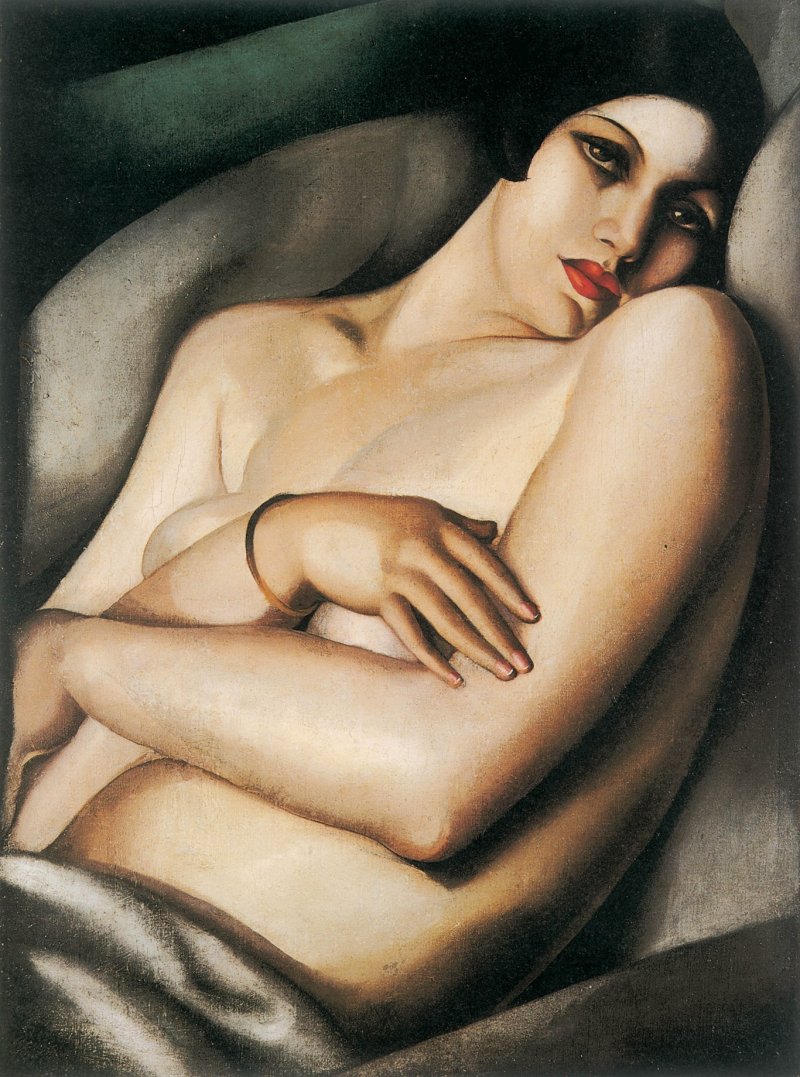
Tamara de Lempicka – “Rafaela sur fond vert” (1927)
What psychoanalysis points to as defining woman is that she lacks lack. She lacks lack? Curious to put it in so contradictory, so extremely paradoxical, a manner: she lacks lack. To say she lacks lack is also, after all, to say she doesn’t miss lack … since she doesn’t miss the lack of lack. Yes, they say, but the point is “she lacks The Lack,” The Lack, lack of the Phallus. And so, supposedly, she misses the great lack, so that without man she would be indefinite, indefinable, nonsexed, unable to recognize herself: outside the Symbolic. But fortunately there is man: he who comes … Prince Charming. And it’s man who teaches woman (because man is always the Master as well), who teaches her to be aware of lack, to be aware of absence, aware of death. It’s man who will finally order woman, “set her to rights,” by teaching her that without man she could “misrecognize.” He will teach her the Law of the Father. Something of the order of: “Without me, without me-the Absolute-Father (the father is always that much more absolute the more he is improbable, dubious)-without me you wouldn’t exist, I’ll show you.” Without him she’d remain in a state of distressing and distressed undifferentiation, unbordered, unorganized, “unpoliced” by the phallus… incoherent, chaotic, and embedded in the Imaginary in her ignorance of the Law of the Signifier. Without him she would in all probability not be contained by the threat of death, might even, perhaps, believe herself eternal, immortal. Without him she would be deprived of sexuality. And it might be said that man works very actively to produce “his woman.” Take for example Marguerite Duras’ Le Ravissement de Lol V. Stein, and you will witness the moment when man can finally say “his” woman, “my” woman. It is that moment when he has taught her to be aware of Death. So man makes, he makes (up) his woman, not without being himself seized up and drawn into the dialectical movement that this sort of thing sets in play. We might say that the Absolute Woman, in culture, the woman who really represents femininity most effectively… who is closest to femininity as prey to masculinity, is actually the hysteric…. he makes her image for her!
The hysteric is a divine spirit that is always at the edge, the turning point, of making. She is one who does not make herself… she does not make herself but she does make the other. It is said that the hysteric “makes-believe” the father, plays the father, “makes-believe” the master. Plays, makes up, makes-believe: she makes-believe she is a woman, unmakes-believe too … plays at desire, plays the father… turns herself into him, unmakes him at the same time. Anyway, without the hysteric, there’s no father… without the hysteric, no master, no analyst, no analysis! She’s the unorganizable feminine construct, whose power of producing the other is a power that never returns to her. She is really a wellspring nourishing the other for eternity, yet not drawing back from the other … not recognizing herself in the images the other may or may not give her. She is given images that don’t belong to her, and she forces herself, as we’ve all done, to resemble them.
And so in the face of this person who lacks lack, who does not miss lack of lack, we have the construct that is infinitely easier to analyze, to put in place-manhood, flaunting its metaphors like banners through history. You know those metaphors: they are most effective. It’s always clearly a question of war, of battle. If there is no battle, it’s replaced by the stake of battle: strategy. Man is strategy, is reckoning . . . “how to win” with the least possible loss, at the lowest possible cost. Throughout literature masculine figures all say the same thing: “I’m reckoning” what to do to win. Take Don Juan and you have the whole masculine economy getting together to “give women just what it takes to keep them in bed” then swiftly taking back the investment, then reinvesting, etc., so that nothing ever gets given, everything gets taken back, while in the process the greatest possible dividend of pleasure is taken. Consumption without payment, of course.
no one leaves home unless
home is the mouth of a shark
you only run for the border
when you see the whole city running as well
your neighbours running faster than you
breath bloody in their throats
the boy you went to school with
who kissed you dizzy behind the old tin factory
is holding a gun bigger than his body
you only leave home
when home won’t let you stay.
no one leaves home unless home chases you
fire under feet
hot blood in your belly
it’s not something you ever thought of doing
until the blade burnt threats into
your neck
and even then you carried the anthem under
your breath
only tearing up your passport in an airport toilets
sobbing as each mouthful of paper
made it clear that you wouldn’t be going back.
you have to understand,
that no one puts their children in a boat
unless the water is safer than the land
no one burns their palms
under trains
beneath carriages
no one spends days and nights in the stomach of a truck
feeding on newspaper unless the miles travelled
means something more than journey.
no one crawls under fences
no one wants to be beaten
pitied
no one chooses refugee camps
or strip searches where your
body is left aching
or prison,
because prison is safer
than a city of fire
and one prison guard
in the night
is better than a truckload
of men who look like your father
no one could take it
no one could stomach it
no one skin would be tough enough
the
go home blacks
refugees
dirty immigrants
asylum seekers
sucking our country dry
niggers with their hands out
they smell strange
savage
messed up their country and now they want
to mess ours up
how do the words
the dirty looks
roll off your backs
maybe because the blow is softer
than a limb torn off
or the words are more tender
than fourteen men between
your legs
or the insults are easier
to swallow
than rubble
than bone
than your child body
in pieces.
i want to go home,
but home is the mouth of a shark
home is the barrel of the gun
and no one would leave home
unless home chased you to the shore
unless home told you
to quicken your legs
leave your clothes behind
crawl through the desert
wade through the oceans
drown
save
be hunger
beg
forget pride
your survival is more important
no one leaves home until home is a sweaty voice in your ear
saying-
leave,
run away from me now
i dont know what i’ve become
but i know that anywhere
is safer than here
—
Warsan Shire is a Kenyan-born Somali poet, writer and educator based in London. Born in 1988, Warsan has read her work extensively all over Britain and internationally – including recent readings in South Africa, Italy, Germany, Canada, North America and Kenya – and her début book, TEACHING MY MOTHER HOW TO GIVE BIRTH (flipped eye), was published in 2011. Her poems have been published in Wasafiri, Magma and Poetry Review and in the anthology The Salt Book of Younger Poets (Salt, 2011). She is the current poetry editor at SPOOK magazine. In 2012 she represented Somalia at the Poetry Parnassus, the festival of the world poets at the Southbank, London. Warsan is also the unanimous winner of the 2013 Inaugural Brunel University African Poetry Prize.
Luister is a documentary about the lives of students of colour who attend Stellenbosch University, a South African institution of higher learning. In a series of interviews, students recount instances of racial prejudice that they continue to experience in the town of Stellenbosch, and the enormous challenges that they face due to the use of Afrikaans as a language of teaching at the university. Luister is a film about Afrikaans as a language and a culture. It is a film about the continuing racism that exists within a divided society. It is a film about a group of students whose stories have been ignored. Luister is the Afrikaans word for Listen.
“’Then you are a man, my son’: Kipling and the Zuma Rape Trial” presented by Lucy Graham (UWC)
When: Thursday, 30 July 2015
Time: 13h00 – 14h30
Venue: HUMA Seminar Room, 4th Floor, The Neville Alexander Building (formerly known as the Humanities Building), University Avenue, Upper Campus, UCT
One of the strangest incidents during the Jacob Zuma rape trial was surely the moment when Judge Willem van der Merwe, handing down his verdict that exonerated Zuma, addressed Zuma with the following words: “Had Rudyard Kipling known of this case at the time he wrote his poem, ‘If’, he might have added the following: ‘And, if you can control your body and your sexual urges, then you are a man, my son’”.
It is now nine years since the Zuma rape trial, and yet this allusion to Kipling’s famous poem has been passed over by other commentators on the trial. Of what exactly is Kipling a spectre as he appeared in the judge’s verdict, and how do we read the judge’s strange politics of (dis)affinity that arises out of his rescripting of Kipling: his insistence on the developmental and racialised difference of boyhood and manhood, while at the same time his possible consolidation of a more absolute difference based on gender? How was discourse and performativity during and around the Zuma rape trial related to the history of “Zuluness”, and to the reception of narratives of intraracial sexual violence by the ANC? What significance does an analysis of the Zuma rape trial that takes into account colonial history have for contemporary South Africa, and specifically for the UCT: Rhodes Must Fall movement at the University of Cape Town? In this paper I am interested in the ways in which spectres of colonial patriarchy continue to haunt the South African present.
Just dreamed I was working at a mattress abattoir/factory in some long ago time and place. The mattresses were somehow living organisms. I had to use a guillotine and also sometimes a huge cleaver, if the guillotine didn’t slice all the way through, and chop them cleanly and very systematically, blood pooling on the rushes underfoot. Every blow I dealt nauseated me to tears. There was a foreman forcing me to speed up all the time. There was nothing else to the dream but this enforced, repetitive violence, and all I could do to try to make it better was to do the awful hacking with more precision.
But what does it mean?
Myself, I think it has to do with being inescapably forced to inhabit the violent, corporate machine of colonialism… I’m working on knowledge production about Africa by missionaries and scientists, through looking at archival objects, which are objects but also subjects, violently wrenched from their contexts. The mattress here symbolises something… maybe related to peace of mind, restfulness, not being awake or aware… I don’t know. Whatever it is, it is being violently ruptured. I think this could be about being forced to make one’s bed to lie in, as a researcher and writer inserted into the chain of murderous history, unable to escape perpetuating it even as I try to undo it, still half asleep.





 fleurmach