Watch the whole of this incredible film online, free, HERE.
Watch the whole of this incredible film online, free, HERE.
(Reading a Fyodor Tyuchev poem*, also used by Björk and Antony Hegarty HERE.)
*Please watch from 2:33 into the clip – the embedding function has been disabled by the copyright holder.
Lilith Performance Studio, June 5, 2010
Melati Suryodarmo (b. in 1969 in Surakarta, Indonesia, lives and works in Braunschweig, Germany) performs EXERGIE – Butter dance, an older piece but shown for the first time at Lilith.
20 blocks of butter in a square on the black dance carpet. Suryodarmo enters the space, dressed in a black tight dress and red high heels. She steps on the pieces of butter. She starts to dance to the sound of Indonesian shamanistic drums. She dances and falls, hitting the floor hard, rising, and continuously being on the verge of standing, slipping and falling in the butter. After twenty minutes Suryodarmo rises one last time, covered in butter, and leaves the space.
http://www.melatisuryodarmo.com/
Copyright of the performance: Melati Suryodarmo
Documentation done by Lilith Performance Studio.
Copyright of the documentation belongs to Melati Suryodarmo and Lilith Performance Studio, Malmo, Sweden.
Watch this short film, companion piece to the award-winning Keys, Money, Phone, starring Michelle Du Plessis, Amy Louise Wilson, and Sive Gubangxa.
Director: Roger Young
Producer: Shanna Freedman
DOP: Alfonzo Franke
Editor: Natalie Perel
Original Score: Nic Van Reenen
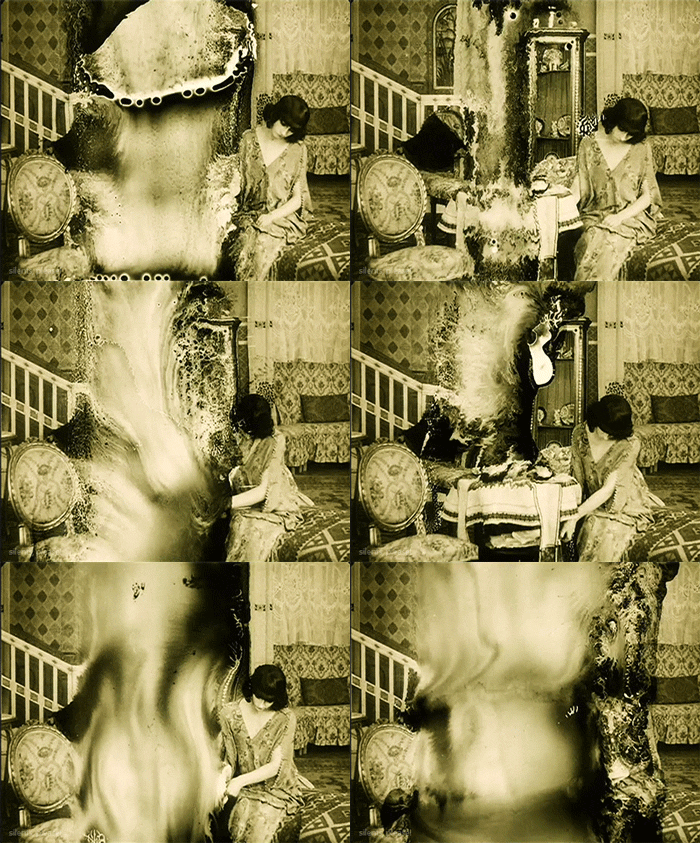
Song from the album Angel Guts: Red Classroom (Bella Union, 2014)
Music : Xiu Xiu
Lyrics : Jamie Stewart
Video : Florent Texier
“The laws of macro- and microcosm are alike. Travel in the interior is as a voyage in outer space: we must in each case burst past the circumference of our surface – our here-space and now-time – and, cut loose from the anchorage of an absolute, fixed center, enter worlds where the relationship of parts is the sole gravity. When the sun sets, the stars become apparent; when our eyes close out the light to sleep, there rises in the night-eye the constellation by which sleep-walkers plot their incalculable accuracies. By day we move according to desire and decision; by night Noctambulo advances without moving, led by the twins Gemini (as the eyes are twins or as the I of night is twin to that of day). It is by the dark geometry of such celestial navigation that the day‘s erratic negotiations are corrected and reconciled into the total orbits of our lives.
The film is in the negative. The blackness of night erases all horizon and, released from the leveling pressure of this plane, the movements both of the dancers and of the camera become as four-dimensional and directional as those of birds in air or fish in water.”
– Maya Deren: Chamber Films, program notes for a presentation, 1960
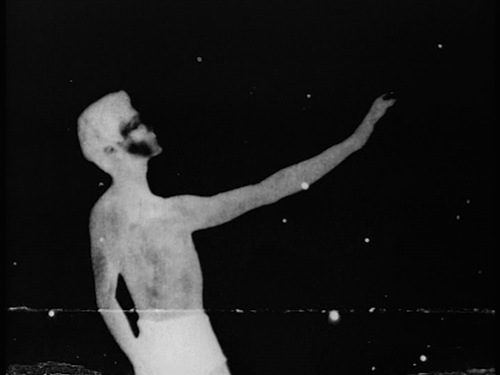
#Title: The Very Eye of Night
#Director: Maya Deren
#Year of Production: 1958
#Duration: 00:15:00
#Choregraphy: Antony Tudor, Metropolitan Opera Ballet School
#Dancers / Actors: Philp Salem, Rosemary Williams, Richard Englund, Richard Sandifer, Don Freisinger, Patricia Ferrier, Barbara Levin, Bud Bready, Genaro Gomez
#Camera: Maya Deren
#Editing: Maya Deren
#Foley Assistance: Harrison Starr
#Sound: Louis and Bebe Barron
#Music: Teiji Ito
Just dropped today! From the album Lest We Forget What We Came Here To Do, released 25 September on Naim Jazz Records.

I can’t think of a better way to start understanding a country’s culture and mores than by watching its kids’ programmes (also, the simple language is good when you’re just starting to learn). The cat in this is so beautifully rendered. It teaches gentleness and consideration for others. What is weird, though, is that only the invisible narrator has a voice, although there is other diegetic sound. It’s very clearly meant to be didactic, like the voice of the superego.
This dubbed video is completely hilarious, but what it also shows up starkly is the relative authority and gravitas we give to the American voice. We shouldn’t. Global media speaks in an American accent. Even when what it peddles is not true, it sounds convincing. Question it. Always.
DEAD.
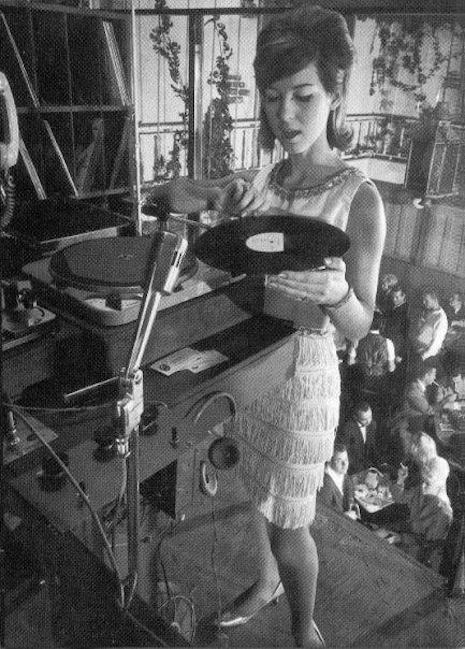
Joanie Labine, the first DJ at The Whisky a Go-Go in LA, 1964. Great clip here:
Luister is a documentary about the lives of students of colour who attend Stellenbosch University, a South African institution of higher learning. In a series of interviews, students recount instances of racial prejudice that they continue to experience in the town of Stellenbosch, and the enormous challenges that they face due to the use of Afrikaans as a language of teaching at the university. Luister is a film about Afrikaans as a language and a culture. It is a film about the continuing racism that exists within a divided society. It is a film about a group of students whose stories have been ignored. Luister is the Afrikaans word for Listen.
Watch Roger Young’s award-winning portrait of white South African male entitlement:
Practically unconscious from a night of drinking, Sebastian is deposited by taxi outside his security complex. Too late he realises that he doesn’t have his keys, wallet or cellphone.
Failing to convince a security guard to just let him in, he sets off into the night to find the taxi driver responsible. Sebastian attempts to bully his way home through a mounting series of micro-aggressions against women and service staff, verging increasingly on violence, unaware of the redemption that lies just outside his grasp.
“A portrait of a young man who, while seemingly popular, has no real relationships, no community, and yet no sense of humility.” – Dylan Valley / Africa Is A Country
“A slick, fierce sociopolitical critique” – Grethe Koen / City Press
Winner: Best South African Short
– DIFF 2014
Official Selection:
– Lights, Camera, Africa (Nigeria)
– AFRIFF (Nigeria)
– Zimbabwe International Film Festival
– Shnit Cape Town (South Africa)
– Lusaka International Film and Music Festival (Zambia)
– Verona Festival Africano (Italy)
– Cap Spartel Film Festival (Morocco)
– XPONorth Film Festival (Scotland)
– Picture Farm Film Festival (USA)
– IMSFF (South Africa)
– Indie Karoo Film Festival (South Africa)
Rhodes Must Fall issue a powerful new statement:
Madonna – Another Suitcase in Another Hall, from Evita (1996).
Song produced and mixed by Hernán A. Ambrogi
Video shooting and editing by Fusée Dorée.
http://www.facebook.com/fuseedoree
Including wonderful commentary from Tricky, Peter Gabriel, David Gilmour, John Lydon, Tori Amos, Natasha Khan, St Vincent, Neil Gaiman, Brett Anderson, and some fascinating archive.
Using as her source material a segment of 1970s European softcore pornography, Naomi Uman created this derived piece by painstakingly removing the female from each frame using bleach and nail polish remover, thus presenting the viewer with a bizarre, ghostly effect of a figure; a blank void of a woman.
The Beatles’ song, I am the Walrus, slowed down 800% and set to the 1969 film Vertige by Jean Beaudin.
“Sympathetic but subtly critical, Vertige presents itself as a psychological portrait of the escape and/or contestation tactics of the decade’s youth: while war, violence, famine and poverty continue to devastate the planet, these youngsters seek refuge in the hedonistic haven of sexual liberation, lysergic research and communal fictions.”
Watch the film at ubu.com. And HERE is an etymological investigation into the phrase “goo goo g’joob”.
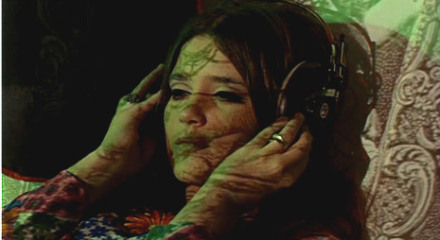
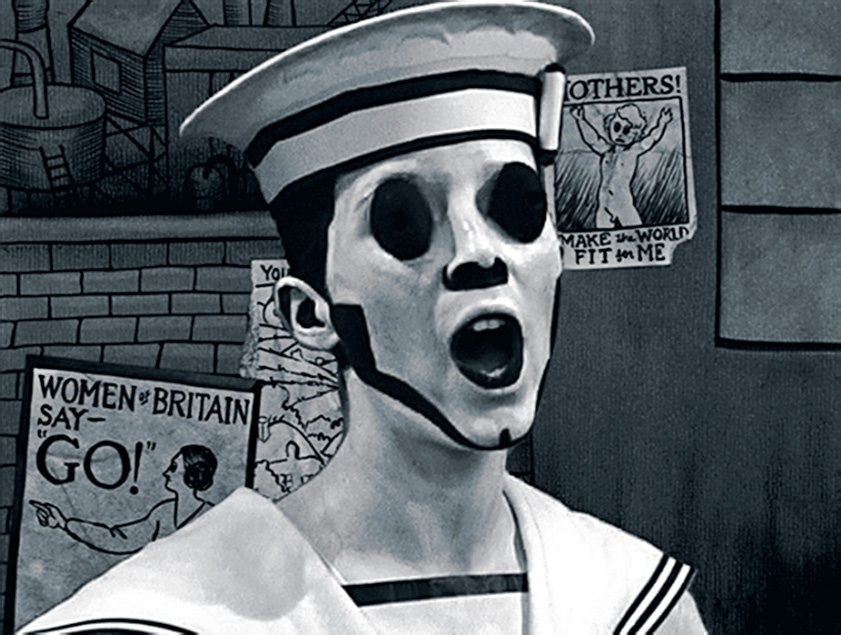
Filmed in 2011 at Mary Reid Kelley’s home and studio in Saratoga Springs, New York, the video artist and painter discusses her video work “You Make Me Iliad” (2010). In researching the lives and experiences of women who lived during the first World War, Reid Kelley was struck by how few first-hand accounts she was able to uncover. Mary Reid Kelley explains her attempts to reconstitute an experience that would have otherwise been lost to history by creating an imagined narrative involving a prostitute, a soldier, and a medical officer.
In black-and-white videos and drawings filled with punning wordplay and political strife, Mary Reid Kelley presents her take on the clash between utopian ideologies and the realities of women’s lives in the struggle for liberation. Performing scripted narratives in rhyming verse— featuring characters such as nurses, soldiers, prostitutes, and saltimbanques—Reid Kelley playfully jumbles historical periods to trace the ways in which present concerns are rooted in the past.
Watch an excerpt from another of Reid Kelley’s works, Sadie the Saddest Sadist on Reid Kelley’s website.
Sadie, the Saddest Sadist (7 minutes, 23 seconds), 2009, is set in Great Britain in 1915, according to a free booklet that includes the video’s lyrics. The title character, a munitions worker, wants to learn a trade “so [she] could be a traitor.” She meets Jack, a sailor (played by Reid Kelley in drag), and with “passions inflamed,” she requests rousing war stories. His sung reply: “Calm down sweetheart / Britannia rules the waves.” In pledging herself to him, she offers her “surplus devotion,” and after their off-camera tryst, she sings, “The stains on my sheets / will come out with some lemon / I know that you care / by these Marx on my Lenin.” Live action alternates with stop-motion animation in which dancing refrigerator magnet-style letters spell out the dialogue or toy with it, as when “surplus devotion” is anagrammatized into “spurs devolution.”…
… Reid Kelley’s interest seems to be primarily in historical material, expressed in details such as the patriotic flyers that hang on the walls behind Sadie and Jack when they meet, which urge citizens to conserve food and to fight for king and country. Her fine ear for popular verse makes Reid Kelley’s work rich fun for those who are, as Jack describes himself, “verbally inclined.”
Source: http://www.artinamericamagazine.com/reviews/mary-reid-kelley/
Pause to watch, listen and reflect.
Have you ever experienced the weird magic of coming across something obliquely on Youtube, on your way somewhere else, and it speaks so powerfully, so uncannily, to all the things happening right now around you that all the hairs on your body stand on end? This is one of those times. The scene comes from a 1952 film called The Member of the Wedding, based on the book/play by Carson McCullers, starring Ethel Waters, Julie Harris and Brandon De Wilde. I came across it because my housemate Khanyi and I were singing this old hymn, hamming it up Lauryn-Hill-in-Sister-Act-2 style. I wanted to check out some of the older versions… and this clip revealed itself to me, complete with contextual preamble.
Just to tether this to a little of my own current context (I unfortunately don’t have time to write much right now), here is something written by one of my MPhil classmates about the student protests demanding the removal of the statue of Cecil John Rhodes that are currently happening at UCT, and here is the official SRC statement on the matter.

Miss May Whitley kicks ass with panache and palpable glee in this British Pathé clip from 1933, entitled The Weaker Sex! (Sayest Thou!) Who said “weaker sex?” The intertitle reads: ‘Slow motion demonstrates exactly how 7-stone-odd, scientifically applied, can defeat 14 stone.’
The 1960s – Two teenagers take fate into their own hands and become the ultimate fashion victims in this existential folie a deux starring Donna Modrowski and Michael Onesko. Story by Michael Onesko, original score by Mark Winner, directed by Dan Winner, voiceover by Linda Snelton, assisted by Germain Modrowski, Karen Winner and Connie Karabatsos. Shown at The Women’s Film Forum of Chicago, 1977.
 fleurmach