“This is a city of heartless beings; what can I do?”
This provocative song featured in the 1993 film, Khalnayak (Hindi = “Villain”), starring an incandescent Madhuri Dixit and Sanjay Dutt. It was a huge yet controversial hit, largely due to the erotic lyrics.
Shot in 1996 and edited in 2000, this is a short documentary about a group of 13-year-old riot grrrls who were socially ostracized at school by their peers and upperclassmen. Everyone in the schoolyard held strong opinions about these so-called “dirty girls,” and meanwhile the “dirty girls” themselves aimed to get their message across by distributing their zine across campus. Directed by Michael Lucid. Music: “Batmobile” by Liz Phair.
Archival interview with David Cronenberg from Bombsite (1986)
Bette Gordon (BG) Are your nightmares like your movies? Do you actually see your movie images in your dreams?
David Cronenberg (DC) Rarely. My images come out of the process of making film. I do really think that movies work on the level of dream logic. However realistic or narrative they might like to think they are, they are dreamlike.
BG You, as a director, have an incredible ability to tap into the unconscious.
DC I was once on a talk show with a psychiatrist who worked at the Clark Institute with criminals. He had seen my film, Videodrome and said to me, “I’m almost afraid to be sitting here next to you.” He was totally mystified as to how I could empathize with those states of mind and he obviously, could not. It is mostly intuitive with me. One of the reasons I make a movie is that I’m then in a position where I have to analyze and I enjoy that process.
BG In They Came from Within there was a line of dialogue—”Man thinks too much, he’s lost touch with the body, with instincts. Too much brain and not enough guts.” Do you think the mind is stronger than the body?
DC No. I think the quote is particular to that film. What interests me is the mind/body schism.
BG What do you mean by mind/body schism?
DC I think the mind grows out of the body. I don’t believe in an afterlife. I don’t see the mind or the spirit or the soul continuing after our body dies. The mind and body are completely dependent and interrelated. The mind is somehow organic and physical. It’s only our perception and our culture that keeps them separate.
BG What about the mind creating its own monsters in a sense, that the monster comes from within the mind. Like in Dead Ringers for example, or in Videodrome where it’s the mind that is completely in charge of the body.
DC In as much as the mind is ever in charge of anything. I don’t think it is always in control.
BG Or in Scanners where through mind control, you can . . .
DC Affect the body. But you see, I think everybody does that. I don’t think it’s just Western culture, other cultures even accentuate it more by saying the body’s nothing; it’s only temporary and the mind and the spirit are eternal. I think that’s very destructive. It’s not true. All philosophical, metaphysical and religious forces should be concentrating on trying to form a perception and reality for ourselves that integrates the two. And that would include coming to terms with death as a physical event rather than trying to evade it.
BG So how would you come to terms with death?
DC There’s a Japanese religion that thinks of all of life as a preparation for death, which to the Western mind seems like a very morbid approach to life. But if you think of death as a true end of something, of a process, it makes perfect sense. There we get into the old idea of Western culture being death denying, but I actually think Eastern culture is too. Because they try to trivialize death as being not important.
BG So it falls somewhere between the two as being very important and not important at all.
DC One of the main subjects of all of my films is exactly that. In Dead Ringers you get a body split into two (the twins) with basically, one mind. Just doing that is like an experiment in a lab—which all my movies really are. I set out to see how they work, to illuminate something for myself by doing these experiments.
Videodrome – with James Woods and Debbie Harry
BG There is something about the medical profession in all of your films.
DC Scientists and doctors to me, are at the leading edge of what all human beings do all of the time; which is to change, everything. We’ve never been satisfied with what we’re given. We don’t accept the earth as a given. We change our body chemistry, our physiology, our biology, our biochemistry. We clear the forest, we build our own environment, we climate control it . . . And, the interface between that impulse and the human body often is doctors, biologists, and biochemists.
BG Were you a biochemist?
DC I did go into biochemistry at the University of Toronto. But when I came face to face with what science required, I realized that my temperament was much more suited to some form of art; writing or whatever. I didn’t think of film at the time. I found I would prefer to invent my own science rather than spend two years with rats in a lab getting results.
BG There’s an ambivalence for the medical/science profession in all of your films. You don’t really have villains in the film, nobody’s quite evil . . .
DC That’s right. It is ambivalence. Because I think that they’re heroic even when they’re crazed. I think that being crazed and obsessed is part of being heroic. You don’t get one without the other. Ambition is something else. It’s not ambition in the material sense. My characters are obsessed with discovery and that does excite me and I do identify with that. A good creative scientist is as good as a good creative artist. No question in my mind.
BG What is your notion of the hero? You said your characters are heroic even when they are crazed.
DC Yes, maybe even especially because they’re crazed. I’m obviously drawn to people as main characters who are not embedded so completely in their culture that they can’t see any . . . a visionary’s process . . . people who are jarred into being outside. Continue reading →
Song from Fiona Apple’s 2012 album The Idler Wheel Is Wiser Than the Driver of the Screw and Whipping Cords Will Serve You More Than Ropes Will Ever Do.
Video excerpted from Fritz’s Lang’s 1926 sci-fi masterpiece, Metropolis.
“The first thing that came to mind was an image that gradually deteriorates with visual noise, echoing the sonic noise present in the song. We go from lightness to darkness, away from a structured, fabricated place and into raw territory.”
~ Jose Wolff – August, 2012
Music by Julia Holter
Directed by Jose Wolff
Photography by Robson Muzel and Jose Wolff
“Broken figure” portrayed by Bryan Dodds
Shot on site at The Wulf, Elysian Park, and the Angeles Angeles Natural Forest. Special thanks to Emily Jane Kuntz and Eric KM Clark and Michael Winter at The Wulf
“The small town is plagued with alcoholism, marital infidelity, unbridled masculinity, violence, and moral ambivalence. Mouchette’s father and brother, we have already seen, operate by selling liquor on the black market, with complicit police that turn an indifferent eye to a crate left behind. They, like other townsfolk, are paid in shots of alcohol, consumed without speech. Following Sunday mass, the village parishioners leave church and hastily head to the bar before the bells cease to toll. Mouchette’s dying mother has to hide gin from her abusive spouse. Even the town’s interdependent poacher/warden pair, Arsène and Mathieu, bring an end to their cat-and-mouse charade in the woods by sharing a drink from Arsène’s canteen full of gin. The motif of alcohol and its abuse stands as a distinctive mark of the moral decay of Mouchette’s society; however, the corruption of this town is not limited to alcoholism… Indeed, Mouchette’s society is one of extreme decadence and lawlessness, one that is ripe for a scapegoat upon whose back it can collectively discharge the burden of its vice and one from which the victim will gladly depart.”
Herk Harvey’s low-budget yet influential 1962 cult horror film that relied more heavily on its organ-based score by Gene Moore than it did on special effects for its spookiness… to chilling effect!
Righard Kapp performing “Moloch” in Cape Town, 21 January 2013. Check out more high quality videos of performances by underground South African musicians on the new Cheap Seats Vlog.
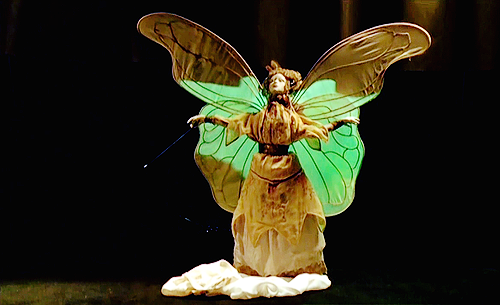
The marionette scene from Krzysztof Kieslowski’s The Double Life of Veronique (1991).Watch the full film HERE.
“The director’s international breakthrough remains one of his most beloved films, a ravishing, mysterious rumination on identity, love, and human intuition. Irène Jacob is incandescent as both Weronika, a Polish choir soprano, and her double, Véronique, a French music teacher. Though unknown to each other, the two women share a mysterious and emotional bond that transcends language and geography, which Kieslowski details in gorgeous reflections, colours, and movements. Aided by Slawomir Idziak’s shimmering cinematography and Zbigniew Preisner’s haunting, operatic score, Kieslowski creates one of cinema’s most purely metaphysical works. The Double Life of Veronique is an unforgettable symphony of feeling.
“Krzysztof Kieslowski focuses on identity using actress Irene Jacobs in the dual role of French music teacher Veronique and Polish soprano Weronika – both born on the same day. Metaphysically they are aware of each other’s counterpart – this harkens back to the director’s penchant for fate, chance and circumstance,and we envision a possible meeting of the intertwined souls… Our unspoken desire for a mirrored being – who can non-verbally share our most intimate loves and joys – is the ultimate expression of personal support… Overall, an ambiguous and enigmatic offering, this is a film that clings to you for years after viewing. A true masterpiece of cinema.”
~ Gary W. Tooze
A portion of the opening movement of Paul Sharits’ 1968 film.
N:O:T:H:I:N:G is a film deplenished of all, of any signified stance and involved only in the manner of film itself. Just the drawing of a bulb, the projector light and a chair remain in the space of the screen. But these are just random disruptions of monochrome frames.
The whole film is built as a vibration of rhythms, ‘energy-colour’, based on the structure of the Tibetan mandala of five Dyani Bouddhas. Formally the composition is centred on the psychic flickering caused by four symbolic colours: white, yellow, red and green. The more the film is next to the centre that is the centre of the mandala, the empty point, the more the monochrome frames flicker faster, up to invert the speed in the second part of the film (bearing off the centre), the retrograde of the first one. Sharits constructed the structure of the film about the ‘Om’ Nembutsu droning: nevertheless the film can be considered as the visual translation of this sound.
“The screen, illuminated by Paul Sharits’ N:O:T:H:I:N:G, seems to assume a spherical shape, at times – due, I think, to a pearl-like quality of light his flash-frames create… a baroque pearl, one might say – wondrous!… One of the most beautiful films I’ve seen.” – Stan Brakhage
“You are pulled into the world of color, your color senses are expanded, enriched. You become aware of changes, of tones around your own daily reality. Your vision is changed. You begin to see light on objects around you… Your experience range is expanded. You have gained a new insight. You have become a richer human being.” – Jonas Mekas
“Wave Become Wings” and “Barramundi” from It’ll End in Tears, an album released in 1984 by the label 4AD, using the name “This Mortal Coil” as an umbrella title for a loose grouping of guest musicians and vocalists brought together by label boss Ivo Watts-Russell.
Images taken from Baraka (directed by Ron Fricke).
From the album Buried Dreams (1988).
Clips used for video: L’Eden et Après (1970), Glissements Progressifs du Plaisir (1974), La Belle Captive (1983) – Alain Robbe-Grillet
“There are moments in cinematic art when the narrative of the film is subjectively implied and subsequently written by the viewer. While this is common to most structural and lyrical films in the experimental genre, none hits louder than T,O,U,C,H,I,N,G, an angry and demonic piece that simultaneously lulls you into awareness and hypnotizes you into an emotive overload.”
One of three Vitaphone films Lee Morse starred in in 1930. She was a gifted songwriter, composer and band leader – Lee Morse and her Bluegrass Boys. The songs performed here are “Mailman Blues” and “In the Middle of the Night.” For a synopsis of the film, go HERE. For more biographical info, go HERE.
Meshes of the Afternoon (1943) is a short experimental film directed by wife and husband team, Maya Deren and Alexander Hammid. The film’s narrative is circular, and repeats a number of psychologically symbolic images, including a flower on a long driveway, a key falling, a door unlocked, a knife in a loaf of bread, a mysterious Grim Reaper-like cloaked figure with a mirror for a face, a phone off the hook and an ocean. Through creative editing, distinct camera angles, and slow motion, this surrealist film depicts a world in which it is more and more difficult to catch reality.
“This film is concerned with the interior experiences of an individual. It does not record an event which could be witnessed by other persons. Rather, it reproduces the way in which the subconscious of an individual will develop, interpret and elaborate an apparently simple and casual incident into a critical emotional experience.”
— Maya Deren on Meshes of the Afternoon, from DVD release Maya Deren: Experimental Films 1943–58.
The film was originally silent – the soundtrack, by Deren’s third husband, Teiji Ito, was only added in 1959.
Tale of Tales, like Tarkovsky’sMirror, attempts to structure itself like a human memory. Memories are not recalled in neat chronological order; instead, they are recalled by the association of one thing with another, which means that any attempt to put memory on film cannot be told like a conventional narrative. The film is thus made up of a series of related sequences whose scenes are interspersed between each other. One of the primary themes involves war, with particular emphasis on the enormous losses the Soviet Union suffered on the Eastern Front during World War II. Several recurring characters and their interactions make up a large part of the film, such as the poet, the little girl and the bull, the little boy and the crows, the dancers and the soldiers, and especially the little grey wolf (Russian: се́ренький волчо́к, syeryenkiy volchok). Another symbol connecting nearly all of these different themes are green apples (which may symbolise life, hope, or potential).
Yuriy Norshteyn wrote in Iskusstvo Kino magazine that the film is “about simple concepts that give you the strength to live.”
A year or so ago, some colleagues of mine did a campaign for a film called Night Drive, which was a slashy, schlocky horror that centred on the body-parts-for-muthi trade. The campaign handed out a couple hundred pamphlets, in the style of those ridiculous pamphlets that offer penis enlargement, bad luck cure, womb cleaning etc that we see littered around town every day. The pamphlets offered money for body parts, and linked to a website that detailed the “doctor’s” cash-for-organs trade in more detail. The people who received the pamphlets went ape-shit, calls were made to the national media, everyone was pranked and much outrage ensued. The campaign was slammed by the Department of Health for trivialising a “Serious Problem”, and was pulled, effective immediately, complete with apology from the ad agency in question, and a promise to conduct an “internal disciplinary procedure”.
Pamphlet collected in Durban by Rosemary Lombard, 2009
My question is, what exactly is being done about this serious problem? Why do people get up in arms about a cash-for-body-parts hoax, but think its OK (and hilarious) for there to be pamphlets offering safe abortions, womb cleaning, AIDS cures and a whole manner of sexual health treatment that is not only bogus, but seriously harmful to those who pursue it. What effort is being made by the Department of Health to shut down these “doctors”? Most disturbing is the discriminatory gender ideas at the root of these so called treatments. Muthi to “make lover have sex with you”, and treatment for women for, among other things “cleaner vaginas, more willingness to have sex.”
These charlatan muthi men make a mockery of traditional healing, and the pamphlets and posters not only mislead the poor, vulnerable and uneducated, but reinforce negative stereotypes about traditional healing and the communities that take advantage of them. Is any work being done to address this “Serious Problem”, or do people only care so long as the content of said media panders to savage stereotypes of murderous muthi men lurking in the shadows to chop your heart out?
Pamphlet collected in Durban by Rosemary Lombard, 2009
“Our first film. This Way Up had money to make a video, we wanted to make something more like a film. We were told about Jarvis and Steve from Pulp, who were making films with Martin Wallace. We made it during the summer of ’93. Dickon’s not in it because he was in Mexico as part of his studies. It was good fun and hard work, driving around in our Ford Cortina, Jarvis squashed on the passenger seat floor. Sidonie, Stuart’s daughter, is the baby. It was the start of a long and joyful relationship with Martin Wallace, who’s become a wonderful friend.”
Marching orders from Fleurmach! Here’s to 2013 kicking 2012’s sorry ass!
Lucille Ball and Paula Stewart as Wildy and Janey Jackson, live on the Ed Sullivan Show (1961), performing “Hey, Look Me Over” from the Broadway musical, Wildcat. These feisty dames are Thelma and Louise’s crazy aunts.
Hey look me over, lend me an ear,
Fresh out of clover, morgaged up to here,
Don’t pass the plate folks,
Don’t pass the cup,
I figure whenever you’re down and out,
The only way is up…
And I’ll be up like a rose bud,
High on the vine,
Don’t thumb your nose folks,
Take a tip from mine,
I’m a little bit short of elbow room,
But let me get me some,
And look out world, here I come!
To go in the dark with a light is to know the light.
To know the dark, go dark. Go without sight,
and find that the dark, too, blooms and sings,
and is traveled by dark feet and dark wings.



 fleurmach