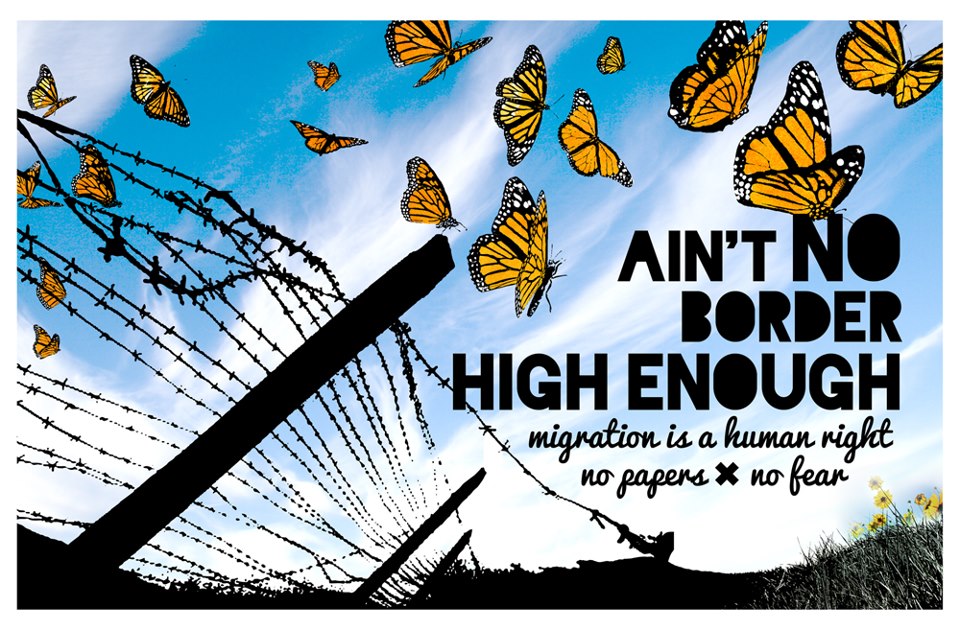
- Image by Phoonam Whabi
Design Action Collective
i see amakwerekwere
everywhere
somebody please
shatter all mirrors.
i see amakwerekwere
everywhere
somebody please
shatter all mirrors.
The natural born cheater is a deadly animal. Research suggests that a cheater can comfortably live up to nine lives simultaneously. That’s why it moves in for the kill so fast. There is very little at stake. Its young must fend for themselves from an early age. Just look at it go! The finesse, the merciless focus, the fondness for black eyeliner. But the cheater has little stamina. It tires quickly of the chase, seeking new quarry rather than putting in effort beyond a certain point… Success! Yet what a bloody mess afterwards as it lies licking its chops… Replete… for tonight.

As I stepped into Jessie Mae Hemphill’s trailer, my eyes fell upon Sweet Pea (her dog) and a revolver. By the end of that first meeting, I couldn’t help thinking that this was the allure of Jessie Mae. She is sweetness incarnate, but you really wouldn’t want to mess with her either.
This same duality is present in her music. Listen to her voice and you can hear a lilting quality, bringing to mind a Billie Holiday. But listen to the lyrics, and you sense a woman who’s seen a thing or two of the world. As she pulled a hollow-tip bullet out of her blouse she spoke loudly so the young “punks” hanging out near her trailer could hear. “A bullet like this one here will put a hole in you this big,” she said, making a circle with her good arm.
As it turns out, the revolver plays a practical role. Ever since a stroke left Jessie Mae partially paralyzed, she knows a vulnerability that she had clearly never experienced. This same stroke rendered her unable to play guitar, effectively ending a successful career that was on the rise.
Read more about Jessie Mae Hemphill HERE.
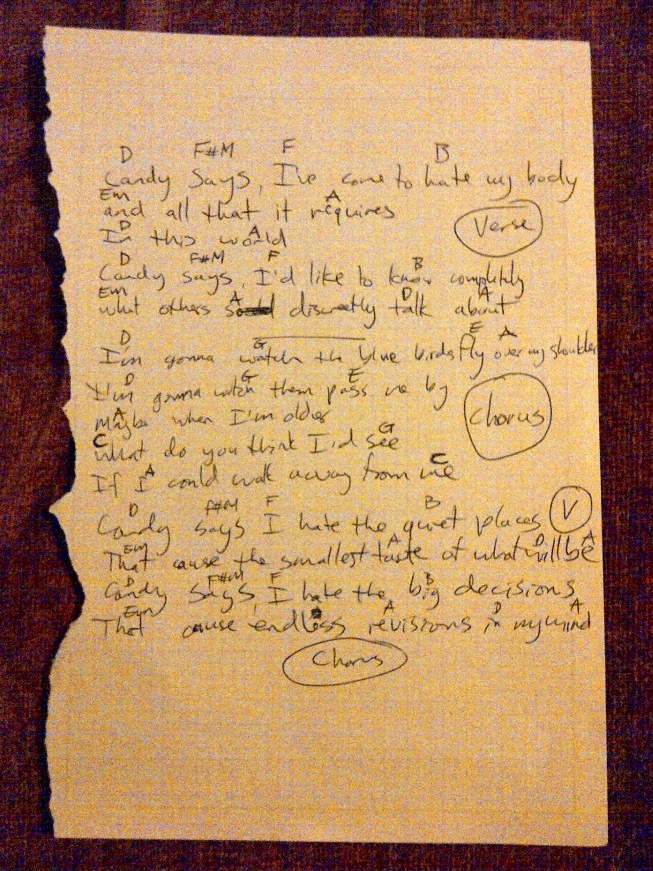
You must learn one thing. The world was made to be free in. Give up on all other worlds except the one to which you belong. Sometimes it takes darkness and the sweet confinement of your aloneness to learn anything or anyone that does not bring you alive is too small for you.
– David Whyte, from The House of Belonging.
“It took me a long time and most of the world to learn what I know about love and fate and the choices we make, but the heart of it came to me in an instant, while I was chained to a wall and being tortured. I realised, somehow, through the screaming in my mind, that even in that shackled, bloody helplessness, I was still free: free to hate the men who were torturing me, or to forgive them. It doesn’t sound like much, I know. But in the flinch and bite of the chain, when it’s all you’ve got, that freedom is a universe of possibility. And the choice you make, between hating and forgiving, can become the story of your life.”
“The past reflects eternally between two mirrors—the bright mirror of words and deeds, and the dark one, full of things we didn’t do or say.”
“The ancient Sanskrit legends speak of a destined love, a karmic connection between souls that are fated to meet and collide and enrapture one another. The legends say that the loved one is instantly recognised because she’s loved in every gesture, every expression of thought, every movement, every sound, and every mood that prays in her eyes. The legends say that we know her by her wings—the wings that only we can see—and because wanting her kills every other desire of love.
The same legends also carry warnings that such fated love may, sometimes, be the possession and obsession of one, and only one, of the two souls twinned by destiny. But wisdom, in one sense, is the opposite of love. Love survives in us precisely because it isn’t wise.”
” … the soul has no culture. The soul has no nations. The soul has no colour or accent or way of life. The soul is forever. The soul is one. And when the heart has its moment of truth and sorrow, the soul can’t be stilled.”
“It’s forgiveness that makes us what we are. Without forgiveness, our species would’ve annihilated itself in endless retributions. Without forgiveness, there would be no history. Without that hope, there would be no art, for every work of art is in some way an act of forgiveness. Without that dream, there would be no love, for every act of love is in some way a promise to forgive. We live on because we can love, and we love because we can forgive.”
“They claim a hidden corner of our hearts, all those moments that stay with us unscreamed. That’s where loves, like elephants, drag themselves to die. It’s the place where pride allows itself to cry.”
“You can’t kill love. You can’t even kill it with hate. You can kill in-love, and loving, and even loveliness. You can kill them all, or numb them into dense, leaden regret, but you can’t kill love itself. Love is the passionate search for a truth other than your own; and once you feel it, honestly and completely, love is forever. Every act of love, every moment of the heart reaching out, is a part of the universal good: it’s a part of God, or what we call God, and it can never die.”
“The cloak of the past is cut from patches of feelings, and sewn with rebus threads. Most of the time, the best we can do is wrap it around ourselves for comfort or drag it behind us as we struggle to go on. But everything has its cause and its meaning. Every life, every love, every action and feeling and thought has its reason and significance: its beginning, and the part it plays in the end. Sometimes, we do see. Sometimes, we see the past so clearly, and read the legend of its parts with such acuity, that every stitch of time reveals its purpose, and a kind of message is enfolded in it. Nothing in any life, no matter how well or poorly lived, is wiser than failure or clearer than sorrow. And in the tiny, precious wisdom that they give to us, even those dread and hated enemies, suffering and failure, have their reason and their right to be.”
“Silently, Siddhartha exposed himself to burning rays of the sun directly
above, glowing with pain, glowing with thirst, and stood there, until he
neither felt any pain nor thirst any more. Silently, he stood there in
the rainy season, from his hair the water was dripping over freezing
shoulders, over freezing hips and legs, and the penitent stood there,
until he could not feel the cold in his shoulders and legs any more,
until they were silent, until they were quiet. Silently, he cowered in
the thorny bushes, blood dripped from the burning skin, from festering
wounds dripped pus, and Siddhartha stayed rigidly, stayed motionless,
until no blood flowed any more, until nothing stung any more, until
nothing burned any more.
Siddhartha sat upright and learned to breathe sparingly, learned to
get along with only few breaths, learned to stop breathing. He
learned, beginning with the breath, to calm the beat of his heart,
leaned to reduce the beats of his heart, until they were only a few and
almost none.”
– from Siddhartha by Hermann Hesse
My favorite Lee Morse song
The despairing man who is unconscious of being in despair is, in comparison with him who is conscious of it, merely a negative step further from the truth and from salvation. Despair itself is a negativity, unconsciousness of it is a new negativity. But to reach truth one must pierce through every negativity. For here applies what the fairy tale recounts about a certain enchantment: the piece of music must be played through backward; otherwise the enchantment is not broken.
~ Søren Kierkegaard (under the pseudonym Anti-Climacus) – from The Sickness Unto Death (1849)
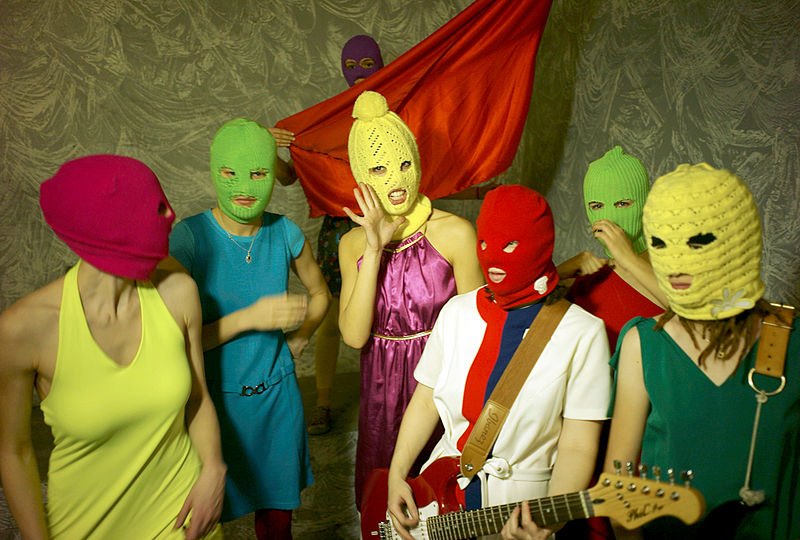
This just in from English PEN:
We are delighted to announce the publication of CATECHISM: POEMS FOR PUSSY RIOT, edited by Mark Burnhope, Sarah Crewe & Sophie Mayer.
There will be ePUB, Kindle and PDF versions available on this page from 00:01hrs on Monday 1st October 2012.
The book is distributed on the ‘Pay What You Think It’s Worth’ model popularised by Radiohead and others. We recommend £5, but any amount is welcome. All revenue will go to the Pussy Riot Legal fund, and the English PEN Writers at Risk Programme.
Get it HERE!
FLEURMACH EDITOR’S NOTE: The e-book will contain a poem by Fleurmach contributor Michelle McGrane (Peony Moon).
An astonishing piece, created for the Venice Biennale’s International Festival of Contemporary Dance, Italy, 2005 by Canadian dancer, choreographer and dance company director Marie Chouinard, OC (born 14 May 1955). Some excerpts from the performance at Place des Arts, Montreal, 2007:
In this work by Marie Chouinard, the company’s ten dancers execute variations on the exercise of freedom. Often, the dancers appear on points: on one, two, and even four at a time. In a spectroscopy of the gesture, we also see them using different devices – crutches, rope, prostheses, horizontal bars, and harnesses – which at times liberate their movements, at others fetter it, and at still others create it.
This use of accessories gives rise to unusual bodily shapes and gestural dynamics and opens onto a universe of meticulous and playful explorations in which solos, duos, trios and group work, in their labour, pleasure and invention, echo the human condition.
An aesthete beyond norms, Marie Chouinard presents her ideas on the way the indefinableness of the Other and the flagrancy of Beauty brush up against one another through an interpretation of Johann Sebastian Bach’s Goldberg Variations. Subtle and extravagant, sumptuous and wild, the work’s movements plumb the insoluble mystery of the body, of the living being.
HANS BELLMER: The female body…is like an endless sentence that invites us to rearrange it, so that its real meaning becomes clear through a series of endless anagrams. (1)
UNICA ZÜRN: If woman is to put into form the ‘ule’ [Greek: matter] that she is, she must not cut herself off from it nor leave it to maternity, but succeed in creating with that primary material that she is […] Otherwise, she risks using or reusing what man has already put into forms, especially about her, risks remaking what has already been made, and losing herself in that labyrinth. (2)
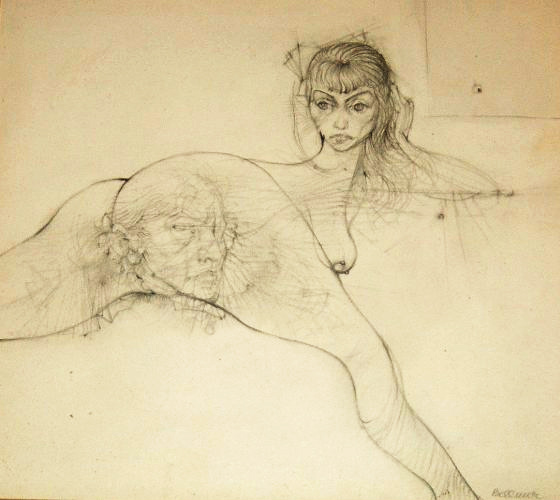
A Portrait of Hans Bellmer
Unica Zurn, 1965
References
(1) Webb P.& Short R., Hans Bellmer (New York: Quartet Books, 1985). Cited in: Miranda Argyle, “Hans Bellmer and The Games of the Doll” (Online Publication, 2004).
(2) Quote cited in: Subversive Intent: Gender, Politics, and the Avant-Gardex by Susan Rubin Suleiman (Cambridge, MA: Harvard University Press, 1990).
“The main theme [of what we do] is expanding musical structures to a point where you can’t tell the difference anymore between music and not-music, or expanded to a point where it doesn’t make any difference anymore to you if it is music or not… It’s not going to be simplified into something like simple “destruction”. We don’t want anyone to come to the concerts just to see us destroying something. If we feel an attitude like that coming up we just get in a bad mood!”
Ah, Blixa, you lovely creature!
I had always believed in Andre Breton’s freedom, to write as one thinks, in the order and disorder in which one feels, to follow sensations and absurd correlations of events and images, to trust to the new realms they lead one into. “The cult of the marvelous.” Also the cult of the unconscious leadership, the cult of mystery, the evasion of false logic. The cult of the unconscious as proclaimed by Rimbaud. It is not madness. It is an effort to transcend the rigidities and the patterns made by the rational mind.
Winter, 1931-1932, from The Diary of Anaïs Nin , Volume One 1931-1934
In a logical system, it is convenient to say that possibility passes over into actuality. However, in actuality it is not so convenient, and an intermediate term is required. The intermediate term is anxiety… Anxiety is neither a category of necessity nor a category of freedom; it is entangled freedom, where freedom is not free in itself but entangled, not by necessity, but in itself…
… Anxiety may be compared with dizziness. He whose eye happens to look down into the yawning abyss becomes dizzy. But what is the reason for this? It is just as much in his own eye as in the abyss, for suppose he had not looked down. Hence anxiety is the dizziness of freedom, which emerges when the spirit wants to posit the synthesis and freedom looks down into its own possiblity, laying hold of finiteness to support itself. Freedom succumbs in this dizziness. Further than this, psychology cannot and will not go. In that very moment everything is changed, and freedom, when it again rises, sees that it is guilty. Between these two moments lies the leap, which no science has explained and which no science can explain.
~ Søren Kierkegaard (under the pseudonym Vigilius Haufniensis) – from The Concept of Anxiety (1844)
Cinema is identical to life, because each one of us has a virtual and invisible camera which follows us from when we’re born to when we die. In reality, cinema is an infinite film sequence-shot. Each individual film interrupts and rearranges this infinite sequence-shot and thus creates meaning, which is what happens to us when we die. It is only at our moment of death that our life, to that point undecipherable, ambiguous, suspended, acquires a meaning. Montage thus plays the same role in cinema as death does in life.
~ Pier Paolo Pasolini, “Ora tutto è chiaro, voluto, non imposto dal destino”, Cineforum 68 October 1967, p. 609. 
I have been thinking about the similarities between editing and blogging, about how in juxtaposition meaning comes to light, and this comment from Pasolini that I just came across resonated with my thoughts. An online archive of everyday apprehension, a place to pin the things floating amorphous just behind my eyes… It is powerfully transformative to be able to reflect, live, with others, on chains of thoughts, connections, coincidences, concatenations… More powerful for clarity than a diary. Although the public nature of this grappling is uncomfortable for me, it prevents me from dismissing my thoughts as solipsistic delusions, something to which I am prone, especially because sketching them out in a simple A to B trajectory is often impossible, rendering attempts at expression incomprehensible to others in ordinary conversation.
What I like about the montage inherent in blogging, as distinct from other more traditional types of montage, is that the possibilities of hypertext allow me not to foreclose other meanings, not to narrow connections and paths of interpretation down, as is inevitable when making a film, or a music mix, or any object concrete and discrete in itself. The intertextual permeability and wild openness of virtuality is so exciting in this sense… The possibility of creating and reshaping meaning without having to be final or definitive, which necessarily involves the murder of other meanings in the process… This I love, though it makes me dizzy.
Jean-Pierre Léaud and Anne Wiazemsky in Pasolini’s Porcile (1969)
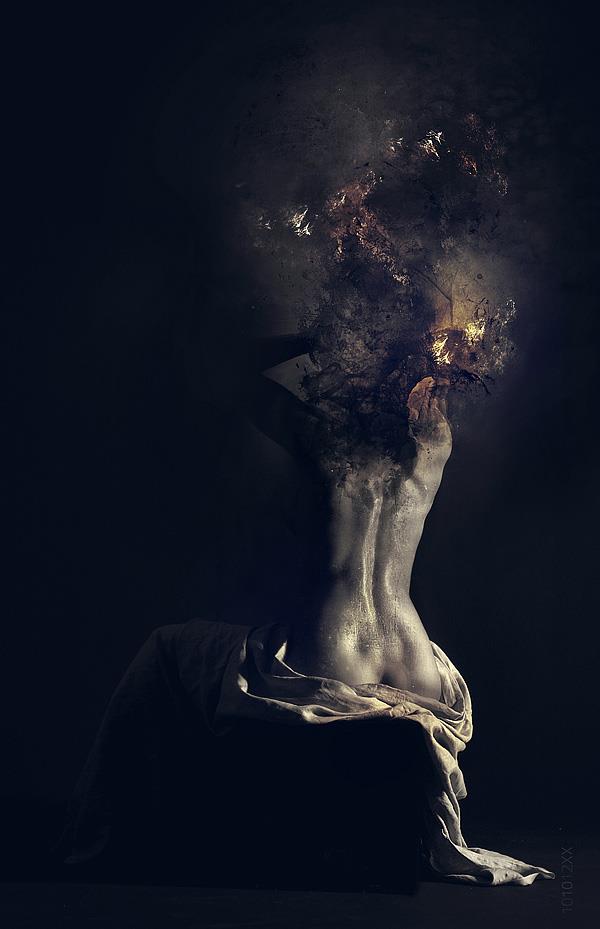
Fabio Selvatici – “Chaos”
2010, from The Obscure Series
Photomanipulation
Explore Selvatici’s work further on his official site (in Italian).
A haunting 1959 field recording by folklorist Dr. Harry Oster of a prison worksong from Angola State Penitentiary in Lousiana: inmate Odea Mathews, accompanied only by the whirr of her sewing machine. You can find more information and purchase this recording HERE.
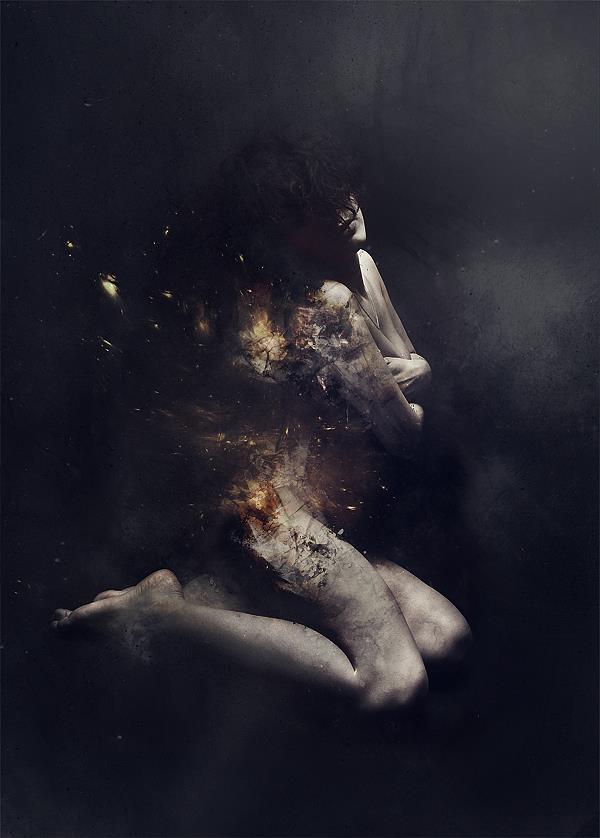
Fabio Selvatici – “Hope”
2010, from The Obscure Series
Photomanipulation
Born in Ferrara, Italy, in 1987, Fabio Selvatici is completely self-taught. Although his surrealistic images may appear to be ultra-realist paintings, they are actually intricately beautiful photo-manipulations. He uses traditional means such as acrylics and ink over previously digitally-altered images.
On his official website, Fabio says, about his use of both traditional and digital media, that “the combination of these techniques allows me to create effects of visual impact that act directly on the physicality of human subjects depicted, emphasizing them in a Gothic, deliberately grotesque and extreme style, invoking the inner drives of the human soul, the travails of the psyche and their inadequacy in relation to the claustrophobic environment that oppresses them.” (thanks to Golden Wolves for this information in English.)
Explore Selvatici’s work further on his official site (in Italian).
Lyrics and music by Bernice Johnson Reagon
Until the killing of black men, black mothers’ sons
Is as important as the killing of white men, white mothers’ sons
We who believe in freedom cannot rest
We who believe in freedom cannot rest until it comes
“Peter” from Daughter (Elena Tonra). Tales From Shop Session, filmed in Bristol by Tom Swindell, 2010.
Machine translation with a bit of editing (my French is not great and will never do poetry justice – help and corrections most welcome!):
The world is a village… What a shame! A universe reduced to a bunch of earthworms, wandering without crossing borders … we are all orphans of the light … it’s dead … it died giving us that day …. in 1789.
We are not brothers and sisters, but solitary tapeworms with more discomfort and just one eye … yes … yes … we are homogenous, even our genes!
We import love, we export hate…
The world is visible … there is no invisible world … yes … yes …
Predictable … we are all predictable … every man for himself … and we’re all for something.
Whether we like it or not.
Me, I do not go out.
I vibrate … but I’m not free …
In a world where we speak of free movement of capital, goods, services and people …
You put it politely when you say nomadism is back in fashion … “neocapitalism” is the code name of that planetary lie … where money acts as identity… I’m dollar, you’re yen, he’s euro … it’s all close to zero!
Temporary identity … illusory … ridiculous … it’s sick …
No identity madness please; everything is all and for all those who want access to it WITHOUT BORDERS on the basis of a universal constitution … the rights of every man and dog.
Why the dog?
Because it is necessary that someone speaks. No, I’m not talking about my dog … he is dead and buried … but of myself … I’ve replaced him in barking … barking … always knowing that I do not impede the caravan from passing.
Read it the original French.
Everything which today constitutes an acceptable landscape for us is the result of bloody violences and conflicts of rare brutality.
One can thus summarize that the demokratic government wants to make us forget. Forget that the suburbs have devoured the countryside, that the factory has devoured the suburbs, that the metropolis—tentacled, deafening and without repose—has devoured everything.
This observation doesn’t imply regret, this observation implies: seize everything. In the past, in the present.
The controlled territory where our life passes, between the supermarket and the digital lock on the lobby door, between the traffic signals and the pedestrian pathways, forms us. We are moreover inhabited by the space in which we live. Especially when everything, or nearly everything, from now on, functions there like a subliminal message. We don’t do certain things at certain places because we do not do those things.
Street furniture for example has almost no utility—how often, to our surprise, do we wonder who exactly could fill the benches of a neo-square without succumbing to more violent despair?—it has precisely one meaning and one function, and these are dissuasive. Their mission/charter “You are only home when at home, or where you pay, or where you are monitored.”
The world is becoming global, but it is shrinking.
The physical landscape we traverse each day with great speed (by car, using public transportation, on foot, in a rush) has effectively an unreal character because while there, no one lives as anything at all, nor could anyone possibly live as anything there. It’s a type of micro-desert where one is like an exile, between one private property and another, between one obligation and another.
The virtual landscape seems much more welcoming to us. The liquid crstal screen of the computer, internet navigation, the tele-visual or the play-station universes—these are infinitely more familiar to us than the streets of our neighborhood, populated at night by the moonlight of the streetlamps and the metal gates of closed stores.
It is not the global which opposes the local, it is the virtual.
The global is so little opposed to the local that actually the global creates it. The global only designates a certain distribution of differences from an homogenizing norm. Folklore is the product of cosmopolitanism. If we didn’t know that the local was local, it would be for us a little globality. The local is revealed as the global makes itself possible, and necessary. Go to work, do your shopping, travel far from home: this is what constitutes the local, which otherwise would more modestly be the place where we live.
All the same, we live strictly speaking nowhere. Our existence is simply divided into layers of schedules and topologies, in slices of tailored life.
But this isn’t all. They presently would like to make us live in the virtual, definitively deported. There, the life they wish for us would recompose into a curious unity of non-time and non-place. The virtual, says one Internet publicity, is ” the place where you do all that you cannot do in reality.” But when “everything is permitted,” it is the mechanism of the transfer from the power to act which is under surveillance. In other words” the virtual is the place where possibilities never become real, but remain indefinitely in the virtual state. Here, prevention has won over intervention: if everything is possible in the virtual it’s because the mechanism ensures that everything remains unchanged in our real life
Already, we tele-work and tele-consume. In tele-life, we will no longer be afflicted by the feelings of suffering from avoiding the possibilities which still dwell in public spaces, at each glance crossed and so soon abandoned. The unease, the embarrassing immersion among our contemporaries, for the better part unknown, in the streets or elsewhere, will be abolished. The local, expelled from the global, will itself be projected into the virtual in order to make us believe definitively that only the global exists. Draping this uniformity of multi-ethnicity and multi-culturalism will be necessary, to ensure the pill is swallowed.
As we wait for the tele-life, we post the hypothesis that our bodies in space have a political meaning and that the dominant ones maneuver permanently to hide this fact.
Shouting a slogan at home is not the same as shouting it in the stairwell or in the street. Doing it alone is not the same as doing it wit many others, and so on.
Space is political and space is alive, because space is populated, populated with our bodies which transform it by the simple fact that it contains them. And this is why it is monitored, and this is why it is closed.
Whoever imagines it as a void soon to fill up with objects, bodies, and things has a false idea of space. On the contrary, this idea of space is obtained by mentally removing from a tangible space of all the objects, of all the bodies, of all the things which dwell in it. The powers that be have now materialized this idea in their plazas, their highways, their architecture. But its threatened without pause by its birth defect. Should something take place inside the space it controls, should—thanks to some event—one end of the this space become a place, making an unexpected crease, this is what the Global Order wants to prevent. And against this, it has invented “the local,” in the sense of continuous adjustment of all input, capture, and management devices.
That is why I say that the local is political; because it is the place of present confrontation.
From Tiqqun 2.
A very naughty voicenote!
For more of this kind of stuff, check out Videowave on Facebook – an archive of music and art ignored by mainstream media.
The opening track from Nunsexmonkrock (1981)
“If I can stand up to angels and men, I’ll never get swallowed in darkness again.”
 fleurmach