“like me, you must suffer in rhythm”

The truth is that I can’t put down my pen: I think I’m going to have the Nausea and I feel as though I’m delaying it while writing. So I write whatever comes into my mind. Madeleine, who wants to please me, calls to me from the distance, holding up a record:

“Your record, Monsieur Antoine, the one you like, do you want to hear it for the last time?”

“Please.”

I said that out of politeness, but I don’t feel too well disposed to listen to jazz. Still, I’m going to pay attention because, as Madeleine says, I’m hearing it for the last time: it is very old, even too old for the provinces; I will look for it in vain in Paris. Madeleine goes and sets it on the gramophone, it is going to spin; in the grooves, the steel needle is going to start jumping and grinding and when the grooves will have spiralled it into the centre of the disc it will be finished and the hoarse voice singing “Some of these days” will be silent forever.

It begins. To think that there are idiots who get consolation from the fine arts. Like my Aunt Bigeois:
“Chopin’s Preludes were such a help to me when your poor uncle died.” And the concert halls overflow with humiliated, outraged people who close their eyes and try to turn their pale faces into receiving antennas. They imagine that the sounds flow into them, sweet, nourishing, and that their sufferings become music, like Werther; they think that beauty is compassionate to them. Mugs. I’d like them to tell me whether they find this music compassionate. A while ago I was certainly far from swimming in beatitudes. On the surface I was counting my money, mechanically. Underneath stagnated all those unpleasant thoughts which took the form of unformulated questions, mute astonishments and which leave me neither day nor night. Thoughts of Anny, of my wasted life. And then, still further down, Nausea, timid as dawn. But there was no music then, I was morose and calm.

All the things around me were made of the same material as I, a sort of messy suffering. The world was so ugly, outside of me, these dirty glasses on the table were so ugly, and the brown stains on the mirror and Madeleine’s apron and the friendly look of the gross lover of the patronne, the very existence of the world so ugly that I felt comfortable, at home.

Now there is this song on the saxophone. And I am ashamed. A glorious little suffering has just been born, an exemplary suffering. Four notes on the saxophone. They come and go, they seem to say: You must be like us, suffer in rhythm. All right! Naturally, I’d like to suffer that way, in rhythm, without complacence, without self-pity, with an arid purity. But is it my fault if the beer at the bottom of my glass is warm, if there are brown stains on the mirror, if I am not wanted, if the sincerest of my sufferings drags and weighs, with too much flesh and the skin too wide at the same time, like a sea elephant, with bulging eyes, damp and touching and yet so ugly? No, they certainly can’t tell me it’s compassionate—this little jewelled pain which spins around above the record and dazzles me. Not even ironic: it spins gaily, completely self-absorbed; like a scythe it has cut through the drab intimacy of the world and now it spins and all of us, Madeleine, the thick-set man, the patronne, myself, the tables, benches, the stained mirror, the glasses, all of us abandon ourselves to existence, because we were among ourselves, only among ourselves, it has taken us unawares, in the disorder, the day to day drift: I am ashamed for myself and for what exists in front of it.

It does not exist. It is even an annoyance; if I were to get up and rip this record from the table which holds it, if I were to break it in two, I wouldn’t reach it. It is beyond—always beyond something, a voice, a violin note. Through layers and layers of existence, it veils itself, thin and firm, and when you want to seize it, you find only existants, you butt against existants devoid of sense. It is behind them: I don’t even hear it, I hear sounds, vibrations in the air which unveil it. It does not exist because it has nothing superfluous: it is all the rest which in relation to it is superfluous. It is.

And I, too, wanted to be. That is all I wanted; this is the last word. At the bottom of all these attempts which seemed without bonds, I find the same desire again: to drive existence out of me, to rid the passing moments of their fat, to twist them, dry them, purify myself, harden myself, to give back at last the sharp, precise sound of a saxophone note. That could even make an apologue: there was a poor man who got in the wrong world. He existed, like other people, in a world of public parks, bistros, commercial cities and he wanted to persuade himself that he was living somewhere else, behind the canvas of paintings, with the doges of Tintoretto, with Gozzoli’s Florentines, behind the pages of books, with Fabrizio del Dongo and Julien Sorel, behind the phonograph records, with the long dry laments of jazz. And then, after making a complete fool of himself, he understood, he opened his eyes, he saw that it was a misdeal: he was in a bistro, just in front of a glass of warm beer. He stayed overwhelmed on the bench; he thought: I am a fool. And at that very moment, on the other side of existence, in this other world which you can see in the distance, but without ever approaching it, a little melody began to sing and dance: “You must be like me; you must suffer in rhythm.”

The voice sings:

Some of these days
You’ll miss me, honey

Someone must have scratched the record at that spot because it makes an odd noise. And there is something that clutches the heart: the melody is absolutely untouched by this tiny coughing of the needle on the record. It is so far—so far behind. I understand that too: the disc is scratched and is wearing out, perhaps the singer is dead; I’m going to leave, I’m going to take my train. But behind the existence which falls from one present to the other, without a past, without a future, behind these sounds which decompose from day to day, peel off and slip towards death, the melody stays the same, young and firm, like a pitiless witness.

The voice is silent. The disc scrapes a little, then stops. Delivered from a troublesome dream, the cafe ruminates, chews the cud over the pleasure of existing. The patronne’s face is flushed, she slaps the fat white cheeks of her new friend, but without succeeding in colouring them. Cheeks of a corpse. I stagnate, fall half-asleep. In fifteen minutes I will be on the train, but I don’t think about it. I think about a clean-shaven American with thick black eyebrows, suffocating with the heat, on the twenty-first floor of a New York skyscraper. The sky burns above New York, the blue of the sky is inflamed, enormous yellow flames come and lick the roofs; the Brooklyn children are going to put on bathing drawers and play under the water of a fire-hose. The dark room on the twenty-first floor cooks under a high pressure. The American with the black eyebrows sighs, gasps and the sweat rolls down his cheeks. He is sitting, in shirtsleeves, in front of his piano; he has a taste of smoke in his mouth and, vaguely, a ghost of a tune in his head. “Some of these days.” Continue reading

down by the schoolyard

Paul Simon and a wonderfully spunky child in improvisational counterpoint on the Muppet Show in 1977. Thank you to Genna Gardini for reminding me about this awkward, amazing moment. Read more on the Muppet Wiki.

Simon later would stress the concept of rhythm itself communicating a deeper message, and his earlier writing also demonstrates his dedication to making a deceptively simple rock and roll song embody a unified, total package in which each part must complement the others. “If you take a song that has some rhythm to it…and I don’t get the rhythm right… then the song doesn’t seem real.” With the right rhythm, though, “the listener gives up his defense. You’re willing to entertain a number of ideas, you’re having that good a time.” Rhythm, he said, “is good for lyrics that express emotion. And in allowing emotion to speak, rhythm connects us in anger or in love, to others.” Again, Simon stresses that the artist must communicate, and the songwriter´s communication must appeal to a sense well beyond that of the five recognized senses, a sense of rhythm innately found in songwriter and audience alike.

belly – star (feed the tree version)

Sweet, sweet, sweet wind
Burn off this skin
Get it to reach
Sachuest beach
I can never win
With this body I live in

Belly’s Star  has been one of my favourite albums since the early 1990s. This is a version of the title track that appeared as a B-side on the “Feed the Tree” single. The version on the album is slower and sparser, and not online, unless you listen to the entire album HERE, which I highly recommend you do!

a protest jam from istanbul this week

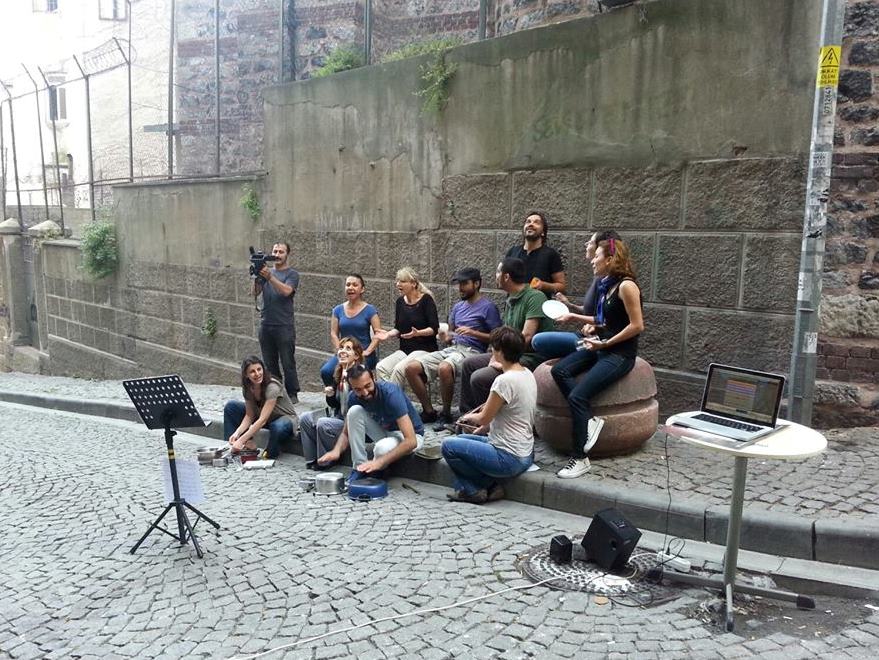
Kardeş Türküler perform “Tencere Tava Havası” (“Sound of Pots and Pans”) in the streets of Istanbul this week. Check out the Kardeş Türküler’s website HERE for background on the group, which came into being in 1993 as a concert project by the Boğaziçi University Folklore Club.

And, here’s an explanation of the penguin footage later in the video from a Youtube comment:

“If people don’t know about it, the penguins mock mainstream media that has very close relations to the government. Main news channels have been nearly totally silent about the protests, not wanting to be hated by the government. One main news channel (CNNTurk) preferred to broadcast a penguin documentary while all of these are happening. Similar attitude from others. After being severely mocked by protesters, an apology and more coverage came.”

Istanbul group Kardeş Türküler recording the video "Pots & Pans" in response to the Taksim/Gezi Park protests this week.

Istanbul group Kardeş Türküler recording the video “Pots & Pans” in response to the Taksim/Gezi Park protests this week.

evelyn glennie – how to listen with your whole body

In this fascinating TED talk, virtuoso deaf percussionist Evelyn Glennie demonstrates how listening to music involves much more than simply letting sound waves hit your eardrums.

According to Wikipedia, Glennie has been profoundly deaf since the age of 12, having started to lose her hearing from the age of 8. This does not inhibit her ability to perform at an international level. She regularly plays barefoot during both live performances and studio recordings in order to feel the music better.

Glennie contends that deafness is largely misunderstood by the public. She claims to have taught herself to hear “sound colours” with parts of her body other than her ears. In response to criticism from the media, Glennie published Hearing Essay in 1993, in which she discussed her condition. Read it HERE.

pleased to meet you, hope you guess my name

“Just keep still; keep together!”

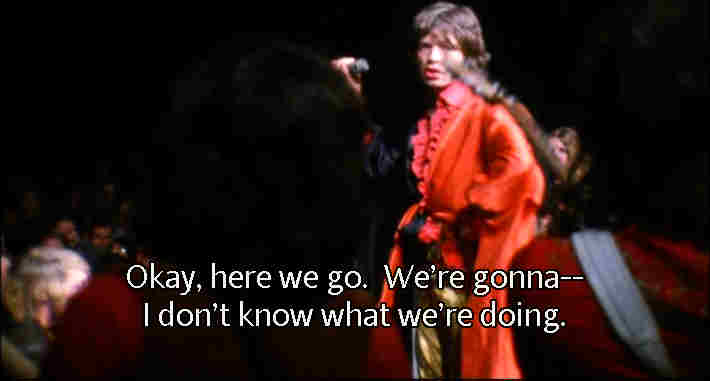
6 December, 1969: A free live performance by the Rolling Stones at Altamont of “Sympathy for the Devil” with Hells Angels doing security descends into chaos.

Screenshot of the infamous Altamont concert from the film "Gimme Shelter"

Screenshot of the infamous Altamont concert from the film “Gimme Shelter”

rené clair & erik satie – relâche/entr’acte

Relâche,  ballet instantanéiste en deux actes: un entr’acte cinématographique, et “la queque de chien” is a 1924 ballet by Francis Picabia with music composed by Erik Satie. The title was thought to be a Dadaist practical joke, as relâche is the French word used on posters to indicate that a show is cancelled, or the theatre is closed (and the first performance was indeed cancelled, due to the illness of Jean Börlin, the principal dancer, choreographer, and artistic director of the Ballets Suédois).

Still from "Entr'acte"

Still from “Entr’acte”

Picabia commissioned filmmaker René Clair to create a cinematic entr’acte to be shown during the ballet’s intermission. The film, simply titled Entr’acte, consists of a scene shown before the ballet and a longer piece between the acts. The score was also composed by Satie.

Entr’acte premiered as an entr’acte for the Ballets Suédois production Relâche at the Théâtre des Champs-Élysées in Paris in 1924. The Dadaists collaborating on the project invented a new mode of production: instantanéisme. Watching the 20 minute film involves seeing people running in slow motion, things happening in reverse, looking at a ballet dancer from underneath, watching an egg over a fountain of water get shot and instantly become a bird, and watching people disappear. The cast included cameo appearances by Francis Picabia, Erik Satie, Man Ray, and Marcel Duchamp. The conductor of the orchestra at the premiere was Roger Désormière. The edition of the soundtrack featured here was conducted in 1967 by Henri Sauguet.

goodbye, ray manzarek

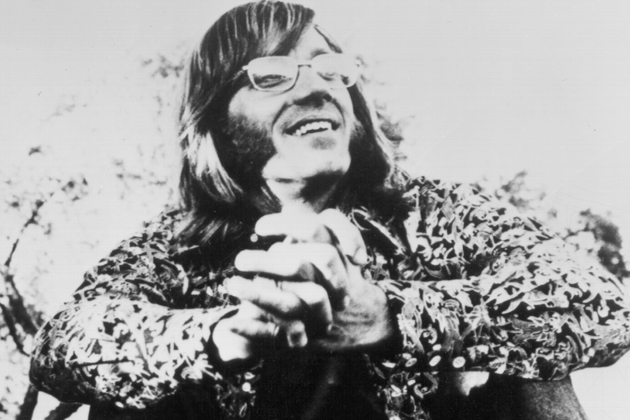
The Doors, live in Copenhagen,1968. Ray, I was always even more in love with you than I was with Jim…  That organ of yours is what really hypnotised me (that’s what she said).

doors-Michael-Ochs-Archives

From Michael Ochs’ archive

As my friend Carlo Germeshuys just put it, “Goodbye, Ray Manzarek – without your swirly lounge keyboard old Jimbo wouldn’t have gotten far with his whole bozo Dionysus act.” Oh wait, Carlo says he was referencing a diss by Lester Bangs. Well, whatever. “Bozo Dionysus” = best description of Jim Morrison ever.

HERE‘s an obituary from Rolling Stone.

chelsea wolfe – halfsleeper

All the parts of me that lived inside
Are drowning in the sea of waking life
They don’t know their colours don’t belong on the outside
They don’t know their colours don’t belong

Til they’re spread across the open road
Til they’re spread across the asphalt on the open road
Til they’re streaming in the wind like cassette tape or jellyfish
Long dark veins and records playing memories

All the things we yell don’t mean a thing
When we’re spinning out of darkened meadow wind
When we’re flying like we’re Mary’s angels through the shattered glass
When we find that tall dark shadow waiting there with outstretched hands
He has given me a dress of red and you a skin of gray
We’ll be twisting here for hours ’til the light will bring us day

And we’re spread across the open road
And we’re spread across the asphalt on the open road
And we’re streaming in the wind like cassette tape or jellyfish
Long dark veins and records playing memories

spectrum – undo the taboo

The opening track of Highs, Lows and Heavenly Blows, released in 1994 on Silvertone Records.

Spectrum was the most high-profile and straightforward of the projects undertaken by Pete “Sonic Boom” Kember after the demise of the trance-rock avatars Spacemen 3. As his work as a member of the Experimental Audio Research coterie allowed Kember the opportunity to explore ambient textures and tonal constructs, Spectrum satisfied the singer/guitarist’s more conventional pop leanings, while never losing sight of the hypnotic otherworldliness which became his music’s trademark and legacy.

(Info from Allmusic.com)


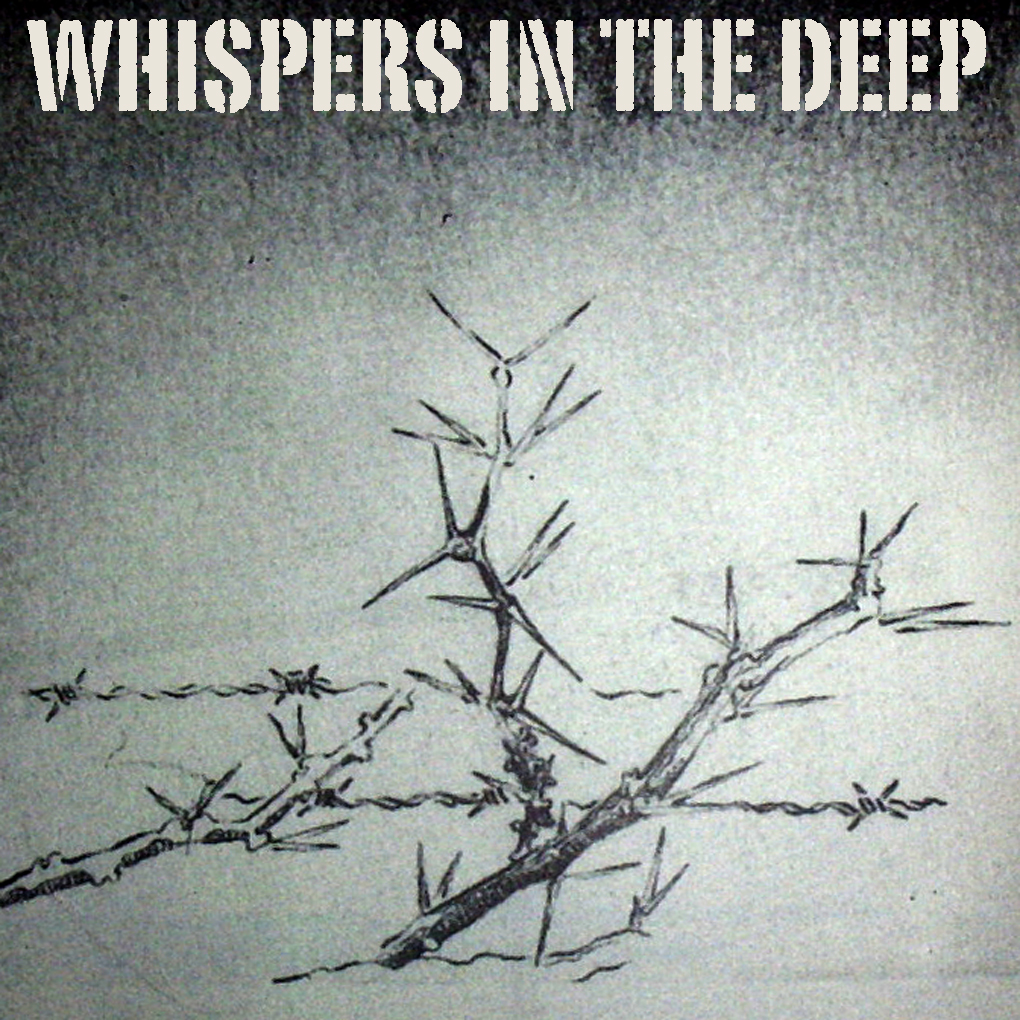
whispers in the deep

Matt Temple, of the excellent African music blog Electric Jive, has just uploaded another fascinating compilation of rare and historical sounds. This time the focus is on music and censorship in South Africa, and tracks span the period from 1960 to 1994. Accompanying the download link is an essay by Peter M Stewart, written in 2003, when this compilation was originally made, which provides some context for listening.

whispers in the deep

“Given the recent Secrecy Bill passed by the South African Parliament it’s worth reflecting on music that caught the attention of the censors during the previous dark period of Apartheid… this is a compilation I put together for private distribution in August 2003, almost 10 years ago. It fits the Bill!

Whispers in the Deep collects a number of anthems, agit-pop songs, and propaganda pieces. Many of the tracks were intended as direct responses to the South African social order as it was prior to 1994. The other tracks might as well have been. Nevermind the revolution, nothing was televised in South Africa prior to 1976.

Whispers in the Deep also documents some of the ways in which access to popular music was restricted in South Africa – the obstacles that prevented persons resident in South Africa from listening to songs, hearing them broadcast, or seeing them performed. It explores the cultural boycott, censorship by the state in South Africa, and various manifestations of the ‘climate of censorship’.”

Read more and download it HERE.

twin shadow – tether beat

Loving this track at the moment:

Twin Shadow, AKA George Lewis Junior, is doing something interesting while touring: he’s collecting narratives from people online and weaving them into his itinerary. Check out his call for stories:

“Welcome to the Twin Shadow True Story tour, As some of you may know, My father and I have written stories for every stop on the tour, True Stories from our own lives and the people around us. I’m always trying to keep the tours that we do special, I think that, while we live our lives in unison, digitally, and without lines and boundaries on the internet (which I think is amazing), we are still very much from different places. The Line that divides Florida from Georgia is still a hard line. I feel it when I talk to someone from my side of that divide. So I’m asking fans to write stories about where they are from or where they currently call home. Tell us about a place in your town that holds one of your stories. This isn’t a tweet, really tell me in as many words as you want about the time you stole money from the cash register at your old coffee shop, about the time you had your first kiss out the back of the cinema. Tell me everything about those places, and when we come to your town or city we will try to visit these places, and take some photos there. Once I get all the submissions, I’d like to pick the best ones, publish them on my tumblr and read the stories on my soundcloud Podcast called FORGET RADIO.

I love our short form world, but this is a call to talk a bit more about the details that make your lives unique from mine. So often we (bands) roll through your towns with a stop at a grocery store, a gas station, and if you are Twin Shadow your local arcade and go cart racing complex. We wanna know about the rivers you visit, the book stores you love, the bars you drink at, the fields you’ve slept in. This is my wish, let it be known, let it be done.

G

Submit your stories HERE.”