Excerpt from an article by Aya Lurie, from the exhibition catalogue: “The Naked Eye – Surrealist Photography in the First Half of the 20th Century”, 2013:
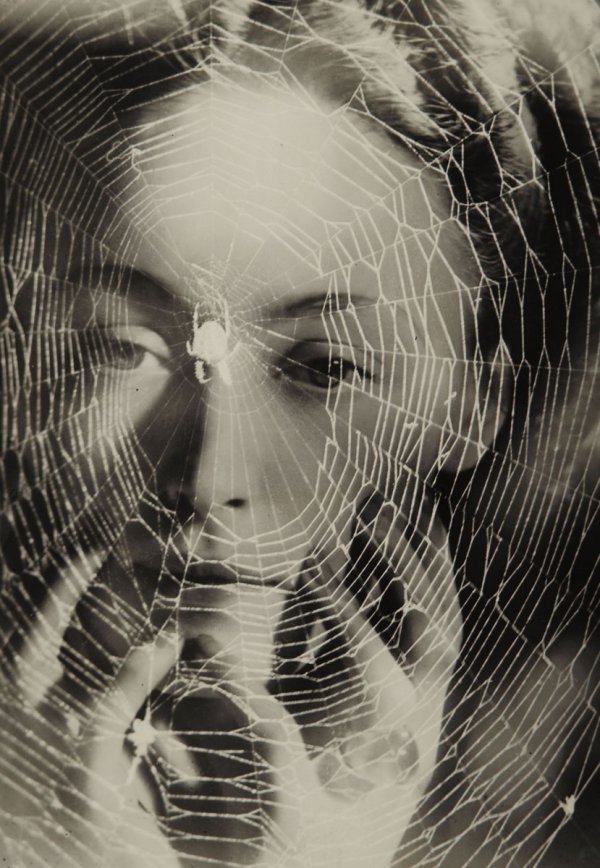
The languishing face of a strikingly beautiful young woman is seen behind a spider web. Is she trapped behind the web? Is she trapped in it? The spider may be lying in wait for her, and maybe she is on the prowl, with her manicured feminine hands, which call to mind the articulated legs of a spider. Perhaps it is rather the lurking time, as indicated by the title of the photograph, that threatens youth and beauty, serving as a reminder of their ephemerality.
The association between the woman and the spider dates back to Greek mythology, where it is embodied in the figure of Arachne, a weaver who made Athena jealous enough to turn her into a spider.1
In the history of culture, the figure of the “spider-woman” has come to be identified with the femme fatale — the archetype of the woman who leads to the downfall of the man attracted to her. In this context, Arachne is presented as a patient plotter who spins a web of schemes to trap and devour the reckless male.2 Dr. Ruth Markus, in her essay about the representations of the castrating woman in Surrealist art, ties the female praying mantis with the female “Black Widow” spider, which characteristically devour their males during or directly after the sexual act. She explains the Surrealist interest in the mantis and similar insects in that they represent the two primordial Freudian instincts: Eros and Thanatos.3
Dora Maar linked the photographed portrait by Man Ray with a manipulated image of a cobweb, to create the effect of transparent contours on the woman’s face in the final print. The resulting photomontage thus fuses the woman’s figure with the spider and its web. The Surrealists were drawn to the mimetic ability of various animals to camouflage themselves in nature, and created many works in which flora, fauna, and the inanimate merge and assimilate into one another.4 In the spirit of pantheist romanticism, this capacity was taken to represent an aspiration to eliminate the boundaries between man and nature, to the point of total fusion with the cosmos, which leads to absolute void. It is, in fact, a yearning for a primordial unconscious state, an existential state which precedes consciousness.
In the photograph in question, the paths of two of the most fascinating women who operated among the Surrealists cross. Photographer Dora Maar (born as Henrietta Theodora Markovitch) was a talented artist in her own right, but her fame came mainly from her relationship with Pablo Picasso, her partner, who often depicted her figure. In addition, Maar also modeled for Man Ray in some of his prime photographs…
… The model in Maar’s photograph is Nusch Éluard (1906–1946, née Maria Benz), a German show dancer who, in 1934, married poet Paul Éluard, one of the kingpins of Surrealism, after his first wife, Gala, left him for Salvador Dalí… Nusch Éluard also served as inspiration for her husband’s poetic work, and he combined her photographs in his books of poetry as elaboration and illustration for the written text.
In 1935, daring nude photographs of Nusch were included in his book Facile. Following her sudden death in 1946, at the age of 40, her portrait, taken by Dora Maar (with which she constructed the montage here), was included in a book by her husband in her memory, Le temps débordé (Time Overflows). The portrait, this time without cobweb,[fig. 3] accompanied the poem “Ecstasy” in which Éluard praises and mourns his wife: “I am in front of this feminine land / Like a child in front of the fire / Smiling vaguely with tears in my eyes / […] / I am in front of this feminine land / Like a branch in the fire.”5
- See Ovid’s Metamorphoses, books 6–10, ed. William S. Anderson (Norman, Oklahoma: University of Oklahoma Press, 1972), pp. 15-22.
- See Doron Lurie, cat. Femme Fatale (Tel Aviv Museum of Art, 2006), p. 108 [Hebrew].
- Ruth Markus, “Surrealism’s Praying Mantis and Castrating Woman”, Woman’s Art Journal, vol. 21:1 (Spring/Summer, 2000), pp. 33-39.
- Ibid.
- Paul Éluard, “Ecstasy,” trans. A. S. Kline, 2001. http://www.poetryintranslation.com/PITBR/French/Eluard.htm.















 fleurmach