Category Archives: politics
anaïs nin on lou andreas-salomé and other remarkably rebellious women
Nin talks fondly about some of her favourite rebellious women, including psychoanalyst Lou Andreas-Salomé (who could hold her own with Rilke, Freud and Nietzsche) and Caresse Crosby, the infamous libertine, anti-war crusader and publisher, about being an artist and exploring psychological worlds, beyond judgement.
shane koyczan – to this day project
Help this message have a far reaching and long lasting effect in confronting bullying. Please share generously.
what about mind enlargement? #genderfreesa #dicktatorfreejozi #takingbackourcity

I don’t just live my life, I create my life. And after almost a year of creating images reflecting my vision of the city and its inhabitants, I no longer just want to reflect the city, but create it. Just as I need to be an activist in my own life and my own identity to fully be alive, as an artist, I need to be an artivist, actively participating in the creation of the city I want to live in. Joburg is not just a city, it is my city; it is my home. And as an artivist it is not just a place I want to live in, but a place I actively want to participate in creating.The idea for #takingbackourcity was born out of my return to Joburg from my first real visit to Cape Town. My return to Jozi from CT shocked me with the everyday messages and symbols we Joburgers take for granted; the messages and symbols that shape the collective unconscious of our city and our people. The ‘Penis Enlargement’ posters that adorn every robot, electrical box and street pole were the most glaring example. I asked myself: what does this say about Joburg? what does this say about Joburgers?
We are a city obsessed with the power of the phallus; a presidency obsessed with the symbol and virility and representation of the phallus; a people whose penis size reflects its masculinity, whose masculinity reflects its identity. The effect of this overtly embodied and gendered mantra on our collective unconscious plays itself out in our lives daily.
tracy chapman – behind the wall
From her self-titled debut album, released in 1988 on Elektra.
billy bragg – valentine’s day is over (peel sessions)
Recorded live on 30 August 1988 for the John Peel Show.
“God didn’t make you an angel; the devil made you a man
That brutality and economy are related now I understand
When will you realise that as above so below there is no love?
For the girl with the hour glass figure
Time runs out very fast
We used to want the same things but that’s all in the past
And lately it seems that as it all gets tougher
Your ideal of justice just becomes rougher and rougher…”
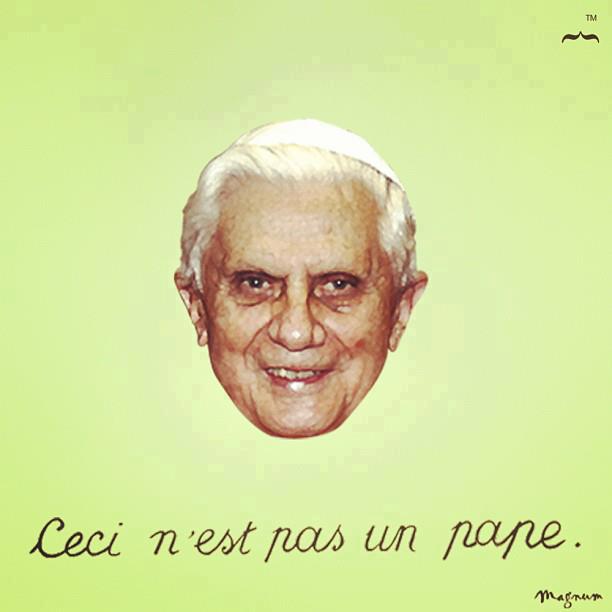
after magritte
heavens to betsy – my red self/my secret (demo tape, 1992)
Heavens to Betsy was an American indie-punk band formed in Olympia, Washington in 1991. They were part of the DIY riot grrrl movement in the punk rock underground in the early 1990s, and were the first band of Sleater-Kinney vocalist/guitarist Corine Tucker. These two demos are intimate and powerful.
silent vigil this wednesday in cape town
Via Malika Ndlovu:
Stand Up! Be still. Join the Tower of Silence in reflection and protest against the silencing, a pillar of honouring and mourning. Wear white (a symbol of spirit, light, cleansing, unity beyond gender, language, political or religious agenda) and join this 1 hour vigil against the violence epitomized by the death and brutalisation of Anene Booysen… and too many of our daughters and sisters like her. This Wednesday, 13th February 2013, on the steps of St George’s Cathedral, from 12 pm to 1 pm.
Bring a photograph on a placard of anyone you think we need to remember in this way too. We will not be sloganeering or shouting retaliations against our lost sons, brothers who have perpetuated this crime against their own and her humanity. Our collective presence and solidarity speaks volumes and calls for multiple responses to this complex situation, affecting an entire nation. We make this physical visual statement on the eve of onebillionrising.org global campaign and the president’s “State of the Nation” address. For us, these faces, these stories, these discarded bodies and all the reasons why this continues to happen in the world and all over South Africa – THIS is OUR ‘State of our Nation’ call to address!
taking back our city #takingbackourcity #dicktatorfreejozi #genderfreesa
Participate in the creation of the city you want to live in. #takingbackourcity #dicktatorfreejozi #genderfreesa
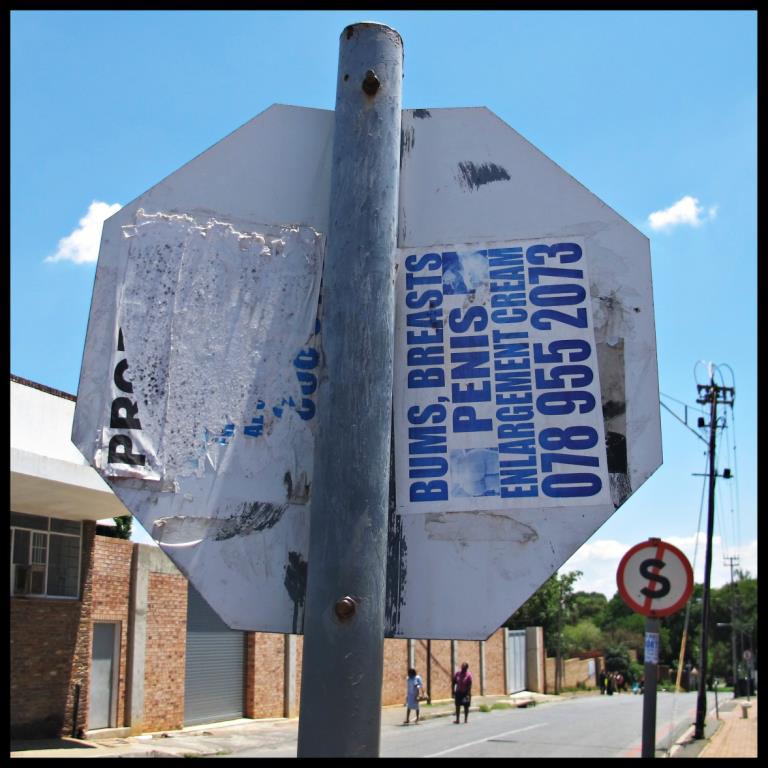
I don’t just live my life, I create my life. And after almost a year of creating images reflecting my vision of the city and its inhabitants, I no longer just want to reflect the city, but create it. Just as I need to be an activist in my own life and my own identity to fully be alive, as an artist, I need to be an artivist, actively participating in the creation of the city I want to live in. Joburg is not just a city, it is my city; it is my home. And as an artivist it is not just a place I want to live in, but a place I actively want to participate in creating.The idea for #takingbackourcity was born out of my return to Joburg from my first real visit to Cape Town. My return to Jozi from CT shocked me with the everyday messages and symbols we Joburgers take for granted; the messages and symbols that shape the collective unconscious of our city and our people. The ‘Penis Enlargement’ posters that adorn every robot, electrical box and street pole were the most glaring example. I asked myself: what does this say about Joburg? what does this say about Joburgers?
We are a city obsessed with the power of the phallus; a presidency obsessed with the symbol and virility and representation of the phallus; a people whose penis size reflects its masculinity, whose masculinity reflects its identity. The effect of this overtly embodied and gendered mantra on our collective unconscious plays itself out in our lives daily.
More so than with other cultures, Joburg constantly genders us. It equates our identity with our gender, places our gendered attributes – our penises, our breasts – under the microscope, and finds us wanting. Those who are found wanting and those who pass the grade play out the script of the power struggle that has been written for us. And as with the Battle of the Sexes in decades before us, the Battle of the Genders brings with it a long, long casualty list. Being part of the female-bodied and -gendered community, as well as the LGBTIQ community, from where so many of the casualties come, I cannot be part of an existence or an art that hides behind the privilege of aesthetic.
Those of you who follow my work know that I believe that gender is nothing more than a social construction and that I perform my gender through my identity and my art daily. But playing with gender and bearing witness to the daily reality of my and others’ lives as queers in my writing and images is not enough. How do I as a queer artist respond to the overt gendering of our city; the grossly embodied sexing of the spirit of Joburg?
I need to take responsibility for the city I want to live in and actively participate in creating it. I need to undermine the gendering of the city and its inhabitants with more than just my existence and my documentation of my play with gender and identity, more than just through my collaborations with others who do the same.
‘Taking Back our City’ is thus this journey of active and creative participation in my city. I hope that you will follow my journey and join me in taking our city back.
glenda kemp and “oupa”


 Glenda Kemp’s blog is HERE. Also check out this fascinating interview that Genevieve Louw did with her in 2008.
noise and capitalism
“This book, Noise and Capitalism, is a tool for understanding the situation we are living through, the way our practices and our subjectivities are determined by capitalism. It explores contemporary alienation in order to discover whether the practices of improvisation and noise contain or can produce emancipatory moments and how these practices point towards social relations which can extend these moments.
If the conditions in which we produce our music affects our playing then let’s try to feel through them, understand them as much as possible and, then, change these conditions.
If our senses are appropriated by capitalism and put to work in an ‘attention economy’, let’s, then, reappropriate our senses, our capacity to feel, our receptive powers; let’s start the war at the membrane! Alienated language is noise, but noise contains possibilities that may, who knows, be more affective than discursive, more enigmatic than dogmatic.
Noise and improvisation are practices of risk, a ‘going fragile’. Yet these risks imply a social responsibility that could take us beyond ‘phoney freedom’ and into unities of differing.
We find ourselves poised between vicariously florid academic criticism, overspecialised niche markets and basements full of anti-intellectual escapists. There is, after all, ‘a Franco, Churchill, Roosevelt, inside all of us…’ yet this book is written neither by chiefs nor generals.
Here non-appointed practitioners, who are not yet disinterested, autotheorise ways of thinking through the contemporary conditions for making difficult music and opening up to the wilfully perverse satisfactions of the auricular drives.”
Sound interesting? HERE, DOWNLOAD NOISE AND CAPITALISM FREE.
Edited by Mattin Iles and Anthony Iles
Contributions from Ray Brassier, Emma Hedditch, Matthew Hyland, Anthony Iles, Sara Kaaman, Mattin, Nina Power, Edwin Prévost, Bruce Russell, Matthieu Saladin, Howard Slater, Csaba Toth, Ben Watson.
More details from the publishers, Arteleku Audiolab (Kritika series), Donostia-San Sebastián (Gipuzkoa)
Publication date: September 2009
thoughts on meaningful work, 14 november 2012, 5:38 a.m.
What follows is something I wanted to blog from Turkey in November but was unable to due to lack of an internet connection at the time. I woke up very early one morning, typed it into my phone’s notes app, half asleep, and promptly forgot about it. The incredibly tedious work I am currently doing (editing an MSc thesis on anthropometric measurements for office chairs) reminded me of its existence. So, two months later, here it is.
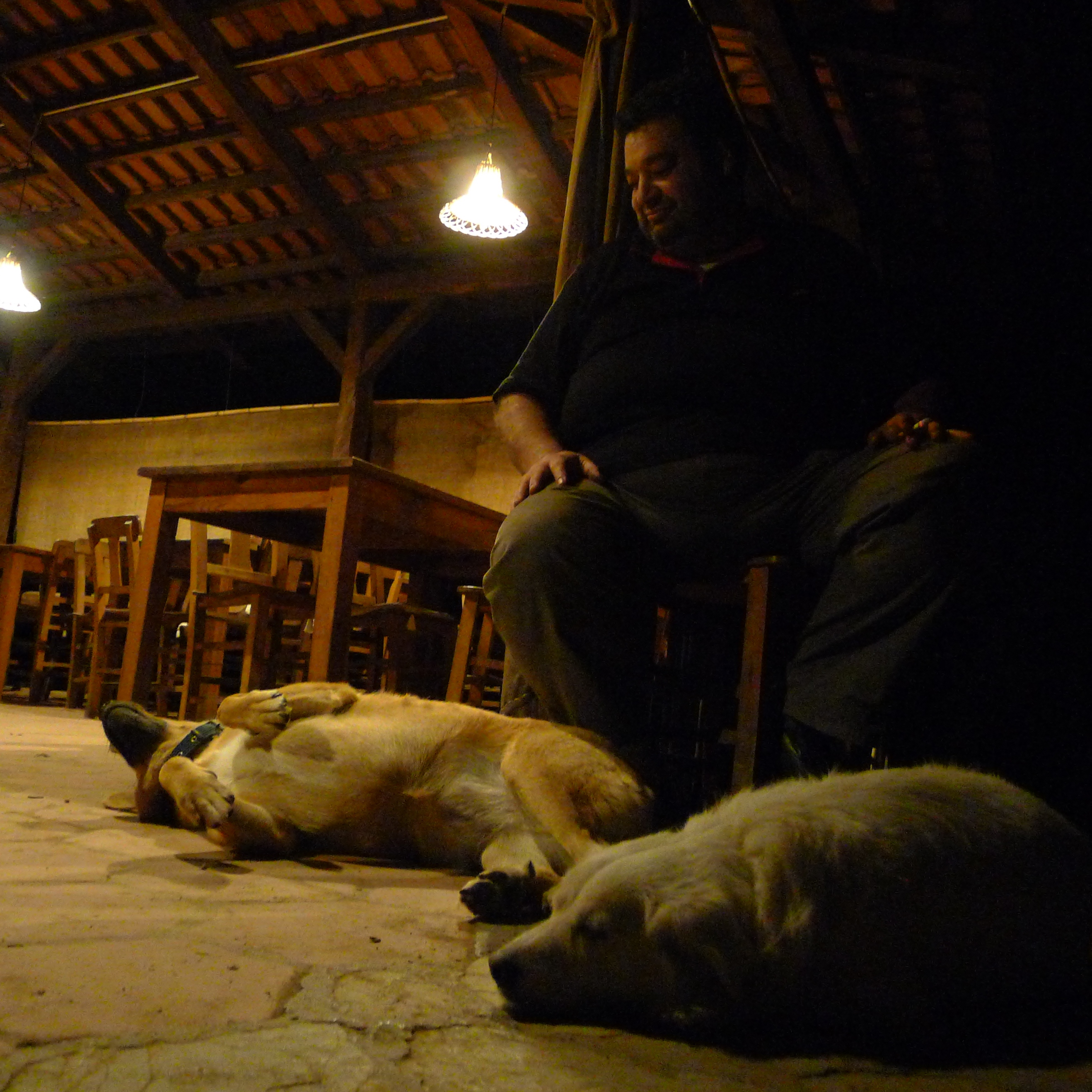
Arif Cerit with the farm dogs, Shanslar (Lucky) and Beyaz (White), at Pastoral Vadi. Photo: Rosemary Lombard.
Last night I had a profound conversation, in my bad Turkish and his bad English, with Arif Cerit, a guy who lives at Pastoral Vadi, the organic/permaculture farm near Fethiye in South-Western Turkey which I am visiting – working in exchange for food and a bed. It’s a very comfortable bed, in a neat, well-appointed cottage designed and built of cob (straw and mud) five years ago by Ahmet Kizen, an architect passionate about sustainable living and ecotourism who bought this farm 14 years ago and opened it to visitors about 7 years back. No maintenance has been necessary since the cottage was built, I’m told. The thick walls keep it cool during the day and surprisingly warm at night.
So, back to what I wanted to blog about, which has resonated for me with my friend P‘s latest gier on Facebook, which involves a sort of Dada/absurdist attempt to animalise interactions. Having been away and in limited contact with everyone, I haven’t had a chance to ask him more about it, but, basically, instead of clicking “like”, he types animal noises. “Baaa, baaa”, mostly. For me it draws attention to the essentially animal nature of human interaction, which we have become unconscious of and detached from, as we live large swathes of our lives online, “denatured”, unquestioning. “Like” has become a capricious yet ubiquitous form of social capital. Facebook’s shady manipulation of this currency of late has triggered consternation and outrage. They’ve put in place algorithms that restrict the “organic” (terms such as “organic” and “viral” in the world of virtual memes are interesting in their ironic detachment!) reach of posts on the network, requiring one to pay (“real” money) to secure an audience greater than an arbitrary sliver of the profiles to whom one is connected… Just when I thought it was because I only had a sliver of die-hards who actually enjoyed what I post anymore, I realised that most of my Facebook friends no longer see my updates in their news feeds. What a relief (?). The virtual landscape increasingly resembles a targeted marketing environment more than it does a communal hangout, a place for exchanging ideas and thoughts, as it used to. Now it’s mostly about Profit. By monetising the prominence of posts, equal access is effectively being stifled. Concomitantly, freedom of association and meaningful interaction are withering.
That’s another aside, or, rather, more context. ANYWAY. So, what I gleaned from my conversation with big, friendly Arif was that he had been a taxi driver with a fleet of cars in the west coast city of Izmir for 21 years, before dropping everything and moving here to the farm. He sold his business, gave the money to his brothers and left it all behind.
He says that the city is a big jungle, very dark, very dense, very dangerous, full of artifice and chemical poisons. People are a species of animal, he says, like all animals… In cities you have to be a predator to do well. If you are not a predator, you have to live your life very small, like a rat, to survive. Your mind is very important, he says. The chasing after money and things that you need to do to live in the city takes up all your time and your thoughts. Money is a cancer. TV is the morphine you need to kill the pain at the end of the day: the pain of your mind being eaten away.
Out here on the farm, life is real, he says. There is space, there is ground, and air, and the smell of greenness. Animals who are not predators can live happily, widely, openly, productively.
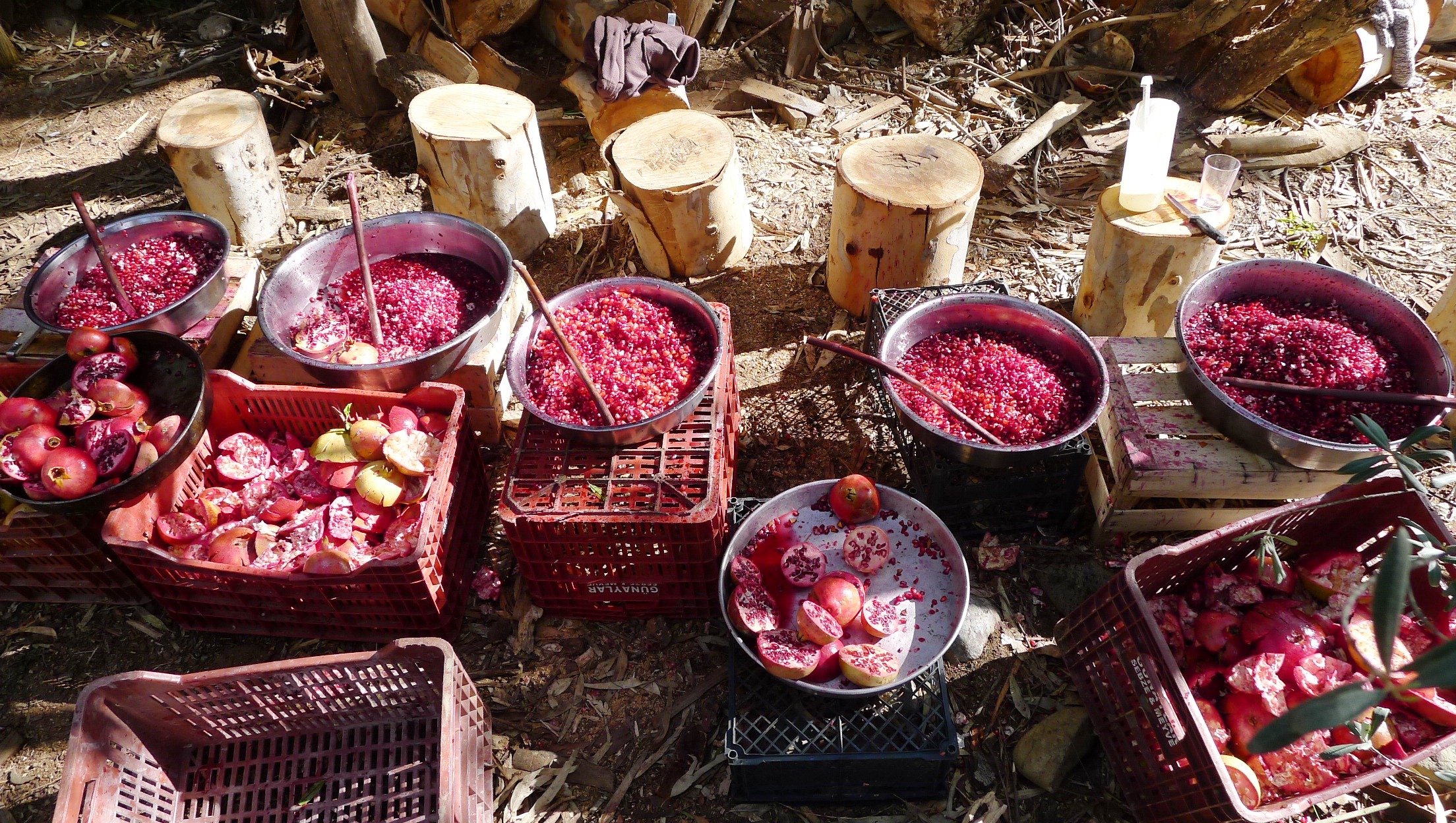
Processing pomegranates by hand to make nar ekshili sos (pomegranate reduction). Photo: Rosemary Lombard
Sticky, crimson pomegranate juice is running down my arms and dripping off my elbows. I’m stained with the joy of manual labour. It’s so satisfying, this repetitive bashing of crates and crates of halved fruit to knock out the arils, then the squeezing in a bag to extract the juice, which is then boiled over a fire for ten hours to reduce it to a dark, tart syrup, then strained through muslin into bottles. It’s slow-going, messy, tiring work. I have blisters, purple palms. But, at the end of each day, I can see the results of my time spent. It’s nothing like the virtual world of work I mostly inhabit, where I shut down my computer and a sense of the hours and hours I have spent shunting pixels around evaporates.
For so long now, my life has felt paper-thin, no, thinner, as if I barely cast even a shadow of influence in the world, and I realise now that it is largely because of the intangible nature of the work I have been doing, which mostly involves cleaning, tidying and correcting other people’s writing, or recording their work, or facilitating their conversations… It’s all work towards actualising goals that I have deemed worthwhile; nonetheless, these are goals which are not my own. I have tried to frame them as my own, tried to see my part in the whole as indispensable, my purpose as contiguous with that of the projects’, my place as “a tiny cog in the great wheel of evolution” – that was how Billy Wilder put it, writing the words of Ninotchka played by Greta Garbo in Ernst Lubitsch’s wonderful 1939 satire of the same name.
Alas, my heart just hasn’t been convinced. I haven’t been able to shake this unbearable sense of lightness, of the unnecessary breaths I’m taking, of the lack of any other humans who truly require or desire my existence, irreplaceably, here on Earth. All this needs to change if I am to remain sane when I get back. Living with a heavenly purpose is too far beyond me. I’d be satisfied to have done with consumption, thanks. I started this blog in an attempt to make something indelible of the ephemeral. I need to do more. I’m starving.
“If I had an orchard, I’d work till I was sore.” ~ Fleet Foxes – “Helplessness Blues“.

Sweet! A break to drink some freshly-squeezed pomegranate juice. Photo: Rosemary Lombard
danni diana on bogus muthi (and ad agencies)
A year or so ago, some colleagues of mine did a campaign for a film called Night Drive, which was a slashy, schlocky horror that centred on the body-parts-for-muthi trade. The campaign handed out a couple hundred pamphlets, in the style of those ridiculous pamphlets that offer penis enlargement, bad luck cure, womb cleaning etc that we see littered around town every day. The pamphlets offered money for body parts, and linked to a website that detailed the “doctor’s” cash-for-organs trade in more detail. The people who received the pamphlets went ape-shit, calls were made to the national media, everyone was pranked and much outrage ensued. The campaign was slammed by the Department of Health for trivialising a “Serious Problem”, and was pulled, effective immediately, complete with apology from the ad agency in question, and a promise to conduct an “internal disciplinary procedure”.

Pamphlet collected in Durban by Rosemary Lombard, 2009
My question is, what exactly is being done about this serious problem? Why do people get up in arms about a cash-for-body-parts hoax, but think its OK (and hilarious) for there to be pamphlets offering safe abortions, womb cleaning, AIDS cures and a whole manner of sexual health treatment that is not only bogus, but seriously harmful to those who pursue it. What effort is being made by the Department of Health to shut down these “doctors”? Most disturbing is the discriminatory gender ideas at the root of these so called treatments. Muthi to “make lover have sex with you”, and treatment for women for, among other things “cleaner vaginas, more willingness to have sex.”
These charlatan muthi men make a mockery of traditional healing, and the pamphlets and posters not only mislead the poor, vulnerable and uneducated, but reinforce negative stereotypes about traditional healing and the communities that take advantage of them. Is any work being done to address this “Serious Problem”, or do people only care so long as the content of said media panders to savage stereotypes of murderous muthi men lurking in the shadows to chop your heart out?

Pamphlet collected in Durban by Rosemary Lombard, 2009
the gulabi gang

The Gulabi Gang (from Hindi “gulabi” = “pink” – “pink gang”) is a group of women vigilantes and activists originally from Banda in Bundelkhand district, Uttar Pradesh, India, but reported to be active across North India as of 2010. It is named after the pink saris worn by its members.
The gang was founded in 2006 by Sampat Pal Devi, a mother of five and former government health worker (also a former child bride), as a response to widespread domestic abuse and other violence against women. Gulabis visit abusive husbands and beat them up with laathis (bamboo sticks) unless they stop abusing their wives. In 2008, they stormed an electricity office in Banda district and forced officials to turn back the power they had cut in order to extract bribes. They have also stopped child marriages and protested dowry and female illiteracy.

 More information HERE and HERE, and more pictures by Arindam Mukherjee HERE.
born free, and everywhere in chains (1762)
“L’homme est né libre, et partout il est dans les fers.”
~ Jean-Jacques Rousseau (1712-1778), from Du contrat social, Préambule (1762).
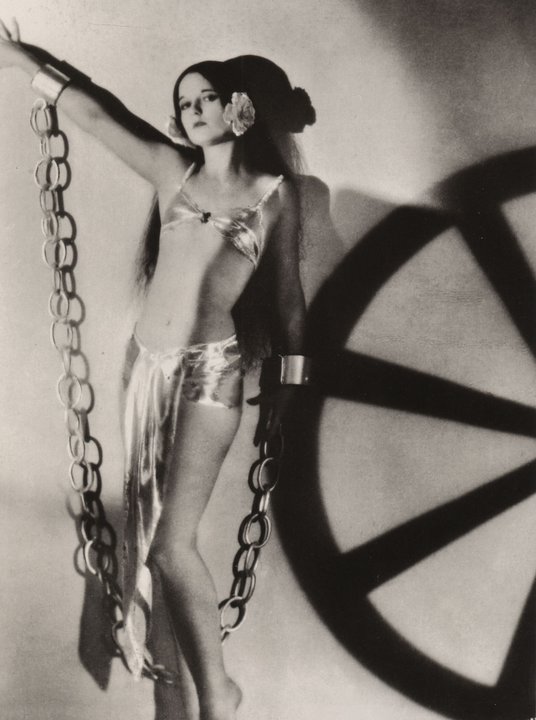
Louise Brooks (photographer and date unknown)
jayne cortez and the firespitters – there it is
feminism: the stereotyping and disempowerment of dominant gender roles – jada pinkett smith
Jada Pinkett-Smith: “The War on Men Through the Degradation of Woman” – “How is man to recognize his full self, his full power through the eyes of an incomplete woman? The woman who has been stripped of Goddess recognition and diminished to a big ass and full breast for physical comfort only. The woman who has been silenced so she may forget her spiritual essence because her words stir too much thought outside of the pleasure space. The woman who has been diminished to covering all that rots inside of her with weaves and red bottom shoes.I am sure the men, who restructured our societies from cultures that honored woman, had no idea of the outcome. They had no idea that eventually, even men would render themselves empty and longing for meaning, depth and connection.
There is a deep sadness when I witness a man that can’t recognize the emptiness he feels when he objectifies himself as a bank and truly believes he can buy love with things and status. It is painful to witness the betrayal when a woman takes him up on that offer.
He doesn’t recognize that the [creation] of a half woman has contributed to his repressed anger and frustration of feeling he is not enough. He then may love no woman or keep many half women as his prize.
He doesn’t recognize that it’s his submersion in the imbalanced warrior culture, where violence is the means of getting respect and power, as the reason he can break the face of the woman who bore him 4 four children.
When woman is lost, so is man. The truth is, woman is the window to a man’s heart and a man’s heart is the gateway to his soul.
Power and control will NEVER out weigh love.
May we all find our way.
~ Jada Pinkett-Smith, published in Sinuous Magazine (http://www.sinuousmag.com/). Originally published on her Facebook page.
das boot

nina hagen – du hast den farbfilm vergessen
Nina Hagen & Automobil (1974). One of her first performances on film. There’s a version with English subtitles HERE.
Raised by her mother, well-known film and TV actress Eva-Maria Hagen and her stepfather, dissident singer-songwriter Wolf Biermann (who was a big influence on her political views and a big nuisance to the GDR), Hagen began singing professionally at a young age. Backed by her group, Automobil, her 1974 single, “Du Hast den Farbfilm Vergessen” (“You forgot the color film”) became a huge hit in the GDR and made Hagen a big star. The seemingly innocent-sounding lyrics (a girlfriend berating her boyfriend for not bringing color film on their vacation) were a subtle dig mocking the sterile, gray, Communist state. The fluffy-sounding ditty became one the most popular songs of 1974 and the double meaning of the comical lyrics was apparently well-understood by both the general population and the Politbüro elites.
In 1976, Wolf Biermann was stripped of his citizenship and refused re-admittance into the GDR after he’d played a TV concert in Cologne. When her mother left to join her husband, Nina claimed to be Biermann’s biological daughter. However, the thing that probably got her visa stamped stat was her threat to the authorities that she would become “the next Wolf Biermann.”
Four days later she was living in the West. I wonder how many people were thrown OUT of East Germany? That’s punk! (from dangerousminds.net)
And here’s a version from 1985 (in full, garish colour):
bill hicks – revelations (1993)
Bill Hicks performing live at the Dominion Theatre in London. This is the entire show.
howard zinn on war, violence and human nature
Howard Zinn talking about the environmental factors that influence aggression. Excerpt from You Can’t Be Neutral On a Moving Train, 2004 [DVD], available from firstrunfeatures.com.
palaces of jacob zuma

playa 4 lyf

ukulele orchestra of great britain – pretty girls
the general malaise
“To have accomplished nothing and to die overworked.”
~ Emile Cioran
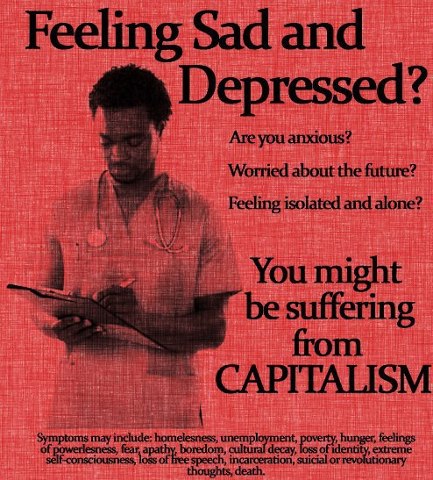
in my facebook feed right now
baloji with konono n°1 – karibu ya bintou (english subtitles)
From the album Kinshasa Succursale (Crammed Discs, 2011)
Video shot in the streets of Kinshasa.
Electric thumb piano (likembé) played by Konono N°1, the legendary Congolese band whose junkyard sonics and trademark “Congotronics” sound has had a major influence on the electronic and indie rock scenes.
Directors: Spike and Jones
DOP: Nicolas Karakatsanis
Producer: Annemie Decorte (Dr. Film)
Styling: Ann Lauwerys
Mask: Katrien Matthys
More info:
http://www.baloji.com
http://www.crammed.be
“we don’t mean to offend you by calling you racist”
‘Young gentros in Urban Outfitters “Navajo” tees saying “F**k the system” and “I don’t see color”: You are the problem.’
Two slam poets with Brave New Voices deliver this indictment of hipster cultural appropriation and its collateral damage. Read more HERE.
songs from the second floor (sweden, 2000)
This poetic, surrealistic and disturbing Swedish film – sometimes called a “black comedy” – written and directed by Roy Andersson, received a number of awards, including the Swedish Film Critics Award and the Special Jury Prize at the Cannes Film Festival. It makes use of many quotations from the work of the Peruvian poet César Vallejo. It’s like a multiple pile-up where Vallejo is crashed into by Beckett, tail-ended by Bergman… and Monty Python can’t slow down or swerve enough to avoid sandwiching them all together.
Reviewed by Anton Bitel:
“Everything has its day,” says the CEO Lennart (Bengt CW Carlsson), concealed (but for his bare feet) beneath a sunbed, to his flustered sub-manager Pelle (Torbjörn Fahlström) in the opening scene of Roy Andersson’s Songs From The Second Floor. “This is a new day and age, Pelle – you have to realise that.” Faced with the imminent collapse of his business empire and the mass unemployment that will inevitably result, this invisible mogul has already decided to take the money and run, contemplating a better life (or should that be afterlife?) abroad for himself in the future once he has put the past behind him. With blithe disregard for those that he is abandoning, he asks, “What’s the point of staying where there is only misery?” – and yet Andersson’s film offers a dystopian vision of the new millennium, where misery, pain, guilt and despair are the universal condition, where escape is impossible, and where, no matter how much anyone tries to turn their back on the past, somehow it always returns.
If everything has its day, the Songs From The Second Floor was certainly a long time in coming. Andersson first discovered the avant-garde Peruvian poet César Vallejo (19892-1938) back in 1965, and first read his poem Stumble Between Two Stars while working on his second feature Gilliap (1975). In the early Eighties he began preparations for a documentary feature based around the poem, before concluding that the material would be better served by the medium of fiction. So he established an independent film studio in 1981, and devoted the next 15 years of work (in short films and commercials) to inventing and honing an aesthetic style that would make his unique vision for this third feature possible. Production proper began in 1996, and lasted four long years – but the results were well worth the wait, and would indeed win the Swedish writer/director a slew of international awards.
The film is told in a series of stylised, hyperreal tableaux, unfolding in indifferent wideshot before an unmoving camera whose very distance helps convert all the tragedy of human experience on display into a very singular brand of dark comedy. Hence the mannered grey makeup worn by the performers – for while this may reflect their status as spiritual zombies lost to their own moral damnation, it is also the familiar mask of clowns, and all these characters are both the living dead and comic chumps. So it is that when, in one sequence, a stage magician (Lucio Vucina) accidentally saws into the belly of his hapless volunteer (Per Jörnelius), eliciting immediate cries of pain, we share the fictive audience’s initial instinct to laugh, even as we are horrified.
Some of the film’s episodes are self-contained vignettes, while others feature an ensemble of recurring characters in the orbit of Kalle (Lars Nordh). Having just torched his own furniture business, this corpulent, middle-aged salesman must deal with sceptical insurance adjusters and find a new outlet (viz. crucifixes) for his flagging spirit of entrepreneurship, even as a strong sense of guilt, both personal and collective, keeps creeping up on him.
Meanwhile Kalle’s eldest son, the poet Thomas (Peter Roth), suffers in silence in a mental institution, leaving his sensitive younger brother Stefan (Stefan Larsson) to pick up the pieces and hear the depressed confessions of passengers in his taxi cab. In the background of all this grief and anxiety, Andersson reveals a grimly absurd vista of societal breakdown, where acts of racist violence go unchecked, traffic jams go on forever, suited flagellants mortify themselves in the street, the dead walk among the (almost) living, panicking financiers resort to crystal balls, and a virgin is publicly sacrificed in a last-ditch effort to fend off not just economic ruin but the end of days.
“Beloved be the ones who sit down,” reads on-screen text near the beginning of Songs From The Second Floor, cited from Vallejo’s Stumble Between Two Stars – and it will recur, along with other lines from the poem, several times within the film itself. At first there might seem little room for poetry in Andersson’s nightmarish picture of a venal, gloomy and bleakly prosaic metropolis whose only poet, Thomas, whether driven mad by his work or by the world, has been reduced to inarticulate muteness.
And yet, like the ghosts of the dead that continue to haunt Kalle’s heavy conscience, or like the buried Nazi past of the superannuated general (Nils-Åke Olsson) that resurfaces in a torrent of Tourette’s-style outbursts (à la Dr Strangelove), poetry just keeps coming back. Even in a setting as banal as a commuter train, Andersson’s drab characters are apt to burst into choral song (magisterially scored by none other than ABBA’s Benny Andersson).
Much of the film’s poetic humanism derives from the word ‘beloved’ that forms a refrain in Vallejo’s poem. For while Andersson may offer up a monstrous parade of vices and vulnerabilities, he invites us to love his gallery of rogues precisely for the flaws that make them – and all of us – so human. A key, repeating image in the film is of different characters perched on the end of their beds, making each and every one of them “the ones who sit down” – but it is a phrase that rather pointedly describes any viewer as well, ensconced in cinema or on sofa. After all, Andersson’s story of frailty and folly is our story too – and at the end of the extraordinary 10-minute single take that closes Songs From The Second Floor, the look that Kalle gives straight to camera implicates us all in the film’s haunting return of the repressed.
Put simply, the everyday apocalypse envisaged in Songs From The Second Floor is a wonder to behold, an idiosyncratic humanist allegory without parallel in cinema – unless, of course, you include Andersson’s equally astonishing follow-up You, The Living (2007), with which it forms the first two parts of a projected trilogy on the “inadequacy of man”.
Directed and written by: Roy Andersson
Director of Photography: István Borbás, Jesper Klevenås
Music: Benny Andersson
This review was first published HERE.
thanksgiving prayer
William S. Burroughs performing A Thanksgiving Prayer. (C) 1990 The Island Def Jam Music Group
 fleurmach