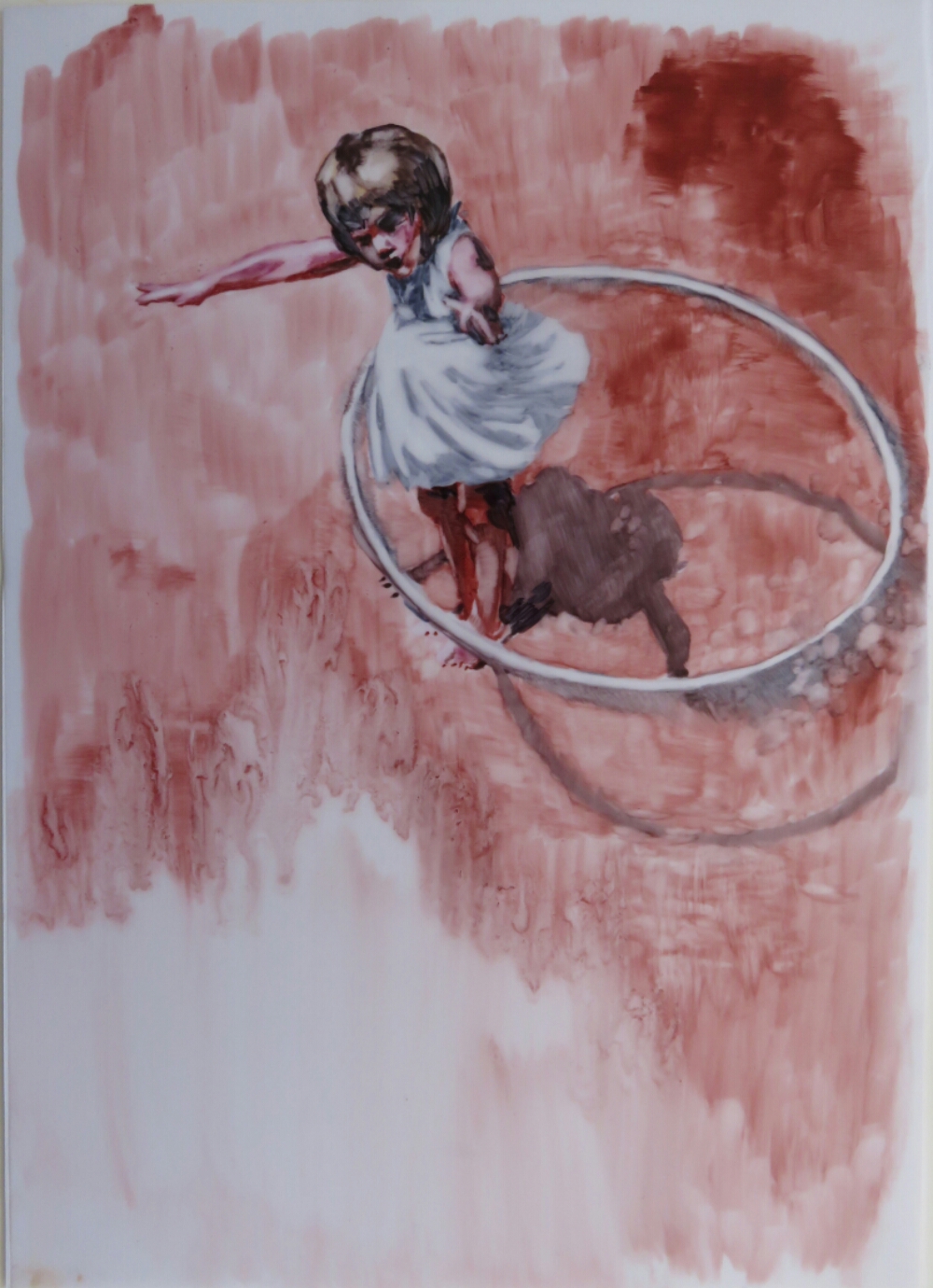
simone weil – the ring of gyges

REMEMBER MARIKANA

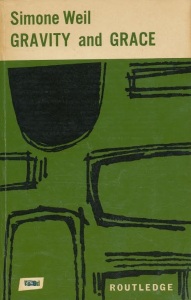
simone weil gravity and grace… We set things aside without knowing we are doing so; that is precisely where the danger lies. Or, which is still worse, we set them aside by an act of the will, but by an act of the will that is furtive in relation to ourselves. Afterwards we do not any longer know that we have set anything aside. We do not want to know it, and, by dint of not wanting to know it, we reach the point of not being able to know it.

This faculty of setting things aside opens the door to every sort of crime. Outside those departments where education and training have forged solid links, it provides a key to absolute licence. That is what makes it possible for men to behave in such an incoherent fashion, particularly wherever the social, collective emotions play a part (war, national or class hatreds, patriotism for a party or a church). Whatever is surrounded with the prestige of the social element is set in a different place from other things and is exempt from certain connexions.

We also make use of this key when we give way to the allurements of pleasure.
I use it when, day after day, I put off the fulfillment of some obligation. I separate the obligation and the passage of time.

There is nothing more desirable than to get rid of this key. It should be thrown to the bottom of a well whence it can never again be recovered.

The ring of Gyges who has become invisible—this is precisely the act of setting aside: setting oneself aside from the crime one commits; not establishing the connexion between the two.

The act of throwing away the key, of throwing away the ring of Gyges—this is the effort proper to the will. It is the act by which, in pain and blindness, we make our way out of the cave. Gyges: ‘I have become king, and the other king has been assassinated.’ No connexion whatever between these two things. There we have the ring!
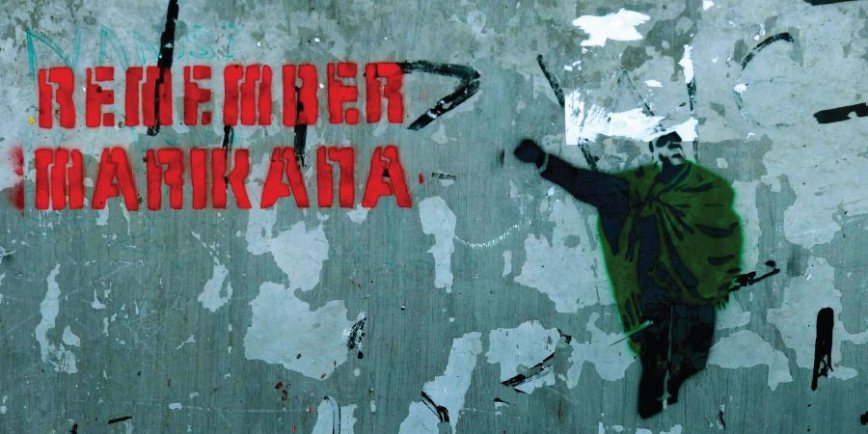
remember-marikana

The owner of a factory: ‘I enjoy this and that expensive luxury and my workmen are miserably poor.’ He may be very sincerely sorry for his workmen and yet not form the connexion.

For no connexion is formed if thought does not bring it about. Two and two remain indefinitely as two and two unless thought adds them together to make them into four.
We hate the people who try to make us form the connexions we do not want to form.

Justice consists of establishing between analogous things connexions identical with those between similar terms, even when some of these things concern us personally and are an object of attachment for us.

This virtue is situated at the point of contact of the natural and the supernatural. It belongs to the realm of the will and of clear understanding, hence it is part of the cave (for our clarity is a twilight), but we cannot hold on to it unless we pass into the light.

REMEMBER MARIKANA.

__
Excerpted from Simone Weil‘s Gravity and Grace. First French edition 1947. Translated by Emma Crawford. English language edition 1963. Routledge and Kegan Paul, London.
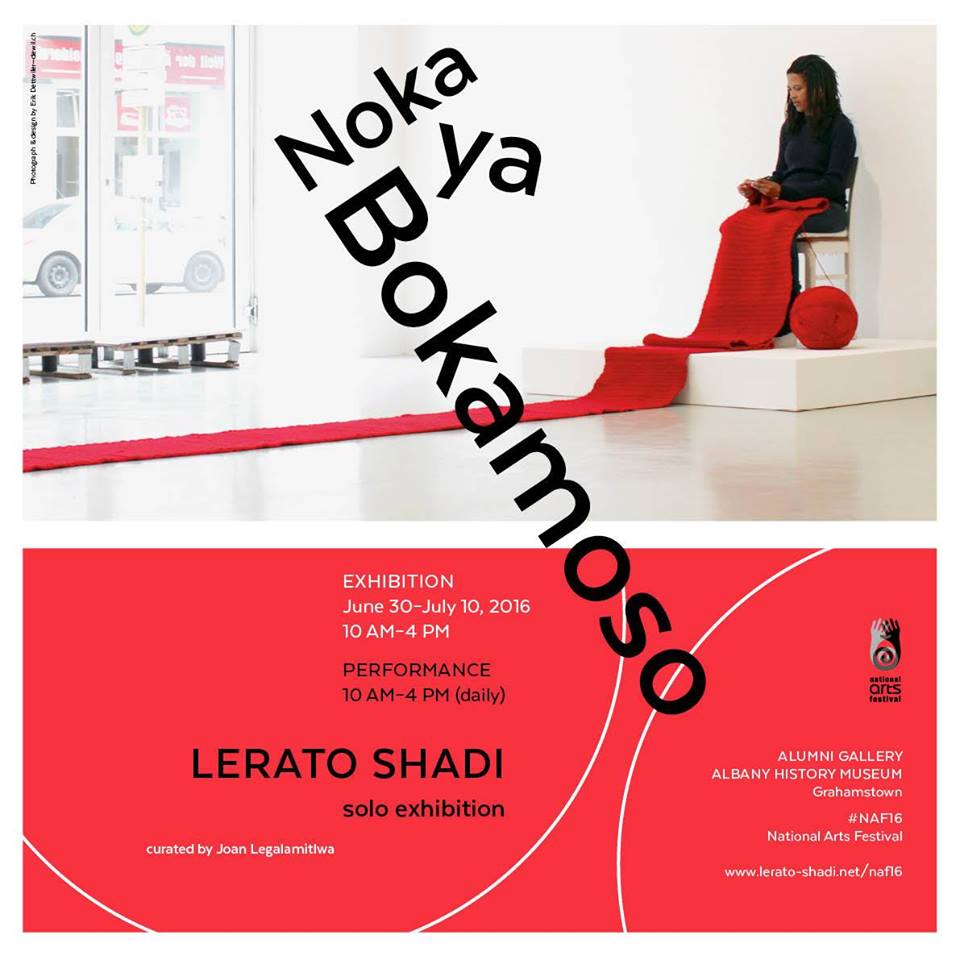
opening tomorrow: lerato shadi – noka ya bokamoso

lerato shadi
NOKA YA BOKAMOSO: A SOLO EXHIBITION BY LERATO SHADI

2016 National Arts Festival – Grahamstown
Alumni Gallery, Albany History Museum
30 June – 10 July

Lerato Shadi invites you to her latest solo exhibition and debut National Arts Festival appearance, Noka Ya Bokamoso. This exhibition by the Mahikeng born, Berlin based video and performance artist is one of the six visual art showcases chosen for the main programme.

The exhibition features four of Shadi’s latest works; two performative installations Makhubu and Mosako Wa Nako as well as two video works Sugar & Salt and Untitled.

Curator, Joan Legalamitlwa says,

“The works on the show were purposefully selected as they weave together history as told by and through the Black female body, in its truest and sincerest form, as it should be. Noka Ya Bokamoso is about the Black subject being in control of its own narrative and also about encouraging the visitors to do some introspection when it comes to matters of identity and representation.”

Makhubu is a work performed in the days preceding the festival, executed in absence of an audience. This performance involves Shadi arduously writing in concentric circles with a red pencil, then erasing the writing, leaving traces of the text on the wall and red remnants of the rubber eraser on the floor. This work looks at the historical erasure of the Black subject within the context of Grahamstown’s problematic history as well as historic erasure in the national narrative and how that has impacted on the kinds of stories that we currently tell. The absence of an audience becomes a corporeal metaphor, emphasising the ways in which South Africans, continue to construct a sense of nationhood unaware of significant violent acts that have shaped them.

For Mosako Wa Nako, Shadi will be seated one end of the gallery space for an uninterrupted six hours a day, over the eleven days of the Festival, crocheting what looks like be a red woollen carpet. Sugar & Salt, a video work featuring Shadi and her mother consuming a mineral in the form of salt and a carbohydrate in the form of sugar, makes references to the complexities and intricacies of mother-daughter relationships.

Untitled, Shadi’s latest video work, having its world premiere at the National Arts Festival, will be shot on location in her home village of Lotlhakane, in June 2016. The work consists of a two channel video work conceptualised in three parts: the first deals with the utmost extremes of individual resistance; the second deals with how Shadi experiences the impact of colonial language; the final part is an allegory of resistance.

Shadi’s work explores problematic assumptions projected onto the Black female body and how performance, video and installation create a space for artists to engage with those preconceived notions, making the body both visible and invisible. Using time, repetitive actions as well as stillness, she questions, ‘How does one create oneself?’ rather than allowing others or history to shape one’s person.

The key aim of Noka Ya Bokamoso is to re-center Shadi’s works to its primary audience – the South African audience. Shadi has practiced and exhibited in New York, Bern, Dakar, Moscow and Scotland and now seeks to utilise her work to foster and encourage dialogue around questions of historical knowledge production and its inclusion and exclusion of certain subjects. Her ultimate goal is that she, along with her audiences, will be encouraged not only to consume, but consciously engage in the processes of unearthing subsumed histories and producing critical knowledge.

Lerato Shadi lives and works in Berlin. She completed a BFA in Fine Art from the University of Johannesburg. She was included in The Generational: ‘Younger Than Jesus’ artists directory published by the New Museum, New York. In 2010 she was awarded a Pro Helvetia residency in Bern. In the same year she had her solo exhibition Mosako Wa Seipone at Goethe on Main in Johannesburg. From 2010 to 2012 she was a member of the Bag Factory artist studios in Johannesburg. In 2012 her work was featured at the Dak’art Biennale in Dakar, Senegal and in the III Moscow International Biennale. She is a fellow of Sommerakademie 2013 (Zentrum Paul Klee) and completed in the same year a residency program by invitation of INIVA at Hospitalfield (supported by ROSL). In 2014 she was awarded with the mart stam studio grant. She is currently completing her MFA at the Kunsthochschule Berlin Weissensee.

Noka Ya Bokamoso is made possible through the generous support of the National Arts Festival.

adrienne rich – diving into the wreck

adrienne richFirst having read the book of myths,
and loaded the camera,
and checked the edge of the knife-blade,
I put on
the body-armor of black rubber
the absurd flippers
the grave and awkward mask.
I am having to do this
not like Cousteau with his
assiduous team
aboard the sun-flooded schooner
but here alone.

There is a ladder.
The ladder is always there
hanging innocently
close to the side of the schooner.
We know what it is for,
we who have used it.
Otherwise
it is a piece of maritime floss
some sundry equipment.

I go down.
Rung after rung and still
the oxygen immerses me
the blue light
the clear atoms
of our human air.
I go down.
My flippers cripple me,
I crawl like an insect down the ladder
and there is no one
to tell me when the ocean
will begin.

First the air is blue and then
it is bluer and then green and then
black I am blacking out and yet
my mask is powerful
it pumps my blood with power
the sea is another story
the sea is not a question of power
I have to learn alone
to turn my body without force
in the deep element.

And now: it is easy to forget
what I came for
among so many who have always
lived here
swaying their crenellated fans
between the reefs
and besides
you breathe differently down here.

I came to explore the wreck.
The words are purposes.
The words are maps.
I came to see the damage that was done
and the treasures that prevail.
I stroke the beam of my lamp
slowly along the flank
of something more permanent
than fish or weed

the thing I came for:
the wreck and not the story of the wreck
the thing itself and not the myth
the drowned face always staring
toward the sun
the evidence of damage
worn by salt and sway into this threadbare beauty
the ribs of the disaster
curving their assertion
among the tentative haunters.

This is the place.
And I am here, the mermaid whose dark hair
streams black, the merman in his armored body.
We circle silently
about the wreck
we dive into the hold.
I am she: I am he

whose drowned face sleeps with open eyes
whose breasts still bear the stress
whose silver, copper, vermeil cargo lies
obscurely inside barrels
half-wedged and left to rot
we are the half-destroyed instruments
that once held to a course
the water-eaten log
the fouled compass

We are, I am, you are
by cowardice or courage
the one who find our way
back to this scene
carrying a knife, a camera
a book of myths
in which
our names do not appear.

__

From Diving into the Wreck: Poems 1971-1972. W. W. Norton & Company, 2013

alexis pauline gumbs – pulse (for the 50 and beyond)

A poem for those who died, shot in Pulse nightclub in Orlando this weekend past.

i was going to see you
i was going to dance
in the same place with you someday
i was going to pretend not to notice
how you and your friends smiled
when you saw me and my partner
trying to cumbia to bachata
but i was going to feel more free anyway
because you were smiling
and we were together
and you had your stomach out
and you felt beautiful in your sweat

i was going to smile when i walked by
i was going to hug you the first time
a friend of a friend introduced us
i was going to compliment your shoes
instead of writing you a love poem
i was going to smile every time i saw you
and struggle to remember your name

we were going to sing together
we were going to belt out Selena
i was going to mispronounce everything
except for amor
and ay ay ay
i was going to covet your confidence and your bracelet
i was going to be grateful for the sight of you
i was going scream YES!!! at nothing in particular
at everything especially
meaning you
meaning you beyond who i knew you to be

i was going to see you in hallways
and be too shy to say hello
you were going to come to the workshop
you were going to sign up for the workshop and not come
you were going to translate the webinar
even though my politics seemed out there

we were going to sign up for creating change the same day
and be reluctant about it for completely different reasons
we were going to watch the keynotes
and laugh at completely different times

i was going to hold your hand in a big activity
about the intimacy of strangers
about the strangeness of needing prayer
we were going to get the same automated voice message
when we complained that it was not what it should have been

we were going to be standing in the same line
for various overpriced drinks
during a shift change
i was going to breathe loudly so you would notice me
you were going to compliment my hair

it isn’t fair
because we were going to work
to beyonce and rihanna
and the rihanna’s and beyonce’s to come
and the beyonce’s and rihanna’s after that

we were going to not drink enough water
and stay out later than our immune systems could handle
we were going to sit in traffic in each others blindspots
listening to top 40 songs that trigger queer memories
just outside the scope of marketing predictions

we were going to get old and i was going to wonder
about the hint of a tattoo i could see under your sleeve
i was going to blink and just miss
the fought-for laughter lines around your liner-loved eyes

i was going to go out for my birthday
but i didn’t
and you did

we were going to be elders
just because we were still around
and i was going to listen to you on a panel
we didn’t feel qualified for
and hear you talk about your guilt
for still being alive
when so many of your friends were taken
by suicide
by AIDS
by racist police
and jealous ex-lovers
and poverty
and no access to healthcare
and how you had a stable job
you suffered at until the weekend
how you avoided the drama
and only went to the club at pride
and so here you were with no one to dance with anymore

i was going to see you and forget you
and only remember you in my hips
and how my smile came easier than clenching my teeth eventually
and how i finally learned whatever it is i still haven’t learned yet
i was going to hear you laugh and not know why
and not care

our ancestors fought for a future
and we were both going to be there
until we weren’t

and i don’t know if it would hurt more
to lose you later after knowing you
i don’t know if it would hurt more
to know you died on your own day
by your own hands
or any of the other systems
that stalk you and me and ours forever

i only know the pain that i am having
and that you are not here to share it
you are not here to bear it
you were going to pass me a candle at the next vigil

but now i am pulse

and now you
are flame.

ica 3rd space symposium at uct

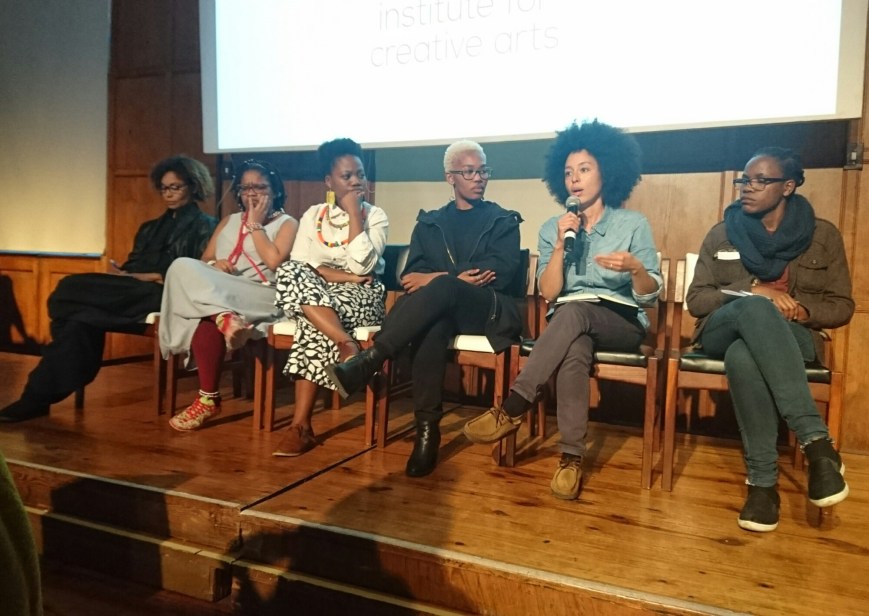
image

L-R: jackï job, Dee Moholo, Koleka Putuma, Khanyi Mbongwa (Vasiki), Ilze Wolff, Lois Anguria

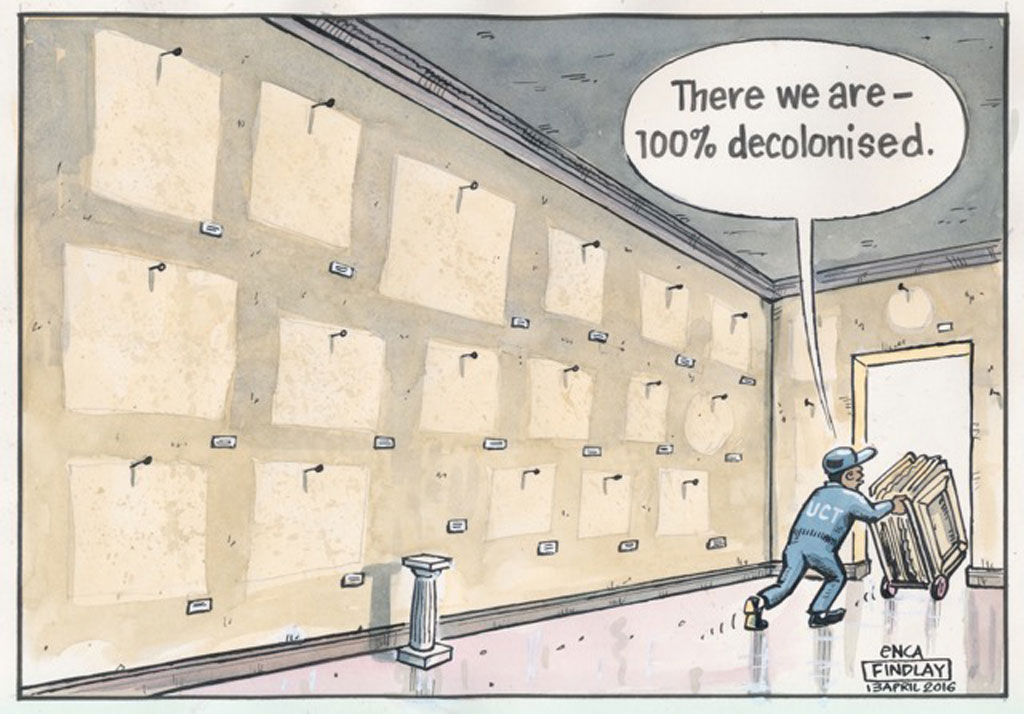
The most decolonised academic space I have yet had the joy of experiencing. The conference continues today. If you’re in Cape Town, come. It’s free!
HERE is the programme. 🌸

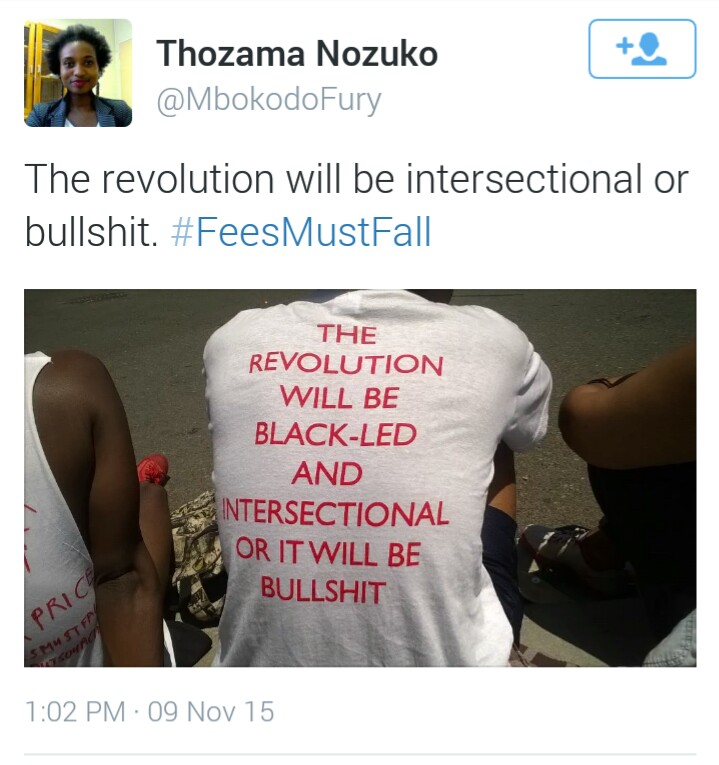
intersectional or bullshit

fb_img_1459830146966.jpgPress release from Wits Fees Must Fall:

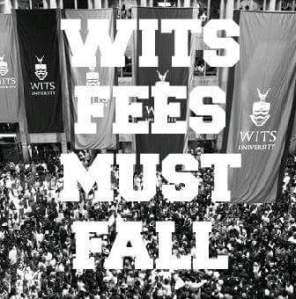
FOR IMMEDIATE RELEASE: FEMINIST AND QUEER DISRUPTION OF WITS SHUTDOWN, 04 APRIL:

Today, 04 April 2016, a group of students attempted to shut down Wits University in the name of Wits Fees Must Fall. These students were comprised of some members of the Wits student body and other popular faces from the #Fallist movements throughout the country. Leaders of this movement have been quoted in media confirming the shutdown as an act in solidarity with suspended, intimidated and deregistered from Wits as of today, 04 April 2016 as well as the continued struggle against outsourcing of workers on university campuses.

Through reliable sources and substantive evidence, we know that the plan to shut down the Wits campus was discussed at a private symposium this past weekend, convened under the banner of Fess Must Fall, the invite to which was not extended to the broader Fees Must Fall movement on different campuses as well as the explicit exclusion of feminist and queer persons. The feminist and queer bodies that have continued to challenge the problematic and archaic investment in the institutions of patriarchal masculinities by student leaders who have continued to erase and silence their narratives and participation in the struggle for free decolonised education and outsourcing.

As a collective, the democratic process of convening and mandating members to attend Fees Must Fall related events has always been one that is consultative and open. The collective mandates representatives at each turn as the movement maintains a flat democratic structure. Therefore, the symposium of the past weekend, facilitated through external funders that seek to infiltrate the movement, and the employ of what we suspect to be non Wits students and members of the public, is one we do not recognise and refuse to be held hostage by its political dictates and ambitions.

We have maintained our integrity as an intersectional; student led non partisan movement that is fighting for free decolonised education and the insourcing of workers.

As a movement, we fully support the disruption of systems of power that have continued to exclude black students from accessing the higher education space as well as the outsourcing and dehumanisation of black workers on campuses. However, we will never tolerate a situation in which these disruptions are allowed to happen at the expense of queer and feminist bodies wherein their bodies are only utilised for the purposes of protecting heterosexual black men on the firing line.

Since the inception of the #Fallist movements, the student’s movements have been plagued by incidences and complaints of latent and rampant misogyny, sexism, patriarchy, homophobia and transmisogyny and this must come to an end. The disruption of the shut down this morning was a step towards disrupting this problematic trend where feminist and queer bodies are only good to be used for protecting heterosexual black men.

The revolution for a decolonised South Africa where free decolonised quality education is a reality for every Black child is one that feminist and queer bodies have maintained will be intersectional or it will not be a revolution at all. However, this afternoon, feminist and queer bodies were assaulted, strangled, kicked and beaten by these black men in the service of the black revolutionary project. Black feminist and queer bodies continue to put their bodies on the line and continue to be disregarded and erased by heterosexual black men.

This practise by heterosexual black men to sacrifice feminist and queer bodies in this revolution will not be tolerated any longer. The exclusion, abuse, assault and endangering of Black Feminist, Queer, Trans and Disabled bodies by heterosexual black men will no longer be tolerated.

All identities of Blackness will be included in this revolution or it will be bullshit!

To all Feminist, Queer, Trans and marginalised bodies, we are convening at the Revolutionary benches (Green benches in front of Umthombo Building) from 10:30 on 05 April 2016.

#NotMyFMF #FuckyourErasure #AllofUsorNoneofUs

seminar at huma (uct) tomorrow

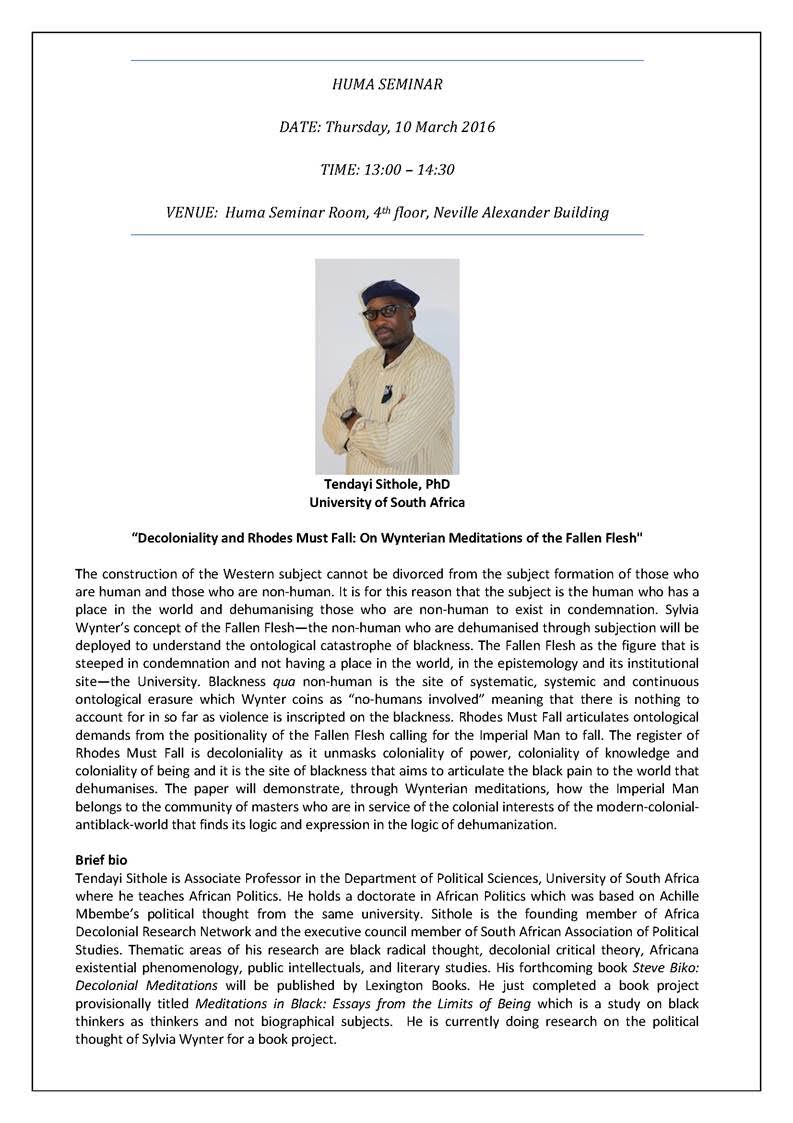
Tendayi Sithole: “Decoloniality and Rhodes Must Fall: On Wynterian Meditations of the Fallen Flesh” – happening at the University of Cape Town’s Institute for Humanities in Africa (Huma) tomorrow at lunch time.huma seminar

melati suryodarmo – “exergie – butter dance”

Lilith Performance Studio, June 5, 2010

Melati Suryodarmo (b. in 1969 in Surakarta, Indonesia, lives and works in Braunschweig, Germany) performs EXERGIE – Butter dance, an older piece but shown for the first time at Lilith.
20 blocks of butter in a square on the black dance carpet. Suryodarmo enters the space, dressed in a black tight dress and red high heels. She steps on the pieces of butter. She starts to dance to the sound of Indonesian shamanistic drums. She dances and falls, hitting the floor hard, rising, and continuously being on the verge of standing, slipping and falling in the butter. After twenty minutes Suryodarmo rises one last time, covered in butter, and leaves the space.
http://www.melatisuryodarmo.com/

Copyright of the performance: Melati Suryodarmo
Documentation done by Lilith Performance Studio.
Copyright of the documentation belongs to Melati Suryodarmo and Lilith Performance Studio, Malmo, Sweden.

jeannette ehlers – whip it good

This is an incredibly powerful performance.

Performances took place 24 – 30 April 2015, presented by Autograph ABP at Rivington Place, London. Presented in two parts, seven evening performances in the gallery followed by a seven-week exhibition, ‘Whip it Good’ retraces the footsteps of colonialism and maps the contemporary reverberations of the triangular slave trade via a series of performances that will result in a body of new ‘action’ paintings.

During each performance, the artist radically transforms the whip – a potent sign and signifier of violence against the enslaved body – into a contemporary painting tool, evoking within both the spectators and the participants the physical and visceral brutality of the transatlantic slave trade. Deep black charcoal is rubbed into the whip, directed at a large-scale white canvas, and – following the artist’s initial ritual – offered to members of the audience to complete the painting.

However, the themes that emerge from Whip It Good trace beyond those of slavery: Ehlers’ actions powerfully disrupt historical relationships between agency and control in the contemporary. The ensuing ‘whipped’ canvases become transformative bearers of the historical legacy of imperial violence, and through a controversial artistic act re-awaken critical debates surrounding gender, race and power within artistic production. What the process generates for the artist, is an intensely focused space in which to make new work as part of a cathartic collaborative process.

Read Chandra Frank’s review of the performance, which also took place in Gallery Momo in South Africa, HERE.


scott woods on the structural nature of whiteness and racism

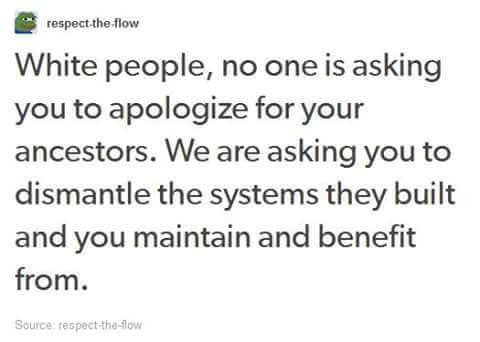
The problem is that white people see racism as conscious hate, when racism is bigger than that. Racism is a complex system of social and political levers and pulleys set up generations ago to continue working on the behalf of whites at other people’s expense, whether whites know/like it or not. Racism is an insidious cultural disease. It is so insidious that it doesn’t care if you are a white person who likes Black people; it’s still going to find a way to infect how you deal with people who don’t look like you.

Yes, racism looks like hate, but hate is just one manifestation. Privilege is another. Access is another. Ignorance is another. Apathy is another, and so on. So while I agree with people who say no one is born racist, it remains a powerful system that we’re immediately born into. It’s like being born into air: you take it in as soon as you breathe.

It’s not a cold that you can get over. There is no anti-racist certification class. It’s a set of socioeconomic traps and cultural values that are fired up every time we interact with the world. It is a thing you have to keep scooping out of the boat of your life to keep from drowning in it. I know it’s hard work, but it’s the price you pay for owning everything.

~ Scott Woods

More HERE.