shilpa ray with nick cave and warren ellis – pirate jenny

My favourite version of this Weill/Brecht classic, ever.

“Pirate Jenny” (German: “Seeräuberjenny”) is a well-known song from The Threepenny Opera by Kurt Weill, with lyrics by Bertolt Brecht. The English lyrics are by Marc Blitzstein. This cover by Shilpa Ray, Nick Cave and Warren Ellis was published in February 2013 on Sons of Rogues Gallery: Pirate Ballads, Sea Songs and Chanteys, a Hal Willner-produced compilation album of songs performed by a roster of artists which also includes Tom Waits, Shane MacGowan, Iggy Pop, Patti Smith, Macy Grey, Johnny Depp, Frank Zappa and Richard Thompson.

woman, object, corpse: killing women through media

Linda Stupart wrote this about Reeva Steenkamp, and also the YOU DECIDE billboard and corpses and objects and women.

Linda Stupart's avatarAfrica is a Country (Old Site)

Since Valentine’s Day everyone has been talking about the murder of Reeva Steenkamp, although rarely in those terms. We know that her boyfriend, Oscar Pistorius, shot her four times and killed her while she was behind a locked door in their bathroom in a gated estate. We know that he has a history of domestic violence, a penchant for shooting things. We know absolutely everything about his extensive sporting achievements. The main thing, however, that we know about Steenkamp is that she was a model, and that she was really hot. 

View original post 1,866 more words

missing, forever

missing cat head

I made this poster in reference to this one, but the events it describes are entirely true. My cat’s head was never found. That night, I think I lost a part of me too, though I didn’t realise it at the time: the part that trusted and expected people who said they loved me not to hurt me intentionally.

What made me realise how this all fitted together was a chain status update game that went around on Facebook a few weeks ago. My answers to the questions went like this:

Age I was given: 17 (I balked because it was a very heavy year for me, but here goes…)
Where I lived: Waterfall, a village in KZN a little north of the Comrades Marathon route, through the sugarcane fields (which are now Tuscan townships).
What I did: Wrote matric with the help of regular immunoglobulin injections and reflexology to stave off the Chronic Fatigue Syndrome/M.E.that I’d been severely ill with since 14 when I’d contracted Glandular Fever. Spent a lot of my study time taping songs off the radio. Went to Turkey on short term Rotary Exchange after finishing school.
Who had my heart: My cat, Jorgy, who had been my constant companion throughout my illness. He was killed while I was in Turkey. I’d broken up with my first boyfriend during matric trials – I couldn’t handle his obsessive, controlling demands for attention. He turned stalker on me, hanging around outside my house, phoning all the time, sending letters threatening suicide, warning me that I would be sorry if “I left him” and went to Turkey. A day or two before I got back, my family found the headless body of our beloved Jorgensen Fassbinder Kittyman Von Streichen Hashimoto Lighoré at the bottom of the garden, tossed over the fence. I wish I was making this up.

Age I am now: 34
Where I live: Oranjezicht, Cape Town
What I do: I excel at giving too much of a shit.
Who has my heart: My heart is a hot potato.
__
The shadow of this manifested down the years in relationships with a string of men who were deliberately unkind and dismissive to me too often; with me always holding on too long because I mistakenly identified their cruelty or disloyalty as evidence of their love for me in spite of what they judged to be my shortcomings. At the darkest junctures over those years, I actually believed that I might deserve the humiliation, the punishment; that I should be grateful anyone humoured me. If they weren’t critical or manipulative enough, if I didn’t have cause to be outraged by their mistreatment, to defend myself against their accusations, to demand consideration, recognition… then it didn’t feel like they could really care (how twisted is that?).

The men I fell most deeply for were never truly available or fully present, would leave me because they cared more about someone else, or were running for their own damaged reasons. I guess I only felt safe from being smothered when they had one foot outside the door, though I yearned with all my heart to be held unconditionally, the way I held them.

This delusion is broken and I am free of its bonds.

excerpts from suketu metha’s ‘maximum city’

Maximum City: Bombay Lost and Found, by Suketu Metha, is the most mind-blowing book I have read for quite some time. Metha left Mumbai then returned from New York, and began documenting his hood.

Here are some little snippets:

‘Many wars begin with an act of rape, real or imagined. It is always the men who are disturbed enough by the rape to go to war.’

‘Bombay survives on the scam. We are all complicit. A man who has made his money through a scam is more respected than a man who has made his money through hard work, because the ethic of Bombay is quick upward mobility and a scam is a short-cut. A scam shows good business sense and a quick mind. Anyone can work and make money. What’s to admire about that? But a well-executed scam? Now, there’s a thing of beauty!’

‘When a man touches his killer’s feet and begs for his life, saying, “Please don’t kill me, I have children,” it is the worst argument he can offer. Thinking the killer will let you off because you have kids assumes that you can locate a hidden source of sympathy in your killer based on something shared, something in common. But very few killers are fathers. Very few of them have had good experiences with their own fathers. So that bond between father and son, which for you and me is the most convincing argument against your death – don’t kill me because it will break that sacred bond – means nothing to them. It is a bond, in fact, that the hit-men have consciously been trying to break all their lives. As far as they’re concerned, ridding your children of their father is the greatest favour they can do them.’

‘ [Bal Thackeray’s] vandals are young men, who, after working 12hour days as peons in some office where they endure humiliation and even a slap or two from men who are richer … than they are, take the train home. Inside the train, they bathe in perspiration; the air is fetid with sweat and farts. When they get home to the slum, their mother and fathers and grandmothers will ask them what they have bought home. Such a man lives with a constant sense of his own powerlessness, except when he is part of a mob, part of a contingent of 70 patriots fighting for the country’s honour, walking unmolested into movie theatres, posh apartments, and the offices of the cricket lords of the country, smashing trophies, beating up important people who drive fine cars. All the accumulated insults, rebukes and disappointments of life in a decaying megalopolis come out in a cathartic release of anger. It’s okay to be angry in a crowd; the crowd feeds on your anger, digests it, nourishes it, nourishes your rage as your rage nourishes it. All of a sudden you feel powerful. You can take on anybody. It is not their city any more, it is your city.
You own this city by the right of your anger.’

billy bragg – valentine’s day is over (peel sessions)


Recorded live on 30 August 1988 for the John Peel Show.

“God didn’t make you an angel; the devil made you a man
That brutality and economy are related now I understand
When will you realise that as above so below there is no love?
For the girl with the hour glass figure
Time runs out very fast
We used to want the same things but that’s all in the past
And lately it seems that as it all gets tougher
Your ideal of justice just becomes rougher and rougher…”

be my valentine

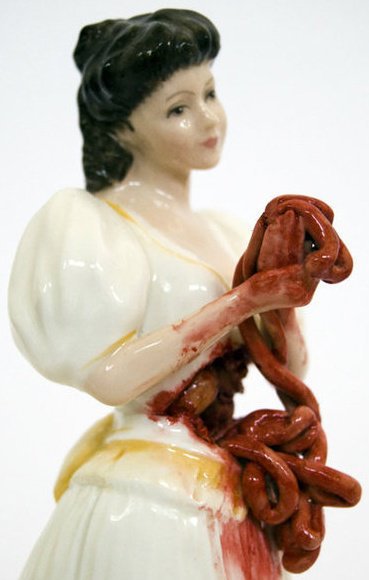
"Persephone" - Image copyright Joshua Hoffine, 2003.

“Persephone” – Image copyright Joshua Hoffine, 2013.

More of Joshua Hoffine’s horror photography can be found HERE.

The Garden of Proserpine by Algernon Charles Swinburne, written in 1866

Here, where the world is quiet,
Here, where all trouble seems
Dead winds’ and spent waves’ riot
In doubtful dreams of dreams;
I watch the green field growing
For reaping folk and sowing,
For harvest-time and mowing,
A sleepy world of streams.

I am tired of tears and laughter,
And men that laugh and weep
Of what may come hereafter
For men that sow to reap:
I am weary of days and hours,
Blown buds of barren flowers,
Desires and dreams and powers
And everything but sleep.

Here life has death for neighbour,
And far from eye or ear
Wan waves and wet winds labour,
Weak ships and spirits steer;
They drive adrift, and whither
They wot not who make thither;
But no such winds blow hither,
And no such things grow here.

No growth of moor or coppice,
No heather-flower or vine,
But bloomless buds of poppies,
Green grapes of Proserpine,
Pale beds of blowing rushes
Where no leaf blooms or blushes,
Save this whereout she crushes
For dead men deadly wine.

Pale, without name or number,
In fruitless fields of corn,
They bow themselves and slumber
All night till light is born;
And like a soul belated,
In hell and heaven unmated,
By cloud and mist abated
Comes out of darkness morn.

Though one were strong as seven,
He too with death shall dwell,
Nor wake with wings in heaven,
Nor weep for pains in hell;
Though one were fair as roses,
His beauty clouds and closes;
And well though love reposes,
In the end it is not well.

Pale, beyond porch and portal,
Crowned with calm leaves she stands
Who gathers all things mortal
With cold immortal hands;
Her languid lips are sweeter
Than love’s who fears to greet her
To men that mix and meet her
From many times and lands.

She waits for each and other,
She waits for all men born;
Forgets the earth her mother,
The life of fruits and corn;
And spring and seed and swallow
Take wing for her and follow
Where summer song rings hollow
And flowers are put to scorn.

There go the loves that wither,
The old loves with wearier wings;
And all dead years draw thither,
And all disastrous things;
Dead dreams of days forsaken,
Blind buds that snows have shaken,
Wild leaves that winds have taken,
Red strays of ruined springs.

We are not sure of sorrow,
And joy was never sure;
To-day will die to-morrow;
Time stoops to no man’s lure;
And love, grown faint and fretful,
With lips but half regretful
Sighs, and with eyes forgetful
Weeps that no loves endure.

From too much love of living,
From hope and fear set free,
We thank with brief thanksgiving
Whatever gods may be
That no life lives for ever;
That dead men rise up never;
That even the weariest river
Winds somewhere safe to sea.

Then star nor sun shall waken,
Nor any change of light:
Nor sound of waters shaken,
Nor any sound or sight:
Nor wintry leaves nor vernal,
Nor days nor things diurnal;
Only the sleep eternal
In an eternal night.

the rape of persephone (homeric hymn)

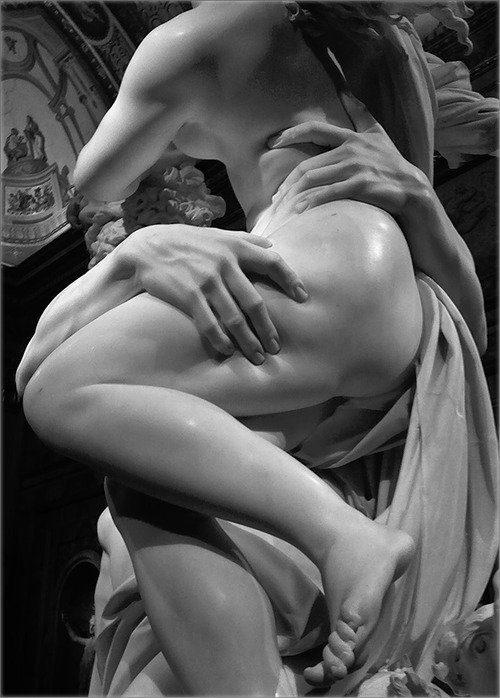
The Rape of Proserpina – Gian Lorenzo Bernini (1622)

I) HAIDES ABDUCTS PERSEPHONE
Homeric Hymn ii to Demeter (abridged) (trans. Evelyn White) (Greek epic circa 7th or 6th B.C.)

“[Demeter’s] trim-ankled daughter whom Aidoneus [Haides] rapt away, given to him by all-seeing Zeus the loud-thunderer. Apart from Demeter, lady of the golden sword and glorious fruits, she was playing with the deep-bosomed daughters of Okeanos and gathering flowers over a soft meadow, roses and crocuses and beautiful violets, irises also and hyacinths and the narcissus, which Gaia made to grow at the will of Zeus and to please Polydektor (the Host of Many), to be a snare for the bloom-like girl – a marvellous, radiant flower. It was a thing of awe whether for deathless gods or mortal men to see: from its root grew a hundred blooms and it smelled most sweetly, so that all wide heaven (Ouranos) above and the whole earth (Gaia) and the sea’s (Thalassa’s) salt swell laughed for joy.

And the girl was amazed and reached out with both hands to take the lovely toy: but the wide-pathed earth yawned there in the plain of Nysa, and the lord, Polydegmon (Host of Many), with his immortal horses sprang out upon her — the Son of Kronos, Polynomos (He who has many names). He caught her up reluctant on his golden car and bare her away lamenting.

Then she cried out shrilly with her voice, calling upon her father, [Zeus] the Son of Kronos, who is most high and excellent. But no one, either of the deathless gods or mortal men, heard her voice, nor yet the olive-trees bearing rich fruit: only tender-hearted Hekate, bright-coiffed, the daughter of Persaios, heard the girl from her cave, and the lord Helios (the Sun), Hyperion’s bright son, as she cried to her father, the Son of Kronos. But he was sitting aloof, apart from the gods, in his temple where many pray, and receiving sweet offerings from mortal men. So he [Haides], that Son of Kronos, Polynomos (of Many Names), Polysemantor (Ruler of Many) and Polydegmon (Host of Many), was bearing her away by leave of Zeus on his immortal chariot – his brother’s child and all unwilling.

And so long as she, the goddess, yet beheld earth and starry heaven and the strong-flowing sea where fishes shoal, and the rays of the sun, and still hoped to see her dear mother and the tribes of the eternal gods, so long hope claimed her great heart for all her trouble… and the heights of the mountains and the depths of the sea ran with her immortal voice: and her queenly mother heard her.

Continue reading

heavens to betsy – my red self/my secret (demo tape, 1992)

Heavens to Betsy was an American indie-punk band formed in Olympia, Washington in 1991. They were part of the DIY riot grrrl movement in the punk rock underground in the early 1990s, and were the first band of Sleater-Kinney vocalist/guitarist Corine Tucker. These two demos are intimate and powerful.

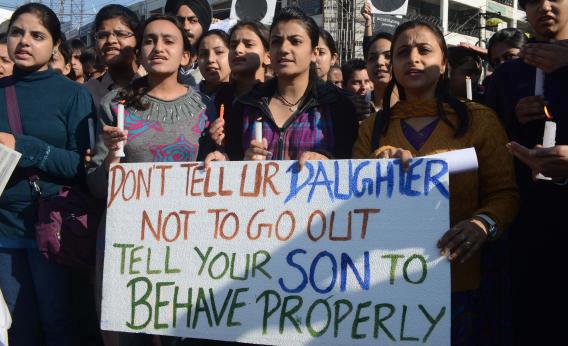
silent vigil this wednesday in cape town

Via Malika Ndlovu:

Stand Up! Be still. Join the Tower of Silence in reflection and protest against the silencing, a pillar of honouring and mourning. Wear white  (a symbol of spirit, light, cleansing, unity beyond gender, language, political or religious agenda) and join this 1 hour vigil against the violence epitomized by the death and brutalisation of Anene Booysen… and too many of our daughters and sisters like her. This Wednesday, 13th February 2013, on the steps of St George’s Cathedral, from 12 pm to 1 pm.

Bring a photograph on a placard of anyone you think we need to remember in this way too. We will not be sloganeering or shouting retaliations against our lost sons, brothers who have perpetuated this crime against their own and her humanity. Our collective presence and solidarity speaks volumes and calls for multiple responses to this complex situation, affecting an entire nation. We make this physical visual statement on the eve of onebillionrising.org global campaign and the president’s “State of the Nation” address. For us, these faces, these stories, these discarded bodies and all the reasons why this continues to happen in the world and all over South Africa – THIS is OUR ‘State of our Nation’ call to address!

mouchette

Final scene from Robert Bresson’s 1967 film.

“The small town is plagued with alcoholism, marital infidelity, unbridled masculinity, violence, and moral ambivalence. Mouchette’s father and brother, we have already seen, operate by selling liquor on the black market, with complicit police that turn an indifferent eye to a crate left behind. They, like other townsfolk, are paid in shots of alcohol, consumed without speech. Following Sunday mass, the village parishioners leave church and hastily head to the bar before the bells cease to toll. Mouchette’s dying mother has to hide gin from her abusive spouse. Even the town’s interdependent poacher/warden pair, Arsène and Mathieu, bring an end to their cat-and-mouse charade in the woods by sharing a drink from Arsène’s canteen full of gin. The motif of alcohol and its abuse stands as a distinctive mark of the moral decay of Mouchette’s society; however, the corruption of this town is not limited to alcoholism… Indeed, Mouchette’s society is one of extreme decadence and lawlessness, one that is ripe for a scapegoat upon whose back it can collectively discharge the burden of its vice and one from which the victim will gladly depart.”

Read more about the film HERE.

as long as we exist, we will be raped – sisonke msimang

(First published HERE.)

anene

I read an article on Thursday morning. It said: “The victim had been sliced open from her stomach to her genitals and dumped.” The radio is full of this story. Full of politicians and posers, trying to outdo one another. Like funeral criers. But it will end, the show. And there will be marches and petitions. There will be statements and rage. But it will happen again. Until we are inured to shock. It will happen again. Until our bones are worn into dust and our teeth crushed into the sand. It will happen and happen. Until we invent a way to stop being women. Until we find a way for our blood to no longer bleed between our legs. As long as we exist, we will be raped.

So, no, I will not march. I don’t believe my marching will stop this war. I will cry, as I have been already this morning. And maybe, I will begin to feel my way out of the lurching, heavy knowing after I have spoken with others. With the mothers and the sisters, the brothers and fathers – those like me, who have girls.

There is only this: a dead, hollow knowing that has always been knocking at my heart. From the minute she was born, it fell in step with the rhythm of my breath: to raise a girl in this world, to raise her strong and healthy and proud, to ensure that she survives and then to insist ferociously that she laugh and dance and think and dream, is to choose the most heartbreaking and joyous path. It is to tempt fate every single day, it is to fear that her breath will be strangled by a stranger. It is to live with the horrible possibility that this could be your child.

Anene was raped and mutilated because she was a girl. It was her vagina and her breasts that they wanted to destroy. It was her walk and her talk. It was her girl-ness. These parts of her were broken and sliced and pulled apart, not by monsters, but by friends. Each of her 10 fingers were broken.

Ten fingers and 10 toes. I kiss my baby girl goodnight. Ten fingers and 10 toes, I counted them when she was born just to be sure that she was real. I found love in the spaces between each. I cried at the weight of her. Tiny and strong.

Tonight, I will kiss her neck in the bath and she will wiggle away from me. ‘Stop it Mama’, and I will pinch her wet bum and she will sparkle. Tonight, she will be safe. But they will not stop killing girls.

And I will die defending her. Let them wear my bones into dust. Let them crush my teeth into the sand. Only this will stop the war. That we be prepared to die – our bodies barricades against the fingers that should not be there. The knives that slit. The guns that lodge. Let them lodge in me. In us.

Anene’s mother said that if she hadn’t seen her shoes, she wouldn’t have known that it was her own child. Her intestines? Her intestines.

God help us. And if God will not, Let the women be the barricades. The men, surely will follow.

Sisonke Msimang writes and comments on gender, race and politics. She works with Sonke Gender Justice Network, and is a Yale World Fellow.

t,o,u,c,h,i,n,g

TOUCHING is a 1969 short film by Paul Sharits.

“There are moments in cinematic art when the narrative of the film is subjectively implied and subsequently written by the viewer. While this is common to most structural and lyrical films in the experimental genre, none hits louder than T,O,U,C,H,I,N,G, an angry and demonic piece that simultaneously lulls you into awareness and hypnotizes you into an emotive overload.”

thoughts on meaningful work, 14 november 2012, 5:38 a.m.

What follows is something I wanted to blog from Turkey in November but was unable to due to lack of an internet connection at the time. I woke up very early one morning, typed it into my phone’s notes app, half asleep, and promptly forgot about it. The incredibly tedious work I am currently doing (editing an MSc thesis on anthropometric measurements for office chairs) reminded me of its existence. So, two months later, here it is.
Turkey 2012 492a

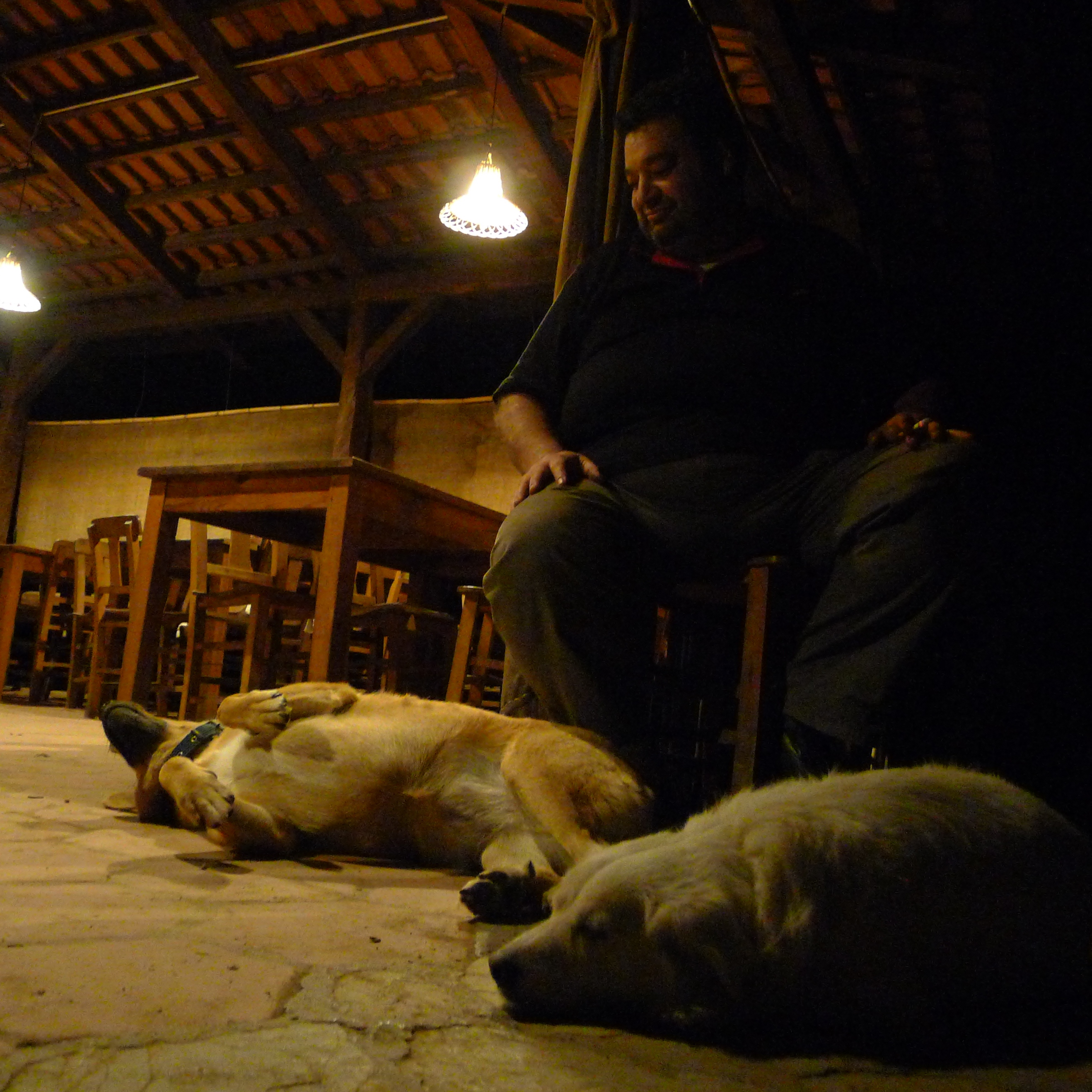
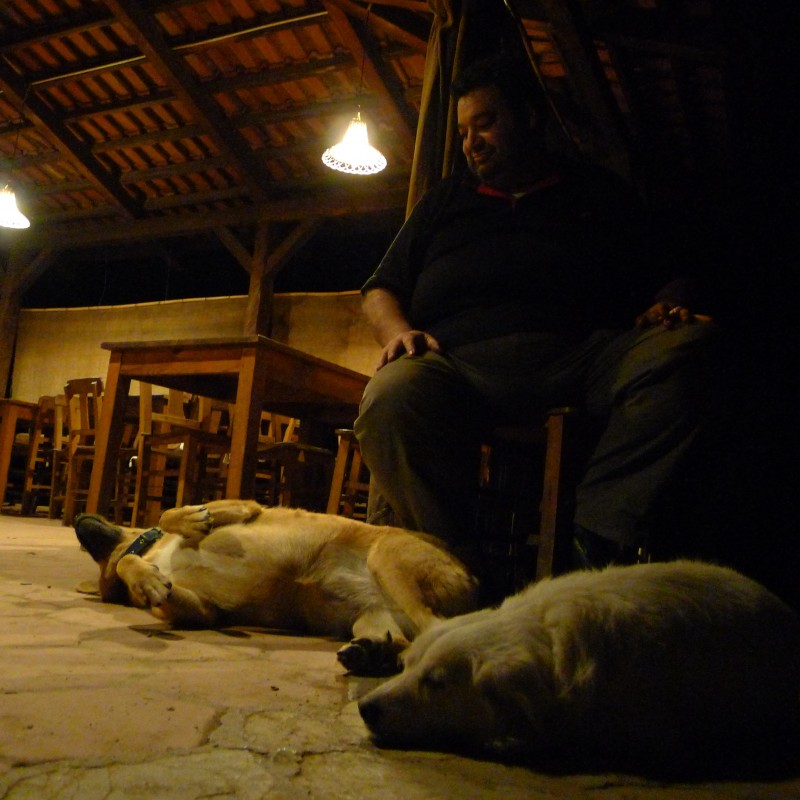
Arif Cerit with the farm dogs, Shanslar (Lucky) and Beyaz (White), at Pastoral Vadi. Photo: Rosemary Lombard.

Last night I had a profound conversation, in my bad Turkish and his bad English, with Arif Cerit, a guy who lives at Pastoral Vadi, the organic/permaculture farm near Fethiye in South-Western Turkey which I am visiting – working in exchange for food and a bed. It’s a very comfortable bed, in a neat, well-appointed cottage designed and built of cob (straw and mud) five years ago by Ahmet Kizen, an architect passionate about sustainable living and ecotourism who bought this farm 14 years ago and opened it to visitors about 7 years back. No maintenance has been necessary since the cottage was built, I’m told. The thick walls keep it cool during the day and surprisingly warm at night.

So, back to what I wanted to blog about, which has resonated for me with my friend P‘s latest gier on Facebook, which involves a sort of Dada/absurdist attempt to animalise interactions. Having been away and in limited contact with everyone, I haven’t had a chance to ask him more about it, but, basically, instead of clicking “like”, he types animal noises. “Baaa, baaa”, mostly. For me it draws attention to the essentially animal nature of human interaction, which we have become unconscious of and detached from, as we live large swathes of our lives online, “denatured”, unquestioning.  “Like” has become a capricious yet ubiquitous form of social capital. Facebook’s shady manipulation of this currency of late has triggered consternation and outrage. They’ve put in place algorithms that restrict the “organic” (terms such as “organic” and “viral” in the world of virtual memes are interesting in their ironic detachment!) reach of posts on the network, requiring one to pay (“real” money) to secure an audience greater than an arbitrary sliver of the profiles to whom one is connected… Just when I thought it was because I only had a sliver of die-hards who actually enjoyed what I post anymore, I realised that most of my Facebook friends no longer see my updates in their news feeds. What a relief (?). The virtual landscape increasingly resembles a targeted marketing environment more than it does a communal hangout, a place for exchanging ideas and thoughts, as it used to. Now it’s mostly about Profit. By monetising the prominence of posts, equal access is effectively being stifled. Concomitantly, freedom of association and meaningful interaction are withering.

That’s another aside, or, rather, more context. ANYWAY. So, what I gleaned from my conversation with big, friendly Arif was that he had been a taxi driver with a fleet of cars in the west coast city of Izmir for 21 years, before dropping everything and moving here to the farm. He sold his business, gave the money to his brothers and left it all behind.

He says that the city is a big jungle, very dark, very dense, very dangerous, full of artifice and chemical poisons. People are a species of animal, he says, like all animals… In cities you have to be a predator to do well. If you are not a predator, you have to live your life very small, like a rat, to survive. Your mind is very important, he says. The chasing after money and things that you need to do to live in the city takes up all your time and your thoughts. Money is a cancer. TV is the morphine you need to kill the pain at the end of the day: the pain of your mind being eaten away.

Out here on the farm, life is real, he says. There is space, there is ground, and air, and the smell of greenness. Animals who are not predators can live happily, widely, openly, productively.
Turkey 2012 467a

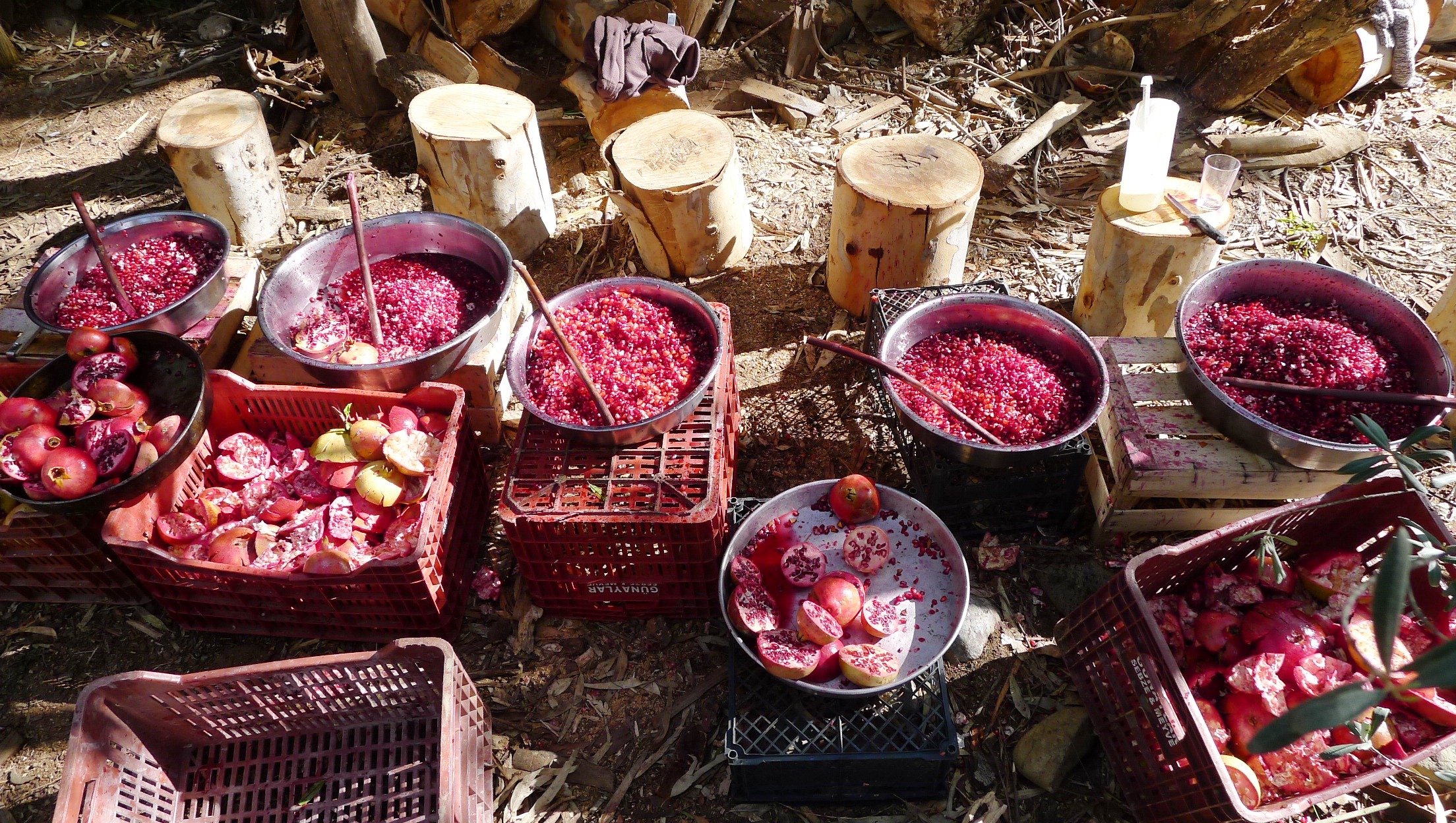
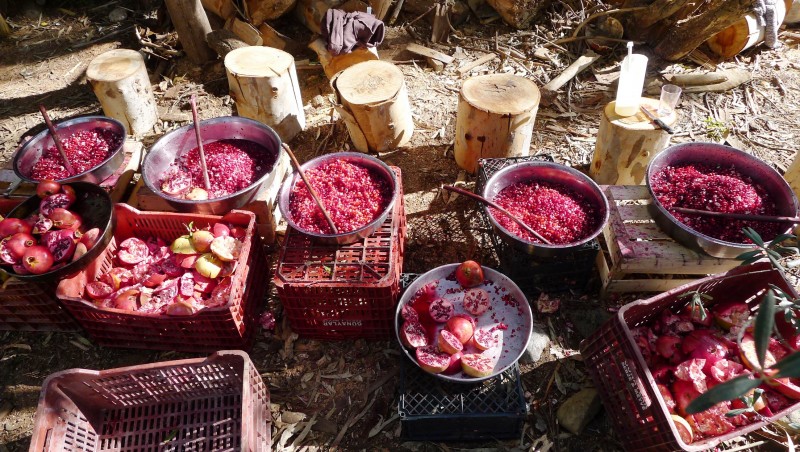
Processing pomegranates by hand to make nar ekshili sos (pomegranate reduction). Photo: Rosemary Lombard

Sticky, crimson pomegranate juice is running down my arms and dripping off my elbows. I’m stained with the joy of manual labour. It’s so satisfying, this repetitive bashing of crates and crates of halved fruit to knock out the arils, then the squeezing in a bag to extract the juice, which is then boiled over a fire for ten hours to reduce it to a dark, tart syrup, then strained through muslin into bottles.  It’s slow-going, messy, tiring work. I have blisters, purple palms. But, at the end of each day, I can see the results of my time spent. It’s nothing like the virtual world of work I mostly inhabit, where I shut down my computer and a sense of the hours and hours I have spent shunting pixels around evaporates.

For so long now, my life has felt paper-thin, no, thinner, as if I barely cast even a shadow of influence in the world, and I realise now that it is largely because of the intangible nature of the work I have been doing, which mostly involves cleaning, tidying and correcting other people’s writing, or recording their work, or facilitating their conversations… It’s all work towards actualising goals that I have deemed worthwhile; nonetheless, these are goals which are not my own. I have tried to frame them as my own, tried to see my part in the whole as indispensable, my purpose as contiguous with that of the projects’, my place as “a tiny cog in the great wheel of evolution” – that was how Billy Wilder put it, writing the words of Ninotchka played by Greta Garbo in Ernst Lubitsch’s wonderful 1939 satire of the same name.

Alas, my heart just hasn’t been convinced. I haven’t been able to shake this unbearable sense of lightness, of the unnecessary breaths I’m taking, of the lack of any other humans who truly require or desire my existence, irreplaceably, here on Earth. All this needs to change if I am to remain sane when I get back. Living with a heavenly purpose is too far beyond me. I’d be satisfied to have done with consumption, thanks. I started this blog in an attempt to make something indelible of the ephemeral. I need to do more. I’m starving.

“If I had an orchard, I’d work till I was sore.” ~ Fleet Foxes – “Helplessness Blues“.
Fethiye-20121113-01327

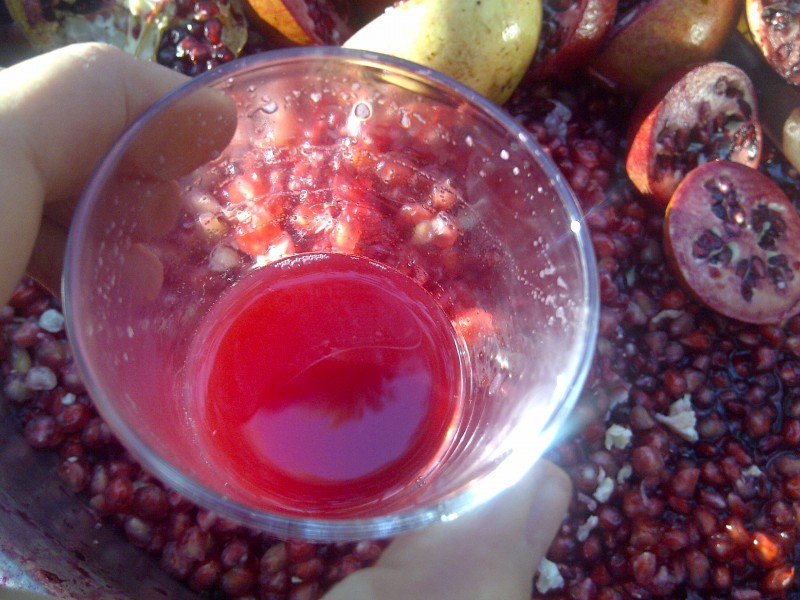
Sweet! A break to drink some freshly-squeezed pomegranate juice. Photo: Rosemary Lombard

Ş
apples

snow white poison appleLife will break you. Nobody can protect you from that, and living alone won’t either, for solitude will also break you with its yearning. You have to love. You have to feel. It is the reason you are here on earth. You are here to risk your heart. You are here to be swallowed up. And when it happens that you are broken, or betrayed, or left, or hurt, or death brushes near, let yourself sit by an apple tree and listen to the apples falling all around you in heaps, wasting their sweetness. Tell yourself you tasted as many as you could.

 Louise Erdrich (The Painted Drum)

danni diana on bogus muthi (and ad agencies)

A year or so ago, some colleagues of mine did a campaign for a film called Night Drive, which was a slashy, schlocky horror that centred on the body-parts-for-muthi trade. The campaign handed out a couple hundred pamphlets, in the style of those ridiculous pamphlets that offer penis enlargement, bad luck cure, womb cleaning etc that we see littered around town every day. The pamphlets offered money for body parts, and linked to a website that detailed the “doctor’s” cash-for-organs trade in more detail. The people who received the pamphlets went ape-shit, calls were made to the national media, everyone was pranked and much outrage ensued. The campaign was slammed by the Department of Health for trivialising a “Serious Problem”, and was pulled, effective immediately, complete with apology from the ad agency in question, and a promise to conduct an “internal disciplinary procedure”.

0141

Pamphlet collected in Durban by Rosemary Lombard, 2009

My question is, what exactly is being done about this serious problem? Why do people get up in arms about a cash-for-body-parts hoax, but think its OK (and hilarious) for there to be pamphlets offering safe abortions, womb cleaning, AIDS cures and a whole manner of sexual health treatment that is not only bogus, but seriously harmful to those who pursue it. What effort is being made by the Department of Health to shut down these “doctors”? Most disturbing is the discriminatory gender ideas at the root of these so called treatments. Muthi to “make lover have sex with you”, and treatment for women for, among other things “cleaner vaginas, more willingness to have sex.”

These charlatan muthi men make a mockery of traditional healing, and the pamphlets and posters not only mislead the poor, vulnerable and uneducated, but reinforce negative stereotypes about traditional healing and the communities that take advantage of them. Is any work being done to address this “Serious Problem”, or do people only care so long as the content of said media panders to savage stereotypes of murderous muthi men lurking in the shadows to chop your heart out?

Pamphlet collected in Durban by Rosemary Lombard, 2009

Pamphlet collected in Durban by Rosemary Lombard, 2009

the gulabi gang

APTOPIX India Pink Women

The Gulabi Gang (from Hindi “gulabi” = “pink” – “pink gang”) is a group of women vigilantes and activists originally from Banda in Bundelkhand district, Uttar Pradesh, India, but reported to be active across North India as of 2010. It is named after the pink saris worn by its members.

The gang was founded in 2006 by Sampat Pal Devi, a mother of five and former government health worker (also a former child bride), as a response to widespread domestic abuse and other violence against women. Gulabis visit abusive husbands and beat them up with laathis (bamboo sticks) unless they stop abusing their wives. In 2008, they stormed an electricity office in Banda district and forced officials to turn back the power they had cut in order to extract bribes. They have also stopped child marriages and protested dowry and female illiteracy.

gulabi

gulabi 4More information HERE and HERE, and more pictures by Arindam Mukherjee HERE.

for the birds

i really don’t get it,
never have.
hard rock/metal in general, i mean.
too much sweaty hair thrashing around,
too many notes overcrowding each bar,
too many gratuitous tempo changes,
the voice (always male) too yowly or growly,
the lyrics, ridiculous.
i can dig the more spacey prog stuff from the ’70s, king crimson for example, or the o.t.t. weirdness of frank zappa, but the testosserterrain of deep purple/motorhead/budgie etc etc… i just don’t get it.

it reminds me of all the wankers i tried to sing or play guitar with at school.
i could never find anyone who wanted to do anything interesting.
all they did was spank away over and over for hours and hours at the same led zeppelin or sabbath or metallica riffs,
show off their paradiddle-diddle-diddle drumming,
their kakky renditions of les claypool slap bass,
drink black label quarts, smoke dagga, crow about forcing themselves on girls.

iron_maiden_bring_your_daughter_to_the_slaughter

here’s a memory from when i was about 15 or 16… i’m at a house party in kloof, drunk and very bored, after one such disappointing “jam”. the drummer, julian (still remember his stinking name), with long fluffy hair and a straggly beard and juicy zits who’s maybe a bit older than the rest of us, starts kissing me and i’m kinda flattered but not feeling anything at all. so i crawl off a bit later when he’s getting another beer to go sleep in someone’s bedroom plastered with creepy iron maiden posters.

he comes to find me and i wake to his entire weight bearing down on me, smothered in salty, smoky hair and he’s forcing his hands into my panties and shoving his filthy callused stompie fingers in my virginity and his penis is grinding into my thigh and i can’t move or breathe. i’m choking. i bite at his furry beer tongue and he swears at me and slaps me, calls me a cocktease, and then he’s gone. mercifully. i need to vomit and wash myself but i daren’t go to the bathroom. i’m scared that he’ll come back. i’m lying there groggy and rigid with the reek of him on me, his plaque in my mouth, with that eddie creature leering down at me from the moonlit posters, with the drone of mosquitoes and the signature riffs of the morning birds over and over for hours and hours – bulbul, white-eye, hadeda, bulbul, white-eye, hadeda, bulbul, hadeda… somewhere a cock is crowing and finally i can get out of there.

coda: my younger sister got seduced by the whole scene and ended up pregnant at 16 by one of these fret-tapping frauds that she’d called her boyfriend for about 2 years. a few months after the baby came, he slunk off with the chick he’d been cheating on her with.

so yeah. i don’t enjoy hard rock/metal’s machismo-drenched doodling.
i find it the aural equivalent of being fucked badly.
there’s not a smidgen of feminine awareness in its puffed-up rooster strut.

september 15, 2008