“The mind which is most capable of receiving impressions is very often the least capable of drawing conclusions.”
— Virginia Woolf in The Second Common Reader
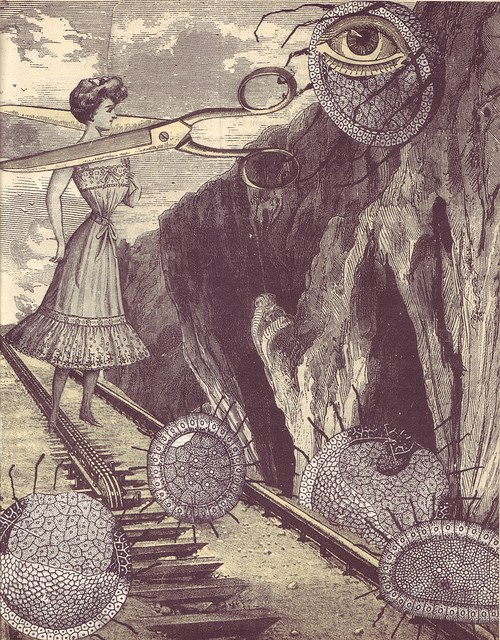
Adolf Hoffmeister (1902 – 1973) – Collage
“The mind which is most capable of receiving impressions is very often the least capable of drawing conclusions.”
— Virginia Woolf in The Second Common Reader
Adolf Hoffmeister (1902 – 1973) – Collage
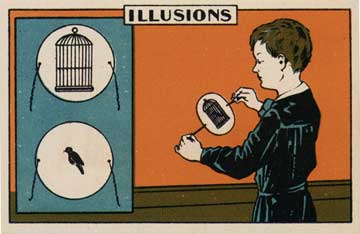
birdcage thaumatrope
[7 may 2012]
i am a dervish
a thaumaturge
i spin very fast
bore downwards
pour stuff out of the top of me churned rich like butter as i whirl
why do i spin so?
see
the thing about spinning
is that it is an oscillation between opposites that generates the movement
it’s how motors work
it’s how hard drives work
it’s how atoms work
the spin is ambi-valence made physical
attracted/repulsed/attracted/repulsed
so i am always moving fast yet can seem to be going nowhere
in my indecision, in the swinging tension between irreconcilable polar opposites
i can actually drill down deeper
because i am always spinning, seeing both sides almost, but not quite,
simultaneously
it’s impossible to see both sides simultaneously
but the quicker you are at seeing multiple perspectives
eddying off on fractal tangents
the faster you spin
(and the dizzier it can make you and others)
how do you solve a problem like maria?
i am not moving linearly
not climbing a ladder
it does not mean i am unproductive
it does not mean i am trapped
the hum is just my motor running at a higher frequency than the
general populace
a powerful magnet
drawing stuff in constantly
flipping it over and over
360 degrees of perspective, 365 days a year
a thaumatrope
it’s a funny thing
i can actually spin, physically, round and round for ages and not get dizzy
i think this is how i manage to get through life, mentally
i am mostly able to tune out the vertigo
i have learned
others can’t
they can’t take how fast i am going all the time
the spinning keeps me upright
in perpetual motion but never able to choose only one definite course
drawing straws
in perfect tension
twirling thread
spinning gold
activates
sigils
semiotics
polarity
magnetism
solenoids
speakers
the speed of sound
affects aerodynamics
flow
determinism and chaos
it’s all connected
all ways
in the dance of particles
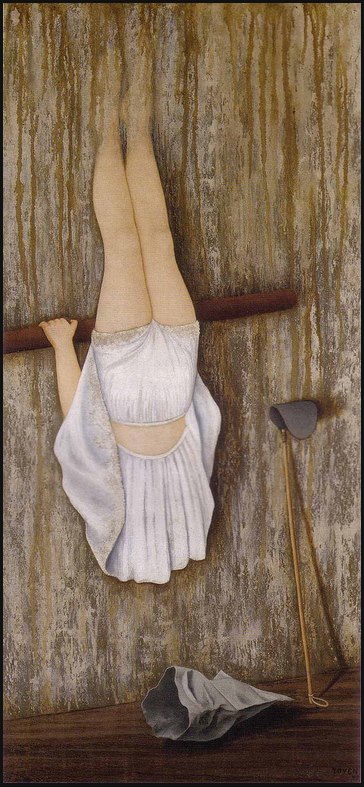
Toyen (Marie Čermínová) – “Relâche”, 1943
Dear God,
When we fall, let us fall inwards.
Let us fall freely and completely:
that we may find our depth and humility:
the solid earth from which we may rise up and love again.
Amen.
— Michael Leunig
[E]ffective differences pass between the lines, even though they are all immanent to one another, all entangled in one another. This is why the question of schizoanalysis or pragmatics, micropolitics itself, never consists in interpreting, but merely in asking what are your lines, individual or group, and what are the dangers on each.
JR around the pole at Desperado’s Saloon, Observatory, Cape Town, 15 May 2013. Photo: Rosemary Lombard
What are your rigid segments, your binary and overcoding machines? For even these are not given to you ready-made; we are not simply divided up by binary machines of class, sex, or age: there are others which we constantly shift, invent without realising it. And what are the dangers if we blow up these segments too quickly? Wouldn’t this kill the organism itself, the organism which possesses its own binary machines, even in its nerves and its brain?
What are your supple lines, what are your fluxes and thresholds? Which is your set of relative deterritorialisations and correlative reterritorialisations? And the distribution of black holes: which are the black holes of each one of us, where a beast lurks or a microfascism thrives?
— Deleuze and Guattari: Toward Freedom. Read more HERE.
Sent from my BlackBerry® wireless device

Sketch of Søren Kierkegaard. Based on a sketch by Niels Christian Kierkegaard (1806-1882)
Hegel was the great system-maker. What others viewed as his grand achievement Kierkegaard viewed as his unforgivable crime, the attempt to rationally systematise the whole of existence. The whole of existence cannot be systematised, Kierkegaard insisted, because existence is not yet whole; it is incomplete and in a state of constant development. Hegel attempted to introduce mobility into logic, which, said Kierkegaard, is itself an error in logic. The greatest of Hegel’s errors, however, was his claim that he had established the objective theory of knowledge. Kierkegaard countered with the argument that subjectivity is truth. As he put it, “The objective uncertainty maintained in the most passionate spirit of dedication is truth, the highest truth for one existing.” … Kierkegaard, it remains to be said, is not a systematic theologian. We know what he thought of systems and system makers, of which Hegel was the prime example. There is hardly a page in his writings that does not prompt from the systematically minded reader a protest against disconnections and apparent contradictions. Like Flannery O’Connor, he shouted to the hard of hearing and drew startling pictures for the almost blind.
— Richard John Neuhaus, in Kierkegaard for Grownups (2004)


Jack Daniels promo girls at the Cape Town book launch for “The Shining Girls”, while author Lauren Beukes was reading. Photo: Rosemary Lombard

Helen Green – “Dorothy and Alice”
Find more of Helen Green’s illustration work HERE.
‘The blunt, pathetic reality today is that a little old lady has died, who in the winter of her life had to water roses alone under police supervision. If you behave like there’s no such thing as society, in the end there isn’t. Her death must be sad for the handful of people she was nice to and the rich people who got richer under her stewardship. It isn’t sad for anyone else.’
‘Barack Obama, interestingly, said in his statement that she had “broken the glass ceiling for other women”. Only in the sense that all the women beneath her were blinded by falling shards. She is an icon of individualism, not of feminism.’
Russell Brand has an intelligent, evocative way with reflection. I remember the piece he wrote when Amy Winehouse died — the fine-grained, personal memories, the honesty. THIS BIT OF WRITING, on a very different sort of figure in his life, has that same quality.

“The process of growth is, it seems, the art of falling down. Growth is measured by the gentleness and awareness with which we once again pick ourselves up, the lightness with which we dust ourselves off, the openness with which we continue and take the next unknown step, beyond our edge, beyond our holding, into the remarkable mystery of being.”
— Stephen Levine

“Maybe the older you grow and the less easy it is to put thought into action, maybe that’s why it gets all locked up in your head and becomes a burden.”
__
Truman Capote, from Breakfast at Tiffany’s
 It will do you no harm to find yourself ridiculous.
Resign yourself to be the fool you are.
You will find that you survive humiliation
And that’s an experience of incalculable value.
That is the worst moment, when you feel you have lost
The desires for all that was most desirable,
Before you are contented with what you can desire;
Before you know what is left to be desired;
And you go on wishing that you could desire
What desire has left behind. But you cannot understand.
How could you understand what it is to feel old?
We die to each other daily.
What we know of other people
Is only our memory of the moments
During which we knew them. And they have changed since then.
To pretend that they and we are the same
Is a useful and convenient social convention
Which must sometimes be broken. We must also remember
That at every meeting we are meeting a stranger.
There was a door
And I could not open it. I could not touch the handle.
Why could I not walk out of my prison?
What is hell? Hell is oneself.
Hell is alone, the other figures in it
Merely projections. There is nothing to escape from
And nothing to escape to. One is always alone.
Half the harm that is done in this world
Is due to people who want to feel important.
They don’t mean to do harm — but the harm does not interest them.
Or they do not see it, or they justify it
Because they are absorbed in the endless struggle
To think well of themselves.
There are several symptoms
Which must occur together, and to a marked degree,
To qualify a patient for my sanitorium:
And one of them is an honest mind. That is one of the causes of their suffering.
To men of a certain type
The suspicion that they are incapable of loving
Is as disturbing to their self-esteem
As, in cruder men, the fear of impotence.
I must tell you
That I should really like to think there’s something wrong with me —
Because, if there isn’t, then there’s something wrong
With the world itself — and that’s much more frightening!
That would be terrible.
So, I’d rather believe there’s something wrong with me, that could be put right.
Everyone’s alone — or so it seems to me.
They make noises, and think they are talking to each other;
They make faces, and think they understand each other.
And I’m sure they don’t. Is that a delusion?
Can we only love
Something created in our own imaginations?
Are we all in fact unloving and unloveable?
Then one is alone, and if one is alone
Then lover and beloved are equally unreal
And the dreamer is no more real than his dreams.
I shall be left with the inconsolable memory
Of the treasure I went into the forest to find
And never found, and which was not there
And is perhaps not anywhere? But if not anywhere
Why do I feel guilty at not having found it?
Disillusion can become itself an illusion
If we rest in it.
Two people who know they do not understand each other,
Breeding children whom they do not understand
And who will never understand them.
There is another way, if you have the courage.
The first I could describe in familiar terms
Because you have seen it, as we all have seen it,
Illustrated, more or less, in lives of those about us.
The second is unknown, and so requires faith —
The kind of faith that issues from despair.
The destination cannot be described;
You will know very little until you get there;
You will journey blind. But the way leads towards possession
Of what you have sought for in the wrong place.
We must always take risks. That is our destiny.
If we all were judged according to the consequences
Of all our words and deeds, beyond the intention
And beyond our limited understanding
Of ourselves and others, we should all be condemned.
Only by acceptance of the past will you alter its meaning.
All cases are unique, and very similar to others.
Every moment is a fresh beginning.
__
Excerpted from T.S. Eliot’s 1949 play, The Cocktail Party
 I don’t want to be a designer, a marketer, an illustrator, a brander, a social media consultant, a multi-platform guru, an interface wizard, a writer of copy, a technological assistant, an applicator, an aesthetic king, a notable user, a profit-maximizer, a bottom-line analyzer, a meme generator, a hit tracker, a re-poster, a sponsored blogger, a starred commentator, an online retailer, a viral relayer, a handle, a font or a page. I don’t want to be linked in, tuned in, ‘liked’, incorporated, listed or programmed. I don’t want to be a brand, a representative, an ambassador, a bestseller or a chart-topper. I don’t want to be a human resource or part of your human capital.
I don’t want to be an entrepreneur of myself.
Don’t listen to the founders, the employers, the newspapers, the pundits, the editors, the forecasters, the researchers, the branders, the career counsellors, the prime minister, the job market, Michel Foucault or your haughty brother in finance – there’s something else!
I want to be a lover, a teacher, a wanderer, an assembler of words, a sculptor of immaterial, a maker of instruments, a Socratic philosopher and an erratic muse. I want to be a community centre a piece of art, a wonky cursive script and an old-growth tree! I want to be a disrupter, a creator, an apocalyptic visionary, a master of reconfiguration, a hypocritical parent, an illegal download and a choose-your-own-adventure! I want to be a renegade agitator! A licker of ice cream! An organiser of mischief! A released charge! A double jump on the trampoline! A wayward youth! A volunteer! A partner.
I want to be a curator of myself, an anti-preneur, a person.
Unlimited availabilities. No followers required. Only friends.
~ Danielle Leduc
First published HERE (thanks to Emma Arogundade for sharing it on Facebook).
Note from the author:
I actually didn’t write this as an ‘anti-preneurial manifesto’ – it was more of a poetic rant written in frustration from combing through the online job market. I meant it as less of a takedown of capitalism and more of a critique of how we are told to sell ourselves as brands, to self-promote, in order to make it in this world, and as such we allow our job titles to define us to a certain extent. I think all of us are many of the things I listed towards the end, but these things don’t appear as marketable skills in a neoliberal economy with a tight and precarious job market. We are not our resumes, is all.
Once, in a dry season, I wrote in large letters across two pages of a notebook that innocence ends when one is stripped of the delusion that one likes oneself. Although now, some years later, I marvel that a mind on the outs with itself should have nonetheless made painstaking record of its every tremor, I recall with embarrassing clarity the flavor of those particular ashes. It was a matter of misplaced self-respect.
I had not been elected to Phi Beta Kappa. This failure could scarcely have been more predictable or less ambiguous (I simply did not have the grades), but I was unnerved by it; I had somehow thought myself a kind of academic Raskolnikov, curiously exempt from the cause-effect relationships which hampered others. Although even the humorless nineteen-year-old that I was must have recognized that the situation lacked real tragic stature, the day that I did not make Phi Beta Kappa nonetheless marked the end of something, and innocence may well be the word for it. I lost the conviction that lights would always turn green for me, the pleasant certainty that those rather passive virtues which had won me approval as a child automatically guaranteed me not only Phi Beta Kappa keys but happiness, honor, and the love of a good man; lost a certain touching faith in the totem power of good manners, clean hair, and proved competence on the Stanford-Binet scale. To such doubtful amulets had my self-respect been pinned, and I faced myself that day with the nonplussed apprehension of someone who has come across a vampire and has no crucifix at hand.
Although to be driven back upon oneself is an uneasy affair at best, rather like trying to cross a border with borrowed credentials, it seems to me now the one condition necessary to the beginnings of real self-respect. Most of our platitudes notwithstanding, self-deception remains the most difficult deception. The tricks that work on others count for nothing in that well-lit back alley where one keeps assignations with oneself; no winning smiles will do here, no prettily drawn lists of good intentions. One shuffles flashily but in vain through one’s marked cards the kindness done for the wrong reason, the apparent triumph which involved no real effort, the seemingly heroic act into which one had been shamed. The dismal fact is that self-respect has nothing to do with the approval of others – who we are, after all, deceived easily enough; has nothing to do with reputation, which, as Rhett Butler told Scarlett O’Hara, is something people with courage can do without.
To do without self-respect, on the other hand, is to be an unwilling audience of one to an interminable documentary that deals one’s failings, both real and imagined, with fresh footage spliced in for every screening. There’s the glass you broke in anger, there’s the hurt on X’s face; watch now, this next scene, the night Y came back from Houston, see how you muff this one. To live without self-respect is to lie awake some night, beyond the reach of warm milk, the Phenobarbital, and the sleeping hand on the coverlet, counting up the sins of commissions and omission, the trusts betrayed, the promises subtly broken, the gifts irrevocably wasted through sloth or cowardice, or carelessness. However long we postpone it, we eventually lie down alone in that notoriously uncomfortable bed, the one we make ourselves. Whether or not we sleep in it depends, of course, on whether or not we respect ourselves.
To protest that some fairly improbable people, some people who could not possibly respect themselves, seem to sleep easily enough is to miss the point entirely, as surely as those people miss it who think that self-respect has necessarily to do with not having safety pins in one’s underwear. There is a common superstition that “self-respect” is a kind of charm against snakes, something that keeps those who have it locked in some unblighted Eden, out of strange beds, ambivalent conversations, and trouble in general. It does not at all. It has nothing to do with the face of things, but concerns instead a separate peace, a private reconciliation. Although the careless, suicidal Julian English in Appointment in Samara and the careless, incurably dishonest Jordan Baker in The Great Gatsby seem equally improbably candidates for self-respect, Jordan Baker had it, Julian English did not. With that genius for accommodation more often seen in women than men, Jordan took her own measure, made her own peace, avoided threats to that peace: “I hate careless people,” she told Nick Carraway. “It takes two to make an accident.”
Like Jordan Baker, people with self-respect have the courage of their mistakes. They know the price of things. If they choose to commit adultery, they do not then go running, in an access of bad conscience, to receive absolution from the wronged parties; nor do they complain unduly of the unfairness, the undeserved embarrassment, of being named co-respondent. In brief, people with self-respect exhibit a certain toughness, a kind of mortal nerve; they display what was once called character, a quality which, although approved in the abstract, sometimes loses ground to other, more instantly negotiable virtues. The measure of its slipping prestige is that one tends to think of it only in connection with homely children and United States senators who have been defeated, preferably in the primary, for reelection. Nonetheless, character – the willingness to accept responsibility for one’s own life – is the source from which self-respect springs.
Self-respect is something that our grandparents, whether or not they had it, knew all about. They had instilled in them, young, a certain discipline, the sense that one lives by doing things one does not particularly want to do, by putting fears and doubts to one side, by weighing immediate comforts against the possibility of larger, even intangible, comforts. It seemed to the nineteenth century admirable, but not remarkable, that Chinese Gordon put on a clean white suit and held Khartoum against the Mahdi; it did not seem unjust that the way to free land in California involved death and difficulty and dirt. In a diary kept during the winter of 1846, an emigrating twelve-yaer-old named Narcissa Cornwall noted coolly: “Father was busy reading and did not notice that the house was being filled with strange Indians until Mother spoke out about it.” Even lacking any clue as to what Mother said, one can scarcely fail to be impressed by the entire incident: the father reading, the Indians filing in, the mother choosing the words that would not alarm, the child duly recording the event and noting further that those particular Indians were not, “fortunately for us,” hostile. Indians were simply part of the donnee.
In one guise or another, Indians always are. Again, it is a question of recognizing that anything worth having has its price. People who respect themselves are willing to accept the risk that the Indians will be hostile, that the venture will go bankrupt, that the liaison may not turn out to be one in which every day is a holiday because you’re married to me. They are willing to invest something of themselves; they may not play at all, but when they do play, they know the odds.
That kind of self-respect is a discipline, a habit of mind that can never be faked but can be developed, trained, coaxed forth. It was once suggested to me that, as an antidote to crying, I put my head in a paper bag. As it happens, there is a sound physiological reason, something to do with oxygen, for doing exactly that, but the psychological effect alone is incalculable: it is difficult in the extreme to continue fancying oneself Cathy in Wuthering Heights with one’s head in a Food Fair bag. There is a similar case for all the small disciplines, unimportant in themselves; imagine maintaining any kind of swoon, commiserative or carnal, in a cold shower.
But those small disciplines are valuable only insofar as they represent larger ones. To say that Waterloo was won on the playing fields of Eton is not to say that Napoleon might have been saved by a crash program in cricket; to give formal dinners in the rain forest would be pointless did not the candlelight flickering on the liana call forth deeper, stronger disciplines, values instilled long before. It is a kind of ritual, helping us to remember who and what we are. In order to remember it, one must have known it.
To have that sense of one’s intrinsic worth which constitutes self-respect is potentially to have everything: the ability to discriminate, to love and to remain indifferent. To lack it is to be locked within oneself, paradoxically incapable of either love or indifference. If we do not respect ourselves, we are the one hand forced to despise those who have so few resources as to consort with us, so little perception as to remain blind to our fatal weaknesses. On the other, we are peculiarly in thrall to everyone we see, curiously determined to live out – since our self-image is untenable – their false notion of us. We flatter ourselves by thinking this compulsion to please others an attractive trait: a gist for imaginative empathy, evidence of our willingness to give. Of course I will play Francesca to your Paolo, Helen Keller to anyone’s Annie Sullivan; no expectation is too misplaced, no role too ludicrous. At the mercy of those we cannot but hold in contempt, we play roles doomed to failure before they are begun, each defeat generating fresh despair at the urgency of divining and meeting the next demand made upon us.
It is the phenomenon sometimes called “alienation from self.” In its advanced stages, we no longer answer the telephone, because someone might want something; that we could say no without drowning in self-reproach is an idea alien to this game. Every encounter demands too much, tears the nerves, drains the will, and the specter of something as small as an unanswered letter arouses such disproportionate guilt that answering it becomes out of the question. To assign unanswered letters their proper weight, to free us from the expectations of others, to give us back to ourselves – there lies the great, the singular power of self-respect. Without it, one eventually discovers the final turn of the screw: one runs away to find oneself, and finds no one at home.
__
This essay first published 1961 in Vogue; reprinted 1968 in Slouching Toward Bethlehem, included in Didion, Collected Works (Norton, 2006).
“Life moves on, whether we act as cowards or heroes. Life has no other discipline to impose, if we would but realise it, than to accept life unquestioningly. Everything we shut our eyes to, everything we run away from, everything we deny, denigrate or despise, serves to defeat us in the end. What seems nasty, painful, evil, can become a source of beauty, joy, and strength, if faced with an open mind. Every moment is a golden one for him who has the vision to recognise it as such.”
~ Henry Miller
“The best moments in reading are when you come across something — a thought, a feeling, a way of looking at things — which you had thought special and particular to you. And now, here it is, set down by someone else, a person you have never met, someone, even, who is long dead. And it is as if a hand has come out, and taken yours.”
— Alan Bennett
Linda Stupart wrote this about Reeva Steenkamp, and also the YOU DECIDE billboard and corpses and objects and women.
 Africa is a Country (Old Site)
 Since Valentine’s Day everyone has been talking about the murder of Reeva Steenkamp, although rarely in those terms. We know that her boyfriend, Oscar Pistorius, shot her four times and killed her while she was behind a locked door in their bathroom in a gated estate. We know that he has a history of domestic violence, a penchant for shooting things. We know absolutely everything about his extensive sporting achievements. The main thing, however, that we know about Steenkamp is that she was a model, and that she was really hot.
View original post 1,866 more words
i got a square peg
you got a round hole
i got a square peg
you got a round hole
i got a round hole
you got a square peg
i got a square peg
you got a round hole
you got a round peg
i got a round peg
you got a square hole
i got a square hole
you got a round peg
i got a square peg
i got a round hole
you got a square hole
you got a square peg
i got a round peg
etcetera, etcetera.
“Loneliness is like starvation: you don’t realize how hungry you are until you begin to eat.”
― Joyce Carol Oates, Faithless

Maximum City: Bombay Lost and Found, by Suketu Metha, is the most mind-blowing book I have read for quite some time. Metha left Mumbai then returned from New York, and began documenting his hood.
Here are some little snippets:
‘Many wars begin with an act of rape, real or imagined. It is always the men who are disturbed enough by the rape to go to war.’
‘Bombay survives on the scam. We are all complicit. A man who has made his money through a scam is more respected than a man who has made his money through hard work, because the ethic of Bombay is quick upward mobility and a scam is a short-cut. A scam shows good business sense and a quick mind. Anyone can work and make money. What’s to admire about that? But a well-executed scam? Now, there’s a thing of beauty!’
‘When a man touches his killer’s feet and begs for his life, saying, “Please don’t kill me, I have children,” it is the worst argument he can offer. Thinking the killer will let you off because you have kids assumes that you can locate a hidden source of sympathy in your killer based on something shared, something in common. But very few killers are fathers. Very few of them have had good experiences with their own fathers. So that bond between father and son, which for you and me is the most convincing argument against your death – don’t kill me because it will break that sacred bond – means nothing to them. It is a bond, in fact, that the hit-men have consciously been trying to break all their lives. As far as they’re concerned, ridding your children of their father is the greatest favour they can do them.’
‘ [Bal Thackeray’s] vandals are young men, who, after working 12hour days as peons in some office where they endure humiliation and even a slap or two from men who are richer … than they are, take the train home. Inside the train, they bathe in perspiration; the air is fetid with sweat and farts. When they get home to the slum, their mother and fathers and grandmothers will ask them what they have bought home. Such a man lives with a constant sense of his own powerlessness, except when he is part of a mob, part of a contingent of 70 patriots fighting for the country’s honour, walking unmolested into movie theatres, posh apartments, and the offices of the cricket lords of the country, smashing trophies, beating up important people who drive fine cars. All the accumulated insults, rebukes and disappointments of life in a decaying megalopolis come out in a cathartic release of anger. It’s okay to be angry in a crowd; the crowd feeds on your anger, digests it, nourishes it, nourishes your rage as your rage nourishes it. All of a sudden you feel powerful. You can take on anybody. It is not their city any more, it is your city.
You own this city by the right of your anger.’
“We look for the sermon in the suicide, for the social or moral lesson in the murder of five. We interpret what we see, select the most workable of the multiple choices. We live entirely, especially if we are writers, by the imposition of a narrative line upon disparate images, by the ‘ideas’ with which we have learned to freeze the shifting phantasmagoria which is our actual experience.”
— Joan Didion, The White Album
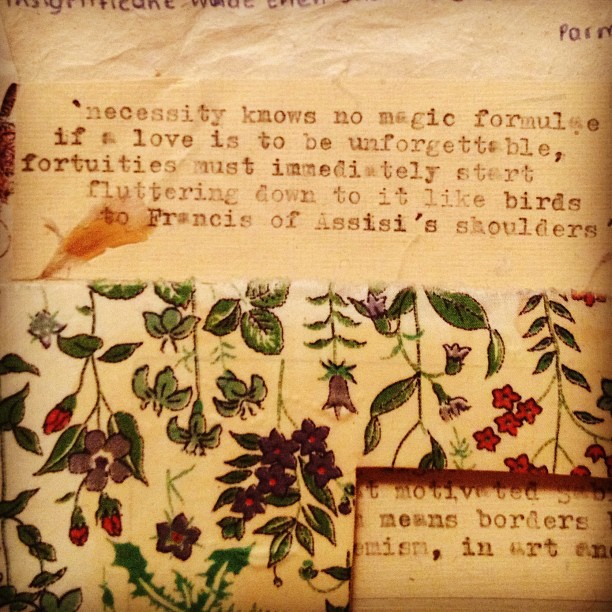
 “My hate is general, I detest all men;
Some because they are wicked and do evil,
Others because they tolerate the wicked,
Refusing them the active vigorous scorn
Which vice should stimulate in virtuous minds.”
From Molière’s Le Misanthrope (1666)
“When I was fourteen, I discovered the sound of iniquity on a long-playing record for the blind from the Library of Congress. I listened to Paradise Lost, and sometimes after hours of playing the story of Satan I’d walk to the driveway’s edge and feel the elaborate work of sunlight and wind and imagine, the way only a teenager can, the falling of Satan in a blackness so pure you could feel it in the bones of your face… I’d discovered the gift of Milton: the soul’s path is in the ear – not the mirror.”
~ Stephen Kuusisto, from Eavesdropping: A Memoir of Blindness and Listening (W. W. Norton & Company, 2006)
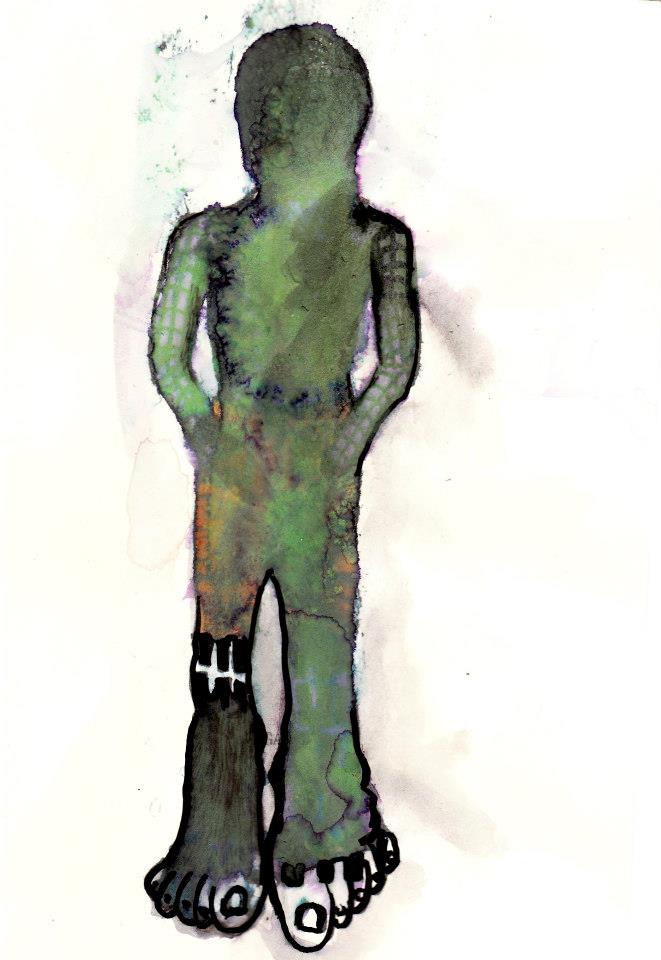 each and every one one of us has a book of narratives, that we read write and become part of. each chapter verse and paragraph tells our stories and as time passes, we become familiar with our own characters and our own cast of characters become familiar with us.
there is the longing, the dreaming, the ambition, the beauty and the ugliness and above all, there is the love.. the love of others, the love of others like self and the love of self..
the hardest part though, is to be and become part of the narrative..beauty.. to not negate from its positivity its validity as a document to the light rays streaming through our windows of hope and courage to go forward.
the sun rises and sets in a distant sky, as trees bend, bow, blow leaves, jingling. we are hushed into our own simplicities, the grace of intelligence..
man woman or child is the subtotal of a life lived and hoped for.. the narrative of distant and close dreams are but moments, in our own being, where we are awake and know and overstand that it is in the power of our being that we learn that our own empowerment is the storehouse.. that we are capable of more than the small parts that make up the whole.
love, romance, career, children are all part of the course of our own destined future, but the inner self, the inner voice is the calling to follow your own path, all love, and in doing so .. this becomes a mantra, a calling even..
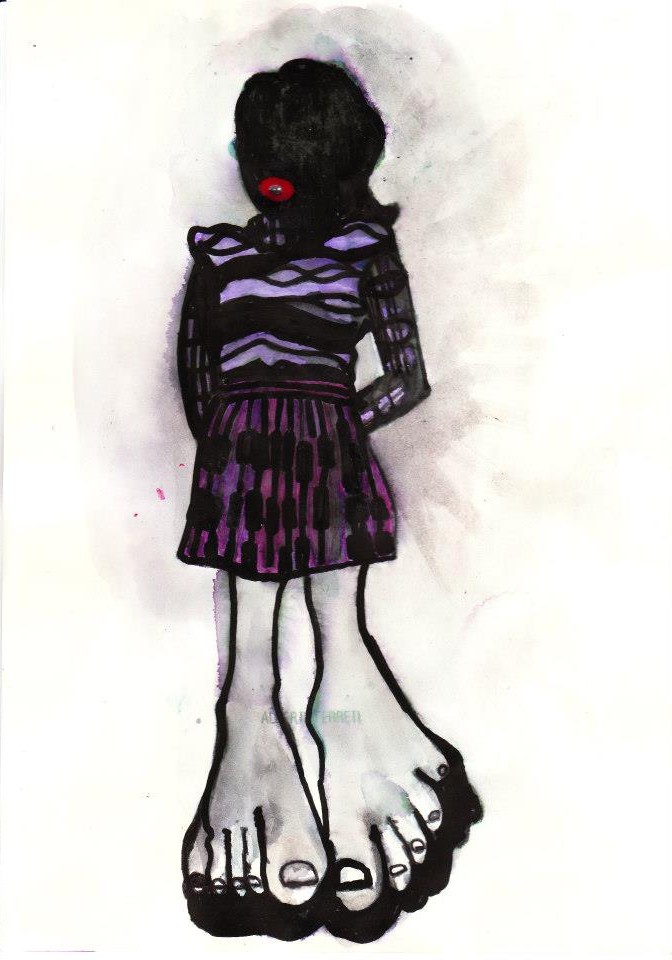
It’s New Year’s Day, away for the weekend with a smallish group of friends… people on different continents, in one place in my mind. We leftovers – avatars of Stella, Michelle, Marco and me, I think it might be – wander back through in the early morning to the communal lapa sort of place where all the dancing had been, the remains of last night’s party trodden into the ground, our affect similarly flattened. The day is wrapped in a quiet mist blanket, grey and clammy. All the couples are still in bed.
“OK, we need music.”
I pick my way over to the old boombox, there on a table surrounded by empty cups, the dregs of stale liquor… Scratching around blearily, I find a Nina Simone tape. (CASSETTE TAPES? WTF, dreambrain?) Anyway, I want to put on “He’s Got the Whole World in His Hands” for we souls with nowhere to be curled into.
I slide the wonky cassette into the player, reach out to press play, and my finger can’t. The buttons are melted, changed into some unearthly goo. Not sticky, not hot, not cold, just melted, uncooperative and soft in an alien, irreparable way. This weird flux will crust over, re-harden as the day wears on into a single mass of equally unbiddable plastic.
Someone must have been using a lighter to illuminate what they were doing during last night’s revelry, I suppose. What a bright idea it must have seemed in that moment, but now we can’t hear the one song that I was hoping might make us feel sort of OK about living through another year alone on Earth.

 fleurmach