pablo neruda – from sonnet xvii

“… I love you as certain dark things are to be loved,
in secret, between the shadow and the soul.

I love you as the plant that never blooms
but carries in itself the light of hidden flowers;
thanks to your love a certain solid fragrance,
risen from the earth, lives darkly in my body…”

__
From 100 Love Sonnets. Translated by Stephen Tapscott (UT Press, 1986).

gayatri spivak at uct next week

spivak at uct

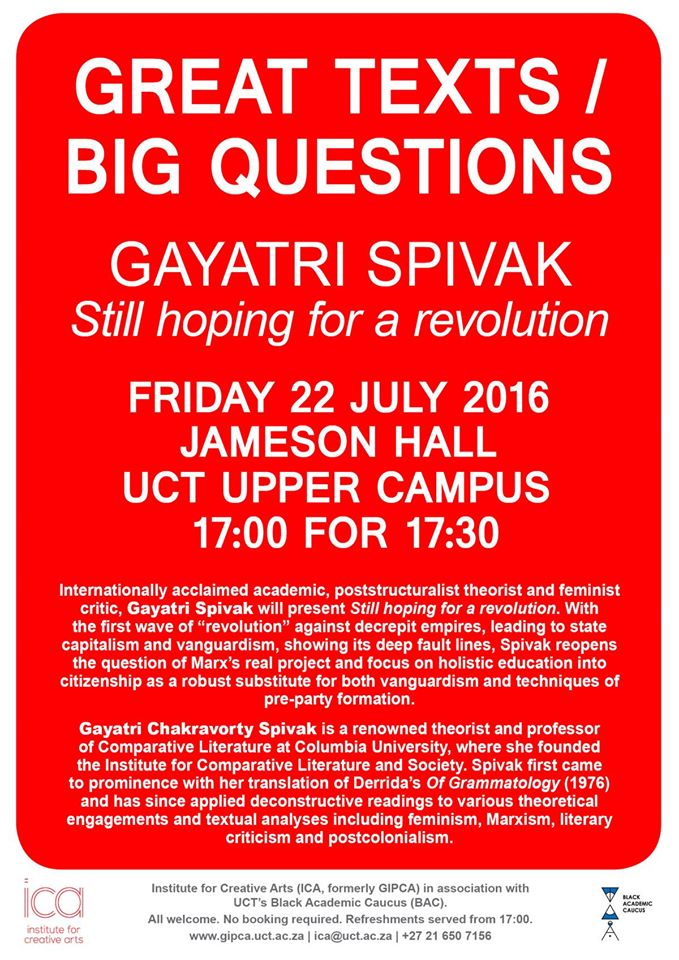
The Institute for Creative Arts is proud to present internationally renowned theorist, Professor Gayatri Spivak.

Gayatri Chakravorty Spivak is one of the most significant and influential literary theorists of our time.

Having first come to prominence with her translation of Derrida’s Of Grammatology in 1976, Spivak has since applied deconstructive readings to theoretical engagements and textual analyses including feminism, Marxism, literary criticism and postcolonialism – capturing complex theories that transgress disciplinary boundaries.

The Institute for Creative Arts (ICA, formerly GIPCA) in collaboration with UCT’s Black Academic Caucus (BAC) is honoured to present this esteemed academic and philosopher as part of the ICA’s Great Texts/Big Questions lecture series.

Of her address, entitled “Still hoping for a revolution”, Spivak writes:

Now that the first wave of “revolution” against decrepit empires, leading to state capitalism and vanguardism, is showing its deep fault lines, I reopen the question of Marx’s real project and focus on holistic education into citizenship – as the conjuncture has moved from the central agency of the industrial proletariat – as a robust substitute for both vanguardism and techniques of pre-party formation.

This is particularly interesting for me because I have myself learned from many mistakes made since 1992, when I presented the T.B. Davie Memorial Lecture in Cape Town on “Thinking Academic Freedom in Gendered Post-Coloniality.” The general response, as I heard it reported, was “we already do this.” Yet, in 2002, Joan Vincent included the piece in her The Anthropology of Politics: A Reader in Ethnography, Theory, and Critique, commenting that I had been “prescient.” I therefore hope that my audience, which will be different, will also have learned from past “mistakes.”

Gayatri Chakravorty Spivak is currently professor of Comparative Literature at Columbia University where she founded the Institute for Comparative Literature and Society. Her critical writings include Of Grammatology (1976), In Other Worlds: Essays in Cultural Politics (1987), The Post-Colonial Critic (1990), Thinking Academic Freedom in Gendered Post-Coloniality (1992), Outside in the Teaching Machine (1993), A Critique of Postcolonial Reason (1999), Death of a Discipline (2003), and Other Asias (2005).

The lecture, followed by an open question and answer session, will take place from 17:30 – 19:00 on Friday 22 July 2016 at Jameson Hall, University Avenue, University of Cape Town Upper Campus.

Refreshments will be served from 17:00.

No booking is necessary and all are welcome.

For more information, contact the ICA office: +27 21 650 7156 or ica@uct.ac.za

alden wood – radical intersections: the rise of atonal music and the invisible committee’s “the coming insurrection”

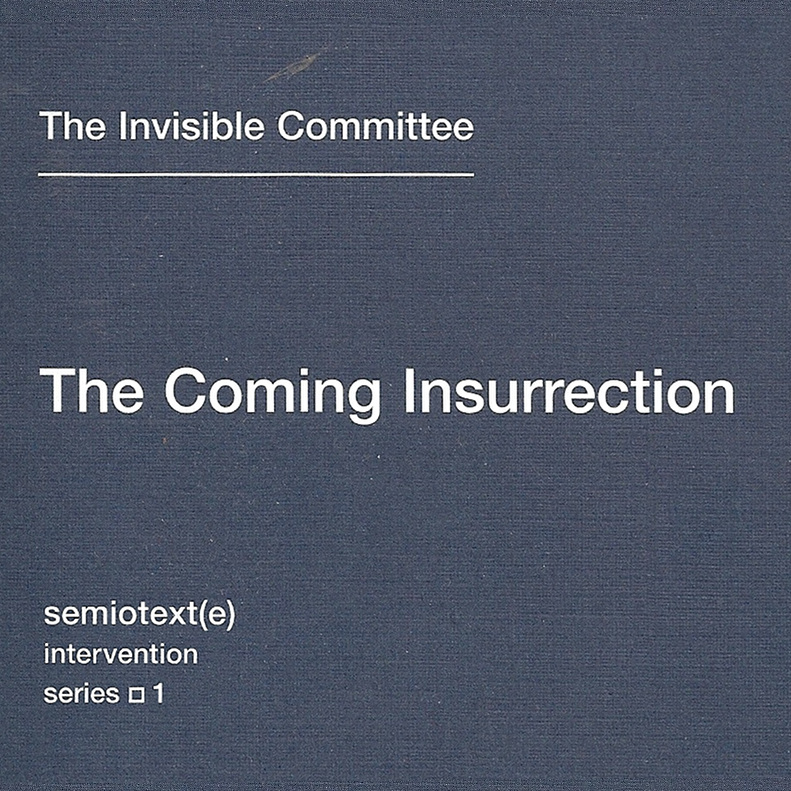
the-coming-insurrectionThe Coming Insurrection, a notorious 2007 ultra-left polemical tract written by a collective of French anti-state communists writing under the group-moniker The Invisible Committee, posits a conception of insurrection as the creation of new collective ontologies through acts of radical social rupture. Eschewing the orthodox Marxist line that revolution is something temporally removed from the present, towards which pro-revolutionaries must organize and work, The Invisible Committee’s use of insurrection claims it as an antagonistic challenge to late-capitalism firmly grounded in its own immediacy. Communism is therefore made immediate, and it is willed into being by insurrectionary acts of social rupture.

While much has been written on the debt that The Invisible Committee owes to French strains of ultra-left anti-state communism, Michel Foucault, Gilles Deleuze, Giorgio Agamben, Situationism, and the Italian Autonomia movement of the 1970s, their implicit nod to the sociopolitical themes of music has been largely ignored. By subtly claiming that insurrection spreads by resonance and that such proliferation “takes the shape of a music,” The Invisible Committee allows for the interpretation of its “coming insurrection” as an inherently musical act. Using a historical reading of the shift from tonality to atonality in Western art music, as exemplified by Arnold Schoenberg, Alden Wood’s interpretation of The Coming Insurrection aims at imbuing its explicitly political premises with a more thorough exploration of its implicit musical qualities.

Published in Interdisciplinary Humanities Vol. 30 pp. 57-65, 2013.

Read this essay HERE, and The Coming Insurrection HERE.

mary oliver – not anyone who says

Not anyone who says, “I’m going to be
careful and smart in matters of love,”
who says, “I’m going to choose slowly,”
but only those lovers who didn’t choose at all
but were, as it were, chosen
by something invisible and powerful and uncontrollable
and beautiful and possibly even
unsuitable —
only those know what I’m talking about
in this talking about love.

___
From Felicity (Penguin Press, 2015).

the doors – alive, she cried

https://youtu.be/oErfxU2Tqhc

I can recommend this as a great album for dancing around a winter-sun-drenched flat at the end of the world, doing housework.

A compilation of live recordings made in Los Angeles, New York, Detroit, Boston, and Copenhagen, between 1968 and 1970.

DSC_2026

“I’ll tell you this…
No eternal reward will forgive us now
For wasting the dawn.
And one morning you awoke in the strange sun,
And opening your door…”

akira rabelais – eisoptrophobia (2001)

Akira Rabelais, one of my best Myspace discoveries – remember that strange place? I love this video, too, which was not available back then – one simply couldn’t stream hour-long films online. Get the album Eisoptrophobia (which is a term for the fear of one’s own image in reflection) HERE.

joy division – atmosphere (1980)

“Atmosphere”, produced by Martin Hannett, was originally released in March 1980 on record label Sordide Sentimental as “Licht und Blindheit” (“Light and Blindness”), a France-only limited edition single featuring the track “Dead Souls” as the B-side. Following Ian Curtis’s death two months later, it was re-released as a 12″ single by record label Factory with “She’s Lost Control” as the B-side.

scientist – scientist rids the world of the evil curse of the vampires (1981)

https://youtu.be/937GFSXbcb0

Scientist sourced his material for this album from artists Michael Prophet, Wailing Souls, Johnny Osbourne and Wayne Jarrett. Here are Scientist’s mixes and their original equivalents:

Scientist Originals
1. “Voodoo Curse” “Oh What a Feeling” – Wailing Souls (Fire House Rock, 1981)
2. “Dance of the Vampires” “You Are a No Good” – Michael Prophet (Righteous Are The Conqueror, 1980)
3. “Blood On His Lips” “Love in My Heart” – Wayne Jarrett (Chip In, 1981)
4. “Cry of the Werewolf” “Hold On To What You Got” – Michael Prophet (Gunman, 1981)
5. “The Mummy’s Shroud” “Fire House Rock” – Wailing Souls (Fire House Rock, 1981)
6. “The Corpse Rises” “Bandits Taking Over” – Wailing Souls (Fire House Rock, 1981)
7. “Night of the Living Dead” “Youthman” – Michael Prophet (Gunman, 1981)
8. “Your Teeth In My Neck” “Love and Unity” – Michael Prophet (Gunman, 1981)
9. “Plague of Zombies” “He Can Surely Turn The Tide” – Johnny Osbourne (Fally Lover, 1981)
10. “Ghost of Frankenstein” “Sweet Loving” – Michael Prophet (Gunman, 1981)

abbas kiarostami – two solutions for one problem (1975)

https://youtu.be/_oDD8B_O6xM

Two Solutions for One Problem (Persian: دو راه حل برای يک مسئله ‎‎, Dow Rahehal Baraye yek Massaleh) is an Iranian short film from 1975, directed by Abbas Kiarostami, who died yesterday.

During breaktime, Dara and Nader have an altercation about a torn exercise book that the former has given back to the latter. There are two possible outcomes, which the film shows one after the other.

carl jung on the projection of evil (1957)

scapegoat

Quite apart from the barbarities and blood baths perpetrated by the Christian nations among themselves throughout European history, the European has also to answer for all the crimes he has committed against the dark-skinned peoples during the process of colonization.

In this respect the white man carries a very heavy burden indeed.

It shows us a picture of the common human shadow that could hardly be painted in blacker colors.

The evil that comes to light in man and that undoubtedly dwells within him is of gigantic proportions, so that for the Church to talk of original sin and to trace it back to Adam’s relatively innocent slip-up with Eve is almost a euphemism.

The case is far graver and is grossly underestimated.

Since it is universally believed that man is merely what his consciousness knows of itself, he regards himself as harmless and so adds stupidity to iniquity. He does not deny that terrible things have happened and still go on happening, but it is always “the others” who do them.

And when such deeds belong to the recent or remote past, they quickly and conveniently sink into the sea of forgetfulness, and that state of chronic woolly-mindedness returns which we describe as “normality.”

In shocking contrast to this is the fact that nothing has finally disappeared and nothing has been made good.

The evil, the guilt, the profound unease of conscience, the obscure misgiving are there before our eyes, if only we would see. Man has done these things; I am a man, who has his share of human nature; therefore I am guilty with the rest and bear unaltered and indelibly within me the capacity and the inclination to do them again at any time.

Even if, juristically speaking, we were not accessories to the crime, we are always, thanks to our human nature, potential criminals.

In reality we merely lacked a suitable opportunity to be drawn into the infernal melée. None of us stands outside humanity’s black collective shadow.

Whether the crime lies many generations back or happens today, it remains the symptom of a disposition that is always and everywhere present – and one would therefore do well to possess some “imagination in evil”, for only the fool can permanently neglect the conditions of his own nature.

In fact, this negligence is the best means of making him an instrument of evil.

Harmlessness and naïveté are as little helpful as it would be for a cholera patient and those in his vicinity to remain unconscious of the contagiousness of the disease.

On the contrary, they lead to projection of the unrecognized evil into the “other.”

This strengthens the opponent’s position in the most effective way, because the projection carries the fear which we involuntarily and secretly feel for our own evil over to the other side and considerably increases the formidableness of his threat.

What is even worse, our lack of insight deprives us of the capacity to deal with evil.

Here, of course, we come up against one of the main prejudices of the Christian tradition, and one that is a great stumbling block to our policies.

We should, so we are told, eschew evil and, if possible, neither touch nor mention it. For evil is also the thing of ill omen, that which is tabooed and feared.

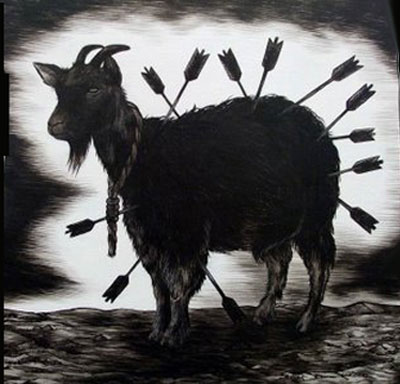
This attitude towards evil, and the apparent circumventing of it, flatter the primitive tendency in us to shut our eyes to evil and drive it over some frontier or other, like the Old Testament scapegoat, which was supposed to carry the evil into the wilderness.

But if one can no longer avoid the realization that evil, without man’s ever having chosen it, is lodged in human nature itself, then it bestrides the psychological stage as the equal and opposite partner of good.

This realization leads straight to a psychological dualism, already unconsciously prefigured in the political world schism and in the even more unconscious dissociation in modern man himself. The dualism does not come from this realization; rather, we are in a split condition to begin with.

It would be an insufferable thought that we had to take personal responsibility for so much guiltiness. We therefore prefer to localize the evil with individual criminals or groups of criminals, while washing our hands in innocence and ignoring the general proclivity to evil.

This sanctimoniousness cannot be kept up, in the long run, because the evil, as experience shows, lies in man – unless, in accordance with the Christian view, one is willing to postulate a metaphysical principle of evil.

The great advantage of this view is that it exonerates man’s conscience of too heavy a responsibility and fobs it off on the devil, in correct psychological appreciation of the fact that man is much more the victim of his psychic constitution than its inventor.

Considering that the evil of our day puts everything that has ever agonized mankind in the deepest shade, one must ask oneself how it is that, for all our progress in the administration of justice, in medicine and in technology, for all our concern for life and health, monstrous engines of destruction have been invented which could easily exterminate the human race.

No one will maintain that the atomic physicists are a pack of criminals because it is to their efforts that we owe that peculiar flower of human ingenuity, the hydrogen bomb.

The vast amount of intellectual work that went into the development of nuclear physics was put forth by men who devoted themselves to their task with the greatest exertions and self-sacrifice and whose moral achievement could just as easily have earned them the merit of inventing something useful and beneficial to humanity.

But even though the first step along the road to a momentous invention may be the outcome of a conscious decision, here, as everywhere, the spontaneous idea – the hunch or intuition – plays an important part.

In other words, the unconscious collaborates too and often makes decisive contributions.

So it is not the conscious effort alone that is responsible for the result; somewhere or other the unconscious, with its barely discernible goals and intentions, has its finger in the pie.

If it puts a weapon in your hand, it is aiming at some kind of violence.

Knowledge of the truth is the foremost goal of science, and if in pursuit of the longing for light we stumble upon an immense danger, then one has the impression more of fatality than of premeditation.

It is not that present-day man is capable of greater evil than the man of antiquity or the primitive. He merely has incomparably more effective means with which to realize his proclivity to evil.

As his consciousness has broadened and differentiated, so his moral nature has lagged behind. That is the great problem before us today. Reason alone does not suffice.

— From The Undiscovered Self (1957).

“i made a film that you will never see” (2015)

A short film about Michiel Kruger, who despite being blind, has set and broken various sports records the last 56 years. At the age of 70 he still holds 2 world records and runs a piano tuning business in Bloemfontein.

Director – Elmi Badenhorst
Camera and Edit – Jaco Bouwer
Music Composition – Braam Du Toit
Script and concept – Annelize Frost and Elmi Badenhorst
Ruan Scott – Subtitles

jimi hendrix experience – all along the watchtower (1968)

Dylan described his reaction to hearing Hendrix’s version of his song: “It overwhelmed me, really. He had such talent, he could find things inside a song and vigorously develop them. He found things that other people wouldn’t think of finding in there. He probably improved upon it by the spaces he was using. I took license with the song from his version, actually, and continue to do it to this day.”

— “Interview with Dylan: 09/29/95”. Fort Lauderdale Sun Sentinel.