


 Glenda Kemp’s blog is HERE. Also check out this fascinating interview that Genevieve Louw did with her in 2008.
Category Archives: art
a special message from jimmy rage
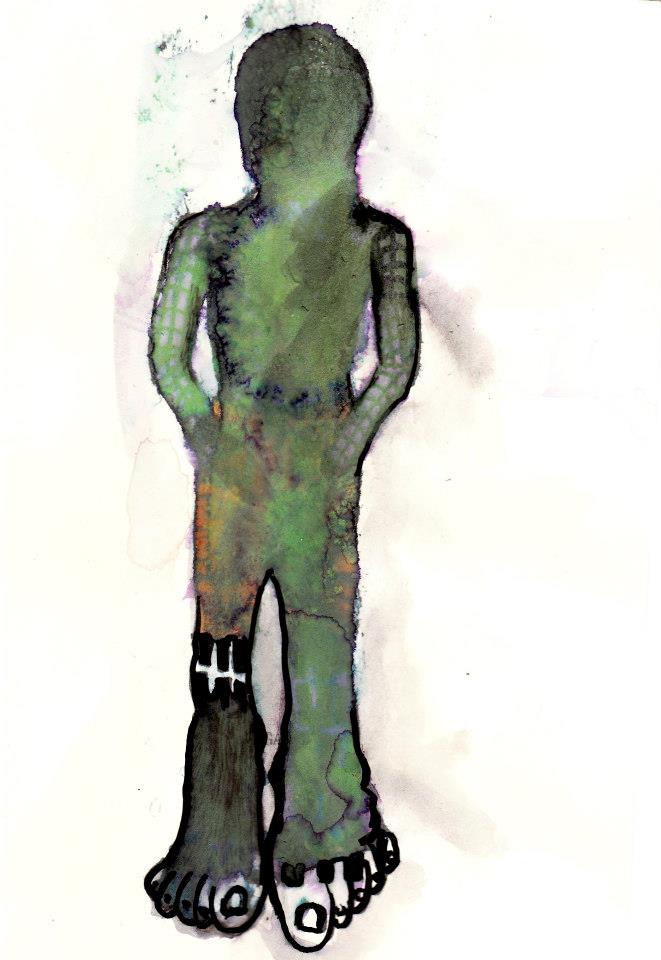 each and every one one of us has a book of narratives, that we read write and become part of. each chapter verse and paragraph tells our stories and as time passes, we become familiar with our own characters and our own cast of characters become familiar with us.
there is the longing, the dreaming, the ambition, the beauty and the ugliness and above all, there is the love.. the love of others, the love of others like self and the love of self..
the hardest part though, is to be and become part of the narrative..beauty.. to not negate from its positivity its validity as a document to the light rays streaming through our windows of hope and courage to go forward.
the sun rises and sets in a distant sky, as trees bend, bow, blow leaves, jingling. we are hushed into our own simplicities, the grace of intelligence..
man woman or child is the subtotal of a life lived and hoped for.. the narrative of distant and close dreams are but moments, in our own being, where we are awake and know and overstand that it is in the power of our being that we learn that our own empowerment is the storehouse.. that we are capable of more than the small parts that make up the whole.
love, romance, career, children are all part of the course of our own destined future, but the inner self, the inner voice is the calling to follow your own path, all love, and in doing so .. this becomes a mantra, a calling even..
colleen – i’ll read you a story
“I’ll Read You a Story” appears on The Golden Morning Breaks; also on Colleen Et Les Boîtes À Musique.
colleen – the sad panther
Appears on the album Colleen… Et Les Boîtes à Musique.
noise and capitalism
“This book, Noise and Capitalism, is a tool for understanding the situation we are living through, the way our practices and our subjectivities are determined by capitalism. It explores contemporary alienation in order to discover whether the practices of improvisation and noise contain or can produce emancipatory moments and how these practices point towards social relations which can extend these moments.
If the conditions in which we produce our music affects our playing then let’s try to feel through them, understand them as much as possible and, then, change these conditions.
If our senses are appropriated by capitalism and put to work in an ‘attention economy’, let’s, then, reappropriate our senses, our capacity to feel, our receptive powers; let’s start the war at the membrane! Alienated language is noise, but noise contains possibilities that may, who knows, be more affective than discursive, more enigmatic than dogmatic.
Noise and improvisation are practices of risk, a ‘going fragile’. Yet these risks imply a social responsibility that could take us beyond ‘phoney freedom’ and into unities of differing.
We find ourselves poised between vicariously florid academic criticism, overspecialised niche markets and basements full of anti-intellectual escapists. There is, after all, ‘a Franco, Churchill, Roosevelt, inside all of us…’ yet this book is written neither by chiefs nor generals.
Here non-appointed practitioners, who are not yet disinterested, autotheorise ways of thinking through the contemporary conditions for making difficult music and opening up to the wilfully perverse satisfactions of the auricular drives.”
Sound interesting? HERE, DOWNLOAD NOISE AND CAPITALISM FREE.
Edited by Mattin Iles and Anthony Iles
Contributions from Ray Brassier, Emma Hedditch, Matthew Hyland, Anthony Iles, Sara Kaaman, Mattin, Nina Power, Edwin Prévost, Bruce Russell, Matthieu Saladin, Howard Slater, Csaba Toth, Ben Watson.
More details from the publishers, Arteleku Audiolab (Kritika series), Donostia-San Sebastián (Gipuzkoa)
Publication date: September 2009
paul sharits – n:o:t:h:i:n:g
A portion of the opening movement of Paul Sharits’ 1968 film.
N:O:T:H:I:N:G is a film deplenished of all, of any signified stance and involved only in the manner of film itself. Just the drawing of a bulb, the projector light and a chair remain in the space of the screen. But these are just random disruptions of monochrome frames.
The whole film is built as a vibration of rhythms, ‘energy-colour’, based on the structure of the Tibetan mandala of five Dyani Bouddhas. Formally the composition is centred on the psychic flickering caused by four symbolic colours: white, yellow, red and green. The more the film is next to the centre that is the centre of the mandala, the empty point, the more the monochrome frames flicker faster, up to invert the speed in the second part of the film (bearing off the centre), the retrograde of the first one. Sharits constructed the structure of the film about the ‘Om’ Nembutsu droning: nevertheless the film can be considered as the visual translation of this sound.
“The screen, illuminated by Paul Sharits’ N:O:T:H:I:N:G, seems to assume a spherical shape, at times – due, I think, to a pearl-like quality of light his flash-frames create… a baroque pearl, one might say – wondrous!… One of the most beautiful films I’ve seen.” – Stan Brakhage
“You are pulled into the world of color, your color senses are expanded, enriched. You become aware of changes, of tones around your own daily reality. Your vision is changed. You begin to see light on objects around you… Your experience range is expanded. You have gained a new insight. You have become a richer human being.” – Jonas Mekas
t,o,u,c,h,i,n,g
TOUCHING is a 1969 short film by Paul Sharits.
“There are moments in cinematic art when the narrative of the film is subjectively implied and subsequently written by the viewer. While this is common to most structural and lyrical films in the experimental genre, none hits louder than T,O,U,C,H,I,N,G, an angry and demonic piece that simultaneously lulls you into awareness and hypnotizes you into an emotive overload.”
duke ellington – the mooche
lipstiffie
Facebook status update, this evening:
Storyboarding is strangely interesting when it gives a view into how different nation-states construct and respond to sales stereotypes. I’m doing a lipstick ad for actual French people from Paris right now, and it is noticeably stripped of that subtext one inevitably finds in American or South African ads that says, “Don’t worry, she’s not dangerous and what she really wants is to be your submissive little wifey.” This ad would freeze the testicles off a Sarf-Effriken jock, even though all it’s about is glamour.
It’s odd, because it is all about women achieving an aesthetic perfection so intense they are geisha-like objects of contemplation, yet the glamour is also tangibly an end in itself which doesn’t necessarily include men. It’s not like we don’t already know this, but it brought to my attention that South African culture which considers itself sophisticated is not only colonial but downright rural. Sexuality is confined to breeding, like farmyard-style.
Comments:
Lynne: Sounds like fun for a change! X are you gonna buy the lipstick? X
Lizza: Being briefed for a storyboard doesn’t necessarily go as far as anyone telling me what the product is! This time I needed to be told what it looked like, but I didn’t get the brand. Probably a load of bollocks. For all I know this could be the French version of Sarie magazine – I really wouldn’t be able to spot the difference.
maya deren/alexander hammid – meshes of the afternoon
Meshes of the Afternoon (1943) is a short experimental film directed by wife and husband team, Maya Deren and Alexander Hammid. The film’s narrative is circular, and repeats a number of psychologically symbolic images, including a flower on a long driveway, a key falling, a door unlocked, a knife in a loaf of bread, a mysterious Grim Reaper-like cloaked figure with a mirror for a face, a phone off the hook and an ocean. Through creative editing, distinct camera angles, and slow motion, this surrealist film depicts a world in which it is more and more difficult to catch reality.
“This film is concerned with the interior experiences of an individual. It does not record an event which could be witnessed by other persons. Rather, it reproduces the way in which the subconscious of an individual will develop, interpret and elaborate an apparently simple and casual incident into a critical emotional experience.”
— Maya Deren on Meshes of the Afternoon, from DVD release Maya Deren: Experimental Films 1943–58.
The film was originally silent – the soundtrack, by Deren’s third husband, Teiji Ito, was only added in 1959.
tale of tales (skazka skazok)
Astoundingly beautiful animation masterpiece by Yuri Norstein (USSR,1979, 28 min).
From Wikipedia:
Tale of Tales, like Tarkovsky’s Mirror, attempts to structure itself like a human memory. Memories are not recalled in neat chronological order; instead, they are recalled by the association of one thing with another, which means that any attempt to put memory on film cannot be told like a conventional narrative. The film is thus made up of a series of related sequences whose scenes are interspersed between each other. One of the primary themes involves war, with particular emphasis on the enormous losses the Soviet Union suffered on the Eastern Front during World War II. Several recurring characters and their interactions make up a large part of the film, such as the poet, the little girl and the bull, the little boy and the crows, the dancers and the soldiers, and especially the little grey wolf (Russian: се́ренький волчо́к, syeryenkiy volchok). Another symbol connecting nearly all of these different themes are green apples (which may symbolise life, hope, or potential).
Yuriy Norshteyn wrote in Iskusstvo Kino magazine that the film is “about simple concepts that give you the strength to live.”
that very night in max’s room a forest grew . . . and the walls became the world all around
treading through an untrimmed memory

Tran Nguyen – Treading Through An Untrimmed Memory
Tran Nguyen is a Georgia-based artist. Born in Vietnam and raised in the States, she received a BFA from Savannah College of Art and Design in 2009. She is fascinated with creating visuals that can be used as a psycho-therapeutic support vehicle, treading the mind’s surreal dreamscape. Her paintings are created with a delicate quality using color pencil and thin glazes of acrylic on paper. Tran’s oeuvre has been exhibited with galleries in New York, Los Angeles, Miami, London, and Barcelona. “ I find interest in illustrating the universal emotions we come across in everyday living — emotions that are tucked away, deep inside our psyches.”
Her blog is HERE.
viva gluttony
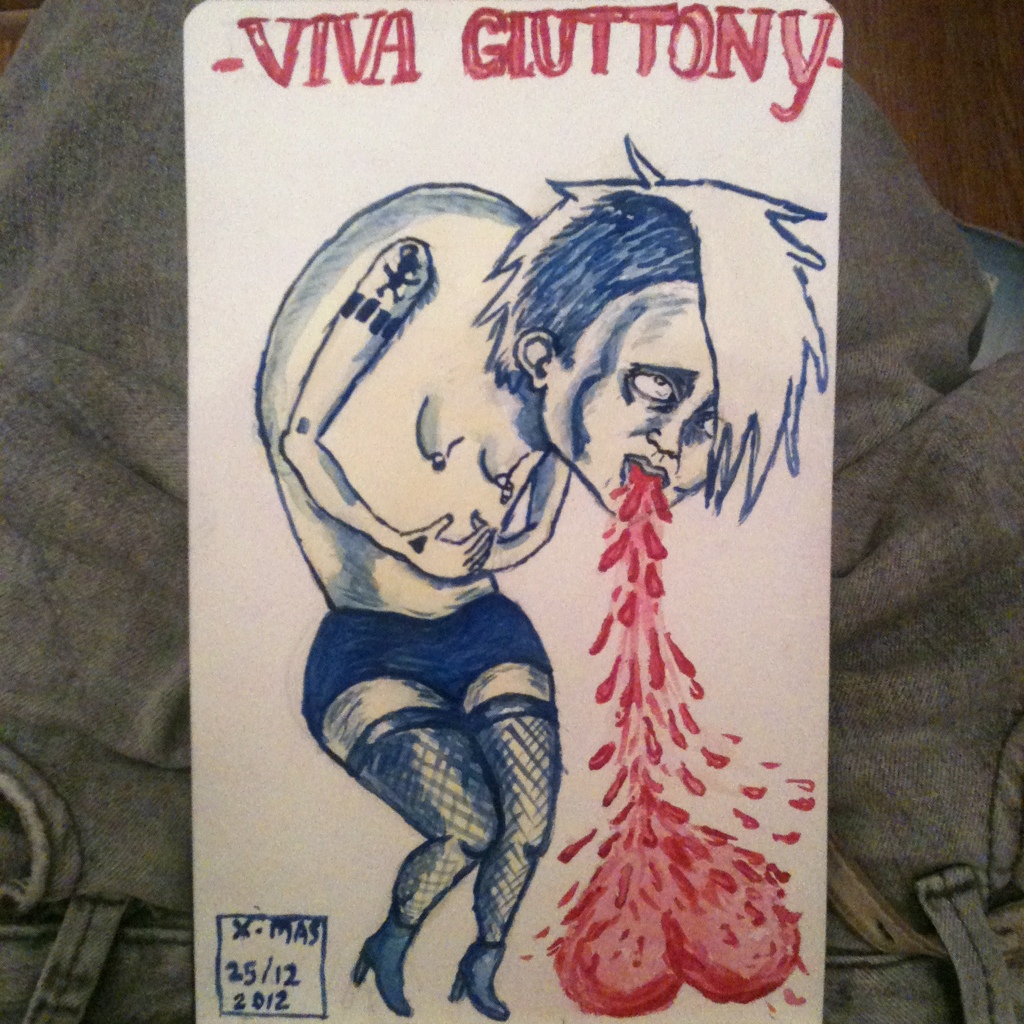
Diary 25/12/12 (On xmas evening, i ate so much meat. I felt like coughing it up. Puking a warm sour slimy heartshaped pile of meat on the diningtable.. A lil token of appreciation for my mom, who prepared this feast of gluttony)
herman’s bed

photograph by Alec Soth.
from the series ‘sleeping by the mississippi’.
http://alecsoth.com/photography/projects/sleeping-by-the-mississippi/
nora keyes – tomb song
Nora Keyes – Songs to Cry by for the Golden Age of Nothing
in the cathedral
Kip (Naveen Andrews) and Hana (Juliette Binoche) in The English Patient (1996), directed by Anthony Minghella, based on the book by Michael Ondaatje.
opening your heart hurts
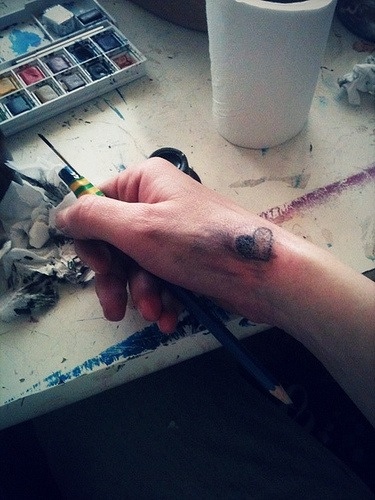
DIY handpoke
pipilotti rist – ever is over all (excerpt)
1997. Video installation, two overlapping projections (color, sound with Anders Guggisberg), Dimensions variable. Fractional and promised gift of Donald L. Bryant, Jr. © Pipilotti Rist
jenny morgan


untitled, 1923

Man Ray – Untitled, 1923
“Between the demand to be clear and the temptation to be obscure, impossible to decide which deserves more respect.”
~ E.M.Cioran, from Anathemas and Admirations
nobunny – blow dumb
I like it,that its a;velvet underground ripoff,but its not annoying..i love this song
shocking! the real purpose of your life!
And you thought you knew! Produced by Trey Parker and Matt Stone.
complete notes on the dissection of cadavers
Complete Notes on the Dissection of Cadavers is an Edo-period Japanese anatomical atlas by Kawaguchi Shinnin (1736-1811) with woodcut illustrations by Aoki Shukuya (d. 1802), published in Kyoto in 1772.


More illustrations from the book HERE.
“unbound” tonight at greatmore studios’ 2012 showcase
Fleurmach highly recommends that you check out Greatmore Studios‘ Showcase 2012, particularly tonight’s live improvisational performance, entitled ‘Unbound’. Don’t miss this once-off collaboration, involving sound by musicians Alex Bozas, Garth Erasmus and Niklas Zimmer, dance by Jacki Job and photography of the performance projected live by Noncedo Gxekwa.
When? Wednesday 28 November (TONIGHT!). Doors open 18h00. Live performance commences 18h30.
Where? 47-49 Greatmore St, Woodstock, Cape Town. Map HERE.
The live performance will accompany an extensive exhibition by resident artists, visiting artists and guests, which promises to be really worthwhile. More info HERE.

Greatmore Studios is an artist-run initiative based in Cape Town. It revolves around a pool of permanent artists, an international visiting-artists-in-residency programme and a range of workshops and other activities. This initiative forms part of the Triangle Arts Trust, a United Kingdom-based organisation that facilitates an international network of artist-led workshops and residencies. This association affords artists access to information and opportunities to exchange ideas and skills with other artists around the world.
ana teresa barboza
Si quieres puede ser puro
Pero para mí puro es salvaje
Como el primer día del sol
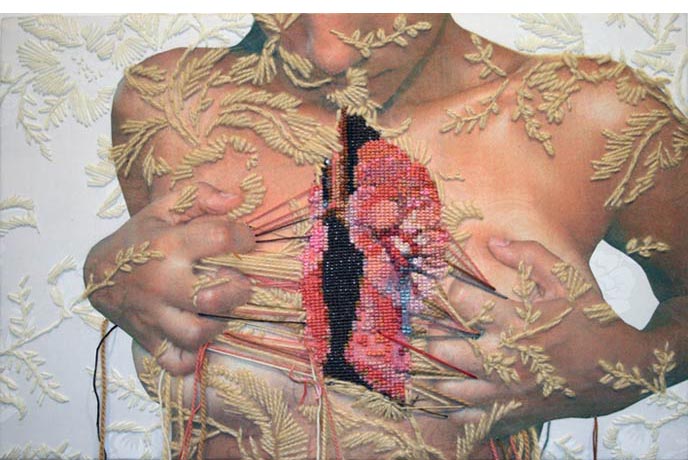
Ana Teresa Barboza – embroidery and photo transfer on fabric
Check out more of Peruvian artist Ana Teresa Barboza’s fascinating work on her blog, HERE.
marie menken – arabesque for kenneth anger (1961)
“There is no why for my making films. I just liked the twitters of the machine, and since it was an extension of painting for me, I tried it and loved it. In painting I never liked the staid and static, always looked for what would change the source of light and stance, using glitters, glass beads, luminous paint, so the camera was a natural for me to try—but how expensive!” – Marie Menken
16mm, color, sound, 4 min
Original score by Teiji Ito. “A new sound version of this classic. It is a beautiful experience to see her fabulous shooting. The cutting is just as fabulous and is something for all to study; the new score by Teiji Ito is ‘out of this world’ with its many-leveled instrumentation. Marie says ‘These animated observations of tiles and Moorish architecture were made as a thank-you to Kenneth for helping to shoot on another film in Spain.’ Shot in the Alhambra in one day.” – Gryphon Film Group
eva

Old work
feedbackpiece
An improvisation with microphone, guitar effects pedal and bongos.
tiqqun – la congiura sacra – san francisco bay blues
Tiqqun – La Congiura Sacra – Operation Acephale 2 – San Francisco Bay Blues
 fleurmach