From the album At the Down-Turned Jagged Rim of the Sky (Kranky, 2012). Video featuring Claudia Cardinale.
From the album At the Down-Turned Jagged Rim of the Sky (Kranky, 2012). Video featuring Claudia Cardinale.

Bill Henson – Untitled #20 (2003-3)
C-type print, Roslyn Oxley Gallery, Sydney
Bill Henson (born 1955) is an Australian contemporary art photographer.
Henson’s photographs reflect an interest in ambiguity and transition. The use of chiaroscuro is common throughout his works. His photographs are painterly and often presented as diptychs, triptychs and other groupings.
Henson’s works often meditate on the categories of and relationships between male and female; youth and adulthood; day and night; light and dark; nature and civilisation. His images often use flattened perspective and tend towards abstraction. The faces of the subjects are often blurred or partly shadowed and do not directly face the viewer.
According to Crawford, Henson presents “adolescents in their states of despair, intoxication and immature ribaldry”. He has said that these “moments of transition and metamorphosis are important in everyone’s lives”.
Information taken from HERE.
Check out more of Henson’s work HERE.
My favourite version of this Weill/Brecht classic, ever.
“Pirate Jenny” (German: “Seeräuberjenny”) is a well-known song from The Threepenny Opera by Kurt Weill, with lyrics by Bertolt Brecht. The English lyrics are by Marc Blitzstein. This cover by Shilpa Ray, Nick Cave and Warren Ellis was published in February 2013 on Sons of Rogues Gallery: Pirate Ballads, Sea Songs and Chanteys, a Hal Willner-produced compilation album of songs performed by a roster of artists which also includes Tom Waits, Shane MacGowan, Iggy Pop, Patti Smith, Macy Grey, Johnny Depp, Frank Zappa and Richard Thompson.
The full movie is here:
(or was…)
Archival interview with David Cronenberg from Bombsite (1986)
Bette Gordon (BG) Are your nightmares like your movies? Do you actually see your movie images in your dreams?
David Cronenberg (DC) Rarely. My images come out of the process of making film. I do really think that movies work on the level of dream logic. However realistic or narrative they might like to think they are, they are dreamlike.
BG You, as a director, have an incredible ability to tap into the unconscious.
DC I was once on a talk show with a psychiatrist who worked at the Clark Institute with criminals. He had seen my film, Videodrome and said to me, “I’m almost afraid to be sitting here next to you.” He was totally mystified as to how I could empathize with those states of mind and he obviously, could not. It is mostly intuitive with me. One of the reasons I make a movie is that I’m then in a position where I have to analyze and I enjoy that process.
BG In They Came from Within there was a line of dialogue—”Man thinks too much, he’s lost touch with the body, with instincts. Too much brain and not enough guts.” Do you think the mind is stronger than the body?
DC No. I think the quote is particular to that film. What interests me is the mind/body schism.
BG What do you mean by mind/body schism?
DC I think the mind grows out of the body. I don’t believe in an afterlife. I don’t see the mind or the spirit or the soul continuing after our body dies. The mind and body are completely dependent and interrelated. The mind is somehow organic and physical. It’s only our perception and our culture that keeps them separate.
BG What about the mind creating its own monsters in a sense, that the monster comes from within the mind. Like in Dead Ringers for example, or in Videodrome where it’s the mind that is completely in charge of the body.
DC In as much as the mind is ever in charge of anything. I don’t think it is always in control.
BG Or in Scanners where through mind control, you can . . .
DC Affect the body. But you see, I think everybody does that. I don’t think it’s just Western culture, other cultures even accentuate it more by saying the body’s nothing; it’s only temporary and the mind and the spirit are eternal. I think that’s very destructive. It’s not true. All philosophical, metaphysical and religious forces should be concentrating on trying to form a perception and reality for ourselves that integrates the two. And that would include coming to terms with death as a physical event rather than trying to evade it.
BG So how would you come to terms with death?
DC There’s a Japanese religion that thinks of all of life as a preparation for death, which to the Western mind seems like a very morbid approach to life. But if you think of death as a true end of something, of a process, it makes perfect sense. There we get into the old idea of Western culture being death denying, but I actually think Eastern culture is too. Because they try to trivialize death as being not important.
BG So it falls somewhere between the two as being very important and not important at all.
DC One of the main subjects of all of my films is exactly that. In Dead Ringers you get a body split into two (the twins) with basically, one mind. Just doing that is like an experiment in a lab—which all my movies really are. I set out to see how they work, to illuminate something for myself by doing these experiments.

Videodrome – with James Woods and Debbie Harry
BG There is something about the medical profession in all of your films.
DC Scientists and doctors to me, are at the leading edge of what all human beings do all of the time; which is to change, everything. We’ve never been satisfied with what we’re given. We don’t accept the earth as a given. We change our body chemistry, our physiology, our biology, our biochemistry. We clear the forest, we build our own environment, we climate control it . . . And, the interface between that impulse and the human body often is doctors, biologists, and biochemists.
BG Were you a biochemist?
DC I did go into biochemistry at the University of Toronto. But when I came face to face with what science required, I realized that my temperament was much more suited to some form of art; writing or whatever. I didn’t think of film at the time. I found I would prefer to invent my own science rather than spend two years with rats in a lab getting results.
BG There’s an ambivalence for the medical/science profession in all of your films. You don’t really have villains in the film, nobody’s quite evil . . .
DC That’s right. It is ambivalence. Because I think that they’re heroic even when they’re crazed. I think that being crazed and obsessed is part of being heroic. You don’t get one without the other. Ambition is something else. It’s not ambition in the material sense. My characters are obsessed with discovery and that does excite me and I do identify with that. A good creative scientist is as good as a good creative artist. No question in my mind.
BG What is your notion of the hero? You said your characters are heroic even when they are crazed.
DC Yes, maybe even especially because they’re crazed. I’m obviously drawn to people as main characters who are not embedded so completely in their culture that they can’t see any . . . a visionary’s process . . . people who are jarred into being outside. Continue reading
Aimee Mann in 1986.
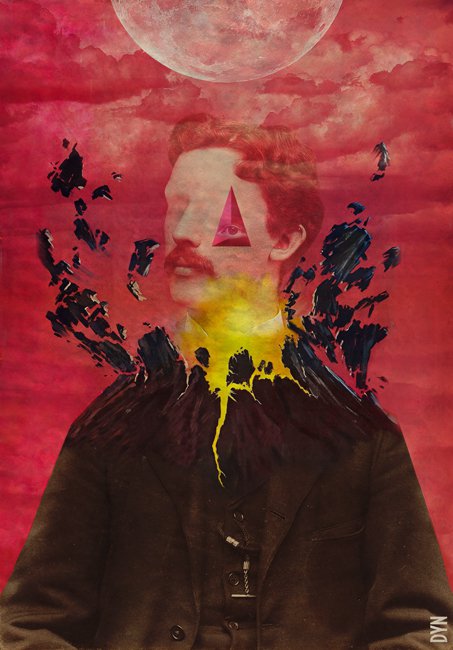
Albane Simon – ‘Eruption’
Mondays are meshed with Tuesdays
and the week with the whole year.
Time cannot be cut
with your weary scissors,
and all the names of the day
are washed out by the waters of night.
No one can claim the name of Pedro,
nobody is Rosa or Maria,
all of us are dust or sand,
all of us are rain under rain.
They have spoken to me of Venezuelas,
of Chiles and of Paraguays;
I have no idea what they are saying.
I know only the skin of the earth
and I know it is without a name.
When I lived amongst the roots
they pleased me more than flowers did,
and when I spoke to a stone
it rang like a bell.
It is so long, the spring
which goes on all winter.
Time lost its shoes.
A year lasts four centuries.
When I sleep every night,
what am I called or not called?
And when I wake, who am I
if I was not I while I slept?
This means to say that scarcely
have we landed into life
than we come as if new-born;
let us not fill our mouths
with so many faltering names,
with so many sad formalities,
with so many pompous letters,
with so much of yours and mine,
with so much signing of papers.
I have a mind to confuse things,
unite them, bring them to birth,
mix them up, undress them,
until the light of the world
has the oneness of the ocean,
a generous, vast wholeness,
a crackling, living fragrance.
December 2012, Cape Town inner city.
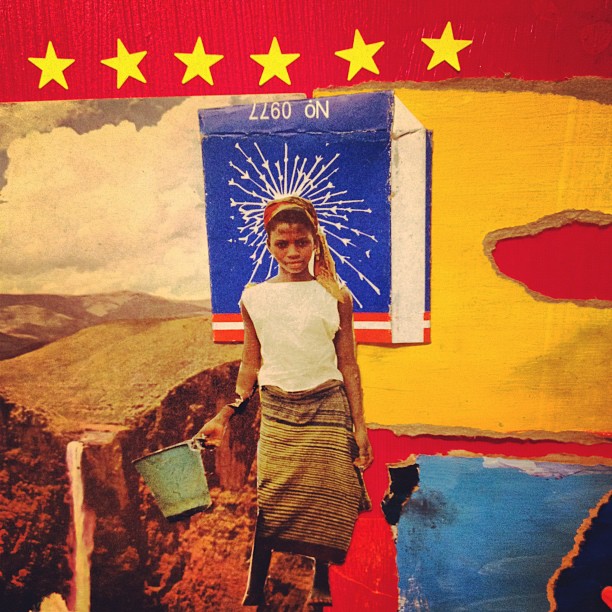
Here are three very different versions out of the countless recordings of this whimsical old standard written by Harold Arlen, with lyrics by E. Y. Harburg and Billy Rose.
The same year it was published (1933), Cliff Edwards, also known as “Ukulele Ike” (and later the voice of Disney’s Jiminy Cricket!), recorded this rendition, with his charming tenor and the sweetest little mouth trumpet solo:
Killer a cappella harmonies from Fiona Apple and Maude Maggart (the pseudonym of Fiona’s elder sister, Amber, a cabaret singer)… Fiona can draw melancholia out of any pretty ditty without being mawkish – I love this about her:
The Miles Davis Sextet, recorded at Apex Studios, New York City, on October 5, 1951.
Personnel:
Miles Davis – Trumpet
Jackie McLean – Alto Sax (sits out)
Sonny Rollins – Tenor Sax
Walter Bishop Jr. – Piano
Tommy Potter – Bass
Art Blakey – Drums
From the album Circuses and Bread (Factory Benelux,1986)
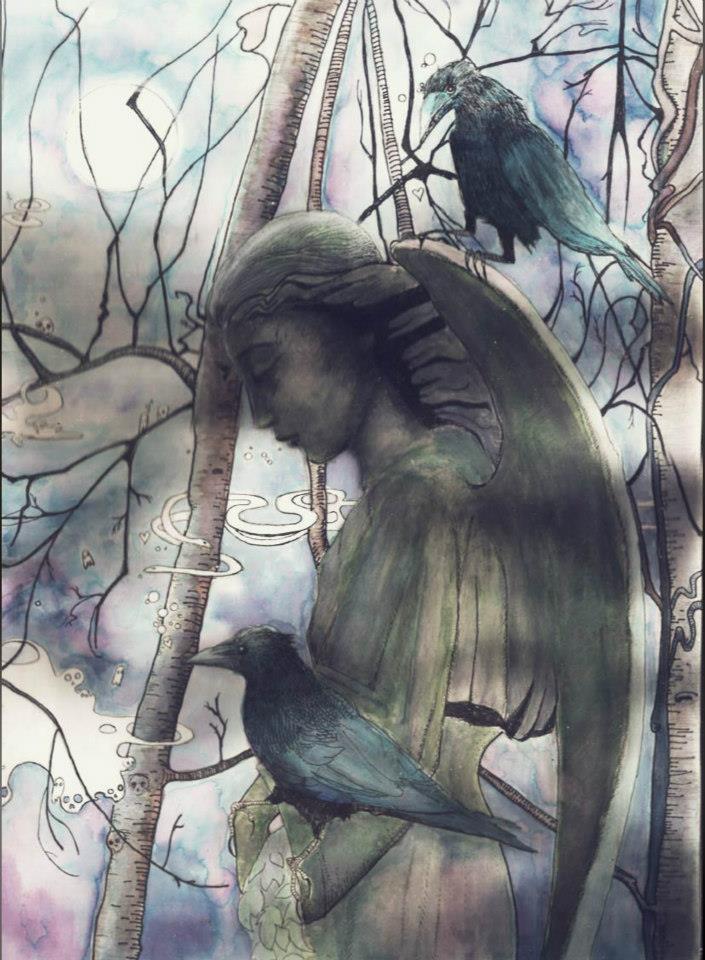
Illustration by Marga Duggan. All Rights Reserved.
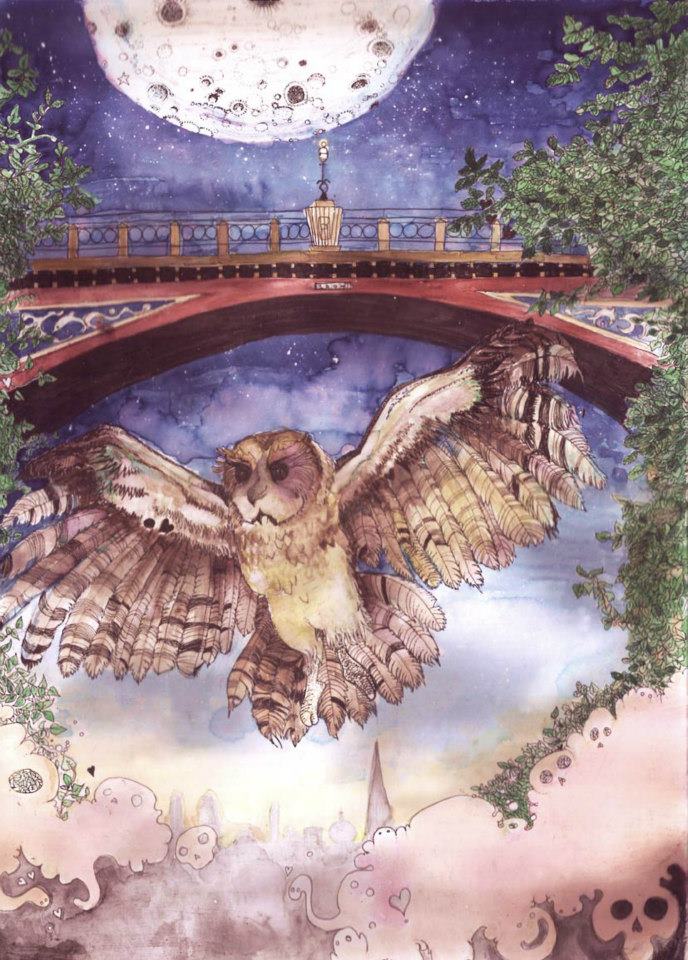
Illustration by Marga Duggan. All Rights Reserved.
Owl flying under the ‘suicide bridge’, Archway Road, Highgate. I never see them, but I hear them.
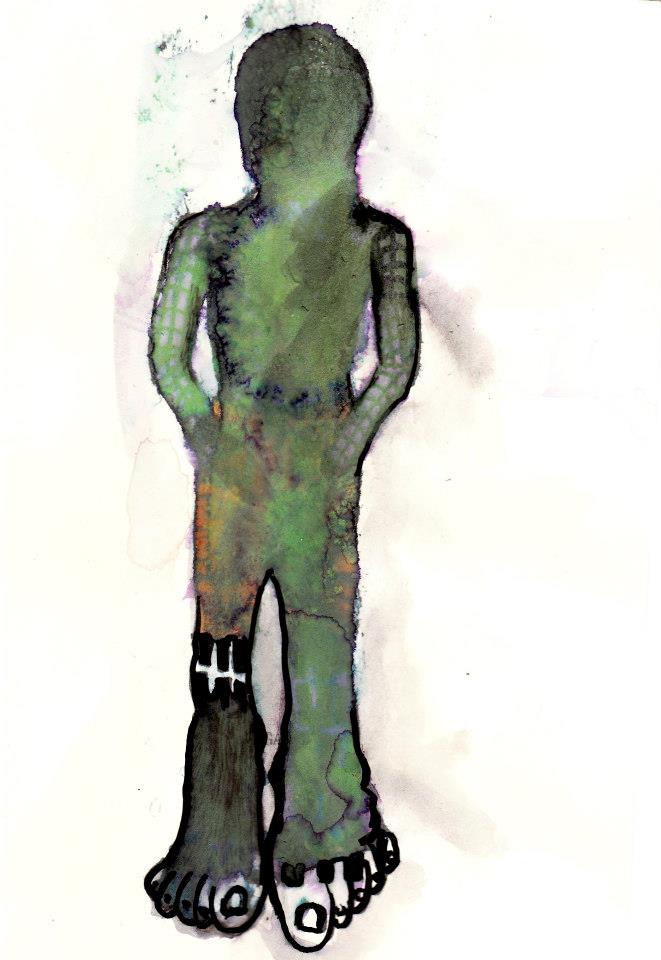 each and every one one of us has a book of narratives, that we read write and become part of. each chapter verse and paragraph tells our stories and as time passes, we become familiar with our own characters and our own cast of characters become familiar with us.
there is the longing, the dreaming, the ambition, the beauty and the ugliness and above all, there is the love.. the love of others, the love of others like self and the love of self..
the hardest part though, is to be and become part of the narrative..beauty.. to not negate from its positivity its validity as a document to the light rays streaming through our windows of hope and courage to go forward.
the sun rises and sets in a distant sky, as trees bend, bow, blow leaves, jingling. we are hushed into our own simplicities, the grace of intelligence..
man woman or child is the subtotal of a life lived and hoped for.. the narrative of distant and close dreams are but moments, in our own being, where we are awake and know and overstand that it is in the power of our being that we learn that our own empowerment is the storehouse.. that we are capable of more than the small parts that make up the whole.
love, romance, career, children are all part of the course of our own destined future, but the inner self, the inner voice is the calling to follow your own path, all love, and in doing so .. this becomes a mantra, a calling even..
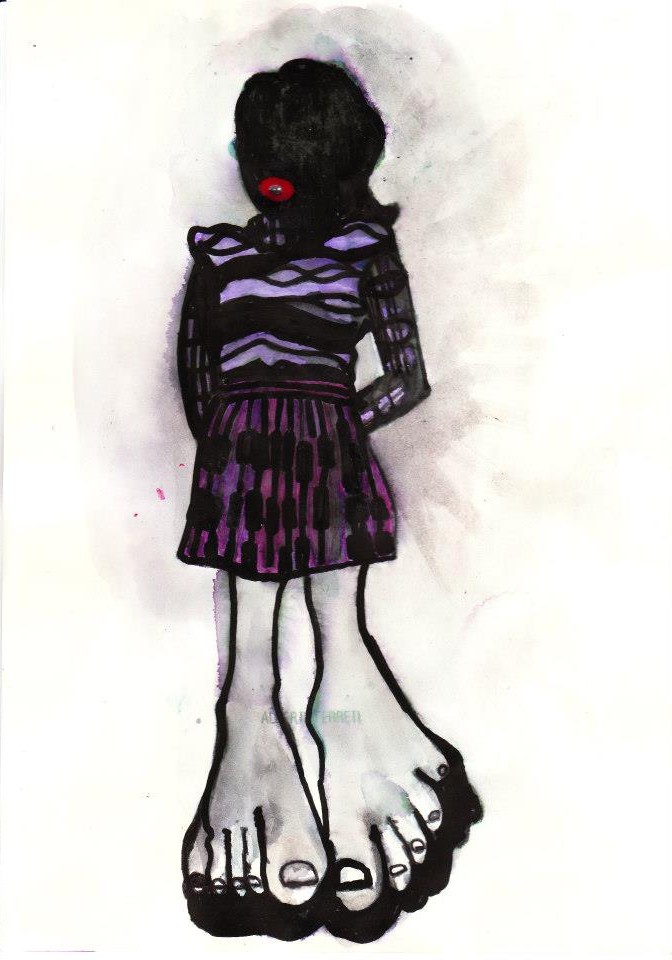
It’s New Year’s Day, away for the weekend with a smallish group of friends… people on different continents, in one place in my mind. We leftovers – avatars of Stella, Michelle, Marco and me, I think it might be – wander back through in the early morning to the communal lapa sort of place where all the dancing had been, the remains of last night’s party trodden into the ground, our affect similarly flattened. The day is wrapped in a quiet mist blanket, grey and clammy. All the couples are still in bed.
“OK, we need music.”
I pick my way over to the old boombox, there on a table surrounded by empty cups, the dregs of stale liquor… Scratching around blearily, I find a Nina Simone tape. (CASSETTE TAPES? WTF, dreambrain?) Anyway, I want to put on “He’s Got the Whole World in His Hands” for we souls with nowhere to be curled into.
I slide the wonky cassette into the player, reach out to press play, and my finger can’t. The buttons are melted, changed into some unearthly goo. Not sticky, not hot, not cold, just melted, uncooperative and soft in an alien, irreparable way. This weird flux will crust over, re-harden as the day wears on into a single mass of equally unbiddable plastic.
Someone must have been using a lighter to illuminate what they were doing during last night’s revelry, I suppose. What a bright idea it must have seemed in that moment, but now we can’t hear the one song that I was hoping might make us feel sort of OK about living through another year alone on Earth.
The marionette scene from Krzysztof Kieslowski’s The Double Life of Veronique (1991). Watch the full film HERE.
“The director’s international breakthrough remains one of his most beloved films, a ravishing, mysterious rumination on identity, love, and human intuition. Irène Jacob is incandescent as both Weronika, a Polish choir soprano, and her double, Véronique, a French music teacher. Though unknown to each other, the two women share a mysterious and emotional bond that transcends language and geography, which Kieslowski details in gorgeous reflections, colours, and movements. Aided by Slawomir Idziak’s shimmering cinematography and Zbigniew Preisner’s haunting, operatic score, Kieslowski creates one of cinema’s most purely metaphysical works. The Double Life of Veronique is an unforgettable symphony of feeling.
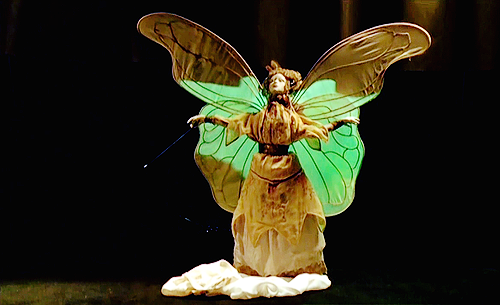
“Krzysztof Kieslowski focuses on identity using actress Irene Jacobs in the dual role of French music teacher Veronique and Polish soprano Weronika – both born on the same day. Metaphysically they are aware of each other’s counterpart – this harkens back to the director’s penchant for fate, chance and circumstance,and we envision a possible meeting of the intertwined souls… Our unspoken desire for a mirrored being – who can non-verbally share our most intimate loves and joys – is the ultimate expression of personal support… Overall, an ambiguous and enigmatic offering, this is a film that clings to you for years after viewing. A true masterpiece of cinema.”
~ Gary W. Tooze
“I’ll Read You a Story” appears on The Golden Morning Breaks; also on Colleen Et Les Boîtes À Musique.
Appears on the album Colleen… Et Les Boîtes à Musique.
An almost unbearably exquisite video for this, one of the most lovely, profound pop songs on Earth.
“Wave Become Wings” and “Barramundi” from It’ll End in Tears, an album released in 1984 by the label 4AD, using the name “This Mortal Coil” as an umbrella title for a loose grouping of guest musicians and vocalists brought together by label boss Ivo Watts-Russell.
Images taken from Baraka (directed by Ron Fricke).
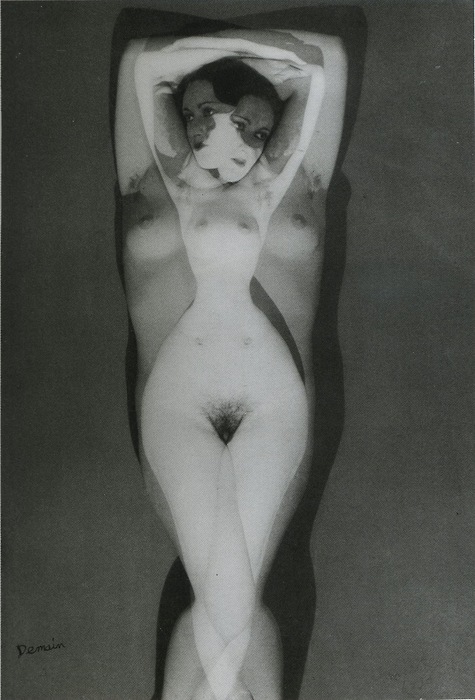
Man Ray – Yesterday, Today, Tomorrow (1924)
This video is from the VHS compilation 23 Eazy Pieces (copyright 1990 by Home Video Club.) The song is from the compilation album Drastic Perversions and the video is by John Zewizz.

Meshes of the Afternoon (1943) is a short experimental film directed by wife and husband team, Maya Deren and Alexander Hammid. The film’s narrative is circular, and repeats a number of psychologically symbolic images, including a flower on a long driveway, a key falling, a door unlocked, a knife in a loaf of bread, a mysterious Grim Reaper-like cloaked figure with a mirror for a face, a phone off the hook and an ocean. Through creative editing, distinct camera angles, and slow motion, this surrealist film depicts a world in which it is more and more difficult to catch reality.
“This film is concerned with the interior experiences of an individual. It does not record an event which could be witnessed by other persons. Rather, it reproduces the way in which the subconscious of an individual will develop, interpret and elaborate an apparently simple and casual incident into a critical emotional experience.”
— Maya Deren on Meshes of the Afternoon, from DVD release Maya Deren: Experimental Films 1943–58.
The film was originally silent – the soundtrack, by Deren’s third husband, Teiji Ito, was only added in 1959.
The erotic is a resource within each of us that lies in a deeply female and spiritual plane, firmly rooted in the power of our unexpressed or unrecognised feeling…
Of course, women so empowered are dangerous. So we are taught to separate the erotic from most vital areas of our lives other than sex…
The principal horror of any system which defines the good in terms of profit rather than in terms of human need, or which defines human need to exclusion of the psychic and emotional components of that need — the principal horror of such a system is that it robs our work of its erotic value, its erotic power and life appeal and fulfilment. Such a system reduces work to a travesty of necessities, a duty by which we earn bread or oblivion for ourselves and those we love. But this is tantamount to blinding a painter and then telling her to improve her work, and to enjoy the act of painting. It is not only next to impossible, it is also profoundly cruel.
. . . [O]nce we begin to feel deeply all the aspects of our lives, we begin to demand from ourselves and from our life-pursuits that they feel in accordance with that joy which we know ourselves to be capable of. Our erotic knowledge empowers us, becomes a lens through which we scrutinize all aspects of our existence, forcing us to evaluate those aspects honestly in terms of their relative meaning within our lives…
During World War II, we bought sealed plastic packets of white, uncolored margarine, with a tiny, intense pellet of yellow coloring perched like a topaz just inside the clear skin of the bag. We would leave the margarine out for a while to soften, and then we would pinch the little pellet to break it inside the bag, releasing the rich yellowness into the soft pale mass of margarine. Then, taking it carefully between our fingers, we would knead it gently back and forth, over and over, until the color had spread throughout the whole pound bag of margarine, thoroughly coloring it.
I find the erotic such a kernel within myself. When released from its intense and constrained pellet, it flows through and colors my life with a kind of energy that heightens and sensitizes and strengthens all my experience.
Lorde, Audre. “Uses of the Erotic: The Erotic as Power.” Sister Outsider: Essays and Speeches. Freedom, CA: Crossing Press, 1984. 53-59.
Astoundingly beautiful animation masterpiece by Yuri Norstein (USSR,1979, 28 min).
From Wikipedia:
Tale of Tales, like Tarkovsky’s Mirror, attempts to structure itself like a human memory. Memories are not recalled in neat chronological order; instead, they are recalled by the association of one thing with another, which means that any attempt to put memory on film cannot be told like a conventional narrative. The film is thus made up of a series of related sequences whose scenes are interspersed between each other. One of the primary themes involves war, with particular emphasis on the enormous losses the Soviet Union suffered on the Eastern Front during World War II. Several recurring characters and their interactions make up a large part of the film, such as the poet, the little girl and the bull, the little boy and the crows, the dancers and the soldiers, and especially the little grey wolf (Russian: се́ренький волчо́к, syeryenkiy volchok). Another symbol connecting nearly all of these different themes are green apples (which may symbolise life, hope, or potential).
Yuriy Norshteyn wrote in Iskusstvo Kino magazine that the film is “about simple concepts that give you the strength to live.”

Tran Nguyen – Treading Through An Untrimmed Memory
Tran Nguyen is a Georgia-based artist. Born in Vietnam and raised in the States, she received a BFA from Savannah College of Art and Design in 2009. She is fascinated with creating visuals that can be used as a psycho-therapeutic support vehicle, treading the mind’s surreal dreamscape. Her paintings are created with a delicate quality using color pencil and thin glazes of acrylic on paper. Tran’s oeuvre has been exhibited with galleries in New York, Los Angeles, Miami, London, and Barcelona. “ I find interest in illustrating the universal emotions we come across in everyday living — emotions that are tucked away, deep inside our psyches.”
Her blog is HERE.
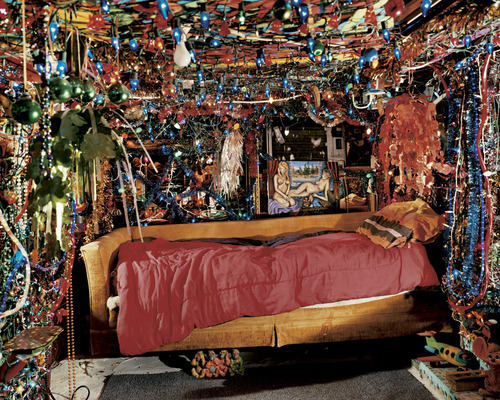
photograph by Alec Soth.
from the series ‘sleeping by the mississippi’.
http://alecsoth.com/photography/projects/sleeping-by-the-mississippi/
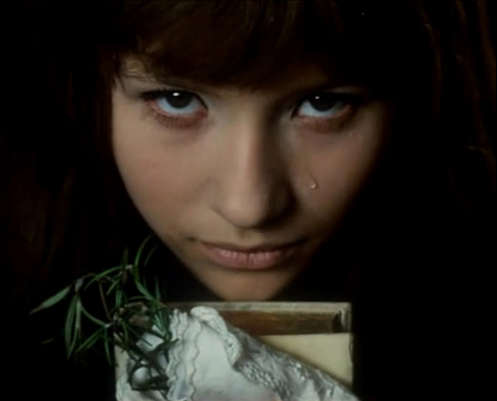
Jaroslava Schallerová in a still from “Valerie a Týden Divu” (Valerie & Her Week of Wonders). Director: Jaromil Jires, 1970
WATCH IT. It’s utterly beautiful.
Nora Keyes – Songs to Cry by for the Golden Age of Nothing
Passion that shouts
Red with anger
I lost myself
Through alleys of mysteries
I went up and down
like a demented train
Don’t take it personal
I choose my own fate
I follow love
I follow hate
Searching for something
that makes hearts move
I found myself
But my best possession
walked into the shade
and threatened to drift away
Don’t take it personal
I choose my own fate
I follow love
I follow hate
For all of myself
I left you behind as if I could
possessed by Quixote’s dream
Went to fight dragons in the land of concrete
Don’t take it personal
I choose my own fate
I follow love
I follow hate
Rolling in pain
discovered what hurts
and tasted hell
infatuated by madness
I danced in flames
and drank in the depth of love
 fleurmach