“In Ursula K. Leguin’s book Gifts, an entire culture lives by the rule of what they call ‘gifts’ – powers to do harm – possessed by certain of its members. Some families possess gifts of Unmaking, where they can turn a farmer’s field into a blackened waste or a puppy into a sack of dissolved flesh. Some possess the ability to create a wasting illness, or blindness, or the gift of calling animals to the hunt.
“By the book’s end, the child at its centre has struggled, against all signs in his culture, to realize something profound and fundamental. The gift they call Unmaking is actually a gift of Making, turned backwards upon itself and rendered unthinkingly into a weapon. The gift of calling animals is turned into a way to hunt them, when it is meant to let humans understand animals and live in balance with them. The wasting disease is the backwards use of a gift of healing illness and old age. He finally asks his sister and closest confidant: what if we are using our gifts backwards? To harm instead of to help? What if they were meant to be used the other way around?”
The opposite of masculine rape culture is masculine nurturance culture: men* increasing their capacity to nurture, and becoming whole.
The Ghomeshi trial is back in the news, and it brings violent sexual assault back into people’s minds and daily conversations. Of course violence is wrong, even when the court system for handling it is a disaster. That part seems evident. Triggering, but evident.
But there is a bigger picture here. I am struggling to see the full shape emerging in the pencil rubbing, when only parts are visible at a time.
A meme going around says ‘Rape is about violence, not sex. If someone were to hit you with a spade, you wouldn’t call it gardening.’ And this is true. But it is just the surface of the truth. The depths say something more, something about violence.
Violence is nurturance turned backwards.
These things are connected, they must be connected. Violence and nurturance are two sides of the same coin. I…
FOR IMMEDIATE RELEASE: FEMINIST AND QUEER DISRUPTION OF WITS SHUTDOWN, 04 APRIL:
Today, 04 April 2016, a group of students attempted to shut down Wits University in the name of Wits Fees Must Fall. These students were comprised of some members of the Wits student body and other popular faces from the #Fallist movements throughout the country. Leaders of this movement have been quoted in media confirming the shutdown as an act in solidarity with suspended, intimidated and deregistered from Wits as of today, 04 April 2016 as well as the continued struggle against outsourcing of workers on university campuses.
Through reliable sources and substantive evidence, we know that the plan to shut down the Wits campus was discussed at a private symposium this past weekend, convened under the banner of Fess Must Fall, the invite to which was not extended to the broader Fees Must Fall movement on different campuses as well as the explicit exclusion of feminist and queer persons. The feminist and queer bodies that have continued to challenge the problematic and archaic investment in the institutions of patriarchal masculinities by student leaders who have continued to erase and silence their narratives and participation in the struggle for free decolonised education and outsourcing.
As a collective, the democratic process of convening and mandating members to attend Fees Must Fall related events has always been one that is consultative and open. The collective mandates representatives at each turn as the movement maintains a flat democratic structure. Therefore, the symposium of the past weekend, facilitated through external funders that seek to infiltrate the movement, and the employ of what we suspect to be non Wits students and members of the public, is one we do not recognise and refuse to be held hostage by its political dictates and ambitions.
We have maintained our integrity as an intersectional; student led non partisan movement that is fighting for free decolonised education and the insourcing of workers.
As a movement, we fully support the disruption of systems of power that have continued to exclude black students from accessing the higher education space as well as the outsourcing and dehumanisation of black workers on campuses. However, we will never tolerate a situation in which these disruptions are allowed to happen at the expense of queer and feminist bodies wherein their bodies are only utilised for the purposes of protecting heterosexual black men on the firing line.
Since the inception of the #Fallist movements, the student’s movements have been plagued by incidences and complaints of latent and rampant misogyny, sexism, patriarchy, homophobia and transmisogyny and this must come to an end. The disruption of the shut down this morning was a step towards disrupting this problematic trend where feminist and queer bodies are only good to be used for protecting heterosexual black men.
The revolution for a decolonised South Africa where free decolonised quality education is a reality for every Black child is one that feminist and queer bodies have maintained will be intersectional or it will not be a revolution at all. However, this afternoon, feminist and queer bodies were assaulted, strangled, kicked and beaten by these black men in the service of the black revolutionary project. Black feminist and queer bodies continue to put their bodies on the line and continue to be disregarded and erased by heterosexual black men.
This practise by heterosexual black men to sacrifice feminist and queer bodies in this revolution will not be tolerated any longer. The exclusion, abuse, assault and endangering of Black Feminist, Queer, Trans and Disabled bodies by heterosexual black men will no longer be tolerated.
All identities of Blackness will be included in this revolution or it will be bullshit!
To all Feminist, Queer, Trans and marginalised bodies, we are convening at the Revolutionary benches (Green benches in front of Umthombo Building) from 10:30 on 05 April 2016.
Melati Suryodarmo (b. in 1969 in Surakarta, Indonesia, lives and works in Braunschweig, Germany) performs EXERGIE – Butter dance, an older piece but shown for the first time at Lilith.
20 blocks of butter in a square on the black dance carpet. Suryodarmo enters the space, dressed in a black tight dress and red high heels. She steps on the pieces of butter. She starts to dance to the sound of Indonesian shamanistic drums. She dances and falls, hitting the floor hard, rising, and continuously being on the verge of standing, slipping and falling in the butter. After twenty minutes Suryodarmo rises one last time, covered in butter, and leaves the space. http://www.melatisuryodarmo.com/
Copyright of the performance: Melati Suryodarmo
Documentation done by Lilith Performance Studio.
Copyright of the documentation belongs to Melati Suryodarmo and Lilith Performance Studio, Malmo, Sweden.
Performances took place 24 – 30 April 2015, presented by Autograph ABP at Rivington Place, London. Presented in two parts, seven evening performances in the gallery followed by a seven-week exhibition, ‘Whip it Good’ retraces the footsteps of colonialism and maps the contemporary reverberations of the triangular slave trade via a series of performances that will result in a body of new ‘action’ paintings.
During each performance, the artist radically transforms the whip – a potent sign and signifier of violence against the enslaved body – into a contemporary painting tool, evoking within both the spectators and the participants the physical and visceral brutality of the transatlantic slave trade. Deep black charcoal is rubbed into the whip, directed at a large-scale white canvas, and – following the artist’s initial ritual – offered to members of the audience to complete the painting.
However, the themes that emerge from Whip It Good trace beyond those of slavery: Ehlers’ actions powerfully disrupt historical relationships between agency and control in the contemporary. The ensuing ‘whipped’ canvases become transformative bearers of the historical legacy of imperial violence, and through a controversial artistic act re-awaken critical debates surrounding gender, race and power within artistic production. What the process generates for the artist, is an intensely focused space in which to make new work as part of a cathartic collaborative process.
Read Chandra Frank’s review of the performance, which also took place in Gallery Momo in South Africa, HERE.
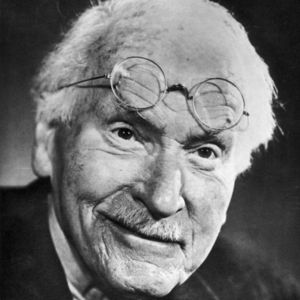
What can a man say about woman, his own opposite? I mean of course something sensible, that is outside the sexual program, free of resentment, illusion, and theory. Where is the man to be found capable of such superiority? Woman always stands just where the man’s shadow falls, so that he is only too liable to confuse the two. Then, when he tries to repair this misunderstanding, he overvalues her and believes her the most desirable thing in the world.
“Protection [of women] is the rock that all men push. We call it our burden, but it’s really our privilege.” — Lou Solverson
Oom Piet * is sitting one night on his farm stoep by a fire. He is alone except for his dog Butch, which lifts its head slowly as a strange figure steps silently into the firelight. Deep in his cups, Piet realises he might be seeing an alien, but it could just be a figment of his inebriation. When his dog wags its tail and goes to greet the tall grey figure, he decides to trust its intuition and, with a slightly trembling hand, offers the large-eyed, curiously sexless creature his glass of brandy.
Turns out, after a couple of dops, that the alien has been studying mankind since it arrived through the medium of Google, so it’s English is pretty much immaculate, though its Afrikaans is at best, patchy. Piet’s English is passable, but he prefers the Taal. The alien’s name is unpronounceable, and from where it hails (though Piet forgets that name too) they have no sexes, replicating from offshoots of their body which are then spliced onto … Anyway, it’s understandably curious about the whole issue of gender, and surmising correctly that Piet knows almost nothing of the experience of being a woman, it asks the oom for some firsthand information about what it means to be a man.
“Well, men are supposed to be stronger than women,” is Piet’s first reaction, to which the alien whips out an iPad and starts checking if this is indeed true. “Well, yes, men are stronger physically,” (1) confirms the alien, enquiring how this factor affects interactions with women.
“Well, we can use our strength to protect our women,” says Piet gallantly.
From what, or whom, the alien wants to know?
Oom Piet thinks a bit. “In the old days, it was against wild animals and other tribes and things, but deesdae, I guess it’s mostly from other men.”
Hélène Cixous’ essay “Castration or Decapitation?” discusses the binary construction of sexuality and society, and how the feminine is defined by the negative: a woman is not a man because she lacks a penis. This “lack” keeps the female subject to definition by the male, as it is seen that because she is the “negative” pole to the man’s “positive”, the woman is concomitantly un-informed, and that therefore it is the position of the man to inform the woman. This imposed silence is what decapitates the feminine metaphorically, precluding her from speaking anything of meaning.
The following is an excerpt from this brilliant essay, translated by Annette Kuhn and published in Signs, Vol. 7, No. 1 (Autumn, 1981), pp. 41-55 (University of Chicago Press) – read the full essay HERE.
* * * * *
… It’s hard to imagine a more perfect example of a particular relationship between two economies: a masculine economy and a feminine economy, in which the masculine is governed by a rule that keeps time with two beats, three beats, four beats, with pipe and drum, exactly as it should be. An order that works by inculcation, by education. It’s always a question of education: an education that consists of trying to make a soldier of the feminine by force, the force history keeps reserved for woman, the “capital” force that is effectively decapitation. Women have no choice other than to be decapitated. The moral is that if they don’t actually lose their heads by the sword, they only keep them on condition that they lose them – lose them, that is, to complete silence, turned into automatons.
It’s a question of submitting feminine disorder, its laughter, its inability to take the drumbeats seriously, to the threat of decapitation. If man operates under the threat of castration, if masculinity is culturally ordered by the castration complex, it might be said that the backlash, the return, on women of this castration anxiety is its displacement as decapitation, execution, of woman, as loss of her head.
We are led to pose the woman question to history in quite elementary forms like, “Where is she? Is there any such thing as woman?” At worst, many women wonder whether they even exist. They feel they don’t exist and wonder if there has ever been a place for them. I am speaking of woman’s place,from woman’s place, if she takes (a) place.
In La Jeune Née I made use of a story that seemed to me particularly expressive of woman’s place: the story of Sleeping Beauty. Woman, if you look for her, has a strong chance of always being found in one position: in bed. In bed and asleep-“laid (out).” She is always to be found on or in a bed: Sleeping Beauty is lifted from her bed by a man because, as we all know, women don’t wake up by themselves: man has to intervene, you understand. She is lifted up by the man who will lay her in her next bed so that she may be confined to bed ever after, just as the fairy tales say.
From Disney’s “Sleeping Beauty”
And so her trajectory is from bed to bed: one bed to another, where she can dream all the more. There are some extraordinary analyses by Kierkegaard on women’s “existence”- or that part of it set aside for her by culture-in which he says he sees her as sleeper. She sleeps, he says, and first love dreams her and then she dreams of love. From dream to dream, and always in second position. In some stories, though, she can be found standing up, but not for long.
Take Little Red Riding Hood as an example: it will not, I imagine, be lost on you that the “red riding hood” in question is a little clitoris. Little Red Riding Hood basically gets up to some mischief: she’s the little female sex that tries to play a bit and sets out with her little pot of butter and her little jar of honey. What is interesting is that it’s her mother who gives them to her and sends her on an excursion that’s tempting precisely because it’s forbidden: Little Red Riding Hood leaves one house, mommy’s house, not to go out into the big wide world but to go from one house to another by the shortest route possible: to make haste, in other words, from the mother to the other.
The other in this case is grandmother, whom we might imagine as taking the place of the “Great Mother,” because there are great men but no great women: there are Grand-Mothers instead. And grandmothers are always wicked: she is the bad mother who always shuts the daughter in whenever the daughter might by chance want to live or take pleasure. So she’ll always be carrying her little pot of butter and her little jar of honey to grandmother, who is there as jealousy … the jealousy of the woman who can’t let her daughter go.
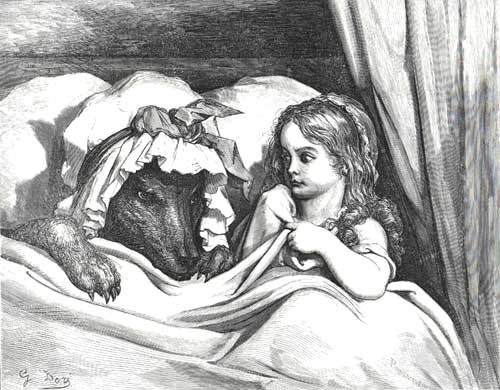
But in spite of all this Little Red Riding Hood makes her little detour, does what women should never do, travels through her own forest. She allows herself the forbidden … and pays dearly for it: she goes back to bed, in grandmother’s stomach. The Wolf is grandmother, and all women recognize the Big Bad Wolf! We know that always lying in wait for us somewhere in some big bed is a Big Bad Wolf.
Gustave Dore – The Disguised Wolf in Bed
The Big Bad Wolf represents, with his big teeth, his big eyes, and his grandmother’s looks, that great Superego that threatens all the little female red riding hoods who try to go out and explore their forest without the psychoanalyst’s permission. So, between two houses, between two beds, she is laid, ever caught in her chain of metaphors, metaphors that organize culture . . . ever her moon to the masculine sun, nature to culture, concavity to masculine convexity, matter to form, immobility/inertia to the march of progress, terrain trod by the masculine footstep, vessel… While man is obviously the active, the upright, the productive… and besides, that’s how it happens in History.
This opposition to woman cuts endlessly across all the oppositions that order culture. It’s the classic opposition, dualist and hierarchical. Man/Woman automatically means great/small, superior/inferior… means high or low, means Nature/History, means transformation/inertia. In fact, every theory of culture, every theory of society, the whole conglomeration of symbolic systems-everything, that is, that’s spoken, everything that’s organized as discourse, art, religion, the family, language, everything that seizes us, everything that acts on us – it is all ordered around hierarchical oppositions that come back to the man/ woman opposition, an opposition that can only be sustained by means of a difference posed by cultural discourse as “natural,” the difference between activity and passivity. It always works this way, and the opposition is founded in the couple [binary]. A couple posed in opposition, in tension, in conflict… a couple engaged in a kind of war in which death is always at work – and I keep emphasizing the importance of the opposition as couple, because all this isn’t just about one word; rather everything turns on the Word: everything is the Word and only the Word. To be aware of the couple, that it’s the couple that makes it all work, is also to point to the fact that it’s on the couple that we have to work if we are to deconstruct and transform culture. The couple as terrain, as space of cultural struggle, but also as terrain, as space demanding, insisting on, a complete transformation in the relation of one to the other. And so work still has to be done on the couple … on the question, for example, of what a completely different couple relationship would be like, what a love that was more than merely a cover for, a veil of, war would be like.
I said it turns on the Word: we must take culture at its word, as it takes us into its Word, into its tongue. You’ll understand why I think that no political reflection can dispense with reflection on language, with work on language. For as soon as we exist, we are born into language and language speaks (to) us, dictates its law, a law of death: it lays down its familial model, lays down its conjugal model, and even at the moment of uttering a sentence, admitting a notion of “being,” a question of being, an ontology, we are already seized by a certain kind of masculine desire, the desire that mobilizes philosophical discourse. As soon as the question “What is it?” is posed, from the moment a question is put, as soon as a reply is sought, we are already caught up in masculine interrogation. I say “masculine interrogation”: as we say so-and-so was interrogated by the police. And this interrogation precisely involves the work of signification: “What is it? Where is it?” A work of meaning, “This means that,” the predicative distribution that always at the same time orders the constitution of meaning. And while meaning is being constituted, it only gets constituted in a movement in which one of the terms of the couple is destroyed in favor of the other.
“Look for the lady,” as they say in the stories… “Cherchez la femme”– we always know that means: you’ll find her in bed. Another question that’s posed in History, rather a strange question, a typical male question, is: “What do women want?” The Freudian question, of course. In his work on desire, Freud asks somewhere, or rather doesn’t ask, leaves hanging in the air, the question “What do women want?” Let’s talk a bit about this desire and about why/how the question “What do women want?” gets put, how it’s both posed and left hanging in the air by philosophical discourse, by analytic discourse (analytic discourse being only one province of philosophical discourse), and how it is posed, let us say, by the Big Bad Wolf and the Grand-Mother.
“What does she want?” Little Red Riding Hood knew quite well what she wanted, but Freud’s question is not what it seems: it’s a rhetorical question. To pose the question “What do women want?” is to pose it already as answer, as from a man who isn’t expecting any answer, because the answer is “She wants nothing.” … “What does she want? … Nothing!” Nothing because she is passive. The only thing man can do is offer the question “What could she want, she who wants nothing?” Or in other words: “Without me, what could she want?”
Old Lacan takes up the slogan “What does she want?” when he says, “A woman cannot speak of her pleasure.” Most interesting! It’s all there, a woman cannot, is unable, hasn’t the power. Not to mention “speaking”: it’s exactly this that she’s forever deprived of. Unable to speak of pleasure = no pleasure, no desire: power, desire, speaking, pleasure, none of these is for woman. And as a quick reminder of how this works in theoretical discourse, one question: you are aware, of course, that for Freud/Lacan, woman is said to be “outside the Symbolic”: outside the Symbolic, that is outside language, the place of the Law, excluded from any possible relationship with culture and the cultural order. And she is outside the Symbolic because she lacks any relation to the phallus, because she does not enjoy what orders masculinity – the castration complex.
Woman does not have the advantage of the castration complex – it’s reserved solely for the little boy. The phallus, in Lacanian parlance also called the “transcendental signifier,” transcendental precisely as primary organizer of the structure of subjectivity, is what, for psychoanalysis, inscribes its effects, its effects of castration and resistance to castration and hence the very organization of language, as unconscious relations, and so it is the phallus that is said to constitute the a priori condition of all symbolic functioning. This has important implications as far as the body is concerned: the body is not sexed, does not recognize itself as, say, female or male without having gone through the castration complex.
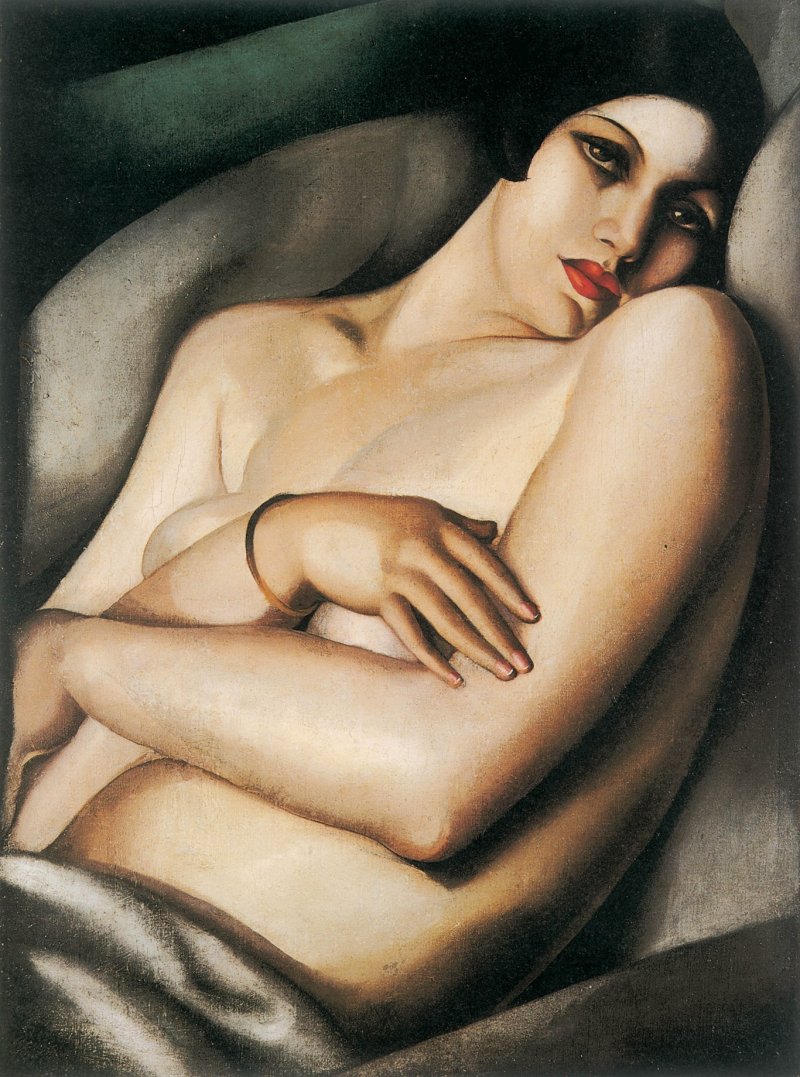
Tamara de Lempicka – “Rafaela sur fond vert” (1927)
What psychoanalysis points to as defining woman is that she lacks lack. She lacks lack? Curious to put it in so contradictory, so extremely paradoxical, a manner: she lacks lack. To say she lacks lack is also, after all, to say she doesn’t miss lack … since she doesn’t miss the lack of lack. Yes, they say, but the point is “she lacks The Lack,” The Lack, lack of the Phallus. And so, supposedly, she misses the great lack, so that without man she would be indefinite, indefinable, nonsexed, unable to recognize herself: outside the Symbolic. But fortunately there is man: he who comes … Prince Charming. And it’s man who teaches woman (because man is always the Master as well), who teaches her to be aware of lack, to be aware of absence, aware of death. It’s man who will finally order woman, “set her to rights,” by teaching her that without man she could “misrecognize.” He will teach her the Law of the Father. Something of the order of: “Without me, without me-the Absolute-Father (the father is always that much more absolute the more he is improbable, dubious)-without me you wouldn’t exist, I’ll show you.” Without him she’d remain in a state of distressing and distressed undifferentiation, unbordered, unorganized, “unpoliced” by the phallus… incoherent, chaotic, and embedded in the Imaginary in her ignorance of the Law of the Signifier. Without him she would in all probability not be contained by the threat of death, might even, perhaps, believe herself eternal, immortal. Without him she would be deprived of sexuality. And it might be said that man works very actively to produce “his woman.” Take for example Marguerite Duras’ Le Ravissement de Lol V. Stein, and you will witness the moment when man can finally say “his” woman, “my” woman. It is that moment when he has taught her to be aware of Death. So man makes, he makes (up) his woman, not without being himself seized up and drawn into the dialectical movement that this sort of thing sets in play. We might say that the Absolute Woman, in culture, the woman who really represents femininity most effectively… who is closest to femininity as prey to masculinity, is actually the hysteric…. he makes her image for her!
The hysteric is a divine spirit that is always at the edge, the turning point, of making. She is one who does not make herself… she does not make herself but she does make the other. It is said that the hysteric “makes-believe” the father, plays the father, “makes-believe” the master. Plays, makes up, makes-believe: she makes-believe she is a woman, unmakes-believe too … plays at desire, plays the father… turns herself into him, unmakes him at the same time. Anyway, without the hysteric, there’s no father… without the hysteric, no master, no analyst, no analysis! She’s the unorganizable feminine construct, whose power of producing the other is a power that never returns to her. She is really a wellspring nourishing the other for eternity, yet not drawing back from the other … not recognizing herself in the images the other may or may not give her. She is given images that don’t belong to her, and she forces herself, as we’ve all done, to resemble them.
And so in the face of this person who lacks lack, who does not miss lack of lack, we have the construct that is infinitely easier to analyze, to put in place-manhood, flaunting its metaphors like banners through history. You know those metaphors: they are most effective. It’s always clearly a question of war, of battle. If there is no battle, it’s replaced by the stake of battle: strategy. Man is strategy, is reckoning . . . “how to win” with the least possible loss, at the lowest possible cost. Throughout literature masculine figures all say the same thing: “I’m reckoning” what to do to win. Take Don Juan and you have the whole masculine economy getting together to “give women just what it takes to keep them in bed” then swiftly taking back the investment, then reinvesting, etc., so that nothing ever gets given, everything gets taken back, while in the process the greatest possible dividend of pleasure is taken. Consumption without payment, of course.
[W]hen I began to write, at about the age of seven, stories in pencil with crayon illustrations that my poor mother was obligated to read, I wrote exactly the kinds of stories I was reading: All my characters were white and blue-eyed, they played in the snow, they ate apples, and they talked a lot about the weather, how lovely it was that the sun had come out. Now, this despite the fact that I lived in Nigeria. I had never been outside Nigeria. We didn’t have snow, we ate mangoes, and we never talked about the weather, because there was no need to.
My characters also drank a lot of ginger beer, because the characters in the British books I read drank ginger beer. Never mind that I had no idea what ginger beer was. And for many years afterwards, I would have a desperate desire to taste ginger beer. But that is another story.
What this demonstrates, I think, is how impressionable and vulnerable we are in the face of a story, particularly as children. Because all I had read were books in which characters were foreign, I had become convinced that books by their very nature had to have foreigners in them and had to be about things with which I could not personally identify. Now, things changed when I discovered African books. There weren’t many of them available, and they weren’t quite as easy to find as the foreign books.
But because of writers like Chinua Achebe and Camara Laye, I went through a mental shift in my perception of literature. I realized that people like me, girls with skin the color of chocolate, whose kinky hair could not form ponytails, could also exist in literature. I started to write about things I recognized.
Now, I loved those American and British books I read. They stirred my imagination. They opened up new worlds for me. But the unintended consequence was that I did not know that people like me could exist in literature. So what the discovery of African writers did for me was this: It saved me from having a single story of what books are…
… If I had not grown up in Nigeria,and if all I knew about Africa were from popular images,I too would think that Africa was a place of beautiful landscapes,beautiful animals,and incomprehensible people,fighting senseless wars, dying of poverty and AIDS,unable to speak for themselvesand waiting to be saved by a kind, white foreigner.
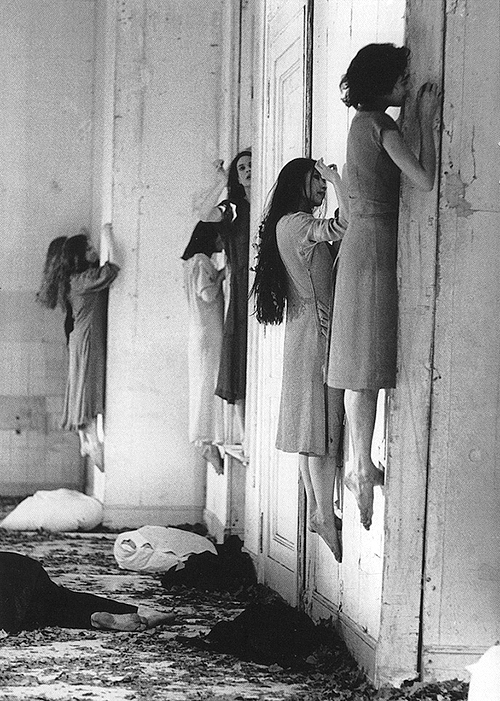
Chilling German expressionist dance performance of the dynamics of domestic violence, choreographed in 1977 by Pina Bausch, to Bartók’s opera Bluebeard’s Castle.
The Sylvia Plath story is told to girls who write.
They want us to think that to be a girl poet means you have to die.
Who is it that told me all girls who write must suicide?
I’ve another good one for you, we are turning cursive letters into
Knives.
“Many women, I think, resist feminism because it is an agony to be fully conscious of the brutal misogyny which permeates culture, society, and all personal relationships.”
― Andrea Dworkin, Our Blood: Prophecies and Discourses on Sexual Politics
Charting a path forward for anti-sexist and anti-racist scholarship and activism. This discussion was hosted by the Van Zyl Slabbert Visiting Chair, the Dean of the Faculty of Humanities and the University of Cape Town’s SRC and moderated by Prof Xolela Mangcu on Thursday 23 April 2015.
“The fact that we are able to have this conversation in South Africa as though it is new, as though these issues have never been thought of before, is precisely because of our inability to engage, and to read…In a staggering display of willful ignorance, we continue to have conversations that have been had, that have been taken in remarkable directions, as though we have just discovered them.” – Pumla Gqola (at 0:26:00)
Released on Rough Trade (1983); re-released with this tracklisting in 1993.
In his definitive study of London punk, England’s Dreaming, Jon Savage describes The Raincoats as “rigorously feminist.” While Savage is perhaps the only writer to assign the word rigorous to The Raincoats’ music (a 1980 Village Voice piece contained the line, “The Raincoats say they rehearse”), it is rigorous nonetheless in the way it creates its own aesthetic space and in the way it pursues fun. “They seemed like ordinary people making extraordinary music,” Kim Gordon of Sonic Youth wrote. “Music that was natural that made room for a cohesion of personalities.”
Filmed in 2011 at Mary Reid Kelley’s home and studio in Saratoga Springs, New York, the video artist and painter discusses her video work “You Make Me Iliad” (2010). In researching the lives and experiences of women who lived during the first World War, Reid Kelley was struck by how few first-hand accounts she was able to uncover. Mary Reid Kelley explains her attempts to reconstitute an experience that would have otherwise been lost to history by creating an imagined narrative involving a prostitute, a soldier, and a medical officer.
In black-and-white videos and drawings filled with punning wordplay and political strife, Mary Reid Kelley presents her take on the clash between utopian ideologies and the realities of women’s lives in the struggle for liberation. Performing scripted narratives in rhyming verse— featuring characters such as nurses, soldiers, prostitutes, and saltimbanques—Reid Kelley playfully jumbles historical periods to trace the ways in which present concerns are rooted in the past.
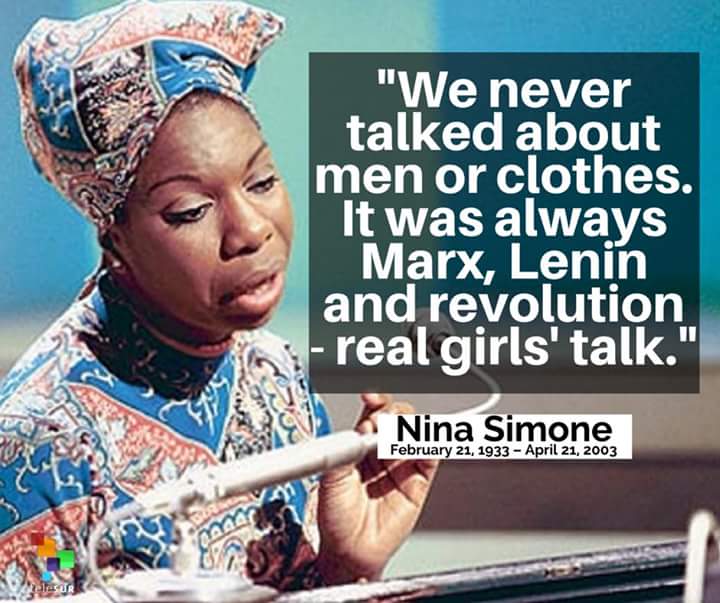
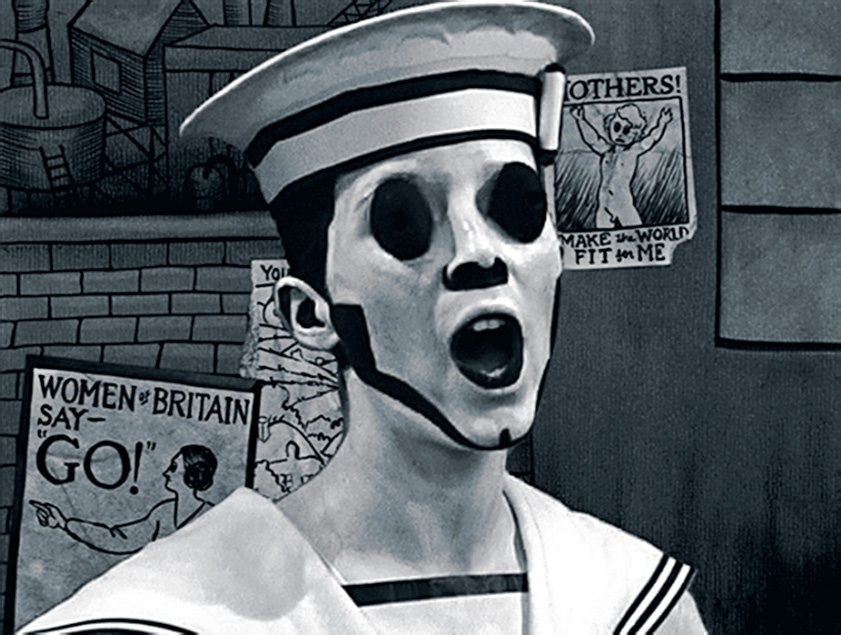
Sadie, the Saddest Sadist (7 minutes, 23 seconds), 2009, is set in Great Britain in 1915, according to a free booklet that includes the video’s lyrics. The title character, a munitions worker, wants to learn a trade “so [she] could be a traitor.” She meets Jack, a sailor (played by Reid Kelley in drag), and with “passions inflamed,” she requests rousing war stories. His sung reply: “Calm down sweetheart / Britannia rules the waves.” In pledging herself to him, she offers her “surplus devotion,” and after their off-camera tryst, she sings, “The stains on my sheets / will come out with some lemon / I know that you care / by these Marx on my Lenin.” Live action alternates with stop-motion animation in which dancing refrigerator magnet-style letters spell out the dialogue or toy with it, as when “surplus devotion” is anagrammatized into “spurs devolution.”…
… Reid Kelley’s interest seems to be primarily in historical material, expressed in details such as the patriotic flyers that hang on the walls behind Sadie and Jack when they meet, which urge citizens to conserve food and to fight for king and country. Her fine ear for popular verse makes Reid Kelley’s work rich fun for those who are, as Jack describes himself, “verbally inclined.”
Have you ever experienced the weird magic of coming across something obliquely on Youtube, on your way somewhere else, and it speaks so powerfully, so uncannily, to all the things happening right now around you that all the hairs on your body stand on end? This is one of those times. The scene comes from a 1952 film called The Member of the Wedding, based on the book/play by Carson McCullers, starring Ethel Waters, Julie Harris and Brandon De Wilde. I came across it because my housemate Khanyi and I were singing this old hymn, hamming it up Lauryn-Hill-in-Sister-Act-2 style. I wanted to check out some of the older versions… and this clip revealed itself to me, complete with contextual preamble.
Miss May Whitley kicks ass with panache and palpable glee in this British Pathé clip from 1933, entitled The Weaker Sex! (Sayest Thou!) Who said “weaker sex?” The intertitle reads: ‘Slow motion demonstrates exactly how 7-stone-odd, scientifically applied, can defeat 14 stone.’
The 1960s – Two teenagers take fate into their own hands and become the ultimate fashion victims in this existential folie a deux starring Donna Modrowski and Michael Onesko. Story by Michael Onesko, original score by Mark Winner, directed by Dan Winner, voiceover by Linda Snelton, assisted by Germain Modrowski, Karen Winner and Connie Karabatsos. Shown at The Women’s Film Forum of Chicago, 1977.
“If you don’t care enough about someone to enjoy their company and respect their decisions when sex is off the table, then that person is right not to sleep with you, because enjoying someone’s company and respecting their decisions is pretty much how sex gets on the table to start with.”
Everyone’s heard of friendzoning – even if they don’t know the word, they sure as hell know the concept. It’s what happens time and again to unfortunate Nice Guys who, despite being nothing but sugar and spice to the girls they love, are nonetheless denied the sexual relationships they so obviously deserve and are instead treated like platonic equals – a terrible, unfair fate spawned by the dark side of feminism.
And if you thought even part of that statement was correct, Imma stop you right there.
Friendzoning is bullshit because girls are not machines that you put Kindness Coins into until sex falls out.
Dear Hypothetical Interlocutor whose hackles just bristled with the unfairness of that statement; who thinks that girls can be in the Friend Zone, too, and that therefore this point is both invalid and reverse-sexist into…
Teenage Jesus and the Jerks/ Beirut Slump – Shut Up and Bleed (Atavistic, 2008)
Review of this compilation by Jordan N. Mamone from Dusted:
Forget what you may already know about Lydia Lunch. Ignore her vitriolic spoken-word performances; her bellicosely feminist writing; her vampy S&M fashion sense; her associations with renegade alpha males Nick Cave and Jim “Foetus” Thirlwell; her orgasmic moans on Sonic Youth’s “Death Valley ’69”; her erotically grizzly romps in the campy-creepy films of Richard Kern; her futile sparring with idiot comedian Joe Rogan. Purge from your mind her queen-size intellect and ego. Erase the subsequent mass-market co-opting of her prescient obsessions: serial murderers, Southern Gothic literature, rape, insanity, proto-Riot Grrl solidarity, buckets of black eyeliner (hardly shocking stuff today, but terra incognita when Lunch was loudly and proudly milking them in the ’70s, ’80s and ’90s).
From a purely musical perspective, it’s the woman’s first two bands, the violently minimalist Teenage Jesus and the Jerks, and the monstrously damaged Beirut Slump, that are her most important accomplishments. And to appreciate them properly, it’s necessary to sever them from their creator’s reputation and to listen to them on their own terms. As a handy compendium of both groups’ slim discographies plus previously unreleased live goods, the excellently titled Shut Up and Bleed allows you to do just that.
Rewind to 1976: An alienated 16-year-old girl named Lydia Koch runs away to Manhattan from Rochester, N.Y. Months later, she stumbles upon a quartet called Mars, whose cataclysm of amateurish dissonance, art-world conceptualism, and primitive rock physicality borrows punk’s urgent thrust while negating the whole equation. Journalists will label this style “no wave.” Smitten, the youngster swoons over the rumpus, which she then personalizes to suit her particular strain of jailbait hostility. Christened Lydia Lunch, she steers Teenage Jesus through 10-minute sets comprised of minute-long songs that pivot around her screeching, electric slide guitar and deviant percussionist Bradley Field’s stiff, staccato thuds on a single snare and cymbal. Their rudimentary, machine-gun approach is undeniably provocative. Who could resist a lascivious high-school vixen yelping about boredom and torture, flanked by a pair of addled weirdos-turned-trained monkeys? In 1978, superstar producer Brian Eno gives Teenage Jesus a coveted slot on the landmark, scene-baptizing No New York LP.
Three decades elapse: Thurston Moore and Byron Coley are nicely summarizing downtown’s sordid past in their luxurious No Wave photography book, which might as well be a love letter to Ms. Lunch. In June 2008, the Jerks herald the tome’s publication and play their sole gig since 1979. The context of this one-shot semi-reunion is quite bizarre: a fleeting, self-destructive epoch re-examined as revered fodder for galleries and coffee-table editions. But onstage at the Knitting Factory, the trio – with its former bassist Jim Sclavunos on drums, and Moore filling in on bass – sounds invigoratingly strident, brusque and, dare it be said, entertaining. Lunch, who’s pushing 50, sticks her tongue out, curses the audience, and barks the lyrics to “Baby Doll” and “Orphans” in a hoarse, jaded snarl that has deepened considerably from perpetual wear and tear. Looser and less aloof than they were in their prime (check the clip from Lydia’s career-spanning Video Hysterie: 1978-2006 DVD on Atavistic), the Jerks still decimate the majority of noise-crud that currently pollutes the local club circuit. This means you, No Fun Fest.
And so it’s no surprise that the material collected on Shut Up and Bleed stands as tall as Yao Ming in platform shoes. Time has eroded much of the initial inaccessibility of barbed stomps such as “Crown of Thorns,” leaving behind a deliciously nihilistic, psycho-cheerleader cha-cha. Lunch is a criminally underrated instrumentalist: Heed the drill-bit whinnies that scar “Red Alert” and the ascending, jet-engine whoosh of “Freud in Flop.” Substantially improving on the 1995 Teenage Jesus retrospective Everything, the new CD affixes decent, if scruffy, archival bonuses (but omits a killer take of “Race Mixing”) and wisely restores many, if not all the tunes to their original aural luster. (Thirlwell had frustratingly “reprocessed” the Jerks’ master tapes in the 1980s, adding gobs of strength-sapping reverb.)
Interspersed throughout the track listing are the complete recorded works of Beirut Slump, an obscure quintet that lurked in the shadows during Teenage Jesus’s final phases. For this unruly combo, Lunch steps aside to concentrate on her trebly, nightmare-surf strumming and assigns the vocals to Bobby “Berkowitz” Swope, a migrant from Florida’s Eckerd College who sings like a nauseous, homosexual Frankenstein menacing you with an ice pick. Vivienne Dick’s B-movie organ disfigures the Doors into a bad-acid freak show; Sclavunos and bassist Liz Swope’s sluggish tempos anticipate the cruel plod of early Swans. Whereas the Jerks’ momentous blurts now come across as abusively catchy, Slump’s frazzled “Staircase” and utterly revulsed “See Pretty” continue to pry open some ghastly portal to hell. A wealth of perverse pleasure awaits anyone brazen enough to peer in and gawk.
Teenage Jesus And The Jerks:
Lydia Lunch, guitar, vocals
Gordon Stevenson, bass
Bradley Field, drums
Kawashima Akiyoshi “Reck”, bass (Tracks 4, 5, 15, 26, 28)
Beirut Slump:
Bobby ‘Berkowitz’ Swope, violin, vocals
Lydia Lunch, guitar, vocals
Vivienne Dick, organ
Liz Swope, bass
Jim Sclavunos, drums
This performance by Lesley Gore, from 1963, is one of my favourite old clips on YouTube. I have watched it countless times. The feral intensity in her perfectly made-up face is so powerfully subversive.
Blue brain, pink brain – a graphic from My Life: I Am Leo
My girl is eight years old. She is clever and kind and tall and strong and funny and stubborn and beautiful – well of course I think all of these things, because she’s my daughter and I love her. “Am I girly-girl or a tomboy?” she asks sometimes, and I can never tell from the way she asks which of them she wants to be: she knows that to be a girly-girl is to belong (she has learned from experience that getting “girly” right will be rewarded and protect her from certain kinds of sanction), but she knows too that “boy” things are laudable and tomboyishness has a cachet that girliness does not. Anyway, the answer is always the same: “You’re you, darling. Whatever you like is right for you.” With her long treacle-coloured hair and…
 Dating Tips for the Feminist Man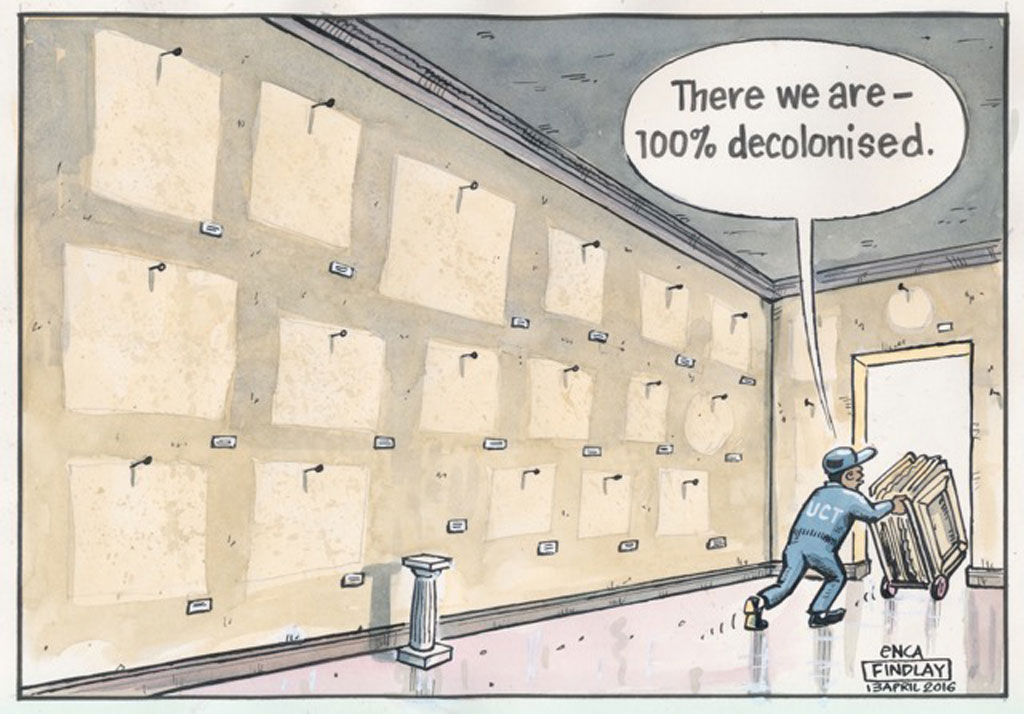
 Press release from Wits Fees Must Fall:









 fleurmach