nevermind the bollocks, here’s deleuze and guattari

[E]ffective differences pass between the lines, even though they are all immanent to one another, all entangled in one another. This is why the question of schizoanalysis or pragmatics, micropolitics itself, never consists in interpreting, but merely in asking what are your lines, individual or group, and what are the dangers on each.

JR at Desperadoes', Observatory, Cape Town, 15  May 2013. Photo: Rosemary Lombard

JR around the pole at Desperado’s Saloon, Observatory, Cape Town, 15 May 2013. Photo: Rosemary Lombard

What are your rigid segments, your binary and overcoding machines? For even these are not given to you ready-made; we are not simply divided up by binary machines of class, sex, or age: there are others which we constantly shift, invent without realising it. And what are the dangers if we blow up these segments too quickly? Wouldn’t this kill the organism itself, the organism which possesses its own binary machines, even in its nerves and its brain?

What are your supple lines, what are your fluxes and thresholds? Which is your set of relative deterritorialis­ations and correlative reterritorialisations? And the distribution of black holes: which are the black holes of each one of us, where a beast lurks or a microfascism thrives?

— Deleuze and Guattari: Toward Freedom. Read more HERE.
Sent from my BlackBerry® wireless device

spectrum – undo the taboo

The opening track of Highs, Lows and Heavenly Blows, released in 1994 on Silvertone Records.

Spectrum was the most high-profile and straightforward of the projects undertaken by Pete “Sonic Boom” Kember after the demise of the trance-rock avatars Spacemen 3. As his work as a member of the Experimental Audio Research coterie allowed Kember the opportunity to explore ambient textures and tonal constructs, Spectrum satisfied the singer/guitarist’s more conventional pop leanings, while never losing sight of the hypnotic otherworldliness which became his music’s trademark and legacy.

(Info from Allmusic.com)


william shakespeare – sigh no more, ladies

Happy 449th birthday, Willy!
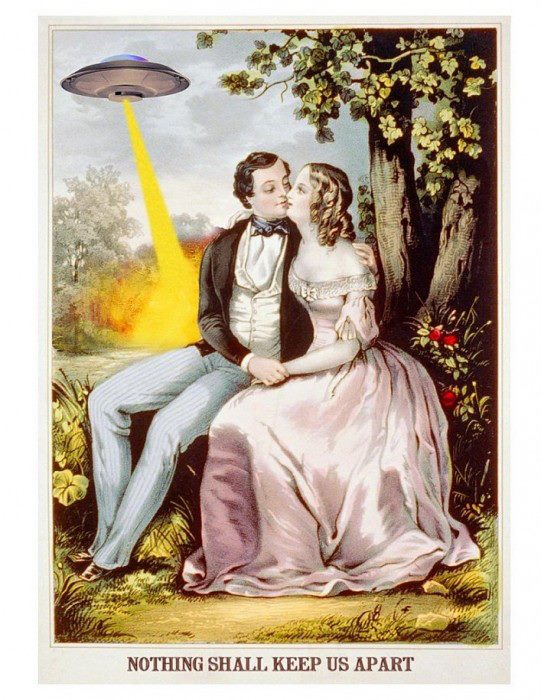
nothing shall keep us apart

Sigh no more, ladies, sigh no more;
Men were deceivers ever;
One foot in sea and one on shore,
To one thing constant never;
Then sigh not so,
But let them go,
And be you blithe and bonny;
Converting all your sounds of woe
Into “Hey nonny, nonny.”

Sing no more ditties, sing no mo,
Of dumps so dull and heavy;
The fraud of men was ever so,
Since summer first was leavy.
Then sigh not so,
But let them go,
And be you blithe and bonny,
Converting all your sounds of woe
Into “Hey, nonny, nonny.”

(From Much Ado about Nothing)

paul simon and wes anderson go cuckoo in april

From Sounds of Silence, Simon and Garfunkel’s second album, released on January 17, 1966. It had also appeared prior to this on a UK-only release, The Paul Simon Songbook, in August 1965.

The song bears a structural resemblance to a traditional English rhyme, “Cuckoo, cuckoo, what do you do?”, a phenology of the Common Cuckoo from April to September:

Cuckoo, Cuckoo, what do you do?
“In April I open my bill;
In May I sing night and day;
In June I change my tune
In July far far I fly;
In August away I must.”
Cuckoo, Cuckoo!

This choral version of the rhyme was featured on the soundtrack to Wes Anderson’s 2012 film, Moonrise Kingdom:

embodied

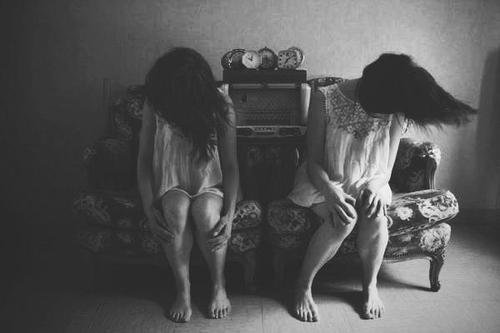
Aëla Labbé - "Sister Sister" series

Aëla Labbé – “Sister Sister” series

Why do you live in your body like you will be given another? As if it were temporary. You starve it, you let anyone touch it, you berate it. Tell it that should be completely different. You tug at your soft flesh, wish it thinner, wish it gone. You fall in love with those who praise the way it sighs under their hands, but who praises the way it holds up your weight, even when you are falling apart?

— Warsan Shire


laurence binyon – the burning of the leaves

Now is the time for the burning of the leaves,
They go to the fire; the nostrils prick with smoke
Wandering slowly into the weeping mist.
Brittle and blotched, ragged and rotten sheaves!
A flame seizes the smouldering ruin, and bites
On stubborn stalks that crackle as they resist.
The last hollyhock’s fallen tower is dust:
All the spices of June are a bitter reek,
All the extravagant riches spent and mean.
All burns! the reddest rose is a ghost.
Sparks whirl up, to expire in the mist: the wild
Fingers of fire are making corruption clean.
Now is the time for stripping the spirit bare,
Time for the burning of days ended and done,
Idle solace of things that have gone before,
Rootless hope and fruitless desire are there:
Let them go to the fire with never a look behind.
That world that was ours is a world that is ours no more.
They will come again, the leaf and the flower, to arise
From squalor of rottenness into the old splendour,
And magical scents to a wondering memory bring;
The same glory, to shine upon different eyes.
Earth cares for her own ruins, naught for ours.
Nothing is certain, only the certain spring.

Thanks to Karolina O’Donaghue for this poem.

julia holter – goddess eyes 1

“The first thing that came to mind was an image that gradually deteriorates with visual noise, echoing the sonic noise present in the song. We go from lightness to darkness, away from a structured, fabricated place and into raw territory.”
~ Jose Wolff – August, 2012

Music by Julia Holter
Directed by Jose Wolff
Photography by Robson Muzel and Jose Wolff
“Broken figure” portrayed by Bryan Dodds
Shot on site at The Wulf, Elysian Park, and the Angeles Angeles Natural Forest. Special thanks to Emily Jane Kuntz and Eric KM Clark and Michael Winter at The Wulf

©2012 RVNG Intl.

be my valentine

"Persephone" - Image copyright Joshua Hoffine, 2003.

“Persephone” – Image copyright Joshua Hoffine, 2013.

More of Joshua Hoffine’s horror photography can be found HERE.

The Garden of Proserpine by Algernon Charles Swinburne, written in 1866

Here, where the world is quiet,
Here, where all trouble seems
Dead winds’ and spent waves’ riot
In doubtful dreams of dreams;
I watch the green field growing
For reaping folk and sowing,
For harvest-time and mowing,
A sleepy world of streams.

I am tired of tears and laughter,
And men that laugh and weep
Of what may come hereafter
For men that sow to reap:
I am weary of days and hours,
Blown buds of barren flowers,
Desires and dreams and powers
And everything but sleep.

Here life has death for neighbour,
And far from eye or ear
Wan waves and wet winds labour,
Weak ships and spirits steer;
They drive adrift, and whither
They wot not who make thither;
But no such winds blow hither,
And no such things grow here.

No growth of moor or coppice,
No heather-flower or vine,
But bloomless buds of poppies,
Green grapes of Proserpine,
Pale beds of blowing rushes
Where no leaf blooms or blushes,
Save this whereout she crushes
For dead men deadly wine.

Pale, without name or number,
In fruitless fields of corn,
They bow themselves and slumber
All night till light is born;
And like a soul belated,
In hell and heaven unmated,
By cloud and mist abated
Comes out of darkness morn.

Though one were strong as seven,
He too with death shall dwell,
Nor wake with wings in heaven,
Nor weep for pains in hell;
Though one were fair as roses,
His beauty clouds and closes;
And well though love reposes,
In the end it is not well.

Pale, beyond porch and portal,
Crowned with calm leaves she stands
Who gathers all things mortal
With cold immortal hands;
Her languid lips are sweeter
Than love’s who fears to greet her
To men that mix and meet her
From many times and lands.

She waits for each and other,
She waits for all men born;
Forgets the earth her mother,
The life of fruits and corn;
And spring and seed and swallow
Take wing for her and follow
Where summer song rings hollow
And flowers are put to scorn.

There go the loves that wither,
The old loves with wearier wings;
And all dead years draw thither,
And all disastrous things;
Dead dreams of days forsaken,
Blind buds that snows have shaken,
Wild leaves that winds have taken,
Red strays of ruined springs.

We are not sure of sorrow,
And joy was never sure;
To-day will die to-morrow;
Time stoops to no man’s lure;
And love, grown faint and fretful,
With lips but half regretful
Sighs, and with eyes forgetful
Weeps that no loves endure.

From too much love of living,
From hope and fear set free,
We thank with brief thanksgiving
Whatever gods may be
That no life lives for ever;
That dead men rise up never;
That even the weariest river
Winds somewhere safe to sea.

Then star nor sun shall waken,
Nor any change of light:
Nor sound of waters shaken,
Nor any sound or sight:
Nor wintry leaves nor vernal,
Nor days nor things diurnal;
Only the sleep eternal
In an eternal night.

this mortal coil – waves become wings/ barramundi

“Wave Become Wings” and “Barramundi” from It’ll End in Tears, an album released in 1984 by the label 4AD, using the name “This Mortal Coil” as an umbrella title for a loose grouping of guest musicians and vocalists brought together by label boss Ivo Watts-Russell.

Images taken from Baraka (directed by Ron Fricke).

waiting to exhale

lsd

*.* Love’s Secret Domain, 2004. Self-portrait manipulated with MS Photo Editor.

“I think,” Tehanu said in her soft, strange voice, “that when I die, I can breathe back the breath that made me live. I can give back to the world all that I didn’t do. All that I might have been and couldn’t be. All the choices I didn’t make. All the things I lost and spent and wasted. I can give them back to the world. To the lives that haven’t been lived yet. That will be my gift back to the world that gave me the life I did live, the love I loved, the breath I breathed.”

~ Ursula K. Le Guin – from The Dispossessed

swans – mind/body/light/sound (1995)

Throw your mind away
Fall into the sea
There’s nothing solid here
Dissolve your body today
There’s a sun in the sky
We’re in the atmosphere
Throw yourself in the sea
There’s nothing solid down here
Mind/body/light/sound
Mindless, bodyless, soundless light
This ordinary night
This ordinary day
They’re twisted out of shape
Then they disintegrate
Cool water runs through the ground
The ocean blends with the air
Throw yourself in the fire
There’s nothing solid around here
Mind/body/light/sound
Mindless, bodyless, soundless light
The world was over today
The time is already gone
Throw your mind in the sea
Eternity doesn’t last very long
There’s some people on earth
They live in separate minds
Dissolve your body today,
There is no more outside
Mind/body/light/sound
Mindless, bodyless, soundless light

scientist – dematerialise

Off Scientist Meets the Space Invaders (Greensleeves Records, 1981), produced by Mikey “Roots” Scott & Linval Thompson. The recording was done at Channel One Studios backed by the Roots Radics, and mixed at King Tubby’s. The recording was by Stanley “Barnabas” Bryan, Anthony “Crucial Bunny” Graham and Maxwell “Maxie” Livington Smith. The cover artwork is by Tony McDermott.

thoughts on meaningful work, 14 november 2012, 5:38 a.m.

What follows is something I wanted to blog from Turkey in November but was unable to due to lack of an internet connection at the time. I woke up very early one morning, typed it into my phone’s notes app, half asleep, and promptly forgot about it. The incredibly tedious work I am currently doing (editing an MSc thesis on anthropometric measurements for office chairs) reminded me of its existence. So, two months later, here it is.
Turkey 2012 492a

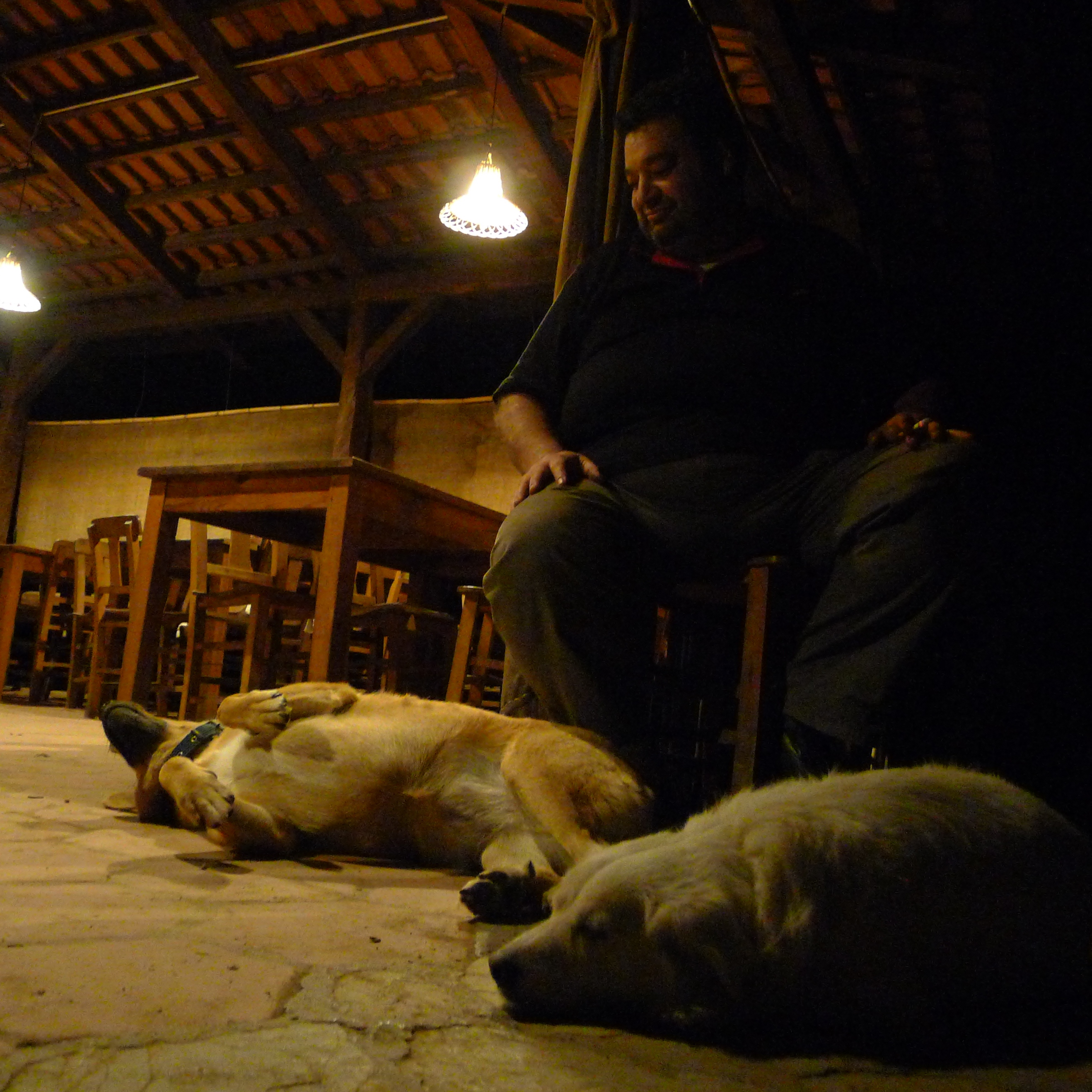
Arif Cerit with the farm dogs, Shanslar (Lucky) and Beyaz (White), at Pastoral Vadi. Photo: Rosemary Lombard.

Last night I had a profound conversation, in my bad Turkish and his bad English, with Arif Cerit, a guy who lives at Pastoral Vadi, the organic/permaculture farm near Fethiye in South-Western Turkey which I am visiting – working in exchange for food and a bed. It’s a very comfortable bed, in a neat, well-appointed cottage designed and built of cob (straw and mud) five years ago by Ahmet Kizen, an architect passionate about sustainable living and ecotourism who bought this farm 14 years ago and opened it to visitors about 7 years back. No maintenance has been necessary since the cottage was built, I’m told. The thick walls keep it cool during the day and surprisingly warm at night.

So, back to what I wanted to blog about, which has resonated for me with my friend P‘s latest gier on Facebook, which involves a sort of Dada/absurdist attempt to animalise interactions. Having been away and in limited contact with everyone, I haven’t had a chance to ask him more about it, but, basically, instead of clicking “like”, he types animal noises. “Baaa, baaa”, mostly. For me it draws attention to the essentially animal nature of human interaction, which we have become unconscious of and detached from, as we live large swathes of our lives online, “denatured”, unquestioning.  “Like” has become a capricious yet ubiquitous form of social capital. Facebook’s shady manipulation of this currency of late has triggered consternation and outrage. They’ve put in place algorithms that restrict the “organic” (terms such as “organic” and “viral” in the world of virtual memes are interesting in their ironic detachment!) reach of posts on the network, requiring one to pay (“real” money) to secure an audience greater than an arbitrary sliver of the profiles to whom one is connected… Just when I thought it was because I only had a sliver of die-hards who actually enjoyed what I post anymore, I realised that most of my Facebook friends no longer see my updates in their news feeds. What a relief (?). The virtual landscape increasingly resembles a targeted marketing environment more than it does a communal hangout, a place for exchanging ideas and thoughts, as it used to. Now it’s mostly about Profit. By monetising the prominence of posts, equal access is effectively being stifled. Concomitantly, freedom of association and meaningful interaction are withering.

That’s another aside, or, rather, more context. ANYWAY. So, what I gleaned from my conversation with big, friendly Arif was that he had been a taxi driver with a fleet of cars in the west coast city of Izmir for 21 years, before dropping everything and moving here to the farm. He sold his business, gave the money to his brothers and left it all behind.

He says that the city is a big jungle, very dark, very dense, very dangerous, full of artifice and chemical poisons. People are a species of animal, he says, like all animals… In cities you have to be a predator to do well. If you are not a predator, you have to live your life very small, like a rat, to survive. Your mind is very important, he says. The chasing after money and things that you need to do to live in the city takes up all your time and your thoughts. Money is a cancer. TV is the morphine you need to kill the pain at the end of the day: the pain of your mind being eaten away.

Out here on the farm, life is real, he says. There is space, there is ground, and air, and the smell of greenness. Animals who are not predators can live happily, widely, openly, productively.
Turkey 2012 467a

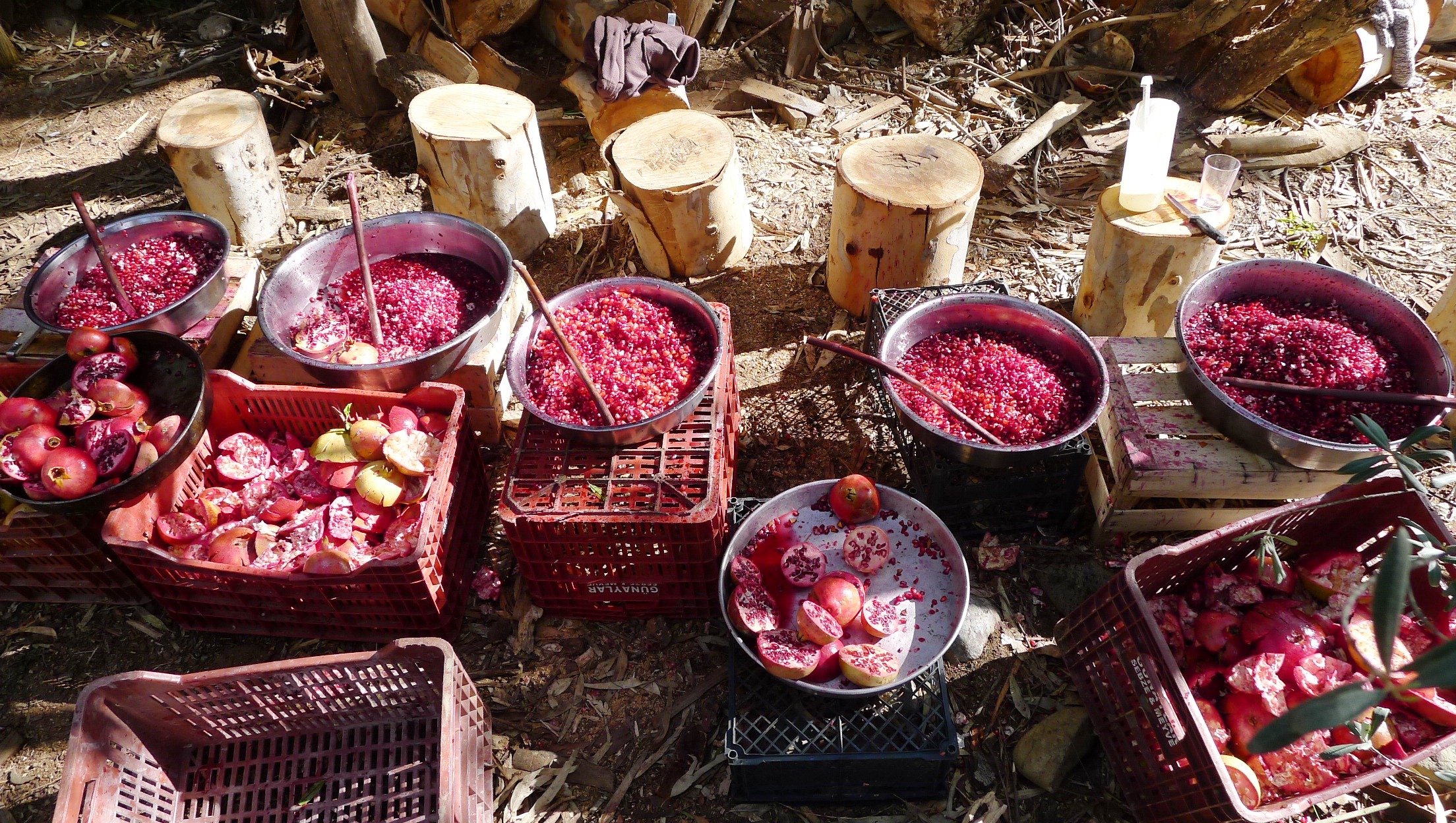
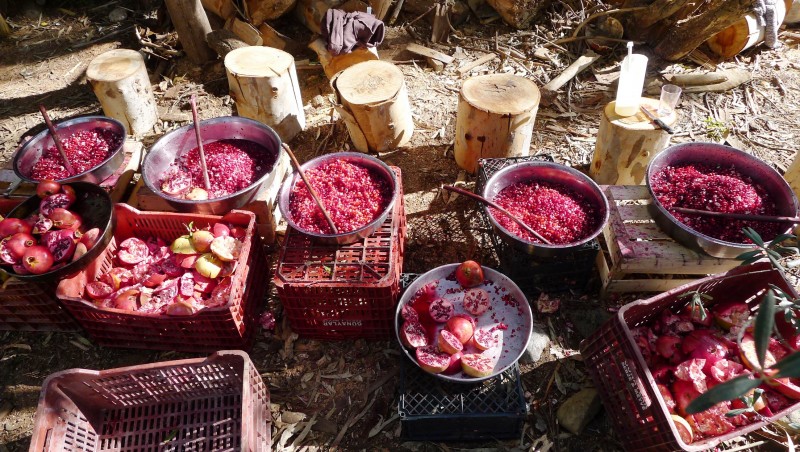
Processing pomegranates by hand to make nar ekshili sos (pomegranate reduction). Photo: Rosemary Lombard

Sticky, crimson pomegranate juice is running down my arms and dripping off my elbows. I’m stained with the joy of manual labour. It’s so satisfying, this repetitive bashing of crates and crates of halved fruit to knock out the arils, then the squeezing in a bag to extract the juice, which is then boiled over a fire for ten hours to reduce it to a dark, tart syrup, then strained through muslin into bottles.  It’s slow-going, messy, tiring work. I have blisters, purple palms. But, at the end of each day, I can see the results of my time spent. It’s nothing like the virtual world of work I mostly inhabit, where I shut down my computer and a sense of the hours and hours I have spent shunting pixels around evaporates.

For so long now, my life has felt paper-thin, no, thinner, as if I barely cast even a shadow of influence in the world, and I realise now that it is largely because of the intangible nature of the work I have been doing, which mostly involves cleaning, tidying and correcting other people’s writing, or recording their work, or facilitating their conversations… It’s all work towards actualising goals that I have deemed worthwhile; nonetheless, these are goals which are not my own. I have tried to frame them as my own, tried to see my part in the whole as indispensable, my purpose as contiguous with that of the projects’, my place as “a tiny cog in the great wheel of evolution” – that was how Billy Wilder put it, writing the words of Ninotchka played by Greta Garbo in Ernst Lubitsch’s wonderful 1939 satire of the same name.

Alas, my heart just hasn’t been convinced. I haven’t been able to shake this unbearable sense of lightness, of the unnecessary breaths I’m taking, of the lack of any other humans who truly require or desire my existence, irreplaceably, here on Earth. All this needs to change if I am to remain sane when I get back. Living with a heavenly purpose is too far beyond me. I’d be satisfied to have done with consumption, thanks. I started this blog in an attempt to make something indelible of the ephemeral. I need to do more. I’m starving.

“If I had an orchard, I’d work till I was sore.” ~ Fleet Foxes – “Helplessness Blues“.
Fethiye-20121113-01327

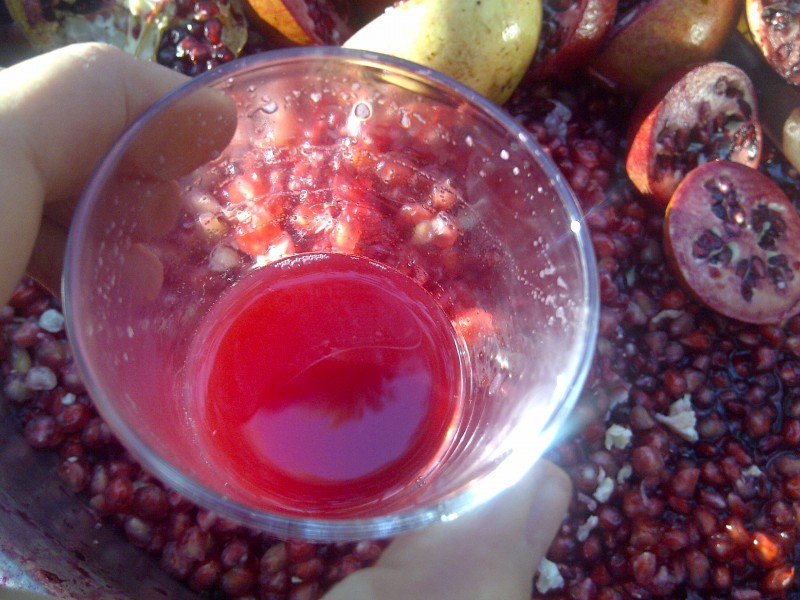
Sweet! A break to drink some freshly-squeezed pomegranate juice. Photo: Rosemary Lombard

Ş
apples

snow white poison appleLife will break you. Nobody can protect you from that, and living alone won’t either, for solitude will also break you with its yearning. You have to love. You have to feel. It is the reason you are here on earth. You are here to risk your heart. You are here to be swallowed up. And when it happens that you are broken, or betrayed, or left, or hurt, or death brushes near, let yourself sit by an apple tree and listen to the apples falling all around you in heaps, wasting their sweetness. Tell yourself you tasted as many as you could.

 Louise Erdrich (The Painted Drum)

tale of tales (skazka skazok)

Astoundingly beautiful animation masterpiece by Yuri Norstein (USSR,1979, 28 min).

From Wikipedia:

Tale of Tales, like Tarkovsky’s Mirror, attempts to structure itself like a human memory. Memories are not recalled in neat chronological order; instead, they are recalled by the association of one thing with another, which means that any attempt to put memory on film cannot be told like a conventional narrative. The film is thus made up of a series of related sequences whose scenes are interspersed between each other. One of the primary themes involves war, with particular emphasis on the enormous losses the Soviet Union suffered on the Eastern Front during World War II. Several recurring characters and their interactions make up a large part of the film, such as the poet, the little girl and the bull, the little boy and the crows, the dancers and the soldiers, and especially the little grey wolf (Russian: се́ренький волчо́к, syeryenkiy volchok). Another symbol connecting nearly all of these different themes are green apples (which may symbolise life, hope, or potential).

Yuriy Norshteyn wrote in Iskusstvo Kino magazine that the film is “about simple concepts that give you the strength to live.”