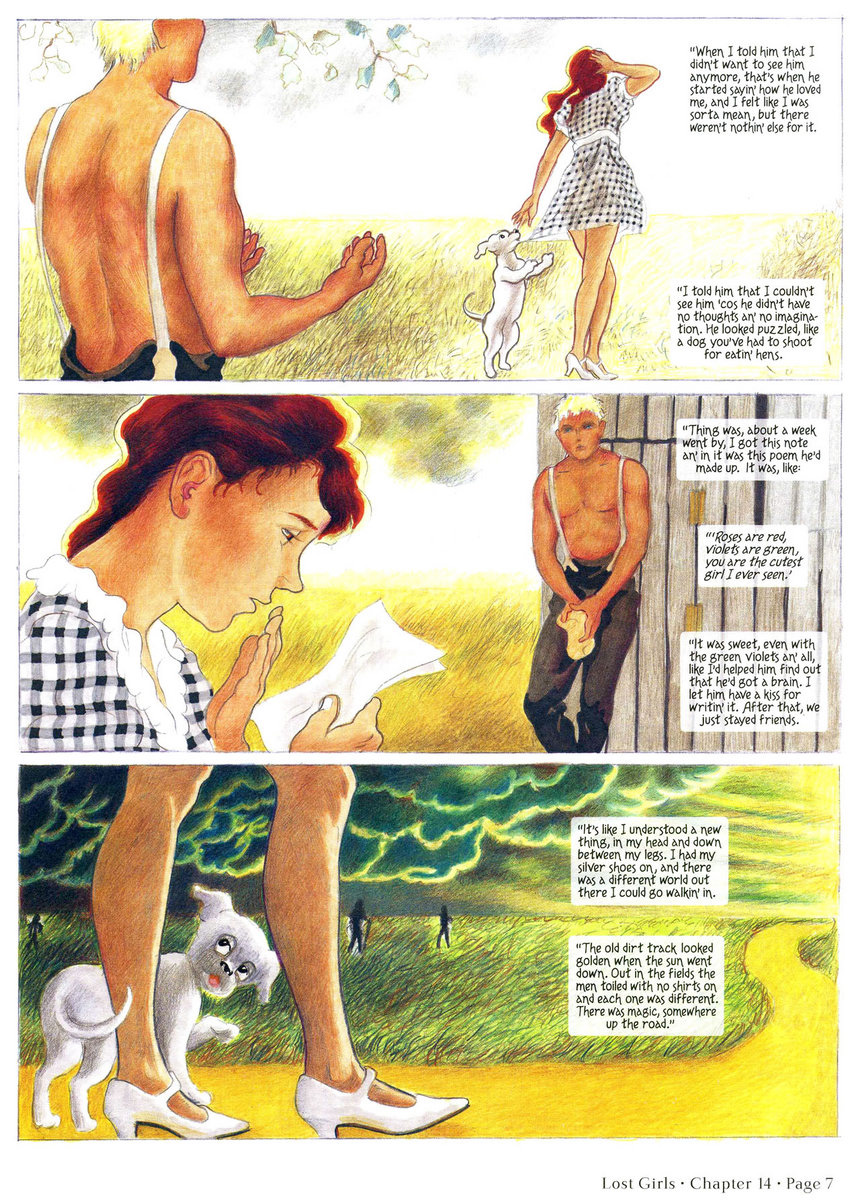
a portrait of hans bellmer, by unica zurn (1965)

HANS BELLMER: The female body…is like an endless sentence that invites us to rearrange it, so that its real meaning becomes clear through a series of endless anagrams. (1)

UNICA ZÜRN: If woman is to put into form the ‘ule’ [Greek: matter] that she is, she must not cut herself off from it nor leave it to maternity, but succeed in creating with that primary material that she is […] Otherwise, she risks using or reusing what man has already put into forms, especially about her, risks remaking what has already been made, and losing herself in that labyrinth. (2)

A Portrait of Hans Bellmer
Unica Zurn, 1965

References
(1) Webb P.& Short R., Hans Bellmer (New York: Quartet Books, 1985). Cited in: Miranda Argyle, “Hans Bellmer and The Games of the Doll” (Online Publication, 2004).
(2) Quote cited in: Subversive Intent: Gender, Politics, and the Avant-Gardex by Susan Rubin Suleiman (Cambridge, MA: Harvard University Press, 1990). 

pamella dlungwana – sweets for thohoyandou

I was seven and she was six. She had came to visit, spend time with her big sister. I was too busy to spend all my days with her. She loved to play outside, roam the rivers and catch frogs and fireflies like she did at home with our sister and brother but that wasn’t my scene. She tried to teach me games, skipping rope, umagalobha and amatshe but I sucked at every one. I always wanted to be inside, alone. I felt bad, not being able to join in on her fun and so everyday I’d come home with a sherbet, a lollipop, something she could squeeze from a wrapper and eat in the dark. Ayanda would rush to the gate to greet me in the afternoon or I’d find her at the bus stop waiting to walk me home, her arms open for a hug. I thought at first that she was after the sweeties in my jumper but discovered that she was excited to have me back. This devotion was new to me. I didn’t know how to hug her back or say simple things like, “I’ll miss you” or “I love you too.”

In the evenings as she washed getting into her nightie I would tell my sister stories. I would lie to her and she would laugh. When I was attacked by a waif of a girl who took me for everything, I told my sister I had met a giant on my way home. I told her he had fangs. I said I’d fought him till he broke down and told me he had a sick child and so I decided to give him everything I had. She thought that I was brave, that I was kind. She told me this as she pressed toothpaste onto the brush, I stopped her before she could wet the brush, reached into the front pocket of my jumper and pressed two socks of sherbet into her wet palm. I leaned in and kissed someone else, for the first time in my life.

Today my sister is at the dentist. I can imagine her panic and fear but I’m glad she’s old enough to brave it on her own.

vbi – chameleon girl (2009)

Chameleon girl,
you switch,
with each serial
killer moment,

A freckle-face, brown eyes soft
with endless promise,
Heels and stockings
in the glare of
the brake lights,

A sexy sneer on a culpable homicide,
Swallow my car-crash
under a blue cross,
soft skin plays over mine
in the morning.

Smells like the garden
of earthly delights,
a chorus of angels;
and demon-spurred riots.

I want to hold you in my arms,
but all it seems I can do is
write you songs.

I will collaborate on the mysteries,
with you take part in their downfall,
With you I am afraid
anything is possible.

I am a dangerous man,
I vanish like mist
in the face of
commitment.

But long after good and evil
and far beyond death do us part,
You’ll look around
and find that I’m still around

Track 3 from the album Severance by VBI. Music by Graeme Feltham. Words and Vocals by Martin Jacklin.  More HERE.

jun togawa – suki suki daisuki (1985)

Without subtitles:

Translated lyrics (probably a bad translation):

My love is increasing and transcends common sense
The love in rose broke out like a mutation
Pure as to be able to call it violence
‘Je t’aime’ with great force that carved into Showa history

Kiss me like thumping, as blood clots on my lips
Hold me, as my ribs are breaking
I love you so much
I love you so much
I love you so much
Say you love me or I’ll kill you!

‘Eros’ breaks the daily life and is crystallizing
Repeating the affairs instinctively in the Avici hell
The intuitive cognition with anti-nihilism is a trigger for latent infant violence

Kiss me like thumping, as blood clots on my lips
Hold me, as my ribs are breaking
I love you so much
I love you so much
I love you so much
Say you love me or I’ll kill you!

With subtitles (they’re kinda distracting):

ted hughes, in a letter to his son

“The only calibration that counts is how much heart people invest, how much they ignore their fears of being hurt or caught out or humiliated. And the only thing people regret is that they didn’t live boldly enough, that they didn’t invest enough heart, didn’t love enough. Nothing else really counts at all.”

kahlil gibran to mary haskell (1908)

October 2, 1908
14 Avenue du Maine
Paris

My dear Mary – I had a long rest in the country with Syrian friends, a rich man with a great heart and a woman with both a beautiful soul and face. They both love poetry and poets. The town in which they live is like a large garden divided into little gardens by narrow paths. From a distance the houses with red roofs look like a handful of corals scattered on a piece of green velvet.

I am painting, or I am learning how to paint. It will take me a long time to paint as I want to, but it is beautiful to feel the growth of one’s own vision of things. There are times when I leave work with the feelings of a child who is put to bed early. Do you not remember, dear Mary, my telling you that I understand people and things through my sense of hearing, and that *sound* comes first to my soul? Now, dear Mary, I am beginning to understand things and people through my eyes. My memory seems to keep the shapes and colours of personalities and objects…

… It is almost midnight. The woman with the sweet voice, in the opposite studio, is no longer singing her sad Russian songs. The silence is profound. Good night, dear Mary. A thousand good nights from
Kahlil

November 8, 1908
Paris

When I am unhappy, dear Mary, I read your letters. When the mist overwhelms the “I” in me, I take two or three letters out of the little box and reread them. They remind me of my true self. They make me overlook all that is not high and beautiful in life. Each and every one of us must have a resting place somewhere. The resting place of my soul is a beautiful grove where my knowledge of you lives.

And now, I am wrestling with colour: The strife is terrible, one of us must triumph! I can almost hear you saying, “And what about drawing, Kahlil?” and Kahlil, with a thirst in his voice says, “Let me, O let me bathe my soul in colours; let me swallow the sunset and drink the rainbow.”

The professors in the academy say, “Do not make the model more beautiful than she is,” and my soul whispers, “O if you could only paint the model as beautiful as she really is.” Now what shall I do, dear Mary? Shall I please the professors or my soul? The dear old men know a great deal, but the soul is much nearer.

It is rather late, and I shall go to bed now, with many thoughts in my heart. Good night, dear Mary. God bless you always.
Kahlil

From Beloved Prophet – the love letters of Kahlil Gibran & Mary Haskell (1972)

on diotima

An excerpt from Joshua Billings’ paper entitled Hyperion’s symposium: an erotics of reception.
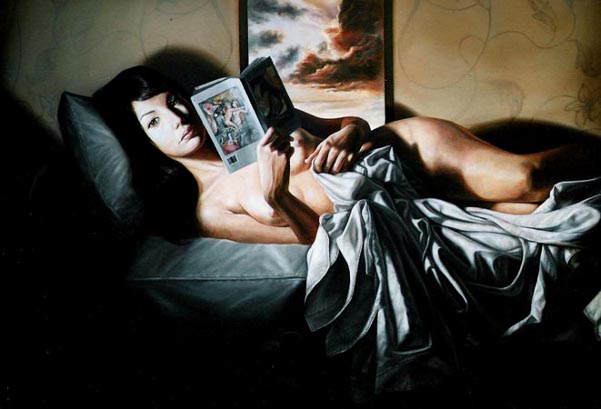
El Crepúsculo de Diotima
Ricardo Celma (1975, Argentina)

Diotima of Mantinea is a present absence in Plato’s Symposium. Her words form the most important of the symposium’s encomia to Eros, but she does not speak them herself. Socrates, her former pupil, relates her lesson in erotics to the assembly. She remains a mysterious figure: her name — ‘honoured by god’ — and her city, cognate with mantis, place her somewhere between human and divinity. Though the main narrative of the Symposium is doubly framed — it records the words of Apollodorus who recounts what he heard from Aristodemus — Diotima is still further removed from the literary present. She exists (if she exists at all) as a liminal, ambiguous being. But this is appropriate to her subject: Eros, a god characterized by perpetual incompleteness.

The Diotima of Friedrich Hölderlin’s Hyperion or the Hermit in Greece (Hyperion oder der Eremit in Griechenland), too, seems poised between being and non-being. As the title character’s beloved, her existence forms the hinge of the entire narrative, yet the pages in which she appears are relatively few and in them, she is most often passive and silent. Most formative for Hyperion, indeed, is her seemingly unmotivated death, reported at second-hand. The form of the novel, a series of retrospective letters from Hyperion, serves to heighten her absence just as the Symposium’s framing places its narrative in a doubly-remembered past. Hölderlin’s Diotima, like Plato’s, exists in eternal mediation, suggesting that Hyperion’s desire cannot be fulfilled, his ideal never realized.

This is the lesson of Diotima in the Symposium. In contrast to the previous speakers, Socrates emphasizes not the positive qualities of Eros, but the poverty that drives the god to seek beauties he does not possess. Socrates reports the speech of Diotima, who disabused him of the notion advocated by his friends. The Eros described by Diotima is liminal, neither beautiful nor ugly, and neither man nor god. He is a daimôn, whose existence is defined by his place between opposing realms. His power is

… interpreting and carrying to gods things from humans, and to humans things from gods: from humans, the entreaties and sacrifices; from gods, orders and exchanges for sacrifices. He is in the middle of both and fills the space between, so that all is bound by him. 

Eros is always relational, a mediation between two elements. This is a consequence of his birth, as the child of Penia and Poros, need and resource. Like his mother, he is unattractive and perpetually impoverished, yet he has the skills of his father that allow him occasionally to attain his desire. This makes him a paradox, poor but able to become rich, immortal but able to die: ‘sometimes he flourishes for a day and lives, whenever he has resources, and sometimes he dies, but is brought back to life again through the nature of his father.’ Eros is not a happy medium of his two parents, but an unstable oscillation between states of euporia and aporia.

Eros’ dialectical nature makes him philosophical, and distinguishes him from his parents. Those who are wise (like Poros) feel no need to philosophize, while those who are ignorant (like Penia) cannot comprehend their need. Eros’s philosophical nature is based on reflection; it results from the recognition of his own ignorance. Philosophy is a state of intellectual poverty that uses resource to gain insight:

Being a philosopher he is between a wise man and an ignorant. The cause of this is his birth: for he is from a wise and resourceful [euporos] father, and an unwise and unresourceful [aporos] mother. 

Socratic philosophy and erotic desire are parallel; both begin in a state of reflective aporia and strive towards euporia. Socrates’s self-conscious ignorance makes him the exemplary erotic seeker. In this respect, it is particularly important that the figure of Diotima is absent in the dialogue: erotic and philosophical fulfilments are deferred, set off in a mysterious past. Furthermore, Socrates (like the speakers who frame the story) is simply repeating an earlier conversation rather than engaging in his usual dialectics. What remains for the symposiasts as for the reader of the Symposium is a mediated presence that relates knowledge without being able to answer for it.

El Crepúsculo de Diotima
Ricardo Celma (1975, Argentina)

The connection of philosophy and desire suggests a productive nature of Eros, a way it escapes the constant oscillation between want and fleeting fulfilment. As we have already learned, Eros is unable to possess what it desires permanently. Instead of possession of the beautiful, Eros seeks to reproduce with the beautiful:

– Eros, Socrates, she said, is not of the beautiful, as you think.

– But what then?

– Of begetting and bringing forth on the beautiful.

– Let it be so, I said.

– It is so absolutely, she said. And why is it of begetting? Because begetting is eternal and undying as far as it is possible for a mortal. From what we have agreed, it is necessary that with good one desire immortality, if indeed eros is of the good being one’s own always. It is necessary from this very account that eros be also of immortality.

The account of Eros’ activity here changes abruptly: Eros finds a way out of lack, to a creative activity. This also necessitates a redefinition of Eros as desire, not for the beautiful or the good, but for an eternal existence. In place of possession, Eros turns to production. This is the crux on which Hölderlin’s reading of the Symposium will focus, as nostalgia for a lost ideal is transformed into the realization of future possibility. This dynamic constitutes what might be termed an ‘erotics of reception’.

Desire, according to Socrates, necessarily turns from the transient present towards an infinite future. In reporting Diotima’s words, Socrates enacts this temporal reorientation, making her absence the basis for philosophical production. He leads his companions, as erotic desire leads the philosopher, on the ascent to higher forms of beauty, and ultimately, to the idea. This is an increasingly contemplative act, in which desire for a beautiful body yields to desire for a beautiful soul, and ultimately, to knowledge of the essence of beauty:

Beginning from these very beauties, for the sake of that highest beauty he ascends eternally, just as if employing the rungs of a ladder, from one to two, and from two to all beautiful bodies; from beautiful bodies he proceeds to beautiful pursuits, from pursuits to beautiful sciences, and from these sciences arrives at that science which is concerned with the beautiful itself and nothing else, so that finally he comes to know what the beautiful is. 

The end of Eros is philosophical fulfilment, conceived as a reflection on immortal beauty. The ascent to the eternal form is parallel to the immortality of giving birth: both begin with a pregnancy of the soul that seeks a beautiful object. From the aporia of mortal bodies, philosophy fashions the euporia of wisdom. The figure of Diotima, an absence that produces knowledge, represents this progress to fulfilment through loss. In the Symposium, as in Hyperion, Diotima’s very pastness makes her the object of an erotic dialectic.
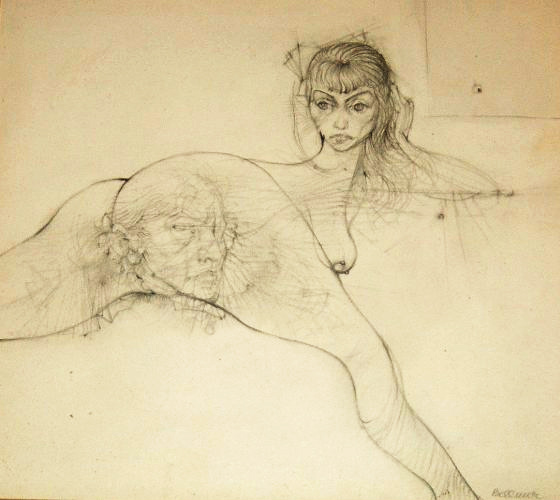
Read Joshua Billings’ whole paper, entitled  Hyperion’s symposium: an erotics of receptionOxford Classical Receptions Journal (2010) 2 (1): 4-24.

on friedrich hölderlin’s “hyperion”

Hölderlin’s work, like Celan’s after him, is a practice of creating the universality of music out of the treacherous medium of words. The frisson of this practice is an impossible, and irresistible, place to live and die. Like Orpheus, Hyperion keeps looking back. And like Orpheus, Hölderlin the poet relives the moment of his lost love in a melodious, maddening loop.

~ Elizabeth Bachner, on Hyperion by Friedrich Hölderlin. Read her whole review HERE.

hildegard von bingen – o euchari (1161)

Eucharius!
you walked blithely when you stayed
with the Son of God,
touching him, watching
his miracle-working.

You loved him with a perfect love
when terror fell on your friends —
who being human had no
strength to bear the brightness
of the good.

But you — in the blaze of utmost love —
drew him to your heart
when you gathered the sheaves
of his precepts.

Eucharius!
when the Word of God possessed you
in the blaze of the dove,
when the sun rose in your spirit,
you founded a church in your bliss.

Daylight shimmers in your heart
where three tabernacles stand
on a marble pillar
in the city of God.

In your preaching Ecclesia
savors old wine with new —
a chalice twice hallowed.

And in your teaching Ecclesia
argued with such force
that her shout rang over the mountains,
that the hills and the woods might bow
to suck her breasts.

Pray for this company now,
pray with resounding voice
that we forsake not Christ
in his sacred rites,
but become before his altar
a living sacrifice.

Translated by Barbara Newman

Comment from the maker of the video: “This piece was influenced by cubist works of circus and theatrical subjects in the Thyssen-Bornemisza Museum of Art in Madrid. It is also influenced by stained glass work I saw at the Theatre of Glass in Bath. The original piece is much more beautiful because of the larger file size.
The kinetic version of this piece is set against Hildegard von Bingens O Euchari (1161) sung by Emma Kirkby and Gothic Voices.”

~ D Lewis Baker

amália rodrigues – barco negro

Amália Rodrigues sings the fado “Barco Negro” in a scene from Henri Verneuil’s 1955 film LES AMANTS DU TAGE.

Translation of the French conversation in the scene (which paraphrases the Portuguese lyrics of the song being performed by Amália behind it):

Child — Do you like it?

Woman —  Very much. I’m sorry I don’t understand Portuguese. It must be beautiful.

Child — It’s the wife of a fisherman who died at sea. She goes down to the beach every night and talks to him as if he were alive. She tells him… She tells him… love things.

Man — [paraphrasing the singer] “I woke up this morning trembling next to you, afraid that I was less beautiful than yesterday. But your eyes told me, ‘No.’

“When you opened the door, the sun was gliding along the sea and your black boat was dancing in the light. Standing on the rocks, I saw you hoist sail and turn towards the open sea, while waving happily.

“The women praying at night along the shore say that you never returned. Madwomen, my love, madwomen! You never left. You’re everywhere around me, as always… In the wind, throwing sand against the windowpanes; in the water, singing on the fire; in the empty chair, staring at me; in the dark of the hearth; in the warmth of the bed; in the crook of my shoulder… You are there always. Always there. Always.”

olive schreiner – life’s gifts

Olive Schreiner

I saw a woman sleeping. In her sleep she dreamt Life stood before her, and held in each hand a gift – in the one Love, in the other Freedom. And she said to the woman, ‘Choose!’

And the woman waited long: and she said, ‘Freedom!’

And Life said, ‘Thou hast well chosen. If thou hadst said, “Love,” I would have given thee that thou didst ask for; and I would have gone from thee, and returned to thee no more. Now, the day will come when I shall return. In that day I shall bear both gifts in one hand.’

I heard the woman laugh in her sleep.