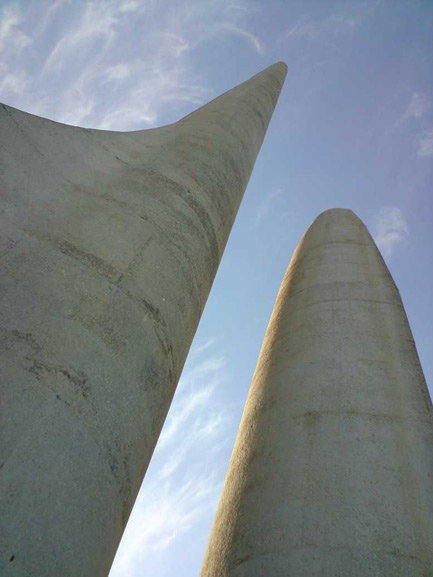
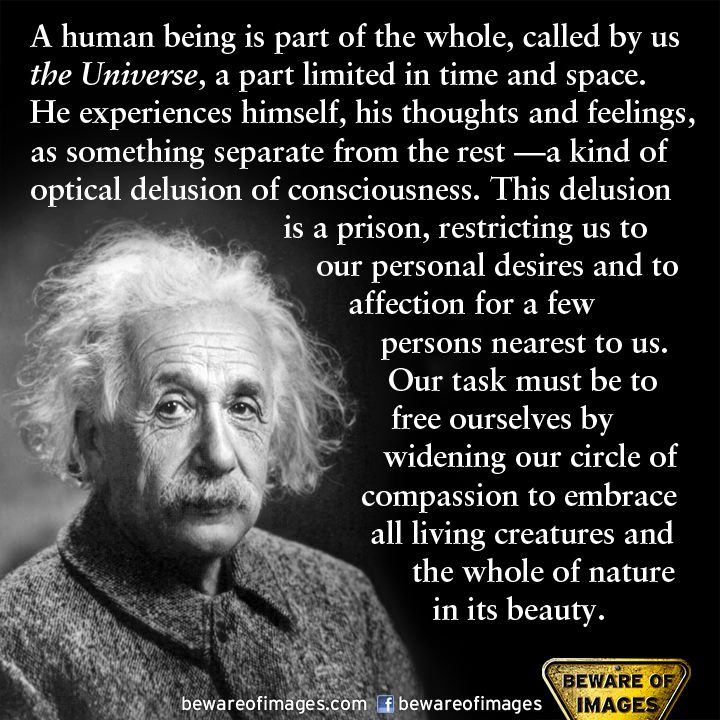
le journal de personne – falestine

Abîme… Abîme!
Tu as commis le pire des crimes
En faisant de Dieu
L’instrument de ta morsure.

Mon père s’est marié à deux reprises
Une fois à l’Est et une deuxième fois à l’Ouest… de Jérusalem…
Je suis palestinienne
Et ma demi- sœur est israélienne
On ne se parle plus…
Je parle arabe, elle parle hébreu
Mais on ne se comprend plus…
On fait semblant de ne plus se comprendre!

From HERE.

katibim (üsküdar’a gider iken) – my scribe (going to üsküdar) (1929)


Folk song, recorded in 1949 in Istanbul. Sung by Safiye Ayla. Played with violin, kanun, ud and clarinet. This recording is in the public domain. You can download it HERE.

Background
Üsküdar (Scottary), now a section of Istanbul on the Anatolian (Asian) side, used to be a village/town across the Bosphorus from Istanbul proper, where nursing began during the Crimean War (British and French assisted Turks against Russia, 1854-56).

There is much fascinating debate about the origins of this song. Whose Is This Song? is a documentary made about the subject by Adela Peeva in 2003. Here’s the blurb:

“In her search for the true origins of a haunting melody, the filmmaker travels to Turkey, Greece, Macedonia, Albania, Bosnia, Serbia and Bulgaria. The trip is filled with humour, suspense, tragedy and surprise as each country’s citizens passionately claim the song to be their own and can even furnish elaborate histories for its origins. The tune emerges again and again in different forms: as a love song, a religious hymn, a revolutionary anthem, and even a Scottish military march. The powerful emotions and stubborn nationalism raised by one song seem at times comical and other times, eerily telling. In a region besieged by ethnic hatred and war, what begins as a light-hearted investigation ends as a sociological and historical exploration of the deep misunderstandings between the people of the Balkans.”

You can watch the preview HERE.

Lyrics
Here’s a translation of the Turkish version’s lyrics (a compound I have made from various versions I found online), which have been credited in some places to Nuri Halil Poyraz (1885 – 1950) and Muzaffer Sarisozen (1899 – 1963):

On the way to Üsküdar, it started raining
My scribe (katip) wears a frock coat, its long skirt muddied
He has just woken from sleep: his eyes are languid

The scribe is mine; I am his; hands will intertwine
It looks so lovely on my scribe, that starched shirt of his

On the way to Üsküdar, I found a handkerchief
I filled the handkerchief with Turkish delight (lokum)
As I was looking for my helper, I found him next to me

The scribe is mine; I am his; what is it to others?
It looks so lovely on my clerk, that starched shirt of his.

haidt on morality

“Morality binds and blinds. It binds us into ideological teams that fight each other as though the fate of the world depended on our side winning each battle. It blinds us to the fact that each team is composed of good people who have something important to say.”

– Jonathan Haidt,    The Righteous Mind: Why Good People are Divided by Politics and Religion

the righteous mind by jonathan haidt

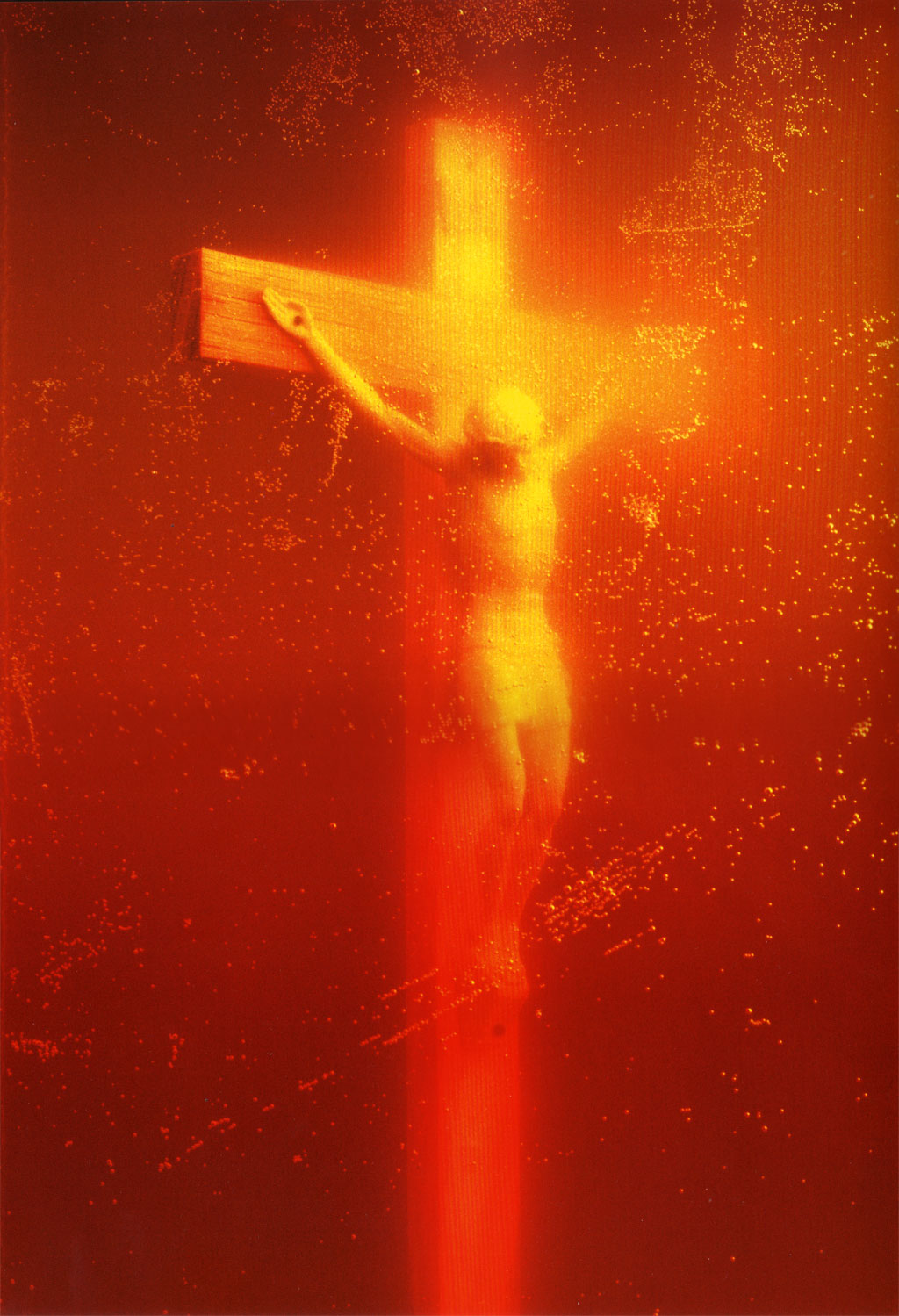
Andres Serrano´s Piss Christ is a photograph is of a small plastic crucifix submerged in what appears to be a yellow liquid. The artist has described the substance as being his own urine in a glass. The photograph was one of a series of photographs that Serrano had made that involved classical statuettes submerged in various fluids—milk, blood, and urine.The full title of the work is “Immersion (Piss Christ)”.The photograph is a 60×40 inch Cibachrome print. It is glossy and its colors are deeply saturated. The presentation is that of a golden, rosy medium including a constellation of tiny bubbles. Without Serrano specifying the substance to be urine and without the title referring to urine by another name, the viewer would not necessarily be able to differentiate between the stated medium of urine and a medium of similar appearance, such as amber or polyurethane.

Serrano has not ascribed overtly political content to Piss Christ and related artworks, on the contrary stressing their ambiguity. He has also said that while this work is not intended to denounce religion, it alludes to a perceived commercializing or cheapening of Christian icons in contemporary culture.

” Here’s a thought experiment. Are you deeply offended by works of art such as Andres Serrano’s Piss Christ, which depicts Jesus as seen through a jar of urine, or Chris Ofili’s The Holy Virgin Mary, which shows Mary smeared with elephant dung? So offended that you think they ought to be banned and the galleries that display them prosecuted? No? OK, then try replacing the religious figures in these pictures with the sacred icons of progressive politics, people such as Martin Luther King and Nelson Mandela. How would you feel if you walked into an art gallery and saw an image of King submerged in urine or Mandela smeared with excrement?

Many people are likely to feel torn. Liberals know the reasoned arguments for freedom of expression and the importance of being consistent on matters of principle. On the other hand, it would be surprising if they did not also feel disgusted and affronted. How dare anyone pass off such gratuitously offensive images as works of art?  Shouldn’t they be stopped? Jonathan Haidt, who gives a version of this thought experiment in his provocative new book, wants us to know that reason and instinctive outrage are always going to co-exist in cases like this. What’s more, in most instances, it’s the outrage that will be setting the agenda.

The arresting image Haidt gives for our sense of morality is that it’s like a rational rider on top of an intuitive elephant. The rider can sometimes nudge the elephant one way or the other, but no one should be in any doubt that the elephant is making the important moves. In fact, the main job of the rider is to come up with post-hoc justifications for where the elephant winds up. We rationalise what our gut tells us. This is true no matter how intelligent we are. Haidt shows that people with high IQs are no better than anyone else at understanding the other side in a moral dispute. What they are better at is coming up with what he calls “side-arguments” for their own instinctive position. Intelligent people make good lawyers. They do not make more sensitive moralists.

Where do these moral instincts come from? Haidt is an evolutionary psychologist, so the account he gives is essentially Darwinian. Morality is not something we learn from our parents or at school, and it’s certainly not something we work out for ourselves. We inherit it. It comes to us from our ancestors, ie from the people whose instinctive behaviour gave them a better chance to survive and reproduce. These were the people who belonged to groups in which individuals looked out for each other, rewarded co-operation and punished shirkers and outsiders. That’s why our moral instincts are what Haidt calls “groupish”. We approve of what is good for the group – our group.”

Read the rest of Runciman´s text here

audre lorde on speaking out

If I didn’t define myself for myself, I would be crunched into other people’s fantasies for me and eaten alive.
___

I was going to die, sooner or later, whether or not I had even spoken myself. My silences had not protected me. Your silences will not protect you… What are the words you do not yet have? What are the tyrannies you swallow day by day and attempt to make your own, until you will sicken and die of them, still in silence? We have been socialized to respect fear more than our own need for language.

I began to ask each time: “What’s the worst that could happen to me if I tell this truth?” Unlike women in other countries, our breaking silence is unlikely to have us jailed, “disappeared” or run off the road at night. Our speaking out will irritate some people, get us called bitchy or hypersensitive and disrupt some dinner parties. And then our speaking out will permit other women to speak, until laws are changed and lives are saved and the world is altered forever.

Next time, ask: What’s the worst that will happen? Then push yourself a little further than you dare. Once you start to speak, people will yell at you. They will interrupt you, put you down and suggest it’s personal. And the world won’t end.

And the speaking will get easier and easier. And you will find you have fallen in love with your own vision, which you may never have realized you had. And you will lose some friends and lovers, and realize you don’t miss them. And new ones will find you and cherish you. And you will still flirt and paint your nails, dress up and party, because, as I think Emma Goldman said, “If I can’t dance, I don’t want to be part of your revolution.” And at last you’ll know with surpassing certainty that only one thing is more frightening than speaking your truth. And that is not speaking.

― Audre Lorde, from Sister Outsider: Essays and Speeches (1984/2007, The Crossing Press).

the transformations of anne sexton, poststructuralist witch

Jeremy DeVito, 2011

“The world of the fairy tale has been traditionally read as one in which anything may happen, in which all things work toward and will eventually culminate in, the ‘perfect’ fairy tale ending of ‘happily ever after.’ However, the last half-century (with the rise of literary theory in general and feminist theory in particular) has produced a degree of cynicism towards this traditional reading. Fairy tale ideology has been challenged on the grounds that it is classist, racist, and, most blatantly, sexist. Hence, such tales have found new storytellers and have been adapted in such a way as to subvert the problematic ideals of tradition and, in most cases, replace them with what is seen as a fresher, more inclusive set of values. In 1972 Anne Sexton published Transformations, a collection of poetic retellings of seventeen widely recognizable fairy tales from the Brothers Grimm, which, in the eyes of such critics as Carol Leventen, “belongs to [this] significant body of revisionist / feminist work” (137). Although these retellings doreflect a new (and distinctly female) voice, however, Sexton’s critique contains complexities that go beyond a feminist objection to patriarchal concepts of perfection and happiness. Rather, Sexton’s tales suggest that the real problem with the fairy tale is to be found in its very striving towards the non-problematic; in short, Sexton’s poems are not so much feminist re-writings as they are poststructuralist re-readings. Their aim is not to adapt the traditional in providing or implying a new (feminist) central philosophy, but rather, to strip the tales of any centre whatsoever… ”

Read the rest of DeVito´s text here

more of the same old, same old…

Johannesburg – The media coverage of the upgrades to President Jacob Zuma’s Nkandla home required government to “dust off” apartheid-era legislation, media law expert Dario Milo said on Friday.

“The Public Works Minister’s (Thulas Nxesi) response to the (Zuma/Nkandla) expose was twofold,” Milo said at Wits University in Johannesburg.

“(These were) to call for the City Press, which first broke the story, to be investigated for the crime of unlawfully processing a ‘top secret’ document, and to refuse to answer questions about the Nkandla funding because it had been declared a ‘national key point’.”

He said both these propositions required Nxesi to use apartheid-era security legislation such as the Protection of Information Act of 1982 and the National Key Points Act of 1980.

“This is hardly the type of legislation I would want to be relying on if I were in the minister’s position.”

The use of these laws was a current threat to media freedom and was being used to stifle transparency and accountability, he said.

Read more of this article HERE.

brave new leaders

Why is it that people we entrust running our countries to – and therefore, in effect, collectively, the world – don’t need to have a degree? A doctor needs to study for seven gruelling years before he or she is allowed to examine and treat your body, but politicians can somehow take a country to glory or ruin based on being elected on sheer charisma.

Would you let someone operate on you because they have a great smile? No? Strange that we let people run a country who, in South Africa for instance, never even attended high school.

Why not establish a special college , call it Polit School, where those who excel at school – the top academics, head boys and girls, etc – go to, and are groomed for, in order to learn how to run a country? Or, if someone who has already left school wants to run a municipality, province or country, that person could apply to study at this institution.

The most important quality must be integrity; the college must be based on a code similar to that of the knights of the middle ages. The strong are there to protect the weak, chivalry and honour top the list. Any blemish of character relating to dishonesty, cruelty or self-enhancement at the expense of others would disqualify candidates immediately. Thorough background checks are mandatory.

The rigorous selection system and exams run by the college board would ensure these professionals adhere to and adopt a code of ethics every bit as strict as those who study to enter the legal or medical field.

One of the most important subjects at this college would have to be history, since learning from past mistakes is something politicians appear to have little aptitude for. Hopefully this prize team of carefully selected individuals could take the human race past its present, circular set of stumbling blocks, and we can stop banging our heads against the same walls so repetitively.

Come election time, citizens would only be allowed to select Polit School candidates to run their country, cabinet, parliament etc from this pool of highly ethical, trained professionals. Of course, once they qualify, they have to enter the field at the lowest rung – in communities and villages and townships – before making their way to the top.

And they would be subject to screening at every step. And those who do the screening and selections – same goes for the candidates – are simply not allowed to be connected to big business in any way whatsoever. The connection between corporates and politicians has to be severed. It’s a serious business running a country. Let’s turn it into a science.

Leadership is also somewhat of an art. Some of us are just not cut out for it, no matter how hard we would work at Polit School. One would rather rule with love than fear. You have huge responsibilities placed on your shoulders, and you chose them; you as leader have been entrusted with taking care of millions of people, not only in your own country, but those bordering it. Today the human race is a global phenomenon ,so whatsoever actions you chose to implement at home will have ripples abroad.

We are no longer isolated entities and our very survival is at stake because – shame to admit it really, as we do regards ourselves as intelligent creatures – we still don’t know how to get on with each other. So the election of the world’s leadership is critical right now.

We need to do away with greedy leaders who comprise the 1% and start sharing resources because there are enough actually, if shared and managed wisely. Leaders need to lead by example. Their behaviour must be impeccable. If there is any slander against them it must be investigated and cleared immediately. People cannot doubt their leaders, just as small children cannot doubt their parents.

What has changed is leaders can’t bullshit the masses as easily as they used to. In the bad old days you could start a border incident with a few well-placed gold coins, a ship gets sunk or a village torched and bingo, you have your excuse to invade the neighbours because “they started it” and we were “acting in defence”.

After that came control of the media – Goebbels realised its power, so did the apartheid regime, and the mainstream media is massively controlled by the US police state even today. But cracks like Wikileaks are appearing and the forces of opposition – Anonymous etc – grow stronger by the day. We can’t be fooled as easily as we once could.

Our leaders need to unite us all to address the real challenges of the day – the destruction of the environment, water scarcity, food shortages, housing, education, meaningful employment and relation to each other – rather than bullshit like wars and squabbling over resources and territories we all need to now share, or we will perish in large swathes.

If there are disagreements, the one thing the ancient tribes resorted to that I kind of dig is at times a champion from each tribe would be put forward to solve the unsolvable disagreement. Sometimes it was the chief himself … maybe there were even herselfs who fought for the tribe’s honour. Imagine today’s leaders doing something like that? We need brave leaders who can walk the talk, not cower behind their police or armies. They have to be at the frontline.

The old order changeth and the new one emerges. A system of leadership which was based on monarchy which became the lapdog of corporates and was always based on lies and fear and plunder is falling. The only world superpower since WWII is becoming replaced by a number of growing, other superpowers. The monetary system as we know it is in danger of complete global collapse. Its a 2012 scenario and its already started.

What replaces it is the question. If the centre collapses, is it filled by complete chaos, anarchy in its worst form? Things are polarising fast, and those with the most possessions have the most to lose. So, whose side are you on, becomes the question … and who will step forward with the guts to lead a new world, with a new style of leadership, is the big question.

on worshipping little pieces of blazing hell

“Still, American television is full of smiles and more and more perfect-looking teeth. Do these people want us to trust them? No. Do they want us to think they’re good people? No again. The truth is they don’t want anything from us. They just want to show us their teeth, their smiles, and admiration is all they want in return. Admiration. They want us to look at them, that’s all. Their perfect teeth, their perfect bodies, their perfect manners, as if they were constantly breaking away from the sun and they were little pieces of fire, little pieces of blazing hell, here on this planet simply to be worshipped.”
― Roberto Bolaño, 2666

frank

My mother has a brave and brilliant eco-activist friend, Frank, who has been fighting to save the estuary of the Black River and squatting in an abandoned building in Paarden Eiland, despite being over 80 years old. The other day, the City Council came to deliver an eviction order, and when they got there, Frank was dead. He’d overdosed on heart pills. Well done, Frank, for choosing how to live and how to die. You’re an inspiration.

the penis: mightier than the sword – rereading an old quotation at the time of abu ghraib (2004)

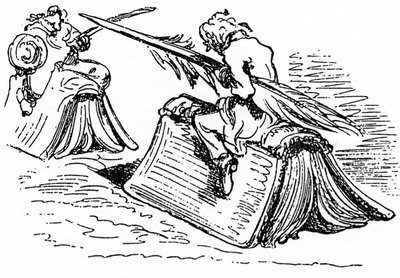
The famous quote ‘the pen is mightier than the sword’ has a different meaning today than it had when the English novelist Edward George Bulwer-Lytton (1803-1873) wrote in 1839: ‘Beneath the rule of men entirely great the pen is mightier than the sword’. Apart from the obvious fact that a sentence fragment cannot convey the same meaning as a full sentence, there are a number of reasons why we can assume there to have been significant changes in the meaning of these frequently quoted words in the last 160-odd years. After an initial non-exhaustive exploration of some of these reasons in order to discuss the contemporary reception of old texts in general, I will present an example of a possible contemporary rereading of the sentence in order to critically approach its form as well as its content in more detail.
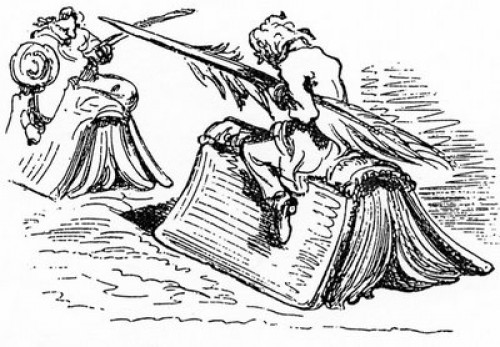
From the 19th through to the 21st century, radical shifts have taken place in the social, political and economic systems of the currently ‘European’ nations like England. Class differences have steadily decreased in importance while the levels of literacy have increased enormously. Nowadays readers of literary, journalistic and other texts come from all walks of life and all classes in society, which was not yet the case in Lytton’s time. Due to the cultural complexity of a postmodern and post-industrialised context, readings of this sentence today are not merely permitted to be different, but are necessarily far more numerous and varied than they would have been expected to be in the 1800s.

In the midst of this new plurality of discourses – which is for reasons of brevity and clarity merely stated here and will not be elaborated on – phrases of such universalising nature are rarely coined by writers and other intellectuals today, whereas in its original context a sentence such as this one may have had only one unmistakeable message to almost anyone reading or hearing it, simply because this context was rather narrow. Those who could read and write of course did not all think alike, but they would all more or less have agreed on what kind of meaning was being transmitted with these words. Nowadays we can observe a very different dynamic unfolding: whatever is said publicly immediately enters a broad field of more or less interconnected discourses, which form more or less homogenous or contradictory opinions as to its meaning within – and its relevance to – their own and possibly other world views.
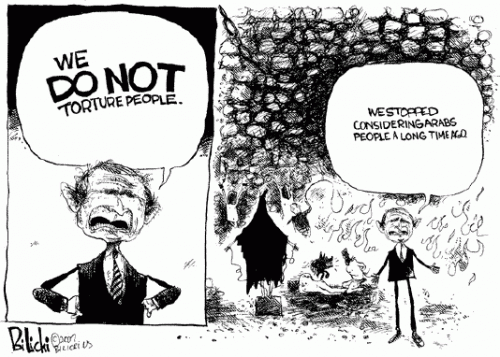
What any given politician is saying on any given day on any given subject is never entirely opaque to anyone reading about it in the paper who has also read the previous day’s edition, but what effectively stands behind these words is ever more difficult to contextualise constructively in terms of its respective outcomes. ‘Right’ and ‘wrong’ are constructs that have become almost interchangeable or irrelevant, because there are so many equally valid viewpoints on any given subject or utterance, which all have a more or less publicly audible – and thereby already minimally validated – voice.

In order to bring meaning to the signifying remnant ‘the pen is mightier than the sword’ of the 19th century message x (as in ‘unknown’) in this widened, or rather exploded context, it is necessary to – at least initially – ‘misunderstand’ it. ‘Misunderstanding’ here shall refer to the application of an interpretation based on the more or less unspecific world knowledge of an individual living in the 21st century, as opposed to assuming to be in the know about what meaning the text had in 19th century England. At best, in any critical approach the inevitability of this process of ‘misunderstanding’ is acknowledged and problematised; else it is taken for granted, or at worst denied. In the last case lies the danger of laying claims to an absolute truth of sorts. Nowadays certain versions alone – of the infinite number of possible readings – may succeed in presenting certain convincing insights, which do not lay claim to finality or completeness.

The penis: mightier than the sword. This modified version arrived at by simply dropping the space between ‘pen’ and ‘is’ and inserting a colon, crassly illustrates the imagery of pen and sword as charged with concepts of maleness. It is psychoanalytically easily accessible: we are presented with two phalluses holding recourse over their size. The reader is asked to identify with the smaller and therefore supposedly weaker member, and he is told that size not only doesn’t matter, but that he will – on this side of the argument – prevail in the face of overpowering adversity, or better still: competition. The question arises: over what? We do not know. Are we to assume that the sword stands for war and the pen for enlightenment – and in effect peace? If this is the case, what we are led to believe in this statement is that war is bad, and that consequently it is to be regarded as disconnected and even structurally different from everything that has to do with writing and reasoning: as ‘mightier’ human endeavours.
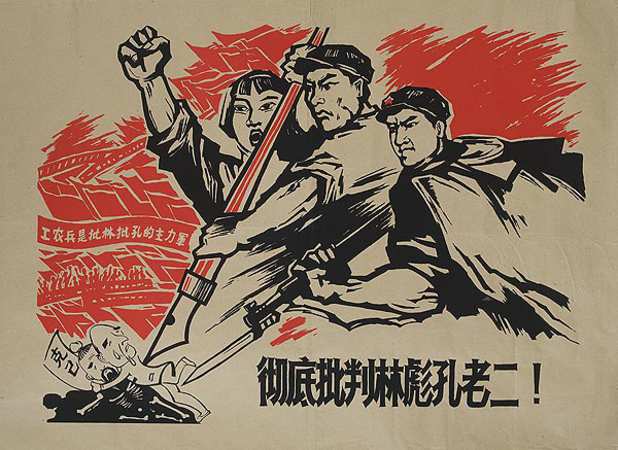
The ‘pen’ here stands for the word, an ideal idea, the thought worth concretising and writing down. The ‘sword’ stands for war, death, planned killing in the name of a higher power or principle. On this literally symbolic level the pen may be mightier than the sword; but moving on from this level it may be argued that the pen harnesses the power that also moves the sword, if less wisely so, and thereby causes greater destruction than the sword alone ever will. Nowadays, if only through the abundance of costume dramas and kung-fu movies, the sword as an image does no longer successfully symbolize chaos and destruction, for in its singularity and crafted clarity it visually far outruns the ill-defined pen. With its size, weight and sharpness, the sword suggests more self-discipline and mental order in its bearer than any pen might afford, which is too often engaged in merely noting down whimsical movements of mental current in forms ranging from scratchy to mannered.

On the surface of the image, pen and sword share the same space, but beyond the rationale of the proposed comparison, which actually draws the argument into one of two courts (where, as we will see later, both parties are at home), another battleground is implied, which stays as empty as it is hidden. Here, logically speaking, the sword has to be fighting with another unmentioned sword in order to be making war. This way the sword is – so to speak: secretly – set up to display its inferiority to the pen; which in turn, firstly as a symbol of a higher order of abstraction, and secondly due to its greater proximity as the first-mentioned in this short and brutal piece of rhetoric, refers more easily and convincingly to an enveloping structure of safety and sense.
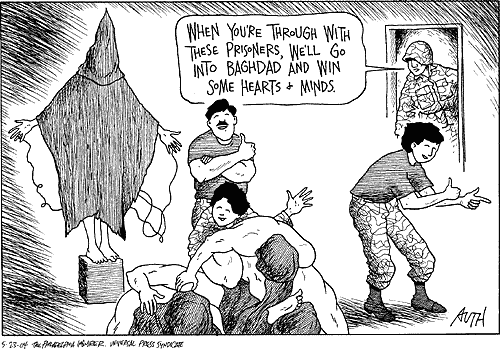
War, in this scenario, is denied any active role in the thinking, conscious persona, and conversely here, the thinking, rational persona is denied all the potency of the fight. The sentiment expressed here is a perfect example of the suppression mechanisms inherent in Western rationalism (‘Civilisation’): Making war, i.e. living out one’s ‘negative’ emotions on a non-intellectual stage – possibly even victoriously – is professedly barbaric, whereas to negate and suppress one’s emotions is constructed as a worthwhile and necessary endeavour. Even in a democratic system that purportedly aims to allow freedom of speech to everyone, there are these cultural limitations of emotional expression. This philosophy in practice may on the one hand be vital for the survival of our species, but the fact that it also provides the breeding ground for arguably the most perverted criminal offences on a daily basis (and has led to the creation of inarguably the most powerful weapons of mass destruction in human history), comes as no surprise when one contemplates how overpowering the restrictive reign of a rationalist culture over the hearts of its members has been. Imperatively, ‘the pen is mightier than the sword’ is voicing pure social conditioning: ‘Do not feel, upon failing at which (inevitable, unless you are dangerously deranged), at least stop yourself from acting on those feelings. Stay distracted, consume continuously according to pre-arranged patterns of perceived needs, and the state will cushion you from fearing death.’
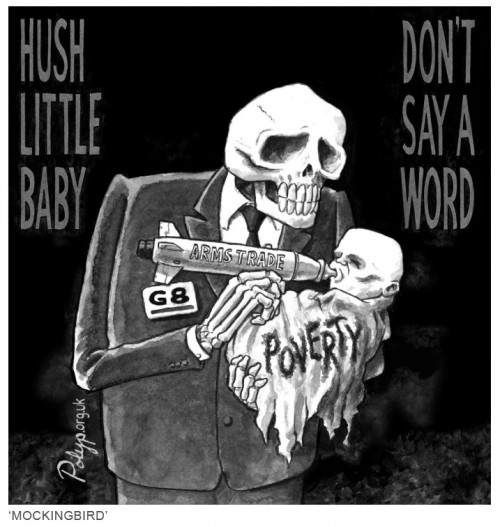
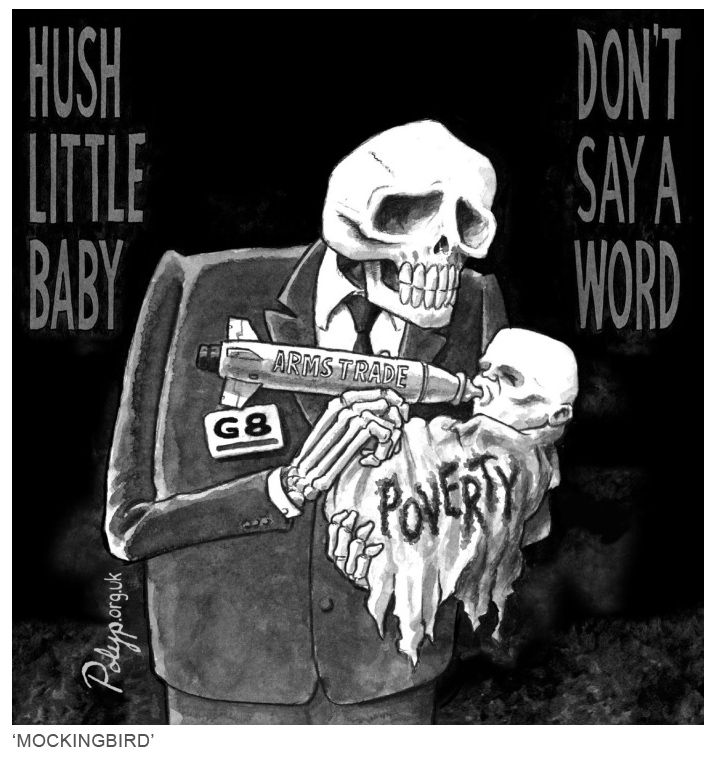
polyp cartoon _ G8 Arms Trade Poverty

It has become clear that, as a result of the immense complexities of our social, political and economic history, not only has the message of this sentence itself – like everything else in the cultural domain – had to change (hence the variety of possible and necessary contemporary readings), but so also has the sentiment that informed this message long vanished and been replaced by a range of new world views and belief systems. At present, what these generally have in common is that they sense themselves to be one of many possible views: heterogeneously scattered outside traditional hierarchies, others always requiring consideration.

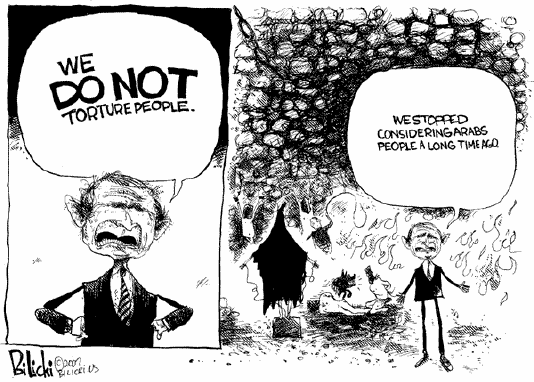
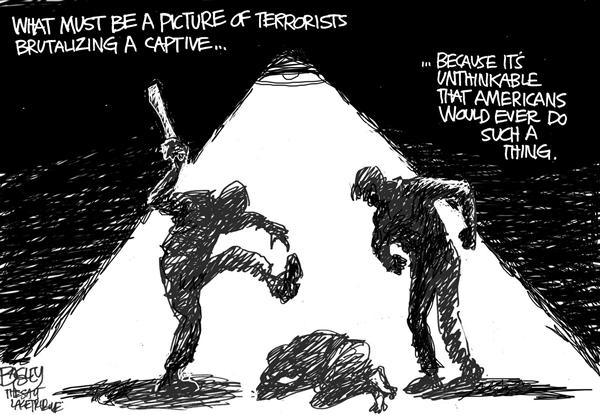
Of course there will always be fundamentalist and self-righteous tendencies in politics and other fields that need to set up an ‘other’ as opposite, with all the horrific consequences that ensue, as in the recent case of ordinary American country folk torturing and killing Iraqi prisoners of war in Abu Ghraib prison. The American defence minister’s public reasoning on this torture is that, far from being the carefully considered act of war between two nations that it was, it was supposedly a dirty deed carried out by rogue individuals. In the terminology of this text: that no ‘sword’ was involved. As a result of this denial the torturers will soon be publicly demonised and punished (under the same principle of othering), thereby serving as scapegoats for all those who have been actively involved in creating a lawless situation in these prisons in the first place. If the idea of a ‘mighty pen’ could be trusted to be referring to a positive pragmatism rather than a positivist idealism, it might now for example be able to symbolise an international military court, which could serve to address this new form of ideological and propagandist warfare. This kind of warfare is reminiscent of the public display of the severed heads of enemy soldiers in the Middle Ages, but it infinitely transcends it in calculation and coldness. That Iraqis are responding ‘in kind’ (with the recent public killing and burning of American tourists), surprises less than the Americans’ refusal to submit their soldiers to said international court of war.
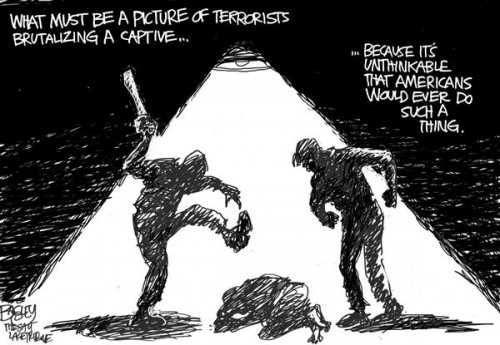
Most people today do not believe that wars are stopped by anything somebody writes with a pen: In fact, we are becoming increasingly sensitised to the demagoguery of the media. The worst wars, the greatest weapons, the most inescapable conflicts, the most far-reaching crimes and deepest infringements of basic human rights are all created on paper, but they are rarely prevented and almost never undone again through the use of that medium.

Once ‘The pen is mightier than the sword’ may actually have been a revolutionary and powerful statement, but nowadays it is merely an overused turn of phrase that invites kitsch sentiments on the one hand and bitter cynicism on the other. Googling this phrase, one comes across fantasy websites, dating chatrooms, reactionary rants by fundamentalist Islamic school children, and all other kinds of intellectually ill-directed verbiage. This selection naturally also has to do with the medium of the internet, and only represents that quantity of writing that has made itself available to us as html code. On the other hand, if ‘mighty’ writing was as easily and readily available today as all that web and magazine copy that likes to borrow this phrase, there would probably be less disillusionment in the mind of today’s reader who comes across it.
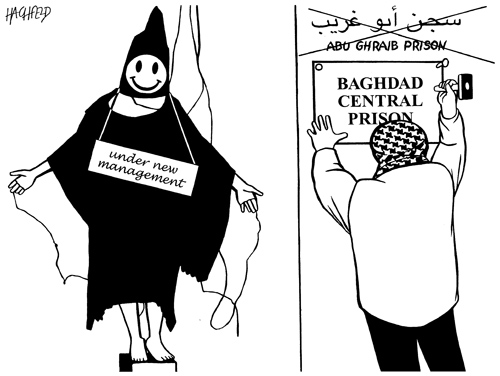
Many readers today are not used to enjoying or savouring the tensions and creative spaces offered by a linguistic symbol – they seem to lack the ability to read symbols as such. This is best exemplified by the mass of websites containing most literal readings of the quote. Self-defence sites for women describe a variety of techniques for using a pen as a weapon; crime-writer blogs publish stories investigating the poisonous qualities of ink; ‘Dungeons and Dragons’-fans have ‘webrings’, where the interpretations voted into the top five all delight in ‘setting things right’: the pen would have to be very big and the sword very small… etc. Many readers who have enjoyed the privilege of being exposed to a variety of literary genres may shudder at the shallowness of this method of constructing linguistic communication, but recognising the widespread reality of this practice could also be a less prematurely judgmental process and even bear new creative fruit: new sets of immediately recognisable symbols are forming all the time, including all the potential pitfalls of more or less hidden reactionary sentiments, but far more open to widespread critical discussion.

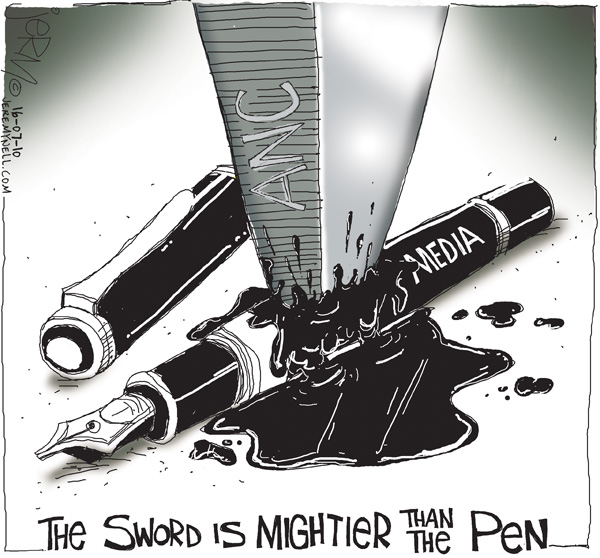
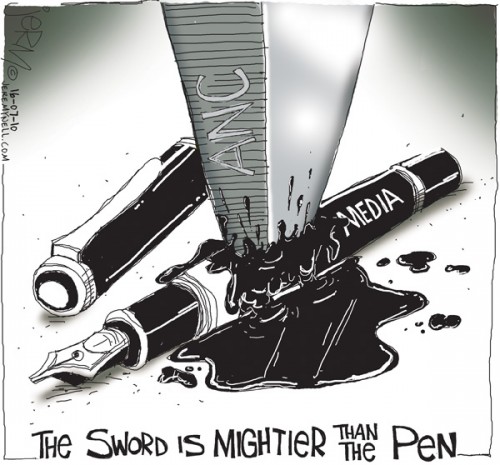
‘The sword is mightier than the pen’ – a statement that holds true, only rather less surprisingly so, which is why it is nowhere to be found as a quotation. What might have made the quote so long lasting is that it seems to be expressing something unthinkable: a pen battling with a sword and beating it, as it were: a poet wrestling down a soldier.
If, hypothetically unencumbered by any knowledge of the quote, a contemporary reader were to come across a sentence expressive of the negative ‘The pen is not mightier than the sword’, they might successfully be moved to contemplate the dynamics of power and information, and the worldwide imbalance regarding the privilege of acquiring knowledge. Installing this modified ‘quote’ publicly in the fashion of, for example, Jenny Holzer’s ‘Truisms’, may serve to draw attention to the Y-generation’s ubiquitous refusal to re-interpret and re-negotiate vital forms of human expression – a refusal structurally inherent in the banality of the practice of ‘sharing’ on (anti-)social networks, of regurgitating and replicating copies of once-historic fragments until the pen is dry.
the flower of seven colours

Cvetik Semicvetik (Flower of Seven Colours) is a beautiful Soviet children’s animation from 1948, based on a beloved folk tale about a little girl who receives a magic flower with seven free wishes from an old crone. None of her wishes leads to happiness, until the last wish, which she doesn’t use for herself, but for someone else. By making someone else happy, she is made happy too.

There are many different illustrated versions out there, but perhaps the most trippy one comes from the mind of Russian artist Benjamin Losin. Losin apparently illustrated two different versions of this book.

north korean children play stupendously creepy music

I found this North Korean children’s ensemble performance disturbing yet also fascinating… Maybe it’s due to my Western bias towards self-determination, but the regimented – no, automated – nature of this; the youngness of the children; their forced smiles, really upset me to watch. Everything is rote, down to the last tilt of the head. It also makes me wonder how much “childhood” they have – how heavy this weighs on their tiny shoulders… Or do they even feel it as oppressive at all? Maybe if you grow up where play (of the spontaneous sort) is not on the cultural menu, you never yearn for it, never feel alienation or exploitation?

Thanks Justin Allart for passing this on.

i love therefore i exist

REFLECTION: LOVE BETWEEN BODIES

They are two people by mistake. The night corrects that.-Eduardo Galeano

The purpose of the reflection that follows is simple. Starting with what has been considered, it is a matter of noting the unsettled relationship with one’s own body and with other bodies (particularly with those that are objects of desire) imposed by the passing of time, a perspective that for reasons indicated in the chapter, our protagonists didn’t even have the possibility of considering.

In an initial very general overview of the subject, one thing that would immediately be noticed by someone who was questioning the place and the importance of the body in our lives is the fact that over the years the body loses its role of opportunity for pleasure, an attribute that it possesses almost spontaneously during one’s youth, and, in its place, it increasingly and unstoppably acquires the role of obstacle to the peaceable development of one’s very existence. With the passing of time, the body in effect turns precisely into that which resists us, which agitates us and reminds us of its existence through symptoms such as pain, discomfort or, of course, illness. In his book The Arc of Words, Andrés Trapiello has expressed this thought with a brilliant aphorism: “The body is like style: the less noticed it is, the healthier it is”.

In other terms, if we agree to call age that specific time that speaks through the body, one could affirm that the greatest characteristic of youth with regards to the relationship that it maintains with corporal physicality is precisely its fluidity, its immediacy, its transience. In this sense, a young person is someone who can call on his or her body with the knowledge that the body will rapidly return the call. On the other hand in a mature age everything is slow as Coetzee has pointed out, sometimes even extremely slow. So much so that even words end up acquiring this calm and slow rhythm and they take time to reach our lips. As I understand it, it was what an old friend of his commented to the great Fernando Fernán-Gómez, remembering the old times nostalgically: “Do you remember when we spoke rapidly?”.

Nevertheless, if it were only that, one could reassuringly maintain that in the last resort living is finding an accommodation —even if paradoxically it is an uncomfortable accommodation— in one’s own body. The problem, at least with respect to one of the subjects that our society thinks about with greatest difficulty (in this regard I could give as an example any of the novels of Michel Houellebecq), lies in the fact that in addition to that intra-subjective dimension to which I have just referred and which each one of us has to take on, there also exists a specific and particular material inter-subjectivity one of whose most prominent expressions is shown through desire.

I note that the most forceful commentaries these days tend to judge with an attitude that to my taste is frankly hypocritical —somewhere between indifference and paternalism— specifically the older the bodies involved are. It looks as if the maximum threshold which those of us who have definitely left behind the condition of glorious bodies find correct to accept, is that of tenderness barely covered by a gentle pastel color of residual passion. But maybe the body responds to a logic that is totally missed by those commentaries. Maybe just like the word remembers the soul, desire preserves the memory of the body.

Or maybe it is that the body has its own memory and is capable of seeing in the body that lies next to it what it was, even though now it may no longer be; it rescues from obscurity the shine of the past and it brings it with loving delicacy to the present, redeeming it from the ravages of time, the unmerciful punishment of evolution. Those who believe that bodies accept, are resigned, agree with what is handed to them are wrong. No. The body remembers the fulfillment that the other, with whom it is now melding with, had. The body preserves the memory —its own memory— of what it knew, of what once was its own. I am not referring to a dreamlike state or a fantasy. All those who do not know this experience: the feel of the violent stab of lust on recognizing in this body that has changed so radically, that almost in no way resembles that of the past, its contours lost, the fresh scent that identified it gone, the now faded smoothness of the skin, all of them should avoid smiling disdainfully, plentiful in their ignorance. Only from that memory of body which I have been referring to can such a revealing experience be understood. Those who do know it will not only know with perfect exactitude —with total precision— what I have been talking about. They will also enjoy an additional privilege: they will understand the deep significance of what is happening to them and, to a similar extent, maybe they will be able to reconcile with it, discarding in one fell swoop the sense of shame and blame that this society insists on placing on their consciences for committing the crime of desiring freely.

To summarize, I have never been able to understand why people limit themselves to swear eternal love to each other (though they do so less and less; that I do know). They ought to have the courage in certain circumstances to swear eternal desire. With luck and sensibility they might even be able to keep their promise. Certainly the mystics believed that. And, much closer to us, André Gorz expressed it at the beginning of a long letter that he wrote to his wife soon after finding out that she was ill, with some moving words embedded with sensitivity and tenderness:

You have just had your 82nd birthday. You have shrunk 6 cm, you don’t weigh more than 45 kg and you continue to be beautiful, elegant and desirable. We have lived together for 58 years and I love you more than ever. Once again I feel in my breast a consuming emptiness that is only eased by the warmth of your body next to mine.”

From I love, therefore I exist.
Love and the philosophers.

by Manuel Cruz
Translated by Gabriel Baum

alan moore’s invisible girls and phantom ladies (1983)

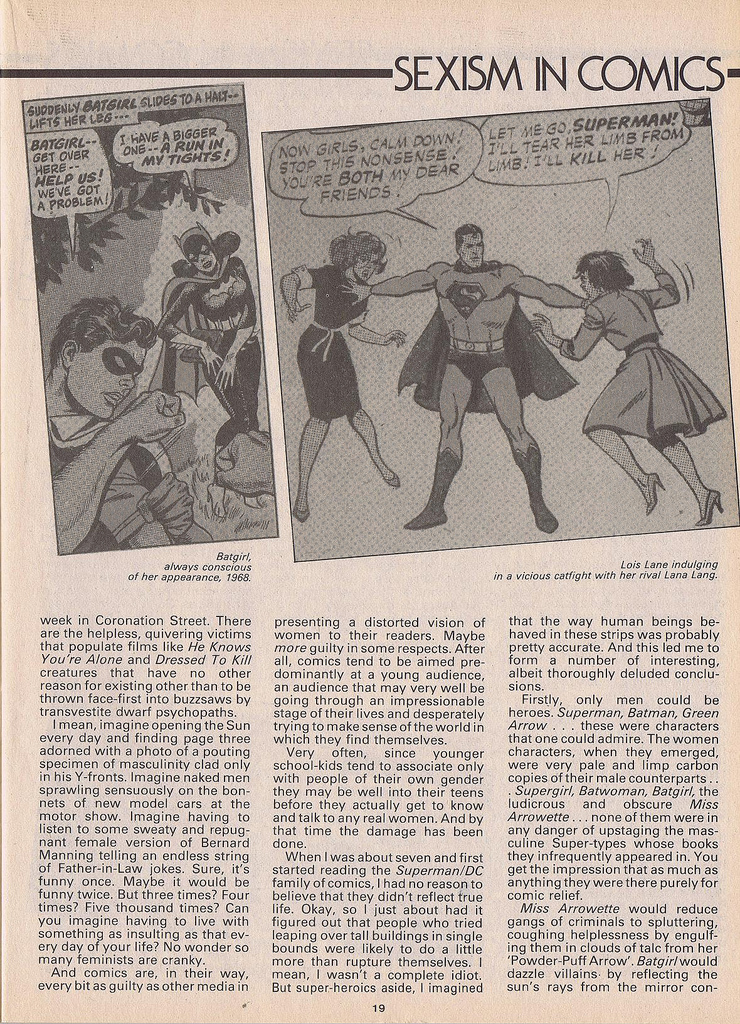
During the afternoons I teach a small group of highly susceptible kids. They are easily influenced because of their age, which is around 9-12 years. Besides Thursdays and Fridays I have a group of only boys. I have my hands full, but a lot about the male specie becomes clear to me as I watch these boys.  They are forever ranting about Comic Books. Of course I share this passion, so we often discuss certain comic book characters etc. I always tell the boys that violence is bad (I mean, when I give a piece of clay to a girl, she will start kneading it and start problem solving about how she would produce a beautiful item. When I give a ball of clay to a boy, chances are he would threaten to throw another boy with it,or, like one boy actually did, start throwing it to the floor as hard as he can to see if he can flatten it in that manner.) One boy said he is going to draw `Thor´ for me, so I asked if there are no female characters he can draw for me and he replied sure, he´ll draw ´Invisible woman`. I am trying to find ways to teach these boys to become real men. And I´m not so sure the comic books are helping. I really love the work of Alan Moore, and recently came across his Invisible Girls and Phantom Ladies.

In his essay ‘And all right, we need a woman’: victimized heroines and heroic victims in Alan Moore’s quasi-Victorian graphic novels`,  Maciej Sulmicki writes:

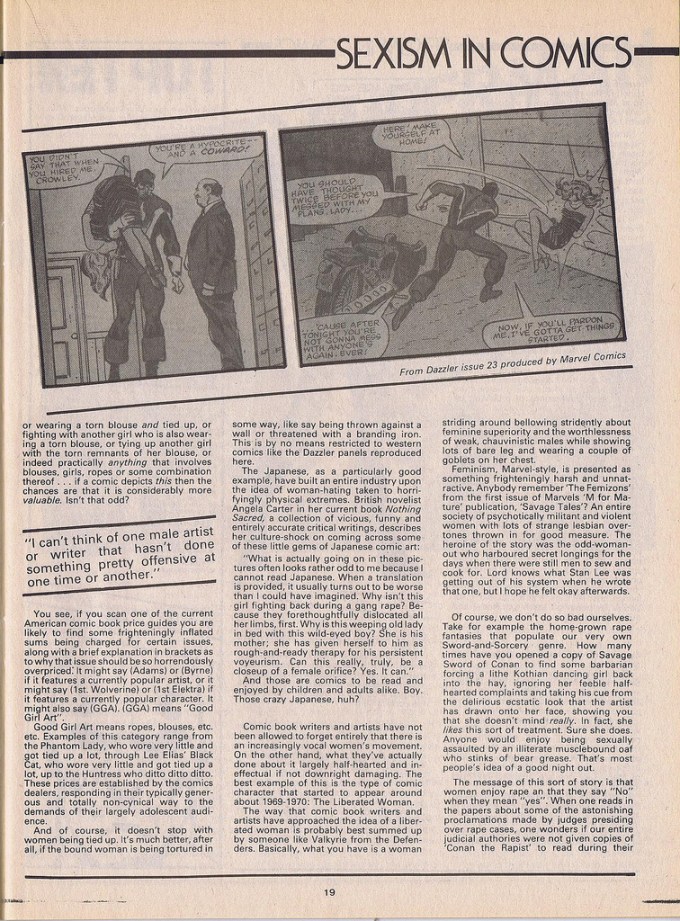
“Moore has long ago declared an interest in the image of women in comics books and recently confirmed that he has always felt ‘that [women’s problems] was an area that needed to be addressed’. 25 years ago, in a three-installment essay in The Daredevils he wrote of ‘Invisible Girls and Phantom Ladies’, i.e. sexism in comics. Although the text is written in a jocular tone, the main message is quite serious: that comics are rather fueling sexism and gender inequality than combating them. Women in mainstream comics are said to serve primarily as decoration, especially in visual terms, this being the case even when the female characters have something important to say. Such an approach to the visual presentation of females is a continuation of a long-standing tradition, visible as early as in comic strips from the first half of the twentieth century. Moore claims, however, that graphic depiction is not as important as the type of character as which the woman is presented. Both ‘helpless quivering victims’ and pale copies of female superheroes, as well as examples of rough ‘Marvel-style’ feminism serve to fuel stereotypes. In the case of the first two, scantily-clad and often captured and tied up heroines are accused of fueling ‘sordid adult fantasies’ and ideas such as women enjoying being raped. In the final installment of the essay Moore opines that the masculine world of comics is unlikely to significantly change its approach in favor of equal rights unless it is motivated from the outside – by the readers.”

Moore´s Invisible Girls and Phantom Ladies: Originally published in The Daredevils #4 – #6 (Marvel UK, April – June 1983)

PART I

Okay. Seeing as this is such a sticky subject suppose I’d better lay my cards on the table straight away.

I’m a wimpy, indecisive, burned-out woolly-minded liberal old hippy who eats quiche, saves whales, is friendly to the Earth and subscribes to Spare Rib, The Black One-Parent Gay Catholic Gazette, and Animal Welfare Against Nuking the Nazis Quarterly and if anybody wants to make anything of it, then I’ll quite cheerfully butt them in the face until their nose is flat enough to rollerskate on.

The reason I’m prepared to make such a candid confession is because I’m pretty sure that after reading the article in hand most of you will be saying pretty much the same things about me anyway and I thought it’d look better if I got in first. And the reason I’m donning my Sou’Wester in preparation for a torrent of abuse is because this feature concerns women, and women don’t seem to be a very popular topic nowadays. There are a couple of possible reasons for this sad state of affairs.

The first is that a small but vocal percentage of feminists are quite obviously as mad as snakes and have hopelessly damaged personalities. They pounce with demented glee upon increasingly trivial and unimportant examples of ‘sexism’, they make outrageously twisted and generalised statements to the Press along the lines of “All men are rapists“, and in general make themselves very difficult to like.

The problem arises when these foaming maniacs are presented in the media as being a representative cross section of the women’s movement, thus reinforcing the image of feminism that most men are only too eager to accept as the truth: an army of crop-haired Amazon gargoyles who chainsmoke untipped Woodbines, shift cement blocks for a living and have a physique somewhere between that of Popeye and a Commer van.

The other reason is that men, over the last few thousand years, have come to enjoy the perks and privileges that are part and parcel of being born into the male gender and are very reluctant to give them up. Men in general are a pretty insecure bunch and when they start to feel threatened by something they tend to respond by hurling forth salvoes of scorn and contempt, or, failing that, they refuse to take the issue seriously at all.

Even generally broadminded people who believe that the abolition of slavery in America was by and large a good thing seem to get very defensive and hysterical when it’s their Sunday Lunch that’s being threatened by the Women’s Movement. My guess is that if these gentlemen had been Southern Plantation owners they’d have felt the same reluctance in forgoing the pleasures of their Negro house-boy bringing them a Mint Julep on the veranda.

All right. So that’s the basic situation, and it’s one that is obscured by a lot of bluster, silliness and ratbrainery on both sides. But once you’ve swept away all the damned lies and statistics, it becomes plain that there really is a serious problem under there somewhere. Women in general are not really getting a fair suck of the sauce-stick, and it’s not just in obvious areas like equal pay for equal work and who brings up baby.

These areas are obviously important, but they’re all symptoms that spring from a central illness, an illness that affects the way it which we see women and the way we treat them in our largely male-oriented society.

The media presents us with a number of different stereotypes to choose from when forming our ideas of womanhood. There’s a wide variety of different designs, and they’re all about as palatable as a lobster with skin cancer. Continue reading

the long wait – part one

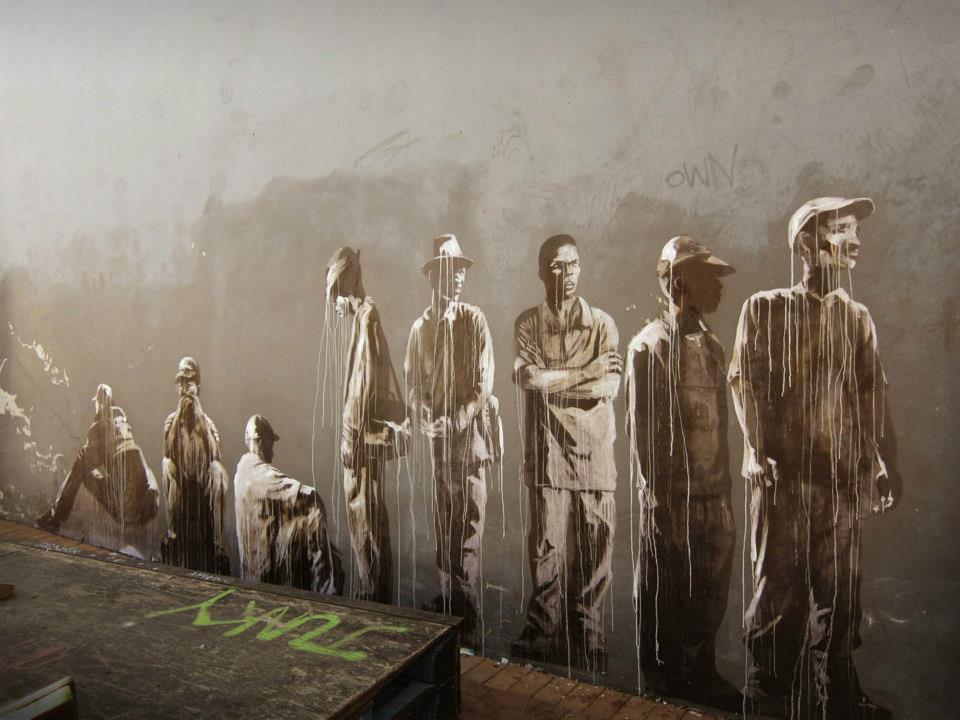
Powerful street art by Faith47

Faith47 – The Long Wait – Part One
2012

“miners are waiting for justice. workers are waiting for a living wage.
people are waiting for service delivery. refugees are waiting for assistance.
men are waiting for jobs. we are all waiting for an honest politician.

“so many people are waiting for others to do things first. to take the blame.
to do things for them. to take the fall. to build the country. to admit defeat.
there has been so much waiting in this country that much time has been lost…”it is the first instalment of my solo exhibition, fragments of a burnt history, which will soon unfold at the david krut gallery in johannesburg on november the 8th 2012.”

poems for pussy riot e-book coming soon!

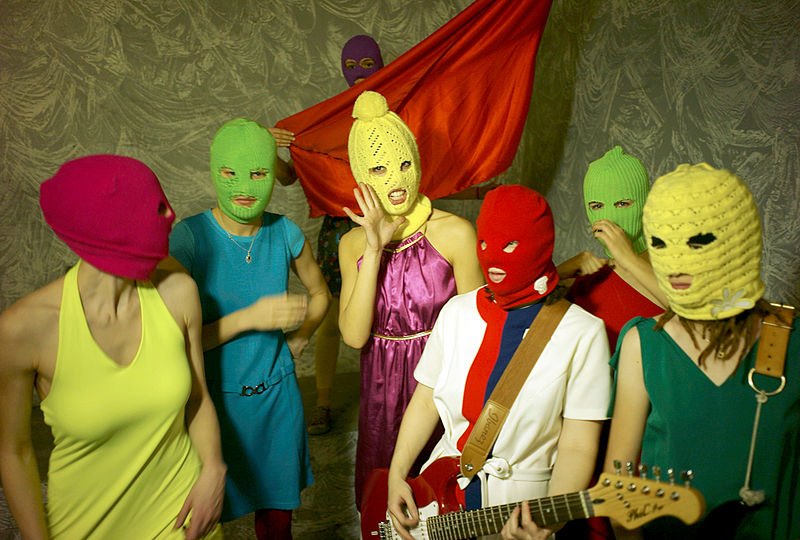
This just in from English PEN:

We are delighted to announce the publication of CATECHISM: POEMS FOR PUSSY RIOT, edited by Mark Burnhope, Sarah Crewe & Sophie Mayer.

There will be ePUB, Kindle and PDF versions available on this page from 00:01hrs on Monday 1st October 2012.

The book is distributed on the ‘Pay What You Think It’s Worth’ model popularised by Radiohead and others. We recommend £5, but any amount is welcome. All revenue will go to the Pussy Riot Legal fund, and the English PEN Writers at Risk Programme.

Get it HERE!

FLEURMACH EDITOR’S NOTE: The e-book will contain a poem by Fleurmach contributor Michelle McGrane  (Peony Moon).

one morning by jamie heckert, 2006

One morning, not that long ago, I answered the door in my dressing gown
to the sight of a man from the energy company. He came to ask me why I had
chosen to switch suppliers. As I explained that I preferred one with a better
environmental policy, I slowly realised that not only did this guy have gorgeous
eyes, he was watching me closely. I went on to say, performing a bit for this
beautiful man, “Of course all corporations and really capitalism in general is bad
for the environment”. He agreed, his eyes glowing with excitement. But, what
could he do? He had a mortgage to pay. I’m not quite sure why, maybe I was
scared of the intensity of my attraction, but suddenly I found myself channeling
some broken record of anarchist propaganda and said, “We need resistance on
the inside, too.” That was it. His beautiful eyes looked away and the connection
was lost.
I feel grief remembering that morning; I would have liked to have listened
with empathy to both his desire for change and for security, to maintained that
beautiful sense of connection. Instead, I tried to recruit him. When I replay the
incident in my mind, it has a different ending. I ask him, “What would you like
to do?”

global anti-fracking day is tomorrow, 22 september – get involved!

Andreas Spath, for News 24:

“On the same day that the South African government decided to lift the moratorium on fracking, the European Union’s environment directorate released a comprehensive 300-page report that identified the controversial method for mining natural gas in underground units of shale rock as a “high risk” to human health and the environment because of its potential to contaminate and deplete water resources, cause a loss of biodiversity, degrade air and land quality and trigger earthquakes.”

Earlier this month, the South African Cabinet endorsed the lifting of a moratorium on prospecting for shale gas, imposed in February last year in line with a report by government’s multi-disciplinary task team, which recommends only “normal” geological exploration, excluding fracking, be allowed, until the extent of the gas reserves are established.

Read this article from SACSIS if you don’t know the history of the fracking debate in South Africa, and this article from Science News if you need more scientific information on how fracking (shale gas extraction) affects the environment and people in its vicinity – which in South Africa’s case, would be the delicate, already arid Karoo.

Send a message to our government on Global Anti-Fracking day, September 22nd 2012, by joining other South Africans who are opposed to fracking, when they CALL FOR A PERMANENT BAN ON FRACKING in South Africa.

In Cape Town, we will meet in front of the gates of Parliament, corner of Plein Street and Roeland Street at 10h30. Bring your anti-fracking banners and posters! The event is open to everyone and supported by several organisations, including Earthlife Africa, SAFCEI, Southern Cape Land Committee, Environmental Monitoring Group, Coalition for Environmental Justice, Treasure the Karoo Action Group and others.

The speakers at the protest will be Muna Lakhani (ELA), Barry Wuganale (Ogoni Solidarity Forum), Thembeka Majali (Million Climate Jobs), Bishop Geoff Davies (SAFCEI), Mpumelelo Mhlalisi (CEJ), Priscilla de Wet (First Indigenous Women’s Movement) and Jonathan Deal (TKAG). Don’t miss it!

In solidarity with our protest, the SCLC are encouraging local Karoo communities (farm workers and dwellers and small-scale farmers in the Chris Hani, Cacadu and Central Karoo District Municipalities) to wear the Black Thursday Land Campaign T-shirts on the day. They will be distributing anti-fracking brochures and raise debate in the areas where they live.

In Prins Albert the trees will be wrapped in black fabric, with black wreaths on shop windows. Please contact Lisa Smith for more information and to see how you can get involved: lisass@intekom.co.za.

In Joburg, Earthlife Africa JHB will host a discussion on ‘Fracking and the implications for water in South Africa’ at the Greenhouse Project 14:00 – 16:00. Contact Judith@earthlife.co.za for more information.

Find the Global Frackdown activist toolkit HERE.