Jean Cocteau began his career as a poet, publishing his first collection, Aladdin’s Lamp, at the age of 19. By 1963, at the age of 73, he had lived one of the richest artistic lives imaginable, transforming every genre he touched. Deciding to leave one last artefact to posterity, Cocteau sat down and recorded the film above, a message to the year 2000, intending it as a time capsule only to be opened in that year (though it was discovered, and viewed a few years earlier). Biographer James S. Williams describes the documentary testament as “Cocteau’s final gift to his fellow human beings.”
Portraying himself as “a living anachronism” in a “phantom-like state,” Cocteau, seated before his own artwork, quotes St. Augustine, makes parables of events in his life, and addresses, primarily, the youth of the future. The uses and misuses of technology comprise a central theme of his discourse: “I certainly hope that you have not become robots,” Cocteau says, “but on the contrary that you have become very humanized: that’s my hope.” The people of his time, he claims, “remain apprentice robots.”
Among Cocteau’s concerns is the dominance of an “architectural Esperanto, which remains our time’s great mistake.” By this phrase he means that “the same house is being built everywhere and no attention is paid to climate, atmospherical conditions or landscape.” Whether we take this as a literal statement or a metaphor for social engineering, or both, Cocteau sees the condition as one in which these monotonous repeating houses are “prisons which lock you up or barracks which fence you in.” The modern condition, as he frames it, is one “straddling contradictions” between humanity and machinery. Nonetheless, he is impressed with scientific advancement, a realm of “men who do extraordinary things.”
And yet, “the real man of genius,” for Cocteau, is the poet, and he hopes for us that the genius of poetry “hasn’t become something like a shameful and contagious sickness against which you wish to be immunized.” He has very much more of interest to communicate, about his own time, and his hopes for ours. Cocteau recorded this transmission from the past in August of 1963. On October 11 of that same year, he died of a heart attack, supposedly shocked to death by news of his friend Edith Piaf’s death that same day in the same manner.
His final film, and final communication to a public yet to be born, accords with one of the great themes of his life’s work—“the tug of war between the old and the new and the paradoxical disparities that surface because of that tension.” Should we attend to his messages to our time, we may find that he anticipated many of our 21st century dilemmas between technology and humanity, and between history and myth. It’s interesting to imagine how we might describe our own age to a later generation, and, like Cocteau, what we might hope for them.
I want to make a praise of sleep. Not as a practitioner—I admit I have never been what is called “a good sleeper” and perhaps we can return later to that curious concept—but as a reader. There is so much sleep to read, there are so many ways to read it. In Aristotle’s view, sleep requires a “daimonic but not a divine” kind of reading. Kant refers to sleep’s content as “involuntary poetry in a healthy state.”
Keats wrote a “Sonnet to Sleep,” invoking its powers against the analytic of the day:
O soft embalmer of the still midnight!
. . . Then save me, or the passed day will shine
Upon my pillow, breeding many woes;
Save me from curious conscience, that still lords
Its strength for darkness, burrowing like a mole;
Turn the key deftly in the oiled wards,
And seal the hushed casket of my soul.
My intention in this essay is to burrow like a mole in different ways of reading sleep, different kinds of readers of sleep, both those who are saved, healthy, daimonic, good sleepers and those who are not. Keats ascribes to sleep an embalming action. This means two things: that sleep does soothe and perfume our nights; that sleep can belie the stench of death inborn in us. Both actions are salvific in Keats’ view. Both deserve (I think) to be praised.
My earliest memory is of a dream. It was in the house where we lived when I was three or four years of age. I dreamed I was asleep in the house in an upper room.
That I awoke and came downstairs and stood in the living room. The lights were on in the living room, although it was hushed and empty. The usual dark green sofa and chairs stood along the usual pale green walls. It was the same old living room as ever, I knew it well, nothing was out of place. And yet it was utterly, certainly, different. Inside its usual appearance the living room was as changed as if it had gone mad.
Later in life, when I was learning to reckon with my father, who was afflicted with and eventually died of dementia, this dream recovered itself to me, I think because it seemed to bespeak the situation of looking at a well-known face, whose appearance is exactly as it should be in every feature and detail, except that it is also, somehow, deeply and glowingly, strange.
The dream of the green living room was my first experience of such strangeness and I find it as uncanny today as I did when I was three. But there was no concept of madness or dementia available to me at that time. So, as far as I can recall, I explained the dream to myself by saying that I had caught the living room sleeping. I had entered it from the sleep side.And it took me years to recognize, or even to frame a question about, why I found this entrance into strangeness so
supremely consoling. For despite the spookiness, inexplicability and later tragic reference of the green living room, it was and remains for me a consolation to think of it lying there, sunk in its greenness, breathing its own order, answerable to no one, apparently penetrable everywhere and yet so perfectly disguised in all the propaganda of its own waking life as to become in a true sense something incognito at the heart of our sleeping house.
It is in these terms that I wish to praise sleep, as a glimpse of something incognito. Both words are important. Incognito means “unrecognized, hidden, unknown.”
Something means not nothing. What is incognito hides from us because it has something worth hiding, or so we judge. As an example of this judgment I shall cite for you two stanzas of Elizabeth Bishop’s poem “The Man-Moth.” The Man- Moth, she says, is a creature who lives most of the time underground but pays occasional visits to the surface of the earth, where he attempts to scale the faces of the buildings and reach the moon, for he understands the moon to be a hole at the top of the sky through which he may escape. Failing to attain the moon each time he falls back and returns to the pale subways of his underground existence.
Here is the poem’s third stanza:
Up the façades,
his shadow dragging like a photographer’s cloth behind him,
he climbs fearfully, thinking that this time he will manage
to push his small head through that round clean opening
and be forced through, as from a tube, in black scrolls on the light.
(Man, standing below him, has no such illusions).
But what the Man-Moth fears most he must do, although
he fails, of course, and falls back scared but quite unhurt.
The Man-Moth is not sleeping, nor is he a dream, but he may represent sleep itself—an action of sleep, sliding up the facades of the world at night on his weird quest. He harbours a secret content, valuable content, which is difficult to extract even if you catch him.
Here is the poem’s final stanza:
If you catch him,
hold up a flashlight to his eye. It’s all dark pupil,
an entire night itself, whose haired horizon tightens
as he stares back, and closes up the eye. Then from the lids
one tear, his only possession, like the bee’s sting, slips.
Slyly he palms it, and if you’re not paying attention
he’ll swallow it. However, if you watch, he’ll hand it over,
cool as from underground springs and pure enough to drink.
To drink the tear of sleep, to detach the prefix “un-” from its canniness and from its underground purposes, has been the project of many technologies and therapies—from the ancient temple of Asklepios at Epidauros, where sick people slept the night in order to dream their own cure, to the psychoanalytic algebras of Jacques Lacan, who understands sleep as a space from which the sleeper can travel in two directions, both of them a kind of waking.
If I were to praise either of these methods of healing I would do so on grounds of their hopefulness. Both Asklepiadic priests and Lacanian analysts posit a continuity between the realms of waking and sleeping, whereby a bit of something incognito may cross over from night to day and change the life of the sleeper. Here is an ancient account of one of the sleep cures at Epidauros:
There came as a suppliant to the god Asklepios a man who was so one eyed that on the left he had only lids, there was nothing, just emptiness. People in the temple laughed at him for thinking he would see with an eye that was not there. But in a vision that appeared to him as he slept, the god seemed to boil some medicine and, drawing apart the lids, poured it in. When day came the man went out, seeing with both eyes.
What could be more hopeful than this story of an empty eye filled with seeing as it sleeps? An analyst of the Lacanian sort might say that the one-eyed man has chosen to travel all the way in the direction of his dream and so awakes to a reality more real than the waking world. He dove into the nothingness of his eye and is awakened by too much light. Lacan would praise sleep as a blindness, which nonetheless looks back at us.
What does sleep see when it looks back at us? This is a question entertained by Virginia Woolf in To the Lighthouse, a novel that falls asleep for twenty-five pages in the middle. The story has three
parts. Parts I and III concern the planning and execution of a trip to the lighthouse by the Ramsay family.
Part II is told entirely from the sleep side. It is called “Time Passes.” It begins as a night that grows into many nights then turns into seasons and years. During this time, changes flow over the house of the story and penetrate the lives of the characters while they sleep. These changes are glimpsed
as if from underneath; Virginia Woolf ’s main narrative is a catalogue of silent bedrooms, motionless chests of drawers, apples left on the dining room table, the wind prying at a window blind, moonlight gliding on floorboards. Down across these phenomena come facts from the waking world, like swimmers stroking by on a night lake. The facts are brief, drastic and enclosed in square brackets.
For example:
[Mr. Ramsay, stumbling along a passage one dark morning, stretched his arms out, but Mrs. Ramsay having died rather suddenly the night before, his arms, though stretched out, remained empty.]
or:
[A shell exploded. Twenty or thirty young men were blown up in France, among them Andrew Ramsay, whose death, mercifully, was instantaneous.]
or:
[Mr. Carmichael brought out a volume of poems that spring, which had an unexpected success. The war, people said, had revived their interest in poetry.]
These square brackets convey surprising information about the Ramsays and their friends, yet they float past the narrative like the muffled shock of a sound heard while sleeping. No one wakes up. Night plunges on, absorbed in its own events. There is no exchange between night and its captives, no tampering with eyelids, no drinking the tear of sleep. Viewed from the sleep side, an empty eye socket is just a fact about a person, not a wish to be fulfilled, not a therapeutic challenge. Virginia Woolf offers us, through sleep, a glimpse of a kind of emptiness that interests her. It is the emptiness of things before we make use of them, a glimpse of reality prior to its efficacy.
Some of her characters also search for this glimpse while they are awake. Lily Briscoe, who is a painter in To the Lighthouse, stands before her canvas and ponders how “to get hold of that very jar on the nerves, the thing itself before it has been made anything.”
In a famous passage of her diaries, Virginia Woolf agrees with the aspiration:
If I could catch the feeling I would: the feeling of the singing of the real world, as one is driven by loneliness and silence from the habitable world.
What would the singing of the real world sound like? What would the thing itself look like? Such questions are entertained by her character Bernard, at the end of The Waves:
“So now, taking upon me the mystery of things, I could go like a spy without leaving this place, without stirring from my chair. . . . The birds sing in chorus; the house is whitened; the sleeper stretches; gradually all is astir. Light floods the room and drives shadow beyond shadow to where they hang in folds inscrutable. What does this central shadow hold? Something? Nothing? I do not know. . . .”
Throughout her fiction Virginia Woolf likes to finger the border between nothing and something. Sleepers are ideal agents of this work.
Read the rest of this brilliant essay: Every Exit is an Entrance from Anne Carson’s Decreation (2005).
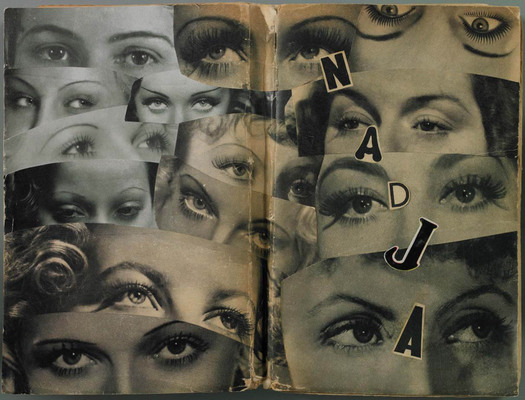
Cover of the 1928 Gallimard edition of Nadja, collaged over by Marcel Mariën, 1938.
The narrator, named André, ruminates on a number of Surrealist principles, before ultimately commencing (around a third of the way through the novel) on a narrative account, generally linear, of his brief ten day affair with the titular character Nadja. She is so named “because in Russian it’s the beginning of the word hope, and because it’s only the beginning,” but her name might also evoke the Spanish “Nadie,” which means “No one.” The narrator becomes obsessed with this woman with whom he, upon a chance encounter while walking through the street, strikes up conversation immediately. He becomes reliant on daily rendezvous, occasionally culminating in romance (a kiss here and there).
His true fascination with Nadja, however, is her vision of the world, which is often provoked through a discussion of the work of a number of Surrealist artists, including himself. While her understanding of existence subverts the rigidly authoritarian quotidian, it is later discovered that she is mad and belongs in a sanitarium. After Nadja reveals too many details of her past life, she in a sense becomes demystified, and the narrator realises that he cannot continue their relationship.
In the remaining quarter of the text, André distances himself from her corporeal form and descends into a meandering rumination on her absence, so much so that one wonders if her absence offers him greater inspiration than does her presence. It is, after all, the reification and materialisation of Nadja as an ordinary person that André ultimately despises and cannot tolerate to the point of inducing tears.
There is something about the closeness once felt between the narrator and Nadja that indicated a depth beyond the limits of conscious rationality, waking logic, and sane operations of the everyday. There is something essentially “mysterious, improbable, unique, bewildering” about her; this reinforces the notion that their propinquity serves only to remind André of Nadja’s impenetrability.
Her eventual recession into absence is the fundamental concern of this text, an absence that permits Nadja to live freely in André’s conscious and unconscious, seemingly unbridled, maintaining her paradoxical role as both present and absent. With Nadja’s past fixed within his own memory and consciousness, the narrator is awakened to the impenetrability of reality and perceives a particularly ghostly residue peeking from under its thin veil. Thus, he might better put into practice his theory of Surrealism, predicated on the dreaminess of the experience of reality within reality itself.
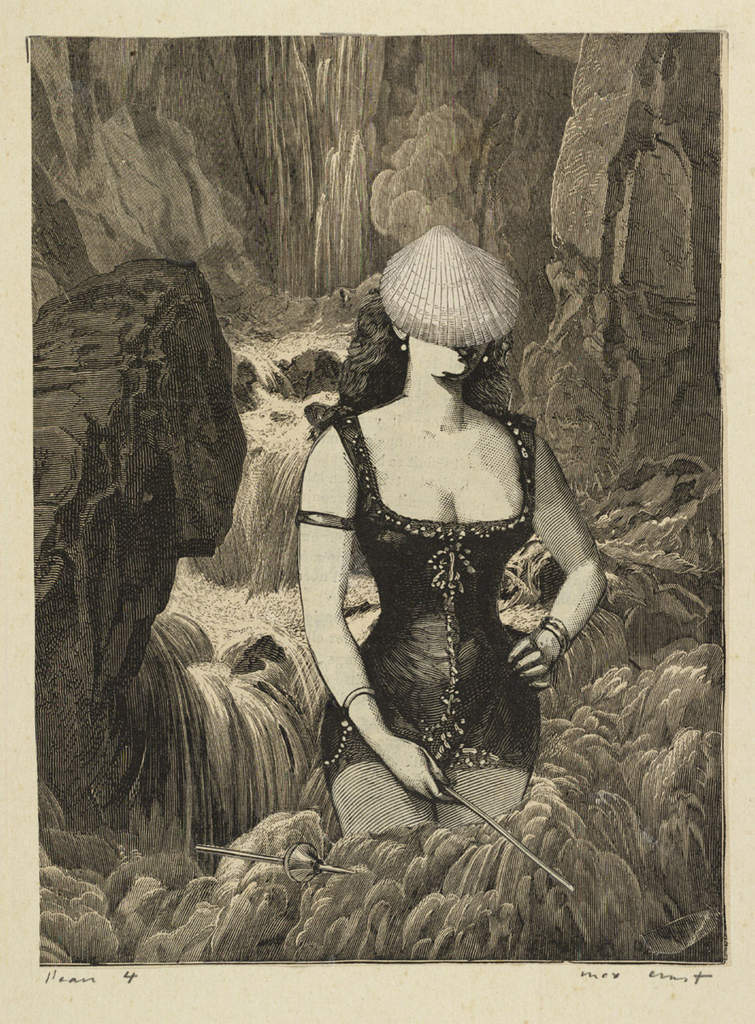
Max Ernst – collage from The Hundred Headless Woman (1929).
… There is always, in such movements, a moment when the original tension of the secret society must either explode in a matter-of-fact, profane struggle for power and domination, or decay as a public demonstration and be transformed. Surrealism is in this phase of transformation at present. But at the time when it broke over its founders as an inspiring dream wave, it seemed the most integral, conclusive, absolute of movements. Everything with which it came into contact was integrated. Life only seemed worth living where the threshold between waking and sleeping was worn away in everyone as by the steps of multitudinous images flooding back and forth, language only seemed itself where, sound and image, image and sound interpenetrated with automatic precision and such felicity that no chink was left for the penny-in-the-slot called ‘meaning’.
Image and language take precedence. Saint-Pol Roux, retiring to bed about daybreak, fixes a noticeon his door: ‘Poet at work.’ Breton notes: ‘Quietly. I want to pass where no one yet has passed, quietly! After you, dearest language.’ Language takes precedence. Not only before meaning. Also before the self. In the world’s structure dream loosens individuality like a bad tooth. This loosening of the self by intoxication is, at the same time, precisely the fruitful, living experience that allowed these people to step outside the domain of intoxication.
This is not the place to give an exact definition of Surrealist experience. But anyone who has perceived that the writings of this circle are not literature but something else – demonstrations, watchwords, documents, bluffs, forgeries if you will, but at any rate not literature – will also know, for the same reason, that the writings are concerned literally with experiences, not with theories and still less with phantasms. And these experiences are by no means limited to dreams, hours of hashish eating, or opium smoking. It is a cardinal error to believe that, of ‘Surrealist experiences’, we know only the religious ecstasies or the ecstasies of drugs. The opium of the people, Lenin called religion, and brought the two things closer together than the Surrealists could have liked.
I shall refer later to the bitter, passionate revolt against Catholicism in which Rimbaud, Lautreamont, and Apollinaire brought Surrealism into the world. But the true creative overcoming of religious illumination certainly does not lie in narcotics. It resides in a profane illumination, ‘a materialistic, anthropological inspiration, to which hashish, opium, or whatever else can give an introductory lesson. (But a dangerous one; and the religious lesson is stricter.)
This profane illumination did not always find the Surrealists equal to it, or to themselves, and the very writings that proclaim it most powerfully, Aragon’s incomparable Paysan de Paris and Breton’s Nadja, show very disturbing symptoms of deficiency. For example, there is in Nadja an excellent passage on the ‘delightful days spent looting Paris under the sign of Sacco and Vanzetti’; Breton adds the assurance that in those days Boulevard Bonne-Nouvelle fulfilled the strategic promise of revolt ‘that had always been implicit in its name. But Madame Sacco also appears, not the wife of Fuller’s victim but avoyante, a fortune-teller who lives at 3 rue des Usines and tells Paul Eluard that he can expect no good from Nadja.
Now I concede that the breakneck career of Surrealism over rooftops, lightning conductors, gutters, verandas, weathercocks, stucco work – all ornaments are grist to the cat burglar’s mill- may have taken it also into the humid backroom of spiritualism. But I am not pleased to hear it cautiously tapping on the window-panes to inquire about its future. Who would not wish to see these adoptive children of revolution most rigorously severed from all the goings-on in the conventicles of down-at-heel dowagers, retired majors, and emigre profiteers?
In other respects Breton’s book illustrates well a number of the basic characteristics of this ‘profane illumination’. He calls Nadja ‘a book with a banging door’. (In Moscow I lived in a hotel in which almost all the rooms were occupied by Tibetan lamas who had come to Moscow for a congress of Buddhist churches. I was struck by the number of doors in the corridors that were always left ajar. What had at first seemed accidental began to be disturbing. I found out that in these rooms lived members of a sect who had sworn never to occupy closed rooms. The shock I had then must be felt by the reader of Nadja.)
To live in a glass house is a revolutionary virtue par excellence. It is also an intoxication, a moral exhibitionism, that we badly need. Discretion concerning one’s own existence, once an aristocratic virtue, has become more and more an affair of petty-bourgeois parvenus. Nadja has achieved the true, creative synthesis between the art novel and the roman-a-clef.
Moreover, one need only take love seriously to recognize in it, too – as Nadja also indicates – a ‘profane illumination’. ‘At just that time’ (i.e., when he knew Nadja), the author tells us, ‘I took a great interest in the epoch of Louis VII, because it was the time of the ‘courts of love’, and I tried to picture with great intensity how people saw life then.’ We have from a recent author quite exact information on Provencal love poetry, which comes surprisingly close to the Surrealist conception of love. ‘All the poets of the ‘new style’,’ Erich Auerback points out in his excellent Dante: Poet of the Secular World, ‘possess a mystical beloved, they all have approximately the same very curious experience of love; to them all Amor bestows or withholds gifts that resemble an illumination more than sensual pleasure; all arc subject to a kind of secret bond that determines their inner and perhaps also their outer-lives’. The dialectics of intoxication are indeed curious. Is not perhaps all ecstasy in one world humiliating sobriety in that complementary to it? What is it that courtly Minne seeks, and it, not love, binds Breton to the telepathic girl, if not to make chastity, too, a transport? Into a world that borders not only on tombs of the Sacred Heart or altars to the Virgin, but also on the morning before a battle or after a victory.
Max Ernst – Une semaine de bonté [A Week of Kindness]. La clé des chants 1 [The Key of Songs 1] 1933
The lady, in esoteric love, matters least. So, too, for Breton. He is closer to the things that Nadja is close to than to her. What are these things? Nothing could reveal more about Surrealism than their canon.Where shall I begin? He can boast an extraordinary discovery. He was the first to perceive the revolutionary energies that appear in the ‘outmoded’, in the first iron constructions, the first factory buildings, the earliest photos, the objects that have begun to be extinct, grand pianos, the dresses of five years ago, fashionable restaurants when the vogue has begun to ebb from them. The relation of these things to revolution, no one can have a more exact concept of it than these authors. No one before these visionaries and augurs perceived how destitution – not only socialbut architectonic, the poverty of interiors/enslaved and enslaving objects – can be suddenly transformed into revolutionary nihilism. Leaving aside Aragon’s Passage de I’Opera, Breton and Nadja are the lovers who convert everything that we have experienced on mournful railway journeys (railways are beginning to age), on Godforsaken Sunday afternoons in the proletarian quarters of the great cities, in the first glance through the rain-blurred window of a new apartment, into revolutionary experience, if not action. They bring the immense forces of ‘atmosphere’ concealed in these things to the point of explosion. What form do you suppose a life would take that was determined at a decisive moment precisely by the street song last on everyone’s lips?
Modernity was built upon ‘technologies that made us all ghosts’, and postmodernity could be defined as the succumbing of historical time to the spectral time of recording devices. Postmodernity screens out the spectrality, naturalising the uncanniness of the recording apparatuses. Anyone hearing a recording of their own voice or seeing a photograph of themselves is presented with a double. The uncanny thought, often repressed or forgotten, is that the recordings and the photographs will survive us; that as we contemplate them, we are put in the position of a ghost.
— From “Phonograph Blues” by k-punk, from a decade-old blog I love, HERE.
“Protection [of women] is the rock that all men push. We call it our burden, but it’s really our privilege.” — Lou Solverson
Oom Piet * is sitting one night on his farm stoep by a fire. He is alone except for his dog Butch, which lifts its head slowly as a strange figure steps silently into the firelight. Deep in his cups, Piet realises he might be seeing an alien, but it could just be a figment of his inebriation. When his dog wags its tail and goes to greet the tall grey figure, he decides to trust its intuition and, with a slightly trembling hand, offers the large-eyed, curiously sexless creature his glass of brandy.
Turns out, after a couple of dops, that the alien has been studying mankind since it arrived through the medium of Google, so it’s English is pretty much immaculate, though its Afrikaans is at best, patchy. Piet’s English is passable, but he prefers the Taal. The alien’s name is unpronounceable, and from where it hails (though Piet forgets that name too) they have no sexes, replicating from offshoots of their body which are then spliced onto … Anyway, it’s understandably curious about the whole issue of gender, and surmising correctly that Piet knows almost nothing of the experience of being a woman, it asks the oom for some firsthand information about what it means to be a man.
“Well, men are supposed to be stronger than women,” is Piet’s first reaction, to which the alien whips out an iPad and starts checking if this is indeed true. “Well, yes, men are stronger physically,” (1) confirms the alien, enquiring how this factor affects interactions with women.
“Well, we can use our strength to protect our women,” says Piet gallantly.
From what, or whom, the alien wants to know?
Oom Piet thinks a bit. “In the old days, it was against wild animals and other tribes and things, but deesdae, I guess it’s mostly from other men.”
I was listening to David Bowie’s brand new album last night, thinking about how much I still love him. I can’t even begin to engage with how important Bowie and his work have been to me since I was a very young teenager. It’s washing over me in waves.
He felt like my guardian angel at times, transcending the vulgarity of the mundane, making alienation tangible and difference something to celebrate wildly… How strange to think of him as mortal.
Sayonara, Starman. What a gut-wrenchingly perfect exit.
Hélène Cixous’ essay “Castration or Decapitation?” discusses the binary construction of sexuality and society, and how the feminine is defined by the negative: a woman is not a man because she lacks a penis. This “lack” keeps the female subject to definition by the male, as it is seen that because she is the “negative” pole to the man’s “positive”, the woman is concomitantly un-informed, and that therefore it is the position of the man to inform the woman. This imposed silence is what decapitates the feminine metaphorically, precluding her from speaking anything of meaning.
The following is an excerpt from this brilliant essay, translated by Annette Kuhn and published in Signs, Vol. 7, No. 1 (Autumn, 1981), pp. 41-55 (University of Chicago Press) – read the full essay HERE.
* * * * *
… It’s hard to imagine a more perfect example of a particular relationship between two economies: a masculine economy and a feminine economy, in which the masculine is governed by a rule that keeps time with two beats, three beats, four beats, with pipe and drum, exactly as it should be. An order that works by inculcation, by education. It’s always a question of education: an education that consists of trying to make a soldier of the feminine by force, the force history keeps reserved for woman, the “capital” force that is effectively decapitation. Women have no choice other than to be decapitated. The moral is that if they don’t actually lose their heads by the sword, they only keep them on condition that they lose them – lose them, that is, to complete silence, turned into automatons.
It’s a question of submitting feminine disorder, its laughter, its inability to take the drumbeats seriously, to the threat of decapitation. If man operates under the threat of castration, if masculinity is culturally ordered by the castration complex, it might be said that the backlash, the return, on women of this castration anxiety is its displacement as decapitation, execution, of woman, as loss of her head.
We are led to pose the woman question to history in quite elementary forms like, “Where is she? Is there any such thing as woman?” At worst, many women wonder whether they even exist. They feel they don’t exist and wonder if there has ever been a place for them. I am speaking of woman’s place,from woman’s place, if she takes (a) place.
In La Jeune Née I made use of a story that seemed to me particularly expressive of woman’s place: the story of Sleeping Beauty. Woman, if you look for her, has a strong chance of always being found in one position: in bed. In bed and asleep-“laid (out).” She is always to be found on or in a bed: Sleeping Beauty is lifted from her bed by a man because, as we all know, women don’t wake up by themselves: man has to intervene, you understand. She is lifted up by the man who will lay her in her next bed so that she may be confined to bed ever after, just as the fairy tales say.
From Disney’s “Sleeping Beauty”
And so her trajectory is from bed to bed: one bed to another, where she can dream all the more. There are some extraordinary analyses by Kierkegaard on women’s “existence”- or that part of it set aside for her by culture-in which he says he sees her as sleeper. She sleeps, he says, and first love dreams her and then she dreams of love. From dream to dream, and always in second position. In some stories, though, she can be found standing up, but not for long.
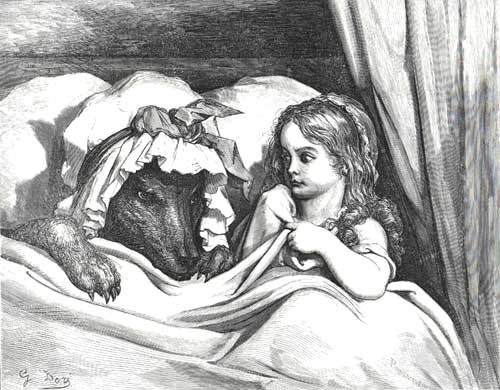
Take Little Red Riding Hood as an example: it will not, I imagine, be lost on you that the “red riding hood” in question is a little clitoris. Little Red Riding Hood basically gets up to some mischief: she’s the little female sex that tries to play a bit and sets out with her little pot of butter and her little jar of honey. What is interesting is that it’s her mother who gives them to her and sends her on an excursion that’s tempting precisely because it’s forbidden: Little Red Riding Hood leaves one house, mommy’s house, not to go out into the big wide world but to go from one house to another by the shortest route possible: to make haste, in other words, from the mother to the other.
The other in this case is grandmother, whom we might imagine as taking the place of the “Great Mother,” because there are great men but no great women: there are Grand-Mothers instead. And grandmothers are always wicked: she is the bad mother who always shuts the daughter in whenever the daughter might by chance want to live or take pleasure. So she’ll always be carrying her little pot of butter and her little jar of honey to grandmother, who is there as jealousy … the jealousy of the woman who can’t let her daughter go.
But in spite of all this Little Red Riding Hood makes her little detour, does what women should never do, travels through her own forest. She allows herself the forbidden … and pays dearly for it: she goes back to bed, in grandmother’s stomach. The Wolf is grandmother, and all women recognize the Big Bad Wolf! We know that always lying in wait for us somewhere in some big bed is a Big Bad Wolf.
Gustave Dore – The Disguised Wolf in Bed
The Big Bad Wolf represents, with his big teeth, his big eyes, and his grandmother’s looks, that great Superego that threatens all the little female red riding hoods who try to go out and explore their forest without the psychoanalyst’s permission. So, between two houses, between two beds, she is laid, ever caught in her chain of metaphors, metaphors that organize culture . . . ever her moon to the masculine sun, nature to culture, concavity to masculine convexity, matter to form, immobility/inertia to the march of progress, terrain trod by the masculine footstep, vessel… While man is obviously the active, the upright, the productive… and besides, that’s how it happens in History.
This opposition to woman cuts endlessly across all the oppositions that order culture. It’s the classic opposition, dualist and hierarchical. Man/Woman automatically means great/small, superior/inferior… means high or low, means Nature/History, means transformation/inertia. In fact, every theory of culture, every theory of society, the whole conglomeration of symbolic systems-everything, that is, that’s spoken, everything that’s organized as discourse, art, religion, the family, language, everything that seizes us, everything that acts on us – it is all ordered around hierarchical oppositions that come back to the man/ woman opposition, an opposition that can only be sustained by means of a difference posed by cultural discourse as “natural,” the difference between activity and passivity. It always works this way, and the opposition is founded in the couple [binary]. A couple posed in opposition, in tension, in conflict… a couple engaged in a kind of war in which death is always at work – and I keep emphasizing the importance of the opposition as couple, because all this isn’t just about one word; rather everything turns on the Word: everything is the Word and only the Word. To be aware of the couple, that it’s the couple that makes it all work, is also to point to the fact that it’s on the couple that we have to work if we are to deconstruct and transform culture. The couple as terrain, as space of cultural struggle, but also as terrain, as space demanding, insisting on, a complete transformation in the relation of one to the other. And so work still has to be done on the couple … on the question, for example, of what a completely different couple relationship would be like, what a love that was more than merely a cover for, a veil of, war would be like.
I said it turns on the Word: we must take culture at its word, as it takes us into its Word, into its tongue. You’ll understand why I think that no political reflection can dispense with reflection on language, with work on language. For as soon as we exist, we are born into language and language speaks (to) us, dictates its law, a law of death: it lays down its familial model, lays down its conjugal model, and even at the moment of uttering a sentence, admitting a notion of “being,” a question of being, an ontology, we are already seized by a certain kind of masculine desire, the desire that mobilizes philosophical discourse. As soon as the question “What is it?” is posed, from the moment a question is put, as soon as a reply is sought, we are already caught up in masculine interrogation. I say “masculine interrogation”: as we say so-and-so was interrogated by the police. And this interrogation precisely involves the work of signification: “What is it? Where is it?” A work of meaning, “This means that,” the predicative distribution that always at the same time orders the constitution of meaning. And while meaning is being constituted, it only gets constituted in a movement in which one of the terms of the couple is destroyed in favor of the other.
“Look for the lady,” as they say in the stories… “Cherchez la femme”– we always know that means: you’ll find her in bed. Another question that’s posed in History, rather a strange question, a typical male question, is: “What do women want?” The Freudian question, of course. In his work on desire, Freud asks somewhere, or rather doesn’t ask, leaves hanging in the air, the question “What do women want?” Let’s talk a bit about this desire and about why/how the question “What do women want?” gets put, how it’s both posed and left hanging in the air by philosophical discourse, by analytic discourse (analytic discourse being only one province of philosophical discourse), and how it is posed, let us say, by the Big Bad Wolf and the Grand-Mother.
“What does she want?” Little Red Riding Hood knew quite well what she wanted, but Freud’s question is not what it seems: it’s a rhetorical question. To pose the question “What do women want?” is to pose it already as answer, as from a man who isn’t expecting any answer, because the answer is “She wants nothing.” … “What does she want? … Nothing!” Nothing because she is passive. The only thing man can do is offer the question “What could she want, she who wants nothing?” Or in other words: “Without me, what could she want?”
Old Lacan takes up the slogan “What does she want?” when he says, “A woman cannot speak of her pleasure.” Most interesting! It’s all there, a woman cannot, is unable, hasn’t the power. Not to mention “speaking”: it’s exactly this that she’s forever deprived of. Unable to speak of pleasure = no pleasure, no desire: power, desire, speaking, pleasure, none of these is for woman. And as a quick reminder of how this works in theoretical discourse, one question: you are aware, of course, that for Freud/Lacan, woman is said to be “outside the Symbolic”: outside the Symbolic, that is outside language, the place of the Law, excluded from any possible relationship with culture and the cultural order. And she is outside the Symbolic because she lacks any relation to the phallus, because she does not enjoy what orders masculinity – the castration complex.
Woman does not have the advantage of the castration complex – it’s reserved solely for the little boy. The phallus, in Lacanian parlance also called the “transcendental signifier,” transcendental precisely as primary organizer of the structure of subjectivity, is what, for psychoanalysis, inscribes its effects, its effects of castration and resistance to castration and hence the very organization of language, as unconscious relations, and so it is the phallus that is said to constitute the a priori condition of all symbolic functioning. This has important implications as far as the body is concerned: the body is not sexed, does not recognize itself as, say, female or male without having gone through the castration complex.
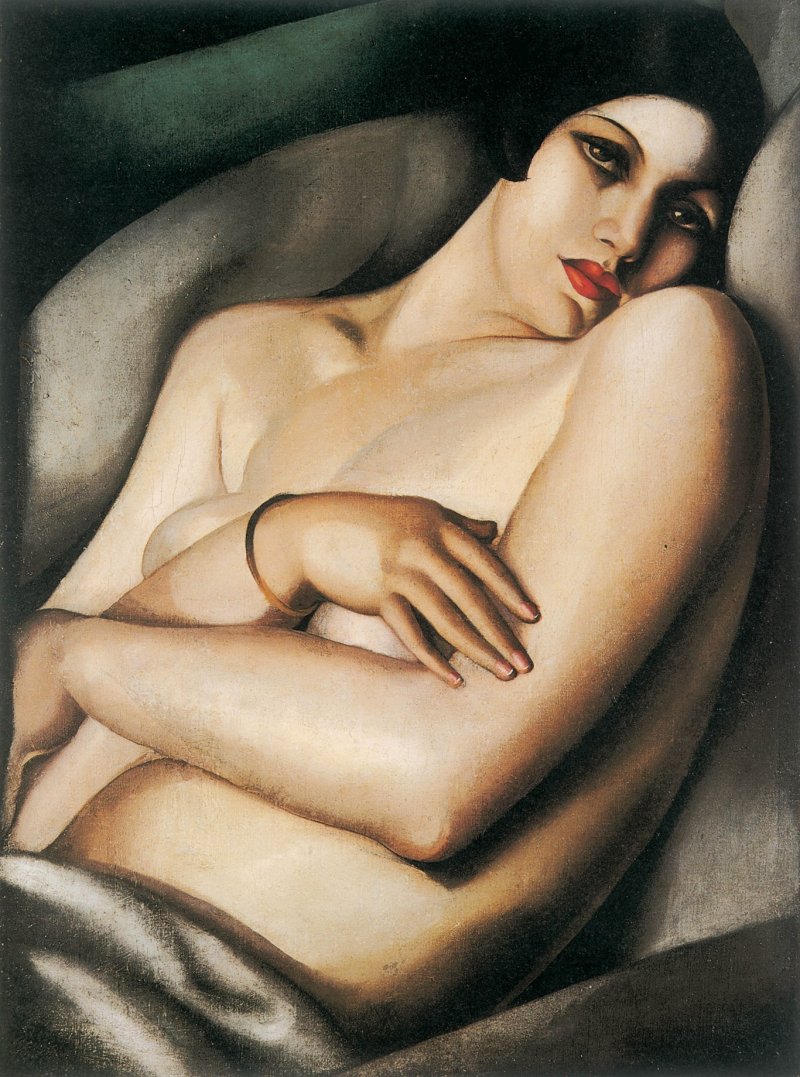
Tamara de Lempicka – “Rafaela sur fond vert” (1927)
What psychoanalysis points to as defining woman is that she lacks lack. She lacks lack? Curious to put it in so contradictory, so extremely paradoxical, a manner: she lacks lack. To say she lacks lack is also, after all, to say she doesn’t miss lack … since she doesn’t miss the lack of lack. Yes, they say, but the point is “she lacks The Lack,” The Lack, lack of the Phallus. And so, supposedly, she misses the great lack, so that without man she would be indefinite, indefinable, nonsexed, unable to recognize herself: outside the Symbolic. But fortunately there is man: he who comes … Prince Charming. And it’s man who teaches woman (because man is always the Master as well), who teaches her to be aware of lack, to be aware of absence, aware of death. It’s man who will finally order woman, “set her to rights,” by teaching her that without man she could “misrecognize.” He will teach her the Law of the Father. Something of the order of: “Without me, without me-the Absolute-Father (the father is always that much more absolute the more he is improbable, dubious)-without me you wouldn’t exist, I’ll show you.” Without him she’d remain in a state of distressing and distressed undifferentiation, unbordered, unorganized, “unpoliced” by the phallus… incoherent, chaotic, and embedded in the Imaginary in her ignorance of the Law of the Signifier. Without him she would in all probability not be contained by the threat of death, might even, perhaps, believe herself eternal, immortal. Without him she would be deprived of sexuality. And it might be said that man works very actively to produce “his woman.” Take for example Marguerite Duras’ Le Ravissement de Lol V. Stein, and you will witness the moment when man can finally say “his” woman, “my” woman. It is that moment when he has taught her to be aware of Death. So man makes, he makes (up) his woman, not without being himself seized up and drawn into the dialectical movement that this sort of thing sets in play. We might say that the Absolute Woman, in culture, the woman who really represents femininity most effectively… who is closest to femininity as prey to masculinity, is actually the hysteric…. he makes her image for her!
The hysteric is a divine spirit that is always at the edge, the turning point, of making. She is one who does not make herself… she does not make herself but she does make the other. It is said that the hysteric “makes-believe” the father, plays the father, “makes-believe” the master. Plays, makes up, makes-believe: she makes-believe she is a woman, unmakes-believe too … plays at desire, plays the father… turns herself into him, unmakes him at the same time. Anyway, without the hysteric, there’s no father… without the hysteric, no master, no analyst, no analysis! She’s the unorganizable feminine construct, whose power of producing the other is a power that never returns to her. She is really a wellspring nourishing the other for eternity, yet not drawing back from the other … not recognizing herself in the images the other may or may not give her. She is given images that don’t belong to her, and she forces herself, as we’ve all done, to resemble them.
And so in the face of this person who lacks lack, who does not miss lack of lack, we have the construct that is infinitely easier to analyze, to put in place-manhood, flaunting its metaphors like banners through history. You know those metaphors: they are most effective. It’s always clearly a question of war, of battle. If there is no battle, it’s replaced by the stake of battle: strategy. Man is strategy, is reckoning . . . “how to win” with the least possible loss, at the lowest possible cost. Throughout literature masculine figures all say the same thing: “I’m reckoning” what to do to win. Take Don Juan and you have the whole masculine economy getting together to “give women just what it takes to keep them in bed” then swiftly taking back the investment, then reinvesting, etc., so that nothing ever gets given, everything gets taken back, while in the process the greatest possible dividend of pleasure is taken. Consumption without payment, of course.
Ever noticed how when you have to leave a place, time speeds up in the last few days, almost gurgling as it’s sucked into the wormhole of your impending absence?
Just dreamed I was working at a mattress abattoir/factory in some long ago time and place. The mattresses were somehow living organisms. I had to use a guillotine and also sometimes a huge cleaver, if the guillotine didn’t slice all the way through, and chop them cleanly and very systematically, blood pooling on the rushes underfoot. Every blow I dealt nauseated me to tears. There was a foreman forcing me to speed up all the time. There was nothing else to the dream but this enforced, repetitive violence, and all I could do to try to make it better was to do the awful hacking with more precision.
But what does it mean?
Myself, I think it has to do with being inescapably forced to inhabit the violent, corporate machine of colonialism… I’m working on knowledge production about Africa by missionaries and scientists, through looking at archival objects, which are objects but also subjects, violently wrenched from their contexts. The mattress here symbolises something… maybe related to peace of mind, restfulness, not being awake or aware… I don’t know. Whatever it is, it is being violently ruptured. I think this could be about being forced to make one’s bed to lie in, as a researcher and writer inserted into the chain of murderous history, unable to escape perpetuating it even as I try to undo it, still half asleep.
I am attracted to ellipsis, to the unsaid, to suggestion, to eloquent, deliberate silence. The unsaid, for me, exerts great power: often I wish an entire poem could be made in this vocabulary. It is analogous to the unseen for example, to the power of ruins, to works of art either damaged or incomplete. Such works inevitably allude to larger contexts; they haunt because they are not whole, though wholeness is implied: another time, a world in which they were whole, or were to have been whole, is implied. There is no moment in which their first home is felt to be the museum. …
… It seems to me that what is wanted, in art, is to harness the power of the unfinished. All earthly experience is partial. Not simply because it is subjective, but because that which we do not know, of the universe, of mortality, is so much more vast than that which we do know. What is unfinished or has been destroyed participates in these mysteries. The problem is to make a whole that does not forfeit this power.
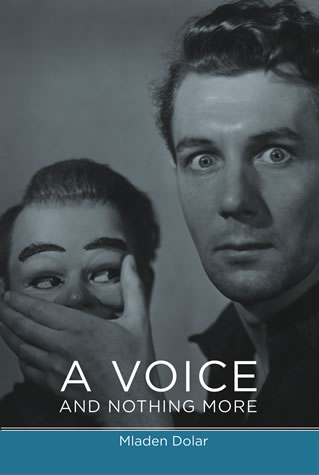
The following essay is excerpted from Mladen Dolar’s book, A Voice and Nothing More(which I’m reading for my dissertation).
The voice did not figure as a major [western] philosophical topic until the 1960s, when Derrida and Lacan separately proposed it as a central theoretical concern. Dolar goes beyond Derrida’s idea of “phonocentrism” and revives and develops Lacan’s claim that the voice is one of the paramount embodiments of the psychoanalytic object (objet a). Dolar proposes that, apart from the two commonly understood uses of the voice as a vehicle of meaning and as a source of aesthetic admiration, there is a third level of understanding: the voice as an object that can be seen as the lever of thought. He investigates the object voice on a number of different levels–the linguistics of the voice, the metaphysics of the voice, the ethics of the voice (with the voice of conscience), the paradoxical relation between the voice and the body, the politics of the voice–and he scrutinizes the uses of the voice in Freud and Kafka. (There’s a great review by Christine Boyko-Head HERE.)
— Plutarch tells the story of a man who plucked a nightingale and finding but little to eat exclaimed: “You are just a voice and nothing more.”
There is a story that goes like this: In the middle of a war, in the middle of a battle, there is a company of Italian soldiers in the trenches. And there is an Italian commander who issues the command “Soldiers, attack!” But nothing happens, nobody moves. So the commander gets angry and shouts even louder “Soldiers, attack!” At which point there is a response, a voice rising from the trenches saying Che bella voce!
This story can serve as a good entry into the problem of the voice. On the first level this is a story of a failed interpellation. The soldiers fail to recognize themselves in the appeal, the call of the other, the call of duty, and they don’t act accordingly. Surely the fact that they are Italian soldiers plays a great role in it, they do act according to their image of not the most courageous soldiers in the world, as legend has it, and the story is most certainly not a model of political correctness, it indulges in tacit chauvinism and national stereotypes. So the command fails, the addressees don’t recognize themselves in the meaning being conveyed, they concentrate instead on the medium, which is the voice. The attention paid to the voice hinders the interpellation and the transmission of a symbolic mandate, the transmission of a mission.
But on a second level another interpellation works in the place of the failed one: if the soldiers don’t recognize themselves in their mission as the soldiers in the middle of a battle, they do recognize themselves as addressees of another message, they constitute a community as a response to the call, the community of people who can appreciate the aesthetics of a beautiful voice. Who can appreciate it when it is hardly the moment, and especially when it is hardly the moment to do so? So if in one respect they act as stereotypical Italian soldiers, they also act as stereotypical Italians in this other respect, namely as opera lovers. They constitute themselves as the community of “the friends of the Italian opera” (to take the immortal line from Some Like It Hot), living up to their reputation of connoisseurs, people of refined taste who have amply trained their ears with bel canto, so they can tell a beautiful voice when they hear one, even among the canon fire.
The soldiers have done the right thing, from our biased present perspective, at least in an incipient way, when they have concentrated on the voice instead of on the message, although, to be sure, for the wrong reasons. They are seized by a sudden aesthetic interest precisely when they would have had to attack, they concentrate on the voice because they have grasped the meaning all too well. But quite apart from their feigned artistic inclination they have also bungled the voice the moment they isolated it, they immediately turned it into an object of aesthetic pleasure, an object of veneration and worship, the bearer of a meaning beyond the ordinary meanings. The aesthetic concentration on the voice loses the voice precisely by turning it into a fetish-object.
I will try to argue that there is a third level: an object voice which doesn’t go up in smoke in conveyance of meaning and which doesn’t solidify either in an object of fetish reverence, but an object which functions as a blind spot in the call and a disturbance of aesthetic appreciation. One shows fidelity to the first by running to the attack, one shows fidelity to the second by running to the opera. But fidelity to the third is far more difficult to achieve. I will try to pursue it on three different levels: linguistics, ethics and politics. Continue reading →
I’ve been listening to old Lata Mangeshkar records on my new, very old His Master’s Voice (model HMV 88a) gramophone. Indescribably magical, to listen to something powered only by the twist of your own wrist.
This song is from the film Dil Bhi Tera Hum Bhi Tere (1960).
Don’t call out to me in the stillness of the night
Don’t play that music which brings tears to my eyes
Don’t play it
Don’t call out to me
Have you ever experienced the weird magic of coming across something obliquely on Youtube, on your way somewhere else, and it speaks so powerfully, so uncannily, to all the things happening right now around you that all the hairs on your body stand on end? This is one of those times. The scene comes from a 1952 film called The Member of the Wedding, based on the book/play by Carson McCullers, starring Ethel Waters, Julie Harris and Brandon De Wilde. I came across it because my housemate Khanyi and I were singing this old hymn, hamming it up Lauryn-Hill-in-Sister-Act-2 style. I wanted to check out some of the older versions… and this clip revealed itself to me, complete with contextual preamble.
Felix opens this particular “Deaf Safari” with a dodgy old recording (that I think I actually gave him!), of Marais and Miranda entertaining a frightfully colonial white 1950s audience with their “knowledge” of “Hottentot” and “Zooloo” linguistics. With a subversive stammer, it segues into an hour-long journey of cut-up sounds and visuals.
Laband displays fluent familiarity with and yet alienation from spectacular capitalist consumer tropes. The oversaturated bricolage of radio preachers, politicians, porn, pulp cinema, big game and exoticised cultural representations is absurd and defaced: eyeless, toothless, festering with skulls. Sound and visuals work in counterpoint: horny assemblages dripping blood and infection; a snatch of Cat Power’s languid “Satisfaction”. His work foregrounds our mindless addiction to and manipulation by these fragments bouncing off the walls onto one another, their banality dismembered, dislocated, demented, discordant, decaying.
A voice in Queen’s English: “I was wondering what it is that you don’t want to remember so badly… To put it another way, what are you trying to forget?”
The response, implied in the guitar run sampled from Nico’s “These Days”: “Please don’t confront me with my failures… I had not forgotten them.”
Felix forces us to examine ourselves honestly. This I love most deeply about what he does: he will not allow us to forget, nor feign ignorance. There are naive melodies, but there is no innocence, no deafness nor blindness. We are taken through his cabinet of jabbering apparitions, racist, patriarchal horror haunting every suburban corner, lullabies, toyi-toyi chants… The valley of the shadow of death… We are not tourists. This is our own back yard. We stare the nightmares down, bopping in slo-mo. The voices persist, demand acknowledgement until they dissolve. It’s a kind of exorcism.
And beyond that, always, despite all the schizophrenic folly and sadness, hope and jubilation live on in the unfinished refrains of blues ghosts captured long ago on wax… Vera Hall, Stack O’Lee, prisoners and murderers alike now free… and there is space to breathe, place to be here now, without judgement… we are bathed in grace and exquisite melody. This is strong muti for South Africans’ sickness.
Collage: Felix Laband
I can’t wait for his new album, and I highly recommend that you see him live if you get the chance: he’s on form like never before and it’s a profound trip.
P.S. Read Sean O’Toole’s great interview piece for Mahala on Felix’s return (his new album, Deaf Safari, is set for release next month, after an almost decade-long gestation).
 And yet, “the real man of genius,” for Cocteau, is the poet, and he hopes for us that the genius of poetry “hasn’t become something like a shameful and contagious sickness against which you wish to be immunized.” He has very much more of interest to communicate, about his own time, and his hopes for ours. Cocteau recorded this transmission from the past in August of 1963. On October 11 of that same year, he died of a heart attack, supposedly shocked to death by news of his friend Edith Piaf’s death that same day in the same manner.
![Max Ernst - Une semaine de bonté [A Week of Kindness]. La clé des chants 1 [The Key of Songs 1] 1933](https://fleurmach.com/wp-content/uploads/2016/03/003_max_ernst_theredlist.jpg)







 Plutarch tells the story of a man who plucked a nightingale and finding but little to eat exclaimed: “You are just a voice and nothing more.”


 fleurmach