From her second album, Solitude Standing (A&M, 1987).
Category Archives: violence
howard zinn: “you can’t be neutral on a moving train”
“Civil disobedience is not our problem. Our problem is civil obedience. Our problem is that people all over the world have obeyed the dictates of leaders…and millions have been killed because of this obedience… Our problem is that people are obedient all over the world in the face of poverty and starvation and stupidity, and war, and cruelty. Our problem is that people are obedient while the jails are full of petty thieves, and all the while the grand thieves are running the country. That’s our problem.”
Watch this documentary:
turkish protest music
The rhythm of outrage…
“What do a park in Istanbul, a baby in Sarajevo, a security chief in Sofia, a TV station in Athens and bus tickets in Sao Paulo have in common? However random the sequence may seem at first, a common theme runs through and connects all of them. Each reveals, in its own particular way, the deepening crisis of representative democracy at the heart of the modern nation state. And each has, as a result, given rise to popular protests that have in turn sparked nationwide demonstrations, occupations and confrontations between the people and the state.” Read more HERE.

Brazilian solidarity poster
daddy (1973)
NB: not for the strait-laced! An experimental Freudian drama by Niki de Saint Phalle and Peter Whitehead. Grotesque, garish, ghastly… with an incredible piano-driven soundtrack that riffs on Cole Porter’s “My Heart Belongs To Daddy”. If you’re needing an antidote to all the commercial, anodyne Father’s Day bull, this should do the trick. 
giorgos bandoek apostolakis – the guns of brixton
Greek cover of The Clash.
a protest jam from istanbul this week
Kardeş Türküler perform “Tencere Tava Havası” (“Sound of Pots and Pans”) in the streets of Istanbul this week. Check out the Kardeş Türküler’s website HERE for background on the group, which came into being in 1993 as a concert project by the Boğaziçi University Folklore Club.
And, here’s an explanation of the penguin footage later in the video from a Youtube comment:
“If people don’t know about it, the penguins mock mainstream media that has very close relations to the government. Main news channels have been nearly totally silent about the protests, not wanting to be hated by the government. One main news channel (CNNTurk) preferred to broadcast a penguin documentary while all of these are happening. Similar attitude from others. After being severely mocked by protesters, an apology and more coverage came.”

Istanbul group Kardeş Türküler recording the video “Pots & Pans” in response to the Taksim/Gezi Park protests this week.
whirling sufi protesters

A whirling Sufi protester wearing a gas mask in a Gezi Protest in Ankara, 2 June 2013
Photograph: Azirlazarus (on Wikipedia)
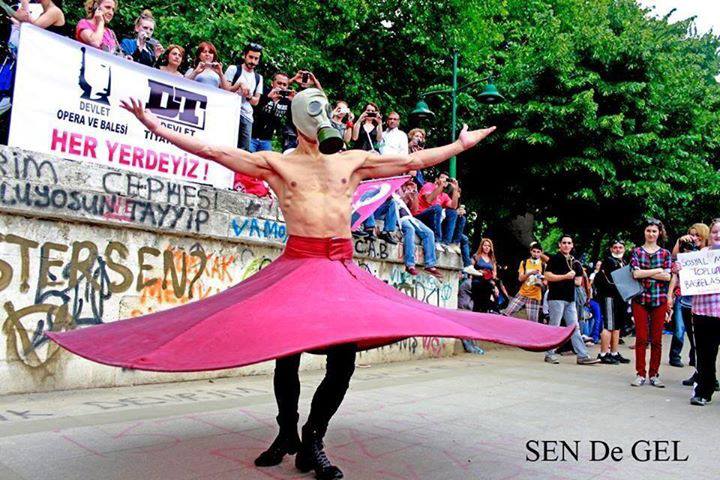
“You come too!”
bergüzar korel – bu sabah güneş doğmuyor
pleased to meet you, hope you guess my name
“Just keep still; keep together!”
6 December, 1969: A free live performance by the Rolling Stones at Altamont of “Sympathy for the Devil” with Hells Angels doing security descends into chaos.
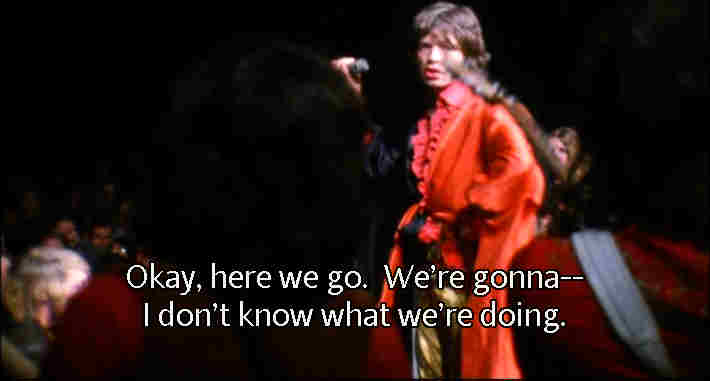
Screenshot of the infamous Altamont concert from the film “Gimme Shelter”
alejandro jodorowsky’s new film
 Watch the trailer:
The Guardian review from Cannes 2013 has this to say:
The extinct volcano of underground cinema has burst into life once again — with a bizarre, chaotic and startling film; there are some longueurs and gimmicks, but The Dance of Reality is an unexpectedly touching and personal work. At the age of 84, and over 20 years since his last movie, Alejandro Jodorowsky has returned to his hometown of Tocopilla in the Chilean desert to create a kind of magic-realist memoir of his father, Jaime Jodorowsky, a fierce Communist whose anger at the world — at his son — was redoubled by the anti-Semitism the family faced.
Of course, the entire story is swathed in surreal mythology, dream logic and instant day-glo legend, resembling Fellini, Tod Browning, Emir Kusturica, and many more. You can’t be sure how to extract conventional autobiography from this. Despite the title, there is more “dance” than “reality” — and that is the point. Or part of the point. For the first time, Jodorowsky is coming close to telling us how personal evasiveness has governed his film-making style; his flights of fancy are flights of pain, flights from childhood and flights from reality. And now he is using his transformative style to come to terms with and change the past and to confer on his father some of the heroism that he never attained in real life.
Read more of this review HERE.
nevermind the bollocks, here’s deleuze and guattari
[E]ffective differences pass between the lines, even though they are all immanent to one another, all entangled in one another. This is why the question of schizoanalysis or pragmatics, micropolitics itself, never consists in interpreting, but merely in asking what are your lines, individual or group, and what are the dangers on each.

JR around the pole at Desperado’s Saloon, Observatory, Cape Town, 15 May 2013. Photo: Rosemary Lombard
What are your rigid segments, your binary and overcoding machines? For even these are not given to you ready-made; we are not simply divided up by binary machines of class, sex, or age: there are others which we constantly shift, invent without realising it. And what are the dangers if we blow up these segments too quickly? Wouldn’t this kill the organism itself, the organism which possesses its own binary machines, even in its nerves and its brain?
What are your supple lines, what are your fluxes and thresholds? Which is your set of relative deterritorialisations and correlative reterritorialisations? And the distribution of black holes: which are the black holes of each one of us, where a beast lurks or a microfascism thrives?
— Deleuze and Guattari: Toward Freedom. Read more HERE.
Sent from my BlackBerry® wireless device
karl marx on how the division of labour is boring

Manufacturing assembly line in China
For as soon as the distribution of labour comes into being, each man has a particular exclusive sphere of activity, which is forced upon him and from which he cannot escape. He is a hunter, a fisherman, a shepherd, or a critical critic and must remain so if he does not wish to lose his means of livelihood; while in communist society, where nobody has one exclusive sphere of activity but each can become accomplished in any branch he wishes, society regulates the general production and thus makes it possible for me to do one thing today and another tomorrow, to hunt in the morning, to fish in the afternoon, rear cattle in the evening, criticize after dinner, just as I have in mind, without ever becoming hunter, fisherman, shepherd or critic.
— From The German Ideology (1845).
happy 195th birthday, karl marx
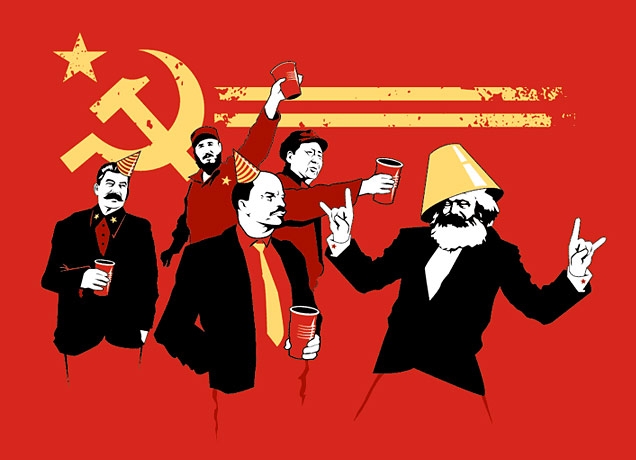
“The Communist Party” – A t-shirt design from http://www.threadless.com
“The fact is that labour is external to the worker, that is, it does not belong to his intrinsic nature. In his work, therefore, he does not affirm himself but denies himself, does not feel content but unhappy, does not develop freely his physical and mental energy but mortifies his body and his mind. The worker therefore only feels himself outside his work, and in his work feels outside himself.”
(From Estranged Labour, 1844)
“Capital is dead labour, that, vampire-like, only lives by sucking living labour, and lives the more, the more labour it sucks. The time during which the labourer works is the time during which the capitalist consumes the labour-power he has purchased of him. If the laborer consumes his disposable time for himself, he robs the capitalist.”
(From Capital, 1867)
l’age d’or (1930)
Sadly, this is a far more profound symbolic critique of Roman Catholic oppression than anything FEMEN is ever likely to pull off (notwithstanding their tops)!
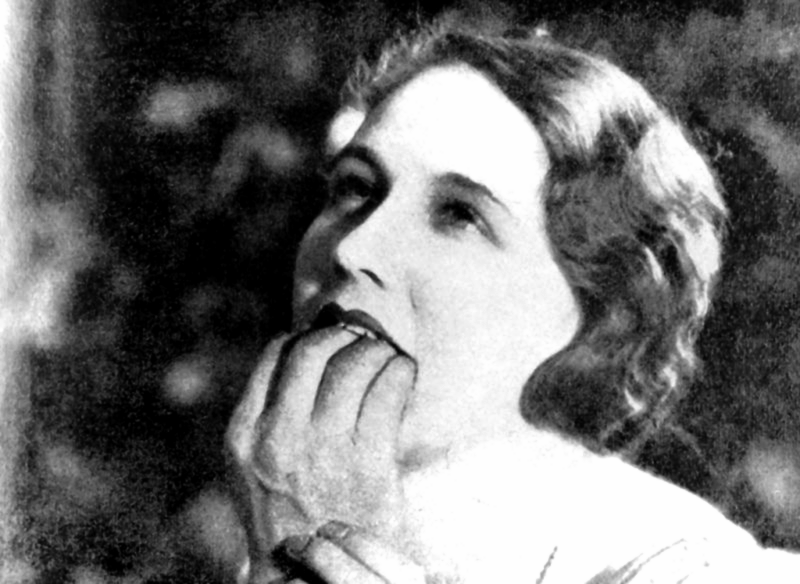 L’Age d’or or The Golden Age (1930), directed by Luis Buñuel, a French surrealist comedy, and one of the first films with synchronous sound ever made in France, was about the insanities of modern life, the hypocrisy of the sexual mores of bourgeois society and the value system of the Roman Catholic Church. Salvador Dalí and Buñuel wrote the screenplay together.
The BBC called it “an exhilarating, irrational masterpiece of censor-baiting chutzpah.”
Read more about the political project of surrealism HERE. Watch the film (in the original French) HERE – turn on the Youtube captions for English subtitles.
Regarding the response of the establishment to the film, from Wikipedia:
Upon receiving a cinematic exhibition permit from the Board of Censors, L’Âge d’or had its premiere presentation at Studio 28, Paris, on 29 November 1930. Later, on 3 December 1930, the great popular success of the film provoked attacks by the right-wing Ligue des Patriotes (League of Patriots), whose angry viewers took umbrage at the story told by Buñuel and Dalí. The reactionary French Patriots interrupted the screening by throwing ink at the cinema screen and assaulting viewers who opposed them; they then went to the lobby and destroyed art works by Dalí, Joan Miró, Man Ray, Yves Tanguy, and others. On 10 December 1930, the Prefect of Police of Paris, Jean Chiappe, arranged to have the film banned from further public exhibition after the Board of Censors re-reviewed the film.
A contemporary right-wing Spanish newspaper published a condemnation of the film and of Buñuel and Dalí, which described the content of the film as “…the most repulsive corruption of our age … the new poison which Judaism, Masonry, and rabid, revolutionary sectarianism want to use in order to corrupt the people”. In response, the de Noailles family withdrew L’Âge d’or from commercial distribution and public exhibition for more than forty years; nonetheless, three years later, in 1933, the film was privately exhibited at the Museum of Modern Art, in New York City. Forty-nine years later, from 1-15 November 1979, the film had its legal U.S. premiere at the Roxie Cinema in San Francisco.
The film critic Robert Short said that the scalp-decorated crucifix and the scenes of socially repressive violence, wherein the love-struck protagonist is manhandled by two men, indicate that the social and psychological repression of the libido and of romantic passion and emotion, by the sexual mores of bourgeois society and by the value system of the Roman Catholic Church, breed violence in the relations among people, and violence by men against women. The opening sequence of the film alludes to that interpretation, by Dalí and Buñuel, with an excerpt from a natural science film about the scorpion, which is a predatory arthropod whose tail is composed of five prismatic articulations that culminate in a stinger with which it injects venom to the prey. Film critic Ado Kyrou said that the five vignettes in the tale of L’Âge d’Or correspond to the five sections of the tail of the scorpion.
click click – a piece of meat
Images from Lot in Sodom (1933) directed by James Sibley Watson and Melville Webber.
Music by Click Click, available on the album Lung Function (Rotorbabe Recordings, 2004).
clouddead – jimmybreeze (1)
From cLOUDDEAD (2001).
rebecca west on sadomasochism (1933)
 “I loathe the way the two cancers of sadism and masochism eat into the sexual life of humanity, so that the one lifts the lash and the other offers blood to the blow, and both are drunken with the beastly pleasure of misery and do not proceed with love’s business of building a shelter from the cruelty of the universe.”
— Rebecca West, Letter to a Grandfather (1933), pg 34.
Read more about the formidable Dame West HERE.
mark lanegan – strange religion
Off the album Bubblegum (Beggars Banquet, 2004), featuring Izzy Stradlin and Duff McKagan.
* Thank you, Stella. *
voortrekker road, goodwood, 9 april 2013

Photo: Rosemary Lombard
(cc by-nc-sa)
russell brand on margaret thatcher
‘The blunt, pathetic reality today is that a little old lady has died, who in the winter of her life had to water roses alone under police supervision. If you behave like there’s no such thing as society, in the end there isn’t. Her death must be sad for the handful of people she was nice to and the rich people who got richer under her stewardship. It isn’t sad for anyone else.’
‘Barack Obama, interestingly, said in his statement that she had “broken the glass ceiling for other women”. Only in the sense that all the women beneath her were blinded by falling shards. She is an icon of individualism, not of feminism.’

Russell Brand has an intelligent, evocative way with reflection. I remember the piece he wrote when Amy Winehouse died — the fine-grained, personal memories, the honesty. THIS BIT OF WRITING, on a very different sort of figure in his life, has that same quality.
crass – how does it feel to be the mother of a thousand dead?
I know this is an awful thing to say, and Alzheimer’s is an awful disease, but I reckon Margaret Thatcher was lucky to lose her mind.
Recorded and mixed in August 1982 at Southern Studios, London. Packaged in a fold-out sleeve with inner sleeve with printed lyrics.

George Barber wrote in The Crass Story:
Crass released another single: ‘How Does It Feel To Be The Mother Of A Thousand Dead?’ A direct attack on Thatcher, it came in a black sleeve decorated with white graveyard crosses. When, during Prime Minister’s Question Time,Thatcher was asked if she’d heard the record, things were getting serious.
‘The Conservative Party attempted to fight back, as the Guardian reported: “The Attorney General, Sir Michael Havers, has been asked by the Conservative MP for Enfield North, Mr. Tim Eggar, to prosecute an Anti-Falklands war record under the Obscene Publications Act. The record, ‘How Does It Feel To Be The Mother of 1,000 Dead?’, by the group Crass, which also owns the record company Crass Records, which released it, is said to have sold 20,000 copies since it was issued last Saturday. It refers to Mrs. Thatcher and the decision to send the Task Force. “You never wanted peace or solution, from the start you lusted after war and destruction… Iron Lady, with your stone heart, so eager that the lesson be taught that you inflicted, you determined, you created, you ordered… It was your decision to have those young boys slaughtered.”
Read more about the history to this recording HERE.
hefner – the day that thatcher dies
For more protest songs about Maggie Milk-Snatcher, check out the Top 13 Anti-Margaret Thatcher Songs.
justine musk – redefining what it means to be bad
This piece by Justine Musk was first published HERE. Thanks to Emma Arogundade for sharing it on Facebook.
Justine Musk – “Well-behaved women seldom make history”: Redefining what it means to be bad
I posed topless for a female photographer who specializes in boudoir. I’m lying on the bed in a man’s velvet smoking jacket, hair blown across my face. I look at the camera. It’s a beautiful portrait (the photographer is very talented) and I’m proud of it. It reminds me slightly of Manet’s Olympia. That painting caused a scandal at the time (1863) — not because the subject was nude — but because of how she stares at the viewer instead of looking away demurely.
It’s that act of shameless eye contact that makes her – according to the moral dictates of the era — truly “bad”.

Édouard Manet – “Olympia” (1863)
I once said to someone, “I don’t know if I’m a good girl with a bad streak, or a bad girl with a good streak.” But I was being ironic. My real point was that, like any other woman (or man), I am both and neither.
In fact, it’s kind of amazing to me that the good girl/bad girl dichotomy still exists. It came up again when movie star Reese Witherspoon accepted an award on television and took her speech as an opportunity to slam other, younger women for being “bad”.
“I understand that it’s cool to be bad, I get it,” she said, in that tone of false camaraderie women sometimes use before they slip in the knife. “But it’s possible to make it in Hollywood without being on a reality show….And when I was coming up, a sex tape was something you hid under your bed…And when you take naked pictures of yourself, you hide your face! Hide your face!” She finished off by declaring that she was going to try to make it “cool” to be a “good girl”.
But imagine this:
Instead of criticizing the same young women for the same things that everybody else is already criticizing them for, she could have slammed reality shows for their misogynist (and monotonous) depiction of women.
She could have criticized the kind of media that turns a girl like Paris Hilton into a celebrity in the first place.
She could have pointed out how advertising – which is so very everywhere that we no longer notice it as we’re breathing it in – co-opts rebellion and sells it back to girls in the “you’ve come a long way, baby” pseudo-liberation supposedly found in a package of cigarettes.
She could have criticized a culture that trains girls to define themselves by their sexual appeal only to punish them for it.
She could have echoed Laurel Ulrich’s famous comment that “well-behaved women seldom make history” and pointed out that ‘bad’ doesn’t have to mean shallow and self-destructive. It can mean cutting against the traditional good-girl dictates of passive and pretty and pleasing and quiet. It can mean speaking up against the status quo, the double standard, the beauty myth. It can mean rejecting the idea that your moral nature depends not on what you do, but on what you don’t do (have sex).
It can mean revolution not rebellion.
She could have said: If you’re going to be ‘bad’, make it MEAN SOMETHING…other than self-sabotage.
Recently I was struck by two different dialogues on Facebook. One was about Charlie Sheen. The other was about Britney Spears. A man posted a status update about going to Sheen’s show, and the thread discussed how smart and funny and talented Sheen is and that despite the controversy and general hubbub, “he’s fine, he’s okay” and “a brilliant marketer” and “totally knows what he’s doing”.
Meanwhile, I’d posted a link to a Britney Spears video on my own Facebook page, partly because I’m fascinated by the way people react to her.
Britney immediately came under fire for being “a poor role model” to young girls everywhere.
No “brilliant marketer” comments for her.
Both Sheen and Spears have a noted history of drug use. Both are sexy and openly sexual. Both are, or have been, at the top of their professions. Both have undergone episodes of bizarre, even tragic behavior that is suggestive of addiction and mental illness.
Yet in the buzz around Charlie Sheen at the height of his notoriety, what I didn’t hear was anything about how he serves as a poor role model for boys.
This is interesting to me, because – unlike Britney, at least to my knowledge – Sheen has a documented history of domestic abuse.
As in: he hits women.
As in: he once shot a woman in the arm.
Let me repeat that: he freaking shot the woman.
But this is no big deal. It gets glossed over. Whenever I brought it up – in person or online – people would lift their virtual shoulders in a virtual shrug and move on.
(Possibly because the women involved were so easily characterized as ‘bad’ girls.
Which in the end comes down to this: slut.
Which means: vile and disposable.)
In comparison to Sheen, Britney did reveal her belly button at a young age. And that, of course, is a threat to civilization as we know it.
Spears is held up as a “poor role model” because we can perceive her as trashy and slutty and “asking for it”. Once you reduce a girl to her sexuality – and god knows that never ever happens in this culture – she becomes less than human, so you no longer have to treat her as a human. Which means the Charlie Sheens of the world – rich, powerful, white – can do with them as they please. If the girls get, you know, a little bit shot — well, it’s their own damn fault. That’s the message that some boys are absorbing from Sheen’s treatment of women and our celebration of him. That attitude, I suspect, will prove more dangerous to girls than any of Britney’s outfits or dance moves or little-girl singing voice.
There’s some irony in the fact that, like Britney, Reese Witherspoon got pregnant at a young age – but unlike Britney, who was married, Reese conceived out of wedlock and had a shotgun wedding.
Also, she said “motherfucker” on stage.
Also, she is still young — and divorced.
Also, she’s an actress (which used to be synonymous with prostitute).
Not so long ago, these things would have pegged her as morally defective. She wouldn’t technically qualify as a “good girl” (which means she’s probably “cooler” than she gives herself credit for).
But what Witherspoon seemed to be getting at in her declaration of herself as a “good girl” has to do with the idea of exposure. Whether it’s a reality TV show or an unfortunate cell phone picture, a good girl does not show herself to the world in this way — or if she does, she “hides her face”.
She guards her shame.
She never makes eye contact.
A “good” girl is not only virginal – and thus qualifies as morally sound, even if, like Jessica Wakefield in the Sweet Valley High novels, she’s kind of a sociopath – but modest and quiet. She covers up. She is seen – without being seen. She talks in a nice voice and smiles a lot. She’s the angel of the house, and stays in the house, which was the historical point of this exercise in the first place.
She’s not loud or opinionated, she doesn’t rock the boat, and she doesn’t draw attention to herself.
All of this is convenient for others. The funny thing about silence is how it tends to favor the dominating person or group. The dominating narrative, the ruling point of view, becomes a sort of truth by default: what we as a culture assume when we’re given no reason to assume otherwise.
It’s the winners who get to write history, after all. The others are silent or silenced.
Which is not my way of saying that appearing on reality TV isn’t a form of evil in its own right, or that a girl should take provocative pictures of herself and post them on the ‘Net. Neither is power so much as a mistaken idea about power (and perhaps too many shots of tequila): when the culture seems to be urging you in one direction (“it’s cool to be ‘bad’”) and you haven’t had time or experience to learn otherwise.
But there does seem to be a link between sexual expression and self-expression, in that a ‘good’ girl is not in full possession of either. Her body doesn’t belong to her: it ‘belongs’ to her father, to her future husband, to the government that decides if she can have an abortion or the religion that decides if she can use birth control.
Her voice doesn’t fully belong to her either: she has to be careful what she says, and how she says it, and who she might offend.
‘Goodness’, then, seems to involve an amputation of the self. You make yourself ‘good’ to be loved and accepted, and in the process sacrifice your authenticity. You give yourself away until you no longer know who you are – assuming you ever did.
I’m not sure what you actually get for this, in the end.
Fitting in, as the wonderful Brene Brown so astutely points out, is not the same as being accepted for who you are – in fact, the one renders the other impossible. Being trained to please and serve leaves you ripe for exploitation; the inability to assert your boundaries makes you easy to abuse in large and small ways.
“Raising a girl to be ‘nice’,” a therapist – a woman in her sixties, married and with daughters — once remarked to me, “is like sending her out into the world with one hand tied behind her back.” She should know. Many of these women turn up in her Beverly Hills office twenty years later: divorced, discarded, aging, with no ability to support themselves and no sense of who they are at core.
So honestly, in the year 2011, these are a girl’s options? She can be ‘bad’ (and disposable) or ‘good’ (and turned in on herself)?
I would like to think that there’s another option.
Not ‘bad’, maybe, but badass.
As in: you get to declare yourself. You get to express your sexuality any way you choose, whether it’s indulging or abstaining, and you’re responsible about it and willing to risk the emotional consequences. When you want or need to speak up — you speak up. You write or blog or paint or dance or study or put on puppet shows or raise your kids or start up your own company or nonprofit or do some combination thereof. You stand for what you believe in. You know what you believe in – and what you don’t. You own your life. You find your tribe. You look out for yourself (ie: you are ‘selfish’). And when you offend people, as anyone with an opinion is bound to do at some point — when people step into your space just to tell you that you suck — you shrug it off and move on, because you know disapproval won’t kill you.
You nurture the fire at your core.
I’m reading the book GAME FRAME, about the rise of social gaming, and came across the idea of “the magic circle”. The circle is the arena in which the game takes place. You step over some kind of threshold and into another world. You participate in a conflict that you recognize as artificial but, for a space of time, accept as reality. You willingly suspend your disbelief.
It struck me that we move in and out of different kinds of magic circles. There are games, yes, but also movies and theater and television and books. There are relationships that become their own world of intimacy. They form a private reality between you and your partner, in which you might ignore your actual experience to buy into an entrancement (“we are soulmates”) or belief system (“he is better and always right, and I am lesser and always wrong”).
And then there’s a magic circle that has to do with language and perception, with how we create our shared reality. The good girl/bad girl labeling strikes me as one of those. Instead of recognizing a woman as a complex and multi-dimensional being, instead of allowing her the flaws, mistakes and happy accidents that come with the trial-and-error process known as the human condition, we stomp her into a cartoon. We accept an artificial conflict (good girl vs bad girl) and make it important. We place her on a pedestal or in the dirt (or on the pedestal so we can knock her off later). We accept this as real instead of a game we can choose not to play.
You could say, instead: We’re all doing the best we can. We all do stupid things from time to time. But we won’t be distracted by this game of blaming and shaming each other. We’ll look to larger forces.
I like this video by Jeffrey Wright, in which he transfers the “willing suspension of disbelief” from the theater to the developing world, from acting to entrepreneurialism and social change.
With the power of your convictions, he says, with the ability to suspend your disbelief and act in the face of uncertainty, you have the chance to reshape reality.
Like Olympia staring out at the viewer — like Manet breaking the rules to paint her — you can reject the game and make a new one.
You can invent a new truth.
Olympia has come down to us through the ages. She refuses to “hide her face”. She is shamelessly comfortable in her own skin. She exudes a badass presence.
Her critics, now, are dust.
snake in the eagle’s shadow (1978)
End fight scene from Jackie Chan’s 1978 breakthrough. Craziest foley and 70s soundtrack: As well as original music by Chou Fu-liang, the original version of the film features Jean Michel Jarre’s “Oxygène (Part 2)” and Space’s “Magic Fly”. Like many Hong Kong movies of the era, it also includes samples from western movie scores, including A Fistful Of Dollars, You Only Live Twice, The Spy Who Loved Me, and even the Death Star explosion moment from Star Wars. The English subtitles over (different) English dubbing are great, too.
The full movie is on Youtube, HERE, but if you’re in South Africa, like me, you won’t be able to watch it due to copyright nonsense.
screen test/bang bang
James Dean and Lois Smith: screen test for East of Eden.
Nancy Sinatra – “Bang Bang (My Baby Shot Me Down)” – piano remix.
one photo a day in the worst year of my life
(Trigger warning for domestic violence)
Serbian campaign against domestic abuse.
love is stronger than death

shintaro kago – mermaid

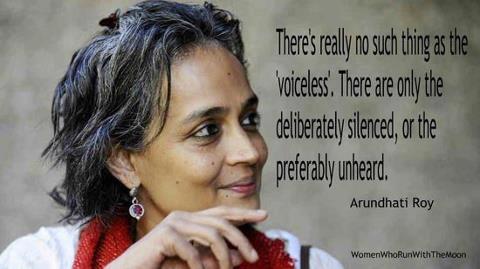
arundhati roy on “the voiceless”
Remember Sharpeville. Remember Soweto. Remember Marikana.
fanon on desire and recognition
As soon as I desire I am asking to be considered. I am not merely here-and-now, sealed into thingness. I am for somewhere else and for something else. I demand that notice be taken of my negating activity insofar as I pursue something other than life; insofar as I do battle for the creation of a human world – that is, of a world of reciprocal recognitions. He who is reluctant to recognize me opposes me. In a savage struggle I am willing to accept convulsions of death, invincible dissolution, but also the possibility of the impossible.
~ Frantz Fanon: Black Skin White Masks. New York: Grove Press (1967)
 fleurmach
