new order – power, corruption and lies (1983)

Peter Saville on his album cover artwork:

“The title seemed Machiavellian. So I went to the National Gallery looking for a Renaissance portrait of a dark prince. In the end, it was too obvious and I gave up for the day and bought some postcards from the shop. I was with my girlfriend at the time, who saw me holding a postcard of the Fantin-Latour painting of flowers and said, ‘You are not thinking of that for the cover?’ It was a wonderful idea. Flowers suggested the means by which power, corruption and lies infiltrate our lives. They’re seductive. Tony Wilson had to phone the gallery director for permission to use the image. In the course of the conversation, he said, ‘Sir, whose painting is it?’ To which the answer was, ‘It belongs to the people of Britain.’ Tony’s response was, ‘I believe the people want it.’ And the director said, ‘If you put it like that, Mr Wilson, I’m sure we can make an exception in this case.’”

(From HERE.)

a lacanian interpretation of sartre’s ‘erostratus’ (1939)

Read Jean Paul Sartre’s short story Erostratus, written the year after his famous NauseaHERE.

Salvador Dali – “Temple of Diana at Ephesus” (1942).

Jordan Alexander Hill on the story from a psychoanalytical perspective:

Jean-Paul Sartre’s “Erostratus” may be the shortest story in The Wall, yet it serves as a fitting psychoanalytic case-study. “Erostratus” tells the story of Paul Hilbert, a lonely man plagued by insecurity and sexual impotency, who attempts and ultimately fails to commit a heinous crime. Shortly into the story, it becomes clear that the crime is mostly an attempt to escape his mediocrity through an act of powerful self-assertion. We will look at this story not only through a traditional psychoanalytic lens, but also by applying important Lacanian principles. Sartre, who developed his own “existential” brand of psychoanalysis, surely wrote “Erostratus” to support certain phenomenological and ethical themes from Being and Nothingness—we’ll look at some of these perspectives. However, in many ways, we arrive at the deepest understanding of Hilbert and his motivations by bringing Lacanian theories into the discussion. In this paper, we first locate the basic existential and psychoanalytic themes that underpin “Erostratus”, in addition to looking at Lacan’s “mirror phase” and how this relates to Hilbert’s social development. “Erostratus” is essentially a story about narcissism, alienation, otherness, and desire. Lacan’s psychic structures—particularly the imaginary and symbolic orders—will give us a sense of where these emotions come from, how they affect our protagonist, and how they function in the larger narrative.

Like in many “existential” works, our protagonist is a bland working class guy with a routine existence and a mundane job. He has no friends to speak of and is a self-professed “anti-humanist”. As Hilbert’s impatience with his situation grows, he decides he must make a statement that will prove his anti-humanism and secure his name in the history books—he will murder six random people on a busy street in Paris. Hilbert is deeply moved by the ancient Greek story of “Erostratus,” which tells of a man who burned down the temple of Artemis at Ephesus to immortalize himself. What strikes him is that while nobody knows the name of the man who built the temple of Artemis, everyone remembers Erostratus, the man who destroyed it. The rest of the story follows Hilbert’s metamorphosis, as the day of his crime draws nearer. In what follows, Hilbert buys a gun and carries it around in public, becoming sexually aroused by the possibilities, and the power he now possesses. He becomes more and more obsessed with this power and even visits a prostitute, commanding her to walk around naked at gunpoint (he does this several times, each time ejaculating in his pants). As the day of his crime draws nearer, Hilbert spends his life savings on expensive meals and prostitutes, and even mails letters of his murderous intent to 102 famous French writers. Yet, in the end, Hilbert is incapable of following through. He winds up shooting only one man, a “big man”, and has a frantic meltdown in the street afterward. The story ends in a café lavatory, as Hilbert gives himself up to the police.

Let us first take a look at some of the elements that make up the “existential” composure of the story. Hilbert’s act of mailing letters to famous writers before committing his crime shows a deep insecurity over the potential legacy he wishes to leave. Hilbert must have others verify and be witness to his crime for the weight of his actions to seem real to him. In existential thought, this is an offense known as “being-for-others” (we’ll return to this later when we discuss Lacan). Hilbert no longer lives in a world where his actions and choices hold any real weight or significance. This lack of self-determination plunges Hilbert into a kind of moral nihilism, which only exacerbates his problems. Another significant element to note is the rise in power Hilbert feels as he buys a gun and brings it around with him wherever he goes. The angst or dread that follows—often described in existential circles as being a kind of “excitement or fear over the possibility of one’s own freedom”—is an important aspect of Hilbert’s condition. Furthermore, one would not have to use queer theory, nor is it beyond any stretch of the imagination, to assert that Sartre uses the gun here as a phallic symbol. For Hilbert, happiness truly is a warm gun, as the gun symbolizes the power he has always lacked socially and sexually. The fact that Hilbert makes prostitutes walk around naked at gun point, without letting them touch or look at him, is another teller. This voyeuristic behavior, according to Sartre, is a mechanism by which the individual avoids his or her own subjectivity—shirking responsibility—in order to live through the imagined subjectivity of another (Sartre, 1953, 244). Hilbert, it turns out, suffers in large part from a staggering lack of being (this “lack of being” doesn’t stem from any shortage of self-consciousness, but rather from a case of what I’ll call “mistaken identity,” in a Lacanian sense).

Hilbert’s crime, we come to find out, is not motivated by material gain or political ideology. What, then, is it motivated by? To start, let’s look at our protagonist’s own self-identification: Hilbert believes his crime is motivated by his “anti-humanism”. In the letter, he congratulates the famous authors for being humanists, for loving men. “You have humanism in your blood…” Hilbert writes, “You are delighted when your neighbor takes a cup from the table because there is a way of taking it which is strictly human… less supple, less rapid than that of a monkey”. He goes on to sarcastically praise the authors for relieving and consoling the masses. “People throw themselves greedily at your books… they think of a great love, which you bring them and that makes up for many things, for being ugly, for being cowardly, for being cuckolded, for not getting a raise on the first of January”. These sound like Hilbert’s own problems.

Later in the letter, Hilbert explains his own hatred of humanity. “I cannot love them… what attracts you to them disgusts me… men chewing slowly, all the while keeping an eye on everything, the left hand leafing through an economic review. Is it my fault I prefer to watch the sea-lions feeding?”. Given this, it would be a mistake to equate Hilbert’s anti-humanism to misanthropy. The word “misanthrope” is normally an intellectual self-label, which is defined by a general disgust with the thoughtlessness or lack of social awareness perceived in others. As Moliere notes in his Les Misanthrope: “I detest all men; Some because they are wicked and do evil, Others because they tolerate the wicked” (Moliere, I.i.). Hilbert, on the other hand, is not a misanthrope; he is a self-reflective watcher, a voyeur. And his anti-humanism—his “all-too-humanness” as he puts it it—seems to involve the hatred of those physical and emotional qualities which he observes in others, and which he himself cannot experience. Hilbert’s condition is strikingly similar to Sartre’s analysis of the poet Baudelaire. “For most of us,” Sartre contends, “it is enough to see the tree or house; we forget ourselves” (Sartre, 1950, 22). Baudelaire, however, “was the man who never forgot himself” (Sartre, 1950, 22). Hilbert, likewise, is too self-conscious to experience normal human emotions. He does not simply see things; but sees himself seeing things. As such, he has lost the unselfconscious grace and naturalness he so despises in others.

This deep self-consciousness, this narcissism, is something that alienates Hilbert, and makes normal communication with others almost impossible. If we asked Lacan, he would probably point us to the mirror phase and the imaginary order, which are both significant in Hilbert’s case. The mirror phase refers to a period in psychosexual development, when “the child for the first time becomes aware, through seeing its image in the mirror” (Homer 24). For Lacan, this marks the emergence of the ego, as the child realizes it can control the movements of this new image. This should not be confused with the advent of “selfhood,” but rather it is a moment of profound alienation, where we actually mistake this new mirror-image for our “self” (Homer 25).

Read more of this article HERE (and read the actual story HERE).

helen mirren in herostratus (1967)

A scene from the movie Herostratus (1967), directed by experimental filmmaker Don Levy.

The plot of Herostratus is deceptively simple: A young poet, Max (Michael Gothard), is sick of being poor, unemployed and feeling inadequate and unnoticed and trapped by society. After a few setbacks early in the film, particularly when it comes to paying the rent to a landlady he can no longer avoid, Max decides to commit suicide by jumping off a tall building. But Max decides to make a point of his death instead, and enlists the help of Farson (Peter Stephens), a successful public relations ad man, who helps him turn his suicide, conceived as a sacrificial act of protest against modern society, into a media circus.

Farson does not actually believe Max will go through with the suicide, and decides to let Max spend time at his studio, and its there that Max falls in love with Farson’s assistant Clio (Gabriella Licudi), with whom he shares his first sexual experience. Farson encourages their coupling, believing it’ll end in tears and the young man’s mental torment will be something he can further exploit, but then everyone finds out just how bad of a poet Max really is, and they encourage him to kill himself, for real, and Max realizes that his reactionary gesture is being seen by everyone as simply a cry for attention.

Depressed by this last futile attempt to make himself understood, Max goes up to to the roof but his suicidal jump is stopped by a man who happens to be working on the roof that day — but during their struggle, the worker falls to his death, and Max escapes into the woods.

Herostratus, it should be noted, is titled for the Greek poet who sought to immortalize his own name by setting fire to the Temple of Artemis in Ephesus, in the fourth century B.C. His name was later stricken from all records until it was discovered that Alexander the Great was born the night Herostratus committed his fatal act.

This was Don Levy’s first feature film after having attending on a scholarship at Cambridge University, where he began a PhD study in Theoretical Chemical Physics. At some point Levy withdrew from his science courses and began focusing on creative endeavors, including painting and playing jazz and filmmaking. He moved over to the London-based Slade School of Fine Art, where he made a series of short science documentaries, including his most successful film, 1962’s Time Is, which explored the theories and conception of time.

James Quinn, then director of the British Film Institute, had worked with Levy onTime Is, helping him secure a grant to finish the film. He then helped the director obtain the funds — from the BFI Experimental Film Fund — to make another short film, but Levy soon found his ambitions were exceeding the budget as it expanded into a feature-length production, with additional funding coming from the BBC. That film was Herostratus, and it took five years to complete, but it was largely met with indifference, and was not the spectacular success that Levy (and Quinn) had hoped for. After a handful of initial screenings, including its premiere at London’s Institute of Contemporary Artst, in April 1968, Herostratus was shelved and virtually forgotten.

Levy’s artistic filmmaking style — juxtaposing images of postwar urban decay and burlesque stripteases with carcasses hanging in an abattoir — met largely with indifference from the public and from most film critics, even though later critics have pointed out that he did have some influence on his contemporaries, including Richard Lester and Stanley Kubrick, especially on the latter’s 1971 film Clockwork Orange.

The few surviving prints of Herostratus show it to be a flawed yet highly perceptive dissection of 1960s idealism, seduced by the Mephistophelian deception of market forces and the empty promise of mass media celebrity.

Helen Mirren’s singular contribution (about 54 minutes into the film) as “Advert Woman” provides one of the few dark moments of humor in an otherwise very dark film. In the scene, she is wearing rubber gloves for the filming of a commercial which is supposed to be a statement about consumerism, but we know what the real product is: the camera lingers lasciviously (as it will so often in her later career) over her cleavage. Once she’s delivered her lines, Gothard scoops her up and carries her off set. The scene is barely more than three minutes long.

Read more HERE and HERE.


hildegard von bingen – a feather on the breath of god (c 1150)

“Listen; there was once a king on his throne anointed with great honour. He sent forth his dove into the world, which dropped the tiniest feather from its wing. The king raised the feather, blew on it, and commanded it to fly. The feather flew, not because of anything in itself, but because the air bore it along.

Thus am I: but a feather on the breath of God.”

– Hildegard of Bingen (1098 – 1179)

This extraordinarily gifted woman, born c. 1098 in Bermersheim, Germany, was given to the church at the age of eight. The tenth child of Hildebert of Bermersheim and Mechthild of Merxheim, she was promised as a tithe to the church from her birth and was later to become an abbess. She was a polymath: a visionary, a theologian, an early scientist and physician and a prodigious letter-writer who numbered kings, emperors and popes among her correspondents. There is a detailed Wikipedia entry about her HERE.

Illumination from the "Liber Scivias" showing Hildegard receiving a vision and dictating to her scribe and secretary.

Illumination from the “Liber Scivias” shows Hildegard receiving a vision and dictating to her scribe.

on undoing the self and paying attention

Excerpted from this post at Wine, Women and Philosophy:

… And aren’t unsettling folk just like that? You think you’ve done them, ticked them off, when suddenly, you’re back to square one… This other quagmire into which we had unwittingly waded – the actual technicalities involved in “undoing the creature in us” so as to successfully “decreatea la Weil – required our immediate attention.

And so, spurred on by Anne Carson’s insight into how to go about actually paying attention – “Attention is a choice of where you put your mind…And looking at the object of your attention to the extent that you forget you’re doing the looking” – we embarked on a series of exercises designed to both instruct us on the ins and outs of destroying the “I,” and sharpen our skills in the attentiveness department.

Of course, there was a lot of preliminary discussion as to whether destroying the “I” was a desirable thing in the first place. In a sense, that Weilian notion of carving out a void in the space where the self normally resides goes counter to the rah-rah-be-your-biggest-and-best-self kind of rhetoric on offer in Self-Esteem for Dummies etc. In a culture where Self reigns Supreme, doing away with it is unnerving at best, terrifying at worst – even if this negation is, as Weil contends, a necessary move if one is to fully open oneself to Truth and Knowledge and Whatever Else Truly Matters.

For the self gets in the way. Like a shadow, it blocks out the light. Like unwanted baggage, it weighs you down. Like the elephant in the room, it takes up all the space. Clear the shadow, the baggage, the elephant, and you’re starting to get somewhere. A strange way to go about getting to the bottom of self-esteem, perhaps. But it seemed to offer something in the way of getting more out of life, and so we bit.

Simone Weil suffered from terrible migraines. She tried many ways of clearing them out of her head, but nothing seemed to work. One thing she knew for sure was that they got in the way of her being able to turn her full attention to what mattered. In April 1938 she found herself attending the Easter Mass at the Abbeye St-Pierre in Solesmes. She felt the Gregorian chanting of the monks enter her body, go straight to the space in her head filled with migraine. As the chanting poured in, her migraine did a peculiar thing: it emptied out. Soon, the space formerly known as migraine was awash with Gregorian Chant. It was a space rendered ready for paying attention: for “a patient holding in the mind,” as Weil referred to the act of paying attention, which in turn would make thought itself “available, empty, penetrable by the object.”

This is a radical take on the role of thought in the life of the mind: not the light bulb switching on as it encounters its object, but rather, the necessary conditions for the object to come to light. In Weil’s conception, thought must be suspended if the object of one’s attention is to find its way in, gain a proper foothold. If thought is busy thinking, the object just passes it by. If thoughtfulness hasn’t twinned itself up with attentiveness, the best we can hope for when it comes to thinking is a worrying – Weil would go so far as to say dangerous – mishmash of “partial attitudes.”

That, at least, is the theory. We obviously needed to put ourselves in Weil’s shoes to grasp what it felt like in practice. And so we experimented with filling our heads with the self-same Gregorian chants that had so impacted Weil, and making of the resulting void a luminous object-ready nesting ground. Yah, right. Weil, as I suggested earlier, was unsettling: not your average, run-of-the-mill, kind of gal.

But we gave it a go, and then turned our attention to other aural stimuli: a metronome’s steady tick-tocking, which brought the Weilian notion of time as “unvarying perpetuity” into the equation; a wind-up music box with its twirling ballerina and its ever-decelerating ditty, which prompted us to probe yet further how time, if invariably monotonous for Weil, could helpfully be categorized as either “time surpassed” – as in here comes the void, which is good monotonous – or as “time sterilized” – as in me just going round and round like “a squirrel turning it its cage” and never getting anywhere near the void, much less admitting to myself that I am going round and round (which for Weil is the worst sin of all, this kind of self-delusion) and which is, not surprisingly, bad monotonous.

This seemed as good a queue for a song as we were likely to get, so we broke out Anne Carson’s Duet of What is a Question from her Weil-inspired opera in three parts, Decreation (2005), and gave it our valiant best. Improvising the vocal arrangements – Carson had only supplied the libretto – provided us with the perfect opportunity to pay attention to each other, and hone our deep listening skills. As for getting us closer to the void, we were still a little in the dark. Enter American poet Fanny Howe (b.1940) and her beautifully observed prose poem, Doubt.

If Baruch Spinoza is the physicists’ philosopher, Simone Weil, it would seem, is the poets’ philosopher. Though it is easy to understand why Weil speaks to poets like Carson and Howe, the writing that comes of their interest in her ideas and her personal narrative is as tantalizing and challenging as Weil herself.

Sometimes, though, what poetry gives us that philosophy cannot is a line of such stark and heart-breaking beauty that knowing what the void, for example, actually is, or what it is to make one or find it or get there no longer seems to matter. For a very brief moment, we just feel decreated – like the creature in us has unraveled, like we have completely come undone.

fanny howe – doubt (2003)

fanny howeVirginia Woolf committed suicide in 1941 when the German bombing campaign against England was at its peak and when she was reading Freud whom she had staved off until then.

Edith Stein, recently and controversially beatified by the Pope, who had successfully worked to transform an existential vocabulary into a theological one, was taken to Auschwitz in August 1942.

Two years later Simone Weil died in a hospital in England—of illness and depression—determined to know what it is to know.
She, as much as Woolf and Stein, sought salvation in a choice of words.

But multiples succumb to the sorrow induced by an inexact vocabulary.

While a whole change in discourse is a sign of conversion, the alteration of a single word only signals a kind of doubt about the value of the surrounding words.
Poets tend to hover over words in this troubled state of mind. What holds them poised in this position is the occasional eruption of happiness.

While we would all like to know if the individual person is a phenomenon either culturally or spiritually conceived and why everyone doesn’t kill everyone else, including themselves, since they can—poets act out the problem with their words.

Why not say “heart-sick” instead of “despairing”?
Why not say “despairing” instead of “depressed”?

Is there, perhaps, a quality in each person—hidden like a laugh inside a sob—that loves even more than it loves to live?
If there is, can it be expressed in the form of the lyric line?

Dostoevsky defended his later religious belief, saying of his work, “Even in Europe there have never been atheistic expressions of such power. My hosannah has gone through a great furnace of doubt.”

According to certain friends, Simone Weil would have given everything she wrote to be a poet. It was an ideal but she was wary of charm and the inauthentic. She saw herself as stuck in fact with a rational prose line for her surgery on modern thought. She might be the archetypal doubter but the language of the lyric was perhaps too uncertain.

As far as we know she wrote a play and some poems and one little prose poem called Prologue.
Yet Weil could be called a poet, if Wittgenstein could, despite her own estimation of her writing, because of the longing for a conversion that words might produce.

In Prologue the narrator is an uprooted seeker who still hopes that a transformation will come to her from the outside. The desired teacher arrives bearing the best of everything, including delicious wine and bread, affection, tolerance, solidarity (people come and go) and authority. This is a man who even has faith and loves truth.

She is happy. Then suddenly, without any cause, he tells her it’s over. She is out on the streets without direction, without memory. Indeed she is unable to remember even what he told her without his presence there to repeat it, this amnesia being the ultimate dereliction.

If memory fails, then the mind is air in a skull.

This loss of memory forces her to abandon hope for either rescue or certainty.

And now is the moment where doubt—as an active function—emerges and magnifies the world. It eliminates memory. And it turns eyesight so far outwards, the vision expands. A person feels as if she is the figure inside a mirror, looking outwards for her moves. She is a forgery.

When all the structures granted by common agreement fall away and that “reliable chain of cause and effect” that Hannah Arendt talks about—breaks—then a person’s inner logic also collapses. She moves and sees at the same time, which is terrifying.

Yet strangely it is in this moment that doubt shows itself to be the physical double to belief; it is the quality that nourishes willpower, and the one that is the invisible engine behind every step taken.
Doubt is what allows a single gesture to have a heart.

In this prose poem Weil’s narrator recovers her balance after a series of reactive revulsions to the surrounding culture by confessing to the most palpable human wish: that whoever he was, he loved her.

Hope seems to resist extermination as much as a roach does.

Hannah Arendt talks about the “abyss of nothingness that opens up before any deed that cannot be accounted for.” Consciousness of this abyss is the source of belief for most converts. Weil’s conviction that evil proves the existence of God is cut out of this consciousness.

Her Terrible Prayer—that she be reduced to a paralyzed nobody—desires an obedience to that moment where coming and going intersect before annihilation.
And her desire: “To be only an intermediary between the blank page and the poem” is a desire for a whole-heartedness that eliminates personality.

Virginia Woolf, a maestro of lyric resistance, was frightened by Freud’s claustrophobic determinism since she had no ground of defense against it. The hideous vocabulary of mental science crushed her dazzling star-thoughts into powder and brought her latent despair into the open air.
Born into a family devoted to skepticism and experiment, she had made a superhuman effort at creating a prose-world where doubt was a mesmerizing and glorious force.

Anyone who tries, as she did, out of a systematic training in secularism, to forge a rhetoric of belief is fighting against the odds. Disappointments are everywhere waiting to catch you, and an ironic realism is always convincing.

Simone Weil’s family was skeptical too, and secular and attentive to the development of the mind. Her older brother fed her early sense of inferiority with intellectual put-downs. Later, her notebooks chart a superhuman effort at conversion to a belief in affliction as a sign of God’s presence.

Her prose itself is tense with effort. After all, to convert by choice (that is, without a blast of revelation or a personal disaster) requires that you shift the names for things, and force a new language out of your mind onto the page.

You have to make yourself believe. Is this possible? Can you turn “void” into “God” by switching the words over and over again?

Any act of self-salvation is a problem because of death which always has the last laugh, and if there has been a dramatic and continual despair hanging over childhood, then it may even be impossible.
After all, can you call “doubt” “bewilderment” and suddenly be relieved?

Not if your mind has been fatally poisoned. . . .
But even then, it seems the dream of having no doubt continues, finding its way into love and work where choices matter exactly as much as they don’t matter—at least when luck is working in your favor.

Fanny Howe, from Gone: Poems. Berkeley: University of California Press, 2003.

charity hamilton – troubled bodies: metaxu, suffering and the encounter with the divine

charity hamilton

Charity Hamilton

The body is the canvas on which the female experience is painted and through which female identity is often understood. The female body is a slate on which a patriarchal story has been written, scarred onto the flesh.

For Simone Weil metaxu was simultaneously that which separated and connected, so for instance the wall between two prison cells cuts off the prisoners but was also the means by which they communicated by knocking on that wall. Could the body be that metaxu all at once separating us and connecting us to the Divine? The nature of metaxu is that it offers a route not just for the individual soul but for the souls of others to travel…

It’s all well and good to dust off a dead French Jewish Catholic not-quite-feminist-philosopher called Simone Weil and say ‘thanks, your theory of metaxu is great’, but what I want to know within the bones of my so-called soul is how this notion of metaxu can draw me into God, how can it liberate my sisters and how can it usher in the kingdom of the mother of all creation?

Human beings are created in the image of God and formed from the dust of the earth, and thus the body has an echoing significance throughout Christian history. The body is the perceived seat of what some describe as the fall, the locus of the incarnation, the home of crucifixion, the vessel of redemption, salvation and resurrection. The body is not an external meaningless diversion from the spiritual path; rather it is an incredibly important recurring theme both biblically and in Christian tradition and history. Bray and Colebrook state that,

The body is a negotiation with images, but it is also a negotiation with pleasures, pains, other bodies, space, visibility, and medical practice; no single event in this field can act as a general ground for determining the status of the body (Bray and Colebrook, 1998).

Yet more than all of this, the body is the place in which we dwell, it is all we have. As Elizabeth Moltmann Wendell says ‘I am my body’ (Moltmann-Wendell, 1994). For each of our sisters the body is the canvas on which the female experience is painted and through which female identity is often understood. It is on the stage of our female bodies that some of the most fixed church doctrines have been written and enacted. The female body is a slate on which a patriarchal story has been written, scarred onto the flesh. These bodies of ours are patriarchal constructs which must be liberated and re-adopted into the Christian story without the limitations of perceived notions or definitions of ‘gender’.

Isherwood and Stuart assert that ‘From the moment we are asked to believe that Eve was a rib removed from the side of Adam we understand that theology is based in the body and we are at a disadvantage!’ (Isherwood and Stuart, 1998: 15). The historical dichotomy between the Eve and the Mary constructions has led to a definitive inequality for women, both in terms of physical wellbeing and in terms of spiritual and psychological wellbeing. The choices for a woman to be the sin-formed, temptress Eve or the virginal pure vessel Mary are seen historically in the precarious place of women in the church and in society.

Elizabeth Stuart writes that ‘Women were regarded as being ensnared in their bodiliness to a far greater degree than men and they too had to be tamed and subdued for their own good and the good of the men they might tempt into sin’ (Stuart, 1996: 23). It is hardly surprising therefore that twentieth and twenty-first century feminist, womanist, mujerista and black theologians have worked hard to undo and re-express a theology of the body which offers a more authentic narrative of the relationship between the Divine and the physical which both liberates the female body and liberates God from the patriarchal box the Church has created around her.

…The female body can only be liberated from that patriarchal overwriting by writing its own narrative, much of which will be based upon experiences of being troubled. The true nature of the female body can only be revealed by a concerted effort to ‘re-own’ this body as our own not as we have been taught to understand it. This in turn means that the systems, doctrines and ‘ways of being’ which exist within the Church and society must be challenged and re-imagined from the perspective of the un-vocalized and troubled female narrative. In the sense that the female body has not really been ours, has not been an authentically female body and yet has the potential to be unlocked as such, it therefore makes for the perfect condition for metaxu, it is that thing which separates in its forms of oppression and connects in its potential liberation. It is at once a place where great evil has been wrought and a place of divine goodness. Weil writes of love that,

Creation is an act of love and it is perpetual. At each moment our existence is God’s love for us. But God can only love himself. His love for us is love for himself through us. Thus, he who gives us our being loves in us the acceptance of not being. Our existence is made up only of his waiting for our acceptance not to exist. He is perpetually begging from us that existence which he gives. He gives it to us in order to beg it from us (Weil, 2002: 28).

According to Weil, our very existence is from God and returns to God. I would argue that to be able to return this ‘not being’ to God, the body has to take some form of action, or have some form of action performed upon it to open a space in which our not being or not existing can be offered to God. It is this removal of our self which I argue can be interpreted as a removal of the socially created self to leave only the God part of ourselves, the authentic self that is God. The body is metaxu in that it is imperfect and yet perfect. The body is human and therefore unreal and socially recreated, yet the body is also created by God and God dwells within it. The female body is both imprisoned and is liberated. Its imprisonment is the very thing that enables it to unravel the layers of patriarchal construction to locate the God part and its imprisonment is the thing which allows for an authentic narrative to be written. The female body has to separate us from the Divine in order to connect us to the Divine.

Read the whole of this interesting paper by Charity Hamilton HERE.

simone weil – metaxu

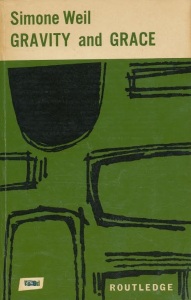
simone weil gravity and graceAll created things refuse to be for me as ends. Such is God’s extreme mercy towards me. And that very thing is what constitutes evil. Evil is the form which God’s mercy takes in this world.

This world is the closed door. It is a barrier. And at the same time it is the way through.

Two prisoners whose cells adjoin communicate with each other by knocking on the wall. The wall is the thing which separates them but it is also their means of communication. It is the same with us and God. Every separation is a link.

By putting all our desire for good into a thing we make that thing a condition of our existence. But we do not on that account make of it a good. Merely to exist is not enough for us.

The essence of created things is to be intermediaries. They are intermediaries leading from one to the other and there is no end to this. They are intermediaries leading to God. We have to experience them as such.

The bridges of the Greeks. We have inherited them but we do not know how to use them. We thought they were intended to have houses built upon them. We have erected skyscrapers on them to which we ceaselessly add storeys. We no longer know that they are bridges, things made so that we may pass along them, and that by passing along them we go towards God.

Only he who loves God with a supernatural love can look upon means simply as means.

Power (and money, power’s master key) is means at its purest. For that very reason, it is the supreme end for all those who have not understood.

This world, the realm of necessity, offers us absolutely nothing except means. Our will is for ever sent from one means to another like a billiard ball.

All our desires are contradictory, like the desire for food. I want the person I love to love me. If, however, he is totally devoted to me, he does not exist any longer, and I cease to love him. And as long as he is not totally devoted to me he does not love me enough. Hunger and repletion.

Desire is evil and illusory, yet without desire we should not seek for that which is truly absolute, truly boundless. We have to have experienced it. Misery of those beings from whom fatigue takes away that supplementary energy which is the source of desire.
Misery also of those who are blinded by desire. We have to fix our desire to the axis of the poles.

What is it a sacrilege to destroy? Not that which is base, for that is of no importance. Not that which is high, for, even should we want to, we cannot touch that. The metaxu. The metaxu form the region of good and evil.

No human being should be deprived of his metaxu, that is to say of those relative and mixed blessings (home, country, traditions, culture, etc.) which warm and nourish the soul and without which, short of sainthood, a human life is not possible.

The true earthly blessings are metaxu. We can respect those of others only in so far as we regard those we ourselves possess as metaxu. This implies that we are already making our way towards the point where it is possible to do without them. For example, if we are to respect foreign countries, we must make of our own country, not an idol, but a stepping-stone towards God.

All the faculties being freely exercised without becoming mixed, starting from a single, unique principle. It is the microcosm, the imitation of the world. Christ according to Saint Thomas. The just man of the Republic. When Plato speaks of specialization he speaks of the specialization of man’s faculties and not of the specialization of men; the same applies to hierarchy. The temporal having no meaning except by and for the spiritual, but not being mixed with the spiritual—leading to it by nostalgia, by reaching beyond itself. It is the temporal seen as a bridge, a metaxu. It is the Greek and Provençal vocation.

Civilization of the Greeks. No adoration of force. The temporal was only a bridge. Among the states of the soul they did not seek intensity but purity.

__
Excerpted from Simone Weil‘s Gravity and Grace. First French edition 1947. Translated by Emma Crawford. English language edition 1963. Routledge and Kegan Paul, London.

grace vanderwaal – i don’t know my name (2016)

I find it so fascinating to watch what fame does to people, largely because I have always eluded it. I often wonder how my life would’ve been different if I had focused on centering myself, publicised my work, taken credit, used one name, the one I was given, instead of a gaggle of pseudonyms. I just never wanted to.

Anyway, here’s another one to watch.

“I don’t know my name
I don’t play by the rules of the game
So you say, I’m not trying
But I’m trying
To find my way”

simone weil – meaning of the universe*

simone weil gravity and graceWe are a part which has to imitate the whole.

The a¯tman. Let the soul of a man take the whole universe for its body. Let its relation to the whole universe be like that of a collector to his collection, or of one of the soldiers who died crying out ‘Long live the Emperor!’ to Napoleon. The soul transports itself outside the actual body into something else. Let it therefore transport itself into the whole universe.

We should identify ourselves with the universe itself. Everything that is less than the universe is subject to suffering.

Even though I die, the universe continues. That does not console me if I am anything other than the universe. If, however, the universe is, as it were, another body to my soul, my death ceases to have any more importance for me than that of a stranger. The same is true of my sufferings.

Let the whole universe be for me, in relation to my body, what the stick of a blind man is in relation to his hand. His sensibility is really no longer in his hand but at the end of the stick. An apprenticeship is necessary.

To limit one’s love to the pure object is the same thing as to extend it to the whole universe.

To change the relationship between ourselves and the world in the same way as, through apprenticeship, the workman changes the relationship between himself and the tool. Getting hurt: this is the trade entering into the body. May all suffering make the universe enter into the body.

Habit, skill: a transference of the consciousness into an object other than the body itself.
May this object be the universe, the seasons, the sun, the stars. The relationship between the body and the tool changes during apprenticeship. We have to change the relationship between our body and the world.

We do not become detached, we change our attachment. We must attach ourselves to the all.

We have to feel the universe through each sensation. What does it matter then whether it be pleasure or pain? If our hand is shaken by a beloved friend when we meet again after a long separation, what does it matter that he squeezes it hard and hurts us?

There is a degree of pain on reaching which we lose the world. But afterwards peace comes. And if the paroxysm returns, so does the peace which follows it. If we realize this, that very degree of pain turns into an expectation of peace, and as a result does not break our contact with the world.

Two tendencies with opposite extremes: to destroy the self for the sake of the universe, or to destroy the universe for the sake of the self. He who has not been able to become nothing runs the risk of reaching a moment when everything other than himself ceases to exist.

External necessity or an inner need as imperative as that of breathing. ‘Let us become the central breath.’ Even if a pain in our chest makes respiration extremely painful, we still breathe, we cannot help it.

We have to associate the rhythm of the life of the body with that of the world, to feel this association constantly and to feel also the perpetual exchange of matter by which the human being bathes in the world.

Things which nothing can take from a human being as long as he lives: in the way of movement over which his will has a hold, respiration; in the way of perception, space (even in a dungeon, even with our eyes blinded and our ear-drums pierced, as long as we live we are aware of space).
We have to attach to these things the thoughts which we desire that no circumstances should be able to deprive us of.

To love our neighbour as ourselves does not mean that we should love all people equally, for I do not have an equal love for all the modes of existence of myself. Nor does it mean that we should never make them suffer, for I do not refuse to make myself suffer. But we should have with each person the relationship of one conception of the universe to another conception of the universe, and not to a part of the universe.

Not to accept an event in the world is to wish that the world did not exist. That is within my power—for myself. If I wish it I obtain it. I am then an excrescence produced by the world.

Wishes in folklore: what makes wishes dangerous is the fact that they are granted. To wish that the world did not exist is to wish that I, just as I am, may be everything.

Would that the entire universe, from this pebble at my feet to the most distant stars, existed for me at every moment as much as Agnès did for Arnolphe or his money-box did for Harpagon. If I choose, the world can belong to me like the treasure does to the miser. But it is a treasure that does not increase.

This irreducible ‘I’ which is the irreducible basis of my suffering—I have to make this ‘I’ universal.

What does it matter that there should never be joy in me since there is perfect joy perpetually in God! And the same is true with regard to beauty, intelligence and all things.

To desire one’s salvation is wrong, not because it is selfish (it is not in man’s power to be selfish), but because it is an orientation of the soul towards a merely particular and contingent possibility instead of towards a completeness of being, instead of towards the good which exists unconditionally.

All that I wish for exists, or has existed, or will exist somewhere. For I am incapable of complete invention. In that case how should I not be satisfied?

Br . . . I could not prevent myself from imagining him living, imagining his house as a possible place for me to listen to his delightful conversation. Thus the consciousness of the fact of his death made a frightful desert. Cold with metallic coldness. What did it matter to me that there were other people to love? The love that I directed towards him, together with the outlines shaping in my mind of exchanges of ideas which could take place with no one else, were without an object. Now I no longer imagine him as alive and his death has ceased to be intolerable for me. The memory of him is sweet to me. But there are others whom I did not know then and whose death would affect me in the same way.

D . . . is not dead, but the friendship that I bore him is dead, and a like sorrow goes with it. He is no more than a shadow.

But I cannot imagine the same transformation for X . . ., Y . . ., Z . . ., who, nevertheless, so short a time ago did not exist in my consciousness.

Just as parents find it impossible to realize that three years ago their child was non-existent, I find it impossible to realize that I have not always known the beings I love.

I think I must love wrongly: otherwise things would not seem like this to me. My love would not be attached to a few beings. It would be extended to everything which is worthy of love.

‘Be ye perfect even as your Father who is in heaven. . . .’ Love in the same way as the sun gives light. Love has to be brought back to ourselves in order that it may be shed on all things. God alone loves all things and he only loves himself.

To love in God is far more difficult than we think.

I can taint the whole universe with my wretchedness without feeling it or collecting it together within myself.

We have to endure the discordance between imagination and fact. It is better to say ‘I am suffering’ than ‘this landscape is ugly’.

We must not want to change our own weight in the balance of the world—the golden balance of Zeus.

The whole cow gives milk although the milk is only drawn from the udder. In the same way the world is the producer of saintliness.
__

* The identification of the soul with the universe has no connexion here with pantheism. One can only fully accept the blind necessity which rules the universe by holding closely through love to the God who transcends the universe. Cf. above: ‘This world, in so far as it is quite empty of God, is God himself.’ [Editor’s note.]
__
Excerpted from Simone Weil‘s Gravity and Grace. First French edition 1947. Translated by Emma Crawford. English language edition 1963. Routledge and Kegan Paul, London.
rainer maria rilke – les roses xvii

dsc_1047.jpgXVII
C’est toi qui prépares en toi
plus que toi, ton ultime essence.
Ce qui sort de toi, ce troublant émoi,
c’est ta danse.
Chaque pétale consent
et fait dans le vent
quelques pas odorants
invisibles.
Ô musique des yeux,
toute entourée d’eux,
tu deviens au milieu
intangible.

XVII
Your inner self is the one creating
more than yourself, your ultimate essence.
The uneasiness emerging from you,
that is your dance.
Each petal consents
and takes a few steps,
invisible, fragrant
in the wind.
O music to the eyes,
petals all around,
in their midst you become
intangible.

Rainer Maria Rilke (c 1926) From his series “Les Roses”, Jung Journal: Culture & Psyche,
5:4, 17-21. Translated from French by Susanne Petermann (2011).