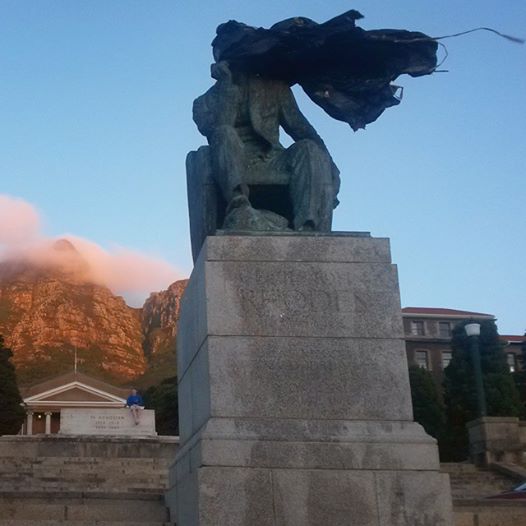
“We fight Rhodes because he means so much of oppression, injustice, and moral degradation to South Africa; – but if he passed away tomorrow there still remains the terrible fact that something in our society has formed the matrix which has fed, nourished, and built up such a man!”
Sadism is not a name finally given to a practice as old as Eros; it is a massive cultural fact which appeared precisely at the end of the eighteenth century, and which constitutes one of the greatest conversions of Western imagination: unreason transformed into delirium of the heart, madness of desire, the insane dialogue of love and death in the limitless presumption of appetite.
Sadism appears at the very moment that unreason, confined for over a century and reduced to silence, reappears, no longer as an image of the world, no longer as a figura, but as language and desire. And it is no accident that sadism, as an individual phenomenon bearing the name of a man, was born of confinement and, within confinement, that Sade’s entire oeuvre is dominated by the images of the Fortress, the Cell, the Cellar, the Convent, the inaccessible Island which thus form, as it were, the natural habitat of unreason.
It is no accident, either, that all the fantastic literature of madness and horror, which is contemporary with Sade’s oeuvre, takes place, preferentially, in the strongholds of confinement.
Filmed in 2011 at Mary Reid Kelley’s home and studio in Saratoga Springs, New York, the video artist and painter discusses her video work “You Make Me Iliad” (2010). In researching the lives and experiences of women who lived during the first World War, Reid Kelley was struck by how few first-hand accounts she was able to uncover. Mary Reid Kelley explains her attempts to reconstitute an experience that would have otherwise been lost to history by creating an imagined narrative involving a prostitute, a soldier, and a medical officer.
In black-and-white videos and drawings filled with punning wordplay and political strife, Mary Reid Kelley presents her take on the clash between utopian ideologies and the realities of women’s lives in the struggle for liberation. Performing scripted narratives in rhyming verse— featuring characters such as nurses, soldiers, prostitutes, and saltimbanques—Reid Kelley playfully jumbles historical periods to trace the ways in which present concerns are rooted in the past.
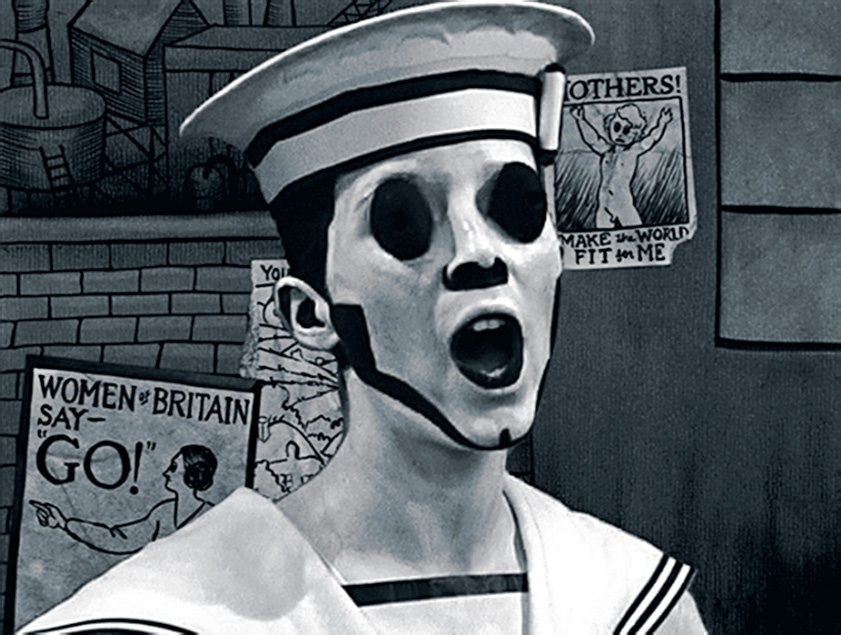
Sadie, the Saddest Sadist (7 minutes, 23 seconds), 2009, is set in Great Britain in 1915, according to a free booklet that includes the video’s lyrics. The title character, a munitions worker, wants to learn a trade “so [she] could be a traitor.” She meets Jack, a sailor (played by Reid Kelley in drag), and with “passions inflamed,” she requests rousing war stories. His sung reply: “Calm down sweetheart / Britannia rules the waves.” In pledging herself to him, she offers her “surplus devotion,” and after their off-camera tryst, she sings, “The stains on my sheets / will come out with some lemon / I know that you care / by these Marx on my Lenin.” Live action alternates with stop-motion animation in which dancing refrigerator magnet-style letters spell out the dialogue or toy with it, as when “surplus devotion” is anagrammatized into “spurs devolution.”…
… Reid Kelley’s interest seems to be primarily in historical material, expressed in details such as the patriotic flyers that hang on the walls behind Sadie and Jack when they meet, which urge citizens to conserve food and to fight for king and country. Her fine ear for popular verse makes Reid Kelley’s work rich fun for those who are, as Jack describes himself, “verbally inclined.”
Maurice Marechal plays this haunting melody from Peer Gynt, the incidental music to Henrik Ibsen’s 1867 play of the same name, written by the Norwegian composer Edvard Grieg in 1875.
Have you ever experienced the weird magic of coming across something obliquely on Youtube, on your way somewhere else, and it speaks so powerfully, so uncannily, to all the things happening right now around you that all the hairs on your body stand on end? This is one of those times. The scene comes from a 1952 film called The Member of the Wedding, based on the book/play by Carson McCullers, starring Ethel Waters, Julie Harris and Brandon De Wilde. I came across it because my housemate Khanyi and I were singing this old hymn, hamming it up Lauryn-Hill-in-Sister-Act-2 style. I wanted to check out some of the older versions… and this clip revealed itself to me, complete with contextual preamble.
I’m on the organising team for the Edge of Wrong. Join us in Cape Town next week – it’s going to be an exhilarating ride!
Edge of Wrong Cape Town 10: A five day festival of experimental, improvised and provocative music.
It’s been a busy six months for EOW. Last October’s event saw noise artists, opera singers, free jazz, chiptunes and the sound of the Ebola genome perform at a metalworks. In January, we hosted a performance of Terry Riley’s In C for two laptops, improvised analogue synth, a postrock/drone quintet, and a memorable moment under a highway bridge with cello and saxophone accompanying traffic noise.
Now, we invite you to join us for our flagship event, the annual Edge of Wrong festival: five days from 25 to 29 March 2015, featuring a diverse range of international and local artists, each of whom epitomises our ethos of encouraging experimental, uncompromising, dangerous music.
This year, the line-up includes cutting-edge Norwegian performers Vilde Sandve Alnæs, Inga Margrete Aas, Harald Fetveit and Morten Minothi Kristiansen (founder and chief provocateur of Edge of Wrong), along with improv jazz outfit As Is, Juliana Venter and her motorbike ensemble, EOW stalwart Dizu Plaatjies and his Souls of Ancient Fish project (with Ruben Mowszowski and Maxim Starke), the Darkroom Contemporary dance troupe, Gugulethu’s jazzy G-Clef, US field recording artist Erik Deluca and EOW co-organiser Aragorn23 on custom electronics and live data manipulation.
The festival will unfold over several days at a number of venues (including a spontaneous flashmob orchestra in the central city which you can join) so be sure to check out the details on our Facebook event page. You can choose between buying tickets for individual events or an all-access pass for the week.
We have not done the things that are necessary to lower emissions because those things fundamentally conflict with deregulated capitalism, the reigning ideology for the entire period we have been struggling to find a way out of this crisis. We are stuck because the actions that would give us the best chance of averting catastrophe – and would benefit the vast majority – are extremely threatening to an elite minority that has a stranglehold over our economy, our political process, and most of our major media outlets.
— Naomi Klein, 8 March 2015. Read the rest of this article HERE.
The bourgeoisie cannot exist without constantly revolutionising the instruments of production, and thereby the relations of production, and with them the whole relations of society. Conservation of the old modes of production in unaltered form, was, on the contrary, the first condition of existence for all earlier industrial classes. Constant revolutionising of production, uninterrupted disturbance of all social conditions, everlasting uncertainty and agitation distinguish the bourgeois epoch from all earlier ones. All fixed, fast-frozen relations, with their train of ancient and venerable prejudices and opinions, are swept away, all new-formed ones become antiquated before they can ossify. All that is solid melts into air, all that is holy is profaned, and man is at last compelled to face with sober senses his real conditions of life, and his relations with his kind.
The need of a constantly expanding market for its products chases the bourgeoisie over the entire surface of the globe. It must nestle everywhere, settle everywhere, establish connexions everywhere.
The bourgeoisie has through its exploitation of the world market given a cosmopolitan character to production and consumption in every country. To the great chagrin of Reactionists, it has drawn from under the feet of industry the national ground on which it stood. All old-established national industries have been destroyed or are daily being destroyed. They are dislodged by new industries, whose introduction becomes a life and death question for all civilised nations, by industries that no longer work up indigenous raw material, but raw material drawn from the remotest zones; industries whose products are consumed, not only at home, but in every quarter of the globe. In place of the old wants, satisfied by the production of the country, we find new wants, requiring for their satisfaction the products of distant lands and climes. In place of the old local and national seclusion and self-sufficiency, we have intercourse in every direction, universal inter-dependence of nations. And as in material, so also in intellectual production. The intellectual creations of individual nations become common property. National one-sidedness and narrow-mindedness become more and more impossible, and from the numerous national and local literatures, there arises a world literature.
The bourgeoisie, by the rapid improvement of all instruments of production, by the immensely facilitated means of communication, draws all, even the most barbarian, nations into civilisation. The cheap prices of commodities are the heavy artillery with which it batters down all Chinese walls, with which it forces the barbarians’ intensely obstinate hatred of foreigners to capitulate. It compels all nations, on pain of extinction, to adopt the bourgeois mode of production; it compels them to introduce what it calls civilisation into their midst, i.e., to become bourgeois themselves. In one word, it creates a world after its own image.
Miss May Whitley kicks ass with panache and palpable glee in this British Pathé clip from 1933, entitled The Weaker Sex! (Sayest Thou!) Who said “weaker sex?” The intertitle reads: ‘Slow motion demonstrates exactly how 7-stone-odd, scientifically applied, can defeat 14 stone.’
black hole
we have sunk in
the spinning time
lost again
just a drop of rain
and the grain of thought
or was it the image of the dead
that kept you from sleep
or just us again
listening to the sound
of words against the mind
energy for the vision
or is it just another path
to safety – the circle
of vulture and all
until you fall
you won’t know how the earth
smells
but hey love – let’s breathe
it is now
it is tomorrow
dreams remind me
that i am reason in reverse
reverse until that verse
before i thought
like a musician would
about an abstract note
i thought it was the syllable
that syllable –
now i know it is the verse
not even the word
the verse
as orgasmic
as the poetic
The 1960s – Two teenagers take fate into their own hands and become the ultimate fashion victims in this existential folie a deux starring Donna Modrowski and Michael Onesko. Story by Michael Onesko, original score by Mark Winner, directed by Dan Winner, voiceover by Linda Snelton, assisted by Germain Modrowski, Karen Winner and Connie Karabatsos. Shown at The Women’s Film Forum of Chicago, 1977.
“If you don’t care enough about someone to enjoy their company and respect their decisions when sex is off the table, then that person is right not to sleep with you, because enjoying someone’s company and respecting their decisions is pretty much how sex gets on the table to start with.”
Everyone’s heard of friendzoning – even if they don’t know the word, they sure as hell know the concept. It’s what happens time and again to unfortunate Nice Guys who, despite being nothing but sugar and spice to the girls they love, are nonetheless denied the sexual relationships they so obviously deserve and are instead treated like platonic equals – a terrible, unfair fate spawned by the dark side of feminism.
And if you thought even part of that statement was correct, Imma stop you right there.
Friendzoning is bullshit because girls are not machines that you put Kindness Coins into until sex falls out.
Dear Hypothetical Interlocutor whose hackles just bristled with the unfairness of that statement; who thinks that girls can be in the Friend Zone, too, and that therefore this point is both invalid and reverse-sexist into…
Hailing from the shadowy world of the London post-jazz scene, the incandescent Sons of Kemet are saxist/clarinetist Shabaka Hutchings, tuba virtuoso Oren Marshall, and the stunning double-drums team of Tom Skinner and Seb Rochford, powering a mix of dancefloor hooks and New Orleans street music with the percussive intricacy of west African drum music, a dose of Caribbean dub, and free jazz.
This is a live set I played on the Pan African Space Station in September 2010 – some dark, psychedelic stuff. The sound quality of the recording is not the best in places but there are some great tunes.
Felix opens this particular “Deaf Safari” with a dodgy old recording (that I think I actually gave him!), of Marais and Miranda entertaining a frightfully colonial white 1950s audience with their “knowledge” of “Hottentot” and “Zooloo” linguistics. With a subversive stammer, it segues into an hour-long journey of cut-up sounds and visuals.
Laband displays fluent familiarity with and yet alienation from spectacular capitalist consumer tropes. The oversaturated bricolage of radio preachers, politicians, porn, pulp cinema, big game and exoticised cultural representations is absurd and defaced: eyeless, toothless, festering with skulls. Sound and visuals work in counterpoint: horny assemblages dripping blood and infection; a snatch of Cat Power’s languid “Satisfaction”. His work foregrounds our mindless addiction to and manipulation by these fragments bouncing off the walls onto one another, their banality dismembered, dislocated, demented, discordant, decaying.
A voice in Queen’s English: “I was wondering what it is that you don’t want to remember so badly… To put it another way, what are you trying to forget?”
The response, implied in the guitar run sampled from Nico’s “These Days”: “Please don’t confront me with my failures… I had not forgotten them.”
Felix forces us to examine ourselves honestly. This I love most deeply about what he does: he will not allow us to forget, nor feign ignorance. There are naive melodies, but there is no innocence, no deafness nor blindness. We are taken through his cabinet of jabbering apparitions, racist, patriarchal horror haunting every suburban corner, lullabies, toyi-toyi chants… The valley of the shadow of death… We are not tourists. This is our own back yard. We stare the nightmares down, bopping in slo-mo. The voices persist, demand acknowledgement until they dissolve. It’s a kind of exorcism.
And beyond that, always, despite all the schizophrenic folly and sadness, hope and jubilation live on in the unfinished refrains of blues ghosts captured long ago on wax… Vera Hall, Stack O’Lee, prisoners and murderers alike now free… and there is space to breathe, place to be here now, without judgement… we are bathed in grace and exquisite melody. This is strong muti for South Africans’ sickness.
Collage: Felix Laband
I can’t wait for his new album, and I highly recommend that you see him live if you get the chance: he’s on form like never before and it’s a profound trip.
P.S. Read Sean O’Toole’s great interview piece for Mahala on Felix’s return (his new album, Deaf Safari, is set for release next month, after an almost decade-long gestation).
“The only dream worth having is to dream that you will live while you are alive, and die only when you are dead. To love, to be loved. To never forget your own insignificance. To never get used to the unspeakable violence and vulgar disparity of the life around you. To seek joy in the saddest places. To pursue beauty to its lair. To never simplify what is complicated or complicate what is simple. To respect strength, never power. Above all to watch. To try and understand. To never look away. And never, never to forget.”
Teenage Jesus and the Jerks/ Beirut Slump – Shut Up and Bleed (Atavistic, 2008)
Review of this compilation by Jordan N. Mamone from Dusted:
Forget what you may already know about Lydia Lunch. Ignore her vitriolic spoken-word performances; her bellicosely feminist writing; her vampy S&M fashion sense; her associations with renegade alpha males Nick Cave and Jim “Foetus” Thirlwell; her orgasmic moans on Sonic Youth’s “Death Valley ’69”; her erotically grizzly romps in the campy-creepy films of Richard Kern; her futile sparring with idiot comedian Joe Rogan. Purge from your mind her queen-size intellect and ego. Erase the subsequent mass-market co-opting of her prescient obsessions: serial murderers, Southern Gothic literature, rape, insanity, proto-Riot Grrl solidarity, buckets of black eyeliner (hardly shocking stuff today, but terra incognita when Lunch was loudly and proudly milking them in the ’70s, ’80s and ’90s).
From a purely musical perspective, it’s the woman’s first two bands, the violently minimalist Teenage Jesus and the Jerks, and the monstrously damaged Beirut Slump, that are her most important accomplishments. And to appreciate them properly, it’s necessary to sever them from their creator’s reputation and to listen to them on their own terms. As a handy compendium of both groups’ slim discographies plus previously unreleased live goods, the excellently titled Shut Up and Bleed allows you to do just that.
Rewind to 1976: An alienated 16-year-old girl named Lydia Koch runs away to Manhattan from Rochester, N.Y. Months later, she stumbles upon a quartet called Mars, whose cataclysm of amateurish dissonance, art-world conceptualism, and primitive rock physicality borrows punk’s urgent thrust while negating the whole equation. Journalists will label this style “no wave.” Smitten, the youngster swoons over the rumpus, which she then personalizes to suit her particular strain of jailbait hostility. Christened Lydia Lunch, she steers Teenage Jesus through 10-minute sets comprised of minute-long songs that pivot around her screeching, electric slide guitar and deviant percussionist Bradley Field’s stiff, staccato thuds on a single snare and cymbal. Their rudimentary, machine-gun approach is undeniably provocative. Who could resist a lascivious high-school vixen yelping about boredom and torture, flanked by a pair of addled weirdos-turned-trained monkeys? In 1978, superstar producer Brian Eno gives Teenage Jesus a coveted slot on the landmark, scene-baptizing No New York LP.
Three decades elapse: Thurston Moore and Byron Coley are nicely summarizing downtown’s sordid past in their luxurious No Wave photography book, which might as well be a love letter to Ms. Lunch. In June 2008, the Jerks herald the tome’s publication and play their sole gig since 1979. The context of this one-shot semi-reunion is quite bizarre: a fleeting, self-destructive epoch re-examined as revered fodder for galleries and coffee-table editions. But onstage at the Knitting Factory, the trio – with its former bassist Jim Sclavunos on drums, and Moore filling in on bass – sounds invigoratingly strident, brusque and, dare it be said, entertaining. Lunch, who’s pushing 50, sticks her tongue out, curses the audience, and barks the lyrics to “Baby Doll” and “Orphans” in a hoarse, jaded snarl that has deepened considerably from perpetual wear and tear. Looser and less aloof than they were in their prime (check the clip from Lydia’s career-spanning Video Hysterie: 1978-2006 DVD on Atavistic), the Jerks still decimate the majority of noise-crud that currently pollutes the local club circuit. This means you, No Fun Fest.
And so it’s no surprise that the material collected on Shut Up and Bleed stands as tall as Yao Ming in platform shoes. Time has eroded much of the initial inaccessibility of barbed stomps such as “Crown of Thorns,” leaving behind a deliciously nihilistic, psycho-cheerleader cha-cha. Lunch is a criminally underrated instrumentalist: Heed the drill-bit whinnies that scar “Red Alert” and the ascending, jet-engine whoosh of “Freud in Flop.” Substantially improving on the 1995 Teenage Jesus retrospective Everything, the new CD affixes decent, if scruffy, archival bonuses (but omits a killer take of “Race Mixing”) and wisely restores many, if not all the tunes to their original aural luster. (Thirlwell had frustratingly “reprocessed” the Jerks’ master tapes in the 1980s, adding gobs of strength-sapping reverb.)
Interspersed throughout the track listing are the complete recorded works of Beirut Slump, an obscure quintet that lurked in the shadows during Teenage Jesus’s final phases. For this unruly combo, Lunch steps aside to concentrate on her trebly, nightmare-surf strumming and assigns the vocals to Bobby “Berkowitz” Swope, a migrant from Florida’s Eckerd College who sings like a nauseous, homosexual Frankenstein menacing you with an ice pick. Vivienne Dick’s B-movie organ disfigures the Doors into a bad-acid freak show; Sclavunos and bassist Liz Swope’s sluggish tempos anticipate the cruel plod of early Swans. Whereas the Jerks’ momentous blurts now come across as abusively catchy, Slump’s frazzled “Staircase” and utterly revulsed “See Pretty” continue to pry open some ghastly portal to hell. A wealth of perverse pleasure awaits anyone brazen enough to peer in and gawk.
Teenage Jesus And The Jerks:
Lydia Lunch, guitar, vocals
Gordon Stevenson, bass
Bradley Field, drums
Kawashima Akiyoshi “Reck”, bass (Tracks 4, 5, 15, 26, 28)
Beirut Slump:
Bobby ‘Berkowitz’ Swope, violin, vocals
Lydia Lunch, guitar, vocals
Vivienne Dick, organ
Liz Swope, bass
Jim Sclavunos, drums
This performance by Lesley Gore, from 1963, is one of my favourite old clips on YouTube. I have watched it countless times. The feral intensity in her perfectly made-up face is so powerfully subversive.









 fleurmach