billy bragg – valentine’s day is over (peel sessions)


Recorded live on 30 August 1988 for the John Peel Show.

“God didn’t make you an angel; the devil made you a man
That brutality and economy are related now I understand
When will you realise that as above so below there is no love?
For the girl with the hour glass figure
Time runs out very fast
We used to want the same things but that’s all in the past
And lately it seems that as it all gets tougher
Your ideal of justice just becomes rougher and rougher…”

jaime sabines – the lovers

The lovers say nothing.
Love is the finest of the silences,
the one that trembles most and is hardest to bear.
The lovers are looking for something.
The lovers are the ones who abandon,
the ones who change, who forget.
Their hearts tell them that they will never find.
They don’t find, they’re looking.

The lovers wander around like crazy people
because they’re alone, alone,
surrendering, giving themselves to each moment,
crying because they don’t save love.
They worry about love. The lovers
live for the day, it’s the best they can do, it’s all they know.
They’re going away all the time,
all the time, going somewhere else.
They hope,
not for anything in particular, they just hope.
They know that whatever it is they will not find it.
Love is the perpetual deferment,
always the next step, the other, the other.
The lovers are the insatiable ones,
the ones who must always, fortunately, be alone.

The lovers are the serpent in the story.
They have snakes instead of arms.
The veins in their necks swell
like snakes too, suffocating them.
The lovers can’t sleep
because if they do the worms eat them.

They open their eyes in the dark
and terror falls into them.

They find scorpions under the sheet
and their bed floats as though on a lake.

The lovers are crazy, only crazy
with no God and no devil.

The lovers come out of their caves
trembling, starving,
chasing phantoms.
They laugh at those who know all about it,
who love forever, truly,
at those who believe in love as an inexhaustible lamp.

The lovers play at picking up water,
tattooing smoke, at staying where they are.
They play the long sad game of love.
None of them will give up.
The lovers are ashamed to reach any agreement.

Empty, but empty from one rib to another,
death ferments them behind the eyes,
and on they go, they weep toward morning
in the trains, and the roosters wake into sorrow.

Sometimes a scent of newborn earth reaches them,
of women sleeping with a hand on their sex, contented,
of gentle streams, and kitchens.

The lovers start singing between their lips
a song that is not learned.
And they go on crying, crying
for beautiful life.

Translated by W.S. Merwin

be my valentine

"Persephone" - Image copyright Joshua Hoffine, 2003.

“Persephone” – Image copyright Joshua Hoffine, 2013.

More of Joshua Hoffine’s horror photography can be found HERE.

The Garden of Proserpine by Algernon Charles Swinburne, written in 1866

Here, where the world is quiet,
Here, where all trouble seems
Dead winds’ and spent waves’ riot
In doubtful dreams of dreams;
I watch the green field growing
For reaping folk and sowing,
For harvest-time and mowing,
A sleepy world of streams.

I am tired of tears and laughter,
And men that laugh and weep
Of what may come hereafter
For men that sow to reap:
I am weary of days and hours,
Blown buds of barren flowers,
Desires and dreams and powers
And everything but sleep.

Here life has death for neighbour,
And far from eye or ear
Wan waves and wet winds labour,
Weak ships and spirits steer;
They drive adrift, and whither
They wot not who make thither;
But no such winds blow hither,
And no such things grow here.

No growth of moor or coppice,
No heather-flower or vine,
But bloomless buds of poppies,
Green grapes of Proserpine,
Pale beds of blowing rushes
Where no leaf blooms or blushes,
Save this whereout she crushes
For dead men deadly wine.

Pale, without name or number,
In fruitless fields of corn,
They bow themselves and slumber
All night till light is born;
And like a soul belated,
In hell and heaven unmated,
By cloud and mist abated
Comes out of darkness morn.

Though one were strong as seven,
He too with death shall dwell,
Nor wake with wings in heaven,
Nor weep for pains in hell;
Though one were fair as roses,
His beauty clouds and closes;
And well though love reposes,
In the end it is not well.

Pale, beyond porch and portal,
Crowned with calm leaves she stands
Who gathers all things mortal
With cold immortal hands;
Her languid lips are sweeter
Than love’s who fears to greet her
To men that mix and meet her
From many times and lands.

She waits for each and other,
She waits for all men born;
Forgets the earth her mother,
The life of fruits and corn;
And spring and seed and swallow
Take wing for her and follow
Where summer song rings hollow
And flowers are put to scorn.

There go the loves that wither,
The old loves with wearier wings;
And all dead years draw thither,
And all disastrous things;
Dead dreams of days forsaken,
Blind buds that snows have shaken,
Wild leaves that winds have taken,
Red strays of ruined springs.

We are not sure of sorrow,
And joy was never sure;
To-day will die to-morrow;
Time stoops to no man’s lure;
And love, grown faint and fretful,
With lips but half regretful
Sighs, and with eyes forgetful
Weeps that no loves endure.

From too much love of living,
From hope and fear set free,
We thank with brief thanksgiving
Whatever gods may be
That no life lives for ever;
That dead men rise up never;
That even the weariest river
Winds somewhere safe to sea.

Then star nor sun shall waken,
Nor any change of light:
Nor sound of waters shaken,
Nor any sound or sight:
Nor wintry leaves nor vernal,
Nor days nor things diurnal;
Only the sleep eternal
In an eternal night.
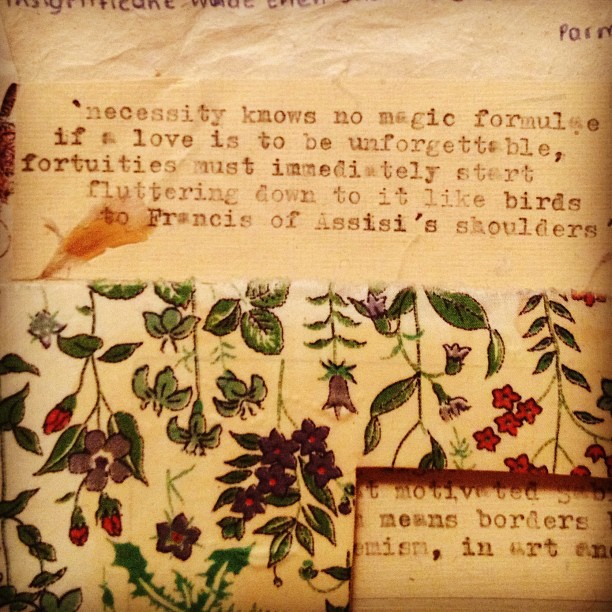

the rape of persephone (homeric hymn)

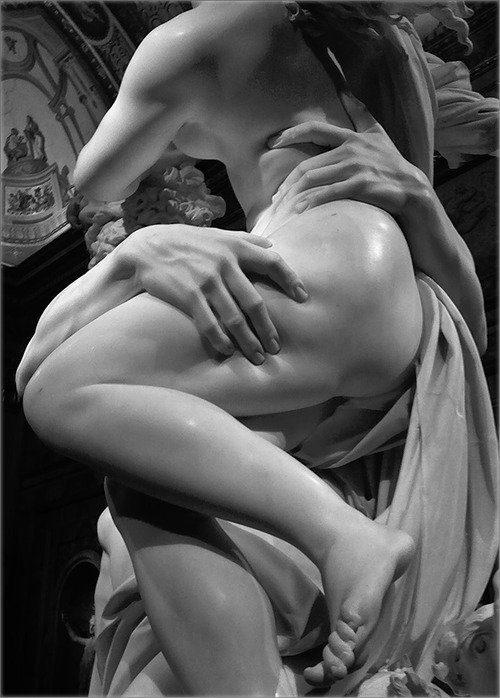
The Rape of Proserpina – Gian Lorenzo Bernini (1622)

I) HAIDES ABDUCTS PERSEPHONE
Homeric Hymn ii to Demeter (abridged) (trans. Evelyn White) (Greek epic circa 7th or 6th B.C.)

“[Demeter’s] trim-ankled daughter whom Aidoneus [Haides] rapt away, given to him by all-seeing Zeus the loud-thunderer. Apart from Demeter, lady of the golden sword and glorious fruits, she was playing with the deep-bosomed daughters of Okeanos and gathering flowers over a soft meadow, roses and crocuses and beautiful violets, irises also and hyacinths and the narcissus, which Gaia made to grow at the will of Zeus and to please Polydektor (the Host of Many), to be a snare for the bloom-like girl – a marvellous, radiant flower. It was a thing of awe whether for deathless gods or mortal men to see: from its root grew a hundred blooms and it smelled most sweetly, so that all wide heaven (Ouranos) above and the whole earth (Gaia) and the sea’s (Thalassa’s) salt swell laughed for joy.

And the girl was amazed and reached out with both hands to take the lovely toy: but the wide-pathed earth yawned there in the plain of Nysa, and the lord, Polydegmon (Host of Many), with his immortal horses sprang out upon her — the Son of Kronos, Polynomos (He who has many names). He caught her up reluctant on his golden car and bare her away lamenting.

Then she cried out shrilly with her voice, calling upon her father, [Zeus] the Son of Kronos, who is most high and excellent. But no one, either of the deathless gods or mortal men, heard her voice, nor yet the olive-trees bearing rich fruit: only tender-hearted Hekate, bright-coiffed, the daughter of Persaios, heard the girl from her cave, and the lord Helios (the Sun), Hyperion’s bright son, as she cried to her father, the Son of Kronos. But he was sitting aloof, apart from the gods, in his temple where many pray, and receiving sweet offerings from mortal men. So he [Haides], that Son of Kronos, Polynomos (of Many Names), Polysemantor (Ruler of Many) and Polydegmon (Host of Many), was bearing her away by leave of Zeus on his immortal chariot – his brother’s child and all unwilling.

And so long as she, the goddess, yet beheld earth and starry heaven and the strong-flowing sea where fishes shoal, and the rays of the sun, and still hoped to see her dear mother and the tribes of the eternal gods, so long hope claimed her great heart for all her trouble… and the heights of the mountains and the depths of the sea ran with her immortal voice: and her queenly mother heard her.

Continue reading

the boswell sisters – shout sister, shout (1931)

Recorded in New York, April 23, 1931

House Orchestra: Mannie Klein or Jack Purvis (tpt) Tommy Dorsey (tbn) Jimmy Dorsey (cl, as) Joe Venuti (vln) Arthur Schutt (p) Eddie Lang (g) Joe Tarto (sb) Chauncey Morehouse (d, vib) Victor Young (cond)

Boswell_sisters_01

E-36655-A Shout, Sister, Shout (Williams-Hill-Brynan) 3:13 Brunswick 6109, Brunswick 6847, Brunswick 6783, [BSC1], [NWST], [IY], [ELMB], [ITG], [TOOMA]

Composed by J. Tim Brymn, Alexander Hill and Clarence Williams

The Boswell Sisters were a close harmony singing group, consisting of sisters Martha Boswell (June 9, 1905 – July 2, 1958), Connee Boswell (original name Connie) (December 3, 1907 – October 11, 1976), and Helvetia “Vet” Boswell (May 20, 1911 – November 12, 1988), noted for intricate harmonies and rhythmic experimentation.

heavens to betsy – my red self/my secret (demo tape, 1992)

Heavens to Betsy was an American indie-punk band formed in Olympia, Washington in 1991. They were part of the DIY riot grrrl movement in the punk rock underground in the early 1990s, and were the first band of Sleater-Kinney vocalist/guitarist Corine Tucker. These two demos are intimate and powerful.

silent vigil this wednesday in cape town

Via Malika Ndlovu:

Stand Up! Be still. Join the Tower of Silence in reflection and protest against the silencing, a pillar of honouring and mourning. Wear white  (a symbol of spirit, light, cleansing, unity beyond gender, language, political or religious agenda) and join this 1 hour vigil against the violence epitomized by the death and brutalisation of Anene Booysen… and too many of our daughters and sisters like her. This Wednesday, 13th February 2013, on the steps of St George’s Cathedral, from 12 pm to 1 pm.

Bring a photograph on a placard of anyone you think we need to remember in this way too. We will not be sloganeering or shouting retaliations against our lost sons, brothers who have perpetuated this crime against their own and her humanity. Our collective presence and solidarity speaks volumes and calls for multiple responses to this complex situation, affecting an entire nation. We make this physical visual statement on the eve of onebillionrising.org global campaign and the president’s “State of the Nation” address. For us, these faces, these stories, these discarded bodies and all the reasons why this continues to happen in the world and all over South Africa – THIS is OUR ‘State of our Nation’ call to address!

edge – sylvia plath

Sylvia Plath died on this day in 1963.

The woman is perfected
Her dead

Body wears the smile of accomplishment,
The illusion of a Greek necessity

Flows in the scrolls of her toga,
Her bare

Feet seem to be saying:
We have come so far, it is over.

Each dead child coiled, a white serpent,
One at each little

Pitcher of milk, now empty
She has folded

Them back into her body as petals
Of a rose close when the garden

Stiffens and odors bleed
From the sweet, deep throats of the night flower.

The moon has nothing to be sad about,
Staring from her hood of bone.

She is used to this sort of thing.
Her blacks crackle and drag.

mouchette

Final scene from Robert Bresson’s 1967 film.

“The small town is plagued with alcoholism, marital infidelity, unbridled masculinity, violence, and moral ambivalence. Mouchette’s father and brother, we have already seen, operate by selling liquor on the black market, with complicit police that turn an indifferent eye to a crate left behind. They, like other townsfolk, are paid in shots of alcohol, consumed without speech. Following Sunday mass, the village parishioners leave church and hastily head to the bar before the bells cease to toll. Mouchette’s dying mother has to hide gin from her abusive spouse. Even the town’s interdependent poacher/warden pair, Arsène and Mathieu, bring an end to their cat-and-mouse charade in the woods by sharing a drink from Arsène’s canteen full of gin. The motif of alcohol and its abuse stands as a distinctive mark of the moral decay of Mouchette’s society; however, the corruption of this town is not limited to alcoholism… Indeed, Mouchette’s society is one of extreme decadence and lawlessness, one that is ripe for a scapegoat upon whose back it can collectively discharge the burden of its vice and one from which the victim will gladly depart.”

Read more about the film HERE.

taking back our city #takingbackourcity #dicktatorfreejozi #genderfreesa

Participate in the creation of the city you want to live in. #takingbackourcity #dicktatorfreejozi #genderfreesa
Image
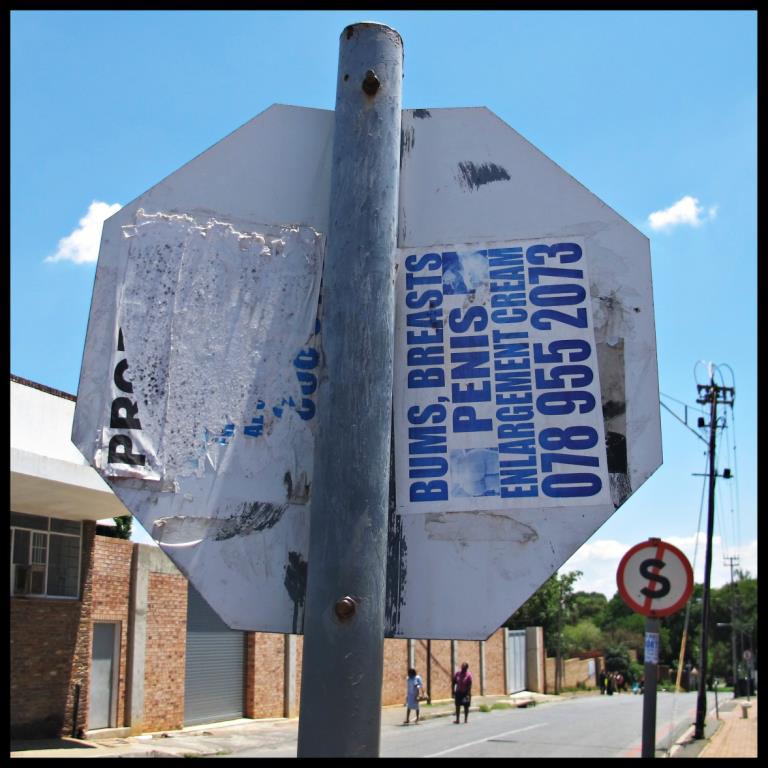
I don’t just live my life, I create my life. And after almost a year of creating images reflecting my vision of the city and its inhabitants, I no longer just want to reflect the city, but create it. Just as I need to be an activist in my own life and my own identity to fully be alive, as an artist, I need to be an artivist, actively participating in the creation of the city I want to live in. Joburg is not just a city, it is my city; it is my home. And as an artivist it is not just a place I want to live in, but a place I actively want to participate in creating.The idea for #takingbackourcity was born out of my return to Joburg from my first real visit to Cape Town. My return to Jozi from CT shocked me with the everyday messages and symbols we Joburgers take for granted; the messages and symbols that shape the collective unconscious of our city and our people. The ‘Penis Enlargement’ posters that adorn every robot, electrical box and street pole were the most glaring example. I asked myself: what does this say about Joburg? what does this say about Joburgers?

We are a city obsessed with the power of the phallus; a presidency obsessed with the symbol and virility and representation of the phallus; a people whose penis size reflects its masculinity, whose masculinity reflects its identity. The effect of this overtly embodied and gendered mantra on our collective unconscious plays itself out in our lives daily.

More so than with other cultures, Joburg constantly genders us. It equates our identity with our gender, places our gendered attributes – our penises, our breasts – under the microscope, and finds us wanting. Those who are found wanting and those who pass the grade play out the script of the power struggle that has been written for us. And as with the Battle of the Sexes in decades before us, the Battle of the Genders brings with it a long, long casualty list. Being part of the female-bodied and -gendered community, as well as the LGBTIQ community, from where so many of the casualties come, I cannot be part of an existence or an art that hides behind the privilege of aesthetic.

Those of you who follow my work know that I believe that gender is nothing more than a social construction and that I perform my gender through my identity and my art daily. But playing with gender and bearing witness to the daily reality of my and others’ lives as queers in my writing and images is not enough. How do I as a queer artist respond to the overt gendering of our city; the grossly embodied sexing of the spirit of Joburg?

I need to take responsibility for the city I want to live in and actively participate in creating it. I need to undermine the gendering of the city and its inhabitants with more than just my existence and my documentation of my play with gender and identity, more than just through my collaborations with others who do the same.

‘Taking Back our City’ is thus this journey of active and creative participation in my city. I hope that you will follow my journey and join me in taking our city back.

as long as we exist, we will be raped – sisonke msimang

(First published HERE.)

anene

I read an article on Thursday morning. It said: “The victim had been sliced open from her stomach to her genitals and dumped.” The radio is full of this story. Full of politicians and posers, trying to outdo one another. Like funeral criers. But it will end, the show. And there will be marches and petitions. There will be statements and rage. But it will happen again. Until we are inured to shock. It will happen again. Until our bones are worn into dust and our teeth crushed into the sand. It will happen and happen. Until we invent a way to stop being women. Until we find a way for our blood to no longer bleed between our legs. As long as we exist, we will be raped.

So, no, I will not march. I don’t believe my marching will stop this war. I will cry, as I have been already this morning. And maybe, I will begin to feel my way out of the lurching, heavy knowing after I have spoken with others. With the mothers and the sisters, the brothers and fathers – those like me, who have girls.

There is only this: a dead, hollow knowing that has always been knocking at my heart. From the minute she was born, it fell in step with the rhythm of my breath: to raise a girl in this world, to raise her strong and healthy and proud, to ensure that she survives and then to insist ferociously that she laugh and dance and think and dream, is to choose the most heartbreaking and joyous path. It is to tempt fate every single day, it is to fear that her breath will be strangled by a stranger. It is to live with the horrible possibility that this could be your child.

Anene was raped and mutilated because she was a girl. It was her vagina and her breasts that they wanted to destroy. It was her walk and her talk. It was her girl-ness. These parts of her were broken and sliced and pulled apart, not by monsters, but by friends. Each of her 10 fingers were broken.

Ten fingers and 10 toes. I kiss my baby girl goodnight. Ten fingers and 10 toes, I counted them when she was born just to be sure that she was real. I found love in the spaces between each. I cried at the weight of her. Tiny and strong.

Tonight, I will kiss her neck in the bath and she will wiggle away from me. ‘Stop it Mama’, and I will pinch her wet bum and she will sparkle. Tonight, she will be safe. But they will not stop killing girls.

And I will die defending her. Let them wear my bones into dust. Let them crush my teeth into the sand. Only this will stop the war. That we be prepared to die – our bodies barricades against the fingers that should not be there. The knives that slit. The guns that lodge. Let them lodge in me. In us.

Anene’s mother said that if she hadn’t seen her shoes, she wouldn’t have known that it was her own child. Her intestines? Her intestines.

God help us. And if God will not, Let the women be the barricades. The men, surely will follow.

Sisonke Msimang writes and comments on gender, race and politics. She works with Sonke Gender Justice Network, and is a Yale World Fellow.

wat die reën bring – neil sandilands

radio lavaDownload “Wat Die Reën Bring” by Neil Sandilands, with music by Riku Lätti, recorded by Riku Lätti at Koptoe, Magaliesberg. It is one of the tracks I found most beautiful from the collection of recordings Lätti has been gradually accumulating, which he has entitled “Die Wasgoedlyn” (The Washing Line). The whole album can be downloaded from HERE.

Some background from Riku Lätti:

“It started off a long time ago when I began my own recording studio “Radio Lava” and every now and then I recorded my friends (who happened to be good musicians) in all kinds of odd locations and precarious states of sobriety. Most of these artists have pristine studio albums which I kind of think of as “the front of the house” (facade). Nice and fancy, polished spotless. Die Wasgoedlyn are those other recordings of all of these artists as they really are at home. Unpolished, stubbled, raw with their underwear on “die wasgoedlyn” blowing in the wind now for all to hear.

“Anywhere I find somebody is keen to play music of quality, I will be interested in capturing it, bottling it and setting it free so that music doesn’t have to be stuck in an inhumane, sorry, un-humanly state of untouchable perfection. I want to hear the breath before the beat starts, the bird in the background, the train leaving the station, the clanging of the friends’ glasses as they celebrate being there when they spot their favourite artist playing a tune he really meant and felt like playing. We are not putting our best foot forward, we are just “human beings being”, if I may quote Loit Sôls, Goema poet who is also featured on “Die Wasgoedlyn”.

Check out the beautiful (Afrikaans) lyrics to Neil Sandiland’s track after the jump. Oh, and thanks to Toast Coetzer of Bush Radio’s Unhappy Hour Show for stelling my in kennis.

Continue reading

the room you made

lolly

how daring,
that you would make a room
so wide,
place my seat in it
and ask that i make up my mind
whether i leave or stay.

the cheek,
to make a room
so wonder-filled
and ask that i be tenant
live on month to month
courtesies
and occasionally flirt
with the idea of making it
a home for this…

bless you always,
for conjuring mirages,
walls too short to hold
all that kicks within me.
may you never
meet your equal
in this treachery.