rainer maria rilke – les roses xvii

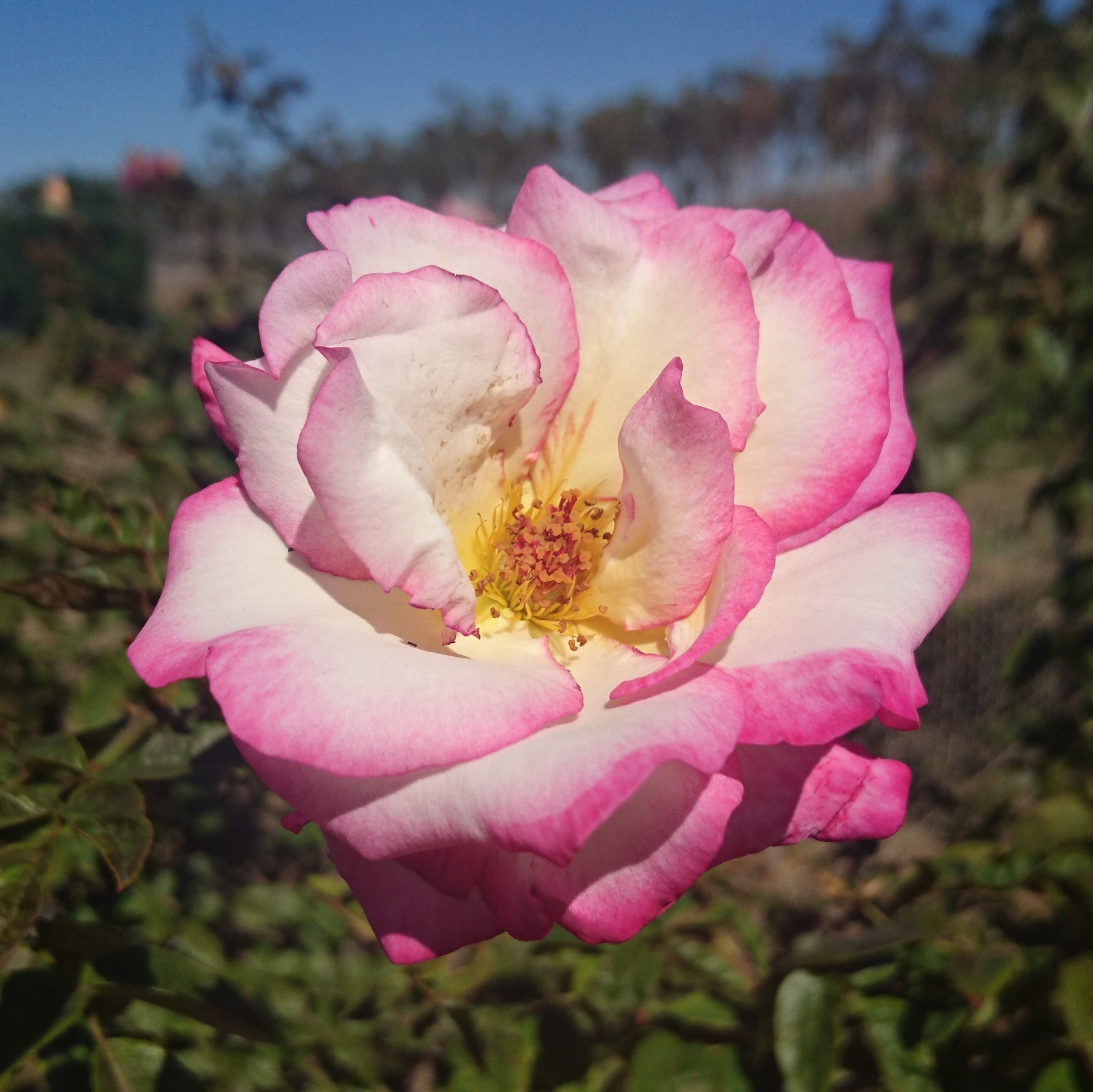
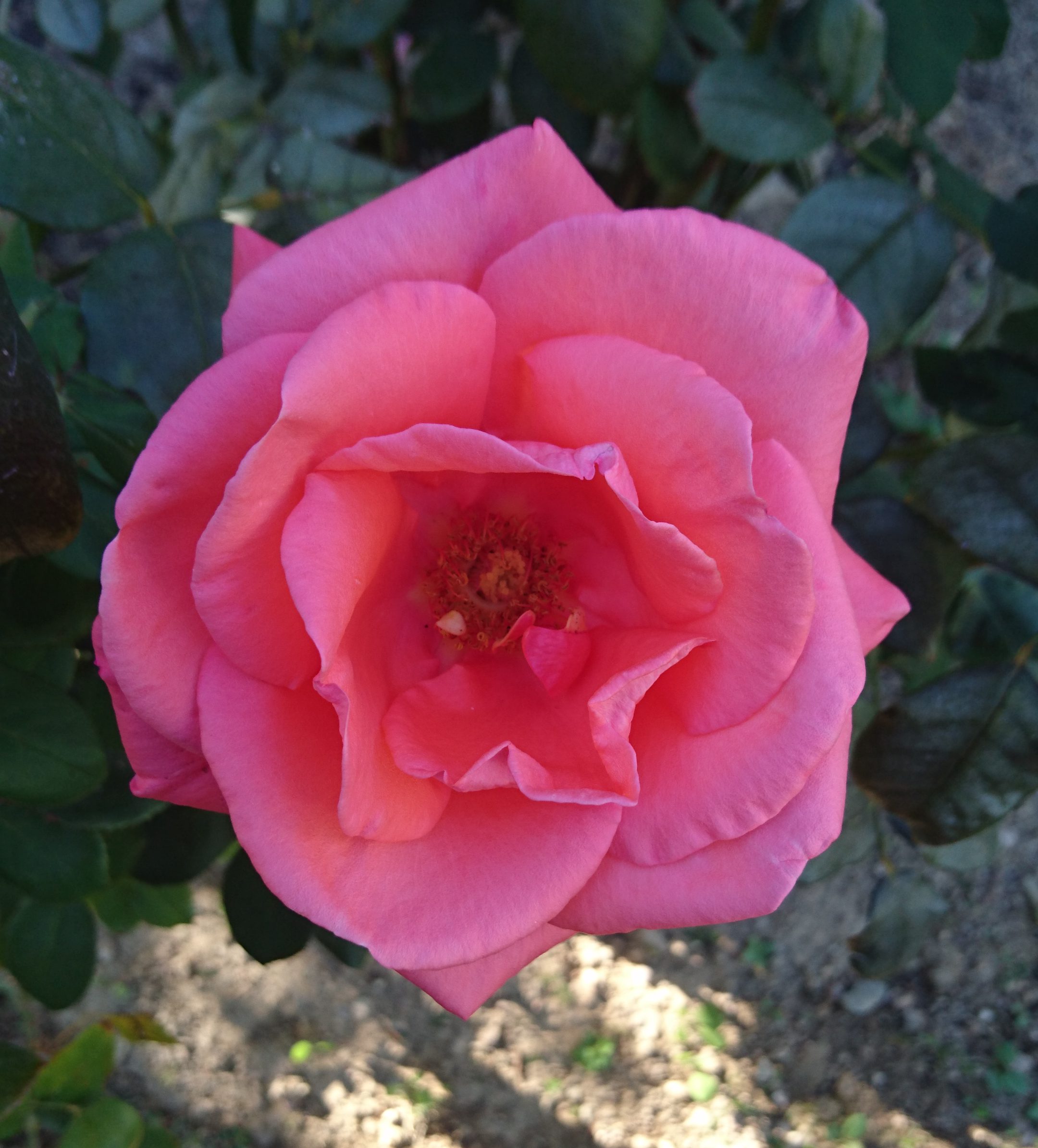
dsc_1047.jpgXVII
C’est toi qui prépares en toi
plus que toi, ton ultime essence.
Ce qui sort de toi, ce troublant émoi,
c’est ta danse.
Chaque pétale consent
et fait dans le vent
quelques pas odorants
invisibles.
Ô musique des yeux,
toute entourée d’eux,
tu deviens au milieu
intangible.

XVII
Your inner self is the one creating
more than yourself, your ultimate essence.
The uneasiness emerging from you,
that is your dance.
Each petal consents
and takes a few steps,
invisible, fragrant
in the wind.
O music to the eyes,
petals all around,
in their midst you become
intangible.

Rainer Maria Rilke (c 1926) From his series “Les Roses”, Jung Journal: Culture & Psyche,
5:4, 17-21. Translated from French by Susanne Petermann (2011).

grimes – art angel documentary (2015)

“At first, I guess, there was just Grimes,” she says in the documentary. “I don’t technically have control of her narrative anymore—she very much exists in pop culture now. Grimes as one person cannot represent more than a couple of ideas. That’s why I started developing some of the other characters, like really abstract from who I am and how I am.”

“i just push the things that i’m naturally good at really hard” (2012)

Interview with Grimes from 2012.
‘She’s only 24, but already releasing her third album Visions: Claire Boucher a.k.a. Grimes. With a sense of irony, the Canadian musician admits that she’s ‘pretty good at faking’. She says she doesn’t know that much about music at all. “I just push the things I’m naturally good at really hard, but if I would play as a back-up musician in someone else’s band, I would totally fuck it up for everybody.”‘

rainer maria rilke – les roses xxi

img_20160410_184513.jpgXXI
Cela ne te donne-t-il pas le vertige
de tourner autour de toi sur ta tige
pour te terminer, rose ronde?
Mais quand ton propre élan t’inonde,
tu t’ignores dans ton bouton.
C’est un monde qui tourne en rond
pour que son calme centre ose
le rond repos de la ronde rose.

XXI
Doesn’t it make you dizzy, rose,
to spin on your stem around yourself
ending in your round self ?
Overwhelmed by your own momentum
you forget the bud that is you.
It’s a world that whirls around,
daring its calm center to hold
the round repose of the round rose.

Rainer Maria Rilke (c 1926) From his series “Les Roses”, Jung Journal: Culture & Psyche,
5:4, 17-21. Translated from French by Susanne Petermann (2011).

rilke on god

fb_img_1461648488387.jpg“Yet, no matter how deeply I go down into myself, my God is dark, and like a webbing made of a hundred roots that drink in silence. I know that my trunk rose from his warmth, but that’s all, because my branches hardly move at all near the ground, and just wave a little in the wind.”

― Rainer Maria Rilke

paul celan – the no-one’s-rose (1963)

nothing rose (2)

PSALM

No one kneads us again out of earth and clay,
no one incants our dust.
No one.

Blessed art thou, No One.
In thy sight would
we bloom.
In thy
spite.

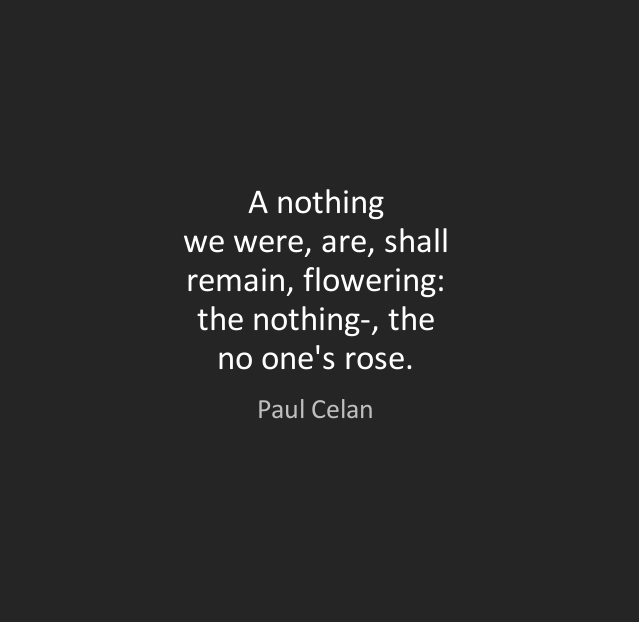
A Nothing
we were, are now, and ever
shall be, blooming:
the Nothing-, the
No-One’s-Rose.

With
our pistil soul-bright,
our stamen heaven-waste,
our corona red
from the purpleword we sang
over, O over
the thorn.

Paul Celan, “Psalm” from Selected Poems and Prose, translated by John Felstiner. Copyright © 2001 by John Felstiner.

michel foucault – the utopian body (1966)

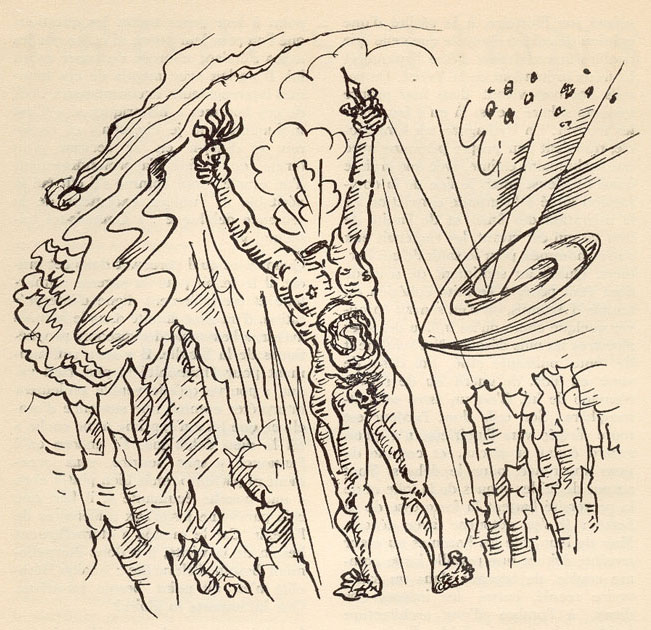
The body is the zero point of the world. There, where paths and spaces come to meet, the body is nowhere. It is at the heart of the world, this small utopian kernel from which I dream, I speak, I proceed, I imagine, I perceive things in their place, and I negate them also by the indefinite power of the utopias I imagine. My body is like the City of the Sun. It has no place, but it is from it that all possible places, real or utopian, emerge and radiate.

Illustration by Andre Masson, 1936.

Illustration by Andre Masson, 1936.

Excerpts from the translation by Lucia Allais of a radio lecture Foucault delivered in 1966. Published in Sensorium, MIT Press, 2006, 229-34:

My body: it is the place without recourse to which I am condemned. And actually I think that it is against this body (as if to erase it) that all these utopias have come into being. The prestige of utopia–to what does utopia owe its beauty, its marvel? Utopia is a place outside all places, but it is a place where I will have a body without body, a body that will be beautiful, limpid, transparent, luminous, speedy, colossal in its power, infinite in its duration. Untethered, invisible, protected–always transfigured. It may very well be that the first utopia, the one most deeply rooted in the hearts of men, is precisely the utopia of an incorporeal body.

No, really, there is no need for magic, for enchantment. There’s no need for a soul, nor a death, for me to be both transparent and opaque, visible and invisible, life and thing. For me to be a utopia, it is enough that I be a body. All those utopias by which I evaded my body–well they had, quite simply, their model and their first application, they had their place of origin, in my body itself, I really was wrong, before, to say that utopias are turned against the body and destined to erase it. They were born from the body itself, and perhaps afterwards they turned against it.

My body, in fact, is always elsewhere. It is tied to all the elsewheres of the world. And to tell the truth, it is elsewhere than in the world, because it is around it that things are arranged. It is in relation to it–and in relation to it as if in relation to a sovereign–that there is a below, an above, a right, a left, a forward and a backward, a near and a far. The body is the zero point of the world. There, where paths and spaces come to meet, the body is nowhere. It is at the heart of the world, this small utopian kernel from which I dream, I speak, I proceed, I imagine, I perceive things in their place, and I negate them also by the indefinite power of the utopias I imagine. My body is like the City of the Sun. It has no place, but it is from it that all possible places, real or utopian, emerge and radiate.

Maybe it should also be said that to make love is to feel one’s body close in on oneself. It is finally to exist outside of any utopia, with all of one’s density, between the hands of the other. Under the other’s fingers running over you, all the invisible parts of your body begin to exist. Against the lips of the other, yours become sensitive. In front of his half-closed eyes, your face acquires a certitude. There is a gaze, finally, to see your closed eyelids. Love also, like the mirror and like death–it appeases the utopia of your body, it hushes it, it calms it, it encloses it as if in a box, it shuts and seals it. This is why love is so closely related to the illusion of the mirror and the menace of death. And if, despite these two perilous figures that surround it, we love so much to make love, it is because, in love, the body is here.

rainer maria rilke – les roses (1926)

Rilke chose as his own epitaph this poem:

Rose, oh reiner Widerspruch, Lust,
Niemandes Schlaf zu sein unter soviel
Lidern.

Rose, o pure contradiction, desire
to be no one’s sleep beneath so many lids.

“The following selections from David Need’s Roses: The Late French Poetry of Rainer Maria Rilke provide an illuminating glimpse into the ways Rilke uses the rose as motif. The poems seek to elucidate how time’s ceaseless transformations do not rectify or allay the contradictions they invoke. The living rose is “fully awake” but discreet, possessing “many pages / of detailed happiness / we will never read.” Rilke is fascinated by these irreducible relationships: the flower’s vitality belies its eventual death; its blooming won’t diminish the impenetrable density of its petals.” —Dan Holmes

Rilke’s posthumously published Roses calls us into a more intimate relationship with things, asking us to consider the material world as sister of our imagination, rather than nameless patient of our ideas.

I
If your blooming sometimes so astonishes us,
happy rose,
it’s that, petal against petal, you rest
within yourself, inside.

Fully awake, your petals, whose surroundings
sleep, though numberless, meet
this silent heart’s tendernesses
which end in these urgent lips.

II
I see you, rose, book half-opened,
having so many pages
of detailed happiness
we will never read. Mage-Book,

which is opened by the wind and can be read,
eyes shut…
from which butterflies scatter, confused
to have had the same ideas.

dsc_1074.jpg

III
Oh Rose, you perfect thing beyond compare,
infinitely restrained
and infinitely lavished, oh, head
of a body with far too much wandering sweetness,

nothing is equal to you, oh you supreme essence
of this inconstant hour,
your perfume wanders all about
this space of love we have scarcely entered.

VI
A single rose, it’s every rose
and this one—the irreplaceable one,
the perfect one—a supple spoken word
framed by the text of things.

How could we ever speak without her
of what our hopes were,
and of the tender moments
in the continual departure.

XVIII
All that we feel, you share,
yet we ignore what happens to you.
There would have to be a hundred butterflies
to read all your pages.

There are ones among you like dictionaries;
those who gather these
are tempted to bind all the pages.
Me? I like the roses which are letters.

XXIII
Rose, come so late, when the bitter nights stop
in their too sidereal brilliance,
Rose, do you divine the facile, perfect pleasures
of your summer sisters?

Day after day, I watch you who hesitate
in your sheath, clasped too tight.
Rose who, when born, imitates in reverse
the slow ways of the dead.

Does your indescribable state make you understand
in a mingling in which all is silenced
that ineffable harmony of nothingness and being
that we ignore?

XXVI
Infinitely reassured
despite so many dangers
with no change ever
in her habits
is the Rose which opens, prelude
to her immeasurable duration.

Do we know how she lives?
One of her days, without doubt,
is all the earth, all
the infinity of this moment.

XXVII
Rose, was it necessary to leave you outdoors,
exquisite dear?
What is a rose doing there, where fate
exhausts itself on us?

Point of turning back. It’s you
who share
with us, desperately, this life, this life
which is not your time.

(Translated from the French by David Need. To read the original, click HERE.)

RosesRainer Maria Rilke.Translation by David Need. Illustrations by Clare Johnson.Horse & Buggy Press, 2014.

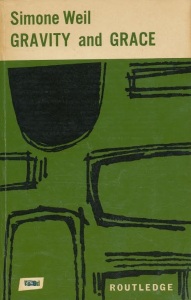
simone weil – training

simone weil gravity and graceWe have to accomplish the possible in order to touch the impossible. The correct exercise (according to our duty) of the natural faculties of will, love and knowledge is, in relation to spiritual realities, exactly what the movement of the body is in relation to the perception of tangible objects. A paralyzed man lacks this perception.

The fulfilment of our strictly human duty is of the same order as correctness in the work of drafting, translating, calculating, etc. To be careless about this correctness shows a lack of respect for the object. The same thing applies to neglect of duty.

Those things which have to do with inspiration are the only ones which are the better for delay. Those which have to do with natural duty and the will cannot allow of delay.

Precepts are not given for the sake of being practised, but practice is prescribed in order that precepts may be understood. They are scales. One does not play Bach without having done scales. But neither does one play a scale merely for the sake of the scale.

Training. Every time we catch ourselves involuntarily indulging in a proud thought, we must for a few seconds turn the full gaze of our attention upon the memory of some humiliation in our past life, choosing the most bitter, the most intolerable we can think of.

We must not try to change within ourselves or to efface desires and aversions, pleasures and sorrows. We must submit to them passively, just as we do to the impressions we receive from colours, according no greater credit to them than in the latter case. If my window is red I cannot, though I should reason day and night for a whole year, see my room as anything but pink. I know, moreover, that it is necessary, just and right that I should see it thus. At the same time, as far as information about my room goes, I only accord to the pink colour a credit limited by my knowledge of its relation to the window. I must accept in this way and no other the desires and aversions, pleasures and sorrows of every kind which I find within me.

On the other hand, as we have also a principle of violence in us—that is to say the will—we must also, in a limited measure, but to the full extent of that measure, use this violent principle in a violent way; we must compel ourselves by violence to act as though we had not a certain desire or aversion, without trying to persuade our sensibility—compelling it to obey. This causes it to revolt and we have to endure this revolt passively, taste of it, savour it, accept it as something outside ourselves, as the pink colour of the room with the red window.

Each time that we do violence to ourselves in this spirit we make an advance, slight or great but real, in the work of training the animal within us.

Of course if this violence we do ourselves is really to be of use in our training it must only be a means. When a man trains a dog to perform tricks he does not beat it for the sake of beating it, but in order to train it, and with this in view he only hits it when it fails to carry out a trick. If he beats it without any method he ends by making it unfit for any training, and that is what the wrong sort of asceticism does.

Violence against ourselves is only permissible when it is based on reason (with a view to carrying out what we clearly consider to be our duty)—or when it is enjoined on us through an irresistible impulsion on the part of grace (but then the violence does not come from ourselves).

The source of my difficulties lies in the fact that, through exhaustion and an absence of vital energy, I am below the level of normal activity. And if something takes me and raises me up I am lifted above it. When such moments come it would seem to me a calamity to waste them in ordinary activities. At other times, I should have to do violence to myself with a violence which I cannot succeed in mustering.

I could consent to the anomaly of behaviour resulting from this; but I know, or I believe I know, that I should not do so. It involves crimes of omission towards others. And as for myself, it imprisons me.

What method is there then?

I must practise transforming the sense of effort into a passive sense of suffering. Whatever I may have to bear, when God sends me suffering, I am inescapably forced to suffer all that there is to suffer. Why, when it comes to duty, should I not in like manner do all that there is to be done?

Mountains, rocks, fall upon us and hide us far from the wrath of the Lamb. At the present moment I deserve this wrath.

I must not forget that according to Saint John of the Cross the inspirations which turn us from the accomplishment of easy and humble obligations come from the side of evil.

Duty is given us in order to kill the self—and I allow so precious an instrument to grow rusty.

We must do our duty at the prescribed time in order to believe in the reality of the external world. We must believe in the reality of time. Otherwise we are in a dream.

It is years since I recognized this defect in myself and recognized its importance, and all this time I have done nothing to get rid of it. What excuse can I find?

Has it not been growing in me since I was ten years old? But however great it may be, it is limited. That is enough. If it is great enough to take from me the possibility of wiping it out during this life and so attaining to the state of perfection, that must be accepted just as it is, with an acceptance that is full of love. It is enough that I know that it exists, that it is evil and that it is finite. But to know each of these three things effectively and to know them all three together implies the beginning and the uninterrupted continuation of the process of wiping out. If this process does not begin to show itself, it is a sign that I do not know in truth the very thing that I am writing.

The necessary energy dwells in me, since I live by means of it. I must draw it relentlessly out of myself, even though I should die in so doing.

Uninterrupted interior prayer is the only perfect criterion of good and evil. Everything which does not interrupt it is permitted, everything which interrupts it is forbidden. It is impossible to do harm to others when we act in a state of prayer—on condition that it is true prayer. But before reaching that stage, we must have worn down our own will against the observance of rules.

Hope is the knowledge that the evil we bear within us is finite, that the slightest turning of the will towards good, though it should last but an instant, destroys a little of it, and that, in the spiritual realm, everything good infallibly produces good. Those who do not know this are doomed to the torture of the Danaïds.

Good infallibly produces good, and evil evil, in the purely spiritual realm. On the other hand, in the natural realm, that of psychology included, good and evil reciprocally produce each other. Accordingly we cannot have security until we have reached the spiritual realm—precisely the realm where we can obtain nothing by our own efforts, where we must wait for everything to come to us from outside.

__

1 ‘If thou wilt thou canst make me clean’ (Gospel text).

__
Excerpted from Simone Weil‘s Gravity and Grace. First French edition 1947. Translated by Emma Crawford. English language edition 1963. Routledge and Kegan Paul, London.