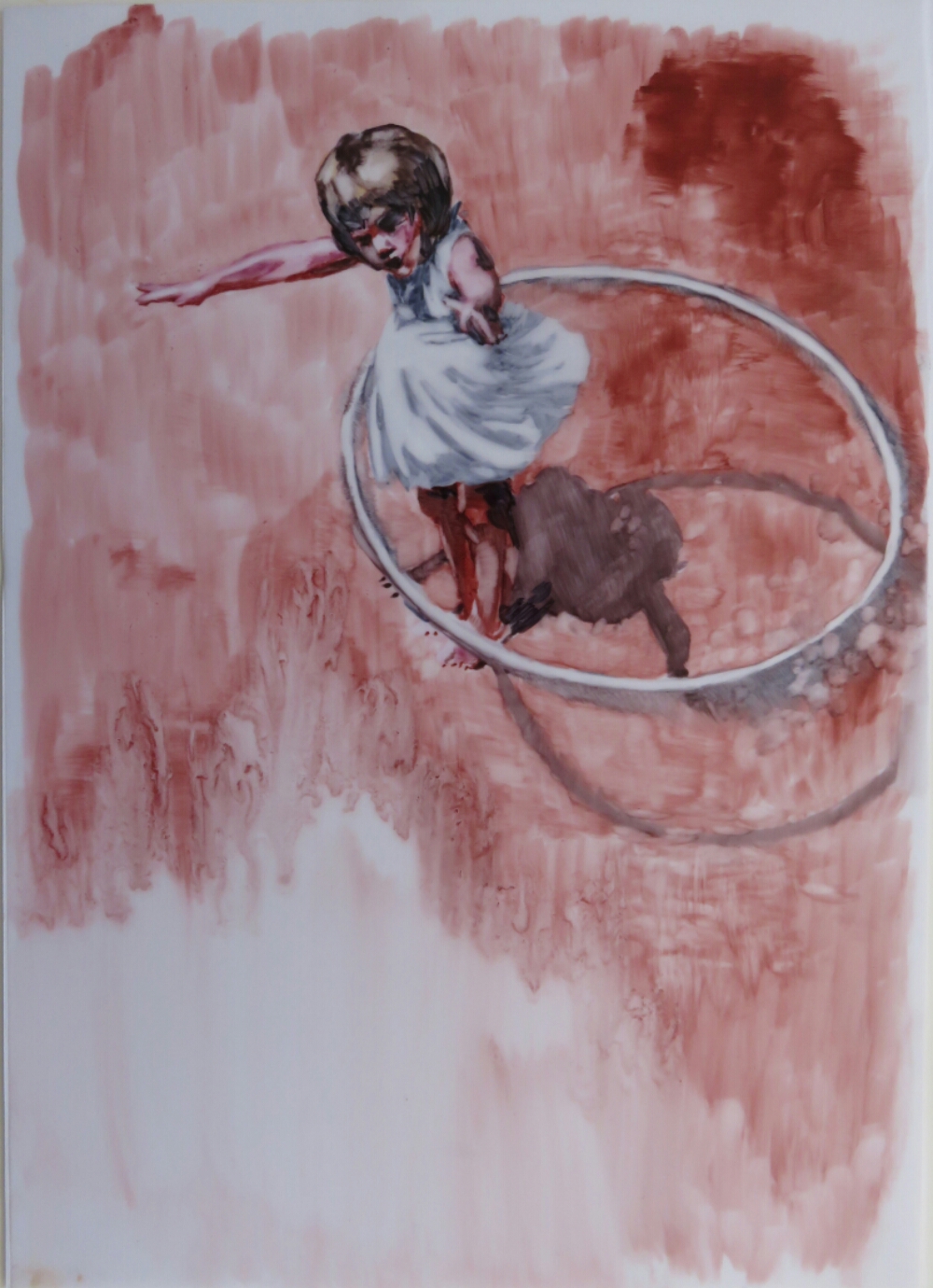

This is the most irrepressible music I have heard in forever.
Dis ‘n roering! And how.
This keyboard!
“Listen; there was once a king on his throne anointed with great honour. He sent forth his dove into the world, which dropped the tiniest feather from its wing. The king raised the feather, blew on it, and commanded it to fly. The feather flew, not because of anything in itself, but because the air bore it along.
Thus am I: but a feather on the breath of God.”
– Hildegard of Bingen (1098 – 1179)
This extraordinarily gifted woman, born c. 1098 in Bermersheim, Germany, was given to the church at the age of eight. The tenth child of Hildebert of Bermersheim and Mechthild of Merxheim, she was promised as a tithe to the church from her birth and was later to become an abbess. She was a polymath: a visionary, a theologian, an early scientist and physician and a prodigious letter-writer who numbered kings, emperors and popes among her correspondents. There is a detailed Wikipedia entry about her HERE.

Illumination from the “Liber Scivias” shows Hildegard receiving a vision and dictating to her scribe.
That sample at the beginning is from Hildegard von Bingen’s “O Euchari in Leta Via”.
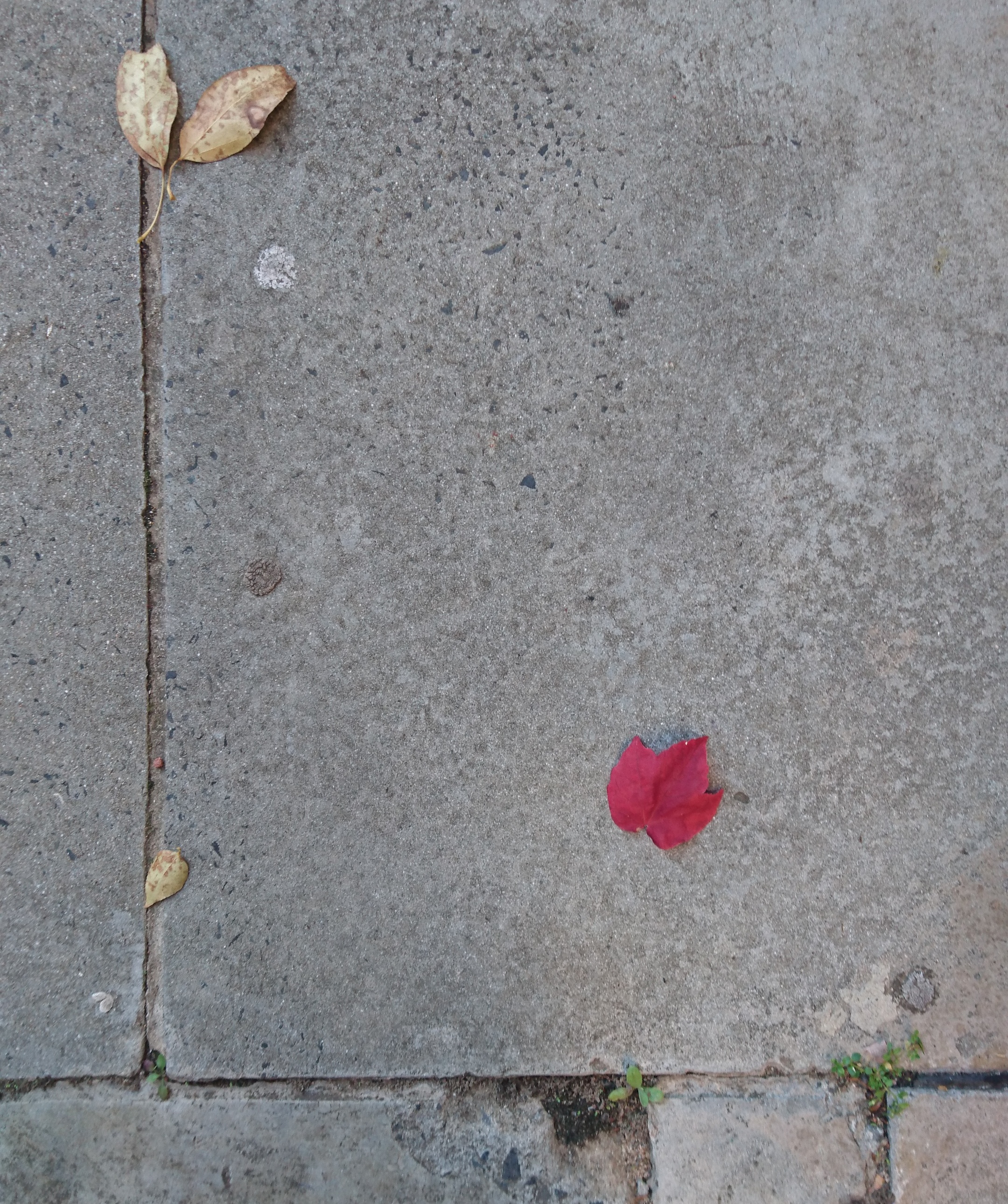
It doesn’t have to be
the blue iris, it could be
weeds in a vacant lot, or a few
small stones; just
pay attention, then patch
a few words together and don’t try
to make them elaborate, this isn’t
a contest but the doorway
into thanks, and a silence in which
another voice may speak.
From Thirst (Beacon Press, 2006).
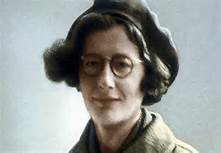 Excerpted from this post at Wine, Women and Philosophy:
… And aren’t unsettling folk just like that? You think you’ve done them, ticked them off, when suddenly, you’re back to square one… This other quagmire into which we had unwittingly waded – the actual technicalities involved in “undoing the creature in us” so as to successfully “decreate” a la Weil – required our immediate attention.
And so, spurred on by Anne Carson’s insight into how to go about actually paying attention – “Attention is a choice of where you put your mind…And looking at the object of your attention to the extent that you forget you’re doing the looking” – we embarked on a series of exercises designed to both instruct us on the ins and outs of destroying the “I,” and sharpen our skills in the attentiveness department.
Of course, there was a lot of preliminary discussion as to whether destroying the “I” was a desirable thing in the first place. In a sense, that Weilian notion of carving out a void in the space where the self normally resides goes counter to the rah-rah-be-your-biggest-and-best-self kind of rhetoric on offer in Self-Esteem for Dummies etc. In a culture where Self reigns Supreme, doing away with it is unnerving at best, terrifying at worst – even if this negation is, as Weil contends, a necessary move if one is to fully open oneself to Truth and Knowledge and Whatever Else Truly Matters.
For the self gets in the way. Like a shadow, it blocks out the light. Like unwanted baggage, it weighs you down. Like the elephant in the room, it takes up all the space. Clear the shadow, the baggage, the elephant, and you’re starting to get somewhere. A strange way to go about getting to the bottom of self-esteem, perhaps. But it seemed to offer something in the way of getting more out of life, and so we bit.
Simone Weil suffered from terrible migraines. She tried many ways of clearing them out of her head, but nothing seemed to work. One thing she knew for sure was that they got in the way of her being able to turn her full attention to what mattered. In April 1938 she found herself attending the Easter Mass at the Abbeye St-Pierre in Solesmes. She felt the Gregorian chanting of the monks enter her body, go straight to the space in her head filled with migraine. As the chanting poured in, her migraine did a peculiar thing: it emptied out. Soon, the space formerly known as migraine was awash with Gregorian Chant. It was a space rendered ready for paying attention: for “a patient holding in the mind,” as Weil referred to the act of paying attention, which in turn would make thought itself “available, empty, penetrable by the object.”
This is a radical take on the role of thought in the life of the mind: not the light bulb switching on as it encounters its object, but rather, the necessary conditions for the object to come to light. In Weil’s conception, thought must be suspended if the object of one’s attention is to find its way in, gain a proper foothold. If thought is busy thinking, the object just passes it by. If thoughtfulness hasn’t twinned itself up with attentiveness, the best we can hope for when it comes to thinking is a worrying – Weil would go so far as to say dangerous – mishmash of “partial attitudes.”
That, at least, is the theory. We obviously needed to put ourselves in Weil’s shoes to grasp what it felt like in practice. And so we experimented with filling our heads with the self-same Gregorian chants that had so impacted Weil, and making of the resulting void a luminous object-ready nesting ground. Yah, right. Weil, as I suggested earlier, was unsettling: not your average, run-of-the-mill, kind of gal.
But we gave it a go, and then turned our attention to other aural stimuli: a metronome’s steady tick-tocking, which brought the Weilian notion of time as “unvarying perpetuity” into the equation; a wind-up music box with its twirling ballerina and its ever-decelerating ditty, which prompted us to probe yet further how time, if invariably monotonous for Weil, could helpfully be categorized as either “time surpassed” – as in here comes the void, which is good monotonous – or as “time sterilized” – as in me just going round and round like “a squirrel turning it its cage” and never getting anywhere near the void, much less admitting to myself that I am going round and round (which for Weil is the worst sin of all, this kind of self-delusion) and which is, not surprisingly, bad monotonous.
This seemed as good a queue for a song as we were likely to get, so we broke out Anne Carson’s Duet of What is a Question from her Weil-inspired opera in three parts, Decreation (2005), and gave it our valiant best. Improvising the vocal arrangements – Carson had only supplied the libretto – provided us with the perfect opportunity to pay attention to each other, and hone our deep listening skills. As for getting us closer to the void, we were still a little in the dark. Enter American poet Fanny Howe (b.1940) and her beautifully observed prose poem, Doubt.
If Baruch Spinoza is the physicists’ philosopher, Simone Weil, it would seem, is the poets’ philosopher. Though it is easy to understand why Weil speaks to poets like Carson and Howe, the writing that comes of their interest in her ideas and her personal narrative is as tantalizing and challenging as Weil herself.
Sometimes, though, what poetry gives us that philosophy cannot is a line of such stark and heart-breaking beauty that knowing what the void, for example, actually is, or what it is to make one or find it or get there no longer seems to matter. For a very brief moment, we just feel decreated – like the creature in us has unraveled, like we have completely come undone.
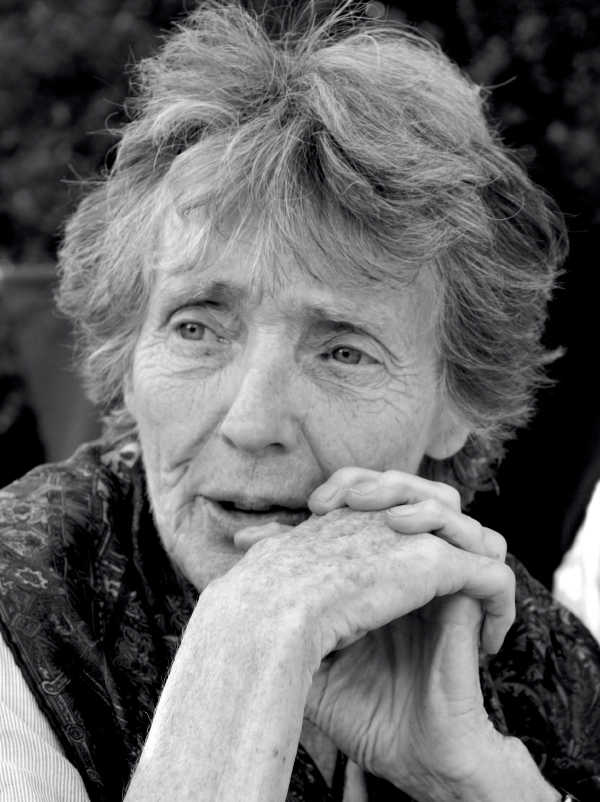 Virginia Woolf committed suicide in 1941 when the German bombing campaign against England was at its peak and when she was reading Freud whom she had staved off until then.
Edith Stein, recently and controversially beatified by the Pope, who had successfully worked to transform an existential vocabulary into a theological one, was taken to Auschwitz in August 1942.
Two years later Simone Weil died in a hospital in England—of illness and depression—determined to know what it is to know.
She, as much as Woolf and Stein, sought salvation in a choice of words.
But multiples succumb to the sorrow induced by an inexact vocabulary.
While a whole change in discourse is a sign of conversion, the alteration of a single word only signals a kind of doubt about the value of the surrounding words.
Poets tend to hover over words in this troubled state of mind. What holds them poised in this position is the occasional eruption of happiness.
While we would all like to know if the individual person is a phenomenon either culturally or spiritually conceived and why everyone doesn’t kill everyone else, including themselves, since they can—poets act out the problem with their words.
Why not say “heart-sick” instead of “despairing”?
Why not say “despairing” instead of “depressed”?
Is there, perhaps, a quality in each person—hidden like a laugh inside a sob—that loves even more than it loves to live?
If there is, can it be expressed in the form of the lyric line?
Dostoevsky defended his later religious belief, saying of his work, “Even in Europe there have never been atheistic expressions of such power. My hosannah has gone through a great furnace of doubt.”
According to certain friends, Simone Weil would have given everything she wrote to be a poet. It was an ideal but she was wary of charm and the inauthentic. She saw herself as stuck in fact with a rational prose line for her surgery on modern thought. She might be the archetypal doubter but the language of the lyric was perhaps too uncertain.
As far as we know she wrote a play and some poems and one little prose poem called Prologue.
Yet Weil could be called a poet, if Wittgenstein could, despite her own estimation of her writing, because of the longing for a conversion that words might produce.
In Prologue the narrator is an uprooted seeker who still hopes that a transformation will come to her from the outside. The desired teacher arrives bearing the best of everything, including delicious wine and bread, affection, tolerance, solidarity (people come and go) and authority. This is a man who even has faith and loves truth.
She is happy. Then suddenly, without any cause, he tells her it’s over. She is out on the streets without direction, without memory. Indeed she is unable to remember even what he told her without his presence there to repeat it, this amnesia being the ultimate dereliction.
If memory fails, then the mind is air in a skull.
This loss of memory forces her to abandon hope for either rescue or certainty.
And now is the moment where doubt—as an active function—emerges and magnifies the world. It eliminates memory. And it turns eyesight so far outwards, the vision expands. A person feels as if she is the figure inside a mirror, looking outwards for her moves. She is a forgery.
When all the structures granted by common agreement fall away and that “reliable chain of cause and effect” that Hannah Arendt talks about—breaks—then a person’s inner logic also collapses. She moves and sees at the same time, which is terrifying.
Yet strangely it is in this moment that doubt shows itself to be the physical double to belief; it is the quality that nourishes willpower, and the one that is the invisible engine behind every step taken.
Doubt is what allows a single gesture to have a heart.
In this prose poem Weil’s narrator recovers her balance after a series of reactive revulsions to the surrounding culture by confessing to the most palpable human wish: that whoever he was, he loved her.
Hope seems to resist extermination as much as a roach does.
Hannah Arendt talks about the “abyss of nothingness that opens up before any deed that cannot be accounted for.” Consciousness of this abyss is the source of belief for most converts. Weil’s conviction that evil proves the existence of God is cut out of this consciousness.
Her Terrible Prayer—that she be reduced to a paralyzed nobody—desires an obedience to that moment where coming and going intersect before annihilation.
And her desire: “To be only an intermediary between the blank page and the poem” is a desire for a whole-heartedness that eliminates personality.
Virginia Woolf, a maestro of lyric resistance, was frightened by Freud’s claustrophobic determinism since she had no ground of defense against it. The hideous vocabulary of mental science crushed her dazzling star-thoughts into powder and brought her latent despair into the open air.
Born into a family devoted to skepticism and experiment, she had made a superhuman effort at creating a prose-world where doubt was a mesmerizing and glorious force.
Anyone who tries, as she did, out of a systematic training in secularism, to forge a rhetoric of belief is fighting against the odds. Disappointments are everywhere waiting to catch you, and an ironic realism is always convincing.
Simone Weil’s family was skeptical too, and secular and attentive to the development of the mind. Her older brother fed her early sense of inferiority with intellectual put-downs. Later, her notebooks chart a superhuman effort at conversion to a belief in affliction as a sign of God’s presence.
Her prose itself is tense with effort. After all, to convert by choice (that is, without a blast of revelation or a personal disaster) requires that you shift the names for things, and force a new language out of your mind onto the page.
You have to make yourself believe. Is this possible? Can you turn “void” into “God” by switching the words over and over again?
Any act of self-salvation is a problem because of death which always has the last laugh, and if there has been a dramatic and continual despair hanging over childhood, then it may even be impossible.
After all, can you call “doubt” “bewilderment” and suddenly be relieved?
Not if your mind has been fatally poisoned. . . .
But even then, it seems the dream of having no doubt continues, finding its way into love and work where choices matter exactly as much as they don’t matter—at least when luck is working in your favor.
—
Fanny Howe, from Gone: Poems. Berkeley: University of California Press, 2003.

Charity Hamilton
The body is the canvas on which the female experience is painted and through which female identity is often understood. The female body is a slate on which a patriarchal story has been written, scarred onto the flesh.
For Simone Weil metaxu was simultaneously that which separated and connected, so for instance the wall between two prison cells cuts off the prisoners but was also the means by which they communicated by knocking on that wall. Could the body be that metaxu all at once separating us and connecting us to the Divine? The nature of metaxu is that it offers a route not just for the individual soul but for the souls of others to travel…
—
It’s all well and good to dust off a dead French Jewish Catholic not-quite-feminist-philosopher called Simone Weil and say ‘thanks, your theory of metaxu is great’, but what I want to know within the bones of my so-called soul is how this notion of metaxu can draw me into God, how can it liberate my sisters and how can it usher in the kingdom of the mother of all creation?
Human beings are created in the image of God and formed from the dust of the earth, and thus the body has an echoing significance throughout Christian history. The body is the perceived seat of what some describe as the fall, the locus of the incarnation, the home of crucifixion, the vessel of redemption, salvation and resurrection. The body is not an external meaningless diversion from the spiritual path; rather it is an incredibly important recurring theme both biblically and in Christian tradition and history. Bray and Colebrook state that,
The body is a negotiation with images, but it is also a negotiation with pleasures, pains, other bodies, space, visibility, and medical practice; no single event in this field can act as a general ground for determining the status of the body (Bray and Colebrook, 1998).
Yet more than all of this, the body is the place in which we dwell, it is all we have. As Elizabeth Moltmann Wendell says ‘I am my body’ (Moltmann-Wendell, 1994). For each of our sisters the body is the canvas on which the female experience is painted and through which female identity is often understood. It is on the stage of our female bodies that some of the most fixed church doctrines have been written and enacted. The female body is a slate on which a patriarchal story has been written, scarred onto the flesh. These bodies of ours are patriarchal constructs which must be liberated and re-adopted into the Christian story without the limitations of perceived notions or definitions of ‘gender’.
Isherwood and Stuart assert that ‘From the moment we are asked to believe that Eve was a rib removed from the side of Adam we understand that theology is based in the body and we are at a disadvantage!’ (Isherwood and Stuart, 1998: 15). The historical dichotomy between the Eve and the Mary constructions has led to a definitive inequality for women, both in terms of physical wellbeing and in terms of spiritual and psychological wellbeing. The choices for a woman to be the sin-formed, temptress Eve or the virginal pure vessel Mary are seen historically in the precarious place of women in the church and in society.
Elizabeth Stuart writes that ‘Women were regarded as being ensnared in their bodiliness to a far greater degree than men and they too had to be tamed and subdued for their own good and the good of the men they might tempt into sin’ (Stuart, 1996: 23). It is hardly surprising therefore that twentieth and twenty-first century feminist, womanist, mujerista and black theologians have worked hard to undo and re-express a theology of the body which offers a more authentic narrative of the relationship between the Divine and the physical which both liberates the female body and liberates God from the patriarchal box the Church has created around her.
…The female body can only be liberated from that patriarchal overwriting by writing its own narrative, much of which will be based upon experiences of being troubled. The true nature of the female body can only be revealed by a concerted effort to ‘re-own’ this body as our own not as we have been taught to understand it. This in turn means that the systems, doctrines and ‘ways of being’ which exist within the Church and society must be challenged and re-imagined from the perspective of the un-vocalized and troubled female narrative. In the sense that the female body has not really been ours, has not been an authentically female body and yet has the potential to be unlocked as such, it therefore makes for the perfect condition for metaxu, it is that thing which separates in its forms of oppression and connects in its potential liberation. It is at once a place where great evil has been wrought and a place of divine goodness. Weil writes of love that,
Creation is an act of love and it is perpetual. At each moment our existence is God’s love for us. But God can only love himself. His love for us is love for himself through us. Thus, he who gives us our being loves in us the acceptance of not being. Our existence is made up only of his waiting for our acceptance not to exist. He is perpetually begging from us that existence which he gives. He gives it to us in order to beg it from us (Weil, 2002: 28).
According to Weil, our very existence is from God and returns to God. I would argue that to be able to return this ‘not being’ to God, the body has to take some form of action, or have some form of action performed upon it to open a space in which our not being or not existing can be offered to God. It is this removal of our self which I argue can be interpreted as a removal of the socially created self to leave only the God part of ourselves, the authentic self that is God. The body is metaxu in that it is imperfect and yet perfect. The body is human and therefore unreal and socially recreated, yet the body is also created by God and God dwells within it. The female body is both imprisoned and is liberated. Its imprisonment is the very thing that enables it to unravel the layers of patriarchal construction to locate the God part and its imprisonment is the thing which allows for an authentic narrative to be written. The female body has to separate us from the Divine in order to connect us to the Divine.
Read the whole of this interesting paper by Charity Hamilton HERE.
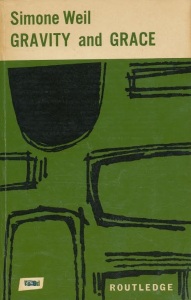 All created things refuse to be for me as ends. Such is God’s extreme mercy towards me. And that very thing is what constitutes evil. Evil is the form which God’s mercy takes in this world.
This world is the closed door. It is a barrier. And at the same time it is the way through.
Two prisoners whose cells adjoin communicate with each other by knocking on the wall. The wall is the thing which separates them but it is also their means of communication. It is the same with us and God. Every separation is a link.
By putting all our desire for good into a thing we make that thing a condition of our existence. But we do not on that account make of it a good. Merely to exist is not enough for us.
The essence of created things is to be intermediaries. They are intermediaries leading from one to the other and there is no end to this. They are intermediaries leading to God. We have to experience them as such.
The bridges of the Greeks. We have inherited them but we do not know how to use them. We thought they were intended to have houses built upon them. We have erected skyscrapers on them to which we ceaselessly add storeys. We no longer know that they are bridges, things made so that we may pass along them, and that by passing along them we go towards God.
Only he who loves God with a supernatural love can look upon means simply as means.
Power (and money, power’s master key) is means at its purest. For that very reason, it is the supreme end for all those who have not understood.
This world, the realm of necessity, offers us absolutely nothing except means. Our will is for ever sent from one means to another like a billiard ball.
All our desires are contradictory, like the desire for food. I want the person I love to love me. If, however, he is totally devoted to me, he does not exist any longer, and I cease to love him. And as long as he is not totally devoted to me he does not love me enough. Hunger and repletion.
Desire is evil and illusory, yet without desire we should not seek for that which is truly absolute, truly boundless. We have to have experienced it. Misery of those beings from whom fatigue takes away that supplementary energy which is the source of desire.
Misery also of those who are blinded by desire. We have to fix our desire to the axis of the poles.
What is it a sacrilege to destroy? Not that which is base, for that is of no importance. Not that which is high, for, even should we want to, we cannot touch that. The metaxu. The metaxu form the region of good and evil.
No human being should be deprived of his metaxu, that is to say of those relative and mixed blessings (home, country, traditions, culture, etc.) which warm and nourish the soul and without which, short of sainthood, a human life is not possible.
The true earthly blessings are metaxu. We can respect those of others only in so far as we regard those we ourselves possess as metaxu. This implies that we are already making our way towards the point where it is possible to do without them. For example, if we are to respect foreign countries, we must make of our own country, not an idol, but a stepping-stone towards God.
All the faculties being freely exercised without becoming mixed, starting from a single, unique principle. It is the microcosm, the imitation of the world. Christ according to Saint Thomas. The just man of the Republic. When Plato speaks of specialization he speaks of the specialization of man’s faculties and not of the specialization of men; the same applies to hierarchy. The temporal having no meaning except by and for the spiritual, but not being mixed with the spiritual—leading to it by nostalgia, by reaching beyond itself. It is the temporal seen as a bridge, a metaxu. It is the Greek and Provençal vocation.
Civilization of the Greeks. No adoration of force. The temporal was only a bridge. Among the states of the soul they did not seek intensity but purity.
__
Excerpted from Simone Weil‘s Gravity and Grace. First French edition 1947. Translated by Emma Crawford. English language edition 1963. Routledge and Kegan Paul, London.
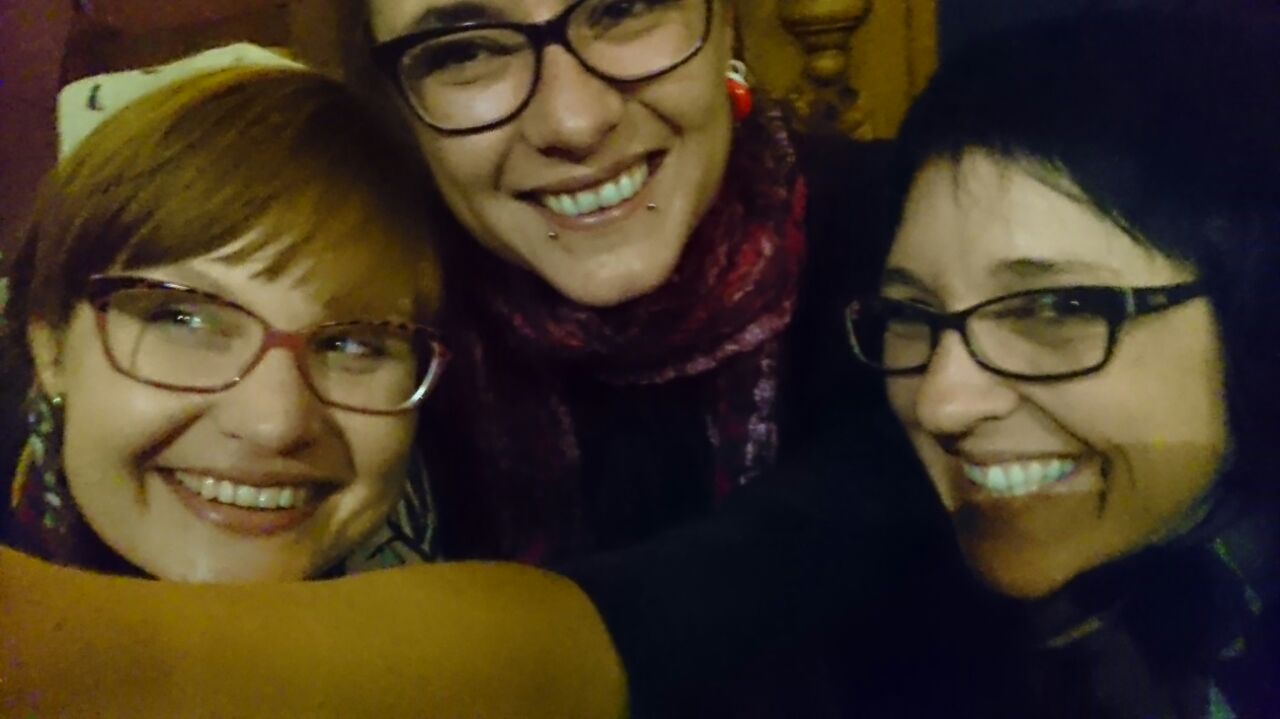
Me with Moon and Rike, last night. Friends since last century!
I find it so fascinating to watch what fame does to people, largely because I have always eluded it. I often wonder how my life would’ve been different if I had focused on centering myself, publicised my work, taken credit, used one name, the one I was given, instead of a gaggle of pseudonyms. I just never wanted to.
Anyway, here’s another one to watch.
“I don’t know my name
I don’t play by the rules of the game
So you say, I’m not trying
But I’m trying
To find my way”
She’s 12.
We are a part which has to imitate the whole.
The a¯tman. Let the soul of a man take the whole universe for its body. Let its relation to the whole universe be like that of a collector to his collection, or of one of the soldiers who died crying out ‘Long live the Emperor!’ to Napoleon. The soul transports itself outside the actual body into something else. Let it therefore transport itself into the whole universe.
We should identify ourselves with the universe itself. Everything that is less than the universe is subject to suffering.
Even though I die, the universe continues. That does not console me if I am anything other than the universe. If, however, the universe is, as it were, another body to my soul, my death ceases to have any more importance for me than that of a stranger. The same is true of my sufferings.
Let the whole universe be for me, in relation to my body, what the stick of a blind man is in relation to his hand. His sensibility is really no longer in his hand but at the end of the stick. An apprenticeship is necessary.
To limit one’s love to the pure object is the same thing as to extend it to the whole universe.
To change the relationship between ourselves and the world in the same way as, through apprenticeship, the workman changes the relationship between himself and the tool. Getting hurt: this is the trade entering into the body. May all suffering make the universe enter into the body.
Habit, skill: a transference of the consciousness into an object other than the body itself.
May this object be the universe, the seasons, the sun, the stars. The relationship between the body and the tool changes during apprenticeship. We have to change the relationship between our body and the world.
We do not become detached, we change our attachment. We must attach ourselves to the all.
We have to feel the universe through each sensation. What does it matter then whether it be pleasure or pain? If our hand is shaken by a beloved friend when we meet again after a long separation, what does it matter that he squeezes it hard and hurts us?
There is a degree of pain on reaching which we lose the world. But afterwards peace comes. And if the paroxysm returns, so does the peace which follows it. If we realize this, that very degree of pain turns into an expectation of peace, and as a result does not break our contact with the world.
Two tendencies with opposite extremes: to destroy the self for the sake of the universe, or to destroy the universe for the sake of the self. He who has not been able to become nothing runs the risk of reaching a moment when everything other than himself ceases to exist.
External necessity or an inner need as imperative as that of breathing. ‘Let us become the central breath.’ Even if a pain in our chest makes respiration extremely painful, we still breathe, we cannot help it.
We have to associate the rhythm of the life of the body with that of the world, to feel this association constantly and to feel also the perpetual exchange of matter by which the human being bathes in the world.
Things which nothing can take from a human being as long as he lives: in the way of movement over which his will has a hold, respiration; in the way of perception, space (even in a dungeon, even with our eyes blinded and our ear-drums pierced, as long as we live we are aware of space).
We have to attach to these things the thoughts which we desire that no circumstances should be able to deprive us of.
To love our neighbour as ourselves does not mean that we should love all people equally, for I do not have an equal love for all the modes of existence of myself. Nor does it mean that we should never make them suffer, for I do not refuse to make myself suffer. But we should have with each person the relationship of one conception of the universe to another conception of the universe, and not to a part of the universe.
Not to accept an event in the world is to wish that the world did not exist. That is within my power—for myself. If I wish it I obtain it. I am then an excrescence produced by the world.
Wishes in folklore: what makes wishes dangerous is the fact that they are granted. To wish that the world did not exist is to wish that I, just as I am, may be everything.
Would that the entire universe, from this pebble at my feet to the most distant stars, existed for me at every moment as much as Agnès did for Arnolphe or his money-box did for Harpagon. If I choose, the world can belong to me like the treasure does to the miser. But it is a treasure that does not increase.
This irreducible ‘I’ which is the irreducible basis of my suffering—I have to make this ‘I’ universal.
What does it matter that there should never be joy in me since there is perfect joy perpetually in God! And the same is true with regard to beauty, intelligence and all things.
To desire one’s salvation is wrong, not because it is selfish (it is not in man’s power to be selfish), but because it is an orientation of the soul towards a merely particular and contingent possibility instead of towards a completeness of being, instead of towards the good which exists unconditionally.
All that I wish for exists, or has existed, or will exist somewhere. For I am incapable of complete invention. In that case how should I not be satisfied?
Br . . . I could not prevent myself from imagining him living, imagining his house as a possible place for me to listen to his delightful conversation. Thus the consciousness of the fact of his death made a frightful desert. Cold with metallic coldness. What did it matter to me that there were other people to love? The love that I directed towards him, together with the outlines shaping in my mind of exchanges of ideas which could take place with no one else, were without an object. Now I no longer imagine him as alive and his death has ceased to be intolerable for me. The memory of him is sweet to me. But there are others whom I did not know then and whose death would affect me in the same way.
D . . . is not dead, but the friendship that I bore him is dead, and a like sorrow goes with it. He is no more than a shadow.
But I cannot imagine the same transformation for X . . ., Y . . ., Z . . ., who, nevertheless, so short a time ago did not exist in my consciousness.
Just as parents find it impossible to realize that three years ago their child was non-existent, I find it impossible to realize that I have not always known the beings I love.
I think I must love wrongly: otherwise things would not seem like this to me. My love would not be attached to a few beings. It would be extended to everything which is worthy of love.
‘Be ye perfect even as your Father who is in heaven. . . .’ Love in the same way as the sun gives light. Love has to be brought back to ourselves in order that it may be shed on all things. God alone loves all things and he only loves himself.
To love in God is far more difficult than we think.
I can taint the whole universe with my wretchedness without feeling it or collecting it together within myself.
We have to endure the discordance between imagination and fact. It is better to say ‘I am suffering’ than ‘this landscape is ugly’.
We must not want to change our own weight in the balance of the world—the golden balance of Zeus.
The whole cow gives milk although the milk is only drawn from the udder. In the same way the world is the producer of saintliness.
__
* The identification of the soul with the universe has no connexion here with pantheism. One can only fully accept the blind necessity which rules the universe by holding closely through love to the God who transcends the universe. Cf. above: ‘This world, in so far as it is quite empty of God, is God himself.’ [Editor’s note.]
__
Excerpted from Simone Weil‘s Gravity and Grace. First French edition 1947. Translated by Emma Crawford. English language edition 1963. Routledge and Kegan Paul, London.
 XVII
XVII
C’est toi qui prépares en toi
plus que toi, ton ultime essence.
Ce qui sort de toi, ce troublant émoi,
c’est ta danse.
Chaque pétale consent
et fait dans le vent
quelques pas odorants
invisibles.
Ô musique des yeux,
toute entourée d’eux,
tu deviens au milieu
intangible.
XVII
Your inner self is the one creating
more than yourself, your ultimate essence.
The uneasiness emerging from you,
that is your dance.
Each petal consents
and takes a few steps,
invisible, fragrant
in the wind.
O music to the eyes,
petals all around,
in their midst you become
intangible.
Rainer Maria Rilke (c 1926) From his series “Les Roses”, Jung Journal: Culture & Psyche,
5:4, 17-21. Translated from French by Susanne Petermann (2011).
“At first, I guess, there was just Grimes,” she says in the documentary. “I don’t technically have control of her narrative anymore—she very much exists in pop culture now. Grimes as one person cannot represent more than a couple of ideas. That’s why I started developing some of the other characters, like really abstract from who I am and how I am.”
Interview with Grimes from 2012.
‘She’s only 24, but already releasing her third album Visions: Claire Boucher a.k.a. Grimes. With a sense of irony, the Canadian musician admits that she’s ‘pretty good at faking’. She says she doesn’t know that much about music at all. “I just push the things I’m naturally good at really hard, but if I would play as a back-up musician in someone else’s band, I would totally fuck it up for everybody.”‘
A mini-documentary about Claire Boucher (Grimes) made by Tim Kelly in 2011.
Grimes performing “Be a Body” at Good Records in Dallas, TX. Shot with a Sony HX9v, with audio from a Zoom H1.
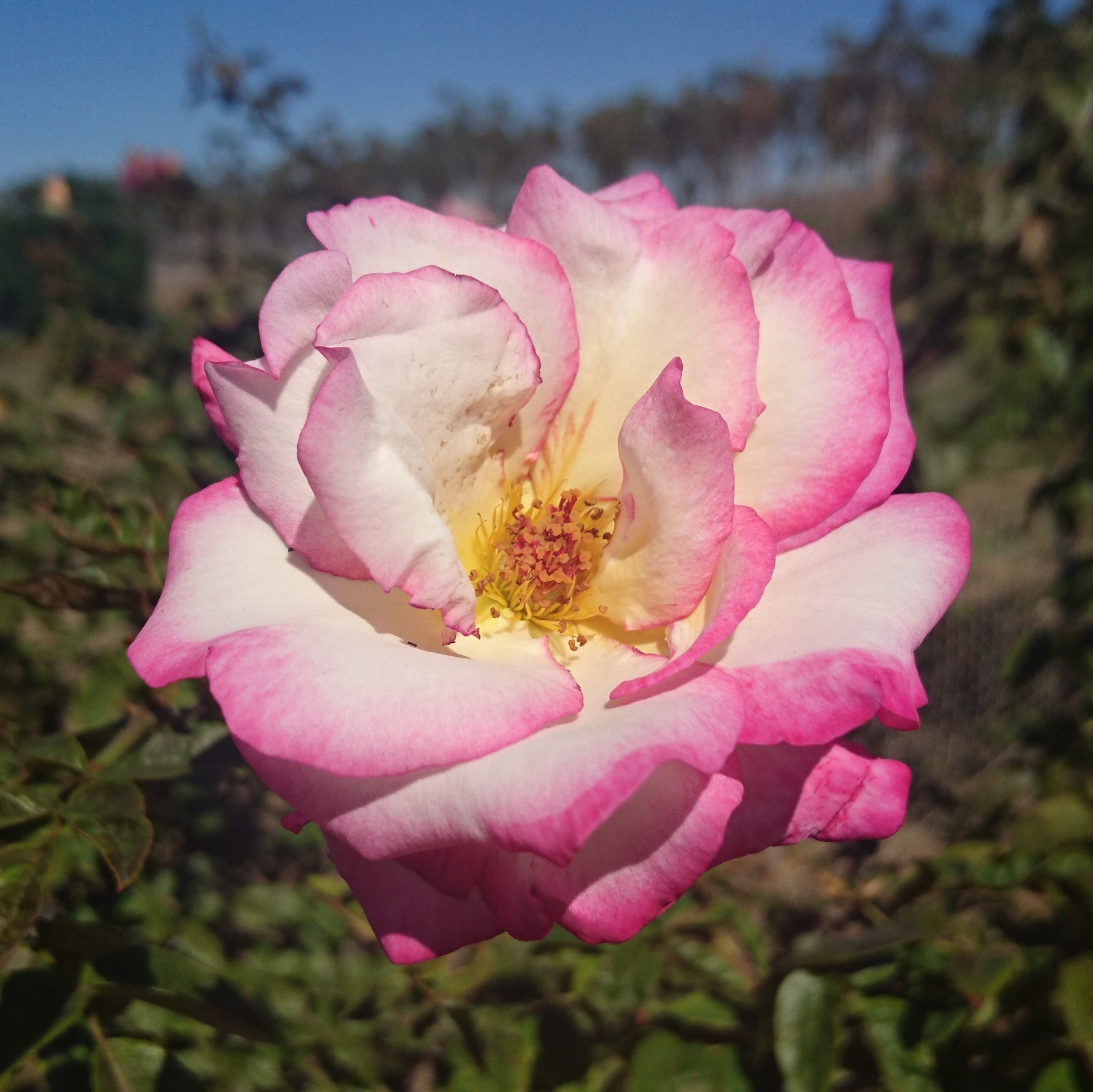 XXI
XXI
Cela ne te donne-t-il pas le vertige
de tourner autour de toi sur ta tige
pour te terminer, rose ronde?
Mais quand ton propre élan t’inonde,
tu t’ignores dans ton bouton.
C’est un monde qui tourne en rond
pour que son calme centre ose
le rond repos de la ronde rose.
XXI
Doesn’t it make you dizzy, rose,
to spin on your stem around yourself
ending in your round self ?
Overwhelmed by your own momentum
you forget the bud that is you.
It’s a world that whirls around,
daring its calm center to hold
the round repose of the round rose.
Rainer Maria Rilke (c 1926) From his series “Les Roses”, Jung Journal: Culture & Psyche,
5:4, 17-21. Translated from French by Susanne Petermann (2011).

 “Yet, no matter how deeply I go down into myself, my God is dark, and like a webbing made of a hundred roots that drink in silence. I know that my trunk rose from his warmth, but that’s all, because my branches hardly move at all near the ground, and just wave a little in the wind.”
― Rainer Maria Rilke
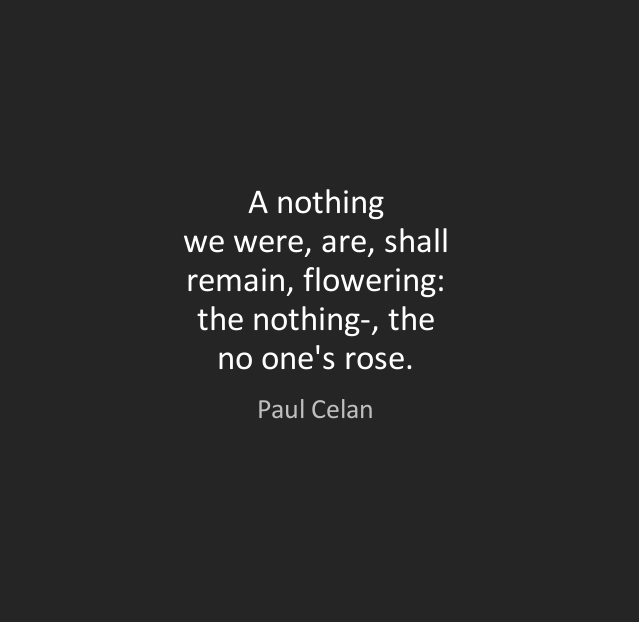
PSALM
No one kneads us again out of earth and clay,
no one incants our dust.
No one.
Blessed art thou, No One.
In thy sight would
we bloom.
In thy
spite.
A Nothing
we were, are now, and ever
shall be, blooming:
the Nothing-, the
No-One’s-Rose.
With
our pistil soul-bright,
our stamen heaven-waste,
our corona red
from the purpleword we sang
over, O over
the thorn.Paul Celan, “Psalm” from Selected Poems and Prose, translated by John Felstiner. Copyright © 2001 by John Felstiner.
The body is the zero point of the world. There, where paths and spaces come to meet, the body is nowhere. It is at the heart of the world, this small utopian kernel from which I dream, I speak, I proceed, I imagine, I perceive things in their place, and I negate them also by the indefinite power of the utopias I imagine. My body is like the City of the Sun. It has no place, but it is from it that all possible places, real or utopian, emerge and radiate.
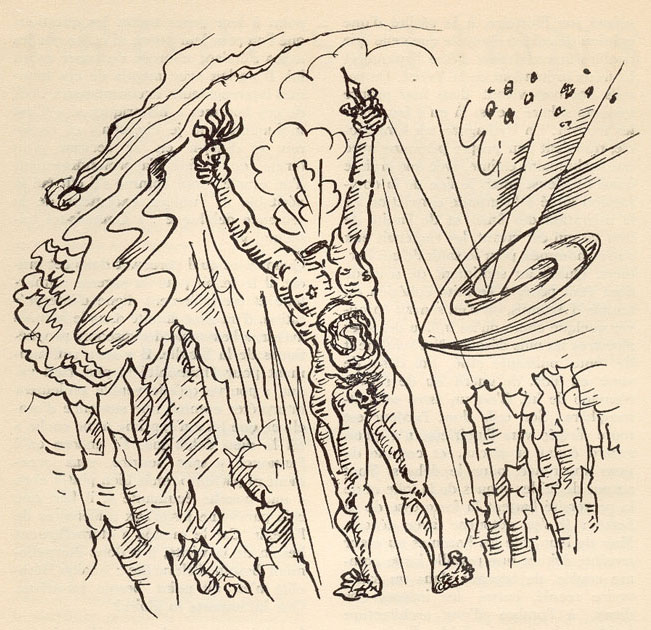
Illustration by Andre Masson, 1936.
Excerpts from the translation by Lucia Allais of a radio lecture Foucault delivered in 1966. Published in Sensorium, MIT Press, 2006, 229-34:
…
My body: it is the place without recourse to which I am condemned. And actually I think that it is against this body (as if to erase it) that all these utopias have come into being. The prestige of utopia–to what does utopia owe its beauty, its marvel? Utopia is a place outside all places, but it is a place where I will have a body without body, a body that will be beautiful, limpid, transparent, luminous, speedy, colossal in its power, infinite in its duration. Untethered, invisible, protected–always transfigured. It may very well be that the first utopia, the one most deeply rooted in the hearts of men, is precisely the utopia of an incorporeal body.
…
No, really, there is no need for magic, for enchantment. There’s no need for a soul, nor a death, for me to be both transparent and opaque, visible and invisible, life and thing. For me to be a utopia, it is enough that I be a body. All those utopias by which I evaded my body–well they had, quite simply, their model and their first application, they had their place of origin, in my body itself, I really was wrong, before, to say that utopias are turned against the body and destined to erase it. They were born from the body itself, and perhaps afterwards they turned against it.
…
My body, in fact, is always elsewhere. It is tied to all the elsewheres of the world. And to tell the truth, it is elsewhere than in the world, because it is around it that things are arranged. It is in relation to it–and in relation to it as if in relation to a sovereign–that there is a below, an above, a right, a left, a forward and a backward, a near and a far. The body is the zero point of the world. There, where paths and spaces come to meet, the body is nowhere. It is at the heart of the world, this small utopian kernel from which I dream, I speak, I proceed, I imagine, I perceive things in their place, and I negate them also by the indefinite power of the utopias I imagine. My body is like the City of the Sun. It has no place, but it is from it that all possible places, real or utopian, emerge and radiate.
…
Maybe it should also be said that to make love is to feel one’s body close in on oneself. It is finally to exist outside of any utopia, with all of one’s density, between the hands of the other. Under the other’s fingers running over you, all the invisible parts of your body begin to exist. Against the lips of the other, yours become sensitive. In front of his half-closed eyes, your face acquires a certitude. There is a gaze, finally, to see your closed eyelids. Love also, like the mirror and like death–it appeases the utopia of your body, it hushes it, it calms it, it encloses it as if in a box, it shuts and seals it. This is why love is so closely related to the illusion of the mirror and the menace of death. And if, despite these two perilous figures that surround it, we love so much to make love, it is because, in love, the body is here.
Rilke chose as his own epitaph this poem:
Rose, oh reiner Widerspruch, Lust,
Niemandes Schlaf zu sein unter soviel
Lidern.
Rose, o pure contradiction, desire
to be no one’s sleep beneath so many lids.
—
“The following selections from David Need’s Roses: The Late French Poetry of Rainer Maria Rilke provide an illuminating glimpse into the ways Rilke uses the rose as motif. The poems seek to elucidate how time’s ceaseless transformations do not rectify or allay the contradictions they invoke. The living rose is “fully awake” but discreet, possessing “many pages / of detailed happiness / we will never read.” Rilke is fascinated by these irreducible relationships: the flower’s vitality belies its eventual death; its blooming won’t diminish the impenetrable density of its petals.” —Dan Holmes
Rilke’s posthumously published Roses calls us into a more intimate relationship with things, asking us to consider the material world as sister of our imagination, rather than nameless patient of our ideas.
—
I
If your blooming sometimes so astonishes us,
happy rose,
it’s that, petal against petal, you rest
within yourself, inside.
Fully awake, your petals, whose surroundings
sleep, though numberless, meet
this silent heart’s tendernesses
which end in these urgent lips.
II
I see you, rose, book half-opened,
having so many pages
of detailed happiness
we will never read. Mage-Book,
which is opened by the wind and can be read,
eyes shut…
from which butterflies scatter, confused
to have had the same ideas.
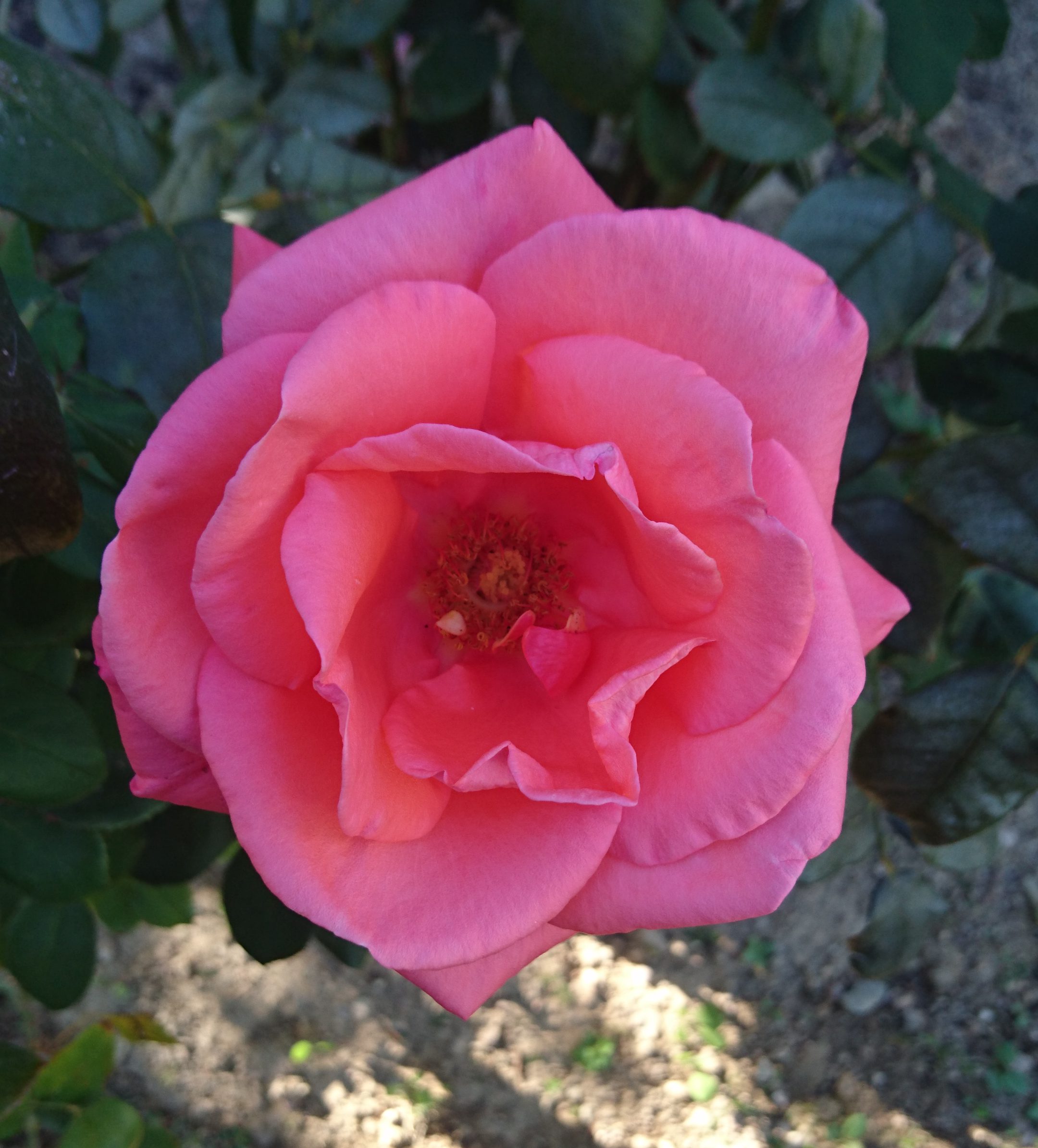
III
Oh Rose, you perfect thing beyond compare,
infinitely restrained
and infinitely lavished, oh, head
of a body with far too much wandering sweetness,
nothing is equal to you, oh you supreme essence
of this inconstant hour,
your perfume wanders all about
this space of love we have scarcely entered.
VI
A single rose, it’s every rose
and this one—the irreplaceable one,
the perfect one—a supple spoken word
framed by the text of things.
How could we ever speak without her
of what our hopes were,
and of the tender moments
in the continual departure.
XVIII
All that we feel, you share,
yet we ignore what happens to you.
There would have to be a hundred butterflies
to read all your pages.
There are ones among you like dictionaries;
those who gather these
are tempted to bind all the pages.
Me? I like the roses which are letters.
XXIII
Rose, come so late, when the bitter nights stop
in their too sidereal brilliance,
Rose, do you divine the facile, perfect pleasures
of your summer sisters?
Day after day, I watch you who hesitate
in your sheath, clasped too tight.
Rose who, when born, imitates in reverse
the slow ways of the dead.
Does your indescribable state make you understand
in a mingling in which all is silenced
that ineffable harmony of nothingness and being
that we ignore?
XXVI
Infinitely reassured
despite so many dangers
with no change ever
in her habits
is the Rose which opens, prelude
to her immeasurable duration.
Do we know how she lives?
One of her days, without doubt,
is all the earth, all
the infinity of this moment.
XXVII
Rose, was it necessary to leave you outdoors,
exquisite dear?
What is a rose doing there, where fate
exhausts itself on us?
Point of turning back. It’s you
who share
with us, desperately, this life, this life
which is not your time.
(Translated from the French by David Need. To read the original, click HERE.)
Roses. Rainer Maria Rilke.Translation by David Need. Illustrations by Clare Johnson.Horse & Buggy Press, 2014.
I can’t quite believe it’s five years today since my beloved grandpa passed on.
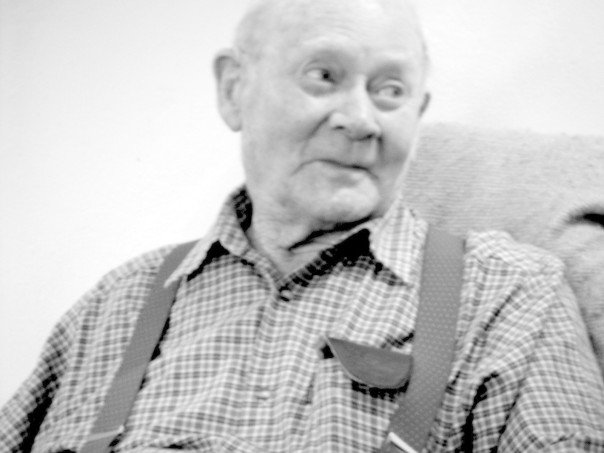
Ed Bean, Melville, December 2006.
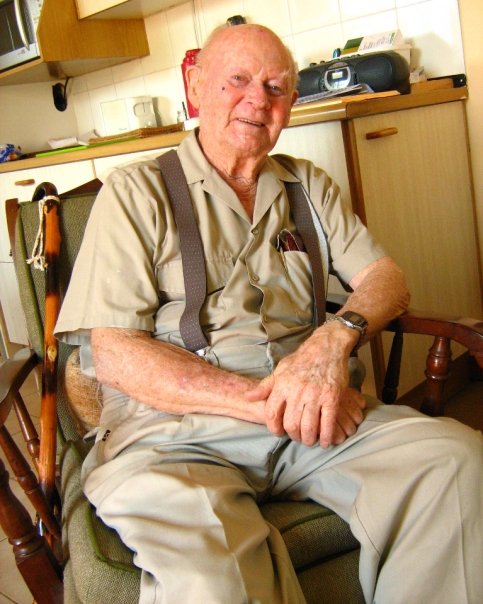
Gramps, behaving himself, 2007.
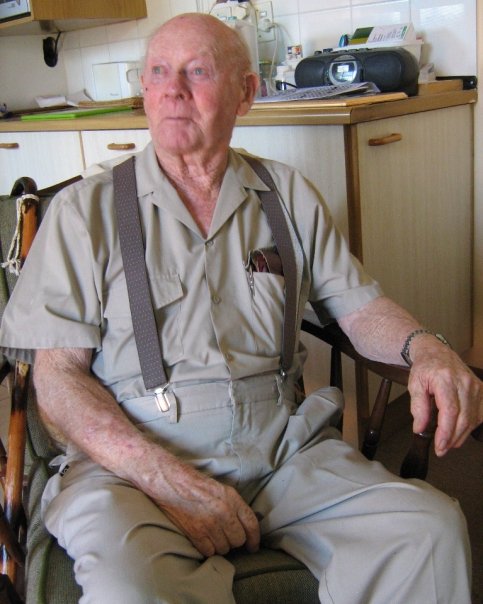
Gramps, posing. 2007.
Marble Machine built and composed by Martin Molin. Video filmed and edited by Hannes Knutsson.
Wintergatan website: www.wintergatan.net.
We have to accomplish the possible in order to touch the impossible. The correct exercise (according to our duty) of the natural faculties of will, love and knowledge is, in relation to spiritual realities, exactly what the movement of the body is in relation to the perception of tangible objects. A paralyzed man lacks this perception.
The fulfilment of our strictly human duty is of the same order as correctness in the work of drafting, translating, calculating, etc. To be careless about this correctness shows a lack of respect for the object. The same thing applies to neglect of duty.
Those things which have to do with inspiration are the only ones which are the better for delay. Those which have to do with natural duty and the will cannot allow of delay.
Precepts are not given for the sake of being practised, but practice is prescribed in order that precepts may be understood. They are scales. One does not play Bach without having done scales. But neither does one play a scale merely for the sake of the scale.
Training. Every time we catch ourselves involuntarily indulging in a proud thought, we must for a few seconds turn the full gaze of our attention upon the memory of some humiliation in our past life, choosing the most bitter, the most intolerable we can think of.
We must not try to change within ourselves or to efface desires and aversions, pleasures and sorrows. We must submit to them passively, just as we do to the impressions we receive from colours, according no greater credit to them than in the latter case. If my window is red I cannot, though I should reason day and night for a whole year, see my room as anything but pink. I know, moreover, that it is necessary, just and right that I should see it thus. At the same time, as far as information about my room goes, I only accord to the pink colour a credit limited by my knowledge of its relation to the window. I must accept in this way and no other the desires and aversions, pleasures and sorrows of every kind which I find within me.
On the other hand, as we have also a principle of violence in us—that is to say the will—we must also, in a limited measure, but to the full extent of that measure, use this violent principle in a violent way; we must compel ourselves by violence to act as though we had not a certain desire or aversion, without trying to persuade our sensibility—compelling it to obey. This causes it to revolt and we have to endure this revolt passively, taste of it, savour it, accept it as something outside ourselves, as the pink colour of the room with the red window.
Each time that we do violence to ourselves in this spirit we make an advance, slight or great but real, in the work of training the animal within us.
Of course if this violence we do ourselves is really to be of use in our training it must only be a means. When a man trains a dog to perform tricks he does not beat it for the sake of beating it, but in order to train it, and with this in view he only hits it when it fails to carry out a trick. If he beats it without any method he ends by making it unfit for any training, and that is what the wrong sort of asceticism does.
Violence against ourselves is only permissible when it is based on reason (with a view to carrying out what we clearly consider to be our duty)—or when it is enjoined on us through an irresistible impulsion on the part of grace (but then the violence does not come from ourselves).
The source of my difficulties lies in the fact that, through exhaustion and an absence of vital energy, I am below the level of normal activity. And if something takes me and raises me up I am lifted above it. When such moments come it would seem to me a calamity to waste them in ordinary activities. At other times, I should have to do violence to myself with a violence which I cannot succeed in mustering.
I could consent to the anomaly of behaviour resulting from this; but I know, or I believe I know, that I should not do so. It involves crimes of omission towards others. And as for myself, it imprisons me.
What method is there then?
I must practise transforming the sense of effort into a passive sense of suffering. Whatever I may have to bear, when God sends me suffering, I am inescapably forced to suffer all that there is to suffer. Why, when it comes to duty, should I not in like manner do all that there is to be done?
Mountains, rocks, fall upon us and hide us far from the wrath of the Lamb. At the present moment I deserve this wrath.
I must not forget that according to Saint John of the Cross the inspirations which turn us from the accomplishment of easy and humble obligations come from the side of evil.
Duty is given us in order to kill the self—and I allow so precious an instrument to grow rusty.
We must do our duty at the prescribed time in order to believe in the reality of the external world. We must believe in the reality of time. Otherwise we are in a dream.
It is years since I recognized this defect in myself and recognized its importance, and all this time I have done nothing to get rid of it. What excuse can I find?
Has it not been growing in me since I was ten years old? But however great it may be, it is limited. That is enough. If it is great enough to take from me the possibility of wiping it out during this life and so attaining to the state of perfection, that must be accepted just as it is, with an acceptance that is full of love. It is enough that I know that it exists, that it is evil and that it is finite. But to know each of these three things effectively and to know them all three together implies the beginning and the uninterrupted continuation of the process of wiping out. If this process does not begin to show itself, it is a sign that I do not know in truth the very thing that I am writing.
The necessary energy dwells in me, since I live by means of it. I must draw it relentlessly out of myself, even though I should die in so doing.
Uninterrupted interior prayer is the only perfect criterion of good and evil. Everything which does not interrupt it is permitted, everything which interrupts it is forbidden. It is impossible to do harm to others when we act in a state of prayer—on condition that it is true prayer. But before reaching that stage, we must have worn down our own will against the observance of rules.
Hope is the knowledge that the evil we bear within us is finite, that the slightest turning of the will towards good, though it should last but an instant, destroys a little of it, and that, in the spiritual realm, everything good infallibly produces good. Those who do not know this are doomed to the torture of the Danaïds.
Good infallibly produces good, and evil evil, in the purely spiritual realm. On the other hand, in the natural realm, that of psychology included, good and evil reciprocally produce each other. Accordingly we cannot have security until we have reached the spiritual realm—precisely the realm where we can obtain nothing by our own efforts, where we must wait for everything to come to us from outside.
__
1 ‘If thou wilt thou canst make me clean’ (Gospel text).
__
Excerpted from Simone Weil‘s Gravity and Grace. First French edition 1947. Translated by Emma Crawford. English language edition 1963. Routledge and Kegan Paul, London.
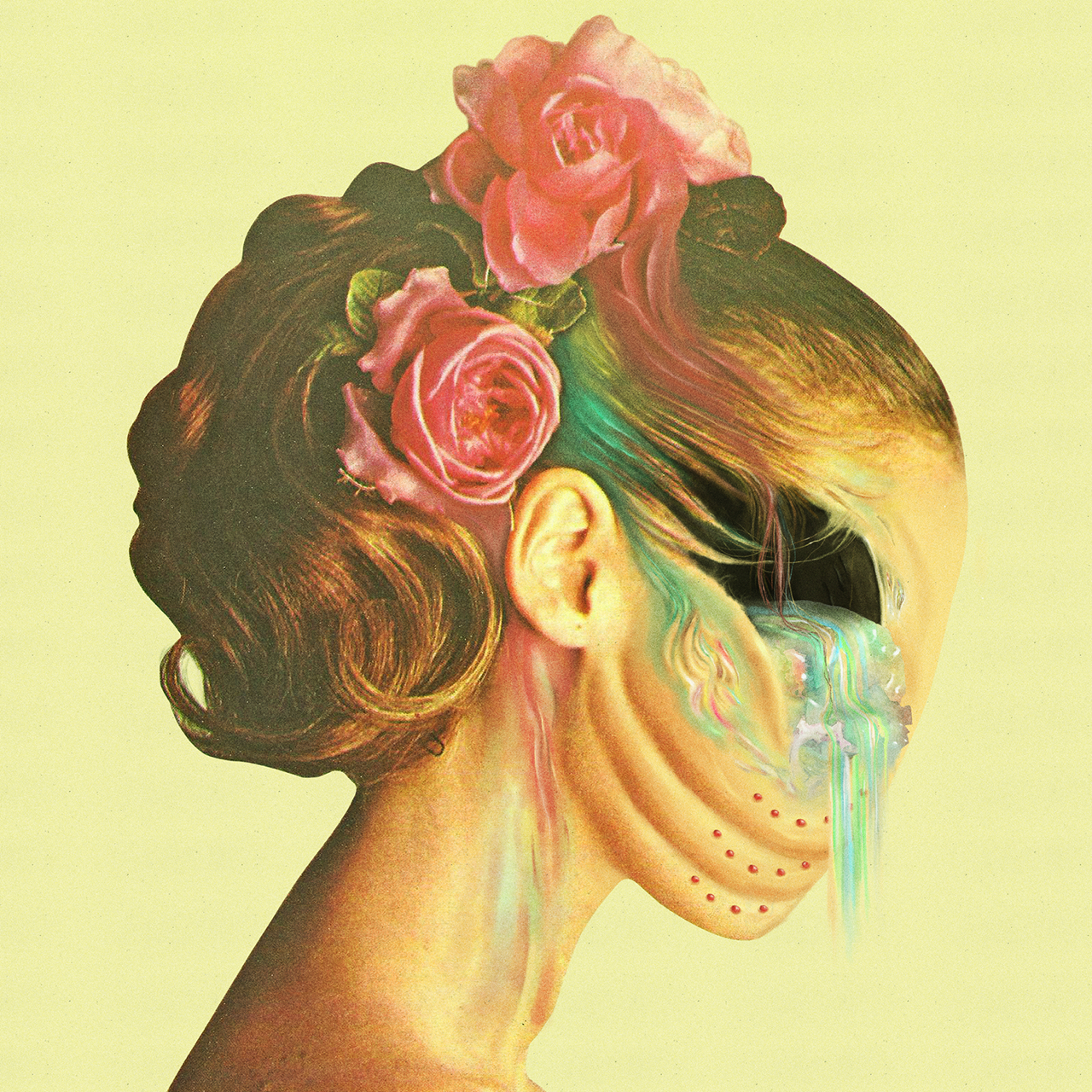
Drømsjel – Side by Side (2016).
Ólöf & Klara Arnalds perform “Mr. Tambourine Man” live from the KEX Hostel in Reykjavik during Iceland Airwaves ’11. Recorded 10/11/2011.
 fleurmach