genna gardini – performance scale (2017)

CN: Chronic illness; Multiple Sclerosis; graphic depictions of bodies and illness.

‘Performance Scale’ is a poem about Genna Gardini’s personal experience of being diagnosed with Multiple Sclerosis (MS). It was adapted into a film by three people close to Gardini and personally affected by MS. The film was created as part of Gardini’s 2016 ICA National Fellowship project MS Independent: Diagnosis.

Written by Genna Gardini
Directed by Gary Hartley
Performed by Amy Louise Wilson
Filmed and edited by Francois Knoetze
A Horses’ Heads Production, created with the assistance of the Institute for Creative Arts.

‘Performance Scale’ was nominated by PEN SA for the 2015 New Voices Award. Read an interview with Genna about the poem here.

Performance Scale
The startling fact was this: my body was offering a precise physiological equivalent to what had been going on in my mind.
Joan Didion, The White Album.

1:

I spent so many years attacking my body,
finding fault in faint abundance, obsessing over every lack
that it didn’t surprise me when I woke up one morning
to discover that it was finally fighting me back.

2:

This was the year you kept killing all the machines you owned
and that is what we refer to as a “running motif”
(and that is what we refer to as “dramatic irony”).

3:

You’ll come to,
conked out on some strange cistern in a Southern Suburbs mall,
your legs hinging against the plastic billboard of the bathroom door,
angled in the jamb like damp cardboard
folded and forced into a full stop.

4:

This is paper as metaphor and limbs as punctuation.
This is the reverse of writing.

5:

You’ll find your phone lying, lesioned, next to you,
a fissure fresh down its crustacean container
like a phantom crack. Like a mime at a wall,
bucking but flat.

6:

You’re tipped against a nurse
whose prophylactic palm pats nerved and certain on your neck.
You have heard her tell the others that they are good girls.
You are not a good girl
because when she sets you straight on the mat, then the scale,
she only says, “Try not to hurl”, then
“You must make a note of your weight”.

7:

The zinging technology of your mouth
steams against the frosted door of the consultation room.

8:

She is warm and alive as an urn at the Church fete
and you are the Styrofoam cup
leaning at her tap.

9:

“Look at it this way, at least you’ll be skinny!”
is quite a funny thing to say to someone
when you think they could be dying.

10:

You began to let your bob grow unbidden,
split and wrought
because if a part of your physicality still chooses to thrive
who are you cut it short?

10:

You make these kinds of jokes.

11:

You are convinced that the nails and hair of a corpse
inch out past conclusion, intrepid as weeds, eternal as worms,
eyeless and edging in all directions, past even the last right
to scratch into life. This is poetry, I thought,
before I was told that I was wrong.

12:

You retract back into yourself, creating the illusion of growth,
moving like a skirt hitched above the knee, balking as if in shock
pressed against the back of the closest ablution block.

13:

At 27, I became blind in one eye
but didn’t realise, because I only notice my mouth.
I thought perhaps a crack had formed between my head
and the cheese-cloth membrane of my disbelief.

14:

Speaking is uncertain and pinpricked.
It is shrouded. It is grief.

15:

Every bad thing that’d happened to me before
was because a man had decided to teach me a lesson
and this is why, after I found out,
I had to reconsider atheism.

14:

You are turning a manuscript into a
fan with the bridging press of pleats.
You are not Keats.

15:

The good doctor made eye-contact with me for the whole beat
which I know is supposed to convey the meaningfulness of the moment
because of my expensive acting degree.

16:

Raisins injected with water.

17:

Thinned the way paint under the slow drip of turpentine is.

18:

I pick this bed because of its proximity to the TV. I am surrounded by women who are in various states of collapse. One spends each day lamenting the canteen’s slopped and unbroiled chicken ala king, sending voicenotes to her daughters to remember to let the cat in. The others cannot walk. I do not want to know them. I do not want to admit that I am one of them. At first, I shuffle, hesitantly, like it’s a character choice, until I realise I am not performing and the gimmick has stuck, gammy. My legs lurch and twitch beyond me.

19:

I look up and there is nothing.

I look down at my own arm, which the nurse has stuck so repeatedly, finding me false and veinless, that the blood clotted before it gathered, like I was a boring meeting they wanted to leave and this might be the exit.

I look up and she is staring straight at me.

Her face is wide and aimed. I pull out my earphones but she is whispering. I say her name. She is mouthing something and I do not know the words but I know that what she is saying is help me and I cannot even help myself

which is why I am plugged into a wall like a faulty Blackberry on charge
which is why I am connected to wet metal that looks like a clothes horse,
which is why I am making so many Joan Crawford wire hanger jokes.
This means help me.

I thumb the call button. The station, which perpindiculates next to us is unlike, myself, without staff. I use the IV as a cane and I call out but the movement of my voice is as interrupted as my legs, cramped, boned by pain. There is a sound here, it rings out, clean and to the side as a scalpel. Panic is a disinfected metal knife, it slices me from myself, each thought going into the brain instead of the mouth, bounced like an email sent to the incorrect address. The prospect of the seizure is thick and electric in her bones, I can see it. The day before, her family had come to visit. Two of them explained how this latest bout was caused of the evil thoughts she allowed to enter her head. She must lose them. My own – which buzzed, a constant cortex, old and reliable as a Cortina that has been veering for years, cutting breaks and ties with whoever passed me by – stay stuck. I wish I had a demon but I don’t, I have my legs and I run past corn rows of beds to find some assistance

20:

towards the end.

pure – no secrets (2017)

‘The journey has been so humbling! The significance of the search for self and internal happiness has been so clear and i’ve started listening in a big way for the very first time. This is my way of saying to myself “Purity i hear you loud and clear”.
This video embodies everything i believe in and stand for as a woman, as an artist and as an ever growing entity. I’ll let the piece speak for itself…’

chantelle gray live at the window (2017)

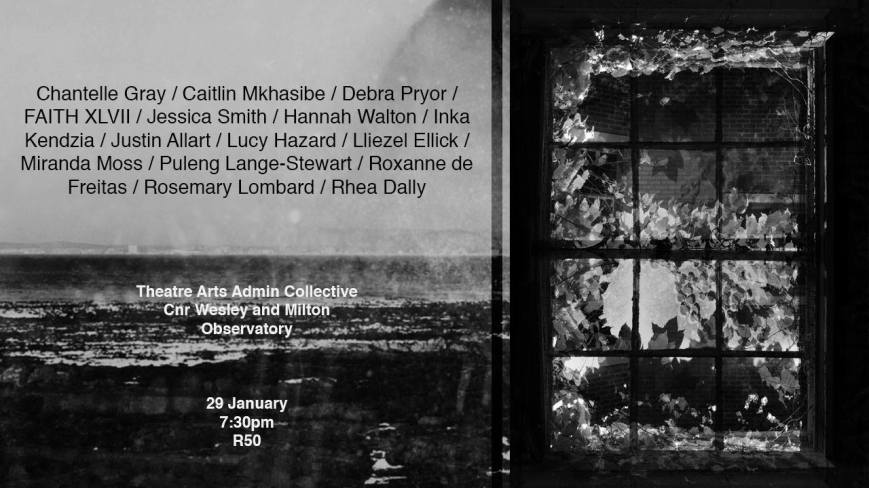
Chantelle Gray live at The Window, an evening of experimental music, performance and visual art at the Theatre Arts Collective, Observatory, Cape Town, 29 January 2017.

Chantelle’s movements are captured by a 3d motion sensor and translated live into controller data for a musical piece written in Supercollider by Aragorn Eloff.

lliezel ellick, rosemary lombard & roxanne de freitas live at the window (2017)

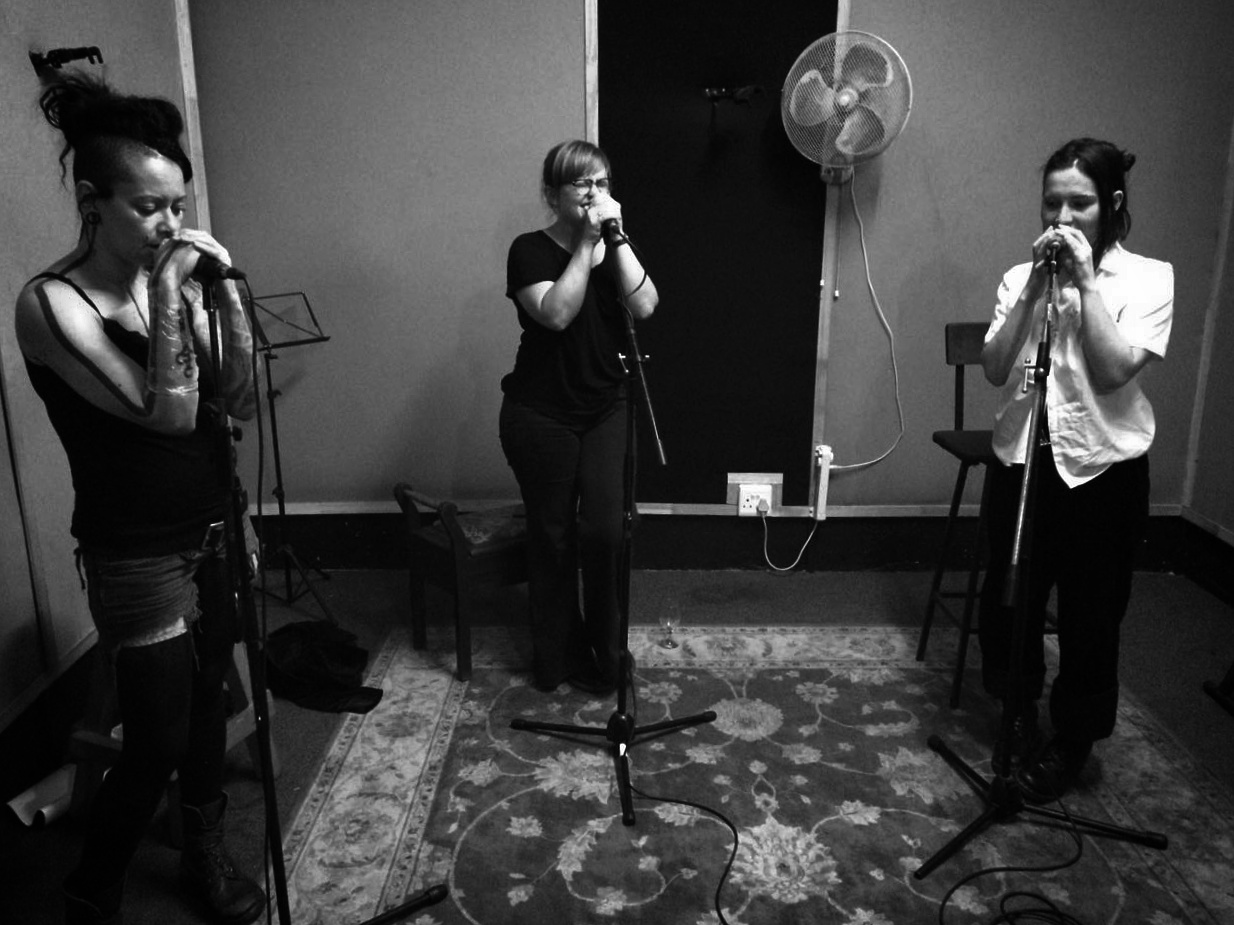
Live non-verbal improvisation performed in absolute darkness, interacting with a cellphone recording from the day before, at The Window, an evening of experimental music, performance and visual art at the Theatre Arts Admin Collective, Observatory, Cape Town, 29 January 2017.

“It’s not easy to improvise… It’s the most difficult thing to do. Even when one improvises in front of a camera or microphone, one ventriloquizes or leaves another to speak in one’s place the schemas and languages that are already there. There are already a great number of prescriptions that are prescribed in our memory and in our culture. All the names are already pre-programmed. It’s already the names that inhibit our ability to ever really improvise. One can’t say what ever one wants, one is obliged more or less to reproduce the stereotypical discourse. And so I believe in improvisation and I fight for improvisation. But always with the belief that it’s impossible. And there where there is improvisation I am not able to see myself. I am blind to myself. And it’s what I will see, no, I won’t see it. It’s for others to see. The one who is improvised here… no, I won’t ever see him.”

— Jacques Derrida, unpublished interview, 1982, reproduced in David Toop’s Into the Maelstrom: Music, Improvisation and the Dream of Freedom: Before 1970, Bloomsbury, 2016, pg 21.

the window – 29 january 2017

fb_img_1485619224214.jpg
Theatre Arts Admin Collective
Methodist Church Hall, Cnr Milton Road & Wesley Street, Observatory, Cape Town
Doors open 19:30
R50

20:00 – Main Hall – Lliezel Ellick / Roxanne De Freitas / Rosemary Lombard (vocal performance piece)
20:25 – Main Hall – Louise Westerhout /Keenan Chas Ahrends / Nicola van Straaten (word/sound/dance)
20:40 – Minor Hall – Inka Kendzia / Jessica Smith (video and live performance)
BREAK
21:00 – Main Hall – Rhea Dally / Justin Allart (sound/noise performance)
21:20 – Main Hall – Lucy Hazard / Puleng Lange-Stewart / Hannah Walton (video with spoken word performance)
21:35 – Minor Hall – FAITH XVII (video installation)
BREAK
22:00 – Main Hall – Chantelle Gray (performance piece)
22:20 – Main Hall – Debra Pryor / Mark O’ Donovan (performance piece)
Continuous – Meeting Room 1 – Sydelle Willow Smith (photography)
Continuous – Meeting Room 2 – Miranda Moss (installation)
___
THE WINDOW

A window I. A partition. A voyeuristic interface between spaces. A civilizing constraint. Gazing. At the window, through the window, beyond the window. The voyeuristic gaze: preconditioned values, assumptions, desire. The civilizing gaze: conditioning values, assumptions, desire. Gazing. An act of memorializing (it suggests spectatorship, a fetishistic surveying; it suggests participation: in memory, in meaning-making).

A window II. A framing device. Commonly used in art and cinema. To exaggerate part or parts of a figure (forms, tones, shapes, shadows). To recompose an image. To slice up the world into smaller, more wieldy frames. To elicit metaphorical interpretation. (The audience is prompted to step into a world of windows.)

A window III. The window. A composing stratagem. (A perspectival arrangement.) A voyeuristic interface between artist and audience. An invitation to interact with the unknown, the unknowable, the known known. It is not a linear perspective of space, but a cutting up of, slicing into, carving through. (It suggests the existence of another, entirely otherworldly, place.)
__

“A concept is a brick. It can be used to build a courthouse of reason. Or it can be thrown through the window.”
– Gilles Deleuze

card on spokes – ribbon tooth (2017)

Written and directed by Sara CF de Gouveia, produced by Reinette Du Toit (aka The Oracle), co-produced by Julia Ramsay, starring Siphokazi Khuboni, DOP Felix Seuffert, make-up/hair Tamara Polakow, and more credits on the YouTube link. Music by Shane Cooper.
(Most of the key players in this project were women – more of this please!)

moment of tangency: a glimpse of what might have been (2017/1913)

The 18 January 2017 word from the Dictionary of Obscure Sorrows.

This resonated for me with a sentiment Rainer Maria Rilke captured in a poem more than a century earlier, in 1913:

You who never arrived
in my arms, Beloved, who were lost
from the start,
I don’t even know what songs
would please you. I have given up trying
to recognize you in the surging wave of
the next moment. All the immense
images in me — the far-off, deeply-felt
landscape, cities, towers, and bridges, and
unsuspected turns in the path,
and those powerful lands that were once
pulsing with the life of the gods–
all rise within me to mean
you, who forever elude me.

You, Beloved, who are all
the gardens I have ever gazed at,
longing. An open window
in a country house– , and you almost
stepped out, pensive, to meet me.
Streets that I chanced upon,–
you had just walked down them and vanished.
And sometimes, in a shop, the mirrors
were still dizzy with your presence and,
startled, gave back my too-sudden image.
Who knows? Perhaps the same
bird echoed through both of us
yesterday, separate, in the evening…

against purity politics

‘“If we want a world with less suffering and more flourishing, it would be useful to perceive complexity and complicity as the constitutive situation of our lives, rather than as things we should avoid,” she writes. We can’t help that we’ve inherited these problems—a warming Earth, institutional racism, increasingly antibiotic-resistant bacteria—nor can we help sometimes perpetuating them. Better to stop pretending at purity, own up to our imperfections, and try to create a morality that works with them.’

READ THIS ARTICLE.

the hauntology of liz mitchell (a long way from home)

This video is one of the things I treasure most on Youtube – it gives me chills every time. It’s a recording of Liz Mitchell of Boney M performing “Motherless Child” live with the Les Humphries singers in the early 1970s. It’s incredible how Mitchell seems to be singing about her removal from herself via recording, its simulacral persistence beyond her existence in that moment… And the wavering picture also speaks of analog decay, arrested and mummified by its digitisation from analog video and (again lossy) upload to Youtube. And then, of course, the song’s origins in slavery and dispossession. So many degrees of loss, so many layers of noise.

the window – 29 january 2017


the-window

Join us! More details HERE. Dedicating my performance to Mark Fisher, who took his own life the other day. His brilliant work, particularly this blog post on hauntology, has been profoundly influential on how I understand archive and aspire to use sound. I’m so sad he is gone.

love & sincerity – holy screaming (1993)

https://youtu.be/Vf49MnP-6Is

Off Come Again II, a Japanese noise compilation released on Furnace Records in 1993, put together by Michio Teshima, head of Vanilla Records, who released the Tawamure – Come Again compilation in 1991.

The liners to the second Come Again compilation call the Japanese noise genre “an exorcism of limits as performed under the clever disguise of music,” a description which effectively negates the idea that the bands which fall under this banner are all about aggression.

pain is… (stephen dwoskin, 1997)

Pain Is…’ (1997) unflinchingly examines the role of pain within society. Attempting “to make an image of pain”, Dwoskin’s film is practical and philosophical.

“Pain Is… combines interviews, archival footage and Dwoskin’s thoughtful voice-over to arrive at a scrupulous anatomy of pain (encompassing disease, dental work and sadomasochism). The interviews range from those who suffer from chronic pain to those who find pleasure in wilfully inflicting pain.” (Dennis Lim, director of Film at Lincoln Centre NYC)

moment (stephen dwoskin, 1969)

https://youtu.be/XMQJVttVRCI

Stephen Dwoskin’s experimental film records in a single continuous shot a woman’s face before, during and after orgasm.

A static camera records, in one single continuous shot, a woman’s face before, during and after orgasm. The act of looking and the limits of the film frame are highlighted in this intimate sexual episode with Tina Fraser. Stephen Dwoskin presents a powerful, personal moment while maintaining a distance and resisting the viewer being subsumed into the action on screen.

Stephen Dwoskin was a highly regarded underground filmmaker who had moved from New York to London and helped to found the London Filmmakers’ Co-op in 1966. His extremely striking work quickly received critical attention and he made several feature-length works through the 1970s with support from German television and the BFI. He continued with both personal and essayistic films and documentaries, and in the 1990s began shooting on handheld video. He made collage films and explored his family’s home movies as he reflected on age, sexuality and the passing of different generations.

Info from the BFI.

cosey fanni tutti ‎– time to tell (1983)

“One must live in the environment of the day and make that environment as free as possible, to as many people as possible. To give people what they already have, but that which has been buried by years of varying human ideals and standards. All COUM asks is that people once more work with themselves, their feelings, and in doing so, become aware of others. It is simple, yet very difficult. The simplest things are the most difficult.”

https://youtu.be/HudSwX3aiyo

rest in peace, pauline oliveros

2016, haven’t you taken enough from us for one year now?

Here is a clip of this brilliant composer and experimental sound artist speaking about the difference between hearing and listening last year:

“In hearing, the ears take in all the sound waves and particles and deliver them to the audio cortex where the listening takes place. We cannot turn off our ears–the ears are always taking in sound information–but we can turn off our listening. I feel that listening is the basis of creativity and culture. How you’re listening, is how you develop a culture, and how a community of people listens, is what creates their culture.”

tibetan book of the dead (1994)

https://youtu.be/nOs8s5zTGnA

Narrated by Leonard Cohen, this two-part documentary series explores ancient teachings on death and dying and boldly visualizes the afterlife according to Tibetan philosophy. Tibetan Buddhists believe that after a person dies, they enter a state of “bardo” for 49 days until a rebirth.

Program 1, The Tibetan Book of the Dead: A Way of Life documents the history of The Tibetan Book of the Dead, tracing the book’s acceptance and use in Europe and North America. Included is remarkable footage of the rites and liturgies surrounding and following the death of a Ladakhi elder as well as the views of the Dalai Lama on life and death. 

Program 2, The Tibetan Book of the Dead: The Great Liberation observes an old Buddhist lama and a 13-year-old novice monk as they guide a deceased person into the afterlife. The passage of the soul is visualized with animation blended into actual location shooting. 

This information comes from the website of the National Film Board of Canada. NFB produced the documentary in co-operation with NHK Japan and Mistral Film of France.

john berger – ways of seeing (1972)

I cannot overstate how immensely John Berger contributed to awakening a critical understanding of Western cultural aesthetics and ethics in me. I feel deeply indebted. Here’s a wonderful recent interview with the man.

On this, his 90th birthday, I thought it fitting to look back on this BAFTA award-winning TV series from 1972, which rapidly became regarded as one of the most influential art programmes ever made. Ways of Seeing is a four-part BBC series of 30-minute films, created chiefly by writer John Berger and producer Mike Dibb. Berger’s scripts were adapted into a book of the same name.

The series and book critique traditional Western cultural aesthetics by raising questions about hidden ideologies in visual images. The series is partially a response to Kenneth Clark’s Civilisation series, which represents a more traditionalist view of the Western artistic and cultural canon.

In the first programme, Berger examines the impact of photography on our appreciation of art from the past.

The second programme deals with the portrayal of the female nude, an important part of the tradition of European art. Berger examines these paintings and asks whether they celebrate women as they really are or only as men would like them to be.

With the invention of oil paint around 1400, painters were able to portray people and objects with an unprecedented degree of realism, and painting became the ideal way to celebrate private possessions. In this programme, John Berger questions the value we place on that tradition.

In this programme, Berger analyses the images of advertising and publicity and shows how they relate to the tradition of oil painting – in moods, relationships and poses.

More John Berger on Fleurmach:

John Berger on being born a woman

John Berger – “Les Petites Chaises”

What I rail against, impotently, and wish I could embrace