“like me, you must suffer in rhythm”

The truth is that I can’t put down my pen: I think I’m going to have the Nausea and I feel as though I’m delaying it while writing. So I write whatever comes into my mind. Madeleine, who wants to please me, calls to me from the distance, holding up a record:

“Your record, Monsieur Antoine, the one you like, do you want to hear it for the last time?”

“Please.”

I said that out of politeness, but I don’t feel too well disposed to listen to jazz. Still, I’m going to pay attention because, as Madeleine says, I’m hearing it for the last time: it is very old, even too old for the provinces; I will look for it in vain in Paris. Madeleine goes and sets it on the gramophone, it is going to spin; in the grooves, the steel needle is going to start jumping and grinding and when the grooves will have spiralled it into the centre of the disc it will be finished and the hoarse voice singing “Some of these days” will be silent forever.

It begins. To think that there are idiots who get consolation from the fine arts. Like my Aunt Bigeois:
“Chopin’s Preludes were such a help to me when your poor uncle died.” And the concert halls overflow with humiliated, outraged people who close their eyes and try to turn their pale faces into receiving antennas. They imagine that the sounds flow into them, sweet, nourishing, and that their sufferings become music, like Werther; they think that beauty is compassionate to them. Mugs. I’d like them to tell me whether they find this music compassionate. A while ago I was certainly far from swimming in beatitudes. On the surface I was counting my money, mechanically. Underneath stagnated all those unpleasant thoughts which took the form of unformulated questions, mute astonishments and which leave me neither day nor night. Thoughts of Anny, of my wasted life. And then, still further down, Nausea, timid as dawn. But there was no music then, I was morose and calm.

All the things around me were made of the same material as I, a sort of messy suffering. The world was so ugly, outside of me, these dirty glasses on the table were so ugly, and the brown stains on the mirror and Madeleine’s apron and the friendly look of the gross lover of the patronne, the very existence of the world so ugly that I felt comfortable, at home.

Now there is this song on the saxophone. And I am ashamed. A glorious little suffering has just been born, an exemplary suffering. Four notes on the saxophone. They come and go, they seem to say: You must be like us, suffer in rhythm. All right! Naturally, I’d like to suffer that way, in rhythm, without complacence, without self-pity, with an arid purity. But is it my fault if the beer at the bottom of my glass is warm, if there are brown stains on the mirror, if I am not wanted, if the sincerest of my sufferings drags and weighs, with too much flesh and the skin too wide at the same time, like a sea elephant, with bulging eyes, damp and touching and yet so ugly? No, they certainly can’t tell me it’s compassionate—this little jewelled pain which spins around above the record and dazzles me. Not even ironic: it spins gaily, completely self-absorbed; like a scythe it has cut through the drab intimacy of the world and now it spins and all of us, Madeleine, the thick-set man, the patronne, myself, the tables, benches, the stained mirror, the glasses, all of us abandon ourselves to existence, because we were among ourselves, only among ourselves, it has taken us unawares, in the disorder, the day to day drift: I am ashamed for myself and for what exists in front of it.

It does not exist. It is even an annoyance; if I were to get up and rip this record from the table which holds it, if I were to break it in two, I wouldn’t reach it. It is beyond—always beyond something, a voice, a violin note. Through layers and layers of existence, it veils itself, thin and firm, and when you want to seize it, you find only existants, you butt against existants devoid of sense. It is behind them: I don’t even hear it, I hear sounds, vibrations in the air which unveil it. It does not exist because it has nothing superfluous: it is all the rest which in relation to it is superfluous. It is.

And I, too, wanted to be. That is all I wanted; this is the last word. At the bottom of all these attempts which seemed without bonds, I find the same desire again: to drive existence out of me, to rid the passing moments of their fat, to twist them, dry them, purify myself, harden myself, to give back at last the sharp, precise sound of a saxophone note. That could even make an apologue: there was a poor man who got in the wrong world. He existed, like other people, in a world of public parks, bistros, commercial cities and he wanted to persuade himself that he was living somewhere else, behind the canvas of paintings, with the doges of Tintoretto, with Gozzoli’s Florentines, behind the pages of books, with Fabrizio del Dongo and Julien Sorel, behind the phonograph records, with the long dry laments of jazz. And then, after making a complete fool of himself, he understood, he opened his eyes, he saw that it was a misdeal: he was in a bistro, just in front of a glass of warm beer. He stayed overwhelmed on the bench; he thought: I am a fool. And at that very moment, on the other side of existence, in this other world which you can see in the distance, but without ever approaching it, a little melody began to sing and dance: “You must be like me; you must suffer in rhythm.”

The voice sings:

Some of these days
You’ll miss me, honey

Someone must have scratched the record at that spot because it makes an odd noise. And there is something that clutches the heart: the melody is absolutely untouched by this tiny coughing of the needle on the record. It is so far—so far behind. I understand that too: the disc is scratched and is wearing out, perhaps the singer is dead; I’m going to leave, I’m going to take my train. But behind the existence which falls from one present to the other, without a past, without a future, behind these sounds which decompose from day to day, peel off and slip towards death, the melody stays the same, young and firm, like a pitiless witness.

The voice is silent. The disc scrapes a little, then stops. Delivered from a troublesome dream, the cafe ruminates, chews the cud over the pleasure of existing. The patronne’s face is flushed, she slaps the fat white cheeks of her new friend, but without succeeding in colouring them. Cheeks of a corpse. I stagnate, fall half-asleep. In fifteen minutes I will be on the train, but I don’t think about it. I think about a clean-shaven American with thick black eyebrows, suffocating with the heat, on the twenty-first floor of a New York skyscraper. The sky burns above New York, the blue of the sky is inflamed, enormous yellow flames come and lick the roofs; the Brooklyn children are going to put on bathing drawers and play under the water of a fire-hose. The dark room on the twenty-first floor cooks under a high pressure. The American with the black eyebrows sighs, gasps and the sweat rolls down his cheeks. He is sitting, in shirtsleeves, in front of his piano; he has a taste of smoke in his mouth and, vaguely, a ghost of a tune in his head. “Some of these days.” Continue reading
la nausée

Hyperobjects are objects that are massively distributed in time and space: Plutonium (half-life of 24 100 years), global warming (7% of effects still occurring 100 000 years later), the BP oil slick. This massive distribution does various things to our perception of them, and to our ideas about what constitutes an “environment” and the significance of being human—among others.

Oil made me develop the metaphor that hyperobjects are viscous. Viscosity here means that the more you know about a hyperobject, the more entangled with it you realize you already are.

Hyperobjects thus push the reset button on what phenomenology (Levinas, Graham Harman) calls sincerity. Sincerity means that in the words of Buckaroo Banzai, “Wherever you go, there you are.” When I’m typing this, I’m totally absorbed in the typing. When I’m experiencing irony, there I am, feeling ironic. Sincerity eats irony! In Lacanian, “there is no metalanguage.”

This is a very curious phenomenon, one that confirms my suspicion that we have entered an ecological era. A few moments ago we were delighting in our ironic free play. Now it seems we’re stuck to the mirror, like Neo in that scene in The Matrix.

We are caught in object-ive existence whether we like it or not.

– Timothy Morton, from his fascinating blog, ECOLOGY WITHOUT NATURE

________________________

A baby vomits curdled milk. She learns to distinguish between the vomit and the not-vomit, and comes to know the not-vomit as self. Every subject is formed at the expense of some viscous, slightly poisoned substance, possibly teeming with bacteria, rank with stomach acid. The parent scoops up the mucky milk in a tissue and flushes the wadded package down the toilet.

Now we know where it goes.

For some time we may have thought that the U-bend in the toilet was a convenient curvature of ontological space that took whatever we flush down it into a totally different dimension called Away, leaving things clean over here. Now we know better: instead of the mythical land Away, we know the waste goes to the Pacific Ocean or the wastewater treatment facility.

Knowledge of the hyperobject Earth, and of the hyperobject biosphere, presents us with viscous surfaces from which nothing can be forcibly peeled. There is no Away on this surface, no here and no there. In effect, the entire Earth is a wadded tissue of vomited milk.

— Timothy Morton, from “Hyperobjects” (University of Minnesota Press, 2013)

a protest jam from istanbul this week

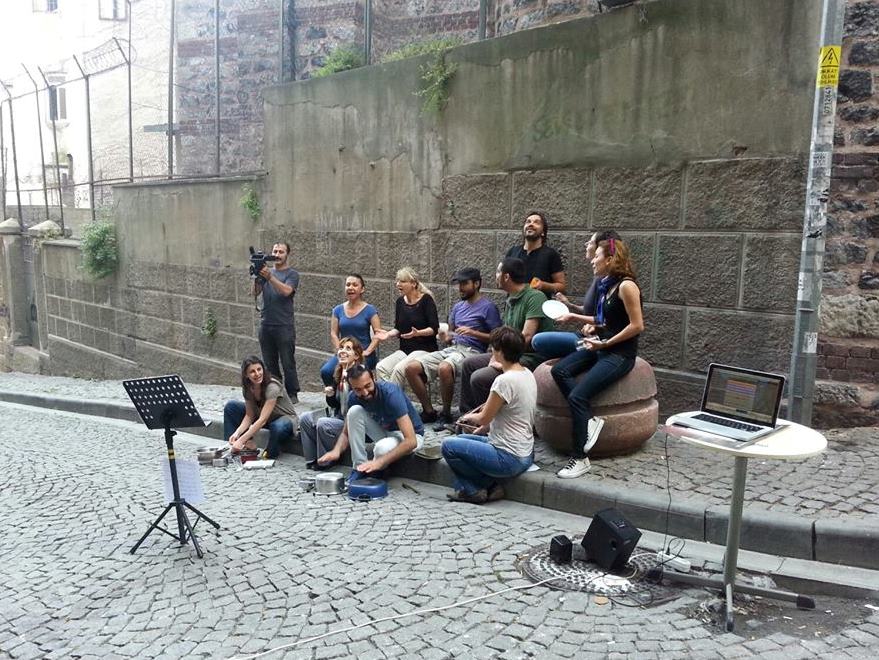
Kardeş Türküler perform “Tencere Tava Havası” (“Sound of Pots and Pans”) in the streets of Istanbul this week. Check out the Kardeş Türküler’s website HERE for background on the group, which came into being in 1993 as a concert project by the Boğaziçi University Folklore Club.

And, here’s an explanation of the penguin footage later in the video from a Youtube comment:

“If people don’t know about it, the penguins mock mainstream media that has very close relations to the government. Main news channels have been nearly totally silent about the protests, not wanting to be hated by the government. One main news channel (CNNTurk) preferred to broadcast a penguin documentary while all of these are happening. Similar attitude from others. After being severely mocked by protesters, an apology and more coverage came.”

Istanbul group Kardeş Türküler recording the video "Pots & Pans" in response to the Taksim/Gezi Park protests this week.

Istanbul group Kardeş Türküler recording the video “Pots & Pans” in response to the Taksim/Gezi Park protests this week.

gramsci on being immersed in life

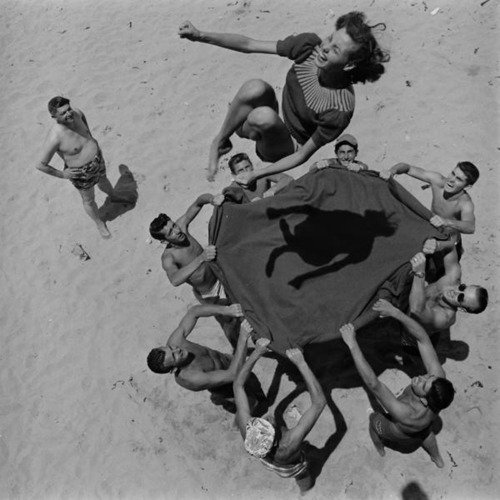
human trampoline

“Give up to life your every action, every ounce of faith. Throw all your best energies, sincerely and disinterestedly, into life. Immerse yourself, living creatures that you are, in the live, pulsing tide of human existence, until you feel at one with it, until it floods through you, and you feel your individual personality as an atom within a body, a vibrating particle within a whole, a violin-string which receives and echoes all the symphonies of history; of that history which, in this way, you’re helping to create.”

– Antonio Gramsci

nevermind the bollocks, here’s deleuze and guattari

[E]ffective differences pass between the lines, even though they are all immanent to one another, all entangled in one another. This is why the question of schizoanalysis or pragmatics, micropolitics itself, never consists in interpreting, but merely in asking what are your lines, individual or group, and what are the dangers on each.

JR at Desperadoes', Observatory, Cape Town, 15  May 2013. Photo: Rosemary Lombard

JR around the pole at Desperado’s Saloon, Observatory, Cape Town, 15 May 2013. Photo: Rosemary Lombard

What are your rigid segments, your binary and overcoding machines? For even these are not given to you ready-made; we are not simply divided up by binary machines of class, sex, or age: there are others which we constantly shift, invent without realising it. And what are the dangers if we blow up these segments too quickly? Wouldn’t this kill the organism itself, the organism which possesses its own binary machines, even in its nerves and its brain?

What are your supple lines, what are your fluxes and thresholds? Which is your set of relative deterritorialis­ations and correlative reterritorialisations? And the distribution of black holes: which are the black holes of each one of us, where a beast lurks or a microfascism thrives?

— Deleuze and Guattari: Toward Freedom. Read more HERE.
Sent from my BlackBerry® wireless device

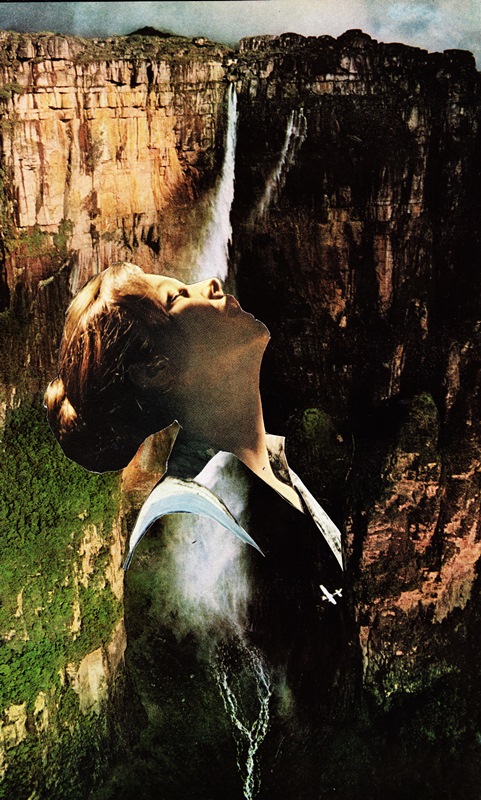
erin case – to be absolved

Erin Case - "To be absolved". Analogue collage.

Erin Case – “To be absolved”.  Analogue collage.

Erin Case is an award winning visual artist based in Midland, Michigan, with a focus in collage. Working in both analog and digital methods, she is regarded for the marriage of surrealism, sincerity, and evocativeness that is present throughout her body of work. Check out more of her work HERE.

rose window


Erin Case - "Rose Window". Digital collage, 2013

Erin Case:”Rose Window”
Digital collage, 2013

Erin Case is an award winning visual artist based in Midland, Michigan, with a focus in collage. Working in both analog and digital methods, she is regarded for the marriage of surrealism, sincerity, and evocativeness that is present throughout her body of work. Check out more of her work HERE.

erin case – haircut eight

Erin Case: "Haircut 8" Digital collage with Andrew Tamlyn, 2012

Erin Case: “Haircut 8”
Digital collage with Andrew Tamlyn, 2012

Erin Case is an award winning visual artist based in Midland, Michigan, with a focus in collage. Working in both analog and digital methods, she is regarded for the marriage of surrealism, sincerity, and evocativeness that is present throughout her body of work. Check out more of her work HERE.

paul simon and wes anderson go cuckoo in april

From Sounds of Silence, Simon and Garfunkel’s second album, released on January 17, 1966. It had also appeared prior to this on a UK-only release, The Paul Simon Songbook, in August 1965.

The song bears a structural resemblance to a traditional English rhyme, “Cuckoo, cuckoo, what do you do?”, a phenology of the Common Cuckoo from April to September:

Cuckoo, Cuckoo, what do you do?
“In April I open my bill;
In May I sing night and day;
In June I change my tune
In July far far I fly;
In August away I must.”
Cuckoo, Cuckoo!

This choral version of the rhyme was featured on the soundtrack to Wes Anderson’s 2012 film, Moonrise Kingdom:

laurence binyon – the burning of the leaves

Now is the time for the burning of the leaves,
They go to the fire; the nostrils prick with smoke
Wandering slowly into the weeping mist.
Brittle and blotched, ragged and rotten sheaves!
A flame seizes the smouldering ruin, and bites
On stubborn stalks that crackle as they resist.
The last hollyhock’s fallen tower is dust:
All the spices of June are a bitter reek,
All the extravagant riches spent and mean.
All burns! the reddest rose is a ghost.
Sparks whirl up, to expire in the mist: the wild
Fingers of fire are making corruption clean.
Now is the time for stripping the spirit bare,
Time for the burning of days ended and done,
Idle solace of things that have gone before,
Rootless hope and fruitless desire are there:
Let them go to the fire with never a look behind.
That world that was ours is a world that is ours no more.
They will come again, the leaf and the flower, to arise
From squalor of rottenness into the old splendour,
And magical scents to a wondering memory bring;
The same glory, to shine upon different eyes.
Earth cares for her own ruins, naught for ours.
Nothing is certain, only the certain spring.

Thanks to Karolina O’Donaghue for this poem.

danielle leduc – the anti-preneur manifesto

adbusters_106_antripreneur_SI don’t want to be a designer, a marketer, an illustrator, a brander, a social media consultant, a multi-platform guru, an interface wizard, a writer of copy, a technological assistant, an applicator, an aesthetic king, a notable user, a profit-maximizer, a bottom-line analyzer, a meme generator, a hit tracker, a re-poster, a sponsored blogger, a starred commentator, an online retailer, a viral relayer, a handle, a font or a page. I don’t want to be linked in, tuned in, ‘liked’, incorporated, listed or programmed. I don’t want to be a brand, a representative, an ambassador, a bestseller or a chart-topper. I don’t want to be a human resource or part of your human capital.

I don’t want to be an entrepreneur of myself.

Don’t listen to the founders, the employers, the newspapers, the pundits, the editors, the forecasters, the researchers, the branders, the career counsellors, the prime minister, the job market, Michel Foucault or your haughty brother in finance – there’s something else!

I want to be a lover, a teacher, a wanderer, an assembler of words, a sculptor of immaterial, a maker of instruments, a Socratic philosopher and an erratic muse. I want to be a community centre  a piece of art, a wonky cursive script and an old-growth tree! I want to be a disrupter, a creator, an apocalyptic visionary, a master of reconfiguration, a hypocritical parent, an illegal download and a choose-your-own-adventure! I want to be a renegade agitator! A licker of ice cream! An organiser of mischief! A released charge! A double jump on the trampoline! A wayward youth! A volunteer! A partner.

I want to be a curator of myself, an anti-preneur, a person.

Unlimited availabilities. No followers required. Only friends.

~ Danielle Leduc

First published HERE (thanks to Emma Arogundade for sharing it on Facebook).
Note from the author:
I actually didn’t write this as an ‘anti-preneurial manifesto’ – it was more of a poetic rant written in frustration from combing through the online job market. I meant it as less of a takedown of capitalism and more of a critique of how we are told to sell ourselves as brands, to self-promote, in order to make it in this world, and as such we allow our job titles to define us to a certain extent. I think all of us are many of the things I listed towards the end, but these things don’t appear as marketable skills in a neoliberal economy with a tight and precarious job market. We are not our resumes, is all.

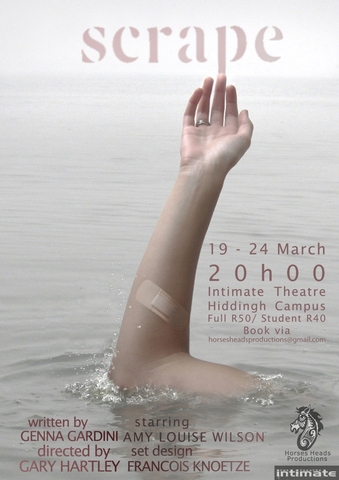
“scrape”: it’s brilliant – go and see it!

This play is on for two more nights at the Intimate Theatre on UCT’s Hiddingh Campus. I went last night. It is an absolute tour de force – insightful, brutal, awkward, compassionate, hilarious. If you are in Cape Town, GO, GO, GO!

SCRAPE_REAL_large

Scrape is the story of an everyday woman suffering from an unusual condition.

After falling and scraping herself, Beth discovers that not only does skin heal, it can sometimes do so with a vengeance.

This one-person show, performed by Amy Louise Wilson, is presented by writer Genna Gardini and director Gary Hartley. It features sound design by musician and performance artist SIYA IS YOUR ANARCHIST and set design by 2011 ABSA L’Atelier and Sasol New Signatures finalist Francois Knoetze.

Scrape is presented by the new theatre company Horses’ Heads Productions. The production will preview at the Intimate Theatre from 19 – 24 March 2013 and go on to feature as part of The Cape Town Edge programme at this year’s National Arts Festival. Scrape will then return to the Mother City for a run at The Alexander Bar in August 2013.

Scrape, 19 – 24 March 2013, 20:00
The Intimate Theatre on UCT’s Hiddingh Campus
R50 general/ R40 students
To book tickets, contact 0827765490 or horsesheadsproductions@gmail.com

Director:
Gary Hartley is a theatre-maker, performer and television producer based in Cape Town. In 2007 he graduated from Rhodes University with a distinction in Drama. His production, WinterSweet, made in collaboration with The Runaway Buni Collective and writer Genna Gardini, won a Standard Bank Ovation Encore prize at the 2012 National Arts Festival. He currently works as a writer and producer at Greenwall Productions and has produced for shows such as The Showbiz Report, The Close Up and Screentime with Nicky Greenwall.

Playwright:
Genna Gardini is a writer based in Cape Town. Her play WinterSweet was produced in collaboration with Gary Hartley and The Runaway Buni Collective for the 2012 National Arts Festival and won a Standard Bank Encore Ovation Award. She has curated The Readings Upstairs, a monthly series of play readings held upstairs at the Alexander Bar, since 2012. Her work as a poet has been published widely both locally and internationally. Gardini has presented papers at the 2012 AFTA Annual International Conference and GIPCA Directors and Directing: Playwrights Symposium. She also works as a freelance arts writer for various publications, including the Cape Times and Art South Africa magazine. She is currently completing her MA Theatre-making (Playwriting) at UCT.

Performer:
Amy Louise Wilson is an actress living in Cape Town. She has studied Acting and Contemporary Performance at Rhodes University; Processes of Performance and Shakespeare Studies at the University of Leeds and Theatre and Performance at the University of Cape Town. Recent performances include The Petticoat Chronicle (dir. Lynne Maree), Voiced (under Clare Stopford) and 2012’s Standard Bank Encore Ovation Award winning Wintersweet (dir. Robert Haxton). She will be presenting her paper ‘Performance, Persona and Identity in the work of Die Antwoord’ at the New Directions in South African Theatre Today: Circulation, Evolutions, Adaptations symposium in France later this year.

Set Designer:
Francois Knoetze is an artist based in Cape Town. Having recently completed his Honours in Fine Art at Rhodes University, he is currently pursuing his MFA at Michaelis. His work is multidisciplinary, incorporating performance, assemblage sculpture and film. In 2011 he was a finalist in both the Absa L’Atelier and Sasol New Signatures competitions. Last year he was named one of Art South Africa magazine’s Bright Young Things. He has been involved in numerous theatre productions as set designer and puppet-maker, including works by the UBOM! Eastern Cape Theatre Company.

Sound designer:
Writer, journalist, musician and filmmaker SIYA IS YOUR ANARCHIST has written for publications like the Sunday World, The Event and The Callsheet. He has performed at the National Arts Festival and written several plays. He has also worked for TV shows such as Rhythm City (E-TV), Font (SABC 3), Breaking New Ground (SABC 2). He directed an SABC2 documentary on Aids activist Zackie Achmat called His Husband in 2011 and has exhibited multi-media installations for Goodman Gallery Cape Town and GIPCA Live Art Festival. He now works for Entertainment Africa as a features writer and is combining writing, music, art and media for the release of his upcoming musical EP.

For more information, see:
Scrape Facebook event
Horses’ Heads Productions Facebook page:
Horses’ Heads Twitter

anne carson – the glass essay

An incredible poem… Thank you to Kate Highman for turning me on to Anne Carson.
I
I can hear little clicks inside my dream.
Night drips its silver tap
down the back.
At 4 A.M. I wake. Thinking
of the man who
left in September.
His name was Law.
My face in the bathroom mirror
has white streaks down it.
I rinse the face and return to bed.
Tomorrow I am going to visit my mother.
SHE
She lives on a moor in the north.
She lives alone.
Spring opens like a blade there.
I travel all day on trains and bring a lot of books—
some for my mother, some for me
including The Collected Works Of Emily Brontë.
This is my favourite author.
Also my main fear, which I mean to confront.
Whenever I visit my mother
I feel I am turning into Emily Brontë,
my lonely life around me like a moor,
my ungainly body stumping over the mud flats with a look of transformation
that dies when I come in the kitchen door.
What meat is it, Emily, we need?

pablo neruda – too many names

32-Eruption

Albane Simon – ‘Eruption’

Mondays are meshed with Tuesdays
and the week with the whole year.
Time cannot be cut
with your weary scissors,
and all the names of the day
are washed out by the waters of night.

No one can claim the name of Pedro,
nobody is Rosa or Maria,
all of us are dust or sand,
all of us are rain under rain.
They have spoken to me of Venezuelas,
of Chiles and of Paraguays;
I have no idea what they are saying.
I know only the skin of the earth
and I know it is without a name.

When I lived amongst the roots
they pleased me more than flowers did,
and when I spoke to a stone
it rang like a bell.

It is so long, the spring
which goes on all winter.
Time lost its shoes.
A year lasts four centuries.

When I sleep every night,
what am I called or not called?
And when I wake, who am I
if I was not I while I slept?

This means to say that scarcely
have we landed into life
than we come as if new-born;
let us not fill our mouths
with so many faltering names,
with so many sad formalities,
with so many pompous letters,
with so much of yours and mine,
with so much signing of papers.

I have a mind to confuse things,
unite them, bring them to birth,
mix them up, undress them,
until the light of the world
has the oneness of the ocean,
a generous, vast wholeness,
a crackling, living fragrance.

taking back our city #takingbackourcity #dicktatorfreejozi #genderfreesa

Participate in the creation of the city you want to live in. #takingbackourcity #dicktatorfreejozi #genderfreesa
Image
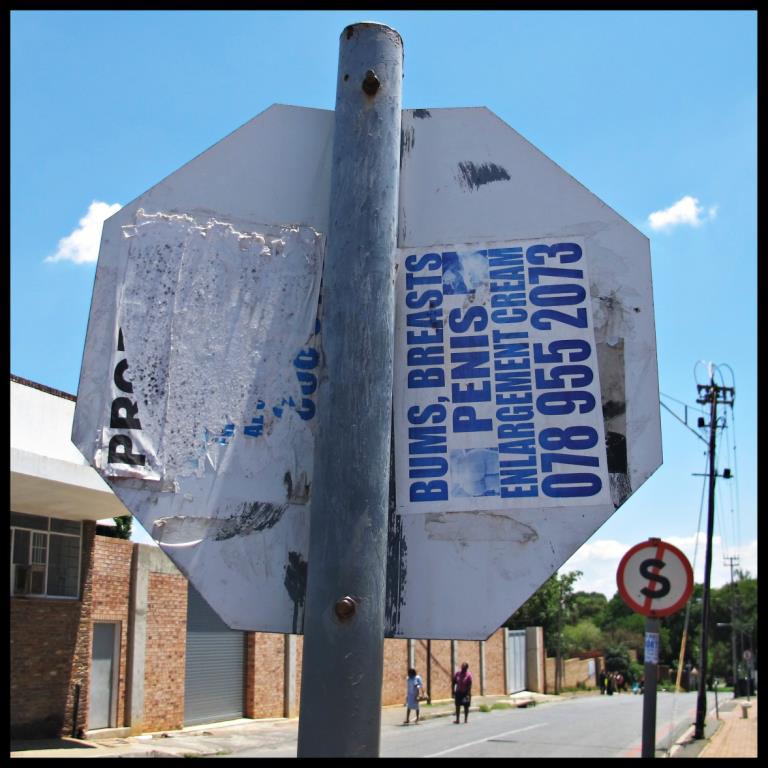
I don’t just live my life, I create my life. And after almost a year of creating images reflecting my vision of the city and its inhabitants, I no longer just want to reflect the city, but create it. Just as I need to be an activist in my own life and my own identity to fully be alive, as an artist, I need to be an artivist, actively participating in the creation of the city I want to live in. Joburg is not just a city, it is my city; it is my home. And as an artivist it is not just a place I want to live in, but a place I actively want to participate in creating.The idea for #takingbackourcity was born out of my return to Joburg from my first real visit to Cape Town. My return to Jozi from CT shocked me with the everyday messages and symbols we Joburgers take for granted; the messages and symbols that shape the collective unconscious of our city and our people. The ‘Penis Enlargement’ posters that adorn every robot, electrical box and street pole were the most glaring example. I asked myself: what does this say about Joburg? what does this say about Joburgers?

We are a city obsessed with the power of the phallus; a presidency obsessed with the symbol and virility and representation of the phallus; a people whose penis size reflects its masculinity, whose masculinity reflects its identity. The effect of this overtly embodied and gendered mantra on our collective unconscious plays itself out in our lives daily.

More so than with other cultures, Joburg constantly genders us. It equates our identity with our gender, places our gendered attributes – our penises, our breasts – under the microscope, and finds us wanting. Those who are found wanting and those who pass the grade play out the script of the power struggle that has been written for us. And as with the Battle of the Sexes in decades before us, the Battle of the Genders brings with it a long, long casualty list. Being part of the female-bodied and -gendered community, as well as the LGBTIQ community, from where so many of the casualties come, I cannot be part of an existence or an art that hides behind the privilege of aesthetic.

Those of you who follow my work know that I believe that gender is nothing more than a social construction and that I perform my gender through my identity and my art daily. But playing with gender and bearing witness to the daily reality of my and others’ lives as queers in my writing and images is not enough. How do I as a queer artist respond to the overt gendering of our city; the grossly embodied sexing of the spirit of Joburg?

I need to take responsibility for the city I want to live in and actively participate in creating it. I need to undermine the gendering of the city and its inhabitants with more than just my existence and my documentation of my play with gender and identity, more than just through my collaborations with others who do the same.

‘Taking Back our City’ is thus this journey of active and creative participation in my city. I hope that you will follow my journey and join me in taking our city back.

this mortal coil – waves become wings/ barramundi

“Wave Become Wings” and “Barramundi” from It’ll End in Tears, an album released in 1984 by the label 4AD, using the name “This Mortal Coil” as an umbrella title for a loose grouping of guest musicians and vocalists brought together by label boss Ivo Watts-Russell.

Images taken from Baraka (directed by Ron Fricke).

jiddu krishnamurti on observing ourselves in space and time

“When the observer is the observed, and the observer has always acted as though the observed is something different from himself, then he could act. But, when he realises that the observer IS the observed, all action ceases on his part… and, therefore, all effort.  And therefore there is no fear at all. This requires a great deal of inward inquiry, inward observation, step by step without coming to any conclusion.

“Why do you choose; what is the necessity of choice? If you see something very clearly (as we just now saw what freedom implied, and that the mind is only free when it can see the total) … when you see that clearly, there is no choice. It’s only the confused mind that chooses. Awareness takes place only when there is no choice, or when you are aware of all the conflicting choices, all the conflicting desires, the strains… Just to observe all this movement of contradiction… and, knowing that the observer is the observed, that therefore in that process there is no choice at all, but only watching what IS.

“And that’s entirely different from concentration. Awareness brings a quality of attention in which there is neither the observer nor the observed. When you really attend, completely attend, like now, if you are really listening, there is neither the listener nor the speaker. And that state of attention brings about an extraordinary  sense of freshness, a quality of newness to the mind…”

thoughts on meaningful work, 14 november 2012, 5:38 a.m.

What follows is something I wanted to blog from Turkey in November but was unable to due to lack of an internet connection at the time. I woke up very early one morning, typed it into my phone’s notes app, half asleep, and promptly forgot about it. The incredibly tedious work I am currently doing (editing an MSc thesis on anthropometric measurements for office chairs) reminded me of its existence. So, two months later, here it is.

Turkey 2012 492a

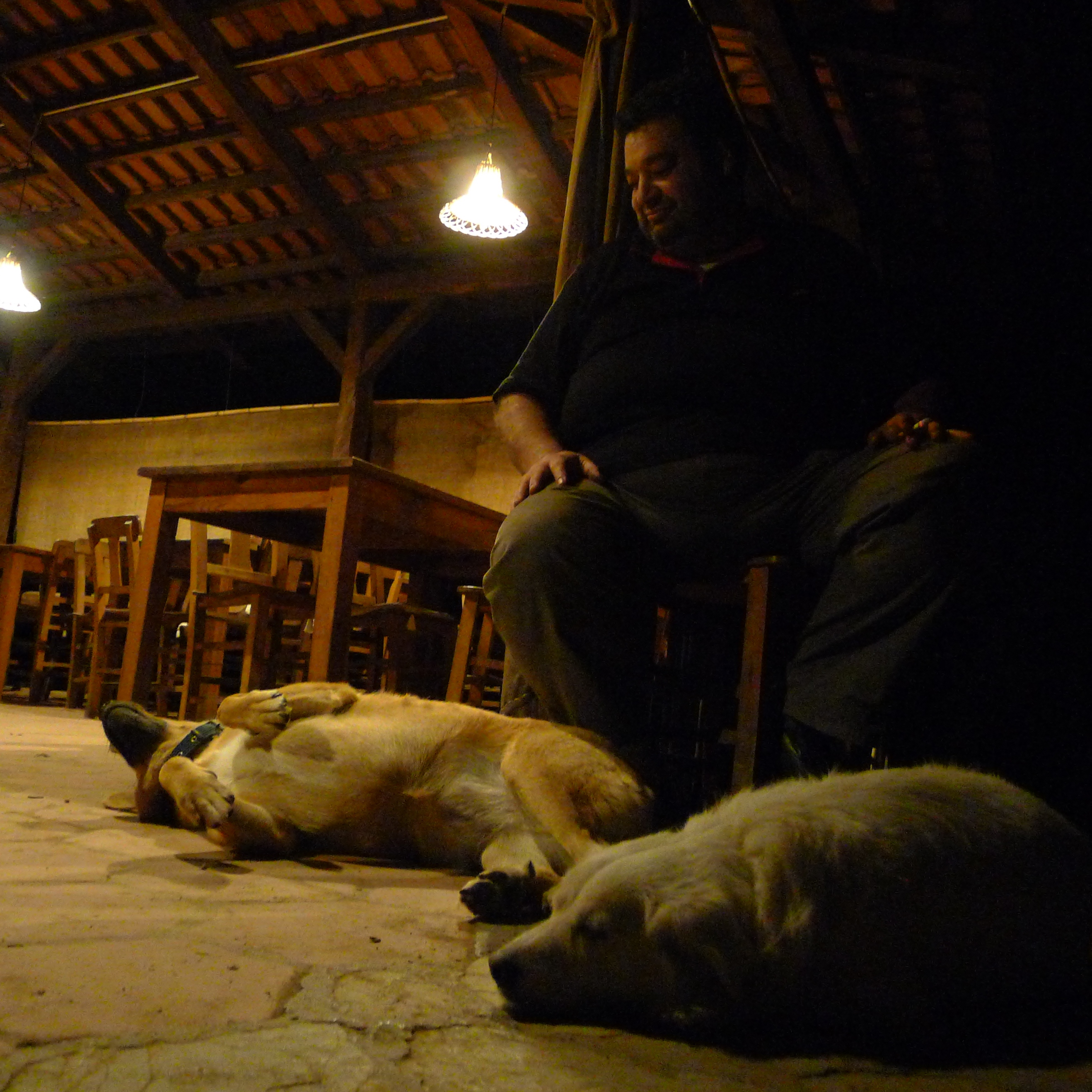
Arif Cerit with the farm dogs, Shanslar (Lucky) and Beyaz (White), at Pastoral Vadi. Photo: Rosemary Lombard.

Last night I had a profound conversation, in my bad Turkish and his bad English, with Arif Cerit, a guy who lives at Pastoral Vadi, the organic/permaculture farm near Fethiye in South-Western Turkey which I am visiting – working in exchange for food and a bed. It’s a very comfortable bed, in a neat, well-appointed cottage designed and built of cob (straw and mud) five years ago by Ahmet Kizen, an architect passionate about sustainable living and ecotourism who bought this farm 14 years ago and opened it to visitors about 7 years back. No maintenance has been necessary since the cottage was built, I’m told. The thick walls keep it cool during the day and surprisingly warm at night.

So, back to what I wanted to blog about, which has resonated for me with my friend P‘s latest gier on Facebook, which involves a sort of Dada/absurdist attempt to animalise interactions. Having been away and in limited contact with everyone, I haven’t had a chance to ask him more about it, but, basically, instead of clicking “like”, he types animal noises. “Baaa, baaa”, mostly. For me it draws attention to the essentially animal nature of human interaction, which we have become unconscious of and detached from, as we live large swathes of our lives online, “denatured”, unquestioning.  “Like” has become a capricious yet ubiquitous form of social capital. Facebook’s shady manipulation of this currency of late has triggered consternation and outrage. They’ve put in place algorithms that restrict the “organic” (terms such as “organic” and “viral” in the world of virtual memes are interesting in their ironic detachment!) reach of posts on the network, requiring one to pay (“real” money) to secure an audience greater than an arbitrary sliver of the profiles to whom one is connected… Just when I thought it was because I only had a sliver of die-hards who actually enjoyed what I post anymore, I realised that most of my Facebook friends no longer see my updates in their news feeds. What a relief (?). The virtual landscape increasingly resembles a targeted marketing environment more than it does a communal hangout, a place for exchanging ideas and thoughts, as it used to. Now it’s mostly about Profit. By monetising the prominence of posts, equal access is effectively being stifled. Concomitantly, freedom of association and meaningful interaction are withering.

That’s another aside, or, rather, more context. ANYWAY. So, what I gleaned from my conversation with big, friendly Arif was that he had been a taxi driver with a fleet of cars in the west coast city of Izmir for 21 years, before dropping everything and moving here to the farm. He sold his business, gave the money to his brothers and left it all behind.

He says that the city is a big jungle, very dark, very dense, very dangerous, full of artifice and chemical poisons. People are a species of animal, he says, like all animals… In cities you have to be a predator to do well. If you are not a predator, you have to live your life very small, like a rat, to survive. Your mind is very important, he says. The chasing after money and things that you need to do to live in the city takes up all your time and your thoughts. Money is a cancer. TV is the morphine you need to kill the pain at the end of the day: the pain of your mind being eaten away.

Out here on the farm, life is real, he says. There is space, there is ground, and air, and the smell of greenness. Animals who are not predators can live happily, widely, openly, productively.

Turkey 2012 467a

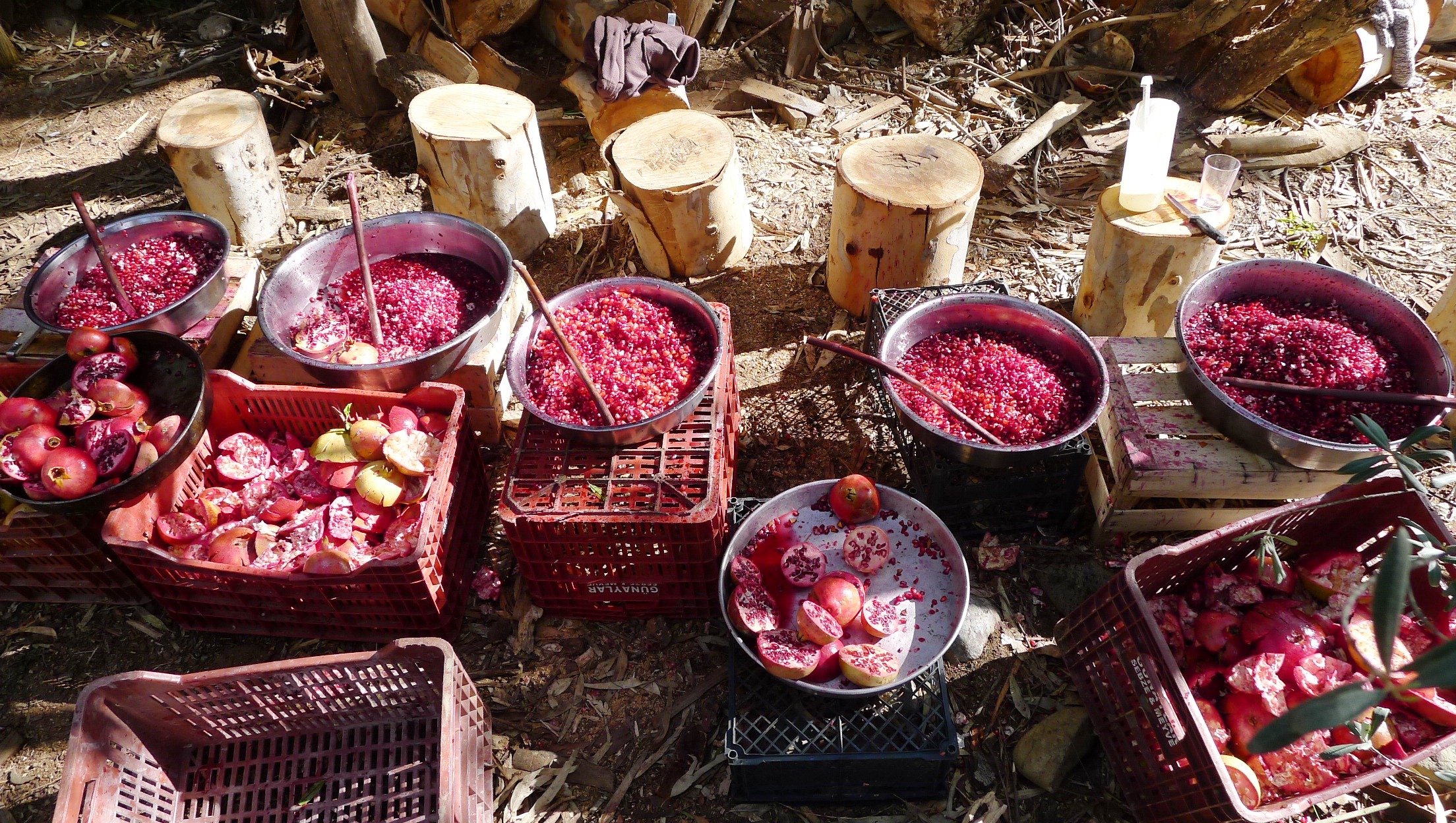
Processing pomegranates by hand to make nar ekshili sos (pomegranate reduction). Photo: Rosemary Lombard

Sticky, crimson pomegranate juice is running down my arms and dripping off my elbows. I’m stained with the joy of manual labour. It’s so satisfying, this repetitive bashing of crates and crates of halved fruit to knock out the arils, then the squeezing in a bag to extract the juice, which is then boiled over a fire for ten hours to reduce it to a dark, tart syrup, then strained through muslin into bottles.  It’s slow-going, messy, tiring work. I have blisters, purple palms. But, at the end of each day, I can see the results of my time spent. It’s nothing like the virtual world of work I mostly inhabit, where I shut down my computer and a sense of the hours and hours I have spent shunting pixels around evaporates.

For so long now, my life has felt paper-thin, no, thinner, as if I barely cast even a shadow of influence in the world, and I realise now that it is largely because of the intangible nature of the work I have been doing, which mostly involves cleaning, tidying and correcting other people’s writing, or recording their work, or facilitating their conversations… It’s all work towards actualising goals that I have deemed worthwhile; nonetheless, these are goals which are not my own. I have tried to frame them as my own, tried to see my part in the whole as indispensable, my purpose as contiguous with that of the projects’, my place as “a tiny cog in the great wheel of evolution” – that was how Billy Wilder put it, writing the words of Ninotchka played by Greta Garbo in Ernst Lubitsch’s wonderful 1939 satire of the same name.

Alas, my heart just hasn’t been convinced. I haven’t been able to shake this unbearable sense of lightness, of the unnecessary breaths I’m taking, of the lack of any other humans who truly require or desire my existence, irreplaceably, here on Earth. All this needs to change if I am to remain sane when I get back. Living with a heavenly purpose is too far beyond me. I’d be satisfied to have done with consumption, thanks. I started this blog in an attempt to make something indelible of the ephemeral. I need to do more. I’m starving.

“If I had an orchard, I’d work till I was sore.” ~ Fleet Foxes – “Helplessness Blues“.

Fethiye-20121113-01327

Sweet! A break to drink some freshly-squeezed pomegranate juice. Photo: Rosemary Lombard

Ş

tale of tales (skazka skazok)

Astoundingly beautiful animation masterpiece by Yuri Norstein (USSR,1979, 28 min).

From Wikipedia:

Tale of Tales, like Tarkovsky’s Mirror, attempts to structure itself like a human memory. Memories are not recalled in neat chronological order; instead, they are recalled by the association of one thing with another, which means that any attempt to put memory on film cannot be told like a conventional narrative. The film is thus made up of a series of related sequences whose scenes are interspersed between each other. One of the primary themes involves war, with particular emphasis on the enormous losses the Soviet Union suffered on the Eastern Front during World War II. Several recurring characters and their interactions make up a large part of the film, such as the poet, the little girl and the bull, the little boy and the crows, the dancers and the soldiers, and especially the little grey wolf (Russian: се́ренький волчо́к, syeryenkiy volchok). Another symbol connecting nearly all of these different themes are green apples (which may symbolise life, hope, or potential).

Yuriy Norshteyn wrote in Iskusstvo Kino magazine that the film is “about simple concepts that give you the strength to live.”

seaside towns they forgot to bomb

14 September 2005 – 01:59

Aah, Sea Point. Maybe it’s just the pheromones, or the exhaust fumes, or the soupy mist of oil from cheap takeaways, or the blinking lights, relentless through the fishy smog… Maybe it’s the conglomeration of them all… The whole place reeks of overtiredness.

Main Road, Sea Point. Photo: Rosemary Lombard

Main Road, Sea Point. Photo: Rosemary Lombard

Know how the Durban beach front feels at night? All sodium glare and humid candyfloss and hooting and “Rayban” pushers, stumbling over sprawling elephantiasis limbs; cabbagey piss and rotting elephantiasis limbs underfoot at every turn, elephantiasis limbs EVERYWHERE?

Or the water slides in Muizenberg? Ice-cream sticks and rusty fish guts and cocoa butter thick in your nostrils? Shrivelled, orange bikini grans and stubbed toes and burnt children scrambling back up, over and over, getting their money’s worth, with fresh snot to add to the circulated stream? Kinda like that.

Like a casino, or a circus, or the school parking lot half an hour before the last night of the end-of-year play. Just like that. The cement, the tar etched with residues of action, the erratic paths of people hopscotching between the pavement’s wet patches of unknown origin, beat-up cabs snaking through the gutters, cruising for someone going somewhere, doing something… you never can be certain what.

There’s an interminable vacancy in all the hyperactivity, a loneliness. A sense that most of what’s done is probably being done to keep up appearances, because it’s in the script. In bar toilets, in sighing lifts and entrance lobbies of peeling flats, people wait, unexpectantly, for something undisclosed… The sour gaggles of Jewish crones… The sweet fags in the coin-op laundrette… The salty dog walkers on the promenade… The makwerekwere… The goosefleshed trannie under the stop sign… LCD Jesus loves you, 01:31, 8°C.

It’s a frustrating place, a titillating place for anyone with even a pinch of the voyeur in them. You never know if today will be your chance to be privy to that something, to overhear the deal… Well, it’s hardly likely to be above board, is it? You daren’t blink in case you miss it, yet you virtually never get to see the loops close, experience the denouement. And your imagination goes crazy.

Oy vey, it’s a schande. Happeningness rubs your nose in it, but, from a distance, it’s too pungent, too slippery to pry open cleanly… You know your conjecture’s amusing but empty.

Romanticism breeds covetousness, even of the sordid. So, you’ve read Burroughs, Bukowski, Genet, Sade. Ballard, Palahniuk, Sartre… Your own illicit missions never feel as archetypal.

It’s like being hopelessly in love, but not being in ’40s Casablanca, you know? Like rainbow soap bubbles popping on your tongue… The bath gets cold before you stop being too distracted by the froth to immerse yourself fully.