Category Archives: freedom
obama is checking your email
 Go to http://obamaischeckingyouremail.tumblr.com/ (thanks to Anthony Collins for sharing this).
giorgos bandoek apostolakis – the guns of brixton
Greek cover of The Clash.
a protest jam from istanbul this week
Kardeş Türküler perform “Tencere Tava Havası” (“Sound of Pots and Pans”) in the streets of Istanbul this week. Check out the Kardeş Türküler’s website HERE for background on the group, which came into being in 1993 as a concert project by the Boğaziçi University Folklore Club.
And, here’s an explanation of the penguin footage later in the video from a Youtube comment:
“If people don’t know about it, the penguins mock mainstream media that has very close relations to the government. Main news channels have been nearly totally silent about the protests, not wanting to be hated by the government. One main news channel (CNNTurk) preferred to broadcast a penguin documentary while all of these are happening. Similar attitude from others. After being severely mocked by protesters, an apology and more coverage came.”
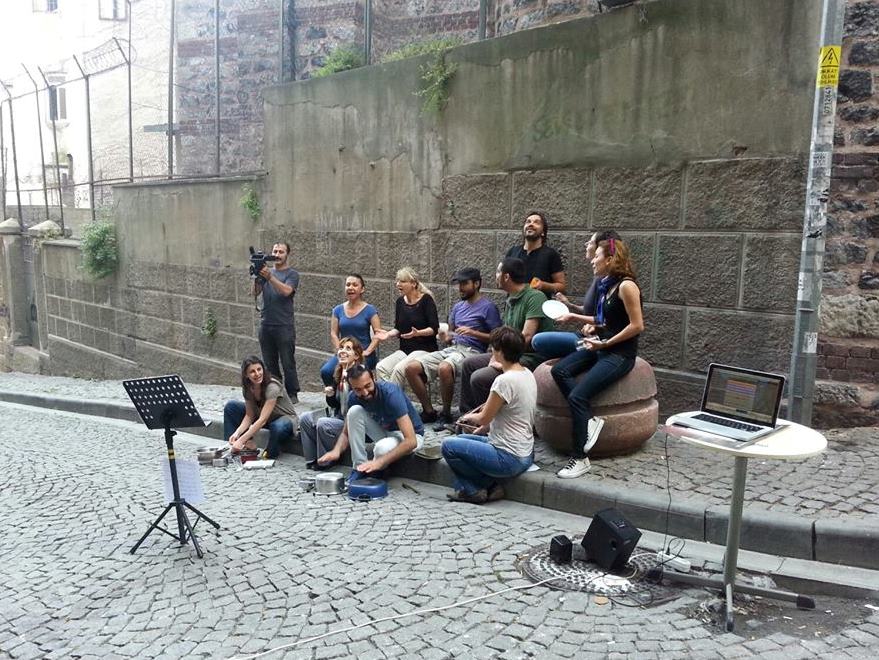
Istanbul group Kardeş Türküler recording the video “Pots & Pans” in response to the Taksim/Gezi Park protests this week.
whirling sufi protesters

A whirling Sufi protester wearing a gas mask in a Gezi Protest in Ankara, 2 June 2013
Photograph: Azirlazarus (on Wikipedia)
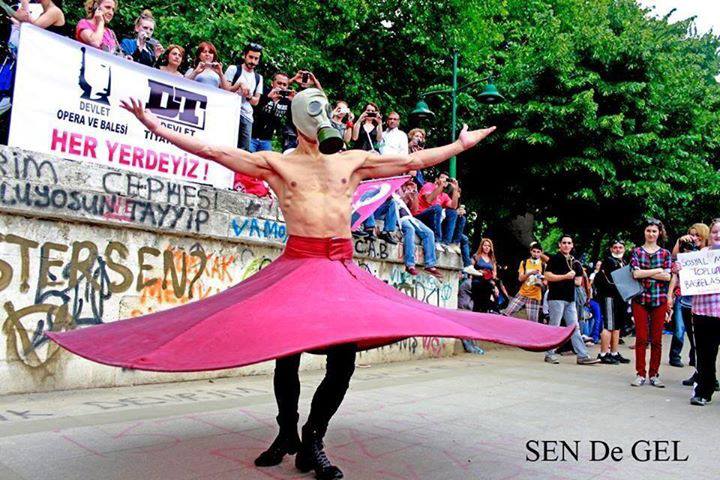
“You come too!”
bergüzar korel – bu sabah güneş doğmuyor
girls upside down
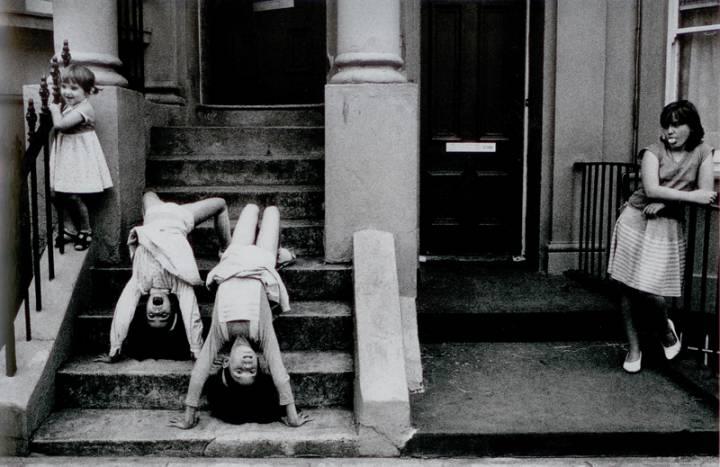
Marketa Luskačová – “Girls upside down, Blenheim Crescent, London, 1984”, from the series ‘Children in Britain’
Born in Prague. Degree in sociology of culture at Charles University, Prague 1967, thesis on traditional religion in Slovakia accompanied with photographs of pilgrims. 1967 – 1969 studied photography at FAMU, Prague. Since 1968, freelance photographer. Check out more of her work HERE.
a rose is a rose is a rose
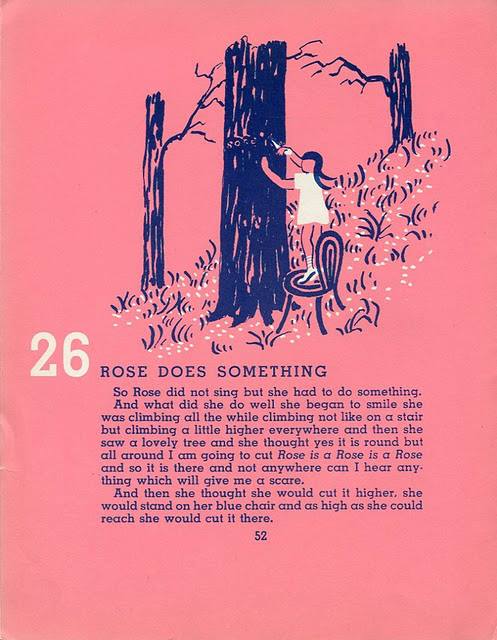 Read more about this book HERE.
colonizing in reverse – louise bennett-coverley
“Wat a joyful news, Miss Mattie
I feel like me heart gwine burs
Jamaica people colonizin
Englan in reverse.
By de hundred, by de tousan
From country and from town,
By de ship-load, by de plane-load
Jamaica is Englan boun.
Dem a pour out a Jamaica
Everybody future plan
Is fe get a big-time job
An settle in de mother lan.
What a islan! What a people!
Man an woman, old an young
Jus a pack dem bag an baggage
An tun history upside dung!
Some people doan like travel
But fe show dem loyalty
Dem all a open up cheap-fare-
To-Englan agency.
An week by week dem shippin off
Dem countryman like fire,
Fe immigrate an populate
De seat a de Empire.
Oonoo see how life is funny,
Oonoo see de tunabout?
Jamaica live fe box bread
Out a English people mout’.
For wen dem ketch a Englan,
An start play dem different role,
Some will settle down to work
An some will settle fe de dole.
Jane say de dole is not too bad
Because dey payin she
Two pounds a week fe seek a job
Dat suit her dignity.
Me say Jane will never fine work
At de rate how she dah look,
For all day she stay pon Aunt Fan couch
An read love-story book.
Wat a devilment a Englan!
Dem face war an brave de worse,
But me wonderin how dem gwine stan
Colonizin in reverse.”
michael leunig – on falling
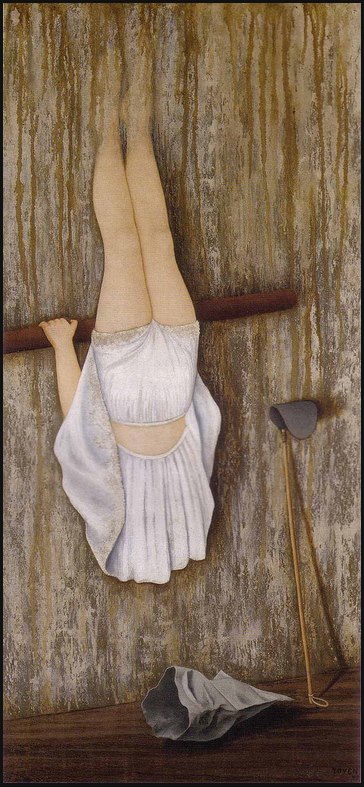
Toyen (Marie Čermínová) – “Relâche”, 1943
Dear God,
When we fall, let us fall inwards.
Let us fall freely and completely:
that we may find our depth and humility:
the solid earth from which we may rise up and love again.
Amen.
— Michael Leunig
not daisy – this is the thing
A cover of a song by Fink.
goodbye, ray manzarek
The Doors, live in Copenhagen,1968. Ray, I was always even more in love with you than I was with Jim… That organ of yours is what really hypnotised me (that’s what she said).

From Michael Ochs’ archive
As my friend Carlo Germeshuys just put it, “Goodbye, Ray Manzarek – without your swirly lounge keyboard old Jimbo wouldn’t have gotten far with his whole bozo Dionysus act.” Oh wait, Carlo says he was referencing a diss by Lester Bangs. Well, whatever. “Bozo Dionysus” = best description of Jim Morrison ever.
HERE‘s an obituary from Rolling Stone.
the damned – new rose (1976)
Wakey wakey! It’s Monday!
nevermind the bollocks, here’s deleuze and guattari
[E]ffective differences pass between the lines, even though they are all immanent to one another, all entangled in one another. This is why the question of schizoanalysis or pragmatics, micropolitics itself, never consists in interpreting, but merely in asking what are your lines, individual or group, and what are the dangers on each.

JR around the pole at Desperado’s Saloon, Observatory, Cape Town, 15 May 2013. Photo: Rosemary Lombard
What are your rigid segments, your binary and overcoding machines? For even these are not given to you ready-made; we are not simply divided up by binary machines of class, sex, or age: there are others which we constantly shift, invent without realising it. And what are the dangers if we blow up these segments too quickly? Wouldn’t this kill the organism itself, the organism which possesses its own binary machines, even in its nerves and its brain?
What are your supple lines, what are your fluxes and thresholds? Which is your set of relative deterritorialisations and correlative reterritorialisations? And the distribution of black holes: which are the black holes of each one of us, where a beast lurks or a microfascism thrives?
— Deleuze and Guattari: Toward Freedom. Read more HERE.
Sent from my BlackBerry® wireless device
spectrum – undo the taboo
The opening track of Highs, Lows and Heavenly Blows, released in 1994 on Silvertone Records.
Spectrum was the most high-profile and straightforward of the projects undertaken by Pete “Sonic Boom” Kember after the demise of the trance-rock avatars Spacemen 3. As his work as a member of the Experimental Audio Research coterie allowed Kember the opportunity to explore ambient textures and tonal constructs, Spectrum satisfied the singer/guitarist’s more conventional pop leanings, while never losing sight of the hypnotic otherworldliness which became his music’s trademark and legacy.
(Info from Allmusic.com)
where the echoes stop
Julie Loen – Title Unknown
Erwin Raphael McManus – Where the Echoes Stop
I want to stand where the echoes stop.
Far past where sound has abandoned thought.
Where silence reigns over redundancy.
Where once well said is more than enough.I want to stand where the echoes stop.
Where words must be born to be heard.
Where speech is a gift and not a curse.
Where there is more of the unique and less of the mundane.I want to stand where the echoes stop.
Where meaning is rescued from noise…
Where conviction replaces thoughtless repetition…
Where what everyone is saying surrenders to what needs to be said.I want to stand where the echoes stop.
Where the shouting of the masses falls silent to the whisper of the one…
Where the voice of the majority submits to the voice of reason…
Where “they” do not exist; but “we” do.I want to stand where the echoes stop.
Where substance overthrows the superficial…
Where courage conquers compliance and conformity…
Where words do not travel farther than the person who speaks them.I want to stand where the echoes stop.
Where I only say what I believe.
Where I only repeat what changes me.
Where empty words finally rest in peace.“Be still and know that I am God…” — Psalm 46:10a

whispers in the deep
Matt Temple, of the excellent African music blog Electric Jive, has just uploaded another fascinating compilation of rare and historical sounds. This time the focus is on music and censorship in South Africa, and tracks span the period from 1960 to 1994. Accompanying the download link is an essay by Peter M Stewart, written in 2003, when this compilation was originally made, which provides some context for listening.
“Given the recent Secrecy Bill passed by the South African Parliament it’s worth reflecting on music that caught the attention of the censors during the previous dark period of Apartheid… this is a compilation I put together for private distribution in August 2003, almost 10 years ago. It fits the Bill!
“Whispers in the Deep collects a number of anthems, agit-pop songs, and propaganda pieces. Many of the tracks were intended as direct responses to the South African social order as it was prior to 1994. The other tracks might as well have been. Nevermind the revolution, nothing was televised in South Africa prior to 1976.
“Whispers in the Deep also documents some of the ways in which access to popular music was restricted in South Africa – the obstacles that prevented persons resident in South Africa from listening to songs, hearing them broadcast, or seeing them performed. It explores the cultural boycott, censorship by the state in South Africa, and various manifestations of the ‘climate of censorship’.”
Read more and download it HERE.
mary oliver on kindness and mischief
karl marx on how the division of labour is boring

Manufacturing assembly line in China
For as soon as the distribution of labour comes into being, each man has a particular exclusive sphere of activity, which is forced upon him and from which he cannot escape. He is a hunter, a fisherman, a shepherd, or a critical critic and must remain so if he does not wish to lose his means of livelihood; while in communist society, where nobody has one exclusive sphere of activity but each can become accomplished in any branch he wishes, society regulates the general production and thus makes it possible for me to do one thing today and another tomorrow, to hunt in the morning, to fish in the afternoon, rear cattle in the evening, criticize after dinner, just as I have in mind, without ever becoming hunter, fisherman, shepherd or critic.
— From The German Ideology (1845).
søren kierkegaard on boredom
Idleness, then, is so far from being the root of all evil that it is rather the true good. Boredom is the root of evil; it is that which must be held off.
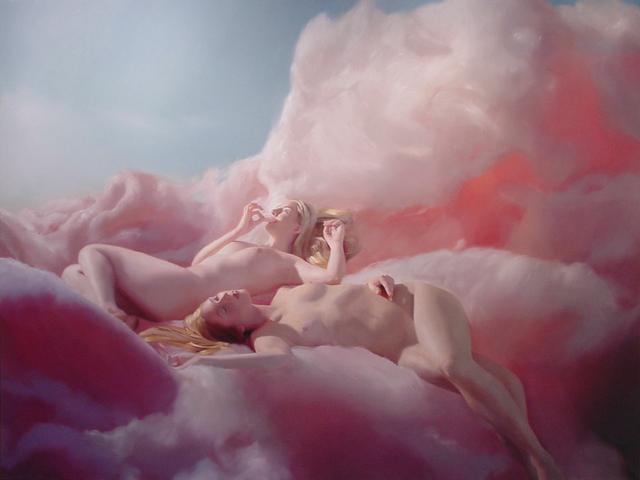
Will Cotton: “Cotton Candy Clouds”.
Oil on Linen, 2004
Since boredom advances and boredom is the root of all evil, no wonder, then, that the world goes backwards, that evil spreads. This can be traced back to the very beginning of the world. The gods were bored; therefore they created human beings. Adam was bored because he was alone; therefore Eve was created. Since that moment, boredom entered the world and grew in quantity in exact proportion to the growth of population. Adam was bored alone; then Adam and Eve were bored en famille. After that, the population of the world increased and the nations were bored en masse. To amuse themselves, they hit upon the notion of building a tower so high that it would reach the sky. This notion is just as boring as the tower was high and is a terrible demonstration of how boredom had gained the upper hand. Then they were dispersed around the world, just as people now travel abroad, but they continued to be bored. And what consequences this boredom had: humankind stood tall and fell far, first through Eve, then from the Babylonian tower.
— From Either/Or (1843).
adrienne rich on telling the truth

freedom
“Freedom’s just another word for ‘nothing left to lose’…”

Raoul Ubac – Tête du Mannequin d’Andre Masson
Silver Print, 11-5/8 x 9-3/8 in.
1938 (Colour tweaked by Cherry Bomb)
l’age d’or (1930)
Sadly, this is a far more profound symbolic critique of Roman Catholic oppression than anything FEMEN is ever likely to pull off (notwithstanding their tops)!
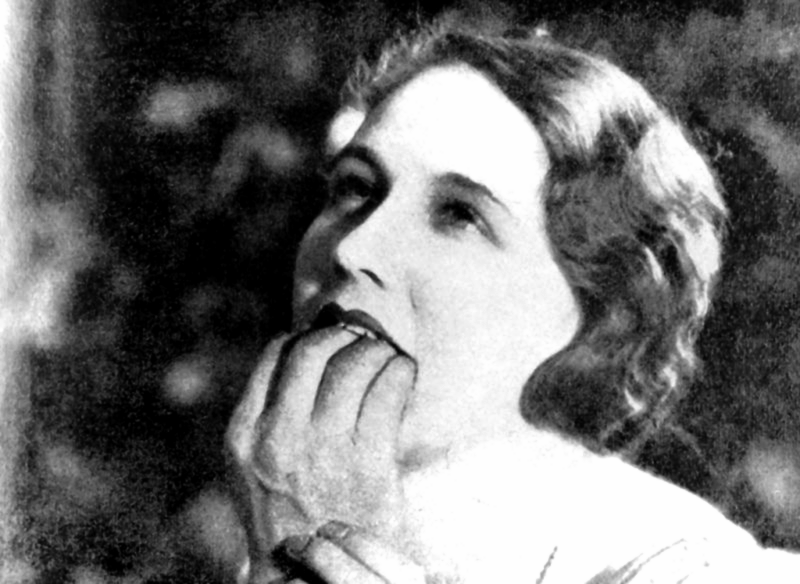 L’Age d’or or The Golden Age (1930), directed by Luis Buñuel, a French surrealist comedy, and one of the first films with synchronous sound ever made in France, was about the insanities of modern life, the hypocrisy of the sexual mores of bourgeois society and the value system of the Roman Catholic Church. Salvador Dalí and Buñuel wrote the screenplay together.
The BBC called it “an exhilarating, irrational masterpiece of censor-baiting chutzpah.”
Read more about the political project of surrealism HERE. Watch the film (in the original French) HERE – turn on the Youtube captions for English subtitles.
Regarding the response of the establishment to the film, from Wikipedia:
Upon receiving a cinematic exhibition permit from the Board of Censors, L’Âge d’or had its premiere presentation at Studio 28, Paris, on 29 November 1930. Later, on 3 December 1930, the great popular success of the film provoked attacks by the right-wing Ligue des Patriotes (League of Patriots), whose angry viewers took umbrage at the story told by Buñuel and Dalí. The reactionary French Patriots interrupted the screening by throwing ink at the cinema screen and assaulting viewers who opposed them; they then went to the lobby and destroyed art works by Dalí, Joan Miró, Man Ray, Yves Tanguy, and others. On 10 December 1930, the Prefect of Police of Paris, Jean Chiappe, arranged to have the film banned from further public exhibition after the Board of Censors re-reviewed the film.
A contemporary right-wing Spanish newspaper published a condemnation of the film and of Buñuel and Dalí, which described the content of the film as “…the most repulsive corruption of our age … the new poison which Judaism, Masonry, and rabid, revolutionary sectarianism want to use in order to corrupt the people”. In response, the de Noailles family withdrew L’Âge d’or from commercial distribution and public exhibition for more than forty years; nonetheless, three years later, in 1933, the film was privately exhibited at the Museum of Modern Art, in New York City. Forty-nine years later, from 1-15 November 1979, the film had its legal U.S. premiere at the Roxie Cinema in San Francisco.
The film critic Robert Short said that the scalp-decorated crucifix and the scenes of socially repressive violence, wherein the love-struck protagonist is manhandled by two men, indicate that the social and psychological repression of the libido and of romantic passion and emotion, by the sexual mores of bourgeois society and by the value system of the Roman Catholic Church, breed violence in the relations among people, and violence by men against women. The opening sequence of the film alludes to that interpretation, by Dalí and Buñuel, with an excerpt from a natural science film about the scorpion, which is a predatory arthropod whose tail is composed of five prismatic articulations that culminate in a stinger with which it injects venom to the prey. Film critic Ado Kyrou said that the five vignettes in the tale of L’Âge d’Or correspond to the five sections of the tail of the scorpion.
swans – nobody
From the album Greed/Holy Money (K.422, 1992).
richie havens, home free at last
Richie Havens’ famous improvised performance of “Freedom”, riffing on “Sometimes I Feel Like a Motherless Child”, during his opening set at the Woodstock Festival in 1969.
There is a collection of other great performances recorded over the course of his almost five-decade-long career that you can watch HERE. May his soul rest in peace.
william shakespeare – sigh no more, ladies
Happy 449th birthday, Willy!
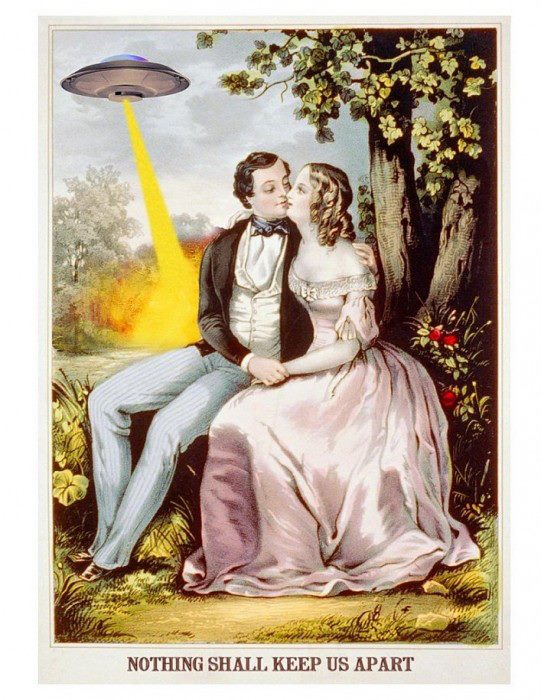
Sigh no more, ladies, sigh no more;
Men were deceivers ever;
One foot in sea and one on shore,
To one thing constant never;
Then sigh not so,
But let them go,
And be you blithe and bonny;
Converting all your sounds of woe
Into “Hey nonny, nonny.”
Sing no more ditties, sing no mo,
Of dumps so dull and heavy;
The fraud of men was ever so,
Since summer first was leavy.
Then sigh not so,
But let them go,
And be you blithe and bonny,
Converting all your sounds of woe
Into “Hey, nonny, nonny.”
(From Much Ado about Nothing)
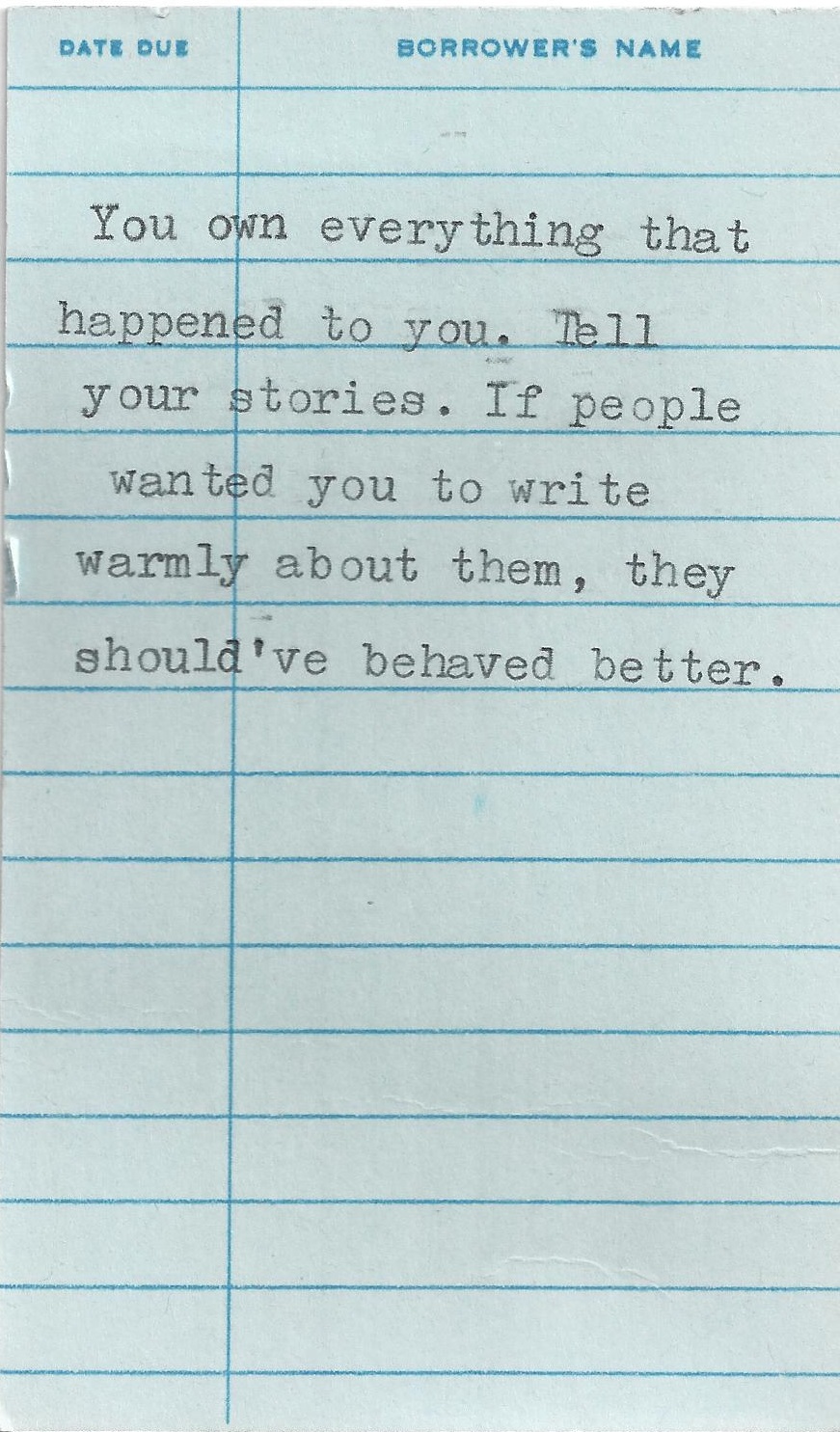
tell your stories
flash mob flamenco
Flamenco flash mob staged by anti-capitalist group flo6x8 inside a bank in Sevilla, Spain, to express anger and frustration at the economic crisis. Flamenco began as an art form centred around protest and social awareness. In the late 18th and early 19th centuries, flamenco songs were largely about poverty, suffering and the hardships of everyday life.
Read more HERE about how flash mobs are reconnecting flamenco to its roots, or watch a 25 minute BBC documentary on the phenomenon.
(Thanks to Lizza Littlewort for posting the featured link on Facebook this morning.)
lauren bacall on companionship
Lauren Bacall interviewed in 1994. Honest and smart… And how!
rebecca west on sadomasochism (1933)
 “I loathe the way the two cancers of sadism and masochism eat into the sexual life of humanity, so that the one lifts the lash and the other offers blood to the blow, and both are drunken with the beastly pleasure of misery and do not proceed with love’s business of building a shelter from the cruelty of the universe.”
— Rebecca West, Letter to a Grandfather (1933), pg 34.
Read more about the formidable Dame West HERE.
 fleurmach