on marching to a different tune

“They are really always saying the same thing. They don’t change; everybody else changes. They are accused of the most incompatible crimes, of egoism and a mania for power, indifference to the fate of their cause, fanaticism, triviality, lack of humour, buffoonery and irreverence. But they sound a certain note. Hence the great practical power of persistent radicals. To all appearance, nobody follows them, yet everyone believes them. They hold a tuning-fork and sound A, and everybody knows it really is A, though the time-honoured pitch is G flat.”

Isn’t this a good description of the effect of Pussy Riot performances? In spite of all accusations, you sound a certain note. It may appear that people do not follow you, but secretly, they believe you, they know you are telling the truth, or, even more, you are standing for truth.

— Slavoj Žižek, quoting political essayist John Jay Chapman (who was writing in 1900) in a recent letter to imprisoned Pussy Riot member, Nadezhda Tolokonnikova. Read more from their correspondence HERE.

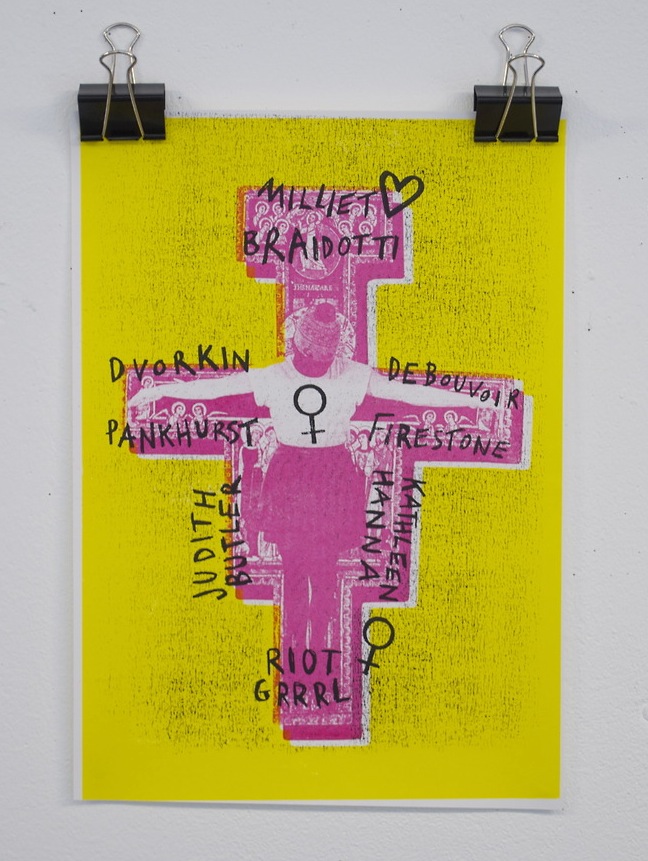
Eve Warren - A Punk Prayer. Find out more HERE

Eve Warren – “A Punk Prayer”. Find out more about this work HERE.

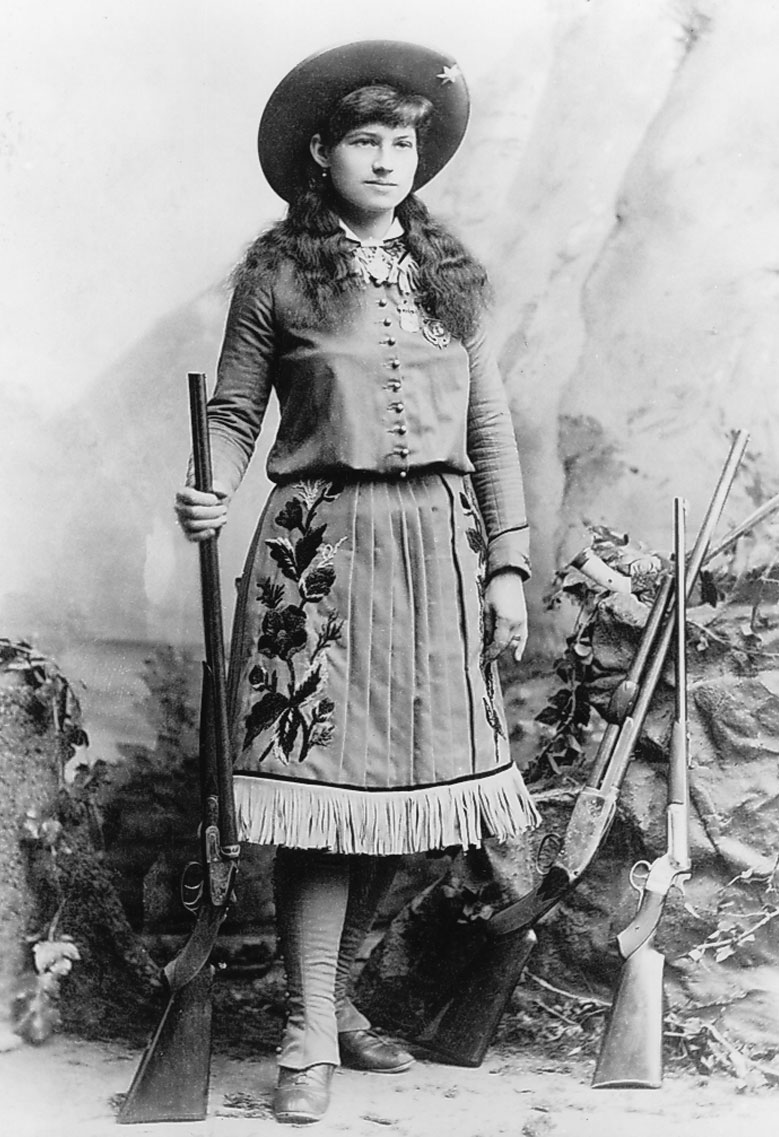
annie oakley in a thomas edison film (1894)

Created and published by the Edison Manufacturing Co., 1894
Performer: Annie Oakley.
Camera: William Heise.
Filmed November 1, 1894, in Thomas Edison’s Black Maria studio.

From Archive.org:

Annie Oakley was probably the most famous marksman/woman in the world when this short clip was produced in Edison’s Black Maria studio in West Orange, New Jersey. Barely five feet tall, Annie was always associated with the wild west, although she was born in 1860 as Phoebe Ann Oakley Mozee (or Moses) in Darke County, Ohio. Nevertheless, she was a staple in the Buffalo Bill Wild West Show and similar wild west companies. Because of her diminutive stature, she was billed as “Little Sure Shot.”

annie oakley

The man assisting her is this appearance is probably her husband, Frank E. Butler. Annie had outshot Butler (a famous dead-eye marksman himself) in a shooting contest in the 1880s. Instead of nursing his bruised ego because he had been throughly outgunned by a woman, Butler fell in love, married Little Sure Shot, and became her manager.

Theirs was a solid and happy marriage that lasted 44 years, and when Annie died on November 3, 1926, at age 66, a heartbroken Butler followed her to the grave 18 days later.

how to tease your hair

WARNING: This may be considered very NSFW if you live in the same society that got Petra Collins’ Instagram account deleted.

MissAsssnatch goes naa-na-na naa-na. Hairy Ass Girlpits (2007) by MissAsssnatch – Music credits: “Pistolet Joe” performed by Anna Karina.

Misanthropic Girlpit Petting (2010) by MissAsssnatch – Music credits: “Sleep Alone” performed by Rowland S Howard.

a new and alarming study on teens and sexual coercion

Excerpted from an article by Martha Kempner, published at RH Reality Check, October 9, 2013 – 12:43 pm

A new study finds that almost one in ten teens and young adults admit to forcing someone into some form of sexual activity. Even more surprising: 50 percent of perpetrators blame the victim for the incident. According to the study, “links between perpetration and violent sexual media are apparent.”

blurred-lines-screenshot-375x250

(RobinThickeVevo / YouTube)

A new study funded by the Centers for Disease Control and Prevention and published online in the Journal of the American Medical Association found that one in ten teens said they had coerced another person into some form of sexual activity. In an online survey in 2010 and 2011, researchers asked 1,058 young people ages 14 to 21 whether they had ever “kissed, touched, or done anything sexual with another person when that person did not want you to?” The results surprised even the lead researcher, Michele Ybarra, who told NPR, “I don’t get creeped out very often, but this was wow.”

This intense reaction stems from the fact that 9 percent of teens said they had coerced another person. Specifically, 8 percent said they had kissed or touched someone when they knew that person did not want to, 3 percent said they “got someone to give in to unwilling sex,” 3 percent said they attempted rape, and 2 percent said they actually raped someone. (This adds to more than 9 percent because young people could admit to more than one behavior.)…

… The authors also note that 50 percent of all perpetrators said that the victim was responsible for the sexual violence. Moreover, most perpetrators said no one ever found out about their actions. The authors conclude, “Because victim blaming appears to be common while perpetrators experiencing consequences is not, there is urgent need for high school (and middle school) programs aimed at supporting bystander intervention.”…

… The survey was conducted as part of an ongoing study called Growing Up With Media. In addition to asking about sexual coercion, respondents were asked about the media they watched. The study found that perpetrators tended to report more frequent exposure to media that depicted sexual and violent situations than those who had not coerced another person, but the results were not always statistically significant. Still, the authors conclude:

[L]inks between perpetration and violent sexual media are apparent, suggesting a need to monitor adolescents’ consumption of this material, particularly given today’s media saturation among the adolescent population.

Elizabeth Schroeder, the executive director of Answer, an organization that educates young people about sexuality and trains teachers, agrees that media consumption is part of the problem. She told RH Reality Check, “This study is extremely distressing, but unfortunately, not a surprise. Sexuality education rarely starts before high school, and by then young people have already received very distorted messages about sex, relationships, and boundaries from other sources such as the media, their peers, adults in their lives, and so on.” Schroeder added, “Age-appropriate lessons about relationships need to start in early childhood and continue throughout high school.”

Read the full article HERE.

the crystals – he hit me (and it felt like a kiss)

One of the most overtly disturbing of Phil Spector’s “wall of sound” productions, released in 1962 on Philles Records.

Dave Thompson writes of the single on AllMusic:

“He Hit Me (And It Felt Like A Kiss)” was written by Gerry Goffin and Carole King, after their live-in babysitter Eva Boyd (19-year-old singer Little Eva) returned from a weekend away with her boyfriend, covered in bruises. The boyfriend seemed to have spent the entire weekend hitting the girl but, when questioned about it, the girl didn’t bat an eyelid. He hit her because he loved her. And, in the song, because she deserved it.

It was a brutal song, as any attempt to justify such violence must be, and Spector’s arrangement only amplified its savagery, framing Barbara Alston’s lone vocal amid a sea of caustic strings and funereal drums, while the backing vocals almost trilled their own belief that the boy had done nothing wrong. In more ironic hands (and a more understanding age), “He Hit Me” might have passed at least as satire. But Spector showed no sign of appreciating that, nor did he feel any need to.

the-crystals-he-hit-me-and-it-felt-like-a-kiss-philles-collectables

a very bad hair day

phil spector

Filthy Phil Spector in the dock, on trial for murdering his girlfriend Lana Clarkson (via Warrick Sony). Just have to share some of the hil-hair-ious comments under the post on Facebook:

Kevin Breed – Wall of hair
Lizza Littlewort – Hairy Antoinette.
Merle Payne – Good Vrou.
Gary Herselman – Is that Phil wigging out again?
Warrick Sony – Phuckwit Phil at his murder of girlfriend trial
Charlie Hamilton – And inside there somewhere is the brain that started the ‘wall of sound’
Andrew Freedman – You are looking good sir ! All those cosmic sounds are taking effect ! Haribol
SJ Ryan – Things took a turn for the worse when he attacked the prosecutor with an afro comb
David Forbes – the evidence was hair-raising.
Merle Payne – Bad hair day.
Warrick Sony – Hair today gone tomorrow
Rosemary Lombard – Full Spectre
Lesley Perkes – hair lair there
Warrick Sony – wait for it… … Hair Traffic Controller
Warrick Sony – oh and the Eno song: “Burning Hairlines Give You so much more”

ntozake shange – dark phrases

dark phrases of womanhood
of never havin been a girl
half-notes scattered
without rhythm/no tune
distraught laughter fallin
over a black girl’s shoulder
it’s funny/it’s hysterical
the melody-less-ness of her dance
don’t tell nobody don’t tell a soul
she’s dancin on beer cans & shingles

this must be the spook house
another song with no singers
lyrics/no voices
& interrupted solos
unseen performances

are we ghouls?
children of horror?
the joke?

don’t tell nobody don’t tell a soul
are we animals? have we gone crazy?

i can’t hear anythin
but maddening screams
& the soft strains of death
& you promised me
you promised me…
somebody/anybody
sing a black girl’s song
bring her out
to know herself
to know you
but sing her rhythms
carin/struggle/hard times
sing her song of life
she’s been dead so long
closed in silence so long
she doesn’t know the sound
of her own voice
her infinite beauty
she’s half-notes scattered
without rhythm/no tune
sing her sighs
sing the song of her possibilities
sing a righteous gospel
let her be born
let her be born
& handled warmly.

— from For Colored Girls Who Have Considered Suicide When the Rainbow is Enuf.  Macmillan Publishing, 1977. Shange was born Paulette L. Williams in Trenton, New Jersey. She later changed her name to isiXhosa/isiZulu – read more HERE.

nina simone – four women

Harlem Cultural Festival, 1969.

Thulani Davis writes of Nina Simone:

What Simone did for African American women was more liberating than the sweet elegance of her take on “I Love You, Porgy” (delivered without the fake dialect of all its predecessors), the thought-provoking militancy she added to spirituals like “Sinnerman,” or the wicked humor of “Old Jim Crow” and “Go Limp,” or the wonderfully ironic cover of Screamin’ Jay Hawkins’s kitsch hit, “I Put a Spell on You.”

First of all, her songs, whether covers or original compositions, always privileged the black woman’s point of view; they spoke for the dispossessed Sister Sadie who cleaned floors or raised children who would never in their lives again treat black women with respect.

Yes, you lied to me all these years/told me to wash and clean my ears/and talk real fine, just like a lady/and you’d stop calling me Sister Sadie.

“See Line Woman” viewed its exotic black female as an object of desire and admiration in a way unknown outside of the black poetry that was its source, or those raunchy blues songs that polite Negroes did not play, which nonetheless lauded the virtues of a full body and brown skin.

My skin is black/My arms are long/My hair is wooly/My back is strong/Strong enough to take the pain/Inflicted again and again/What do they call me?/My name is Aunt Sara. — “Four Women”

It was “Four Women,” an instantly accessible analysis of the damning legacy of slavery, that made iconographic the real women we knew and would become. For African American women it became an anthem affirming our existence, our sanity, and our struggle to survive a culture which regards us as anti-feminine. It acknowledged the loss of childhoods among African American women, our invisibility, exploitation, defiance, and even subtly reminded that in slavery and patriarchy, your name is what they call you. Simone’s final defiant scream of the name Peaches was our invitation to get over color and class difference and step with the sister who said:

My skin is brown/My manner is tough/I’ll kill the first mother I see/ My life has been rough/I’m awfully bitter these days/Because my parents were slaves.

For African American women artists of my generation, “Four Women” became the core of works to come, notably Julie Dash’s film of the same name, and it should be regarded a direct ancestor of Ntozake Shange’s For Colored Girls Who Have Considered Suicide When the Rainbow Is Enuf. This Simone song was a call heard by Alice Walker, Toni Cade Bambara, Gayl Jones, and countless artists who come to mind as women who gave us a whole generation of the stories of Aunt Sara, Safronia, Sweet Thing, and Peaches.

May the High Priestess’s cult widen to take in the unwise who made her as outrageous as she was.

Read the rest of this article over at The Village Voice.

maria callas – mad scene from lucia di lammermoor (donizetti)

“The character of Lucia has become an icon in opera and beyond, an archetype of the constrained woman asserting herself in society. She reappears as a touchstone for such diverse later characters as Flaubert’s adulterous Madame Bovary and the repressed Englishwomen in the novels of E.M. Forster. The insanity that overtakes and destroys Lucia, depicted in opera’s most celebrated mad scene, has especially captured the public imagination. Donizetti’s handling of this fragile woman’s state of mind remains seductively beautiful, thoroughly compelling, and deeply disturbing. Madness as explored in this opera is not merely something that happens as a plot function: it is at once a personal tragedy, a political statement, and a healing ritual.” (Commentary from HERE)

Maria Callas performs “Il dolce suono mi colpì di sua voce”, the “Mad Scene” from the opera Lucia di Lammermoor by Gaetano Donizetti, recorded live in Florence in February 1953. Tullio Serafin conducted Callas, Giuseppe di Stefano, Tito Gobbi, Raffaele Arie, Valliano Natali, Maria Canali, Maggio Musical Fiorentino Orchestra & Maggio Musicale Fiorentino Chorus.

The discussion in the comments underneath the video is quite entertaining, especially if read in light of the Anne Carson essay I posted earlier. Continue reading

anne carson – the gender of sound

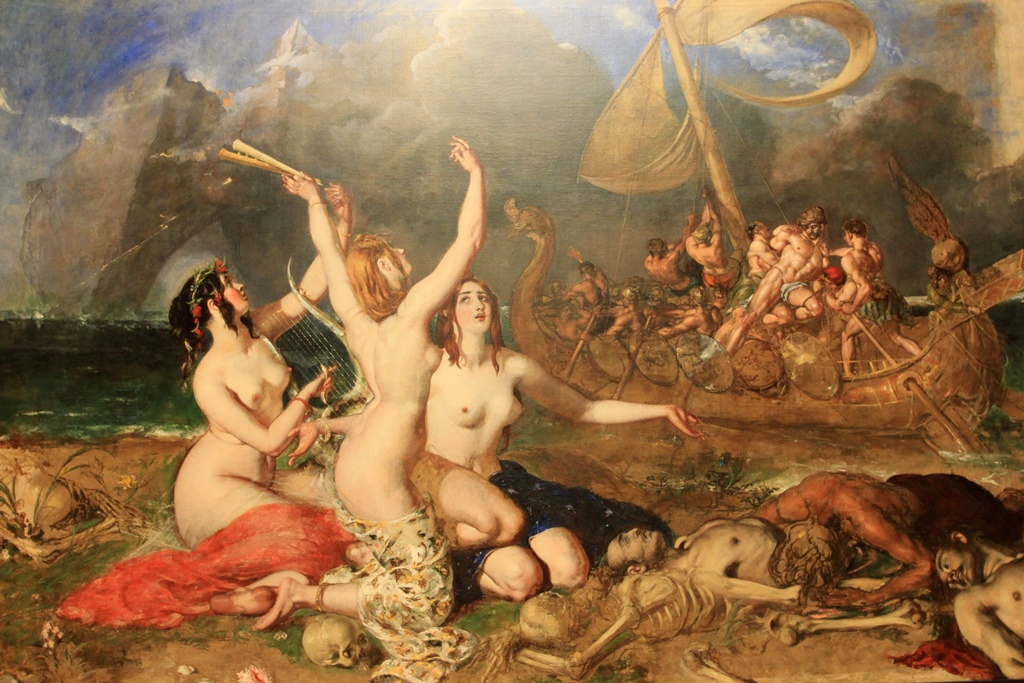
William Etty - "The Siren and Ulysses", 1837.

William Etty – “The Siren and Ulysses”, 1837.

Madness and witchery as well as bestiality are conditions commonly associated with the use of the female voice in public, in ancient as well as modern contexts. Consider how many female celebrities of classical mythology, literature and cult make themselves objectionable by the way they use their voice.

For example, there is the heart-chilling groan of the Gorgon, whose name is derived from a Sanskrit word, *garg meaning “a guttural animal howl that issues as a great wind from the back of the throat through a hugely distended mouth”. There are the Furies whose high-pitched and horrendous voices are compared by Aiskhylos to howling dogs or sounds of people being tortured in hell (Eumenides). There is the deadly voice of the Sirens and the dangerous ventriloquism of Helen (Odyssey) and the incredible babbling of Kassandra (Aiskhylos, Agamemnon) and the fearsome hullabaloo of Artemis as she charges through the woods (Homeric Hymn to Aphrodite). There is the seductive discourse of Aphrodite which is so concrete an aspect of her power that she can wear it on her belt as a physical object or lend it to other women (Iliad). There is the old woman of Eleusinian legend Iambe who shrieks obscenities and throws her skirt up over her head to expose her genitalia. There is the haunting garrulity of the nymph Echo (daughter of Iambe in Athenian legend) who is described by Sophokles as “the girl with no door on her mouth” (Philoktetes).

Putting a door on the female mouth has been an important project of patriarchal culture from antiquity to the present day. Its chief tactic is an ideological association of female sound with monstrosity, disorder and death.

— From “The Gender of Sound”, in Glass, Irony and God. New Directions, 1995: pp 120-121

The brilliant Anne Carson presents a history of the gendered voice, from Sophocles to Gertrude Stein. She outlines what is at stake in our assumptions around sound, questioning whether the concept of ‘self-control’ is a barrier to acknowledging other forms of human order, feeding into wider debates on social order, both past and present.

Read the whole essay HERE.

it’s your fault!

Published on 19 Sep 2013.

Are women responsible for protecting themselves from rape? Indian comedy group All India Bakchod’s sarcastic It’s Your Fault video shows Bollywood actresses Kalki Koechlin and VJ Juhi Pandey blaming themselves for what they wear, working late into the night, and not fighting back. HERE is an explanation of the rationale for the video.

ani difranco on exploitation of young women

An excerpt from a 2007 interview with Ani DiFranco where she speaks about life as a teenager, anger, rape and exploitation, and on finding the tools to stand up for yourself in a world where you don’t feel respected. If you want to watch the whole interview, there are 5 parts on Youtube.

sinéad o’connor’s letter to miley cyrus

“If you have an innocent heart you can’t recognise those who do not.”

Miley Cyrus recently claimed that her controversial video for Wrecking Ball was inspired by Sinéad O’Connor’s Nothing Compares 2 U. Hounded by journalists for her opinion, O’Connor felt compelled to respond, posting a strongly worded yet compassionate public letter warning Cyrus against allowing herself to be exploited. This is the full text, published on www.sineadoconnor.com.

miley1

Dear Miley,

I wasn’t going to write this letter, but today i’ve been dodging phone calls from various newspapers who wished me to remark upon your having said in Rolling Stone your Wrecking Ball video was designed to be similar to the one for Nothing Compares … So this is what I need to say … And it is said in the spirit of motherliness and with love.

I am extremely concerned for you that those around you have led you to believe, or encouraged you in your own belief, that it is in any way ‘cool’ to be naked and licking sledgehammers in your videos. It is in fact the case that you will obscure your talent by allowing yourself to be pimped, whether its the music business or yourself doing the pimping.

Nothing but harm will come in the long run, from allowing yourself to be exploited, and it is absolutely NOT in ANY way an empowerment of yourself or any other young women, for you to send across the message that you are to be valued (even by you) more for your sexual appeal than your obvious talent. I am happy to hear I am somewhat of a role model for you and I hope that because of that you will pay close attention to what I am telling you.

The music business doesn’t give a shit about you, or any of us. They will prostitute you for all you are worth, and cleverly make you think its what YOU wanted … and when you end up in rehab as a result of being prostituted, ‘they’ will be sunning themselves on their yachts in Antigua, which they bought by selling your body and you will find yourself very alone.

None of the men ogling you give a shit about you either, do not be fooled. Many’s the woman mistook lust for love. If they want you sexually that doesn’t mean they give a fuck about you. All the more true when you unwittingly give the impression you don’t give much of a fuck about yourself. And when you employ people who give the impression they don’t give much of a fuck about you either. No one who cares about you could support your being pimped … and that includes you yourself.

Yes, I’m suggesting you don’t care for yourself. That has to change. You ought be protected as a precious young lady by anyone in your employ and anyone around you, including you. This is a dangerous world. We don’t encourage our daughters to walk around naked in it because it makes them prey for animals and less than animals, a distressing majority of whom work in the music industry and it’s associated media.

You are worth more than your body or your sexual appeal. The world of showbiz doesn’t see things that way, they like things to be seen the other way, whether they are magazines who want you on their cover, or whatever … Don’t be under any illusions … ALL of them want you because they’re making money off your youth and your beauty … which they could not do except for the fact your youth makes you blind to the evils of show business. If you have an innocent heart you can’t recognise those who do not.

I repeat, you have enough talent that you don’t need to let the music business make a prostitute of you. You shouldn’t let them make a fool of you either. Don’t think for a moment that any of them give a flying fuck about you. They’re there for the money… we’re there for the music. It has always been that way and it will always be that way. The sooner a young lady gets to know that, the sooner she can be REALLY in control.

You also said in Rolling Stone that your look is based on mine. The look I chose, I chose on purpose at a time when my record company were encouraging me to do what you have done. I felt I would rather be judged on my talent and not my looks. I am happy that I made that choice, not least because I do not find myself on the proverbial rag heap now that I am almost 47 yrs of age … which unfortunately many female artists who have based their image around their sexuality, end up on when they reach middle age.

Real empowerment of yourself as a woman would be to in future refuse to exploit your body or your sexuality in order for men to make money from you. I needn’t even ask the question … I’ve been in the business long enough to know that men are making more money than you are from you getting naked. Its really not at all cool. And its sending dangerous signals to other young women. Please in future say no when you are asked to prostitute yourself. Your body is for you and your boyfriend. It isn’t for every spunk-spewing dirtbag on the net, or every greedy record company executive to buy his mistresses diamonds with.

As for the shedding of the Hannah Montana image … whoever is telling you getting naked is the way to do that does absolutely NOT respect your talent, or you as a young lady. Your records are good enough for you not to need any shedding of Hannah Montana. She’s waaaaaaay gone by now … Not because you got naked but because you make great records.

Whether we like it or not, us females in the industry are role models and as such we have to be extremely careful what messages we send to other women. The message you keep sending is that its somehow cool to be prostituted … its so not cool Miley … its dangerous. Women are to be valued for so much more than their sexuality. We aren’t merely objects of desire. I would be encouraging you to send healthier messages to your peers … that they and you are worth more than what is currently going on in your career. Kindly fire any motherfucker who hasn’t expressed alarm, because they don’t care about you.