howard zinn: “you can’t be neutral on a moving train”

“Civil disobedience is not our problem. Our problem is civil obedience. Our problem is that people all over the world have obeyed the dictates of leaders…and millions have been killed because of this obedience… Our problem is that people are obedient all over the world in the face of poverty and starvation and stupidity, and war, and cruelty. Our problem is that people are obedient while the jails are full of petty thieves, and all the while the grand thieves are running the country. That’s our problem.”

Watch this documentary:

colonizing in reverse – louise bennett-coverley

“Wat a joyful news, Miss Mattie
I feel like me heart gwine burs
Jamaica people colonizin
Englan in reverse.
By de hundred, by de tousan
From country and from town,
By de ship-load, by de plane-load
Jamaica is Englan boun.
Dem a pour out a Jamaica
Everybody future plan
Is fe get a big-time job
An settle in de mother lan.
What a islan! What a people!
Man an woman, old an young
Jus a pack dem bag an baggage
An tun history upside dung!
Some people doan like travel
But fe show dem loyalty
Dem all a open up cheap-fare-
To-Englan agency.
An week by week dem shippin off
Dem countryman like fire,
Fe immigrate an populate
De seat a de Empire.
Oonoo see how life is funny,
Oonoo see de tunabout?
Jamaica live fe box bread
Out a English people mout’.
For wen dem ketch a Englan,
An start play dem different role,
Some will settle down to work
An some will settle fe de dole.
Jane say de dole is not too bad
Because dey payin she
Two pounds a week fe seek a job
Dat suit her dignity.
Me say Jane will never fine work
At de rate how she dah look,
For all day she stay pon Aunt Fan couch
An read love-story book.
Wat a devilment a Englan!
Dem face war an brave de worse,
But me wonderin how dem gwine stan
Colonizin in reverse.”

gramsci on being immersed in life

human trampoline

“Give up to life your every action, every ounce of faith. Throw all your best energies, sincerely and disinterestedly, into life. Immerse yourself, living creatures that you are, in the live, pulsing tide of human existence, until you feel at one with it, until it floods through you, and you feel your individual personality as an atom within a body, a vibrating particle within a whole, a violin-string which receives and echoes all the symphonies of history; of that history which, in this way, you’re helping to create.”

– Antonio Gramsci

pleased to meet you, hope you guess my name

“Just keep still; keep together!”

6 December, 1969: A free live performance by the Rolling Stones at Altamont of “Sympathy for the Devil” with Hells Angels doing security descends into chaos.

Screenshot of the infamous Altamont concert from the film "Gimme Shelter"

Screenshot of the infamous Altamont concert from the film “Gimme Shelter”

rené clair & erik satie – relâche/entr’acte

Relâche,  ballet instantanéiste en deux actes: un entr’acte cinématographique, et “la queque de chien” is a 1924 ballet by Francis Picabia with music composed by Erik Satie. The title was thought to be a Dadaist practical joke, as relâche is the French word used on posters to indicate that a show is cancelled, or the theatre is closed (and the first performance was indeed cancelled, due to the illness of Jean Börlin, the principal dancer, choreographer, and artistic director of the Ballets Suédois).

Still from "Entr'acte"

Still from “Entr’acte”

Picabia commissioned filmmaker René Clair to create a cinematic entr’acte to be shown during the ballet’s intermission. The film, simply titled Entr’acte, consists of a scene shown before the ballet and a longer piece between the acts. The score was also composed by Satie.

Entr’acte premiered as an entr’acte for the Ballets Suédois production Relâche at the Théâtre des Champs-Élysées in Paris in 1924. The Dadaists collaborating on the project invented a new mode of production: instantanéisme. Watching the 20 minute film involves seeing people running in slow motion, things happening in reverse, looking at a ballet dancer from underneath, watching an egg over a fountain of water get shot and instantly become a bird, and watching people disappear. The cast included cameo appearances by Francis Picabia, Erik Satie, Man Ray, and Marcel Duchamp. The conductor of the orchestra at the premiere was Roger Désormière. The edition of the soundtrack featured here was conducted in 1967 by Henri Sauguet.

whispers in the deep

Matt Temple, of the excellent African music blog Electric Jive, has just uploaded another fascinating compilation of rare and historical sounds. This time the focus is on music and censorship in South Africa, and tracks span the period from 1960 to 1994. Accompanying the download link is an essay by Peter M Stewart, written in 2003, when this compilation was originally made, which provides some context for listening.

whispers in the deep

“Given the recent Secrecy Bill passed by the South African Parliament it’s worth reflecting on music that caught the attention of the censors during the previous dark period of Apartheid… this is a compilation I put together for private distribution in August 2003, almost 10 years ago. It fits the Bill!

Whispers in the Deep collects a number of anthems, agit-pop songs, and propaganda pieces. Many of the tracks were intended as direct responses to the South African social order as it was prior to 1994. The other tracks might as well have been. Nevermind the revolution, nothing was televised in South Africa prior to 1976.

Whispers in the Deep also documents some of the ways in which access to popular music was restricted in South Africa – the obstacles that prevented persons resident in South Africa from listening to songs, hearing them broadcast, or seeing them performed. It explores the cultural boycott, censorship by the state in South Africa, and various manifestations of the ‘climate of censorship’.”

Read more and download it HERE.

twin shadow – tether beat

Loving this track at the moment:

Twin Shadow, AKA George Lewis Junior, is doing something interesting while touring: he’s collecting narratives from people online and weaving them into his itinerary. Check out his call for stories:

“Welcome to the Twin Shadow True Story tour, As some of you may know, My father and I have written stories for every stop on the tour, True Stories from our own lives and the people around us. I’m always trying to keep the tours that we do special, I think that, while we live our lives in unison, digitally, and without lines and boundaries on the internet (which I think is amazing), we are still very much from different places. The Line that divides Florida from Georgia is still a hard line. I feel it when I talk to someone from my side of that divide. So I’m asking fans to write stories about where they are from or where they currently call home. Tell us about a place in your town that holds one of your stories. This isn’t a tweet, really tell me in as many words as you want about the time you stole money from the cash register at your old coffee shop, about the time you had your first kiss out the back of the cinema. Tell me everything about those places, and when we come to your town or city we will try to visit these places, and take some photos there. Once I get all the submissions, I’d like to pick the best ones, publish them on my tumblr and read the stories on my soundcloud Podcast called FORGET RADIO.

I love our short form world, but this is a call to talk a bit more about the details that make your lives unique from mine. So often we (bands) roll through your towns with a stop at a grocery store, a gas station, and if you are Twin Shadow your local arcade and go cart racing complex. We wanna know about the rivers you visit, the book stores you love, the bars you drink at, the fields you’ve slept in. This is my wish, let it be known, let it be done.

G

Submit your stories HERE.”

richie havens, home free at last

Richie Havens’ famous improvised performance of “Freedom”, riffing on “Sometimes I Feel Like a Motherless Child”, during his opening set at the Woodstock Festival in 1969.

There is a collection of other great performances recorded over the course of his almost five-decade-long career that you can watch HERE. May his soul rest in peace.

flash mob flamenco

Flamenco flash mob staged by anti-capitalist group flo6x8 inside a bank in Sevilla, Spain, to express anger and frustration at the economic crisis. Flamenco began as an art form centred around protest and social awareness. In the late 18th and early 19th centuries, flamenco songs were largely about poverty, suffering and the hardships of everyday life.

Read more HERE about how flash mobs are reconnecting flamenco to its roots, or watch a 25 minute BBC documentary on the phenomenon.

(Thanks to Lizza Littlewort for posting the featured link on Facebook this morning.)

paul simon and wes anderson go cuckoo in april

From Sounds of Silence, Simon and Garfunkel’s second album, released on January 17, 1966. It had also appeared prior to this on a UK-only release, The Paul Simon Songbook, in August 1965.

The song bears a structural resemblance to a traditional English rhyme, “Cuckoo, cuckoo, what do you do?”, a phenology of the Common Cuckoo from April to September:

Cuckoo, Cuckoo, what do you do?
“In April I open my bill;
In May I sing night and day;
In June I change my tune
In July far far I fly;
In August away I must.”
Cuckoo, Cuckoo!

This choral version of the rhyme was featured on the soundtrack to Wes Anderson’s 2012 film, Moonrise Kingdom:

russell brand on margaret thatcher

Thatcher sign‘The blunt, pathetic reality today is that a little old lady has died, who in the winter of her life had to water roses alone under police supervision. If you behave like there’s no such thing as society, in the end there isn’t. Her death must be sad for the handful of people she was nice to and the rich people who got richer under her stewardship. It isn’t sad for anyone else.’

‘Barack Obama, interestingly, said in his statement that she had “broken the glass ceiling for other women”. Only in the sense that all the women beneath her were blinded by falling shards. She is an icon of individualism, not of feminism.’

Russell Brand has an intelligent, evocative way with reflection. I remember the piece he wrote when Amy Winehouse died — the fine-grained, personal memories, the honesty. THIS BIT OF WRITING, on a very different sort of figure in his life, has that same quality.

björk – prayer of the heart

John Tavener composed this specifically for Björk. She chants a prayer from the Eastern Orthodox Christian tradition, “Prayer of The Heart”, accompanied by the Brodsky Quartet.

“Prayer of The Heart” is a short, simple prayer that has been widely used, taught and discussed throughout the history of Eastern Orthodox Christianity. It is, for the Orthodox, one of the most profound and mystical prayers, and is often repeated endlessly as part of personal ascetic practice. It is particularly used in the practice of the spiritual life known as hesychasm. Based on Christ’s injunction in the Gospel of Matthew, “when thou prayest, enter into thy closet, and when thou hast shut thy door, pray”, hesychasm in tradition has been the process of retiring inward by ceasing to register the senses, in order to achieve an experiential knowledge of God. The prayer is particularly esteemed by the spiritual fathers of this tradition as a method of opening the heart.

Greek: Κύριε Ἰησοῦ Χριστέ, Υἱὲ τοῦ Θεοῦ, ἐλέησόν με (τὸν ἁμαρτωλόν).
English: Lord Jesus Christ, Son of God, have mercy on me (a sinner).

More info from Wikipedia HERE, and from Orthodox Wiki HERE.

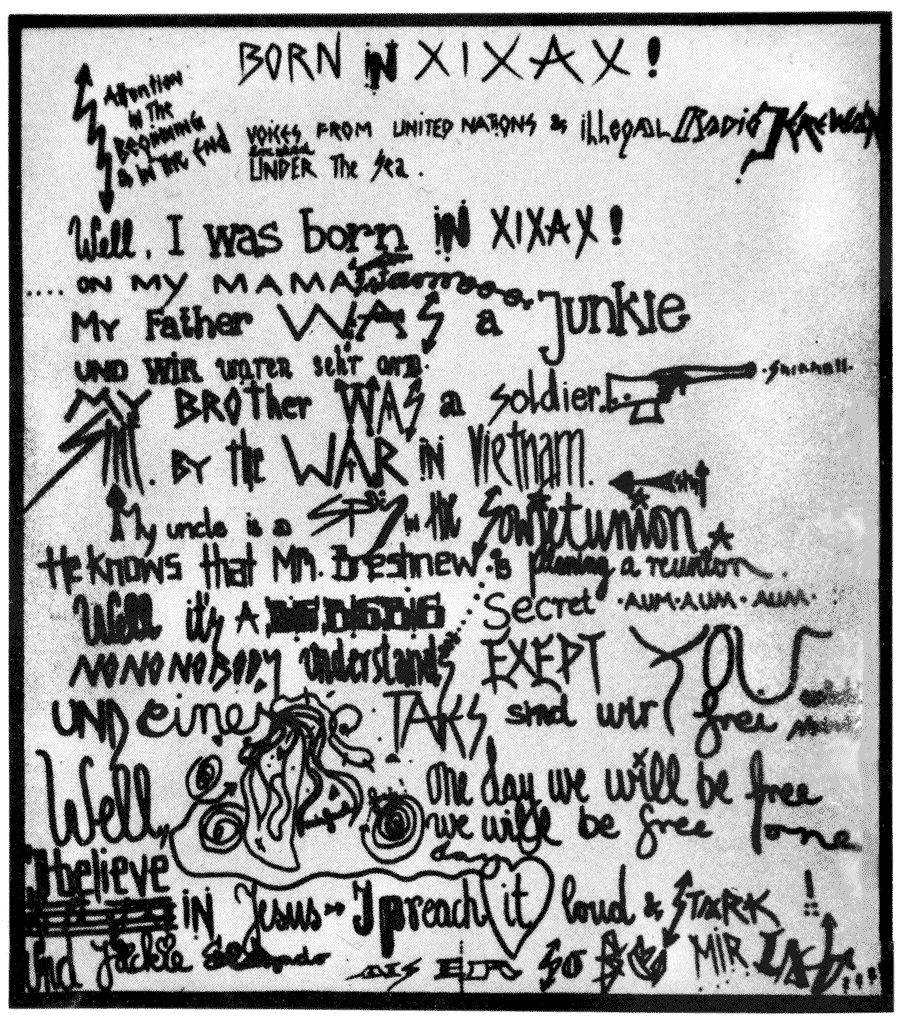
nina hagen – born in xixax (1982)

xixax

This is again radio Yerevan with… our news (claps)
Oh, I’m sorry, you should turn on the machine
This is radio Yerevan, (laughs)
my name is Hans Ivanovich (laughs) Hagen and this is…
The news (laughs)
Continue reading

woman, object, corpse: killing women through media

Linda Stupart wrote this about Reeva Steenkamp, and also the YOU DECIDE billboard and corpses and objects and women.

Linda Stupart's avatarAfrica is a Country (Old Site)

Since Valentine’s Day everyone has been talking about the murder of Reeva Steenkamp, although rarely in those terms. We know that her boyfriend, Oscar Pistorius, shot her four times and killed her while she was behind a locked door in their bathroom in a gated estate. We know that he has a history of domestic violence, a penchant for shooting things. We know absolutely everything about his extensive sporting achievements. The main thing, however, that we know about Steenkamp is that she was a model, and that she was really hot. 

View original post 1,866 more words

missing, forever

missing cat head

I made this poster in reference to this one, but the events it describes are entirely true. My cat’s head was never found. That night, I think I lost a part of me too, though I didn’t realise it at the time: the part that trusted and expected people who said they loved me not to hurt me intentionally.

What made me realise how this all fitted together was a chain status update game that went around on Facebook a few weeks ago. My answers to the questions went like this:

Age I was given: 17 (I balked because it was a very heavy year for me, but here goes…)
Where I lived: Waterfall, a village in KZN a little north of the Comrades Marathon route, through the sugarcane fields (which are now Tuscan townships).
What I did: Wrote matric with the help of regular immunoglobulin injections and reflexology to stave off the Chronic Fatigue Syndrome/M.E.that I’d been severely ill with since 14 when I’d contracted Glandular Fever. Spent a lot of my study time taping songs off the radio. Went to Turkey on short term Rotary Exchange after finishing school.
Who had my heart: My cat, Jorgy, who had been my constant companion throughout my illness. He was killed while I was in Turkey. I’d broken up with my first boyfriend during matric trials – I couldn’t handle his obsessive, controlling demands for attention. He turned stalker on me, hanging around outside my house, phoning all the time, sending letters threatening suicide, warning me that I would be sorry if “I left him” and went to Turkey. A day or two before I got back, my family found the headless body of our beloved Jorgensen Fassbinder Kittyman Von Streichen Hashimoto Lighoré at the bottom of the garden, tossed over the fence. I wish I was making this up.

Age I am now: 34
Where I live: Oranjezicht, Cape Town
What I do: I excel at giving too much of a shit.
Who has my heart: My heart is a hot potato.
__
The shadow of this manifested down the years in relationships with a string of men who were deliberately unkind and dismissive to me too often; with me always holding on too long because I mistakenly identified their cruelty or disloyalty as evidence of their love for me in spite of what they judged to be my shortcomings. At the darkest junctures over those years, I actually believed that I might deserve the humiliation, the punishment; that I should be grateful anyone humoured me. If they weren’t critical or manipulative enough, if I didn’t have cause to be outraged by their mistreatment, to defend myself against their accusations, to demand consideration, recognition… then it didn’t feel like they could really care (how twisted is that?).

The men I fell most deeply for were never truly available or fully present, would leave me because they cared more about someone else, or were running for their own damaged reasons. I guess I only felt safe from being smothered when they had one foot outside the door, though I yearned with all my heart to be held unconditionally, the way I held them.

This delusion is broken and I am free of its bonds.

excerpts from suketu metha’s ‘maximum city’

Maximum City: Bombay Lost and Found, by Suketu Metha, is the most mind-blowing book I have read for quite some time. Metha left Mumbai then returned from New York, and began documenting his hood.

Here are some little snippets:

‘Many wars begin with an act of rape, real or imagined. It is always the men who are disturbed enough by the rape to go to war.’

‘Bombay survives on the scam. We are all complicit. A man who has made his money through a scam is more respected than a man who has made his money through hard work, because the ethic of Bombay is quick upward mobility and a scam is a short-cut. A scam shows good business sense and a quick mind. Anyone can work and make money. What’s to admire about that? But a well-executed scam? Now, there’s a thing of beauty!’

‘When a man touches his killer’s feet and begs for his life, saying, “Please don’t kill me, I have children,” it is the worst argument he can offer. Thinking the killer will let you off because you have kids assumes that you can locate a hidden source of sympathy in your killer based on something shared, something in common. But very few killers are fathers. Very few of them have had good experiences with their own fathers. So that bond between father and son, which for you and me is the most convincing argument against your death – don’t kill me because it will break that sacred bond – means nothing to them. It is a bond, in fact, that the hit-men have consciously been trying to break all their lives. As far as they’re concerned, ridding your children of their father is the greatest favour they can do them.’

‘ [Bal Thackeray’s] vandals are young men, who, after working 12hour days as peons in some office where they endure humiliation and even a slap or two from men who are richer … than they are, take the train home. Inside the train, they bathe in perspiration; the air is fetid with sweat and farts. When they get home to the slum, their mother and fathers and grandmothers will ask them what they have bought home. Such a man lives with a constant sense of his own powerlessness, except when he is part of a mob, part of a contingent of 70 patriots fighting for the country’s honour, walking unmolested into movie theatres, posh apartments, and the offices of the cricket lords of the country, smashing trophies, beating up important people who drive fine cars. All the accumulated insults, rebukes and disappointments of life in a decaying megalopolis come out in a cathartic release of anger. It’s okay to be angry in a crowd; the crowd feeds on your anger, digests it, nourishes it, nourishes your rage as your rage nourishes it. All of a sudden you feel powerful. You can take on anybody. It is not their city any more, it is your city.
You own this city by the right of your anger.’

the rape of persephone (homeric hymn)

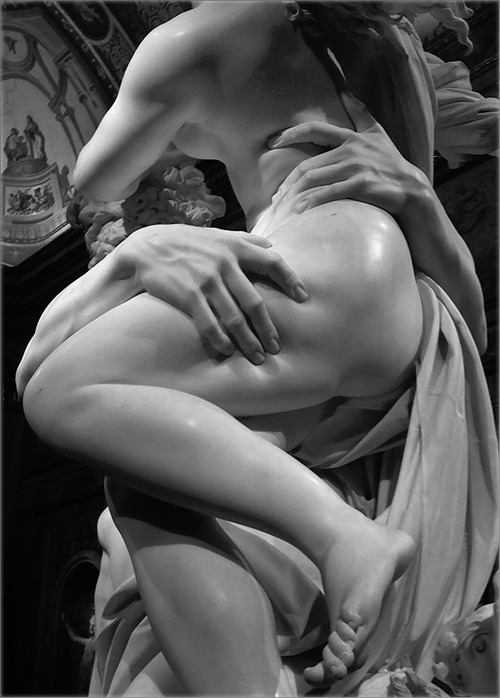
The Rape of Proserpina – Gian Lorenzo Bernini (1622)

I) HAIDES ABDUCTS PERSEPHONE
Homeric Hymn ii to Demeter (abridged) (trans. Evelyn White) (Greek epic circa 7th or 6th B.C.)

“[Demeter’s] trim-ankled daughter whom Aidoneus [Haides] rapt away, given to him by all-seeing Zeus the loud-thunderer. Apart from Demeter, lady of the golden sword and glorious fruits, she was playing with the deep-bosomed daughters of Okeanos and gathering flowers over a soft meadow, roses and crocuses and beautiful violets, irises also and hyacinths and the narcissus, which Gaia made to grow at the will of Zeus and to please Polydektor (the Host of Many), to be a snare for the bloom-like girl – a marvellous, radiant flower. It was a thing of awe whether for deathless gods or mortal men to see: from its root grew a hundred blooms and it smelled most sweetly, so that all wide heaven (Ouranos) above and the whole earth (Gaia) and the sea’s (Thalassa’s) salt swell laughed for joy.

And the girl was amazed and reached out with both hands to take the lovely toy: but the wide-pathed earth yawned there in the plain of Nysa, and the lord, Polydegmon (Host of Many), with his immortal horses sprang out upon her — the Son of Kronos, Polynomos (He who has many names). He caught her up reluctant on his golden car and bare her away lamenting.

Then she cried out shrilly with her voice, calling upon her father, [Zeus] the Son of Kronos, who is most high and excellent. But no one, either of the deathless gods or mortal men, heard her voice, nor yet the olive-trees bearing rich fruit: only tender-hearted Hekate, bright-coiffed, the daughter of Persaios, heard the girl from her cave, and the lord Helios (the Sun), Hyperion’s bright son, as she cried to her father, the Son of Kronos. But he was sitting aloof, apart from the gods, in his temple where many pray, and receiving sweet offerings from mortal men. So he [Haides], that Son of Kronos, Polynomos (of Many Names), Polysemantor (Ruler of Many) and Polydegmon (Host of Many), was bearing her away by leave of Zeus on his immortal chariot – his brother’s child and all unwilling.

And so long as she, the goddess, yet beheld earth and starry heaven and the strong-flowing sea where fishes shoal, and the rays of the sun, and still hoped to see her dear mother and the tribes of the eternal gods, so long hope claimed her great heart for all her trouble… and the heights of the mountains and the depths of the sea ran with her immortal voice: and her queenly mother heard her.

Continue reading